

Part II of the integral equations series. Covers L2 spaces, inner products, norms, Schwarz inequality, and solving integral equations by the trial method with a worked Volterra equation example.

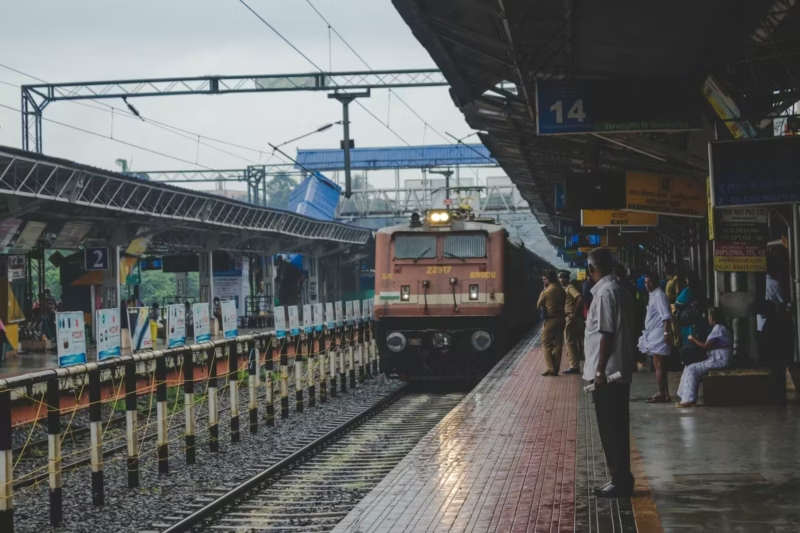
Traveling by train is usually enjoyable, but some rail routes are genuinely terrifying. I’ve documented ten of the world’s most dangerous railroads, from cliff-hugging mountain passes to tracks built on crumbling bridges. Each route has a unique combination of engineering ambition and natural hazards that makes it both impressive and nerve-wracking.

Integral equations look intimidating, but they’re built from ideas you already know. I explain what integral equations are, their classification system (Fredholm vs Volterra, first vs second kind), and how they relate to differential equations. This introduction gives you the vocabulary and framework to tackle more advanced techniques.

Most exam prep advice is folk wisdom. Here are 12 tactics with cognitive-science evidence: spaced repetition, retrieval practice, sleep timing, pacing, and the day-of strategy that picks up missed points.
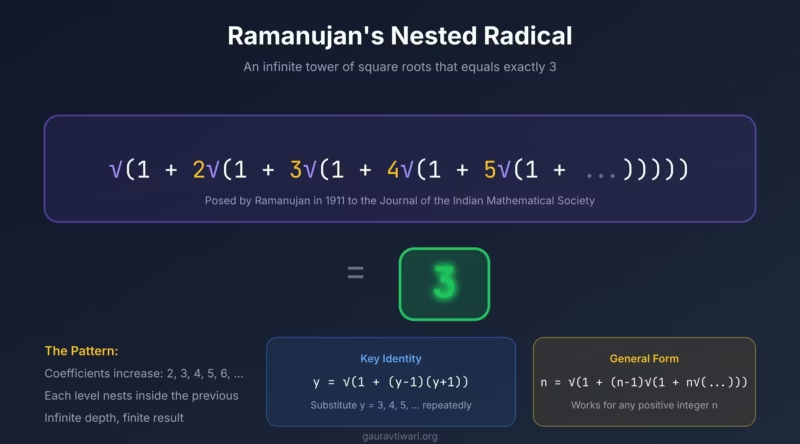
I wrote this analysis in 2010 at age 17, obsessed with Ramanujan’s nested radicals while studying under the INSPIRE-SHE scholarship. Fifteen years later, the mathematics still holds up. This complete elementary analysis breaks down Ramanujan’s nested radical expressions using accessible techniques. A personal project that became my most-referenced work.

Barry Martin’s Hopalong attractor turns three lines of algebra into galaxy-like structures rendered in real-time 3D. Here’s the mathematics behind the iterative map, why the sign function creates the characteristic hopping behavior, and how WebGL and Three.js render a million points at 60fps in your browser.
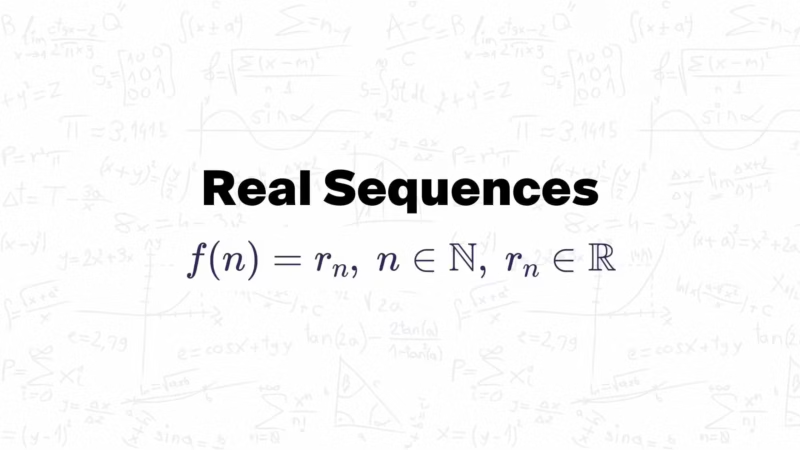
Real sequences form the backbone of real analysis and advanced calculus. I’ve taught this topic to dozens of students, and the key is grasping what sequences represent: ordered lists of real numbers with specific convergence behavior. This guide covers definitions, limit theorems, bounded and monotone sequences, with worked examples throughout.

Drop a ball through a tunnel drilled straight through Earth. It won’t fall forever. It’ll oscillate back and forth, popping out on the other side in exactly 42 minutes. Every single time, regardless of tunnel angle. I walk through the physics behind this elegant thought experiment, from gravitational calculations to simple harmonic motion.
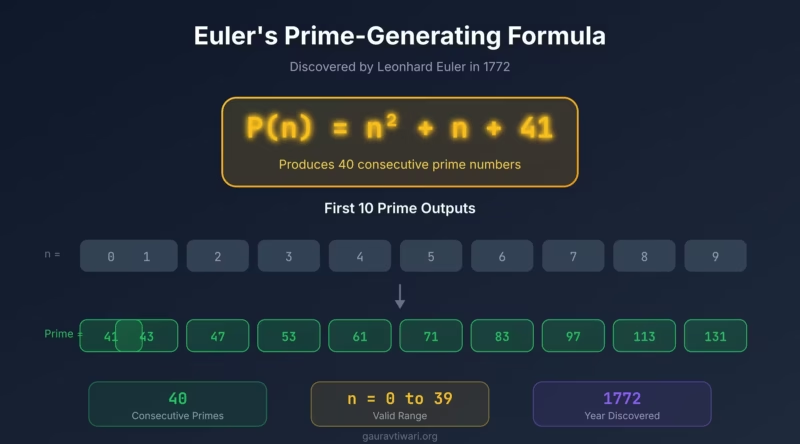
Euler discovered a simple formula that generates 40 consecutive prime numbers: n squared plus n plus 41. Plug in 0 through 39 and every output is prime. I explore why this works, where it fails, and what it reveals about the deep connection between quadratic expressions and prime number distribution.
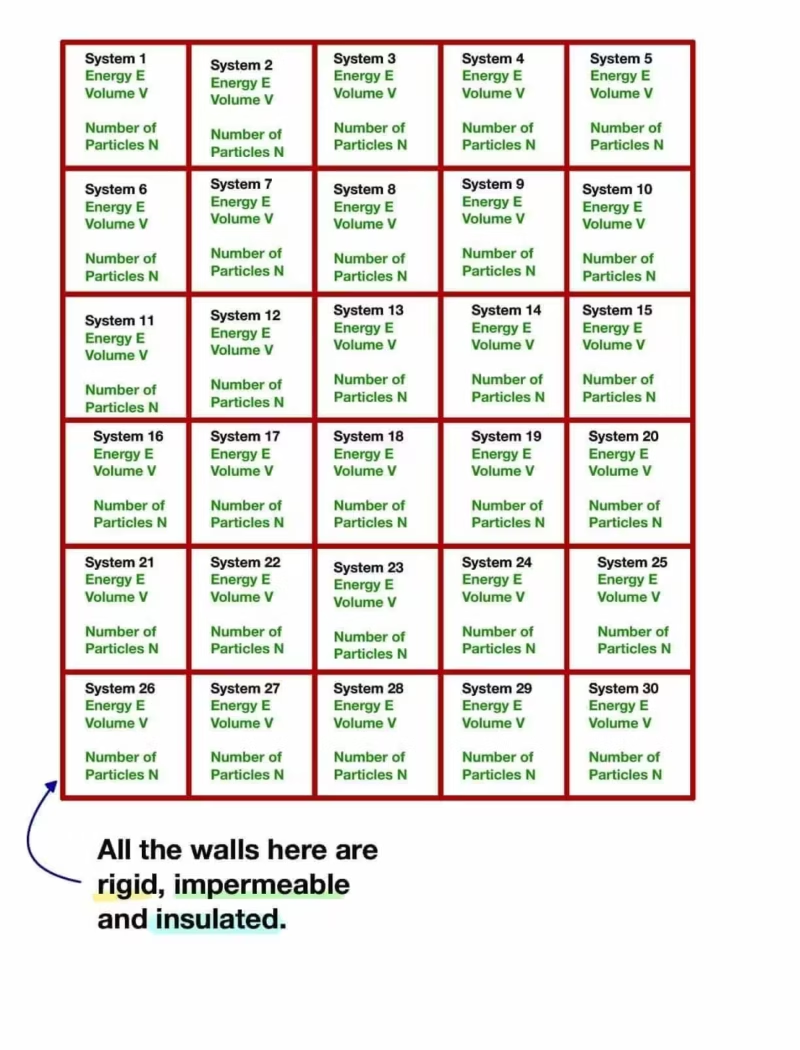
Ensembles are the trick that makes statistical mechanics computable: instead of tracking 10^23 particles, you average over imaginary copies of the system. I explain the microcanonical, canonical, and grand canonical ensembles, the walls that define them, their partition functions, and how the ensemble average connects the whole construction to what your instruments actually measure.

This paper presents a statistical analysis of 20 years of meteorological data from the Pantnagar weather station in Uttarakhand, India. Conducted under the INSPIRE-SHE Scholarship Program, the research examines temperature, rainfall, humidity, and wind patterns from 1989 to 2008. A data-driven look at regional climate trends.

How do you prove a number is irrational? You can’t check infinitely many decimal places. You need a proof. I present the classic proofs of irrationality for square root of 2, e, and pi, showing the elegant reasoning techniques mathematicians use. These are some of the most beautiful arguments in all of mathematics.