
 by
byPerformance marketing is a digital marketing model where you pay for measurable actions, not vague exposure. Those actions can be clicks, leads, app installs, sales, booked calls, or qualified pipeline, depending on the campaign.
That sounds clean until you try to run it. Attribution gets messy, ad costs move by industry, and platforms like Google Ads, Meta, TikTok, LinkedIn, and affiliate networks all measure success differently. My take: performance marketing works when the offer, tracking, margin, and follow-up are already solid. It fails when you use paid traffic to hide a weak business model.
Best fit: performance marketing is best for businesses that can track conversions, know their customer value, and can afford a real test budget.
Skip it for now: if you do not know your margins, do not have conversion tracking, or need brand trust before anyone will buy.
What is performance marketing?
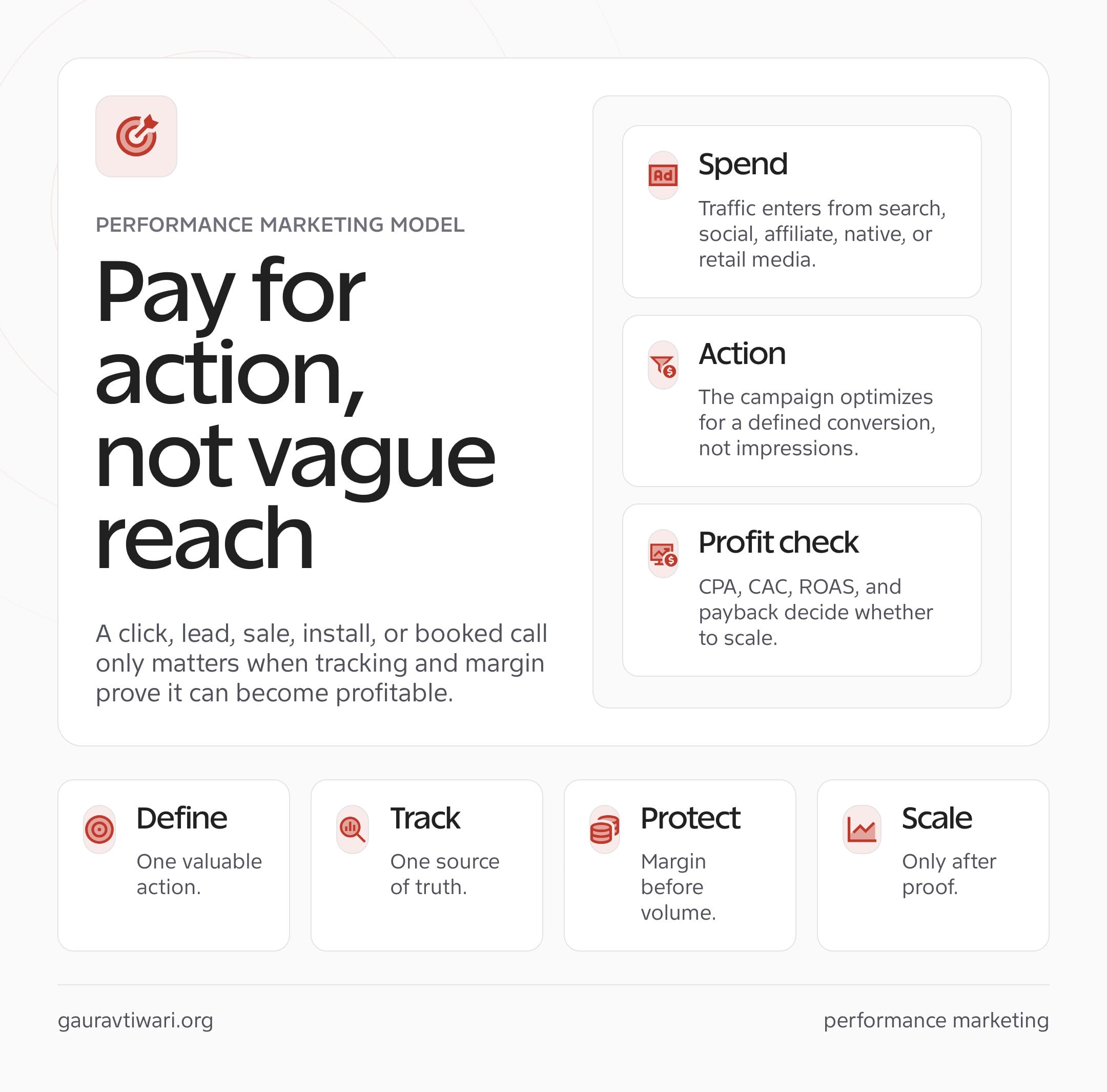
Performance marketing is marketing where payment and optimization are tied to a measurable result. The result might be a click in Google Ads, a lead from LinkedIn Ads, a sale through an affiliate partner, or a qualified signup from Meta Ads. The point is accountability: spend is judged against action, not just reach.
This is why performance marketing sits inside a broader digital marketing strategy. It is not the whole strategy. It is the measurable engine you use when you can define a valuable action and track whether that action happened.
| Element | What it means | Why it matters |
|---|---|---|
| Payment trigger | Click, lead, sale, install, booked call, or qualified action | You can connect spend to a business outcome |
| Common channels | Google Ads, Meta Ads, LinkedIn Ads, TikTok Ads, affiliate marketing, native ads | Each channel captures or creates demand differently |
| Core metrics | CPC, CPL, CPA, ROAS, CAC, LTV, conversion rate | You can see whether campaigns make money |
| Best use case | Measurable offers with clear margins and follow-up | The model rewards clean tracking and fast learning |
| Weak use case | New categories, unclear offers, long trust cycles, poor tracking | The dashboard can look busy while profit disappears |
Performance marketing vs brand marketing
Performance marketing captures and measures demand. Brand marketing creates trust and demand before the click happens. You usually need both. If you only run performance campaigns, your cost per click rises because every sale depends on paid auctions. If you only build brand, you may struggle to prove which activity produced revenue.
| Factor | Performance marketing | Brand marketing |
|---|---|---|
| Primary goal | Measurable actions such as leads, sales, clicks, trials, or installs | Awareness, trust, recall, preference, and category authority |
| Payment model | CPC, CPL, CPA, CPS, affiliate commission, or revenue share | CPM, sponsorship, creative production, PR, content, events, or flat fees |
| Timeline | Hours to weeks if tracking and offer are ready | Months to years because trust compounds slowly |
| Measurement | ROAS, CPA, CAC, LTV, conversion rate, pipeline, payback period | Brand search, direct traffic, share of voice, branded conversion lift |
| Big risk | Over-optimizing for cheap conversions that do not become good customers | Spending money without tying it to business outcomes |
| Best role | Capture demand and scale what already converts | Make future clicks cheaper, warmer, and easier to close |
If you want a simple comparison of paid channels, I have a separate breakdown of Google Ads vs Facebook Ads that goes deeper into intent, cost, and audience quality.
When does performance marketing actually work?
Performance marketing works when you can turn the campaign into a measured feedback loop. The channel matters, but the business math matters more. A bad offer with perfect tracking is still a bad offer. A good offer with broken tracking turns into expensive guesswork.
- The offer is proven. People already buy, book calls, start trials, or join the list without needing heroic persuasion.
- The conversion event is clear. You know whether success means a lead, a purchase, a demo request, a trial, or a qualified pipeline stage.
- The economics work. You know your margin, customer acquisition cost, lifetime value, payback period, and refund risk.
- The tracking is installed before spend starts. GA4, ad platform pixels, server-side tracking, CRM fields, and UTM rules are ready.
- The follow-up is strong. Email, sales calls, retargeting, onboarding, or affiliate partner communication happens fast enough to convert interest.
Bottom line: performance marketing is not magic traffic. It is paid learning. If every click teaches you something useful and profitable, keep scaling. If every click only adds noise, fix the offer and tracking first.
Performance marketing channels that matter
The main performance marketing channels are paid search, paid social, affiliate marketing, performance-based influencer deals, native advertising, programmatic, and retail media. Each one has a different intent level. Search captures demand. Social creates interest. Affiliate borrows trusted distribution. Programmatic and native need stronger creative and landing pages.
Paid search: Google Ads and Microsoft Advertising
Paid search is the cleanest performance marketing channel because the user has already typed the problem into Google or Bing. A person searching “CRM for real estate agents pricing” has more buying intent than someone scrolling Instagram. Start here when people already search for what you sell. If you are new to PPC, read my guide on improving a PPC advertising campaign before you spend heavily.
- Good fit: search demand exists, your landing page answers the query, and conversion tracking works through Google Ads, Google Analytics 4, and your CRM.
- Weak fit: nobody searches for the category yet, CPCs are above your margin, or the landing page cannot handle the intent.
- My rule: start with high-intent and branded-adjacent terms, then expand only after you see profitable conversions.
Paid social: Meta, TikTok, and LinkedIn
Paid social creates demand instead of waiting for it. Meta Ads, TikTok Ads, and LinkedIn Ads can work well when the creative makes the right person stop, understand the offer, and click. The tradeoff is intent. A social user did not ask for your product, so your message and landing page carry more weight.
- Meta Ads: strong for B2C, ecommerce, creators, retargeting, and lookalike audiences.
- TikTok Ads: strong for visual products, younger audiences, and creator-style creative.
- LinkedIn Ads: expensive, but useful for B2B when job title, company size, and industry targeting matter.
Affiliate marketing
Affiliate marketing is performance marketing in its purest commercial form. You pay partners when their content, email list, comparison page, or community sends a sale or lead. Networks like Impact and Awin handle tracking, partner management, and payouts.
This channel works best when the product has strong margins, a clear payout, and a partner audience that already trusts recommendations. I cover the publisher side in my affiliate marketing for beginners guide, but the advertiser lesson is the same: weak products do not become strong because affiliates promote them.
Influencer marketing with performance terms
Performance-based influencer marketing uses tracked links, promo codes, affiliate payouts, or hybrid deals instead of only paying for reach. I like hybrid deals for serious creators: a smaller guaranteed fee plus commission. The creator gets paid for production time, and the brand does not carry all the risk.
- Good fit: creators with niche trust, clear audience fit, and trackable offers.
- Weak fit: broad follower counts, vague awareness goals, and no tracked offer.
- Watch for: fake engagement, reused audiences, coupon leakage, and partners bidding on your brand terms without permission.
Programmatic, native, CTV, and retail media
Programmatic, native advertising, connected TV, and retail media can be performance channels, but they are less beginner-friendly than search or affiliate. They need better creative, cleaner measurement, and more budget because the user intent is usually weaker. I would not start here unless you already have profitable search or social campaigns.
- Native ads: Outbrain and Taboola can work for advertorial funnels, but the landing page must match the promise.
- Connected TV: useful for measured video reach, especially when paired with retargeting and incrementality tests.
- Retail media: Amazon, Walmart, and Instacart ads work when the buyer is already inside a shopping environment.
- Market context: the IAB/PwC 2025 report says U.S. digital ad revenue reached nearly $300 billion in 2025, up 13.9% year over year. More money in the auction means cleaner measurement matters more, not less.
Performance marketing metrics to track
The most useful performance marketing metrics are CPC, CTR, conversion rate, CPL, CPA, ROAS, CAC, LTV, and payback period. Do not optimize for the metric farthest from revenue. Clicks are useful only if those clicks become qualified leads, customers, or pipeline.
| Metric | What it tells you | Mistake to avoid |
|---|---|---|
| CPC | How much each click costs | Treating cheap clicks as good clicks |
| CTR | How often people click after seeing the ad | Rewarding clickbait that brings bad traffic |
| Conversion rate | How many visitors take the desired action | Ignoring lead quality and refund rate |
| CPL or CPA | How much a lead or acquisition costs | Comparing your number to generic benchmarks without industry context |
| ROAS | Revenue returned per ad dollar | Forgetting margin, returns, payment fees, and fulfillment cost |
| CAC vs LTV | Whether the customer is worth more than the acquisition cost | Scaling campaigns with a long or unknown payback period |
| Payback period | How long it takes to recover acquisition cost | Assuming cash flow can survive slow payback |
Benchmark pages such as LocaliQ search advertising benchmarks are useful for context, not for decision-making by themselves. Your product, funnel, industry, geography, and lifetime value decide whether a $40 lead is a bargain or a disaster.
Benefits and limits of performance marketing
The biggest benefit of performance marketing is feedback speed. You can launch, measure, pause, and improve faster than most brand campaigns. The biggest limit is false confidence. A dashboard can make weak attribution look precise, especially when multiple platforms claim credit for the same sale.
| Benefit | What you gain | The catch |
|---|---|---|
| Measurement | You can connect spend to clicks, leads, sales, and pipeline | Attribution is directional, not perfect |
| Budget control | You can cap spend and pause weak campaigns | Algorithms need enough data before they learn |
| Speed | You can see early results in days or weeks | Fast feedback can push you toward short-term thinking |
| Scalability | Winning campaigns can receive more budget | More spend usually means weaker marginal returns |
| Partner reach | Affiliates and creators can bring trusted audiences | Fraud, coupon leakage, and poor partner fit can waste money |
When performance marketing fails
Performance marketing fails when the measurement looks better than the business. If the campaign hits a low CPA but attracts customers who churn, refund, or never buy again, the dashboard is lying to you. The goal is profitable growth, not pretty campaign reports.
- Over-optimization hurts the brand. Chasing CTR can produce ads that overpromise and damage trust.
- Last-click attribution lies. Retargeting and search often get credit for demand that content, referrals, brand, or word of mouth created earlier.
- Costs rise faster than customer value. If CAC climbs and LTV stays flat, scale makes the problem bigger.
- Tracking breaks. Consent rules, browser limits, iOS changes, ad blockers, and cross-device behavior all create gaps.
- Channel dependency gets dangerous. If one paid channel produces most revenue, one policy change or bidding war can hurt the business fast.
- Fraud eats the margin. Affiliate and lead-gen programs need rules against fake leads, cookie stuffing, coupon abuse, and brand-bidding leakage.
How to start performance marketing by budget
Your first performance marketing channel should match your budget and intent level. Small budgets need focus. Bigger budgets can test more channels, but only after the first channel proves that the offer converts.
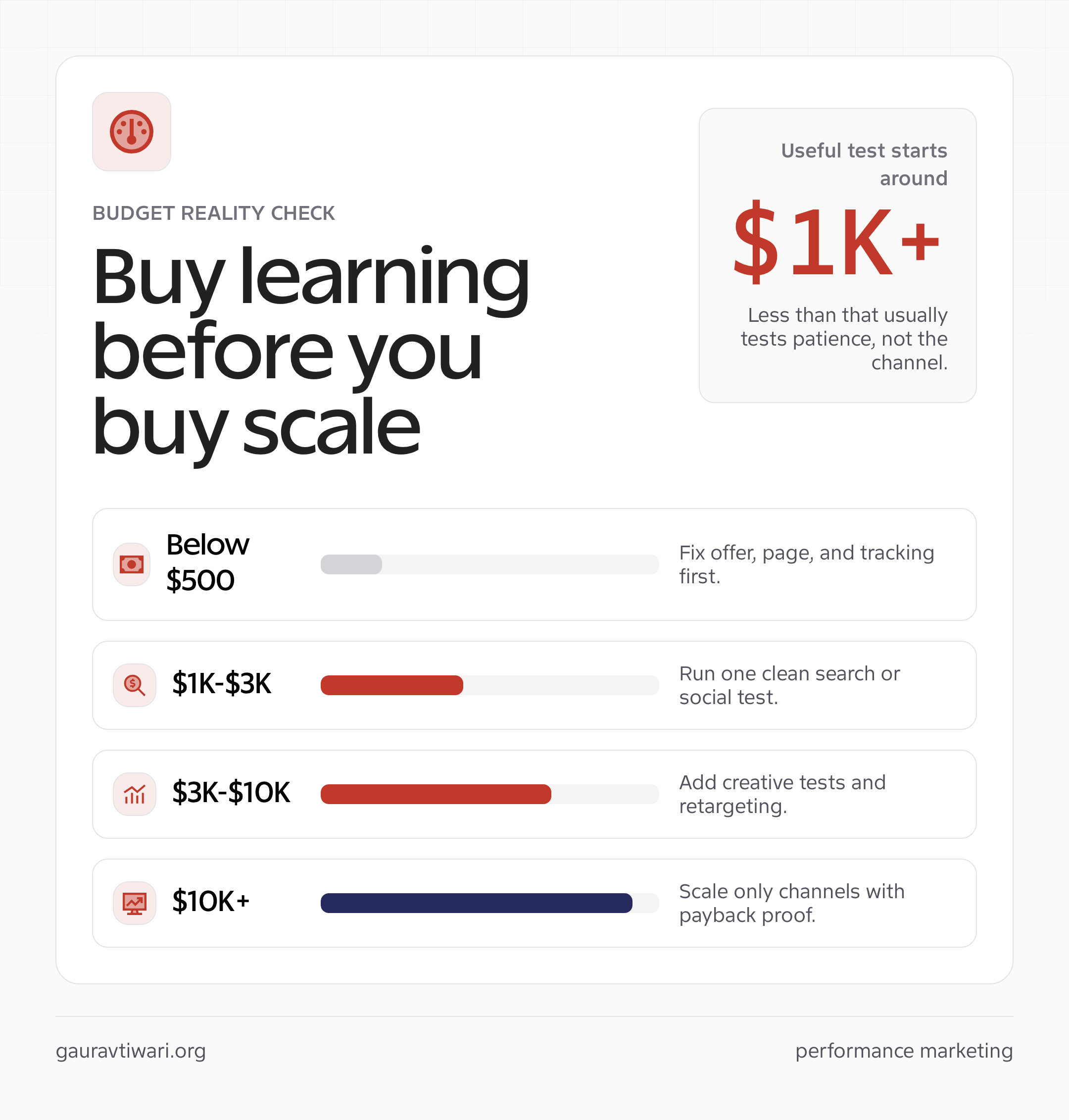
Under $1,000 per month
Start with high-intent Google Ads or Microsoft Advertising keywords only. Do not chase broad terms. Pick a small group of keywords where the searcher is close to buying, booking, or comparing prices.
- Set up GA4, ad conversion tracking, UTMs, and CRM fields before launch.
- Use exact and phrase match first, then expand after profitable search terms appear.
- Send traffic to one focused landing page, not the homepage.
- Stop if you cannot get enough clicks to learn within 30 days.
$1,000 to $5,000 per month
Use paid search for bottom-funnel intent and add one second channel. For B2C, that is often Meta Ads. For B2B, it may be LinkedIn Ads even though the click cost is higher. The goal is not to be everywhere. The goal is to learn where qualified demand comes from.
$5,000 to $20,000 per month
Now you can add retargeting, affiliate partnerships, email follow-up, and better creative testing. If ecommerce margins allow it, launch an affiliate program through Impact or ShareASale/Awin. If you sell B2B, connect ad campaigns to HubSpot, Salesforce, or another CRM so you can measure pipeline quality, not just form fills.
$20,000+ per month
At this level, channel strategy matters more than platform tinkering. Keep the profitable search and social campaigns running, then test programmatic, native, CTV, retail media, and creator partnerships with incrementality in mind. The mistake I see at this budget is spreading $25K across eight channels and learning nothing from any of them.
AI, privacy, and attribution in performance marketing
AI and privacy changes are reshaping performance marketing, but they do not remove the need for strategy. AI can create variations, automate bidding, and find audience patterns. Privacy changes make browser-based tracking less reliable. The businesses that win will have better inputs: first-party data, clear offers, strong creative, and server-side measurement.
- AI is useful for volume. Google Performance Max, Meta Advantage+ campaigns, and creative generation tools can produce and test more combinations than a human team can handle manually.
- Humans still own judgment. AI can draft 50 hooks, but someone has to know which five match the offer, the audience, and the brand.
- Chrome’s cookie story changed. Google said in April 2025 that Chrome would keep its current third-party cookie choice flow instead of forcing a full phaseout. The measurement problem still exists because consent, device switching, iOS privacy rules, and ad blockers reduce data quality. Source: Google Privacy Sandbox.
- Server-side tracking is now practical insurance. Google Tag Manager server-side, Meta Conversions API, LinkedIn Conversions API, and clean CRM imports help recover some lost signal.
Bottom line: do not treat AI as a campaign manager replacement. Treat AI as a production and testing layer. Your advantage is still the offer, the audience insight, the landing page, the follow-up, and the quality of the data you feed back into the platforms.
Performance marketing tools and tracking stack
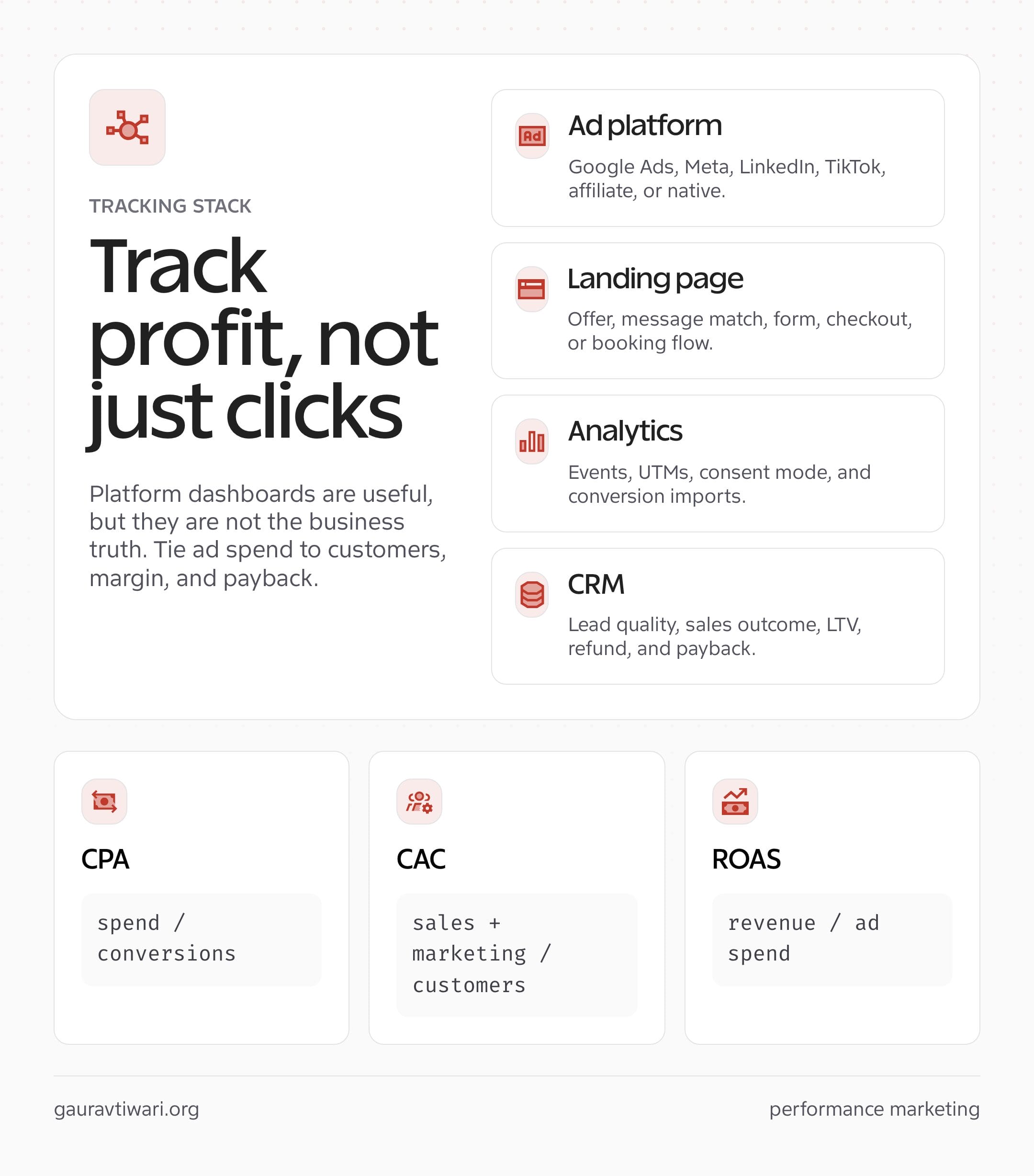
A good performance marketing stack has four layers: ad platforms, analytics, CRM or email automation, and reporting. Start smaller than you think. A clean Google Ads, GA4, Looker Studio, and CRM setup beats a messy stack with ten tools and no reliable conversion data.
| Layer | Starter stack | Upgrade when |
|---|---|---|
| Ad platforms | Google Ads, Meta Ads, LinkedIn Ads, TikTok Ads, Impact or ShareASale/Awin | One channel is profitable and you can fund a second test |
| Analytics | Google Analytics 4, UTMs, conversion tags | You need server-side tracking or multi-touch attribution |
| CRM and email | HubSpot, Salesforce, Klaviyo, ActiveCampaign | Lead quality and follow-up matter more than the form fill |
| Reporting | Looker Studio, spreadsheets, platform dashboards | Stakeholders need blended ROAS, CAC, LTV, and pipeline reporting |
For content-led funnels, performance marketing also depends on assets that warm up the buyer before the click. That is where a proper content marketing strategy and remarketing audiences become useful. Paid campaigns rarely fix a trust problem by themselves.
I trust performance marketing when the numbers survive a business check. If a campaign lowers CPA but brings weak customers, it is not working. If a campaign costs more per lead but creates better customers, it may be the smarter spend.
Performance marketing is worth using when you know what a good customer is worth, can track the action that matters, and have enough budget to learn without panicking after three bad days. Use it as an engine for measured growth. Do not use it as a shortcut around positioning, trust, product quality, or follow-up.
Frequently Asked Questions
What is performance marketing?
Performance marketing is a marketing model where advertisers pay for measurable actions such as clicks, leads, sales, app installs, booked calls, or qualified signups. The spend is judged against outcomes, not just exposure. Common channels include Google Ads, Meta Ads, LinkedIn Ads, affiliate marketing, native ads, and retail media.
What is the difference between performance marketing and digital marketing?
Digital marketing covers all online marketing, including SEO, content, email, social media, paid ads, and analytics. Performance marketing is a subset of digital marketing where payment and optimization are tied to measurable actions. SEO is digital marketing, but it is not usually performance marketing because you do not pay per sale or click.
What are the best performance marketing channels?
The best performance marketing channel depends on intent and budget. Google Ads is usually best when people already search for your offer. Meta Ads and TikTok Ads work when creative can create demand. LinkedIn Ads fits B2B targeting. Affiliate marketing works when partners can recommend your product to a trusted audience.
How much does performance marketing cost?
Performance marketing cost depends on channel, industry, country, and conversion quality. A small Google Ads test often needs at least $1,000 per month to learn anything useful. LinkedIn clicks can cost far more than Meta clicks, but may bring better B2B leads. Judge cost against CAC, LTV, and payback period.
What metrics matter most in performance marketing?
The most useful performance marketing metrics are conversion rate, CPL or CPA, ROAS, CAC, LTV, and payback period. CPC and CTR help diagnose campaign quality, but they do not prove profit. A cheap click is not valuable unless it becomes a qualified lead, sale, or customer with healthy margin.
Does performance marketing still work with privacy changes?
Yes, performance marketing still works, but tracking is less clean than it used to be. Browser restrictions, iOS privacy rules, consent requirements, and ad blockers all reduce signal quality. Use first-party data, server-side tracking, CRM imports, and directional attribution instead of trusting one platform’s last-click report blindly.
Is affiliate marketing performance marketing?
Yes. Affiliate marketing is a type of performance marketing because the advertiser usually pays only when a partner generates a sale, lead, or other agreed action. It works best when commission rules are clear, tracking is reliable, and the product is strong enough for partners to recommend honestly.
When should you avoid performance marketing?
Avoid performance marketing if you do not know your margins, cannot track conversions, have no clear offer, or need brand trust before anyone will buy. Paid traffic makes weak funnels fail faster. Fix positioning, landing pages, follow-up, and customer economics before increasing ad spend.
Tell Google you want more of this.
Add Gaurav Tiwari as a preferred sourceOne tap, and this site shows up more often in your own Top Stories, AI Overviews and AI Mode. Remove it any time.
Disclaimer: This site is reader-supported. If you buy through some links, I may earn a small commission at no extra cost to you. I only recommend tools I trust and would use myself. Your support helps keep gauravtiwari.org free and focused on real-world advice. Thanks. - Gaurav Tiwari