
 by
by
Affiliate marketing is the highest-margin revenue stream in my online business. It was also the slowest one to become dependable. That tension matters more than any screenshot of a good month.
I started in 2009, and the verified lifetime total has now crossed $800,000. The line was uneven: physical-product commissions collapsed during 2020 and 2021, while software and hosting kept paying. Rebuilding around recurring, business-critical products is what made the income durable.
If I were starting today, I would choose a narrow subject I already understand, publish useful comparisons on a site I own, build an email list early, and give the project 12 months before judging it. Affiliate marketing rewards patience and judgment. It punishes copied reviews and commission-first recommendations.
Table of Contents
What is affiliate marketing?
Affiliate marketing is a performance deal. A business gives you a tracked link, you send it customers, and you earn a commission when one of them buys. You never touch inventory, payments, or support. You get paid for the referral, nothing else. That commission is your affiliate income, and it is how you get paid for promoting products you did not have to create.
An affiliate link is just a normal link with a tracking code on the end, so the merchant knows the sale came from you. That is how affiliate links work, and it is the entire technical basis of the model. There are two sides to it. The merchant (or advertiser) is the business paying for sales. That can be a single company like WP Rocket, or an affiliate network like Awin or Impact that hosts thousands of brands under one roof. The affiliate (or publisher) is the person sending traffic and earning the cut. That is you.
If you want the shorter conceptual version first, read the basics of affiliate marketing, then come back here for the 2026 playbook.
How much can you make with affiliate marketing?
Enough to replace a salary, but the distribution is brutal and the timeline is long. So how much do affiliate marketers make? There is no honest average income to quote you, because affiliate marketing income per month runs from $0 to six figures, and most people sit near the bottom because they quit early. One percent of affiliates earn the majority of the money. The chart below records the first $713,650 of that total, the period for which I have a complete year-by-year breakdown. The verified lifetime total has since crossed $800,000.
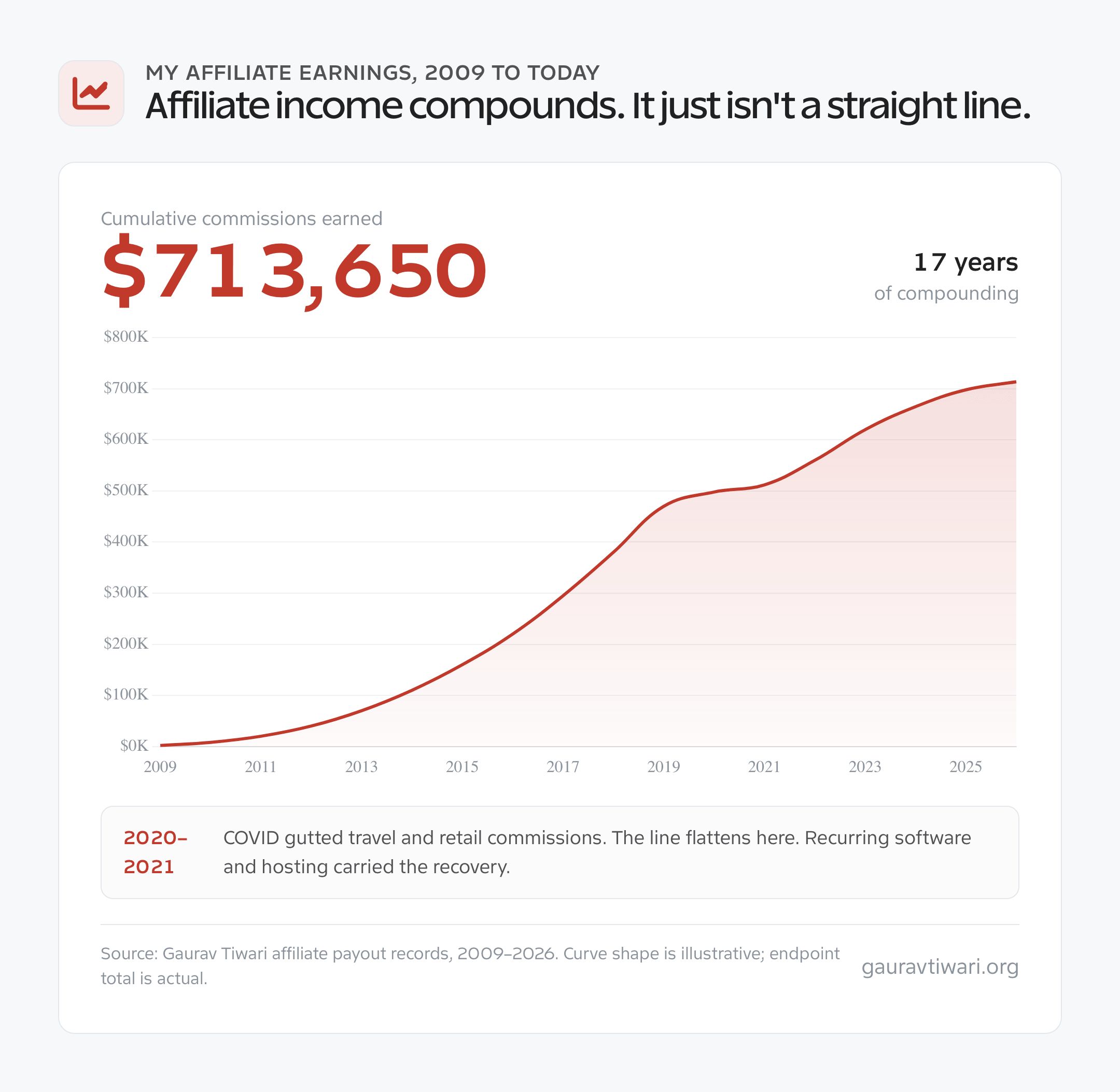
A few things that graph will not tell you on its own. The first three years were slow. The 2020 to 2021 dip was not a strategy failure, it was category exposure. When lockdowns hit, my travel, gadget, and event-related commissions collapsed almost overnight, because nobody was booking or buying. The pages that carried me through were the boring ones: web hosting, SEO tools, and email software, where people kept subscribing no matter what the world was doing. That is my affiliate marketing success story in one number, and it is not a unique one.
That is the single most useful lesson buried in that number. Recurring, business-critical software is recession-resistant. Physical-product commissions are not. I rebuilt the whole portfolio around that after 2021, and it is why the line climbs again.
A realistic first year: if you publish consistently and pick a decent niche, expect roughly this. Months 1 to 4, near zero while Google evaluates your site. Months 5 to 8, your first commissions, maybe $50 to $300 a month. Months 9 to 12, if a few pages rank, $500 to $2,000 a month. Anyone promising faster is selling you a course, not a method.
Pick a niche that pays (recurring beats one-time)
The wrong niche is the most expensive mistake in affiliate marketing, and it costs you time, not money. You can spend a year building authority in a space that pays 3% on a $40 product, or the same year in one that pays $200 recurring per sale. Same effort. Wildly different outcome. The best niches for affiliate marketing in 2026 all pass three filters:
- Do you actually know it? Google’s 2026 ranking systems reward first-hand experience, and readers smell a fake in one paragraph. Pick something you have used, worked in, or genuinely obsess over.
- How big is the commission? A $100 sale at 30% pays the same as 15 sales of a $40 gadget at 5%. High-ticket and software niches let you profit on far less traffic, which is what makes them profitable for beginners.
- Is it recurring? This is the one most beginners ignore. A one-time $65 hosting bounty is nice. A tool that pays you 30% every month the customer stays subscribed builds a passive income floor that grows while you sleep, for real this time.
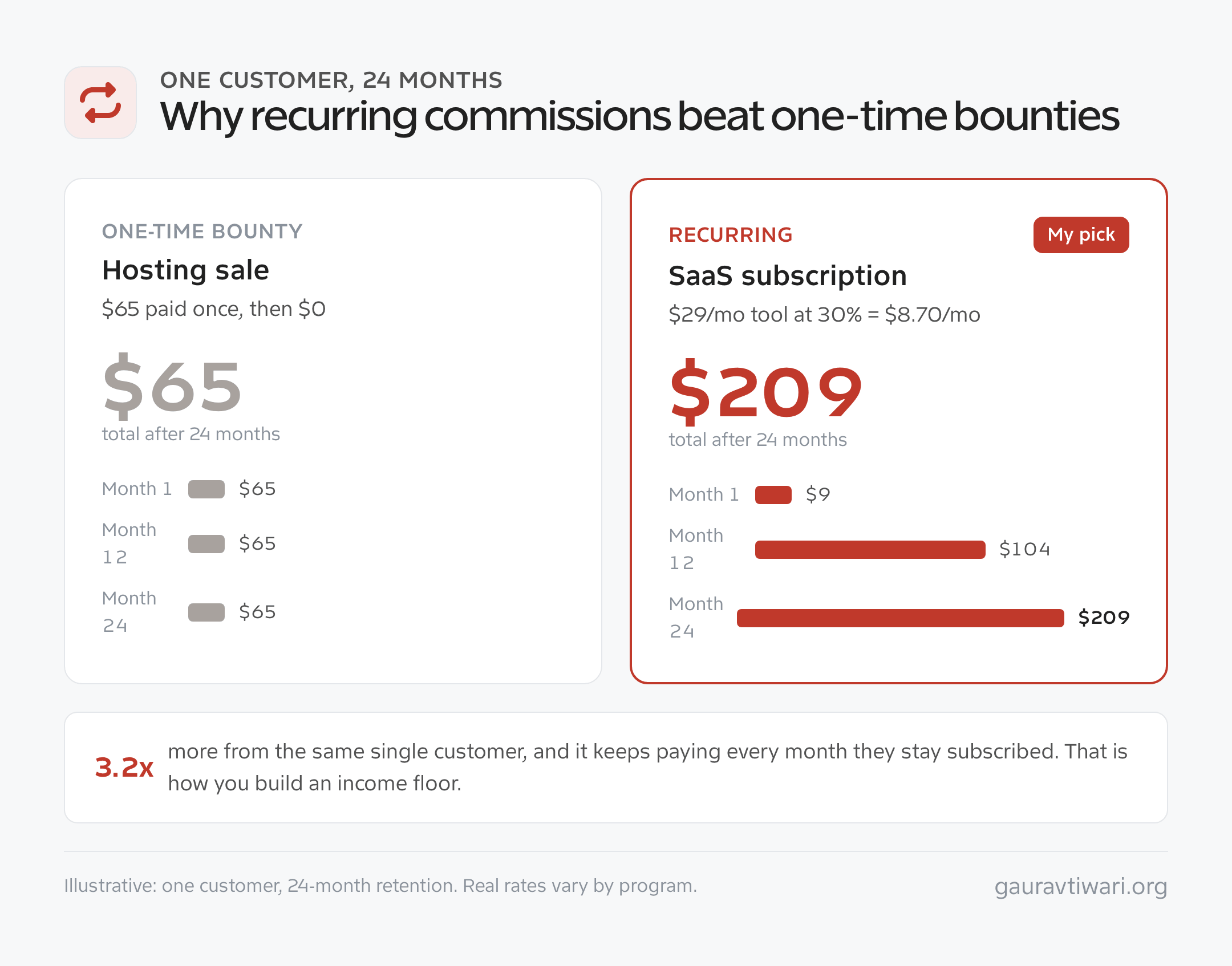
Software, hosting, and SaaS win on all three for creators in the WordPress and marketing world, which is why my portfolio leans there. If your audience is elsewhere, the filters still hold. Look for subscriptions with an affiliate program before you look for physical products. Here are the programs I have earned the most from, sorted so you can see which ones actually recur.
Fire note: for the full breakdown of who pays best and why, see my guide to the best affiliate marketing programs.
| Affiliate Program | Category | Commission | Recurring |
|---|---|---|---|
| Semrush | SEO/Analytics | Up to $450/sale + $10/trial | ❌ |
| WP Engine | Hosting | $100 (Lite) / $200+ (others) | ❌ |
| Kinsta | Hosting | Up to $500 + 10% lifetime | ✅ |
| Rocket.net | Hosting | $150/referral | ❌ |
| Pressable | Hosting | $200+/sale | ❌ |
| Flywheel | Hosting | Up to $500/referral | ❌ |
| Liquid Web | Hosting | Up to 300%/sale (varies) | ❌ |
| SiteGround | Hosting | $50–$100+/sale | ❌ |
| Bluehost | Hosting | $65+/sale | ❌ |
| DreamHost | Hosting | Up to $300/referral | ❌ |
| HostGator | Hosting | Up to $125/sale | ❌ |
| Hosting.com (formerly A2 Hosting) | Hosting | Up to $125/sale | ❌ |
| Cloudways | Hosting | Up to $125/sale (recurring option) | ✅ |
| Scala Hosting | Hosting | $50 – $200 | ❌ |
| WPX | Hosting | $70 – $100+ (varies) | ❌ |
| GreenGeeks | Hosting | Up to $100+/sale | ❌ |
| Hostinger | Hosting | Up to 60% | ❌ |
| Namecheap | Domains/Hosting | Up to 35% (varies) | ❌ |
| Constant Contact | $105 | ❌ | |
| MailerLite | 30% lifetime | ✅ | |
| ActiveCampaign | Email/CRM | Up to 30% recurring | ✅ |
| Kit (ConvertKit) | 50% for 12 months | ✅ | |
| AWeber | 30% | ✅ | |
| HubSpot | CRM/Marketing | Up to 30% recurring (12 months) | ✅ |
| Moosend | 30% recurring | ✅ | |
| Brevo | Bounty (lead + sale) | ❌ | |
| ThemeIsle | Themes | 55% | ❌ |
| Divi (Elegant Themes) | Themes/Builder | Up to 50% | ❌ |
| Elementor | Builder | Up to 50% | ❌ |
| Astra | Themes | 30% | ❌ |
| Blocksy | Themes | 30% | ❌ |
| GeneratePress | Themes | 30% | ❌ |
| Beaver Builder | Builder | 25% | ✅ |
| StudioPress | Themes | 35% | ❌ |
| ThemeForest (Envato) | Marketplace | 30% of 1st payment | ❌ |
| Rank Math | SEO | Up to 30% | ❌ |
| SEOPress | SEO | 20% | ❌ |
| Convert Pro | Plugins | 50% | ❌ |
| Perfmatters | Plugins | 20% recurring | ✅ |
| WP Rocket | Plugins | 20% | ❌ |
| LearnDash | Plugins | 35% | ❌ |
| WPForms | Plugins | 20% (up to $59.90) | ❌ |
| Gravity Forms | Plugins | 20% | ❌ |
| Thrive Themes | Themes/Marketing Suite | 35% (incl. renewals) | ✅ |
| BunnyCDN | CDN | $20 credit | ❌ |
| ThirstyAffiliates | Affiliate | 30% | ❌ |
| Automattic | Other | 20%–30% (varies) | ❌ |
Build your platform: blog, YouTube, or social
You need a place to publish. In 2026, the two that convert best are a blog and a YouTube channel, and the smartest beginners run both from the same content. But you can also do affiliate marketing without a website, so let me cover both paths.
A blog you own
A self-hosted WordPress site is still the highest-leverage asset in affiliate marketing, because you control the content, the links, and the design, and it earns 24/7 through search. The cost to start is about $70 for year one: roughly $10 for a domain and $60 for decent hosting. That is the entire barrier to entry, and it is why setting up an affiliate marketing website is the move I recommend for anyone serious.
Write for buying intent, not just traffic. A post titled “best budget standing desk under $300” converts far better than “10 benefits of standing desks,” because the first reader has a wallet open and the second is just curious. Comparison posts, “best X for Y” lists, and honest reviews are where the money is.
YouTube, social media, and email
You do not strictly need a website. Plenty of people get paid to promote products on social media, on YouTube, or straight to an email list, and starting there is free. Video is where a lot of buying research now happens, and a review or tutorial video can carry affiliate links in the description for years. You do not need a thousand subscribers to earn, you need one video ranking for a buying query.
The efficient move is to write the review as a blog post, then record the same script as a video. One piece of research, two ranking assets, two channels of traffic that do not depend on the same algorithm.
Do not skip email. An email list is the one audience no algorithm can take from you. Even a small list of engaged subscribers outperforms most social channels for affiliate revenue, because they asked to hear from you.
Get your affiliate links and add them the right way
Once you have a few pieces of content live, it is time to actually get affiliate links. Here is how to sign up for affiliate programs: you apply to a program or network, get approved, and the dashboard hands you a unique tracked URL for any product you want to promote. That is how you become an affiliate for a company, and it is usually free. Join two or three programs rather than twenty. A scattered account across a dozen networks you never use looks worse to reviewers and spreads your attention thin. These are the networks worth starting with:
- Awin and ShareASale, huge merchant catalogs including most WordPress tools
- Impact, where a lot of premium software and hosting brands now run their programs
- Commission Junction and ClickBank for broader categories
- The Amazon Associates program, with the caveats below
Now the part beginners get wrong: how you place the link matters as much as where. Raw affiliate URLs are ugly, easy to strip, and impossible to manage when a program changes your ID. Cloak them. A WordPress affiliate link plugin turns a messy tracking URL into a clean branded redirect like yoursite.com/go/product, which you can update in one place if the destination ever changes. That is exactly why every affiliate link on this site runs through a /go/ redirect, and why setting up affiliate links properly is worth the extra ten minutes.
Tag your affiliate links with rel="sponsored nofollow". Google explicitly asks for it, and skipping it is the kind of footprint that invites a manual penalty. Most link-management plugins add it automatically.
Be careful with Amazon
Amazon Associates is the easiest affiliate program to join and the hardest to build a business on. Go in with your eyes open. Commissions in 2026 run from about 1% to 20% by category, but most physical products sit between 1% and 4.5%, so the headline rates are misleading.
The cookie lasts just 24 hours, one of the shortest in the industry. The one saving grace: if the visitor adds the item to their cart within that window, you keep credit for up to 89 more days. And as of the April 14, 2026 Operating Agreement update, the purchase must ship, stream, or download and be paid for within 180 days to count, and anything bought through a paid or boosted ad linking to Amazon is now disqualified. Amazon is fine as a starter and for cheap impulse items. It should never be your only program.
Get traffic that survives 2026
Traffic is the whole game, because affiliate conversion rates sit around 1% to 2%. One percent of 100,000 visitors is a business. One percent of 1,000 is lunch. But the way you earn that traffic changed hard in the last two years, and most old guides never got the memo.
Prove you actually used it (the reviews-system era)
Google’s product reviews system now rewards content that shows first-hand experience and quietly demotes everything that reads like a rewritten spec sheet. That means your own screenshots, photos of the product in your hands, real measurements, pros and cons you could only know from using it, and a clear verdict. A page that could have been written without ever touching the product is exactly what gets buried now.
This is good news for beginners who genuinely use what they recommend, and terrible news for anyone hoping to spin up 200 AI-generated reviews. Learn to write a product review that converts, because in 2026 the review is the money page.
Make money from SEO the honest way
This is how you make money on SEO as an affiliate: rank a buying-intent page, and the traffic converts on autopilot for years. Affiliate marketing and SEO are the same skill pointed at a commercial keyword. To earn money from SEO, target phrases with a wallet behind them (“best,” “vs,” “review,” “alternative”), answer the query better than the pages above you, and earn a few links. You are not chasing pageviews, you are chasing the searches that end in a purchase.
Write to get cited by AI search
AI Overviews, ChatGPT, and Perplexity now answer a huge share of research queries before anyone clicks a blue link. That is a threat and an opportunity. The threat is zero-click: informational posts lose traffic they used to own. The opportunity is that these systems cite sources, and being the cited source sends buyers who are further along and readier to purchase.
To get cited, structure content the way models like to quote it. Open each section with a direct, extractable answer in the first sentence. Name specific tools, prices, and numbers, because entity-dense passages get pulled far more than vague ones. Add original data or a first-hand result nobody else has. The same moves that win AI citations also happen to win Google, so you are not choosing between them.
Do not depend on one channel
The single biggest risk to an affiliate business is a Google update wiping out one traffic source overnight. Spread the risk. Pair search with a YouTube channel, an email list, and one social platform that fits your niche. Pinterest affiliate marketing still drives real buying traffic for visual niches like home, food, and fashion, and it behaves like a search engine rather than a social feed. The point is simple: never let 90% of your income ride on one algorithm.
Convert clicks to commissions
Traffic that does not convert is a vanity metric. Once people are landing on your pages, these are the levers that actually increase affiliate sales, in rough order of impact.
- Recommend one thing, clearly. A confused reader does not buy. “Here are 12 options” converts worse than “buy this one, unless you need X, then buy that one.”
- Sell cheaper, higher-trust items first. As a new creator, people will take your word on a $40 purchase long before a $900 one. Cheaper products convert higher and get cancelled less. I once sold over 1,100 sub-$9 items in a single Black Friday on that principle alone.
- Lead with context and a real verdict. Wrap the link in a genuine opinion and a use case. A product mentioned inside a story of how it solved your problem outsells a bare link every time.
- Use coupons and seasonal spikes. Discount codes and events like Black Friday create urgency you did not have to manufacture. A single well-placed Black Friday post can outperform a normal month.
- Watch your conversion rate, not just your traffic. Track which pages turn clicks into sales, then put more links, better placement, and more internal links into your winners. Most of my affiliate income comes from a small handful of pages, so I feed those.
One scam to skip: you will see sites promising you can earn money by sharing shortened links, or get paid to post links through a URL shortener. Ignore them. Real affiliate income comes from recommending products people actually buy, not from link-shortener pennies. If a “make money sharing links” offer does not involve a real product and a real commission, it is not affiliate marketing.
Disclosure and FTC compliance in 2026
This is not optional, and the rules got sharper. US law requires you to disclose affiliate relationships clearly and conspicuously, which in 2026 the FTC reads to mean the disclosure has to be visible at the same time as the link, not buried in a footer or a separate page. A short line at the top of the post, before the first affiliate link, is the safe standard.
The bigger change is the FTC’s 2024 Consumer Reviews and Testimonials Rule, which bans fake and manipulated reviews and carries real civil penalties. Do not invent testimonials, do not recommend products you have not used, and do not buy reviews. Beyond the legal risk, it is the exact behavior Google’s systems now hunt for. Honesty is the compliant strategy and the ranking strategy at the same time.
Mistakes that quietly kill beginners
Every one of these cost me money or time, most of them more than once. Learn them cheaply here.
- Quitting before month six. The compounding starts late. The people who fail almost always quit right before their content would have started ranking.
- Chasing traffic instead of intent. A million visitors who came to learn a definition will earn less than a thousand who came to decide what to buy.
- Promoting for the commission, not the reader. Recommend the higher-paying option over the better one twice and your audience stops trusting you, which ends the whole business.
- Only-positive reviews. A review with no downsides reads as an ad and converts like one. Real tradeoffs build the trust that closes the sale.
- All-in on Amazon. Tiny commissions, a 24-hour cookie, and an account that can be closed on a policy technicality. Use it, do not build on it.
Affiliate marketing step by step: your next move
You do not need a course to start, you need to publish. Here is affiliate marketing step by step, the exact sequence I would follow if I were starting over today: pick the niche you know, set up a WordPress site (or a free YouTube or social channel), write your first honest comparison or review, get your affiliate link and add it cloaked and disclosed, then do it again next week. The launch checklist below is that sequence in order.
Affiliate Marketing Launch Checklist
If you want the deeper systems, mistakes, and commission math in one place, my Easy Affiliate Marketing Guide walks through the whole build. And once your blog has a few reviews live, learn to monetize your blog with the other income streams that stack neatly on top of affiliate revenue.
Frequently Asked Questions
How much do affiliate marketing beginners actually make?
Most beginners make nothing for the first four to six months while Google evaluates the site, then $50 to $300 a month once early content ranks. By month 12, a focused blog in a decent niche can reach $500 to $2,000 a month. There is no reliable average income, the range is huge and most people quit before it compounds.
Is affiliate marketing dead in 2026?
No, but the low-effort version is. Google’s product reviews system now demotes thin, untested content, and AI Overviews absorb informational clicks. Affiliates who use what they recommend, show first-hand proof, and focus on buying-intent keywords are earning more than ever.
Can you do affiliate marketing without a website?
Yes. You can get paid to promote products on YouTube, social media, or an email list, and starting there is free. But a self-hosted WordPress site is the only platform you fully own and it earns from search 24/7, so most serious affiliates build one eventually.
What is the best affiliate niche for beginners in 2026?
The niche you genuinely know, weighted toward products with recurring commissions. Software, hosting, and SaaS pay $50 to $200 per sale and often recur monthly, so you profit on far less traffic than a physical-product niche paying 3 to 5 percent.
How do affiliate links work?
An affiliate link is a normal URL with a tracking code on the end. When someone clicks it and buys, the merchant sees the sale came from you and pays a commission. You get affiliate links by signing up for a program, getting approved, and copying the tracked URL from your dashboard.
How long before affiliate marketing pays?
Plan for 12 months. New content takes four to six months just to be evaluated by Google, and meaningful income usually starts around month nine. The people who fail almost always quit right before their pages would have started ranking.
Is affiliate marketing hard?
The concept is simple, the patience is hard. There is no technical barrier, setup costs about $70, and the skills are learnable. What trips people up is the six-to-twelve-month wait before content ranks and the discipline to keep publishing honest, useful reviews through the quiet early months.
Does affiliate marketing really make money?
Yes, it is a real, proven model. I have earned more than $800,000 from it since 2009. But it is not fast or guaranteed, income is concentrated among people who treat it as a long-term content business, and most beginners earn little because they quit early or chase low-commission products.
Do I have to disclose affiliate links?
Yes. US law requires a clear and conspicuous disclosure, which the FTC reads to mean it must be visible at the same time as the link, not buried in a footer. A short line at the top of the post, before the first affiliate link, is the safe standard.
Tell Google you want more of this.
Add Gaurav Tiwari as a preferred sourceOne tap, and this site shows up more often in your own Top Stories, AI Overviews and AI Mode. Remove it any time.