
 by
by
Learning how to choose a digital marketing agency is difficult for one annoying reason: weak agencies and excellent agencies can sound almost identical on a sales call. Both can show polished decks, use the right acronyms, and promise a strategy tailored to your business. The difference appears later, when you ask for source data, account access, the names of the people doing the work, and a clean way out.
My recommendation is simple. Hire the specialist that can prove a relevant result, keeps your core accounts in your name, introduces the delivery team before you sign, and accepts a paid but reversible first engagement. Use the 12-test scorecard below. A candidate can score 24 points, but a single ownership or truthfulness failure still disqualifies it.
Proof behind this verdict
- Confirmed: Google documents how Partner status, Ads manager accounts, GA4 roles, and Search Console ownership work.
- Confirmed: The Federal Trade Commission’s current review rule covers fake and false reviews, including specified conduct by advertising and reputation firms.
- Confirmed: Current Clutch pricing data spans more than 100,000 listed digital marketing companies, but its broad and service-specific rate bands differ sharply.
- Inferred: Source records, client-owned accounts, and reversible scope reduce hiring risk more reliably than awards or sales-call chemistry.
- Assumed: Any forecast before the agency has clean baseline data is a working estimate, not a promised result.
Those labels matter. “Confirmed” means you can inspect an official record, live account, signed term, or contactable reference. “Inferred” means the conclusion follows from confirmed facts but isn’t guaranteed. “Assumed” means someone is guessing, hopefully for a useful reason and with a plan to test it.
How do you choose the right digital marketing agency?
Choose a digital marketing agency by defining one business outcome before you build a shortlist. If you can’t connect the assignment to revenue, qualified pipeline, retention, or another real business result, an agency can stay busy forever without becoming accountable.
If you’re trying to figure out how to find a digital marketing agency, resist the directory-first approach. A useful search begins with the business bottleneck, because that tells you which specialty, proof, and delivery capacity belong on the shortlist.
Start with a one-page buying brief. Pull the baseline from Google Analytics 4, HubSpot, Salesforce, your payment system, or your CRM, then write down these facts:
- Business outcome: Increase qualified demo requests, ecommerce contribution margin, booked consultations, or another result the company can count.
- Baseline: State the current number and its source. “We get leads” isn’t a baseline. “GA4 and HubSpot show 42 qualified demo requests per month” is.
- Target: Give the direction and threshold, such as 60 qualified demos per month without raising customer acquisition cost above $700.
- Time window: Separate a 30-day launch task from a six-month search or content program.
- Economics: Record average order value, gross contribution, lead-to-sale rate, customer acquisition cost (CAC), and customer lifetime value (LTV) where they apply.
- Constraints: Name approval delays, engineering limits, regulated claims, geographic reach, inventory, sales capacity, and the available media budget.
- Internal owner: Give one person authority to provide access, make decisions, and unblock the agency.
Here’s the mistake I see: a company decides it needs “SEO, social, and some ads,” then asks five full-service agencies for ideas. Each agency naturally recommends the channels it sells. The proposal feels customized, but the brief quietly let the seller define the problem.
Reverse that order. Diagnose the bottleneck first, then hire the smallest capable specialist for that bottleneck. If search visibility is the problem, use the more specific process for hiring an SEO specialist. If weak positioning or poor conversion is the problem, buying more traffic may only help you lose money faster (a spectacularly measurable failure, but still a failure).
A full-service agency makes sense when several channels genuinely share one strategy, the business has enough budget to fund each channel properly, and someone internal can coordinate the work. It shouldn’t be the default just because one invoice looks tidy.
What should you verify before hiring a marketing agency?
Verify four things before hiring a marketing agency: proof, ownership, economics, and working fit. Reputation can create a shortlist, but source records decide who survives it.
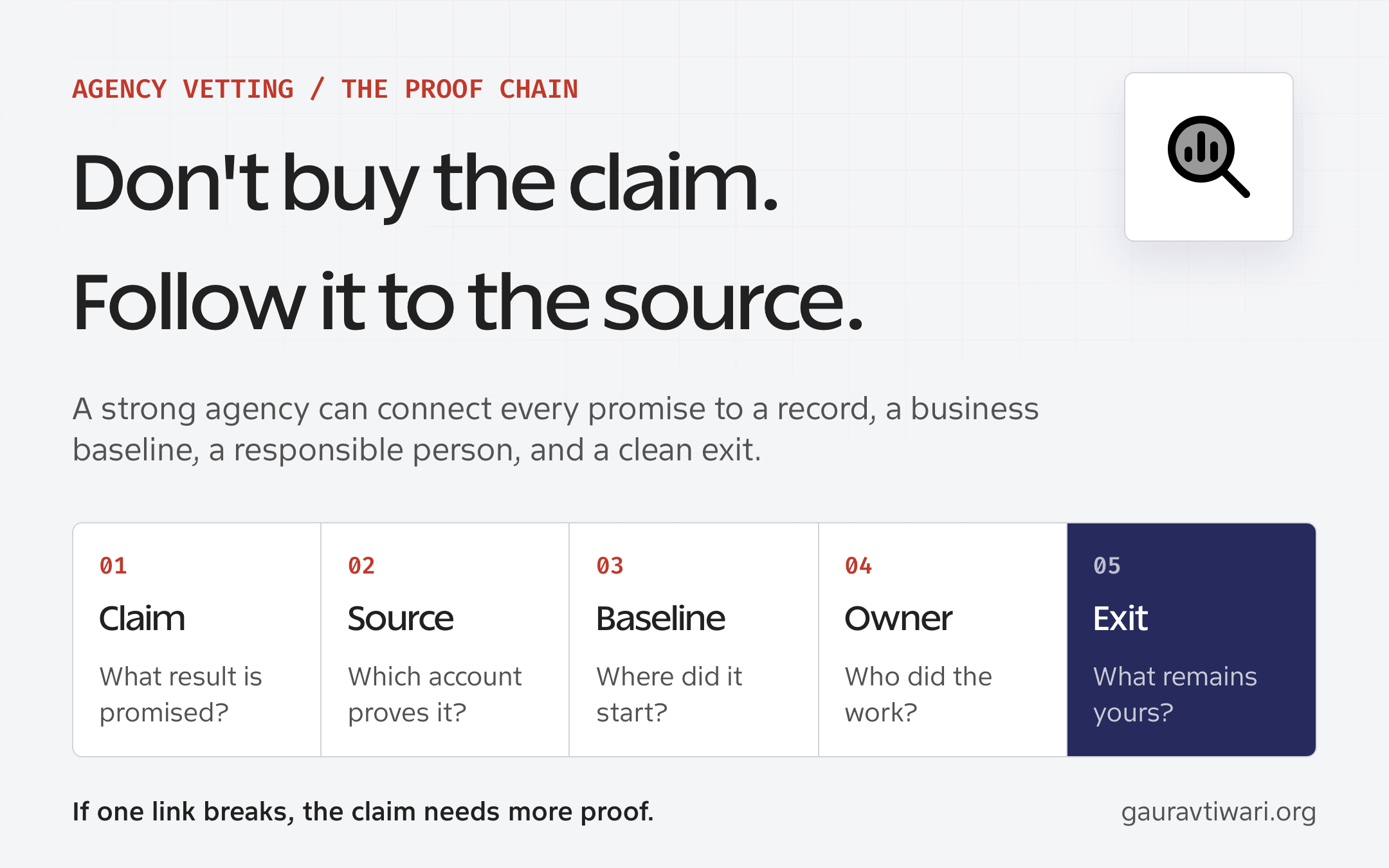
You can use Clutch, LinkedIn, the Google Partners directory, and referrals to discover agencies. None of them replaces verification. Even a real Google Partner badge proves a limited set of Google Ads program requirements 1. Source: Google Ads Help, How to Become a Partner or Premier Partner. Program status is evidence for Google Ads eligibility criteria, not a general marketing-quality certification. , not that the agency is good at SEO, content, Meta Ads, conversion work, or your industry.
Google currently describes these Partner requirements:
- Performance: A minimum 70% optimization score in the registered Ads manager account.
- Spend: At least $10,000 in managed Google Ads spend over 90 days.
- Certifications: At least 50% of account strategists certified, subject to Google’s product-area and spend conditions.
- Premier Partner: Top 3% of participating companies within a country, evaluated using factors Google lists and updates.
That’s confirmed program status. My inference is narrower: it earns one check for paid-search capability, not a blank check for the entire agency.
If a badge appears on an agency site, click it. Google’s badge rules require the web badge to link to the company’s public Partner profile. Compare the business name and status there. A screenshot of a badge is decoration, not verification.
Turn every case study into six numbers
A case study becomes useful when you can reconstruct what changed. Ask the agency to show these six fields:
- Starting baseline: Traffic, leads, revenue, CAC, ROAS, close rate, or the relevant starting measure.
- Exact time window: The dates covered, not “in six months” without a start and end.
- Denominator: Media spend, starting traffic, number of locations, email-list size, or whatever makes the percentage meaningful.
- Conversion definition: What counted as a lead or sale, and which attribution model assigned credit.
- Agency-controlled variables: Landing pages, bids, creative, technical fixes, content, offers, or reporting.
- Confounders: A price change, rebrand, seasonal peak, sales-team expansion, product launch, or offline campaign.
“Organic traffic increased 200%” sounds impressive. If traffic rose from 100 to 300 monthly visits and produced no qualified inquiries, it may still be a poor business result. If it rose from 100,000 to 300,000 relevant visits while contribution margin improved, you’re looking at a different achievement entirely.
An agency may be unable to name a client because of confidentiality. That’s reasonable. It can still show anonymized source screens, define the measurement, explain its work, and arrange a reference that has permission to speak. Confidentiality limits disclosure. It doesn’t turn an empty percentage into proof.
Contact references like an auditor, not a fan
Ask for one current client and one former client with similar scope. The former client matters because you need to know how the agency behaves when a relationship ends.
Ask each reference these questions:
- Who sold the engagement, and who actually delivered it?
- What missed a deadline, and how did the agency respond?
- Which reported result could you confirm in your own account?
- What extra costs appeared after the original quote?
- How quickly did you receive data, files, and access at the end?
- Would you hire the same team again for the same problem?
Treat public reviews as signals. The FTC Consumer Reviews and Testimonials Rule took effect on October 21, 2024 and addresses fake or false reviews, conditioned incentives, review suppression, and other deceptive conduct. The FTC also says advertising, public relations, review-broker, and reputation-management firms aren’t automatically immune from liability.
That doesn’t mean every five-star profile is suspicious. It means a star average isn’t a substitute for a reference, source record, or account walk-through. Reviews help you find whom to investigate next… not whom to wire money to.
Who should own Google Ads, analytics, and your marketing data?
Your company should own every core account, domain, audience, and raw-data store. The agency should receive the minimum access needed to work, through the platform’s supported user or manager roles.
This is a hard gate. If an agency insists on creating your assets inside accounts only it controls, don’t sign. You’re not buying access to its private marketing machine. You’re paying it to improve business assets that must remain usable after the relationship ends.
Use this ownership map:
| Asset | Your company keeps | Agency receives | Required handoff |
|---|---|---|---|
| Domain and DNS | Registrant, billing, recovery, and administrator control | Limited technical access when needed | DNS record list and change log |
| Google Analytics 4 | Administrator access and property ownership | Editor, Marketer, or Analyst as needed | Configuration notes, events, audiences, and exports |
| Google Search Console | Verified owner | Full user or owner only when justified | Verification method, sitemap, and issue log |
| Google Ads | Client account, billing visibility, and primary administrative control | Linked manager-account access | Campaigns, change history, audiences, negatives, and reports |
| Meta Business Portfolio | Business ownership, billing, pixels, pages, catalogs, and audiences | Partner access | Asset list, permissions, creative, and export |
| CRM and email platform | Super-admin, billing, contacts, consent records, and integrations | Role-based access | Workflows, fields, segments, templates, and suppression data |
| Creative and landing pages | Final files plus contractually defined source files | Workspace access | Editable files, fonts, licenses, copy, and version history |
Google Analytics defines Administrator as the role with full control, including user management. Search Console gives verified owners the highest level of control. Google Ads lets an agency link an existing client account to its manager account, so the agency doesn’t need to own your account to manage it.
The same principle belongs in web projects. My guide to hiring a web design agency goes deeper on domains, hosting, source files, and handoff responsibilities.
Put ownership in the contract, not only in an email. The agreement should state:
- Which party creates each account and whose legal entity owns it.
- Who can add or remove users and change billing.
- Which files are included, including editable source files.
- Which third-party licenses stop when the engagement ends.
- The export format and delivery deadline after termination.
- When the agency removes its own access.
- Whether final payment can be withheld if required assets aren’t transferred.
Account ownership can feel like boring paperwork during the pitch. It becomes the entire story on the day you need to leave.
How much should you pay a digital marketing agency?
Pay for a defined scope that can work within your unit economics, not for a market-average retainer. The right fee is one your business can support and one that gives the agency enough skilled time to deliver the promised work.
Clutch’s July 2026 pricing guide is useful because it shows how wide the market is. It reports pricing information from 106,043 digital marketing companies 2. Source: Clutch, Digital Marketing Pricing Guide, July 2026. The directory total and rate bands describe Clutch’s dataset, not a universal quote. :
- Data source: Pricing information from 106,043 digital marketing companies.
- Broad directory rate: Many listed digital marketing agencies at $25 to $49 per hour.
- Reviewed project band: Commonly $10,000 to $49,999.
- Service-specific rates: SEO, PPC, content marketing, email marketing, and social media categories commonly at $100 to $149 per hour.
- Separate cost: Advertising spend usually sits outside the agency fee.
Those rate bands look contradictory because “digital marketing agency” isn’t one standardized product. The directory mixes countries, seniority, service categories, delivery models, and scope. I trust Clutch as a large current directory dataset. I don’t trust any global directory number as the price of your particular job.
Instead, compare the quote with a simple economic ceiling. Suppose one new customer produces $2,400 in gross contribution and you can spend 25% of that to acquire the customer. Your target CAC is $600. If 20% of qualified leads become customers, one qualified lead can cost up to $120 across media and agency work before you hit that target.
That calculation doesn’t guarantee performance. It tells you whether the proposal has room to make sense.
Break every quote into these factual lines:
- Agency fee: Strategy, account management, execution, reporting, and meetings.
- Media spend: Google Ads, Meta Ads, LinkedIn Ads, sponsorships, or placements.
- Creative production: Copy, design, video, photography, landing pages, and revisions.
- Software and data: Call tracking, feeds, analytics, research tools, dashboards, and CRM charges.
- Pass-through costs: Freelancers, printing, stock licenses, or publisher fees.
- Overages: Hourly rates, revision limits, rush work, travel, and work outside scope.
- Taxes and payment terms: Currency, tax treatment, deposit, due dates, and late-payment terms.
Then ask the agency to map hours or capacity to deliverables. A $2,000 monthly retainer that promises senior strategy, weekly content, daily paid-media optimization, original creative, CRO, dashboards, and constant meetings probably doesn’t contain enough skilled labor to do all of it well. Cheap work doesn’t stay cheap when it creates bad data, stranded accounts, or six months of nothing to learn from.
What questions should you ask a digital marketing agency?
Ask questions that force the agency to show its reasoning, records, delivery team, and response to failure. Good interview questions can’t be answered with “we use a proven process.”
These are the questions to ask a digital marketing agency when you need comparable answers, not twelve different sales performances. Use the same wording with every finalist and record what each one can actually document.
Keep the questions to ask a digital marketing agency tied to a record or decision. If a question only invites the agency to praise itself, rewrite it until the answer can be checked.
Take these 12 questions into the call:
- What business outcome would you prioritize, and what would you refuse to work on first? A strong answer challenges part of your brief and explains why.
- Which baseline data do you need before forecasting anything? Listen for GA4, CRM, revenue, margin, sales-cycle, and channel-quality data, not only website traffic.
- Show me one relevant case study using the six-number test. Ask for baseline, dates, denominator, conversion definition, controlled variables, and confounders.
- Who will do the work each week? Get names, roles, seniority, location, employment status, and expected account load.
- What stays with the salesperson, and what transfers to the delivery team? This exposes the handoff gap before it swallows context.
- Which accounts will my company own? The correct default is all core assets, with role-based or manager access for the agency.
- How do you measure incrementality and attribution? A capable answer distinguishes platform-reported conversions from CRM outcomes and admits where attribution is uncertain.
- What will I see in the report that I can’t see in a standard Looker Studio dashboard? Look for decisions, experiments, failures, and next actions, not prettier charts.
- What is excluded from this price? Ask specifically about media, tools, creative, landing pages, meetings, revisions, and taxes.
- What client dependency most often delays your work? Good agencies know where projects jam and make the dependency visible.
- Tell me about a campaign that underperformed and what you changed. A real answer includes the wrong assumption and the evidence that corrected it.
- What happens to access, data, files, and unfinished work if we end the agreement? The answer should match the contract line for line.
Pay attention to how the agency handles a question it can’t answer. “I don’t know yet, but here’s the data we’d need” is a professional answer. A confident invention isn’t.
The sales process is a small live sample of the working relationship. That’s an inference, not a law. Still, if the team misses its own proposal deadline, sends generic follow-ups, hides the delivery people, or can’t remember your business model during courtship, don’t assume service becomes more attentive after the invoice is paid.
What are the biggest digital marketing agency red flags?
Walk away from guaranteed results, agency-owned accounts, hidden fulfillment, unverifiable percentages, and contracts that trap your data. These aren’t minor negotiation points. They change whether the engagement is measurable and reversible.
When you hire a digital marketing agency, the red flags matter more than the polished extras. One hard failure in ownership or honesty can erase a dozen softer strengths.
The biggest digital marketing agency red flags are:
- Guaranteed rankings, leads, or ROAS: Google Ads, Search, Meta, competitors, auctions, demand, and your sales process contain variables no agency controls.
- A strategy before diagnosis: A channel prescription delivered without baseline access is usually a sales package wearing a lab coat.
- Case studies with percentages but no baseline: “Up 300%” is incomplete until you see the starting value, period, denominator, and business outcome.
- A badge presented as universal proof: Google Partner status is relevant to Google Ads. It doesn’t certify the agency’s SEO, email, brand, or conversion work.
- Core accounts created under the agency: This makes switching expensive and can separate your company from its own history and audiences.
- No access to raw data: A PDF or Looker Studio report is a view, not ownership. You should be able to inspect GA4, Search Console, Ads, Meta, and CRM records.
- The delivery team is hidden: If you only meet founders and salespeople, you haven’t evaluated the people responsible for the outcome.
- Vague subcontracting: Contractors aren’t automatically a problem. Undisclosed responsibility, weak quality control, and no named owner are.
- One proposal for every company: Reused structure is efficient. Reused diagnosis is lazy.
- A long lock-in before baseline work: Continuity matters, but a 12-month commitment shouldn’t be the price of discovering whether tracking is broken.
- No failure language: Marketing tests fail. An agency that can’t describe stop-loss rules, learning criteria, or a bad campaign probably isn’t showing you the full record.
- Hostility toward verification: A reputable provider won’t treat reasonable questions about access, references, source data, and exit terms as an insult.
Small agencies aren’t automatically risky. A focused two-person team can offer exceptional senior attention. New agencies may also have experienced founders but little company-level history. In those cases, shrink the first scope and increase the frequency of evidence.
Large agencies aren’t automatically safe either. They may have deeper processes, more coverage, and stronger continuity, but the famous strategist in the pitch may not touch your account. Judge the named team and operating terms, not the logo wall.
This is also where expectations run both ways. The agency needs timely access, decisions, product truth, and feedback from you. My guide to what businesses should expect from a digital marketing agency explains that working relationship in more detail.
Use this 12-test agency scorecard before you sign
Score every candidate from 0 to 2 across 12 tests, then reject any agency that fails an ownership or truthfulness hard gate. This scorecard is my recommended decision framework, not an industry certification 3. Author’s scoring model: the thresholds and hard gates are recommendations built for comparable buying decisions, not a standard published by Google, Clutch, or an industry body. .
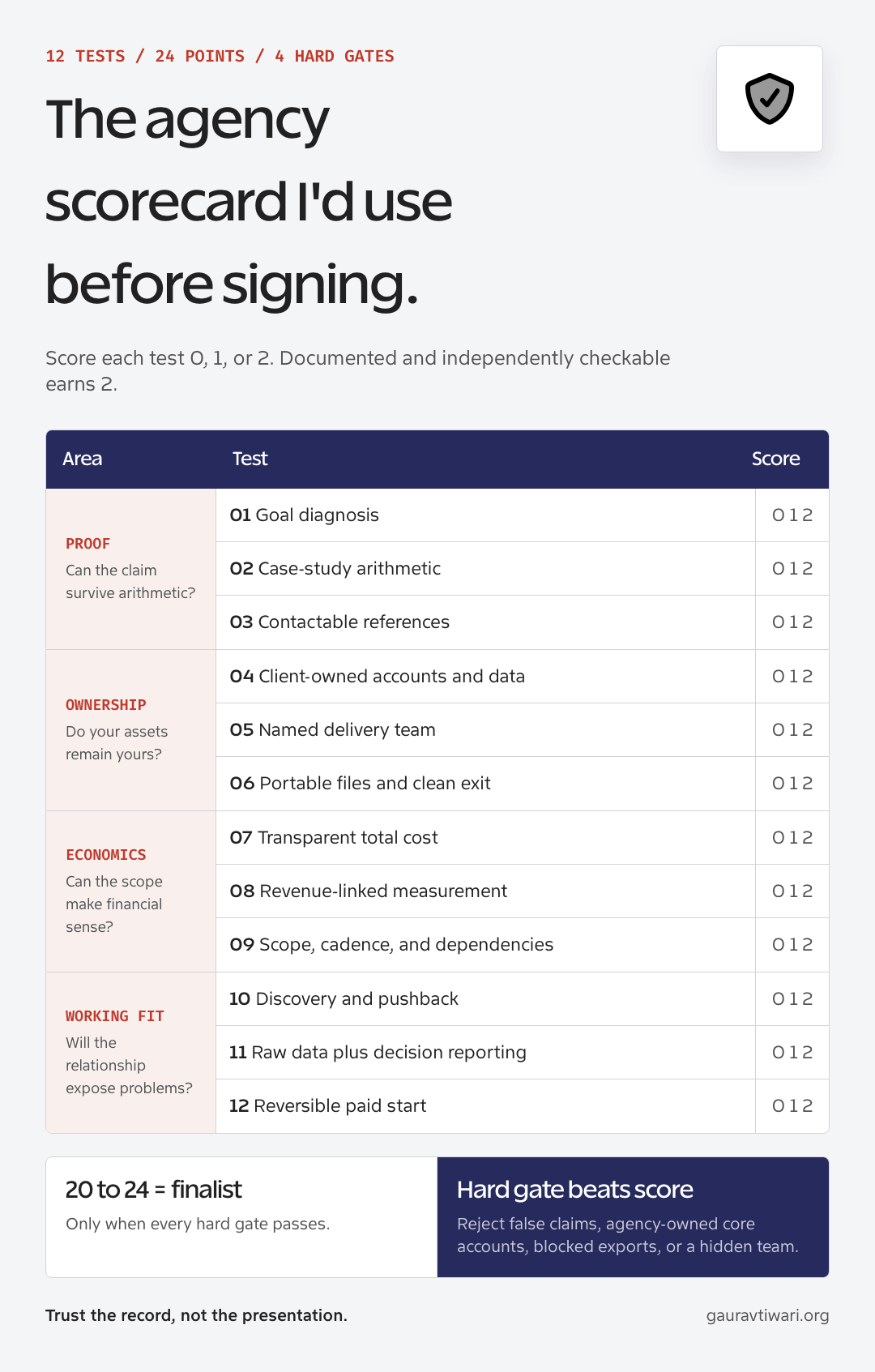
Use this scale:
- 0 points: Missing, contradicted, or refused.
- 1 point: Plausible but incomplete, verbal only, or not yet verified.
- 2 points: Specific, documented, relevant, and independently checkable.
| Area | Test | What earns 2 points |
|---|---|---|
| Proof | 1. Goal diagnosis | Names the bottleneck, baseline, business outcome, and a channel it would not prioritize |
| Proof | 2. Case-study arithmetic | Provides all six fields and connects the result to a business metric |
| Proof | 3. References | Gives a relevant current and former client you can contact |
| Ownership | 4. Accounts and data | Keeps GA4, Search Console, Google Ads, Meta, CRM, and domain assets under client control |
| Ownership | 5. Delivery team | Names the actual team, seniority, responsibility, and capacity |
| Ownership | 6. Portability and exit | Contract defines editable files, data export, access removal, licenses, and timing |
| Economics | 7. Cost transparency | Separates fees, media, software, production, pass-through costs, and overages |
| Economics | 8. Measurement plan | Ties channel metrics to qualified pipeline, CAC, contribution, or another business result |
| Economics | 9. Scope clarity | Defines deliverables, cadence, revisions, dependencies, and exclusions |
| Working fit | 10. Discovery quality | Asks hard questions, challenges a weak assumption, and doesn’t prescribe before diagnosis |
| Working fit | 11. Reporting quality | Provides raw-data access plus decisions, experiments, failures, and next actions |
| Working fit | 12. Reversible start | Offers a paid, tightly scoped first engagement with useful standalone deliverables |
Interpret the result this way:
- 20 to 24: Finalist, but only if every hard gate passes.
- 15 to 19: Unresolved. Request the missing record or contract change before deciding.
- 0 to 14: Reject. Too much of the relationship still depends on hope.
Four conditions override the score:
- The agency insists on owning a core account or audience.
- A material claim is fabricated or can’t be reconciled with its source.
- The contract blocks practical data or file export.
- The agency refuses to identify who will perform the work.
This prevents a charming agency from collecting points for presentation while failing the conditions that protect your business.
Want a working copy? I made a print-friendly decision pack with the buying brief, a three-agency comparison sheet, the reference-call script, and the account-handoff checklist. It gives you space to record the evidence that won’t fit in a sales-call chat window.
Enter your email and I’ll send the five-page PDF straight to your inbox. The optional checked box also signs you up for practical marketing resources and tips.
Should you start with a trial project or a long retainer?
Start with a paid, tightly scoped first engagement unless the work genuinely requires continuity from day one. A useful first engagement produces assets you can keep even if you don’t continue.
I usually prefer a 30- to 45-day starting window 4. Author’s recommendation: use this window to test measurement, access, communication, and one execution slice, not to demand a complete SEO or brand result. for diagnosis plus one meaningful execution slice. That’s a recommendation, not a universal standard. SEO content, brand work, enterprise data migrations, and long sales cycles won’t reveal their full business result in that period. The purpose is to test the operating relationship and establish a trustworthy baseline, not demand instant growth.
A strong first scope can include:
- A baseline covering GA4, Search Console, Google Ads, Meta, CRM, and sales data where relevant.
- A tracking and account-ownership audit.
- A prioritized strategy tied to one business outcome.
- One execution slice, such as a paid-search rebuild, technical SEO sprint, landing-page test, or lifecycle-email sequence.
- A report that records decisions, evidence, failures, and the next recommended move.
- An access map and complete handoff of work produced.
Pay for this work. Asking several agencies to create free speculative strategy rewards the best free-pitch machine, encourages shallow recommendations, and asks professionals to give away useful thinking. A paid start lets you demand depth while keeping the decision reversible.
A longer retainer is justified when:
- The initial work confirms clean measurement and a credible plan.
- The channel needs sustained learning, production, or optimization.
- The contract keeps accounts and data portable.
- The delivery team has demonstrated communication and judgment.
- Your company can supply the approvals, creative inputs, engineering help, and sales follow-up the plan requires.
Once the agency passes that test, continuity becomes an advantage. The next challenge is managing the partnership without turning every meeting into a status recital. I cover that next phase in how to grow your business with a digital marketing agency.
Frequently asked questions
These short answers cover the questions that usually remain after the scorecard. Each answer stands on its own, but the ownership hard gates still outrank every other consideration.
How do I choose the right digital marketing agency?
Define one measurable business outcome, shortlist specialists for the actual bottleneck, then verify case studies, references, account ownership, delivery staff, pricing, reporting, and exit terms. Score each candidate against the same 12 tests. Reject any agency that requires ownership of your Google Ads, GA4, Search Console, Meta, CRM, or domain assets.
How much should I pay a digital marketing agency?
There is no reliable universal retainer. Clutch’s July 2026 dataset shows broad listings at $25 to $49 per hour but several service-specific categories at $100 to $149. Compare the quote’s scope, seniority, media costs, and deliverables with your target CAC, gross contribution, and lead-to-sale rate.
What questions should I ask a digital marketing agency?
The best questions to ask a digital marketing agency cover the outcome it would prioritize, the baseline data it needs, who performs the work, which accounts you own, how attribution is verified, what the fee excludes, what usually fails, and how files and access transfer at exit. Require source records, not only verbal assurances.
How can I verify an agency’s case studies?
Ask for the starting baseline, exact dates, denominator, conversion definition, agency-controlled changes, and confounding factors. Confirm the result in an anonymized source screen or through a contactable reference. A percentage without that arithmetic is a marketing claim, not evidence you can use for a hiring decision.
Should a digital marketing agency own my accounts?
No. Your company should retain administrative ownership of its domain, Google Analytics 4, Search Console, Google Ads, Meta Business Portfolio, CRM, email list, audiences, and creative files. The agency should use role-based or manager access and remove that access after the engagement ends.
Is a Google Partner badge enough to prove an agency is reputable?
No. Google Partner status confirms current program requirements for Google Ads, including performance, spend, and certifications. It doesn’t certify SEO, content, email, Meta Ads, or business fit. Click the badge to verify the public Google Partners profile, then evaluate the actual delivery team and relevant case-study evidence.
What digital marketing agency red flags should make me walk away?
Walk away from guaranteed results, agency-owned core accounts, hidden delivery teams, case studies without baselines, no raw-data access, vague subcontracting, hostile responses to verification, or contracts that block exports. A long commitment before tracking and ownership are established is another strong warning.
Should I hire a full-service or specialist digital marketing agency?
Hire a specialist when one bottleneck is clear, such as paid search, SEO, lifecycle email, or conversion work. Hire a full-service agency only when multiple channels share one strategy, each channel is adequately funded, and an internal owner can coordinate the work. A wider service menu isn’t automatically a better fit.
Make trust cheap to verify
A reputable online marketing agency won’t ask you to treat trust as a leap of faith. It will make trust inexpensive to verify and the relationship safe to leave.
That’s what a reputable online marketing agency looks like in practice: specific claims, inspectable records, client-controlled assets, and no drama when you ask how the relationship ends.
Take the 12-test scorecard into your next three agency calls. Compare the records, not the charisma. If a candidate fails an ownership hard gate, stop there. The best agency for your business is the one whose competence remains visible after the pitch deck closes.
That’s the practical answer to how to find a digital marketing agency without outsourcing your judgment. When you hire a digital marketing agency, buy verifiable work and a clean operating relationship, not a reputation you can’t inspect.
Footnotes
- Source: Google Ads Help, How to Become a Partner or Premier Partner. Program status is evidence for Google Ads eligibility criteria, not a general marketing-quality certification. ↩
- Source: Clutch, Digital Marketing Pricing Guide, July 2026. The directory total and rate bands describe Clutch’s dataset, not a universal quote. ↩
- Author’s scoring model: the thresholds and hard gates are recommendations built for comparable buying decisions, not a standard published by Google, Clutch, or an industry body. ↩
- Author’s recommendation: use this window to test measurement, access, communication, and one execution slice, not to demand a complete SEO or brand result. ↩
Tell Google you want more of this.
Add Gaurav Tiwari as a preferred sourceOne tap, and this site shows up more often in your own Top Stories, AI Overviews and AI Mode. Remove it any time.
Disclaimer: This site is reader-supported. If you buy through some links, I may earn a small commission at no extra cost to you. I only recommend tools I trust and would use myself. Your support helps keep gauravtiwari.org free and focused on real-world advice. Thanks. - Gaurav Tiwari