
5 Principles That Make Source Code Easy to Maintain (2026)
Source code gets read 10× more often than it's written. These five principles — readability, small functions, consistent structure, no duplication, and testability — are what separate maintainable codebases from the ones that quietly accumulate technical debt every sprint.
 by
by
Writing source code that does what it’s supposed to is only one part of the job. In real-world development, code gets read, altered, debugged, and extended far more often than it’s written from scratch. Studies from Microsoft Research and the University of Cambridge put the read-to-write ratio at roughly 10:1 over a project’s lifetime. That’s why maintainability is one of the most critical qualities of good software.
So it’s not enough to write code. The source code needs to be high-quality, maintainable code that a future teammate (or future you, six months from now) can pick up without dread.
Maintainable code saves you a lot of time. It’s less likely to ship bugs, easier for others to collaborate on, and simpler to extend when the product spec inevitably changes. Chaotic or clever-for-cleverness’s-sake code can’t say any of that. One way to avoid the former and achieve the latter is to talk to a source code expert who can audit your codebase against the same patterns experienced teams already use.
Here are five principles that consistently separate easy-to-maintain codebases from the ones that quietly accumulate technical debt every sprint.
1. Focus on Readability First
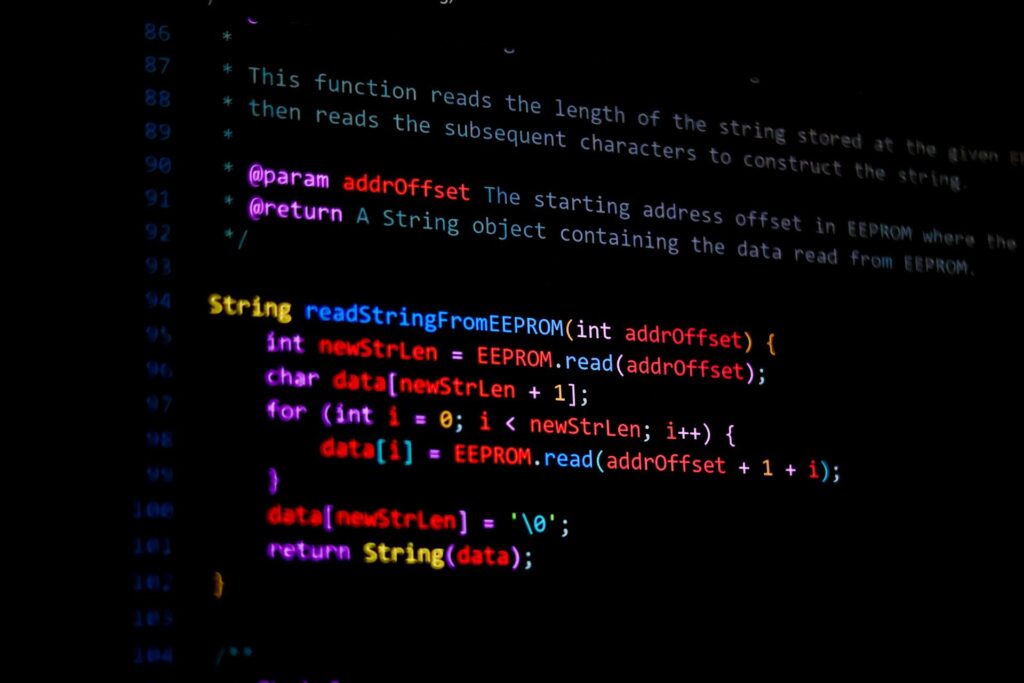
It’s tempting to make your code look impressive by reaching for clever one-liners, deeply nested ternaries, and language tricks that show off how much of the spec you’ve read. Most of those decisions hurt readability. And readability is the single biggest factor in how quickly a teammate can pick up your code on a Monday morning without sending you a Slack DM.
What does readable code actually look like? Three things, in order of impact:
- Descriptive names. Variables and functions should say what they hold or do.
userActiveSubscriptionsbeatsuas.calculateMonthlyRevenue()beatsdoCalc(). - No unnecessary complexity. If a senior dev can’t read the function on first pass, simplify it. Compilers don’t mind gibberish. Humans do.
- Visual simplicity. Whitespace, short lines, and one idea per block. The eye reads code the way it reads prose.
Modern tooling helps. Linters like ESLint, Pylint, and RuboCop catch the obvious problems before code review even starts. Prettier and gofmt remove formatting from the list of things humans argue about. Use them by default on every project, not as a special configuration.
2. Divide Functions Into Smaller Ones
Functions are one of the main components of any programming language. Used properly, they make code dramatically easier to manage. Used poorly — when one function quietly does too much — they become the place where bugs hide longest.
Code should be divided into smaller functions, each performing one distinct action. Instead of a single 200-line function that fetches user data, computes monthly revenue, sends an email, and updates a dashboard, split it into four functions that each do exactly one of those things. The Single Responsibility Principle isn’t an abstract architecture rule. It’s the practical reason debugging gets faster as a project matures, instead of slower.
A simple rule of thumb: if a function won’t fit on your screen without scrolling, it’s probably doing too much. Refactor before you ship. Future you, debugging a related bug at 11 PM, will thank you.
3. Stick to a Consistent Structure
Whether you code alone or in a team, your project needs structure. Indentation matters, but it’s just the surface layer.
Developers working on the same codebase should agree on naming conventions, formatting, code style, and file and directory layout. When everything looks the same, anyone on the team can drop into any file and orient themselves in seconds rather than minutes. Style guides — Google’s, Airbnb’s for JavaScript, PEP 8 for Python, Effective Go for Go — give you a shortcut: don’t argue, just pick one and follow it.
Automate the enforcement. Pre-commit hooks, CI-level lint checks, and IDE settings that match the team’s config will catch 95% of style drift before it ever hits a pull request. This is also where formal agile process stops being a buzzword and becomes a practical advantage — sprints stay focused on real work, not formatting nitpicks.
4. Avoid Duplication
Programmers should follow the Don’t Repeat Yourself (DRY) principle. The reasoning is practical, not philosophical.
When the same logic exists in three places, every bug fix is three changes — and the day you forget the third one, you’ve shipped a regression. Duplication also drifts. Over time, the three copies stop being identical, each one absorbing a small edit nobody documented, until the codebase has three slightly different ways to do the same thing.
The fix is to extract repeated logic into modules, classes, utility functions, or shared services. The same behavior with one source of truth, fewer lines of code, and dramatically faster updates. A reasonable test: if you’ve copy-pasted a block more than twice, it’s a function waiting to happen.
Caveat — don’t over-DRY. Premature abstraction is its own form of technical debt. If two pieces of code look similar but represent different concepts, leave them alone. Wait until the third repetition before reaching for an abstraction, and only abstract along the seams that actually share meaning.
5. Write Testable Code
Well-written code is easy to test. That’s not a coincidence — testability is a direct downstream effect of the other four principles on this list.
To make code testable, three things have to be true. Modules should work independently, with minimal coupling to other code. Dependencies should be explicit — passed in as arguments or injected, never silently pulled from globals or singletons. Each function should have clear inputs and outputs that can be asserted against in a unit test.
Code written this way isn’t just easier to test. It’s easier to reason about, easier to scale, easier to refactor without breaking things downstream. That’s why the architecture decisions made early in custom software projects compound for years — testable code at the start means testable code at month 24.
For practical adoption, set a coverage floor in CI (60-80% for most production codebases is realistic), block merges that drop below it, and treat the test suite as part of the product, not a chore that happens later.
The Short Version
Maintainable code is readable, well-structured, testable, consistent, and free of duplication. None of those qualities show up by accident. They come from teams that bake the principles into code review, tooling, and onboarding from day one — and from leaders who treat code quality as a deliverable, not a nice-to-have.
If you’re inheriting a codebase that already breaks half these rules, or building a new one and want to avoid that fate, working with a source code expert can shorten the path from chaotic to clean by several quarters. The fastest way to learn what good looks like is to see someone else’s good codebase up close.
Tell Google you want more of this.
Add Gaurav Tiwari as a preferred sourceOne tap, and this site shows up more often in your own Top Stories, AI Overviews and AI Mode. Remove it any time.