The Real Cost of Running WordPress Business in 2026 (And How Top Builders Fund It)
WordPress is free. Everything around it is not. A practitioner's breakdown of what running a WordPress business actually costs in 2026, where the hidden expenses hide, the cash flow gap nobody talks about, and the four funding strategies top agencies use to compound instead of survive.
 by
by
Running a WordPress business looks straightforward from the outside. Pick a theme, install a few plugins, launch a site, invoice the client. Anyone with two weeks of YouTube tutorials can talk like an agency. The financial reality behind that pitch is far more layered, and far more expensive, than most people expect when they hang the shingle out.
I’ve been running a WordPress consulting practice for 18 years. 850+ clients across big to small agencies and indie operators. The cost of running a WordPress business in 2026 isn’t what it was in 2016, or even 2022. The platform got more capable. The tooling got more expensive. The client expectations got harder to meet on a shared-host budget. And the gap between “running” a WordPress business and running a profitable one widened sharply.
The costs don’t hit all at once. They creep in. A premium plugin renewal here, a managed hosting upgrade there, a senior developer retainer that suddenly feels essential the first time a client’s site goes down on a Saturday. By the time most operators take stock of their actual annual spend, the number is well past what they budgeted. The question isn’t only what it costs. It’s how the operators who actually scale fund it without bleeding cash flow dry.
What “Running a WordPress Business” Actually Means in 2026
There’s no single version of a WordPress business. Three main flavors, with overlapping economics.
- Agencies. Build and maintain client sites. Revenue from project fees + monthly retainers.
- Product makers. Build and sell their own WordPress products — themes, plugins, SaaS tools layered on top of WP.
- WP-powered operators. Run content sites, e-commerce stores, membership communities, or affiliate properties built on WordPress as the foundation.
Each model carries its own cost structure. They share one reality: WordPress itself is free, and absolutely nothing around it is.
The Core Costs Everyone Faces
Whether you’re a solo freelancer or a team of twelve, certain expenses are unavoidable. Here’s where the money actually goes in 2026, with the ranges I’ve personally watched WordPress businesses pay across my client base.
| Category | Annual cost range | What you’re paying for |
|---|---|---|
| Managed hosting | $300 – $6,000 | Performance-tuned WP hosting across client/product sites |
| Premium plugins | $500 – $3,000 | SEO, forms, security, e-commerce, builders, membership |
| Developer costs | $5,000 – $50,000+ | Retainers, contract work, or in-house salaries |
| Security & backups | $200 – $1,500 | Managed firewalls, malware scanning, offsite backups |
| Tooling & workflow | $2,000 – $8,000 | PM software, staging, version control, CI, monitoring |
| Marketing & acquisition | $3,000 – $15,000 | Site, content, paid ads, referral programs |
| Education & conferences | $1,000 – $5,000 | Courses, WordCamps, training time |
Managed hosting alone has changed dramatically. In 2026, serious WordPress operators are not running their best clients on $10-a-month shared hosting. Platforms like Kinsta and WP Engine pushed the quality benchmark — and the price point — considerably higher. For agencies managing dozens of client sites, hosting alone can reach five figures annually. If you’re still benchmarking your costs against the cheap end of the market, you’re benchmarking against businesses that aren’t going to be around in three years. (I keep my own hosting comparison updated for exactly this reason — every dollar at the hosting layer shows up downstream as faster sites, fewer support tickets, and higher renewal rates.)
Plugin licensing is the other creeping cost most operators underestimate. A fully equipped client site might carry licenses for an advanced SEO suite (Rank Math Pro, Yoast Premium), a page builder (Bricks, Breakdance, GenerateBlocks Pro), a forms plugin (Core Forms, Gravity Forms, Fluent Forms), a membership engine, an e-commerce extension stack, and a security suite. Add those up annually and you’re at $1,500 to $3,000 in plugin renewals alone, before you’ve billed a single client hour.
The Hidden Iceberg Beneath the Obvious Costs
The visible line items are only the surface. Most agencies that fail in years three or four don’t fail because of the obvious costs. They fail because of the costs they never put on a spreadsheet.
                  ━━━━ WATERLINE ━━━━
            ┌──────────────────────────────┐
            │  Hosting, plugins, salaries  │   ← Visible costs
            │  (the spreadsheet line items)│      (the part you budget)
            └──────────────────────────────┘
   ╔══════════════════════════════════════════════╗
   ║  Staging environments, version control       ║
   ║  CI / automated testing, monitoring          ║
   ║  Project management tooling, client portals  ║
   ║  Education + WordCamps + experimentation     ║   ← Hidden costs
   ║  Tax + accounting + legal + insurance        ║      (the part that
   ║  Time spent on bizdev that doesn't bill      ║       compounds quietly)
   ║  Refactoring legacy client sites             ║
   ║  Onboarding + offboarding overhead           ║
   ║  Customer support outside scope              ║
   ║  Plugin migrations after acquisitions        ║
   ║  Owner burnout and replacement hiring        ║
   ╚══════════════════════════════════════════════╝
Tooling and Workflow Infrastructure
Professional WordPress businesses rely on tooling that sits outside WordPress itself. Project management (Linear, ClickUp, Asana, Notion), client portals (SuiteDash, Plutio), staging environments, version control (GitHub or GitLab), automated testing tools, error monitoring (Sentry, Bugsnag). None of this is glamorous. All of it is essential the moment you go from “me and a freelancer” to “team of four”. Combined, this stack runs $2,000 to $8,000 per year depending on team size — and the team I’d take seriously sits at the upper end of that range, not the lower. The developer toolchain I’d actually recommend goes into more specifics if you’re building yours from scratch.
Education and Staying Current
WordPress isn’t a static platform. The block editor keeps evolving. WooCommerce deepened significantly between 2023 and 2026. Full site editing rewrote how themes work entirely. AI features now ship in core. Staying current means investing in courses, conferences, and experimentation hours that don’t bill to clients. It’s a real cost, either in money spent on training or in hours that could have been billable. The operators who skip this are the ones who quietly fall behind, then suddenly look uncompetitive on a Tuesday.
The operators who scale past six figures aren’t the ones who spend the least. They’re the ones who invest strategically and know exactly what each dollar is buying them.
Client Acquisition and Marketing
Agencies and freelancers consistently underestimate what it costs to bring in new work month after month. A professional site, content marketing, paid ads, referral programs, SEO upkeep, networking time — these expenses are ongoing and they compound. Budget $3,000 to $15,000 annually if you’re serious about predictable growth, and accept that the first $5,000 of marketing spend often returns nothing measurable in the first six months. That’s the cost of a pipeline, not a project.
The Cash Flow Problem Nobody Talks About
The biggest financial trap in a WordPress agency isn’t the size of the costs. It’s the timing.
Month 1          Month 2          Month 3          Month 4
─────────────────────────────────────────────────────────────►

Costs incurred   Costs incurred   Costs incurred   ┌──────────┐
(payroll,        (payroll,        (payroll,        │ Revenue  │
 hosting,         hosting,         hosting,        │ lands ✓  │
 licenses)        licenses)        licenses)       └──────────┘
   ▼                ▼                ▼                ▲
   │                │                │                │
   └────────────────┴────────────────┴────────────────┘
              Three months of outflow first.
              One invoice paid at the end.

                    ↑
              This is the gap.
That gap is where most agencies either say no to a project they could’ve delivered, or take it on and then quietly struggle to make payroll on week 9. Neither outcome is good. The first costs you growth. The second costs you sleep, team morale, and eventually your best people.
How Top WordPress Businesses Actually Fund Their Operations
The best WordPress operators don’t wait for revenue to accumulate before investing in the business. They’re deliberate about funding growth, and they use several strategies most smaller operators overlook.
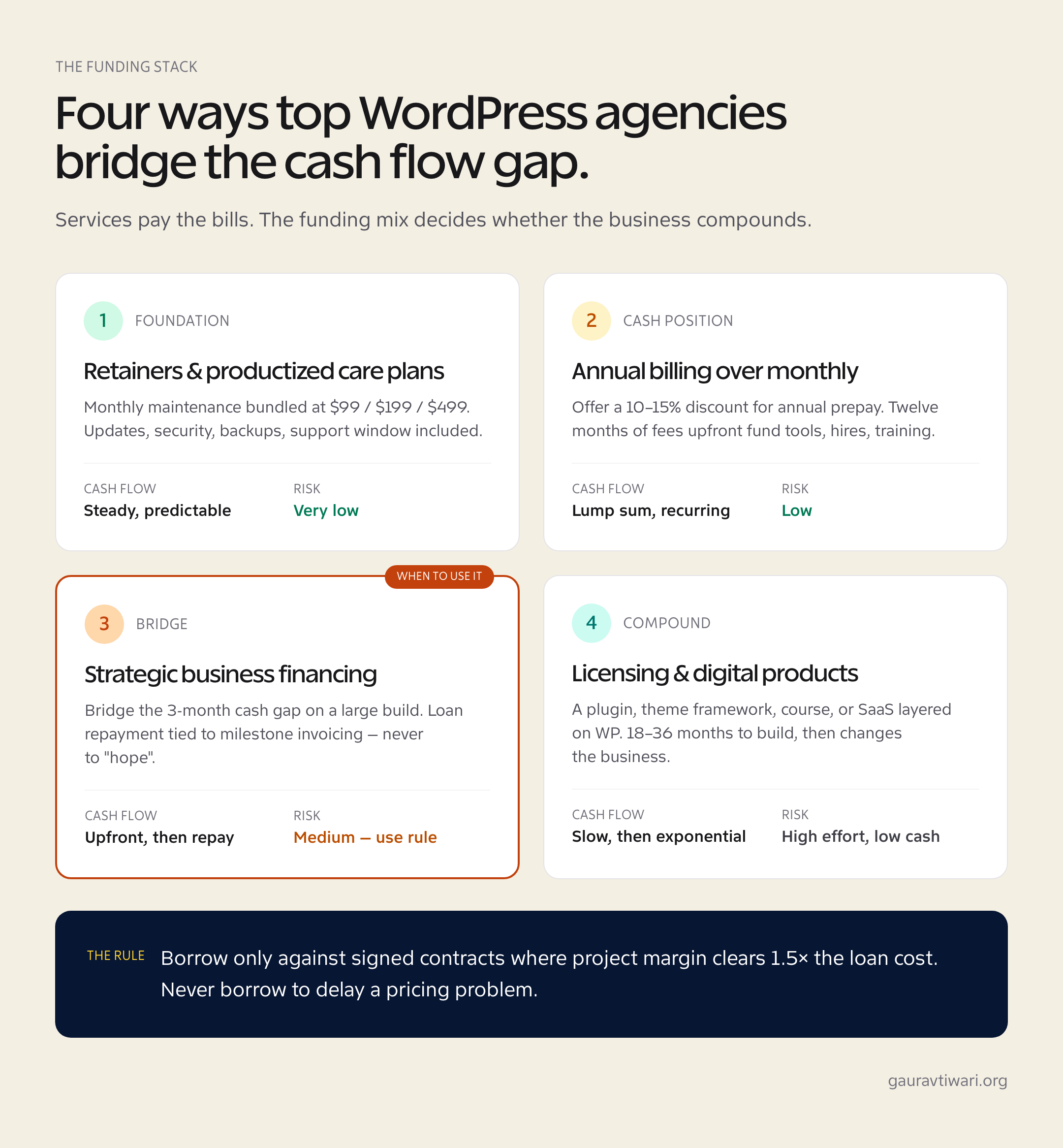
Retainers and Productized Services
Predictable recurring revenue is the foundation of every healthy WordPress agency I’ve seen. Monthly maintenance retainers covering updates, security, backups, and a defined support window create a cash flow baseline that funds operations and tool investments without depending on landing a new project every month. Productized care plans at $99, $199, or $499 a month — tiered by site complexity — convert sporadic work into steady revenue and turn one-off clients into multi-year ones.
Annual Billing Over Monthly
Agencies that switch clients from monthly to annual billing see meaningful improvements in cash position. Collecting twelve months of fees upfront provides capital to invest in better tools, training, or hires — which in turn make the business more competitive. Offer a 10-15% discount to incentivize the switch. The annual prepay is worth more than the discount costs, every time.
Using Business Financing Strategically
One funding approach more established WordPress businesses are turning to is structured borrowing. When a studio lands a large build — say, a custom WooCommerce platform requiring three months of intensive development — the revenue lands at the end, not the beginning. Using business loans to bridge that gap, covering payroll, plugin licensing, and tooling costs during the build, lets the business take on work it couldn’t otherwise without turning high-value clients away. Done carefully, with repayment tied to known incoming revenue, this works well for operators with stable client relationships and a predictable project pipeline.
The decision tree I’d actually use looks like this:
             Does this loan fund growth — or hide a leak?
                              │
              ┌───────────────┴───────────────┐
              ▼                               ▼
         GROWTH                          PLUGGING LEAK
   (signed contract, known         (covering last month's
    revenue date, scoped need)        payroll, no contract)
              │                               │
              ▼                               ▼
   Is the project margin                Stop. Fix pricing
   > 1.5× the loan cost?                 and retainer mix
              │                            first. Don't borrow
   ┌──────────┴──────────┐                 to delay the problem.
   ▼                     ▼
  YES                   NO
   │                     │
   ▼                     ▼
  Borrow.            Renegotiate
  Tie repayment      project terms
  to milestone       (deposit + 2
  invoicing.         payments + final)
Licensing and Digital Products
Many of the most profitable WordPress businesses in 2026 have built recurring product revenue alongside their services. A proprietary plugin sold on a subscription, a theme framework licensed to other developers, a membership community teaching WordPress skills, a SaaS tool that integrates with WP. These create income streams that don’t depend on billing hours. They take 18 to 36 months to build into something meaningful, but they change the financial dynamics of the business in a way nothing else can. Services pay the bills. Products compound.
What a Realistic Annual Budget Looks Like
For a small WordPress agency with two to four people, serving 10 to 20 ongoing clients, the realistic annual operating cost breaks down like this.
| Line item | Low end | High end |
|---|---|---|
| Hosting across all client sites | $4,000 | $10,000 |
| Plugin & tool licensing | $3,000 | $6,000 |
| Developer salaries / contractor fees | $60,000 | $150,000 |
| Marketing & business development | $5,000 | $12,000 |
| Education, conferences, training | $2,000 | $5,000 |
| Admin software & infrastructure | $2,000 | $4,000 |
| Total operating cost | $76,000 | $187,000 |
That puts total operating costs between $76,000 and $187,000 per year, before a single dollar of profit. It’s a sobering number, and it explains why pricing strategy matters so much. Agencies that underprice their services are usually unaware of how tight their actual margins are until they run the full numbers in December and realize they worked 2,200 hours for what amounts to a $40,000 take-home.
According to WPBeginner, WordPress powers over 43% of all websites on the internet as of 2026. The market is enormous. So is the competition. Standing out requires investment. Investment requires capital. And capital, for most agencies, requires deliberate funding decisions — not hope.
Frequently Asked Questions
The Mindset Shift That Changes Everything
The most important financial shift a WordPress business owner can make is moving from viewing costs as burdens to viewing them as bets. Every dollar spent on better hosting, stronger tooling, smarter financing, or a senior hire is a bet on the future output of the business. Some bets pay off in three months (a faster host that cuts your support tickets in half). Some pay off in three years (a product line that adds 30% to gross revenue). Some don’t pay off at all, and you learn to make a different bet next time.
Operators who approach their finances reactively — scrambling month to month, picking the cheapest plugin license, deferring every upgrade until something breaks — rarely build the kind of stable, scalable operation that lasts a decade. The ones who plan, price correctly, and fund strategically tend to build businesses that compound. Year five looks materially different from year one. Year ten looks like a different business entirely.
Running a WordPress business in 2026 is a real commercial endeavor with real financial demands. The numbers are bigger than they used to be. So is the opportunity for the operators who take the economics seriously — and refuse to keep pricing like it’s still 2018.
Tell Google you want more of this.
Add Gaurav Tiwari as a preferred sourceOne tap, and this site shows up more often in your own Top Stories, AI Overviews and AI Mode. Remove it any time.