
20 Highest-Paid YouTubers in 2026
 by
by
MrBeast is the highest-paid YouTuber in 2026, with estimated gross earnings of $300 million between March 2025 and March 2026. That is more than the next 9 highest-paid YouTube-first creators earned combined. Dhar Mann follows at an estimated $65 million, then Markiplier at $38 million and Rhett & Link at $37 million.
Those figures are estimated gross earnings from everything a creator’s business touches: ads, sponsorships, products, licensing, subscriptions, tours and films. They are not net worth, and they are not YouTube ad revenue alone. Every earnings number in this ranking comes from Forbes’ 2026 creator earnings data, and every subscriber count was read from the creator’s own channel in late August 2026.
One clarification before the list, because most pages on this topic quietly mix up 3 different questions. Highest-paid means recent income. Richest means accumulated wealth. Most popular means subscribers and reach. This page ranks by income, and handles the other two further down, because the answers are not the same people.
Highest-Paid YouTubers at a Glance
The table covers the 20 highest-paid YouTube-first creators, ranked by estimated gross earnings for March 2025 to March 2026. Earnings estimates come from the Forbes Top Creators 2026 dataset, which counts income and excludes equity. Subscriber counts are main-channel figures as of August 29, 2026.
| Rank | Creator | Estimated earnings | Subscribers | Main revenue beyond ads |
|---|---|---|---|---|
| 1 | MrBeast | $300M | 515M | Feastables, Beast Games, licensing |
| 2 | Dhar Mann | $65M | 27.6M | Brand deals, Samsung, Fox and Disney licensing |
| 3 | Markiplier | $38M | 38.9M | Iron Lung film, Distractible podcast |
| 4 | Rhett & Link | $37M | 19.7M | Mythical Entertainment, Netflix deal |
| 5 | IShowSpeed | $30M | 61M | Endorsements, live events, music |
| 6 | Mark Rober | $30M | 81.6M | CrunchLabs subscription boxes |
| 7 | Ms. Rachel | $26M | 21.1M | Netflix licensing, Spin Master toys, books |
| 8 | Jesser | $25M | 49.5M | Bucketsquad apparel, live events |
| 9 | MrBallen | $24M | 11.2M | Podcast network, SiriusXM deal |
| 10 | Jacksepticeye | $18M | 31.2M | Top of the Mornin’ Coffee, game projects |
| 11 | Rebecca Zamolo | $15M | 23.1M | Molo supplements, Zamfam merchandise |
| 12 | Nick DiGiovanni | $14M | 45.4M | Osmo pantry brand, Netflix licensing |
| 13 | Brent Rivera | $13.7M | 43.8M | Amp Studios, LEVELS snacks, brand deals |
| 14 | Typical Gamer | $13M | 16M | JOGO Fortnite studio, streaming |
| 15 | Stokes Twins | $12.4M | 145M | Mostly AdSense, by choice |
| 16 | Marques Brownlee | $10.9M | 21.2M | Ridge partnership, sponsorships, podcast |
| 17 | Alan Chikin Chow | $10.5M | 101M | Netflix, Roku and Tubi licensing |
| 18 | Lexi Rivera | $6.7M | 18.1M | Sephora, Prada and Cupshe partnerships |
| 19 | iJustine | $3.4M | 7.05M | Tech brand deals, event hosting |
| 20 | Steven He | $2M | 14M | Acting, film projects |
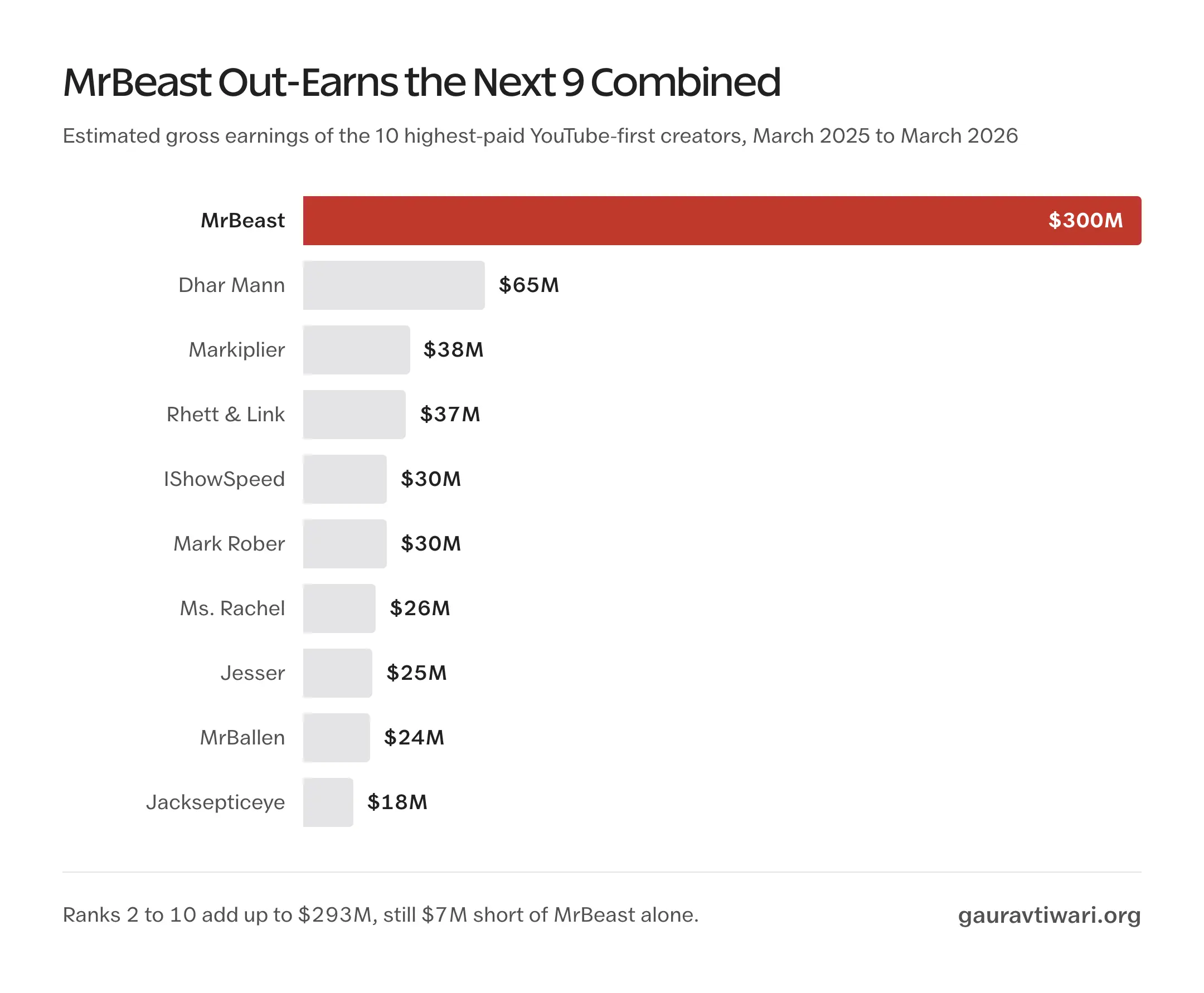
The gap at the top is the story. MrBeast’s $300 million is bigger than the rest of the top 10 put together.
How This Ranking Works
Every earnings figure on this page comes from one dataset: the Forbes Top Creators list published on June 23, 2026, reported by Zoya Hasan and Alexandra York. Forbes estimated each creator’s gross earnings between March 2025 and March 2026, counting income from ads, sponsorships, products, licensing, subscriptions and other ventures. One period, one methodology, applied to everyone.
Two rules in that methodology matter more than the rest:
- Earnings are gross, before taxes and costs. These are not take-home figures.
- Equity is excluded. Forbes counts what a creator’s businesses earned, not what their company stake is worth on paper. Beast Industries has reportedly raised money at a $5 billion valuation, and none of that valuation appears in MrBeast’s $300 million.
Two rules shape the order below. The ranking runs purely on earnings, while Forbes’ own published order blends earnings with an entrepreneurship score and audience clout, so the two differ slightly. And only YouTube-first creators qualify. Steven Bartlett earned an estimated $52 million, which would place him 3rd here, but The Diary of a CEO is a podcast business that happens to use YouTube. TikTok-first and Instagram-first names like Charli D’Amelio, Alix Earle and School of Hard Knocks’ James Dumoulin sit outside the same boundary.
Why not rank by net worth? Because almost no YouTuber net worth figure survives contact with a primary source. Public estimates blend company valuations, projected revenue and guesswork, then get copied between sites until they look like facts. MrBeast’s “net worth” appears online as anything from $1 billion to $2.6 billion, almost all of it his illiquid stake in Beast Industries. He told the Wall Street Journal he has “negative money” and borrows cash because roughly $250 million a year goes back into content. Annual earnings estimates from a named methodology are the more honest instrument, so that is what this page uses.
Also worth stating plainly: Jake Paul and Logan Paul do not appear on the Forbes 2026 creator list at all. Forbes gave no reason, though it did place Jake Paul on its 2026 Highest-Paid Athletes list instead, with an estimated $70 million driven by boxing. Duos like Rhett & Link and the Stokes Twins appear here as single acts, because that is how Forbes counts them and how their businesses operate.
Every figure below is an estimate. Treat the ranking as a well-sourced map, not an audit.
The 20 Highest-Paid YouTubers
Table of Contents
MrBeast
Estimated earnings: $300 million, per Forbes. Subscribers: 515 million, the most of any channel on YouTube.
Jimmy Donaldson’s number needs context to be believed. His media arm reportedly generated about $246 million in 2024 and lost roughly $80 million producing the videos. The money comes from what the audience feeds: Feastables did $251 million in revenue with over $20 million in profit in 2024, Beast Games runs on Prime Video, and Lunchly and licensing fill out the stack. Beast Industries, the holding company behind all of it, has raised over $450 million from investors and has reportedly been valued at $5 billion. The estimate’s limit: gross earnings say nothing about what Donaldson personally keeps, and by his own account most of it goes straight back into the machine.
Dhar Mann
Estimated earnings: $65 million, per Forbes. Subscribers: 27.6 million.
Dhar Mann Studios makes moral-dilemma mini dramas at television scale, with a large full-time staff and a $23 million production campus in Chatsworth that the company bought in August 2026. The revenue mix starts traditional: ads on YouTube and Facebook, plus brand partnerships with Adobe, Old Navy and the NFL. Then the licensing wave hit. Samsung TV Plus took 13 original episodes in 2025, Fox ordered 40 vertical microseries, and in August 2026 Disney signed him for 20 original family-focused episodes, its first creator deal of that kind. The limitation: at this scale, studio revenue and personal income blur, and Forbes’ figure measures the business he owns, not a salary.
Markiplier
Estimated earnings: $38 million, per Forbes. Subscribers: 38.9 million.
Mark Fischbach spent a decade as YouTube’s most durable horror-game creator, then did the thing nobody else on this list has done: released a feature film he wrote, directed and financed himself. Iron Lung opened in independent theaters on January 30, 2026 and grossed about $51 million worldwide on a budget near $4 million. It then moved to YouTube, but as a paid YouTube Movies exclusive from May 29, 2026, at $4.99 to rent, not a free upload. Add the Distractible podcast with its Spotify-exclusive video episodes and The Edge of Sleep adaptation on Prime Video, and his year looks less like a gaming channel and more like a one-man studio. The caveat: a film windfall makes 2026 his outlier year, not necessarily his new baseline.
Rhett & Link
Estimated earnings: $37 million as a duo, per Forbes. Subscribers: 19.7 million on Good Mythical Morning.
Rhett McLaughlin and Link Neal have run Good Mythical Morning every weekday since 2012, and Mythical Entertainment has grown around it into a production company with a podcast network, Mythical Kitchen and the scripted series Wonderhole. The 2026 development is the big one: a deal announced in July brings Good Mythical Morning, Mythical Kitchen and Last Meals to Netflix, with new episodes premiering on Netflix and YouTube simultaneously from September 7, 2026. They earn $37 million on 19.7 million subscribers, a fraction of what the big Shorts channels carry, by keeping costs boring and output relentless. The figure covers both of them, so per person they sit further down this list.
IShowSpeed
Estimated earnings: $30 million, per Forbes. Subscribers: 61 million.
Darren Watkins Jr. converted chaotic livestreams into the strongest endorsement portfolio of any young creator: Beats by Dre, Cash App, Dick’s Sporting Goods, and an Expedia campaign built around a 15-hour livestream across 5 Caribbean countries. He has a signature Prime flavor alongside Logan Paul and KSI, a track on the official FIFA World Cup 2026 album, and in July 2026 he performed at the World Cup final’s closing ceremony at MetLife Stadium, reported as the first content creator to do so. The estimate’s limit is churn: endorsement income renews only as long as the cultural moment does.
Mark Rober
Estimated earnings: $30 million, per Forbes. Subscribers: 81.6 million.
The former NASA engineer runs the second-biggest channel on this list and one of its best businesses: CrunchLabs, the subscription company behind Build Box and Hack Pack, which turns monthly engineering projects into recurring revenue no algorithm can cancel. Rober and CrunchLabs put roughly $60 million into Class CrunchLabs, a free middle-school science curriculum launched in October 2025, and YouTube itself joined the initiative in July 2026 ahead of a fall classroom rollout. A large slice of his operation is deliberately free or philanthropic, which makes the $30 million look conservative next to his reach.
Ms. Rachel
Estimated earnings: $26 million, per Forbes. Subscribers: 21.1 million.
Rachel Accurso built the most trusted brand in preschool media from a home studio and a teaching background. The business runs on 4 rails: YouTube ads on enormous toddler watch time, a non-exclusive Netflix licensing deal that brought compilation episodes to the platform from January 27, 2025, a Spin Master toy line, and a multibook deal with Random House. The Netflix arrangement is the clever part, because she licensed compilations without surrendering her catalog or her upload schedule. The limitation: children’s content lives under tighter ad rules than anything else on this list, so the off-YouTube licensing matters more than her ad rates.
Jesser
Estimated earnings: $25 million, per Forbes. Subscribers: 49.5 million.
Jesse Riedel turned basketball content into an apparel company. Bucketsquad, his direct-to-consumer brand, was on track for 8-figure revenue in 2025 after 3 straight years of doubling, and in April 2026 he formed JesserCo, a holding company with a former Spotify executive as president and a former Adidas basketball executive running the apparel side. A Pros vs. YouTubers show with Dwyane Wade is scheduled for 2027. He is the clearest case on this list of the audience being the marketing department while the merchandise line is the actual business. The caveat: apparel margins are thin, and 8-figure revenue is not 8-figure profit.
MrBallen
Estimated earnings: $24 million, per Forbes. Subscribers: 11.2 million.
John Allen, a former Navy SEAL telling strange, dark and mysterious stories to a camera, earns more than creators with 10 times his subscribers, because audio ad markets pay for attention by the hour rather than the click. Ballen Studios runs a network of shows, and after Amazon broke up Wondery in 2025, SiriusXM signed him to a multiyear exclusive in October 2025 covering ad sales for his podcast and his YouTube channel, plus acquisition of the network and new-show development. He is this list’s proof that 11 million attentive subscribers can out-earn 100 million casual ones. The limit: an exclusive deal concentrates his risk in one partner’s health.
Jacksepticeye
Estimated earnings: $18 million, per Forbes. Subscribers: 31.2 million.
Seán McLoughlin is the other half of the mid-2010s gaming cohort still compounding. Top of the Mornin’ Coffee sells direct and on Amazon, he voiced a character in 2025’s Dispatch, and a Kepler Interactive game built from his own concept was revealed at Gamescom 2026. Thankmas, his annual charity campaign, returns in December 2026 with Make-A-Wish after raising over $29 million lifetime, though that is philanthropy, not income. His earnings look almost modest next to the top 5, which is the point: a loyal gaming audience plus one consumer brand still clears 8 figures a year without a single viral pivot.
Rebecca Zamolo
Estimated earnings: $15 million, per Forbes. Subscribers: 23.1 million.
Rebecca Zamolo spent years building family-adventure content with her husband Matt, and then made the most personal brand extension on this list. Molo, the supplement company she co-founded with her fertility nurse after a public fertility journey, launched in April 2025 and sells prenatal and conception products in Walmart stores nationwide. Around it sit Zamfam merchandise, the Game Master Network game and books, and a CAA signing in February 2026 that points at television ambitions. The limitation: supplements are a crowded, regulation-sensitive category, and the brand is barely a year old.
Nick DiGiovanni
Estimated earnings: $14 million, per Forbes. Subscribers: 45.4 million.
The MasterChef finalist built the biggest food channel of his generation, then monetized it through the pantry. Osmo, his salt and seasoning brand, moved from direct-to-consumer into Walmart stores nationwide in mid-2025 at $6.97 a blend. In July 2026 Netflix signed a comprehensive licensing deal covering his entire back catalog plus day-and-date releases of new videos from both his channels, with an exclusive food podcast in development. A FIFA World Cup partnership added over 30 pieces of content. He is the youngest proof that the Ms. Rachel playbook, license the library and keep the channel, now extends to food. The caveat: packaged goods live and die on repeat purchase, not launch buzz.
Brent Rivera
Estimated earnings: $13.7 million, per Forbes. Subscribers: 43.8 million.
Brent Rivera is as much a studio owner as a creator. Amp Studios, the production company and talent collective he co-founded in 2017, manages about a dozen creators who generate billions of views a month, including his sister Lexi. His snack brand LEVELS, backed by Redbud Brands, debuted at Expo West in March 2025, and his sponsor list runs through Amazon Music, Hasbro and Activision. The limitation is the same as Dhar Mann’s, one tier down: a chunk of that estimate is company revenue from a roster, not one person’s content income.
Typical Gamer
Estimated earnings: $13 million, per Forbes. Subscribers: 16 million, plus a Twitch following.
Andre Rebelo found the loophole the rest of gaming YouTube missed: get paid by the game instead of the platform. JOGO, the Fortnite studio he co-founded in May 2024 with a $2 million investment, builds maps and game modes inside Fortnite’s creator economy and reportedly earned about $7 million in its first 5 months. In May 2025 it made its first acquisition, map studio RHQ Creative, in a deal that could top $1 million with earn-outs. His streams still run GTA and Fortnite, but Epic’s engagement payouts, not YouTube ad rates, are the growth engine. The risk mirrors MrBallen’s: one platform’s payout policy controls the business.
Stokes Twins
Estimated earnings: $12.4 million, per Forbes. Subscribers: 145 million.
Alex and Alan Stokes run the largest channel on this list after MrBeast, and the strangest business model on it. Forbes notes most of their income still comes from AdSense, because the twins deliberately accept few brand deals, arguing that mid-roll interruptions damage retention. A 70-person production team turns out high-frequency, multi-language sketch content that took the channel from 27 million subscribers in March 2024 to 145 million now, a run that put them on the TIME100 Creators list in July 2025 and at the front of the #TeamWater campaign that raised $40 million. The result is the clearest data point on this page: 145 million subscribers, and 14 creators above them in earnings.
Marques Brownlee
Estimated earnings: $10.9 million, per Forbes. Subscribers: 21.2 million.
MKBHD monetizes trust in a category where trust is the whole product. His review business runs on sponsorships priced against a tech audience advertisers cannot reach elsewhere, the Waveform podcast, and a 4-year Ridge deal signed in February 2024 that made him an executive board member and chief creative partner with equity. Not everything worked: Panels, his wallpaper app, shut down on December 31, 2025 after roughly 900,000 downloads and negligible revenue, and he open-sourced the code in January 2026. That shutdown is worth reading as a feature of his model, not a failure of it. Review integrity caps how aggressively he can monetize, which is exactly why the sponsorships stay valuable.
Alan Chikin Chow
Estimated earnings: $10.5 million, per Forbes. Subscribers: 101 million.
Alan Chikin Chow runs YouTube’s most-watched Shorts operation, a scripted drama studio producing Alan’s Universe for an audience of 101 million subscribers. The 2026 story is distribution: Roku took the library in March 2025, Tubi followed, a scripted K-pop series co-produced with HYBE America landed at Netflix in January 2026, and by July 2026 Netflix carried the Alan’s Universe library with new episodes day-and-date. He earns an estimated $10.5 million on the second-largest subscriber base on this page, which says everything about Shorts economics. Licensing exists precisely because Shorts ad revenue cannot carry a studio.
Lexi Rivera
Estimated earnings: $6.7 million, per Forbes. Subscribers: 18.1 million.
Lexi Rivera runs what Forbes calls a split personality: stunts and challenges on YouTube, high fashion on Instagram, and the two audiences compound each other. The brand list reads like a beauty magazine’s ad pages, Sephora, Neutrogena, Netflix and Prada, and her first Cupshe clothing collection arrived in winter 2026. She is also on the Amp Studios roster her brother Brent co-founded, which keeps production and deal flow in the family. The limitation: partnership-led income scales with cultural relevance, not watch time, and it renews one contract at a time.
iJustine
Estimated earnings: $3.4 million, per Forbes. Subscribers: 7.05 million.
Justine Ezarik has been reviewing technology on YouTube since 2006, which makes her the longest-serving creator on this list by more than a decade. The business is steady rather than spectacular: partnerships with Microsoft, Adobe, Apple, Sony, Nintendo and Best Buy, event hosting that included official on-floor coverage of CES 2026, and the Same Brain podcast with her sister. Nothing here is a rocket, and that is the lesson. A mid-size, trusted tech audience has now paid her for 19 consecutive years, through every algorithm change that killed flashier channels.
Steven He
Estimated earnings: $2 million, per Forbes. Subscribers: about 14 million.
The trained actor behind “emotional damage” aims his sketch comedy at the Asian diaspora, and his fictionalized tough father became one of the most quoted characters on YouTube. The business is early by this list’s standards: he recently completed an indie action comedy, Kung Fu Deadly, and is planning a spy comedy he will publish on YouTube in 30-minute segments, effectively using the channel as a distributor for his own films. The limit is structural. Sketch comedy has no product line attached, so his ceiling depends on how well the acting career converts the audience.
How Top YouTubers Make Money
YouTube itself is generous by platform standards. The company said in September 2025 that it had paid over $100 billion to creators, artists and media companies in the previous 4 years. Spread across millions of channels, though, ad revenue alone builds very few fortunes, and at the top it can even be a loss leader: MrBeast’s media business reportedly lost about $80 million in 2024 while his chocolate brand turned a profit.
The actual revenue stack behind this list:
- YouTube ads. The floor, not the ceiling. Reliable, scaled to watch time, and capped by ad rates the creator does not control.
- Sponsorships and endorsements. The fastest money per hour of work. IShowSpeed’s Beats, Cash App and Expedia deals are the model.
- Consumer brands. Feastables, Bucketsquad, Osmo, Molo, Top of the Mornin’ Coffee. The audience becomes a customer list.
- Licensing. The defining 2026 trend. Disney buying Dhar Mann episodes, Netflix carrying Ms. Rachel, Mythical, Nick DiGiovanni and Alan Chikin Chow, Samsung and Fox ordering series. YouTube reportedly began offering top creators multi-million-dollar incentives in August 2026 to keep them from drifting to Netflix.
- Podcasts and ad-sales deals. MrBallen’s SiriusXM exclusive and Markiplier’s Distractible price audio attention separately from video.
- Subscriptions and recurring products. CrunchLabs boxes and paid memberships turn viewers into predictable revenue.
- Live events, tours and film. Iron Lung grossed $51 million theatrically. IShowSpeed tours continents.
If you are building a channel yourself, the takeaway is not “launch a chocolate brand.” It is that monetization starts well before the 1,000-subscriber line, and that growth compounds when you treat the channel as a distribution engine, the way working YouTube channel marketing strategies already assume, rather than as the product itself.
Highest-Paid vs Richest vs Most Popular
The 3 questions this page’s title usually smuggles together deserve separate answers.
| Question | What it measures | 2026 answer |
|---|---|---|
| Highest-paid | Estimated gross income over a defined period | MrBeast, $300M (Mar 2025 to Mar 2026) |
| Richest | Accumulated wealth, mostly equity estimates | MrBeast, $1B to $2.6B on paper |
| Most popular | Subscribers, views, reach | MrBeast, 515M subscribers, then T-Series at 314M |
MrBeast happens to top all 3 in 2026, which hides how differently the lists behave below him. The most-subscribed channels after his are T-Series, Cocomelon and SET India, corporate operations that appear on no creator earnings list. PewDiePie still holds around 110 million subscribers with none of the top-20 earnings. Jeffree Star’s cosmetics wealth and Like Nastya’s kids-media fortune are net-worth stories built over a decade, not current-income stories, and net-worth figures for all of them are estimate-site guesswork.
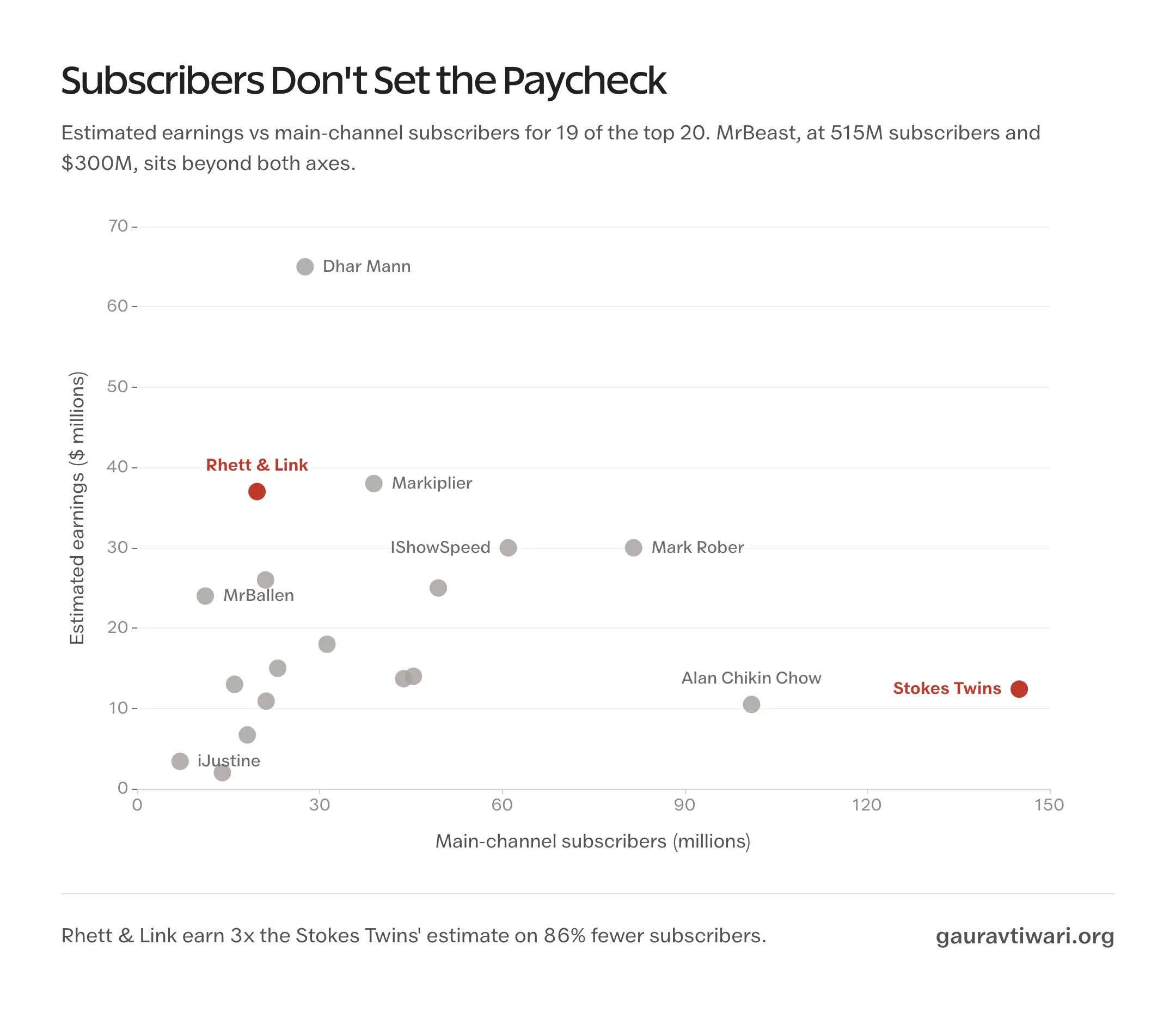
Popularity and pay diverge hard even inside this list. The Stokes Twins carry 145 million subscribers and earn an estimated $12.4 million, while Rhett & Link earn $37 million on 19.7 million. Alan Chikin Chow’s 101 million subscribers produce less income than MrBallen’s 11.2 million. Shorts views monetize at a fraction of long-form rates, sponsors pay for demographics rather than raw counts, and owned products pay for trust. It is also why buying YouTube views is a dead end: reach can be inflated, but income follows a business model. The same split shows up in the YouTube Shorts vs TikTok decision, because raw reach and monetizable attention are different products. Subscribers are distribution. Income is what the distribution sells.
FAQs on Highest-Paid YouTubers
MrBeast, with estimated gross earnings of $300 million between March 2025 and March 2026, per Forbes. That is more than the next 9 highest-paid YouTube-first creators combined.
Forbes estimates $300 million in gross earnings for March 2025 to March 2026, most of it from Feastables, Beast Games and licensing rather than ads. His media arm reportedly lost about $80 million in 2024, so the headline number is business revenue, not salary.
Total creator business earnings: ads, sponsorships, products, licensing, subscriptions and events. No creator on this list earned their rank from YouTube ads alone.
No. Earnings measure income over a defined period, while net worth measures accumulated wealth and is usually dominated by unverifiable company-valuation estimates.
No. The Stokes Twins earn an estimated $12.4 million with 145 million subscribers, while Rhett & Link earn $37 million with 19.7 million.
On paper, MrBeast, with estimates ranging from $1 billion to $2.6 billion, almost all of it his stake in Beast Industries. No audited figure exists for him or any other creator.
Jake and Logan Paul do not appear on the Forbes Top Creators 2026 list. Forbes instead placed Jake Paul on its 2026 Highest-Paid Athletes list with an estimated $70 million, driven by boxing.
Different lists use different time windows, methods and definitions, and many mix company revenue with personal income. This page uses one dataset with one stated period so the numbers stay comparable.
Final Remarks
A decade ago, “highest-paid YouTuber” measured who got the biggest AdSense checks. In 2026 it measures who built the best company on top of a free distribution channel. Every creator in this top 20 owns a product line, a licensing pipeline, a podcast network or a studio, except the Stokes Twins, who prove the ad-only route now tops out around $12 million even with 145 million subscribers.
The honest trade in a page like this: the figures are estimates from one dataset with a stated method, which makes them comparable, not audited. The next measurement window will reshuffle the bottom half of the list, and film-driven years like Markiplier’s may not repeat.
If you make videos, study the business models here, not the subscriber counts. The money followed the creators who stopped renting their audience and started owning what it buys.
Tell Google you want more of this.
Add Gaurav Tiwari as a preferred sourceOne tap, and this site shows up more often in your own Top Stories, AI Overviews and AI Mode. Remove it any time.