
iGaming Technology: The Evolution of Technical Solutions Behind Online Casinos
iGaming technology explained with regulator data: RNG testing, smart contracts, Solana fees, slot design, player protection, and license checks.
 by
by

iGaming technology is easy to oversell because the impressive parts are visible: fast payments, live video, AI recommendations, and cryptographic proofs. The harder question is whether the stack can produce a fair outcome, protect funds and data, identify harmful play, and give a user a workable path when something goes wrong.
I do not treat blockchain speed, a polished slot theme, or a personalized lobby as evidence that an operator is safe. Each solves a different problem. The useful way to evaluate online casino technology is layer by layer, then check whether the operator is authorized in the player’s market.
Quick verdict: certified game testing and a valid local license matter more than a chain name. Smart contracts can make settlement auditable. They cannot guarantee withdrawals, customer support, custody, or regulatory recourse. AI can detect risky behavior, but the same data can also intensify play if the incentives are wrong.
The iGaming Technology Stack That Actually Matters
A casino platform is not one system. It is a chain of systems with different failure modes. If you collapse them into a single word such as “secure” or “provably fair,” you lose the distinction that matters.
| Layer | What it does | What must be verified |
|---|---|---|
| Game outcome | RNG, game rules, pay table, result logging | Independent testing, approved software, immutable records |
| Money movement | Deposits, internal ledger, withdrawals, crypto settlement | Fund controls, reconciliation, withdrawal rules, custody |
| Platform | Accounts, identity, permissions, APIs, data storage | Access controls, audit logs, security testing, incident response |
| Experience | Live video, slot themes, recommendations, promotions | Accessibility, latency, disclosure, safer-design controls |
| Governance | Licensing, limits, self-exclusion, complaints, enforcement | Market-specific regulator register and active authorization |
Marketing and partner attribution sit beside those layers. Teams may use performance marketing and specialized affiliate marketing software for the iGaming sector to track referrals, commissions, and fraud. That infrastructure can make acquisition measurable. It does not certify a game or protect a player’s balance.
What Regulated-Market Data Shows
The best scale figures come from regulators and market operators, not vendor forecasts. The figures below measure different things and use different currencies, so they should not be combined into one global market-size number.
| Market and period | Published evidence | What it tells us |
|---|---|---|
| Great Britain, Apr 2024-Mar 2025 | UK Gambling Commission data: £7.8B remote betting, casino, and bingo GGY; £5.0B online casino GGY; £4.2B from slots; 24.4M active accounts. | Remote casino scale makes testing, security, and player controls infrastructure issues. |
| Ontario, Apr 2024-Mar 2025 | iGaming Ontario annual report: C$82.7B in wagers, C$2.9B in gaming revenue, more than 2.6M active player accounts, and 50 active operators. | A regulated market needs operator oversight and channelization, not only payment rails. |
| Malta, calendar 2025 | Malta Gaming Authority report: 38 new gaming-license applications received and 19 licenses issued. | An application is not the same thing as an authorization. |
The technical takeaway is simple: scale increases the cost of weak logs, manual reconciliation, insecure permissions, and delayed intervention. Automation is necessary, but regulators still need evidence that the automation behaves as intended.
RNG Testing and Provably Fair Systems Solve Different Trust Problems
A regulated random-number generator and a provably fair game are two routes to inspect outcome integrity. Neither is a complete safety label.
- Regulated RNG: In Great Britain, the Remote Gambling and Software Technical Standards cover game and platform behavior, and applicable software is tested before release.
- On-chain randomness: A verifiable random function can return a result with a cryptographic proof. Chainlink VRF is one implementation used by blockchain applications.
- Bad randomness: A smart contract should not use predictable values such as block timestamps as its random source. OWASP documents this failure mode.
- What neither proves: The operator may still have weak withdrawal practices, insecure account recovery, poor data controls, or no license for the player’s location.
The word “verifiable” needs an object. You may be able to verify the random input and result while being unable to verify the operator’s reserves, withdrawal queue, identity controls, or dispute handling.
Smart Contracts Can Automate Payouts, Not Consumer Protection
A smart contract can make a payout rule deterministic: accept a wager, obtain randomness, calculate the result, and settle according to code. That is useful when the code, inputs, and deployed address are available for inspection.
| Stage | Automated action | Main failure to check |
|---|---|---|
| 1. Wager | Receive or lock funds | Wrong token, approval abuse, custody ambiguity |
| 2. Randomness | Request and receive an outcome input | Predictable source, oracle failure, callback failure |
| 3. Result | Apply game rules and pay table | Logic bug, upgradeable contract, hidden admin control |
| 4. Settlement | Transfer funds or update balance | Liquidity shortfall, failed transfer, no practical recourse |
Immutability cuts both ways. A correct contract reduces discretionary interference. A flawed contract can make the flaw permanent. Code review, independent testing, admin-key disclosure, emergency controls, and a clear dispute path still matter.
Low Solana Fees Do Not Make a Solana Casino Safe
Solana can make small on-chain transfers economically practical. Its official fee documentation lists a base transaction fee of 5,000 lamports per signature, with an optional prioritization fee. That describes the network fee, not the operator.
- Chain check: Is the transaction and contract address inspectable?
- Contract check: Is the code verified, audited, and clear about upgrades or admin keys?
- Operator check: Is the legal entity named and licensed for the player’s market?
- Funds check: Who controls deposits before and after an on-chain transfer?
- Exit check: Are withdrawal limits, identity checks, timeframes, and complaints documented?
A fast finality claim can distract from the slow part a player actually cares about: whether the operator approves and funds a withdrawal. Network performance and operator reliability are separate measurements.
Slot Themes Affect Engagement, but Rules Constrain the Design
Theme variation can help a game feel understandable or fresh, but retention is not automatically a quality metric. A design that keeps someone playing longer can also increase harm. The useful measurements include comprehension, return behavior, complaints, limit use, and risky play signals, not session length alone.
Great Britain’s rules make that distinction concrete. The online games design rules require at least 2.5 seconds between online slot game cycles and prohibit features such as autoplay. In June 2026, the regulator announced a £122,835 regulatory settlement after one game recorded a 1.97-second spin and 15 others also fell below the 2.5-second minimum.
The May 21, 2026 UK Gambling Commission release through March 2026 adds a cleaner year-over-year test. I summed January through March for each period instead of comparing two convenient months.
| Great Britain online slots | Jan-Mar 2025 | Jan-Mar 2026 | YoY change |
|---|---|---|---|
| Slot GGY | £688.6M | £772.9M | +12.2% |
| Spins | 23.4B | 25.1B | +7.2% |
| Total sessions | 171.6M | 202.5M | +18.0% |
| Sessions over one hour | 10.08M | 8.91M | -11.6% |
| Average session length | 17 min | 15 min | -11.8% |
| Share of sessions over one hour | 5.87% | 4.40% | -1.47 pp |
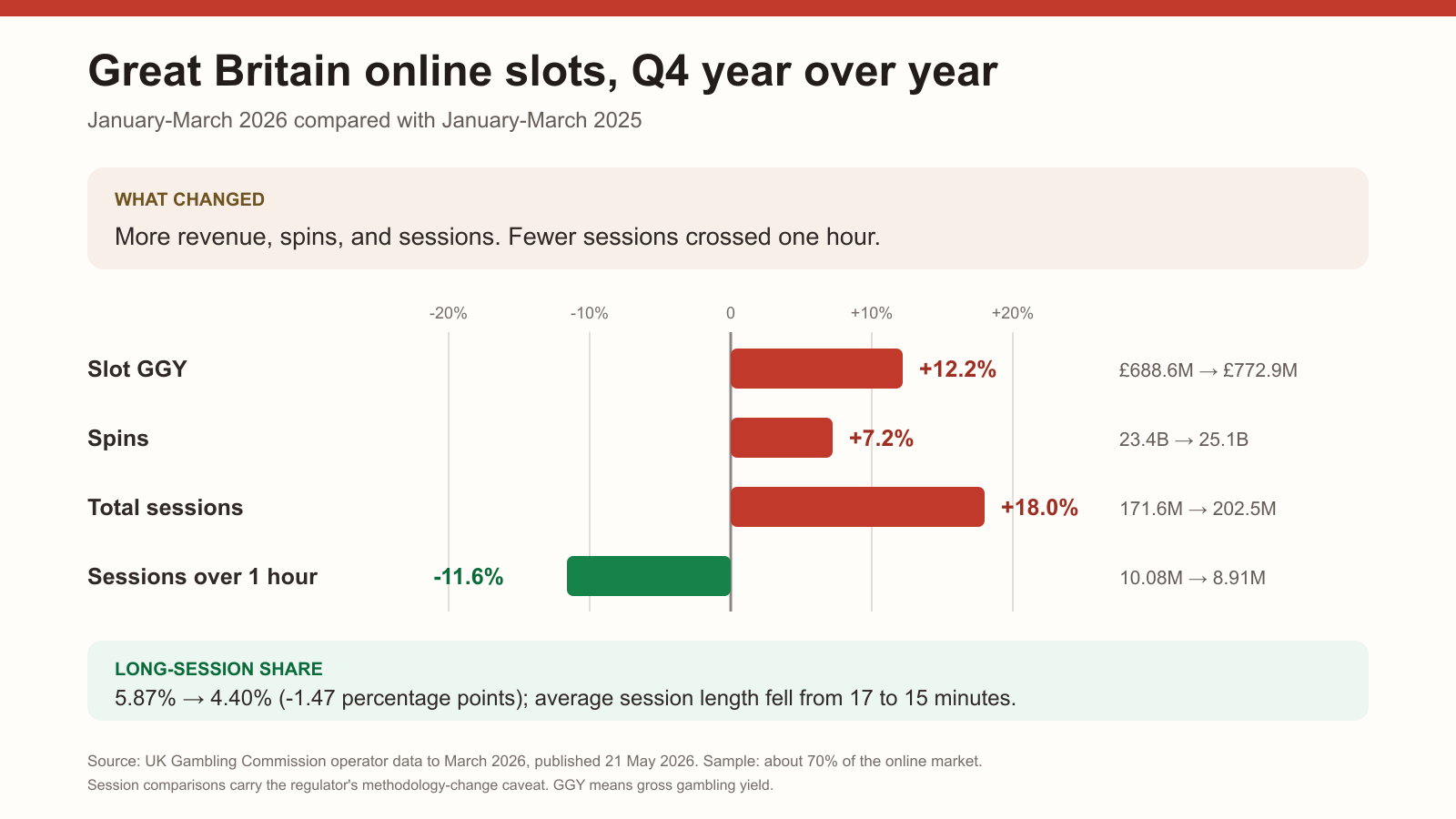
What the comparison says: slot GGY rose 12.2%, spins rose 7.2%, and total sessions rose 18.0%, while sessions longer than one hour fell 11.6%. The long-session share moved from 5.87% to 4.40%, and average session length fell from 17 to 15 minutes. That is a better risk-and-scale picture than revenue alone. It does not prove causation, and the regulator warns that some operators changed their session methodology during the comparison period.
The regulator’s business data through December 2025 shows that total sessions and average session length can move in opposite directions. A theme can influence return behavior without proving that a longer session is safer or more valuable.
AI Personalization Must Share a Pipeline With Player Protection
The same event stream can rank games, detect fraud, and identify risk. That creates a governance problem: a model optimized only for revenue can push in the opposite direction from a model designed to reduce harm.
- Recommendation data: game views, searches, session context, device, and prior choices.
- Fraud data: account changes, payment anomalies, device overlap, and referral patterns.
- Risk data: rapid limit changes, repeated breaks, chasing behavior, and prior self-exclusion.
- Governance data: model version, intervention, staff decision, outcome, and appeal record.
Ontario’s AGCO guidance expects operators to identify people who may be experiencing harm, intervene in proportion to the risk, document the work, and continually evaluate whether the approach is effective. That is a better benchmark for AI in gaming than a claim that the lobby is “personalized.” The wider product tradeoff is similar to the one in how AI is transforming SaaS products: optimization needs constraints, auditable decisions, and a way to correct mistakes.
How to Verify an iGaming Operator by Jurisdiction
A logo in a footer is not proof. Search the regulator’s own register by legal entity, trading name, and domain. Then confirm the authorization is active and applies to the market where the player is located.
| Market or license | Official check | What to match |
|---|---|---|
| Great Britain | UK Gambling Commission public register | Legal entity, trading name, domain, license status |
| Ontario | iGaming Ontario operator directory | Operator and the exact regulated gaming website |
| Malta | MGA licensee register | Licensee, authorization status, URL, gaming service |
| Curaçao | CGA online gaming license register | Operator, certificate, and official cert.cga.cw seal destination |
A license from one jurisdiction does not automatically authorize an operator everywhere. For example, an overseas business offering remote gambling to consumers in Great Britain still needs the relevant UK license. The player’s location and the operator’s target market are part of the technical-risk check.
What Has Changed in the Stack
The useful evolution is not a straight march from old to new. Each layer added capability and a new failure surface.
| Phase | Capability gained | Risk added or exposed |
|---|---|---|
| Certified digital games | Repeatable RNG-based outcomes | Testing quality and software-change control |
| Mobile and live play | Always-available, real-time sessions | Latency, identity, availability, and accessibility |
| Cloud platforms | Elastic scale and shared services | Permissions, vendor concentration, and data exposure |
| Blockchain settlement | Auditable transfers and contract logic | Key custody, contract bugs, and irreversible errors |
| AI-assisted operations | Recommendations, fraud detection, risk signals | Opaque decisions and conflicting objectives |
The same pattern appears across the changes witnessed in the video game industry and the technology behind the future of online slots. Better distribution and automation improve access, but they also raise the standard for security, disclosure, and user controls.
A Practical Decision Checklist
If you are evaluating an iGaming platform, vendor, or casino, ask for evidence in this order:
- Authorization: Can you find the exact entity and domain in the relevant regulator’s register?
- Game integrity: Who tested the RNG, rules, and critical components, and when?
- Funds: Who holds deposits, who can move them, and what happens during a failed withdrawal?
- Security: Are access controls, logs, audits, and incident responsibilities documented?
- Player protection: Can users set limits, take breaks, self-exclude, and reach a real complaints process?
- Automation: Which decisions are automated, what objective is optimized, and can a human review the result?
My stance is simple: use new technology when it makes a specific control stronger and easier to verify. Do not use “AI,” “provably fair,” “instant,” or a blockchain name as a substitute for evidence. A trustworthy iGaming technology stack is not the one with the most modern labels. It is the one whose outcomes, permissions, money flows, and protections can survive inspection.
Tell Google you want more of this.
Add Gaurav Tiwari as a preferred sourceOne tap, and this site shows up more often in your own Top Stories, AI Overviews and AI Mode. Remove it any time.
Disclaimer: This article is for information only, not legal or financial advice. Online betting and iGaming are regulated, and rules vary by location. Make sure you are allowed to play where you live. Gambling involves real financial risk and can be addictive. Only play with money you can afford to lose, and get help if it stops being fun.