
 by
by

Becoming a lawyer in the United States takes seven years of formal education, two standardized tests, a character review, and somewhere between $60,000 and $450,000 depending on which schools you pick. There are no online JD programs that lead to the bar in most states, no shortcuts that bypass the LSAT for top schools, and no one-year accelerated paths at any ABA-accredited institution. The process is intentionally rigid because the licensing standard is intentionally high — every state has decided that the floor for legal practice should sit above what most jobs require.
This article walks through the actual steps in 2026: which undergrad degrees matter (none, really), how the LSAT changed in August 2026, what law schools cost at the budget vs premium ends, the bar exam transition to the NextGen format, and the four state bar apprenticeship programs that let you skip law school entirely. I’ve also put hard numbers on each step so you know what you’re committing to before you commit.
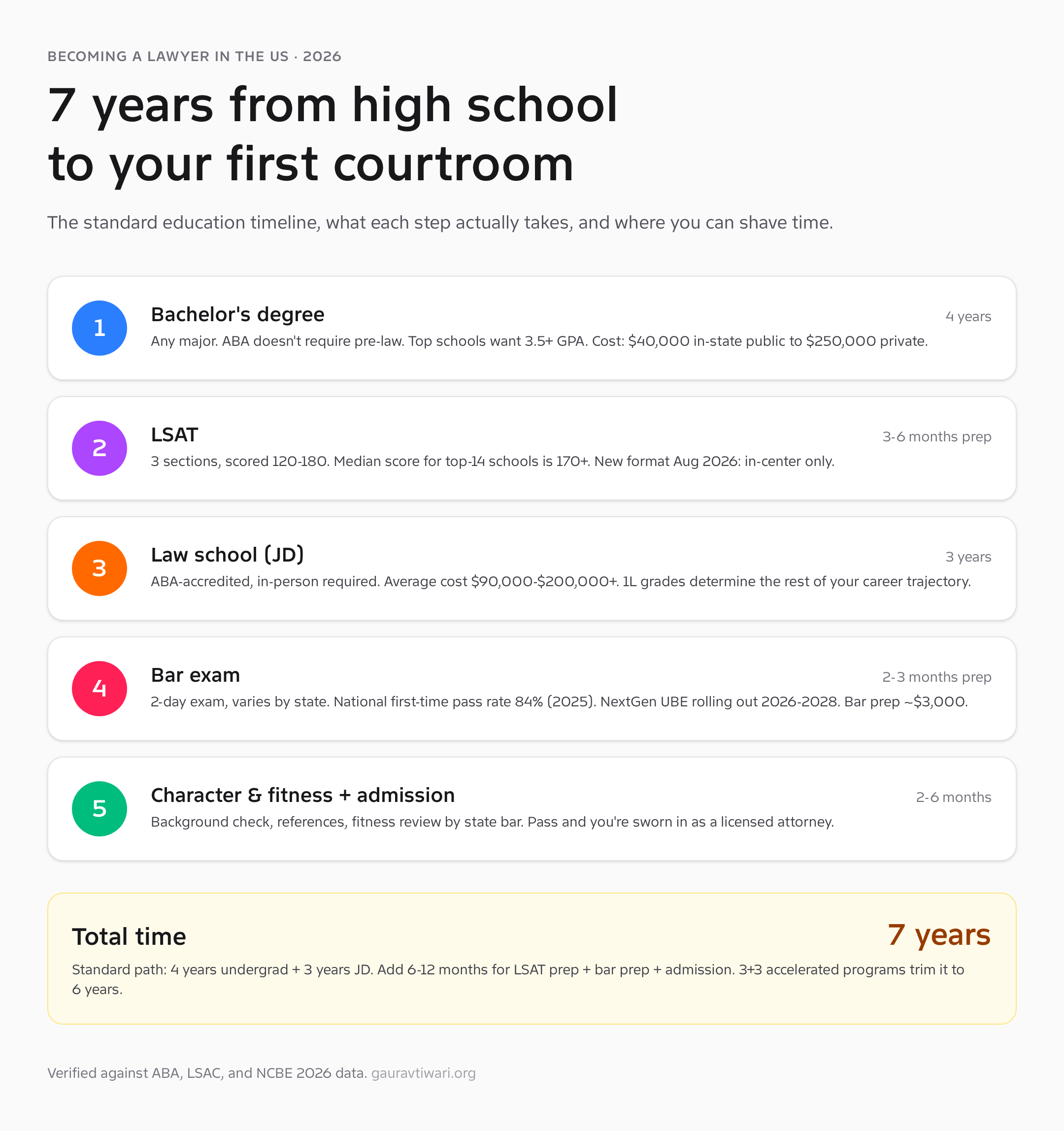
Quick answer: US lawyer education = 4-year bachelor’s degree + LSAT + 3-year ABA-accredited JD + bar exam + character & fitness review = ~7 years and $60,000–$450,000. Four states (California, Vermont, Virginia, Washington) allow apprenticeship paths that bypass law school but require longer timelines. Online JD programs exist but most don’t lead to bar admission in any state.
Undergraduate education: any major works, GPA matters
The American Bar Association does not require a specific undergraduate major for law school admission. Law schools admit philosophy majors, biology majors, English majors, and engineering majors at roughly equal rates. What law schools actually care about is GPA and LSAT — those two numbers determine ~80% of the admissions decision at most schools. The undergrad major is closer to a tiebreaker.
The data does show consistent patterns. Philosophy, classics, and political science majors have higher LSAT averages than the overall pool — likely because the LSAT tests reading comprehension and logical reasoning, both of which philosophy curriculums hammer. STEM majors (especially physics and math) score above average on the analytical sections. Pre-law tracks at most universities are not formal majors; they’re advising programs that overlay any major you pick.
What actually matters: a 3.5+ cumulative GPA opens most ABA-accredited schools. A 3.7+ opens the top-50 schools. A 3.8+ at a strong undergrad opens the T-14. Below 3.3, your LSAT score has to compensate aggressively, which usually means 165+. Schools see your transcript by year, so a strong upward trajectory (rough freshman year, dean’s list senior year) reads better than a flat 3.5 across all four years.
Cost reality: in-state public undergrad runs $40,000-$70,000 over four years (tuition + fees, housing extra). Private undergrad with no aid is $250,000+. Merit scholarships, especially for high-LSAT-potential students, can cover full tuition at flagship state schools — applying early to in-state public flagships is the highest-ROI move most pre-law students don’t make.
The LSAT: what changed in 2026 and what to score
The Law School Admission Test got a meaningful overhaul in 2026. Three major changes: Logic Games (the analytical reasoning section that defined the test for 30 years) was permanently removed in August 2024 and replaced with a second Logical Reasoning section. The Argumentative Writing task was restructured and now plays a larger role in admissions. And starting August 2026, the LSAT moves from at-home online proctored testing to in-center only, after sustained cheating concerns led LSAC to end the online testing program.
The current LSAT is three scored sections (two Logical Reasoning, one Reading Comprehension) plus one unscored experimental section, plus a separate online Argumentative Writing task. Scoring runs 120 to 180. National median is around 152. T-14 schools cluster at 170+ medians. Yale’s 2024 entering class had a 175 median; Stanford and Harvard sat at 174.
What’s good about the new format: Logic Games being gone is genuinely a relief for most takers — it was the section most amenable to brute-force memorization and least related to actual legal reasoning. The new format weighs reading comprehension and argument analysis more heavily, which is closer to what 1L year actually demands.
What’s broken: The transition to in-center testing only is going to be hard for rural test-takers and international applicants. Test centers are concentrated in major US cities; if you live three hours from the nearest one, your LSAT day now starts with a hotel stay. LSAC has indicated some hardship accommodations but the bar for qualifying is high.
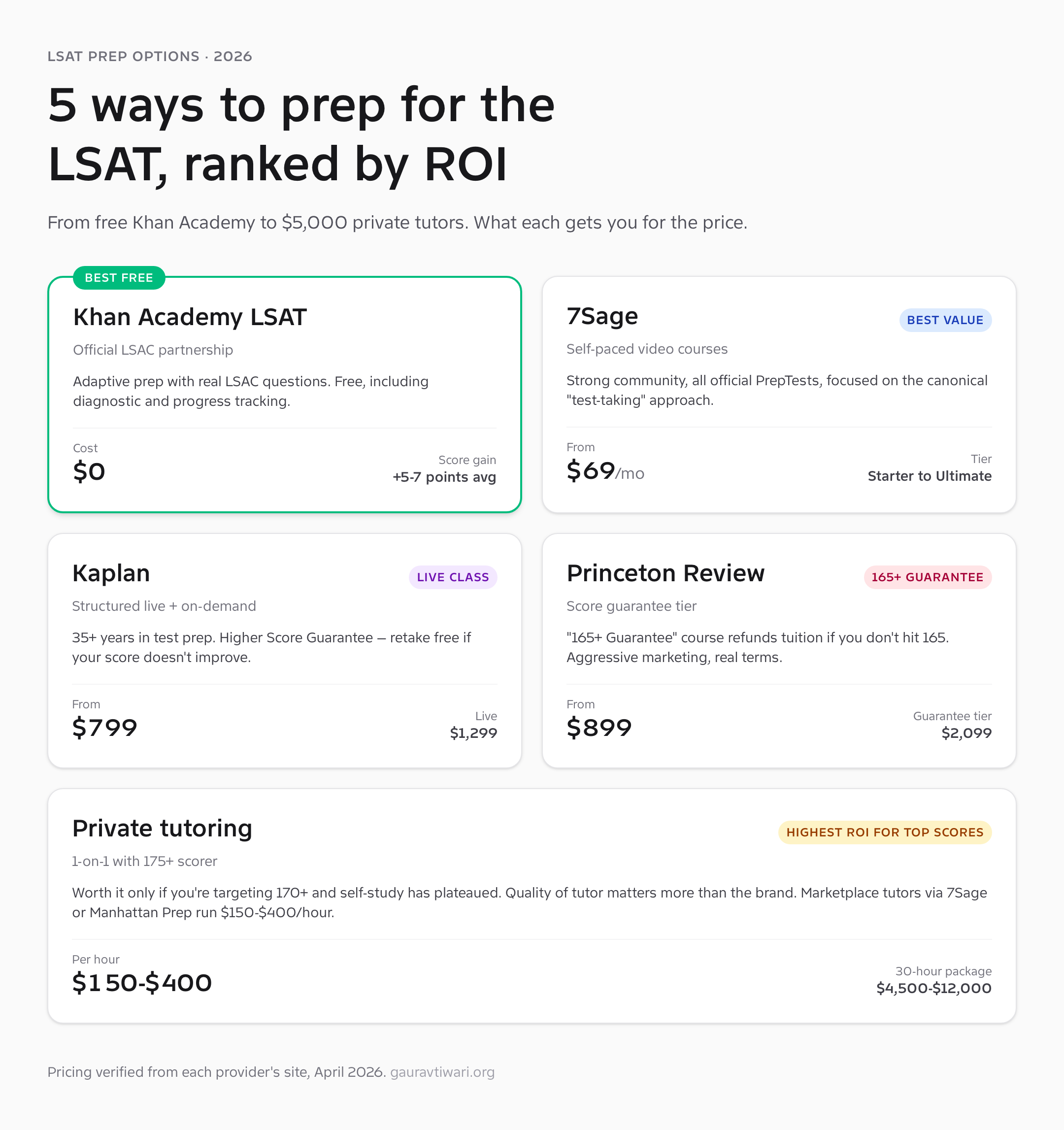
Prep options worth paying for: Khan Academy LSAT (free, official LSAC partnership, real test questions) is genuinely competitive with paid courses for self-disciplined studiers. Coursera’s LSAT prep specializations are useful supplements. 7Sage at $69-$179/month is the best mid-tier paid option — strong community, all official PrepTests, focused on the canonical “test-taking” approach. Kaplan and Princeton Review run $799-$2,099 with score guarantees. Private tutoring with a 175+ scorer is worth it only if you’ve plateaued and need to hit 170+; most test-takers don’t need it.
Law school: 3 years of JD at an ABA-accredited program
The Juris Doctor (JD) is the standard professional law degree in the US. It takes three years at an American Bar Association-accredited law school and is required for bar admission in 47 of 50 states (with the four apprenticeship-state exceptions covered later). The first year (1L) is uniformly grueling and uniformly the same across schools — Constitutional Law, Contracts, Civil Procedure, Torts, Property, Criminal Law. Second and third years (2L, 3L) become electives plus practical training (clinics, journals, externships).
What’s good: The 1L curriculum is standardized enough that transferring is genuinely possible after first year, and law schools have built incentives around it. Top-decile 1L grades at a regional school can transfer up to a T-14, which is a real option for students who didn’t get into their target school out of college. Practical training in 2L/3L (clinics, externships, moot court) is where the actual lawyering skills get built.
What’s broken: The Socratic method is a relic. Cold-calling students to “argue” cases under pressure made sense when legal reasoning had to be performed live in courtrooms; in 2026 it functions mostly as theater. Many top schools have quietly moved toward more interactive seminars and case-based learning, but the marquee lecture courses still feature the cold-call format. The 1L grading curve at most schools is brutal — top 10% get the on-campus interviews that lead to BigLaw, the rest fight for everything else.
Under the hood: ABA accreditation requires in-person instruction, libraries that meet specific size benchmarks, faculty-student ratios, and bar passage rates. Online JD programs exist (e.g., Syracuse, Mitchell Hamline) but they’re hybrid — students still attend in-person weekend intensives multiple times per year. A fully online JD that leads to bar admission anywhere in the US doesn’t exist as of 2026.
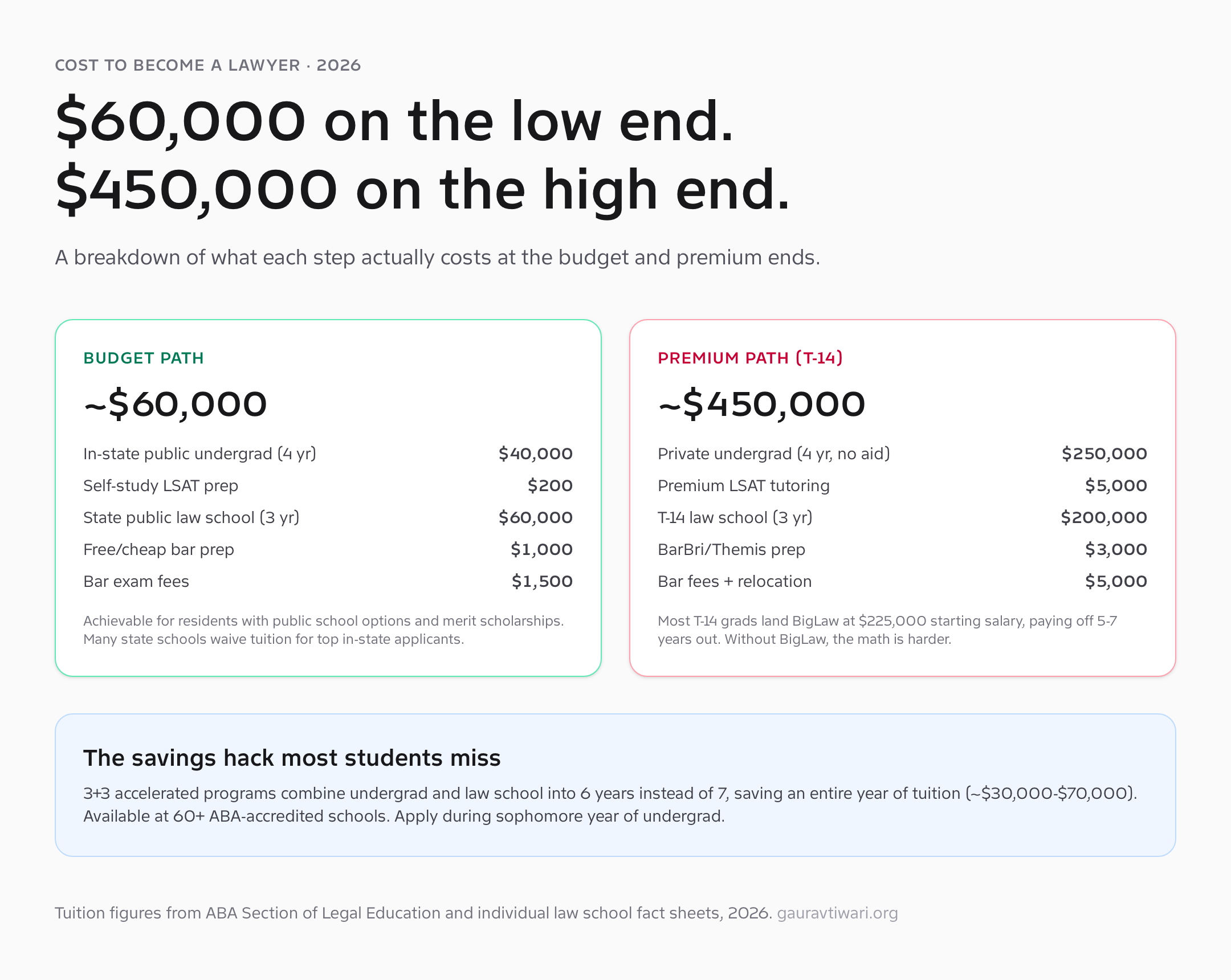
Cost reality: public state law school in your state of residence runs $50,000-$80,000 over three years. Out-of-state at a public school is $90,000-$140,000. T-14 private schools sit at $200,000+ for the JD alone, with another $50,000-$80,000 in living expenses. Merit scholarships at the T-14 are common but not universal — schools use them strategically to pull strong applicants who would otherwise pick a higher-ranked school. The 3+3 accelerated program (combine senior year of undergrad with first year of law school) saves an entire year and is offered at 60+ schools. Most pre-law students don’t know it exists.
Bar exam: NextGen rolls out 2026-2028
After three years of law school, you sit for the bar exam in the state where you want to practice. Most states use the Uniform Bar Exam (UBE), which is portable across UBE jurisdictions. The exam is two days: one day of multiple-choice questions (the MBE, 200 questions across seven core subjects), one day of essays and performance tests testing legal analysis on simulated client scenarios.
What’s changing: the National Conference of Bar Examiners is rolling out the NextGen UBE between 2026 and 2028. Twenty-six jurisdictions have already committed to adopting it. The new format reduces memorization-heavy doctrinal testing and increases practical lawyering skills (legal research, fact analysis, client counseling). For 2026 graduates, this means your bar prep needs to track which exam your state will administer in your sit window.
Pass rates (2025 data): 84.10% national first-time pass rate. 92.15% of 2023 law graduates passed within two years. State variance is significant — California’s first-time rate is around 50-55%, while Iowa and Nebraska sit at 90%+. The variance reflects exam difficulty, not graduate quality.
Bar prep: BarBri, Themis, and Kaplan are the three major commercial providers. BarBri is the most popular and most expensive ($3,000-$4,000). Themis runs $2,000-$2,500 and has comparable pass rates. Free options exist (e.g., your law school’s own bar prep program) and can work for self-motivated students. The 2-3 month full-time bar prep window between graduation and the exam is the most intense single stretch of legal education — students study 50-60 hours a week.
Character & fitness: the step nobody talks about until it bites
Passing the bar exam doesn’t make you a lawyer. Every state has a Character & Fitness review that runs in parallel with bar admission. Background check, fingerprint, financial disclosure, references from law school faculty and employers, and a comprehensive questionnaire about your past — arrests (not just convictions), prior employment, academic discipline, financial issues, mental health treatment in some states.
Disclosure is the part that catches students off-guard. The questionnaires ask about everything — that traffic ticket you got at 19, the shoplifting incident as a high schooler that was supposed to be expunged, the academic probation in sophomore year for the C-minus in Organic Chem. Failure to disclose is worse than the underlying issue in most cases. The bar examiners aren’t looking for unblemished records; they’re looking for evidence of judgment and honesty under questioning.
What’s good: the system catches genuine character problems before they become problems for clients. Lawyers handle other people’s money, freedom, and confidential information; the screen is appropriate for the trust required. Most applicants pass without issue.
What’s broken: the financial disclosure requirements are punitive for student-loan-burdened applicants. Some states require a separate financial responsibility evaluation and have denied admission to applicants based on student loan balances alone, which is a perverse outcome — the system that made you take on the debt now penalizes you for having it.
Timeline: 2-6 months from application to admission. If your application has flagged items (prior arrests, financial issues, academic discipline), expect closer to 6-12 months and possibly an in-person hearing.
Alternative paths: 4 states still allow law office study
Four states permit a path to bar admission that bypasses law school entirely: California, Vermont, Virginia, and Washington. The structure is similar across all four — apprentice in a law office or judge’s chambers under a supervising attorney for a specified period (3-4 years), document study hours, take an additional preliminary exam (the “First-Year Law Students’ Examination” in California, often called the “Baby Bar”), then sit for the regular bar exam.
What’s good: No tuition. The supervising attorney is usually paying you (modestly) rather than you paying a school. The legal training is practical from day one — you’re learning by doing real client work under supervision rather than via case method in a classroom.
What’s broken: Bar pass rates are dramatically lower for apprenticeship candidates. California’s apprenticeship pass rate has historically been around 20-25% vs ~55% for ABA-school graduates. The “Baby Bar” itself has a sub-25% pass rate. The signaling problem in the legal market is also real — most BigLaw firms and federal clerkships will not consider non-JD candidates regardless of bar admission. The path works for solo practice and certain public-interest work but doesn’t open the doors a JD does.
Under the hood: Each state’s rules differ. California’s program (officially the Law Office Study Program) requires four years of supervised study with at least 18 hours per week. Virginia’s law reader program requires three years and approval of the supervising attorney by the Virginia Board of Bar Examiners. Vermont and Washington have similar four-year structures. None of them are easy paths — they’re harder paths than law school, just cheaper.
Beyond education: what else you actually need to be a lawyer
Education and licensing get you the credential. They don’t make you a lawyer in the practical sense. The skills that distinguish working attorneys from new graduates are mostly built on the job in the first 3-5 years.
- Legal writing at the level a partner will accept — succinct, structured, and persuasive. Law school teaches the academic version of this. The professional version is markedly different.
- Client management — the soft skill that determines whether you stay in private practice. Lawyers who can’t manage difficult clients leave the profession faster than those who can.
- Time tracking and billing discipline. Sounds trivial. It’s not. Junior associates who don’t bill properly lose their jobs.
- Domain depth in a specific practice area. The first 5 years of practice are when generalists become specialists. The lawyers who build sustainable careers pick a lane and go deep.
- A network — referrals from former classmates, colleagues at other firms, and clients you’ve helped. The old saying is half-true: it’s not what you know, it’s what you know and who knows you know it.
Continuing Legal Education (CLE) requirements vary by state but most jurisdictions require 12-15 hours per year of CLE credit, including ethics-specific CLE. This isn’t optional — failure to maintain CLE results in license suspension. Most CLE is web-based and runs $50-$300 per credit hour.
Changing specialties after law school
The JD is a generalist degree. Specialization happens during 2L/3L coursework, summer associate placements, post-graduate clerkships, and the first 3-5 years at your firm. Most lawyers do change specialties at least once — corporate to litigation, transactional to regulatory, criminal defense to civil rights. The lateral market accommodates this freely if you’re moving within a connected practice area.
Major shifts (e.g., M&A to family law) are harder. They typically require a step backward in seniority and compensation while you build domain expertise in the new area. The clean exit path is law-firm-to-in-house: most companies hire 3-5 year associates from firms into in-house counsel roles, which usually means you keep the practice area but lose the billable-hour treadmill.
An LL.M. (Master of Laws) is the formal credential for specialization — a one-year graduate degree on top of the JD. Most common for tax law, international law, IP, and for foreign-trained attorneys who want US bar admission. LL.M. tuition is comparable to JD tuition (~$60,000-$80,000) and the credential is more useful in academic and international markets than in standard US private practice.
What I’d actually do if starting over in 2026
Pick an in-state public flagship for undergrad to save the largest single expense (tuition). Pick any major you genuinely care about — your GPA in something you love beats a B+ in pre-law. Take the LSAT once with serious preparation (3-6 months) rather than retaking three times. Apply to a mix of T-14 schools for prestige scholarships, mid-tier private schools likely to offer full tuition for your numbers, and your in-state public flagship law school as a safety. Pick the school where the net price is closest to zero, not the highest-ranked acceptance.
Treat 1L year as the most consequential year of your career trajectory. The grades you earn that year determine your summer associate placement, which determines your post-graduate offer, which determines the next decade. After 1L, the marginal grade matters far less. After graduation, your firm’s reputation and your specialty matter more than your GPA forever.
Don’t go to law school because you don’t know what else to do. The opportunity cost (3 years + $200,000 average debt + a profession with sustained burnout problems) is too high for “I think I might like it.” Go because you’ve talked to working lawyers in the practice area you want, you understand what the day-to-day actually looks like, and you’ve decided it fits.
For more on the broader education and career landscape, see best MBA marketing programs if you’re weighing a JD/MBA dual degree, balancing job and college for working students, and college search engines for international applicants. If you’re already on the legal track and thinking about practice management, the improving legal business profitability guide and SEO for lawyers guide cover the practical sides nobody teaches you in law school.
What education is needed to become a lawyer in the US?
Standard path: a 4-year bachelor’s degree (any major), passing the LSAT, a 3-year Juris Doctor (JD) from an ABA-accredited law school, passing the bar exam in your state, and clearing a Character & Fitness review. Total: about 7 years from high school. Four states (California, Vermont, Virginia, Washington) allow apprenticeship paths that skip law school but require longer timelines and have lower bar pass rates.
How many years does it take to become a lawyer?
Seven years on the standard path: 4 years undergrad + 3 years JD. Add 6-12 months for LSAT preparation, bar exam preparation, and admission. The 3+3 accelerated program (offered at 60+ ABA-accredited schools) combines undergraduate and law school into 6 years total. Apprenticeship paths in California, Vermont, Virginia, and Washington require 7-8+ years and are not faster than the JD route.
What degree do you need to be a lawyer?
A Juris Doctor (JD) from an ABA-accredited law school is required for bar admission in 47 of 50 states. Bachelor’s degree (any major) is a prerequisite for the JD. The Master of Laws (LL.M.) is an optional one-year graduate specialization on top of the JD, common for tax, international, and IP law.
Do you need a specific undergrad major to go to law school?
No. ABA-accredited law schools admit students from every major. Philosophy, classics, political science, English, and economics are common but not preferred. STEM majors (especially physics and math) are well-represented and often score above average on the LSAT. What matters is GPA (3.5+ for most schools, 3.7+ for top-50, 3.8+ for T-14) and LSAT score, not the major itself.
How much does it cost to become a lawyer?
Range: $60,000 (in-state public undergrad + state public law school + minimal LSAT prep + basic bar prep) to $450,000+ (private undergrad + T-14 law school + premium prep). Average JD graduates leave law school with $130,000-$200,000 in student debt. Merit scholarships at the T-14 are common — net cost can be substantially lower than sticker price for strong applicants.
What changed about the LSAT in 2026?
Three major changes. Logic Games was permanently removed in August 2024 and replaced with a second Logical Reasoning section. The Argumentative Writing task was restructured for greater weight in admissions. Starting August 2026, the LSAT moves to in-center testing only, ending the at-home online proctored option that LSAC ran from 2020-2026 after sustained cheating concerns.
Can you become a lawyer without going to law school?
In four US states (California, Vermont, Virginia, Washington), yes — through state-specific apprenticeship programs that require 3-4 years of supervised legal study under a licensed attorney. Each state has additional requirements (preliminary exams, study-hour documentation, supervising attorney approval). Bar pass rates for apprenticeship candidates are dramatically lower than for ABA-school graduates (~20-25% vs ~84% nationally for first-time takers). Most BigLaw firms and federal clerkships still require a JD regardless of bar admission.
What’s the bar exam pass rate in 2025?
The 2025 first-time pass rate was 84.10% nationally, up from 83.02% in 2024. Within two years of graduation, 92.15% of 2023 law graduates passed a bar exam. State variance is significant — California’s first-time rate is around 50-55%, while Iowa, Nebraska, and several Midwestern states sit at 90%+. The NextGen UBE format is rolling out across 26 jurisdictions between 2026 and 2028.
Tell Google you want more of this.
Add Gaurav Tiwari as a preferred sourceOne tap, and this site shows up more often in your own Top Stories, AI Overviews and AI Mode. Remove it any time.