
 by
by
Portfolio vs resume isn’t an either-or choice. A resume summarizes your experience and gets you through a formal application. A portfolio proves what you can do through work samples, case studies, and results. For most knowledge-work roles, the strongest application uses both.
Over the years, I’ve hired people with polished resumes who struggled to deliver and people with unconventional backgrounds whose work made the decision easy. My rule now is simple: use the resume to satisfy the process, then use the portfolio to remove doubt.
This guide explains the difference, when each document matters, and how to build a portfolio that supports your resume instead of competing with it. The practical examples cover developers, designers, writers, marketers, analysts, product managers, freelancers, and career changers.
| Decision factor | Resume | Portfolio |
|---|---|---|
| Core job | Summarizes your career history, skills, education, and results. | Proves your ability with work samples, case studies, and outcomes. |
| Typical format | A concise document, usually one or two pages. | A website, PDF, project repository, or platform profile. |
| Best use | Formal applications, ATS screening, and quick career review. | Interviews, referrals, client pitches, and skill validation. |
| Usually required? | Often required by structured hiring processes. | Required in some creative roles and valuable across knowledge work. |
| Main weakness | Claims are compressed, so context and evidence are limited. | Review takes longer, and weak project context can confuse the reader. |
| How to use both | Link the portfolio near your contact details and relevant claims. | Make the selected work support the resume’s strongest points. |
Free download: the Resume & Cover Letter Pack
An ATS-safe resume skeleton, a fill-in cover-letter template, a per-application tailoring checklist, and a keyword-match worksheet to beat the filter. Copy, fill the brackets, send.
Enter your email and I’ll send the PDF straight to your inbox.
Portfolio vs Resume: Key Differences
The key difference between a portfolio and a resume is depth of proof. A resume compresses your background into a fast, standardized summary. A portfolio lets the reviewer inspect selected work, the decisions behind it, and the results you can honestly document.
The resume gets you into the process. The portfolio makes the case once someone looks more closely. If an employer asks for a resume, send it. Then link to two or three relevant projects that support the claims you make.
A Resume Summarizes Your Career
A resume is built for speed. It gives a recruiter or hiring manager a timeline, role names, skills, education, and selected results in a familiar format. That structure is useful when someone has to compare many applicants.
Its weakness is compression. A bullet can say you redesigned onboarding or grew an audience, but it rarely has room to show the constraints, your exact contribution, or the evidence behind the result.
A Portfolio Provides Evidence
A career portfolio shows the work itself. A useful entry explains the problem, your role, the choices you made, the finished output, and what happened next. That context helps a reviewer judge both craft and thinking.
The portfolio can be a personal website, a PDF, a project repository, or a well-organized profile on a field-specific platform. The format matters less than relevance, clarity, and honest attribution.
Neither Format Is Fraud-Proof
A polished resume can exaggerate responsibility. A polished portfolio can hide team contributions or present copied work as original. Do not assume that a visual artifact proves authorship by itself.
Strong portfolios make the owner’s role explicit and include enough process to support the claim. In an interview, the reviewer should be able to ask why a decision was made and get a specific, coherent answer.
A Portfolio Does Not Bypass ATS Screening
Many employers use applicant tracking systems to collect resumes and screen required information. A portfolio link can strengthen an application after someone opens it, but the link does not replace the requested resume, job history, or relevant terminology.
Treat the resume as the routing document and the portfolio as evidence. Match the job description honestly, put a readable portfolio URL near your contact details, and point to the most relevant case study.
When Should You Use a Resume, Portfolio, or Both?
Use a resume when an application asks for one, an ATS is part of screening, or the reviewer needs a quick career timeline. Use a portfolio when the quality of your work is central to the decision. In most professional applications, submit the resume and link the portfolio.
- Use a resume first for structured job applications, government roles, and processes with required employment fields.
- Lead with a portfolio for referrals, freelance pitches, creative reviews, and conversations where someone already wants to inspect your work.
- Use both when you want the resume to establish fit and the portfolio to make your strongest claims credible.
Put Your Portfolio Link on Your Resume
Place a short URL beside your email and other contact details. If one project directly supports a resume bullet, link that case study too. Do not hide the portfolio behind a QR code or an unlabeled icon.
Tailor the Evidence to the Role
A UX application should surface UX work first. A content role should open with writing and strategy. You do not need a different website for every application, but you should control which projects a reviewer encounters first.
Prepare to Explain the Work
Be ready to walk through the problem, constraints, decisions, and result. If the work was collaborative, explain your contribution without taking credit for the team. The conversation is where proof becomes trust.
What a Portfolio Demonstrates
A strong portfolio demonstrates how you think, the level of work you can produce, and whether you can explain your decisions. The finished artifact matters, but the context around it is what separates evidence from decoration.
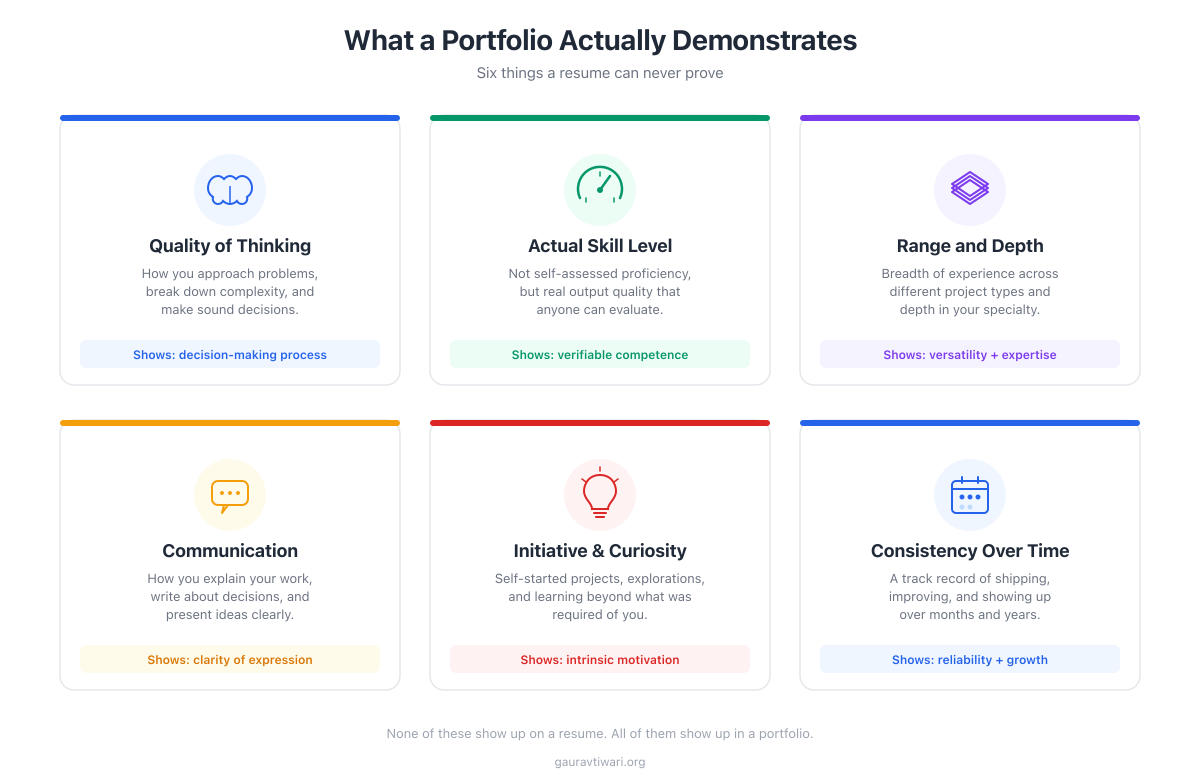
Quality of Thinking
How do you approach problems? What decisions do you make and why? A portfolio entry that walks through your process reveals how you think.
This matters enormously. Skills can be taught. Thinking patterns are harder to develop. When I’m hiring, I care more about how someone thinks than what tools they know. Tools change. Thinking endures.
Actual Skill Level
“Skilled in Photoshop” on a resume could mean anything from basic cropping to professional photo manipulation. A portfolio shows exactly what level you’re at. No ambiguity. No guessing.
Range and Depth
A portfolio demonstrates breadth (different types of projects) and depth (how deeply you’ve gone into particular areas). Employers can see whether you’re a specialist, a generalist, or somewhere in between.
Writing and Communication
For almost any knowledge work, clear communication matters. Portfolio entries, case studies, project descriptions, even code comments, reveal how well you communicate. This is especially valuable for remote work where written communication is primary.
Initiative and Curiosity
Side projects, personal experiments, contributions to open source, blog posts… these show that you’re interested in your field beyond the minimum required. Self-directed learning is a strong signal in rapidly changing fields. When I see a developer who blogs about new technologies they’re exploring, I know they’re someone who keeps growing.
Consistency Over Time
A portfolio that’s been building for years shows sustained interest and continuous improvement. You can see someone’s progression. That’s impossible to convey on a resume.
Building Your Portfolio: The Fundamentals
Start with a small set of relevant work, get permission where needed, and explain each project as a case study. You do not need a perfect website or a long client list before you can build useful proof.
Start With What You Have
You don’t need to create new work to start a portfolio. Begin with what you’ve already done:
Work projects. Past work you have permission to share, or anonymized/genericized versions of client work.
School projects. Class assignments, thesis work, research papers.
Side projects. Personal websites, apps, writing, designs, anything you’ve created independently.
Volunteer work. Work for nonprofits, community organizations, or open source projects.
Learning projects. Tutorial outcomes, course projects, certifications with projects attached.
Most people have more than they realize. The first step is inventorying what already exists. When I helped my first team member build a portfolio, we found 15 solid pieces from work he’d already completed. He was shocked.
Get Permission
For work done as an employee or contractor, you may need permission to share it publicly. Some companies are restrictive; others are fine with it.
Options when you can’t share directly:
- Describe without showing. “Redesigned the checkout flow for a Fortune 500 e-commerce site” without revealing the specific client.
- Remove identifying details. Show the work with logos and brand details removed.
- Create similar samples. Recreate the type of work (not the actual work) as a demonstration.
- Focus on process. Write about your approach and decision-making without showing the final deliverable.
Quality Over Quantity
Don’t dump everything you’ve ever made into your portfolio. Curate ruthlessly.
Five excellent pieces beat twenty mediocre ones. Every entry should be something you’re genuinely proud of and confident discussing in detail.
If something is outdated, embarrassing, or doesn’t represent your current ability, leave it out. Your portfolio demonstrates what you can do, not everything you’ve ever done.

Tell Stories, Not Just Show Pictures
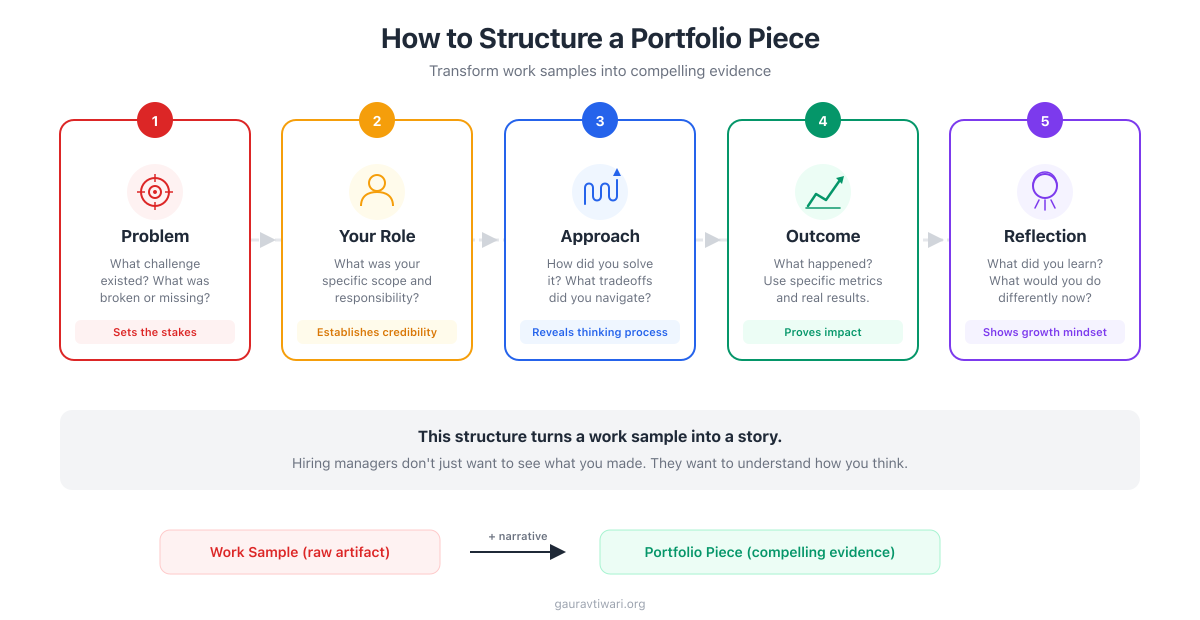
A screenshot or link isn’t a portfolio entry. Context makes work meaningful.
For each piece, include:
- The problem. What challenge were you solving?
- Your role. What specifically did you contribute?
- The approach. Why did you make the decisions you made?
- The outcome. What happened? What did you learn?
- Reflection. What would you do differently?
This narrative transforms work samples into evidence of your thinking. I look for this narrative specifically when reviewing portfolios. Without it, I’m just looking at pretty pictures.
Portfolio Types by Field
The best portfolio format depends on what your field produces. Choose samples a reviewer can evaluate quickly, then add enough context to make your role and decision-making clear.
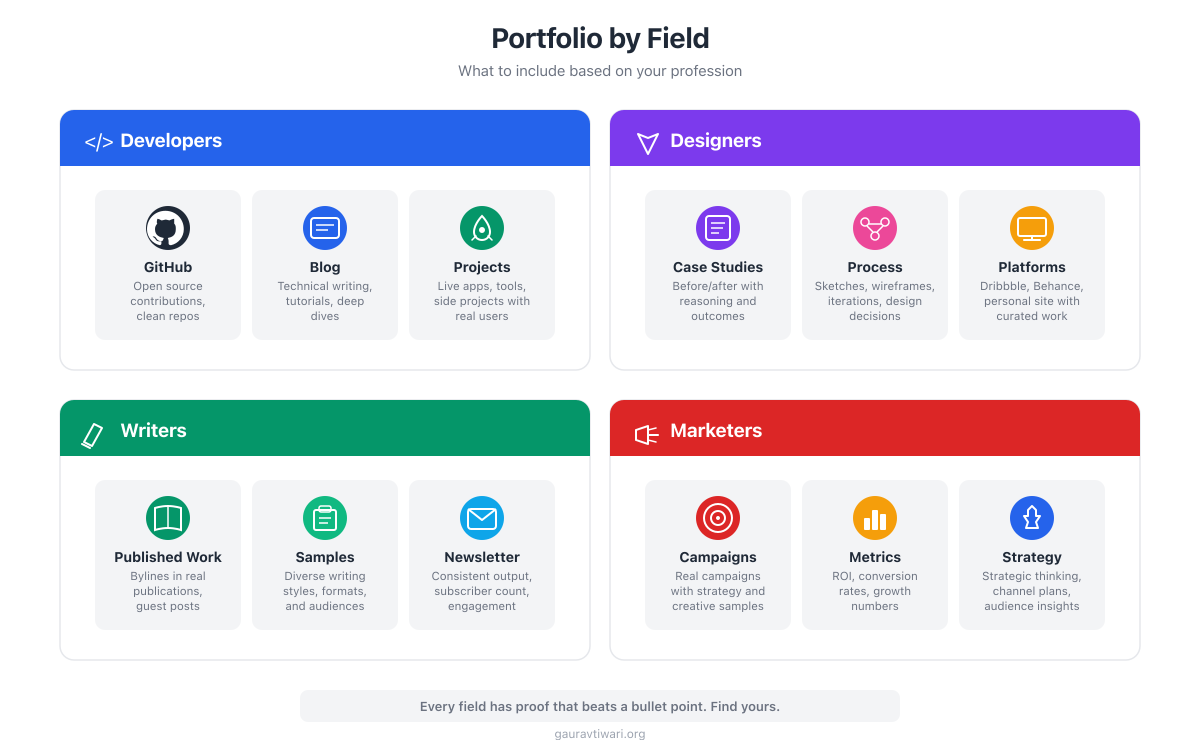
Developers and Engineers
What to include:
- GitHub profile with real projects (not just forked tutorials)
- Personal projects that solve real problems
- Contributions to open source (even documentation counts)
- Technical blog posts explaining concepts
- Code samples demonstrating clean, documented code
Where to host:
- GitHub Pages
- Personal website
- Dev.to, Medium, Hashnode for writing
GitHub’s official resume guide explains how profile content can help hiring managers understand your technical skills. A clear profile README and pinned projects give reviewers a better starting point than an unfiltered activity feed.
Designers
What to include:
- Case studies walking through the design process
- Final deliverables with context
- Before/after comparisons
- Different project types (branding, UX, illustration, etc.)
- Personal or speculative projects if client work is limited
Where to host:
- Behance
- Dribbble
- Personal website (most important for serious designers)
- Figma profile for UI work
Writers and Content Creators
What to include:
- Published articles with context on performance if available
- Writing samples across different styles (blog posts, long-form, copywriting)
- Content strategy documents or frameworks
- Guest posts and bylined articles
- Newsletter or blog if you have one
Where to host:
- Personal website/blog
- Medium (links to external publications)
- Contently or Clippings.me for journalists
- LinkedIn articles for professional content
Marketers
What to include:
- Campaign case studies with metrics
- Content samples you’ve created
- Strategic documents (marketing plans, competitor analyses), anonymized if needed
- Email sequences, ad copy, landing pages
- Any specialization samples (SEO audits, paid campaign results, social media work)
Where to host:
- Personal website with case study pages
- LinkedIn featured section
- Slideshare for presentations
Data and Analytics Professionals
What to include:
- Analysis projects with methodology and findings
- Visualizations and dashboards
- Kaggle competitions or public datasets you’ve worked with
- Technical blog posts explaining analytical approaches
- Tools you’ve built for data processing
Where to host:
- GitHub for code
- Tableau Public for visualizations
- Personal website for case studies
- Observable notebooks for interactive work
Product Managers
What to include:
- Product case studies (features shipped, decisions made)
- PRDs or specification documents (sanitized)
- Writing demonstrating product thinking
- Side projects showing end-to-end product development
- Blog posts about product decisions and frameworks
Where to host:
- Personal website/blog
- LinkedIn featured section
- Substack if you write regularly
Generalists and Career Changers
If you’re changing fields or don’t have traditional portfolio pieces:
Create demonstration projects. Redesign a local business website. Write a marketing plan for a product you like. Analyze publicly available data.
Document learning. Blog about what you’re learning. Show your progression.
Translate adjacent skills. Managed a team project in college? That’s relevant for PM roles. Redesigned your church’s newsletter? That’s design experience.
The key is demonstrating ability, not formal credentials.
Building Your Portfolio Website
For most fields, a personal website is the best portfolio platform.
Keep It Simple
A complex, over-designed portfolio site can distract from the work itself. Clean, simple, easy to navigate. I’ve seen gorgeous portfolio websites where I couldn’t actually find the portfolio.
Essential pages:
- Home. Brief intro and highlighting best work
- Work/Portfolio. Grid or list of projects
- About. Your background and what you’re looking for
- Contact. How to reach you
Make Projects Easy to Find
Don’t make people dig. Feature your best 3-5 pieces prominently. Use clear navigation. Make the path from “lands on site” to “sees impressive work” as short as possible.
Mobile Matters
Many people will view your portfolio on phones. If it doesn’t work well on mobile, you’ve lost them. Test on real devices, not just browser resize.
Fast Loading
Heavy images and fancy animations slow sites down. Speed matters. Compress images, minimize scripts, and test on slower connections.
Domain and Hosting
Your own domain (yourname.com) looks more professional than a subdomain. Basic hosting is cheap. For a simple portfolio, even free options like GitHub Pages, Netlify, or Carrd work well.
Platforms like WordPress, Squarespace, or Webflow make building a professional-looking portfolio site accessible without coding skills.
Portfolio Platforms vs. Custom Sites
Use a field-specific platform when its audience and discovery features help you, but keep a personal website as the durable home for your work. Platforms are useful distribution; a site you control is the better long-term record.
Portfolio Platforms (Behance, Dribbble, etc.)
Advantages:
- Built-in audience and discovery
- Easy to set up
- Industry-standard for some fields (design)
- Social features and networking
Disadvantages:
- Less customization
- You don’t own the platform
- Your work competes for attention with others
- May not suit your specific field
Custom Website
Advantages:
- Full control over presentation
- You own it completely
- Can tailor exactly to your needs
- Unique and memorable
Disadvantages:
- More setup work
- No built-in audience
- Requires maintenance
My Recommendation
Use platform portfolios for discovery and networking. Have a personal website as your home base. Link between them. Don’t rely solely on any platform you don’t control. I’ve seen too many people lose their presence when a platform changed or shut down.
Common Portfolio Mistakes
Most weak portfolios fail because they are uncurated, unexplained, outdated, or difficult to act on. Fix the reading experience before adding more projects.
Five excellent pieces with strong case studies beat twenty mediocre screenshots. Every portfolio entry should be something you’re genuinely proud of and confident discussing in detail. If something is outdated or doesn’t represent your current ability, leave it out.
Too Much, Not Curated
Showing everything dilutes your best work. Edit ruthlessly. Would you be excited to discuss this piece in an interview? If not, cut it.
No Context
Work without explanation is just decoration. Every piece needs the story: problem, role, approach, outcome. I cannot stress this enough.
Outdated Work
That website you built in 2015 doesn’t represent your current skills. Keep your portfolio current. Archive old work if you want to preserve it, but feature recent, representative pieces.
All Work, No Personality
Your portfolio should give a sense of who you are. An about page, some personality in the writing, unique design choices. People hire people, not just skills.
Copying Others’ Work
Never, ever claim work that isn’t yours. This will destroy your reputation instantly when discovered. And it will be discovered. Inspiration is fine; copying is career-ending.
Ignoring the Audience
A portfolio for freelance clients looks different from a portfolio for full-time job applications. Tailor what you show to who you’re trying to reach.
Hard to Contact
Every portfolio should have a clear, easy way to get in touch. Email address, contact form, or LinkedIn link. Don’t make interested parties hunt for how to reach you. I’ve wanted to hire people whose portfolios impressed me… and couldn’t find a way to contact them. That’s a missed opportunity you can’t afford.
Portfolio for Freelancers and Consultants
For freelancers and consultants, a portfolio often does more persuasive work than a resume because the buyer needs evidence of a similar problem solved well. Show relevant work, explain the process, and make the next step obvious.
Client Work with Permission
Whenever possible, get permission to share client work. Some clients are delighted to be featured; ask at project completion. I make this part of my project wrap-up process now.
Case Studies Drive Trust
Detailed case studies build trust because they connect a result to the work behind it. State the starting problem, show the decisions you made, and include the evidence you can verify. The process helps a potential client judge whether your approach fits their situation.
Speculative Work Has Its Place
If you lack client work, create speculative projects. Redesign a famous brand. Write a marketing plan for a startup you admire. Make it clear it’s speculative, but use it to demonstrate capability.
Testimonials and Results
Client testimonials add credibility. Include them near relevant projects. Quantified results (revenue, traffic, efficiency gains) beat vague praise every time.
Make It Easy to Hire You
Clear services, clear process, clear next step. The portfolio should naturally lead to “I want to hire this person” and then immediately show them how. For best practices, see must-have tools for freelancers.
Building a Portfolio Over Time
A portfolio should improve as your work improves. Publish the first useful version, document projects while they are fresh, and replace weaker samples instead of letting the collection grow without a filter.
Start Now, Improve Later
A simple portfolio with three pieces is better than no portfolio while you wait for perfection. Launch what you have. Improve continuously.
Document as You Work
It’s easier to document projects as they happen than to reconstruct them later. Keep screenshots, save process files, write notes about decisions while they’re fresh. I wish I’d started doing this earlier. Reconstructing projects from two years ago is painful.
Regular Updates
Set a reminder quarterly to review your portfolio. Remove outdated pieces. Add new work. Update your about section if circumstances change.
Build in Public
Share work in progress. Write about what you’re learning. Comment on industry developments. The portfolio becomes a living document of your professional growth.
Side Projects Are Portfolio Pieces
That app you built for fun, that blog you write occasionally, that design concept you explored… these are portfolio material. Not every portfolio piece needs to be client work. Some of my most interesting portfolio pieces are personal projects that never earned a dollar.
The Compound Returns of a Portfolio
A portfolio becomes more valuable as published work earns referrals, interviews, client inquiries, and links from other people. Unlike a resume, each public case study can keep working after you finish the project.
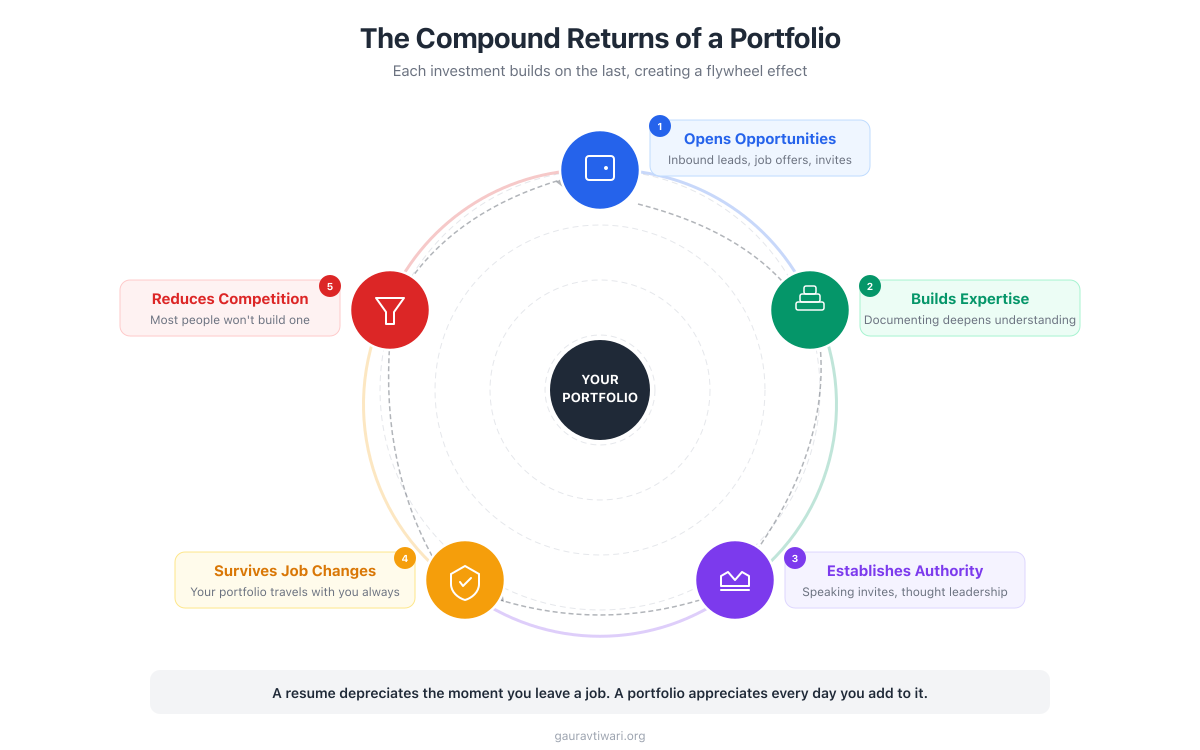
It opens opportunities. People find you through portfolio work and reach out with opportunities you never applied for.
It builds expertise. Writing case studies forces you to reflect and consolidate learning.
It establishes authority. Public work establishes you as someone worth paying attention to in your field.
It survives job changes. Unlike a resume tied to specific employers, your portfolio is yours. It travels with you across roles and industries.
It reduces competition. Most people don’t build portfolios. By having one, you’re in a smaller, better pool.
I’ve gotten clients, speaking invitations, and job offers directly because of portfolio work. Sometimes years after the work was published. The investment keeps paying off long after you’ve stopped thinking about it.
Portfolio work has brought me clients, speaking invitations, and job offers, sometimes years after it was published. It keeps paying long after you stop thinking about it. And when I’m the one hiring, I care far more about how someone thinks than which tools they know. Tools change. Thinking endures.
Your resume is the summary. Your portfolio is the proof. Use both, and make the proof easy to find.
If your work is ready but the site is slowing you down, my web development service can turn the material into a fast, focused portfolio.
Portfolio vs Resume FAQ
These short answers cover the decisions people usually face when choosing between a career portfolio and a resume.
What is the difference between a portfolio and a resume?
A resume is a concise record of your experience, education, skills, and results. A portfolio is a curated set of work samples with enough context to show how you think and what you can deliver. The resume helps reviewers scan your background; the portfolio lets them examine the proof.
Is a portfolio the same as a resume?
No. They solve different parts of the hiring decision. A resume gives a structured career summary that recruiters and application systems can scan quickly. A portfolio shows selected projects in depth. Use the resume for the timeline and requirements, then use the portfolio to support its strongest claims.
Can a portfolio replace a resume?
Usually not in a formal application. Many employers still ask for a resume, and their screening process may depend on it. A strong portfolio can carry more weight in creative, technical, and client-facing work, but if the instructions request a resume, send one and include your portfolio link.
Where should I put my portfolio link on my resume?
Place a short, readable URL beside your email and other contact details near the top. You can also link a relevant case study from a resume bullet when it directly supports the result you describe. Test every link before applying, and do not make a QR code the only way to reach it.
What if I have no professional work to show?
Use school assignments, volunteer work, personal projects, open-source contributions, or clearly labeled demonstration projects. Explain the problem, your decisions, and what you produced. Do not present speculative work as client work. The goal is to show capability honestly, not to manufacture a job history.
How many pieces should a portfolio have?
Start with three to five strong, relevant pieces. That is enough to show a pattern without asking the reviewer to sort through everything you have made. Add more only when each piece proves a different skill or serves a distinct audience. Remove work that no longer represents your current standard.
Can I show work from my employer or a client?
Only with permission and within the terms of your employment or client agreement. When public sharing is restricted, describe the problem without naming the company, remove identifying details, or create a separate demonstration project. Never publish confidential data, private dashboards, proprietary code, or unreleased work.
Should developers use GitHub as their portfolio?
GitHub is useful evidence, but a repository list is not a complete portfolio. Pin the most relevant projects, write clear README files, link to working demos when possible, and add a short case study that explains the problem and your decisions. Give a busy reviewer a guided path through the code.
What makes a good portfolio case study?
A useful case study explains the problem, your role, the constraints, the choices you made, the finished work, and the result or evidence available. Be precise about team contributions. Include a short reflection on what you would change. Screenshots help, but the decision-making is what makes them meaningful.
How often should I update my portfolio?
Review it every quarter and after any project that materially improves the evidence you can show. Remove broken links and outdated work, update your role and contact details, and replace weaker pieces with stronger ones. Document projects while they are fresh so you are not reconstructing the story months later.
Tell Google you want more of this.
Add Gaurav Tiwari as a preferred sourceOne tap, and this site shows up more often in your own Top Stories, AI Overviews and AI Mode. Remove it any time.