
 by
by
Travel agency lead generation has a strange problem in 2026: the click is not always the expensive part. The expensive part is the leak after the click, when a traveler lands on a slow page, sees a bloated form, waits for a reply, and quietly books somewhere else.
So I would not start by asking, “Which channel should we spend on?” I would ask a sharper question: can your agency capture demand, qualify it, respond in minutes, and follow up for the next 45 days without dropping the thread?
The agencies that win this category rarely have the biggest budgets. They have the fewest leaks between a traveler’s first click and a real conversation. So this is less about chasing one more channel and more about building a system that captures intent, replies in minutes, and stays present through a long decision window. The benchmarks below are the current ones I trust, and I link each source where it shows up.
What Travel Agency Lead Generation Has to Do in 2026

Travel agency lead generation has one job: turn scattered travel intent into qualified conversations. A traveler may start with a TikTok idea, compare resorts on an OTA, search Google for visa rules, read your destination page, and only then submit an inquiry.
Lead generation for travel agencies works only when the content, channel, and follow-up match that moment of intent. A dreamer needs useful planning content. A buyer needs a fast route to a specialist.
That is also why lead generation for travel agencies should be measured by qualified conversations and bookings, not by raw form submissions.
That means your funnel has to do more than collect emails. It has to match intent, answer objections, route the lead to the right person, and keep the agency present while the traveler is still deciding.
The mistake I see most often is treating all travel agency leads the same. A honeymoon lead searching “Maldives overwater villa package” is not the same as someone downloading a packing checklist. One needs a call. The other needs a nurture sequence.
- High-intent leads need a destination landing page, price context, click-to-call, and a fast callback.
- Research-stage leads need itinerary content, comparison pages, trip cost calculators, and email follow-up.
- Local leads need Google Business Profile visibility, reviews, location pages, and proof that a human will help them.
- Referral leads need a clean handoff from planners, HR teams, creators, hotels, schools, or local partners.
If your agency handles those four lead types with one generic contact form, you are not doing lead generation. You are collecting vague messages and hoping the good ones announce themselves.
The New Travel Lead Benchmarks
The latest benchmarks make one point clear: paid search is still workable for travel, but weak follow-up economics can destroy the profit. In WordStream/LocaliQ’s 2026 Google and Microsoft Ads data, the Travel category shows a 9.32% CTR, $2.14 CPC, 5.83% conversion rate, and $44.70 cost per lead.
That is not a terrible paid-search environment. Travel’s CPL was down 39.35% year over year in that dataset. But the Adobe/Publicis Sapient/Incisiv report tells the other side: from 2022 to 2025, travel and hospitality acquisition costs rose about 35%, while customer lifetime value grew only 4.5%.
This is why I do not judge a travel agency marketing plan by cost per click alone. Cheap clicks can still be expensive if your site, CRM, and follow-up process fail after the visitor arrives.
| Benchmark | Latest Figure | What I Would Do With It |
|---|---|---|
| Search ads CTR | 9.32% for Travel in WordStream/LocaliQ 2026 | Use Google Ads for high-intent destination and local queries, not broad inspiration terms. |
| Search ads CPL | $44.70 for Travel in WordStream/LocaliQ 2026 | Track cost per qualified consultation and cost per booking, not form fills alone. |
| Travel landing page conversion | 4.8% median for travel and hospitality landing pages in Unbounce | If your inquiry page is below 2%, fix the page before increasing spend. |
| Travel bounce rate | 50.65% average, with mobile at 51.5% in Promodo’s benchmark | Audit speed, mobile layout, first-screen CTA, and form friction. |
| Travel abandonment | 82% cart abandonment for travel in VWO’s 2025 roundup | Run remarketing, abandoned inquiry follow-up, and 30 to 90 day nurture. |
| Email benchmarks | 19.96% open rate and 2.15% CTR for Travel, Transportation and Tourism in Brevo 2026 | Use behavior-triggered emails, not one generic monthly newsletter. |
Fix the Website Before Buying More Travel Agency Leads
Your website is the conversion hub. Every ad, referral, email, Google Business Profile click, and destination article eventually sends people there. If the site does not convert, more traffic just exposes the leak faster.
The travel website conversion rate is the first number I would check before changing ad budgets. If the page is slow, the offer is vague, or the form feels like homework, the channel will get blamed for a website problem.
Promodo’s 2026 travel benchmark reports a 50.65% average bounce rate for travel, with desktop search traffic at 42.0% and mobile at 51.5%. That gap matters because travelers research heavily on mobile, even when they still finish complex bookings on desktop.
Speed is the first filter. Google’s speed research still holds up in practice: when page load time moves from 1 second to 3 seconds, bounce probability rises by 32%. Travel pages are image-heavy by nature, so lazy loading, compressed WebP or AVIF images, a CDN, and fewer third-party widgets are not optional polish. They are lead recovery work.
The second filter is form friction. If the first-touch form asks for destination, dates, number of travelers, budget, phone, WhatsApp, passport status, dietary needs, preferred airline, and a paragraph of notes, people leave. Ask for name, email, destination or trip type, and timeline. Get the rest after trust exists.
If your agency site runs on WordPress, the simple stack is enough: Fluent Forms, WPForms, or Gravity Forms for capture, a CRM for routing, and a clear thank-you page that offers a callback. I have a deeper guide on WordPress lead generation if you want the site-side setup.
One more uncomfortable check: open your site on a mid-range phone, not your laptop. If the inquiry button is hidden below a carousel, the date picker is annoying, or the chat widget covers the submit button, your mobile lead generation is already broken.
Build a Travel Agency Lead Generation Funnel Around Intent
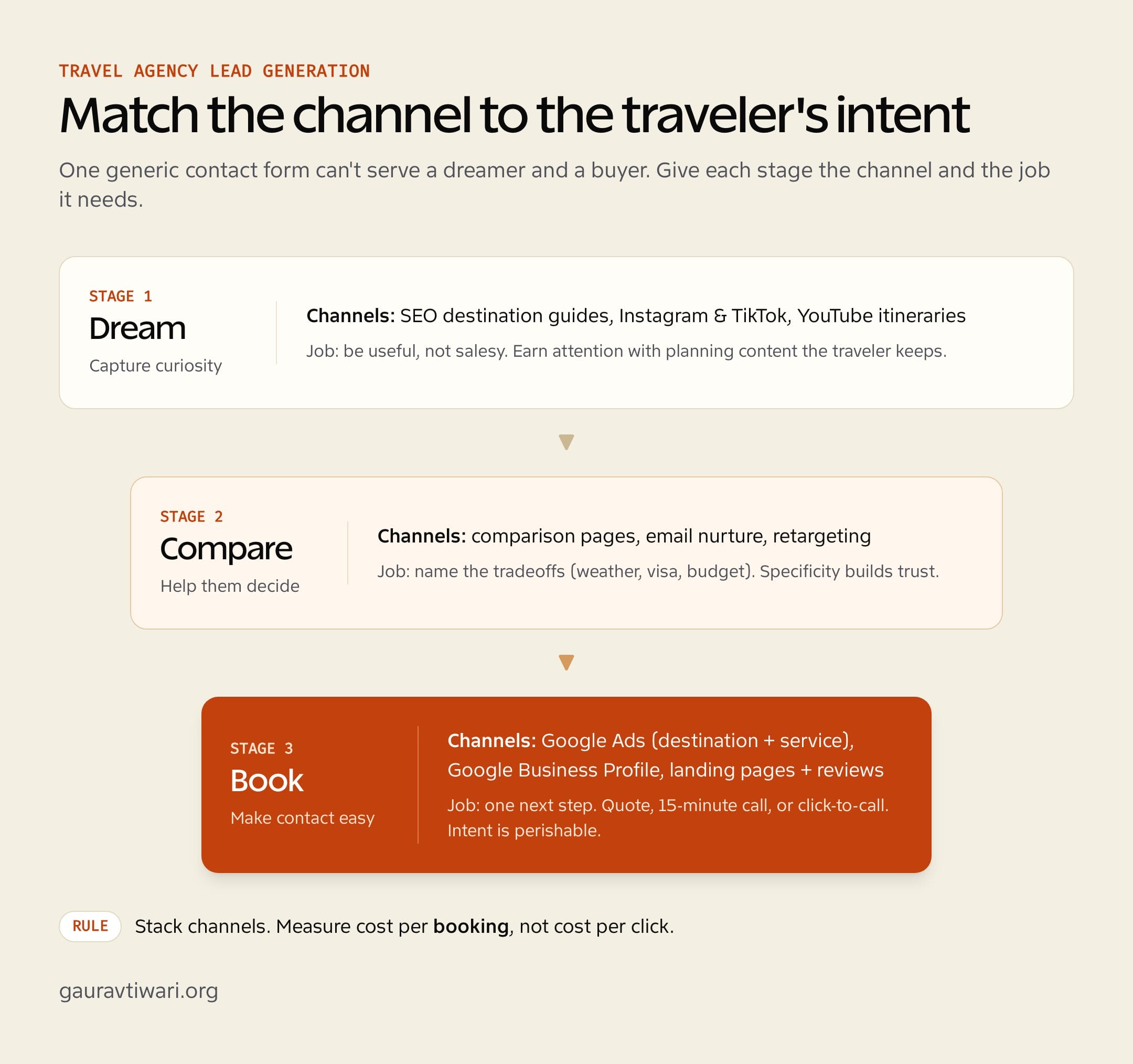
A good travel agency funnel separates dreamers, planners, and buyers. Expedia Group found that travelers view 141 pages of travel content in the 45 days before booking, and 80% visit an online travel agency at some point before purchase.
That does not mean a small agency should copy Expedia. It means you need content and follow-up for the long decision window. The traveler might not be ready today, but your brand can still be the one they remember when the decision gets serious.
Top of Funnel: Capture Destination Curiosity
Top-of-funnel travelers are searching for ideas: best time to visit Japan, Bali honeymoon itinerary, family-friendly Europe trip, or how much a trip to Italy costs. They are not ready for a sales call yet.
Use destination guides, itinerary templates, packing checklists, visa explainers, and cost breakdowns here. This is where content marketing strategy earns attention without forcing a sales pitch too early.
Middle of Funnel: Help Them Compare
Middle-of-funnel travelers compare options. Think Bali vs. Thailand, Japan in April vs. October, group trip vs. private tour, or travel agent vs. booking direct. This is where your expertise should show.
Write comparison pages that name tradeoffs clearly: weather, visa rules, flight time, realistic budget, local transport, safety, and who should skip the destination. The more specific you are, the more trust you build.
Bottom of Funnel: Make Contact Easy
Bottom-of-funnel travelers search with purchase intent: luxury Maldives travel agent, destination wedding planner Italy, corporate retreat travel agency, or Japan family tour quote. This is where Google Ads for travel agencies, local SEO, reviews, and landing pages need to work together.
Give these visitors one next step: request a custom quote, book a 15-minute planning call, or call now. Do not send them to a blog archive or a homepage carousel. Intent is perishable.
Channel Strategy for Travel Agency Marketing
Travel agency marketing works best when each channel has a job. Search captures intent, SEO compounds, email nurtures, social creates desire, local SEO builds trust, and partnerships reduce dependence on paid traffic.
Google Ads for Travel Agencies
Google Ads should focus on commercial and local intent. Start with destination plus service keywords, not broad travel inspiration. A phrase like “Maldives honeymoon travel agent” will usually beat “Maldives vacation ideas” because the buyer is closer to a conversation.
I would split the first budget like this: 50% high-intent destination campaigns, 20% local searches, 15% brand and competitor protection, and 15% remarketing or testing. Keep broad-match experiments small until your negative keyword list is mature.
Do not judge campaigns by CPL only. Track the full path: click, lead, qualified consultation, proposal, booking, commission, and repeat or referral value. Marketing analytics tools matter because a pretty Google Ads dashboard can hide terrible lead quality.
Travel Agency SEO
Travel agency SEO should not be a pile of generic blog posts. Build destination pages, trip-type pages, and comparison content that answer buying questions. Then support them with educational content for early-stage travelers.
A practical structure looks like this: destination page for the commercial keyword, supporting articles for planning questions, an FAQ block for answer engines, and internal links from research content into the booking page.
- Destination pages: luxury Maldives honeymoon packages, Japan family tours, Costa Rica eco travel.
- Trip-type pages: destination weddings, corporate retreats, senior group travel, study tours.
- Comparison pages: Bali vs. Thailand, Switzerland vs. Austria, booking direct vs. using a travel agent.
- Planning content: best months, visa rules, local costs, packing lists, safety, mistakes to avoid.
Google Business Profile and Local SEO
If your agency serves a city or region, Google Business Profile is not optional. Google’s own local ranking guidance says local results are mainly based on relevance, distance, and prominence. For a travel agency, prominence is where reviews, photos, services, and local citations start helping.
SOCi’s Google Reviews research found that responding to 100% of reviews, compared with none, increased Google profile conversion rates by 16.4%. That is not a reason to write fake review replies. It is a reason to treat review management as sales infrastructure.
The local SEO checklist is boring, but it works: complete services, add real destination and office photos, answer Q&A, post offers weekly, respond to reviews, and build local citations. I have a related guide on local SEO for brick-and-mortar businesses that maps the basics.
Meta, Instagram, and Short-Form Video
Social ads work better for desire than direct booking. Use Instagram and Facebook to show destinations, client stories, itinerary angles, and seasonal offers. Then retarget people who viewed destination pages or watched most of a video.
The mistake is asking cold social traffic to book a complex trip immediately. Move them to a lead magnet, a quiz, or an email sequence first. Travel is emotional, but the booking decision is still expensive.
Email and WhatsApp Nurture
Brevo’s 2026 benchmark puts Travel, Transportation and Tourism at a 19.96% standard open rate and 2.15% CTR. Automation and transactional emails perform much better across the dataset, with 30.63% open rate and 7.39% CTR.
That matches what I see in practice. A destination-specific follow-up sent because someone asked for a Japan itinerary beats a generic newsletter every time.
- Instant: send the promised guide or quote confirmation, plus a clear callback expectation.
- Day 2: send one useful planning detail based on the destination or trip type.
- Day 5: share a client story or itinerary sample.
- Day 10: answer the money objection with budget ranges and what affects price.
- Day 21: offer a planning call or seasonal availability update.
For tools, I would keep it practical: HubSpot CRM for routing and pipeline, ActiveCampaign for deeper automation, or Mailchimp if the agency only needs a simpler email setup. My email marketing guide covers the basics if you are starting from scratch.
Travel Lead Magnets That Are Worth the Follow-Up
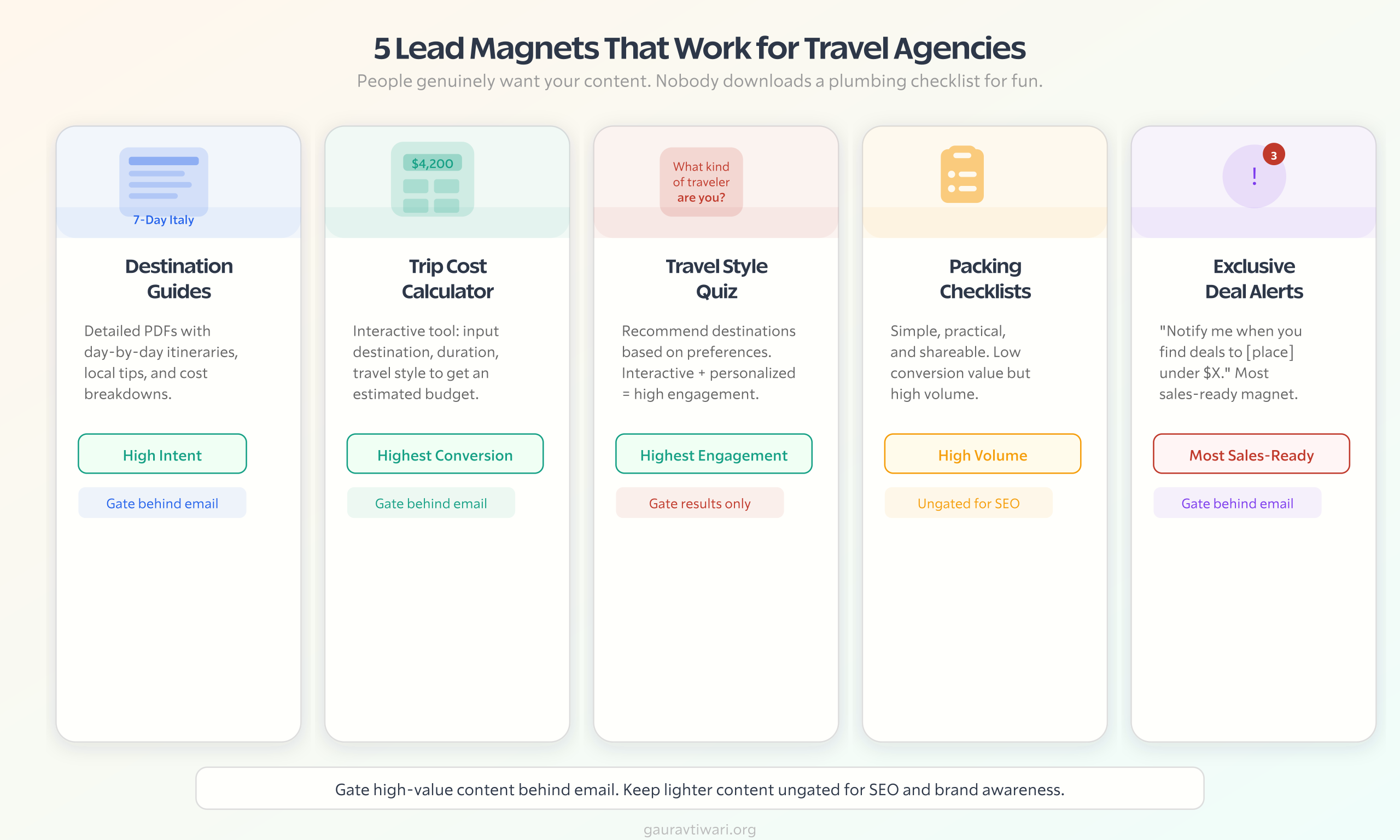
The best travel lead magnets solve a planning problem the traveler already feels. A weak PDF says, “Top 10 places to visit.” A strong one helps someone decide when to go, what it costs, what to avoid, and whether your agency is the right guide.
I would build fewer lead magnets and make them more useful. One good calculator or itinerary can outperform ten generic checklists because it captures intent, not just curiosity.
| Lead Magnet | Best For | Follow-Up Angle |
|---|---|---|
| Trip cost calculator | Budget-aware travelers | Send budget ranges, tradeoffs, and a planning call CTA. |
| Destination itinerary | Research-stage travelers | Send seasonal tips, sample hotels, and a quote invitation. |
| Travel style quiz | Undecided travelers | Segment by luxury, family, adventure, honeymoon, or group travel. |
| Visa and document checklist | High-anxiety international trips | Offer a consultation for complex routes or family groups. |
| Exclusive deal alerts | Sales-ready leads | Send time-sensitive offers with honest availability limits. |
If you want a deeper framework, I have a separate article on lead magnets that convert. The travel version is simple: make the lead magnet useful enough that the reader would have paid a small amount for it.
Travel Agency CRM and Speed to Lead
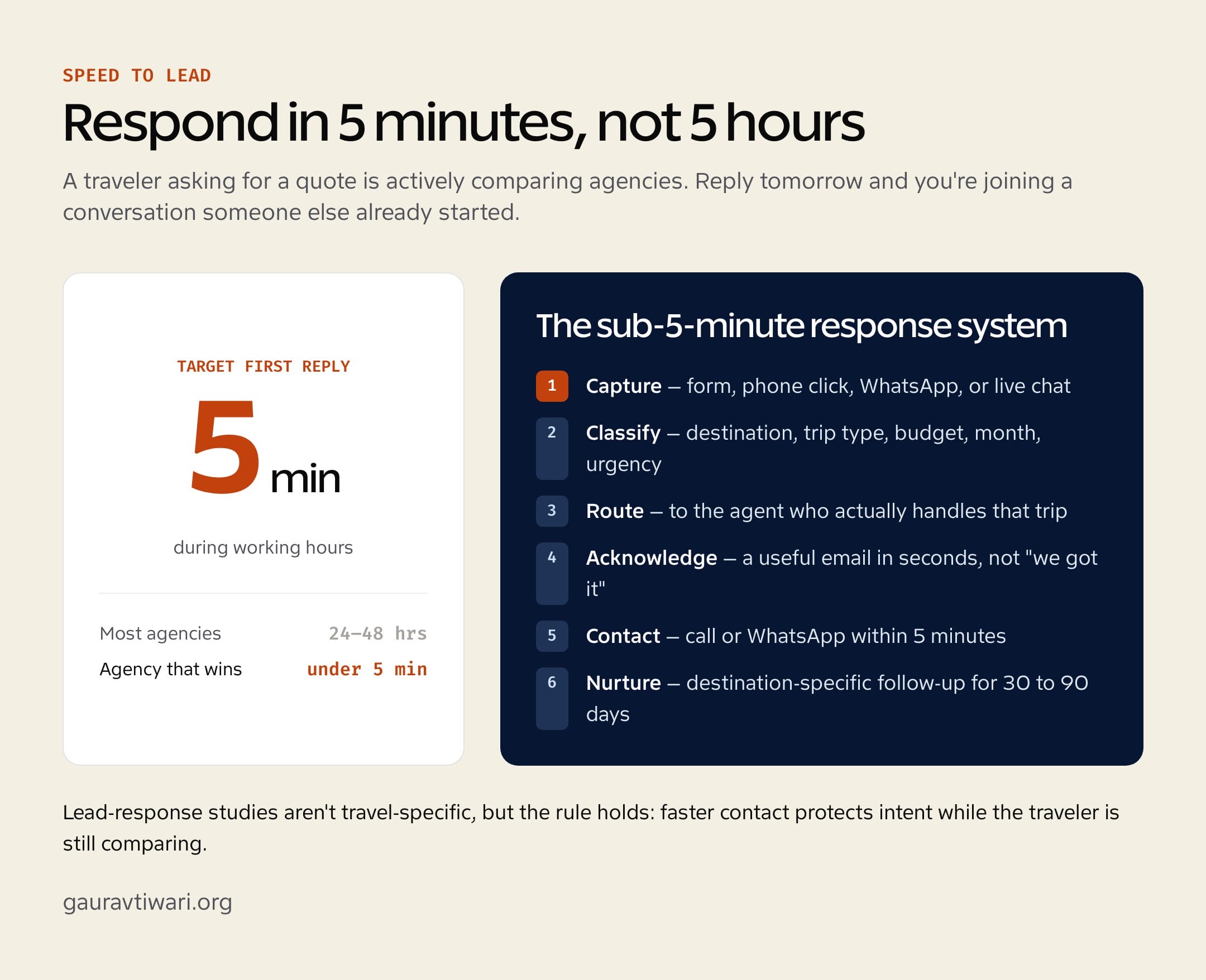
Speed to lead is the part of travel agency lead generation most teams underestimate. A traveler who asks for a quote is actively comparing options. If your response comes tomorrow, you are often joining a conversation another agency already started.
A travel agency CRM should make the next action obvious: who owns the lead, what destination they asked about, how warm they are, and when the first human reply happened. Without that, speed to lead becomes a slogan instead of an operating habit.
The widely cited lead-response research is not travel-specific, so I would not pretend it is. But the principle is hard to ignore: faster contact dramatically improves qualification odds, and many lead-response studies point to a 5-minute window as the standard to beat.
Your sub-5-minute system does not need to be fancy. It needs ownership. Every inquiry should create a CRM record, trigger an instant useful email, notify the right person, and offer a booking link or callback path.
- Capture: form submission, phone click, WhatsApp message, or live chat.
- Classify: destination, trip type, budget range, travel month, and urgency.
- Route: send the lead to the agent who actually handles that destination or travel style.
- Acknowledge: send a useful email within seconds, not a dead “we received your message” note.
- Contact: call, WhatsApp, or email within 5 minutes during business hours.
- Nurture: keep destination-specific follow-up running for 30 to 90 days.
If your site is getting leads but they are not turning into consultations, read why your website is not generating leads. The problem is usually visible in the handoff, not hidden in some advanced tactic.
Retargeting and Partnerships Lower Your Real Cost Per Booking
Retargeting and partnerships matter because not every good travel lead converts on the first visit. VWO’s cart abandonment roundup lists travel abandonment at 82%, with price transparency, complex forms, and checkout friction among the reasons people drop off.
For travel agencies, retargeting should be specific. Someone who viewed a Switzerland honeymoon page should not see a generic agency ad. Show a Switzerland itinerary angle, a planning checklist, a testimonial, or a “talk to a specialist” offer.
- Meta retargeting: destination-page visitors, itinerary downloaders, and video viewers.
- Google remarketing: people who viewed 3+ pages, pricing content, or quote forms.
- Email retargeting: abandoned form starters and guide downloaders.
- WhatsApp follow-up: high-intent leads who requested human contact.
Partnerships are the cleaner long-term play. Wedding planners, corporate HR teams, luxury retailers, schools, study-abroad consultants, visa consultants, and local creators can send warmer leads than cold ads.
Pay referral rewards in a way that makes sense. For a past client, a travel credit toward the next trip can feel better than a small cash bonus and can bring the customer back into your own pipeline.
Measure Bookings, Not Just Travel Agency Leads
A travel agency lead generation dashboard should connect marketing activity to bookings and commission. If it stops at traffic, followers, or form fills, it will push you toward the channels that look busy instead of the channels that make money.
At minimum, track lead source, landing page, destination, trip type, response time, consultation booked, proposal sent, booking value, gross commission, and repeat or referral value. This is not overkill. It is how you stop treating every lead as equal.
Treat the travel website conversion rate as a diagnostic metric, not a trophy. A higher rate matters only when the leads still match your profitable destinations and trip types.
| Metric | Healthy Target | Why It Matters |
|---|---|---|
| Cost per qualified lead | Lower than your average gross commission can support | Filters out cheap but useless inquiries. |
| Lead-to-consultation rate | 20% to 40% for high-intent channels | Shows whether forms and follow-up are working. |
| Consultation-to-booking rate | 15%+ for custom or luxury trips | Shows sales quality, not just marketing quality. |
| First response time | Under 5 minutes during working hours | Protects intent while the traveler is still comparing. |
| Landing page conversion | Above 4.8% as a practical benchmark | Keeps your pages competitive with travel landing page medians. |
| Repeat and referral rate | Track by destination and agent | Shows whether lead quality creates future value. |
Use GA4, Search Console, call tracking, CRM stages, and offline conversion imports where possible. For smaller agencies, even a clean spreadsheet is better than guessing.
What I Would Do First
If I were fixing travel agency lead generation from scratch, I would not start with a massive campaign calendar. I would fix the highest-friction handoffs first.
- Audit the mobile inquiry path. One phone, one destination page, one form, one thank-you page.
- Fix page speed and form friction. Compress images, cut scripts, shorten first-touch forms.
- Create one high-intent landing page. Pick the destination or trip type that already brings profitable inquiries.
- Set up CRM routing. No lead should sit in a shared inbox.
- Build a 30-day nurture sequence. Destination-specific, not generic.
- Launch focused search ads. Only after the page and follow-up are ready.
- Add one partnership channel. Wedding planners, HR teams, schools, creators, or local businesses.
- Measure bookings. Kill channels that produce activity but no revenue.
The agencies that win are not always the ones with the biggest ad budgets. They are the ones with the fewest leaks between interest and conversation.
The travel agencies I trust do two boring things well: they answer fast, and they measure bookings rather than vanity clicks. Pretty campaigns help. Clean handoffs make the money.
Start there. Fix the site. Tighten the response system. Build one useful lead magnet. Then buy more traffic. That order saves money, and it gives every channel a fair chance to work.
Frequently Asked Questions
What is travel agency lead generation?
Travel agency lead generation is the process of attracting, qualifying, and following up with people who are planning trips and may need professional help. It includes SEO, Google Ads, local search, referral partnerships, lead magnets, CRM routing, email nurture, and fast human response.
What is the best channel for travel agency lead generation?
The best channel depends on intent. Google Ads and local SEO work best for high-intent travel agency leads, SEO and destination content work for research-stage travelers, email works for nurture, and partnerships work for warm referrals. I would not rely on one channel.
How much does a travel lead cost in 2026?
WordStream/LocaliQ’s 2026 benchmark puts Travel at $44.70 cost per lead in Google and Microsoft Ads. Your real cost per booking may be much higher or lower depending on lead quality, response speed, consultation rate, commission, and repeat bookings.
How can a travel agency get more leads without increasing ad spend?
Fix the website conversion path, shorten forms, improve mobile speed, add destination-specific lead magnets, respond faster, ask clients for reviews, build referral partnerships, and nurture existing inquiries for 30 to 90 days. These usually reduce wasted demand before you buy more traffic.
Does SEO work for travel agencies?
Yes, travel agency SEO works when it targets commercial destination pages, trip-type pages, comparison content, and planning questions. Generic travel blogs are weaker. Build pages around destinations, budgets, seasons, visa questions, and traveler intent.
What lead magnets work best for travel agencies?
Trip cost calculators, destination itineraries, travel style quizzes, visa checklists, and exclusive deal alerts usually work better than generic PDFs. The best travel lead magnets help a traveler make a decision, not just collect an email address.
Which CRM is best for travel agency leads?
HubSpot CRM is a good general choice for routing, pipelines, and marketing handoffs. ActiveCampaign is strong for email automation. Travel-specific CRMs like helloGTX, Sembark, and Ezus make sense when itinerary building and quotations are part of the sales process.
How fast should a travel agency respond to new leads?
Aim for under 5 minutes during working hours. The exact benchmark varies by study and industry, but the practical rule is simple: travelers compare options quickly. An instant useful email plus fast human follow-up protects intent while the lead is still warm.
Tell Google you want more of this.
Add Gaurav Tiwari as a preferred sourceOne tap, and this site shows up more often in your own Top Stories, AI Overviews and AI Mode. Remove it any time.
Disclaimer: This site is reader-supported. If you buy through some links, I may earn a small commission at no extra cost to you. I only recommend tools I trust and would use myself. Your support helps keep gauravtiwari.org free and focused on real-world advice. Thanks. - Gaurav Tiwari