
 by
byMarketing for solopreneurs works when the plan respects one hard constraint: you are the marketing team and the person who has to deliver the work. More channels don’t fix that. They split the time, cash, attention, and creative energy you already have.
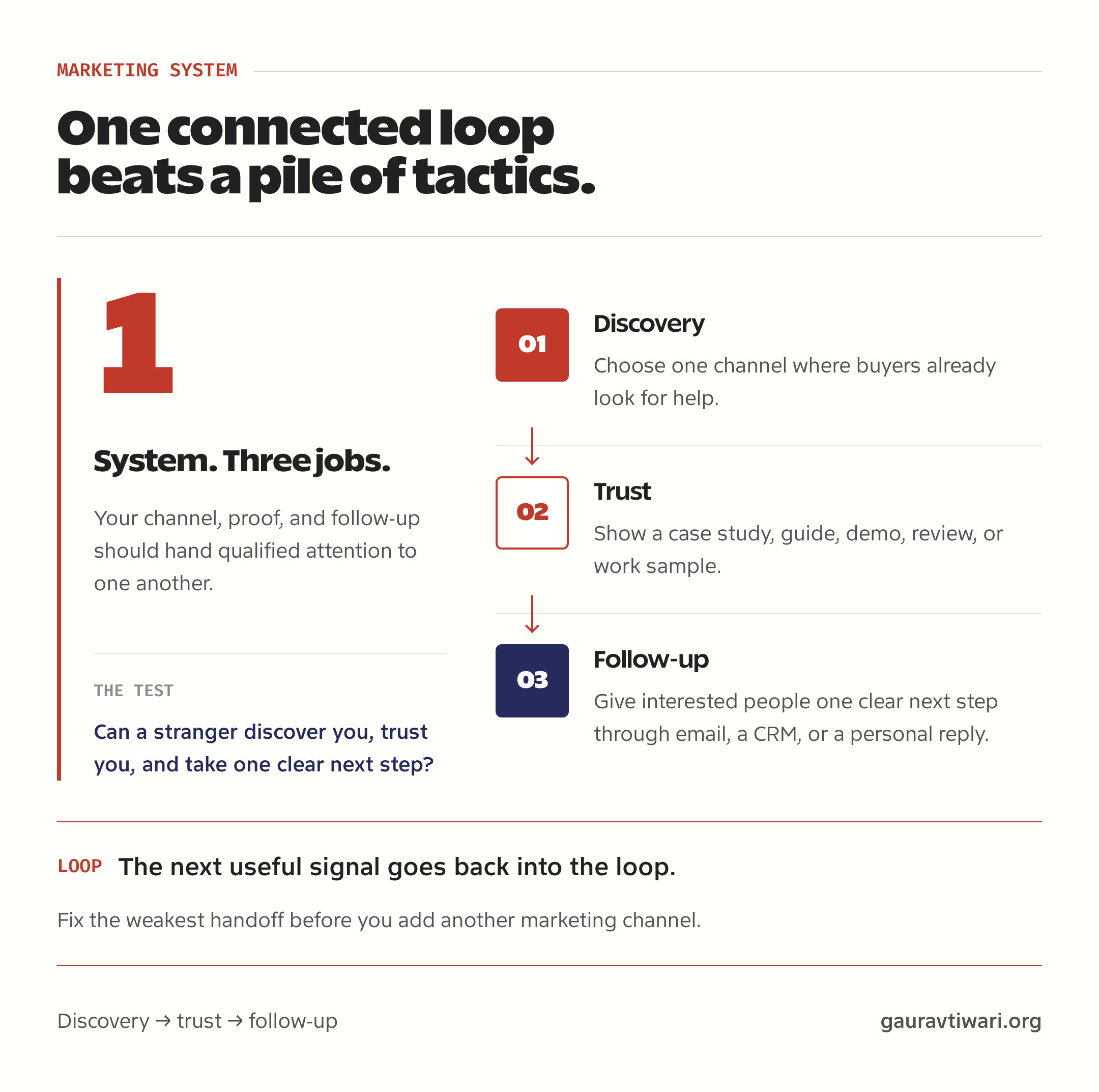
My rule is to build one reliable way to get discovered, one strong reason to trust you, and one way to follow up. Then protect 10 hours a week to run that loop. If a tactic can’t show which of those jobs it performs, cut it.
The plan in one sentence
- Discovery: Choose one primary channel where buyers already look for help.
- Trust: Build one proof asset, such as a case study, guide, demo, or portfolio.
- Follow-up: Give interested people one clear next step through email, a CRM, or a personal reply.
- Time: Treat 10 hours as a planning model, not a universal benchmark. If you have five, keep the priorities and reduce the hours.
What makes marketing for solopreneurs work?
A solopreneur needs one repeatable loop for discovery, trust, follow-up, and review. The U.S. Small Business Administration’s marketing guidance separates the target market, competitive advantage, sales plan, goals, and budget. That structure is more useful than another list of channels.
| Job | Question | Examples |
|---|---|---|
| Discovery | How do the right people find you? | Search, referrals, partnerships, outbound, one social platform |
| Trust | Why should they believe you can help? | Useful content, case study, demo, portfolio, diagnostic |
| Follow-up | What happens when they aren’t ready today? | Email list, CRM reminder, nurture sequence, personal follow-up |
Most solo businesses don’t need more reach. They need fewer leaks between these three jobs. A clear content marketing strategy can support discovery and trust, but it still needs a follow-up path.
How should you use 10 marketing hours?
Start with 10 protected marketing hours per week: three for a useful core asset, two for customer conversations, three for distribution and follow-up, and two for improving the offer and reviewing results. This schedule keeps marketing for solopreneurs measurable without turning it into another full-time job.
| Activity | Hours | Job |
|---|---|---|
| Create one useful core asset | 3.0 | Trust |
| Customer and sales conversations | 2.0 | Research and conversion |
| Distribute and repurpose | 1.5 | Discovery |
| Follow up by email or CRM | 1.5 | Conversion |
| Improve one page or offer | 1.0 | Conversion |
| Review metrics and decide | 1.0 | Learning |
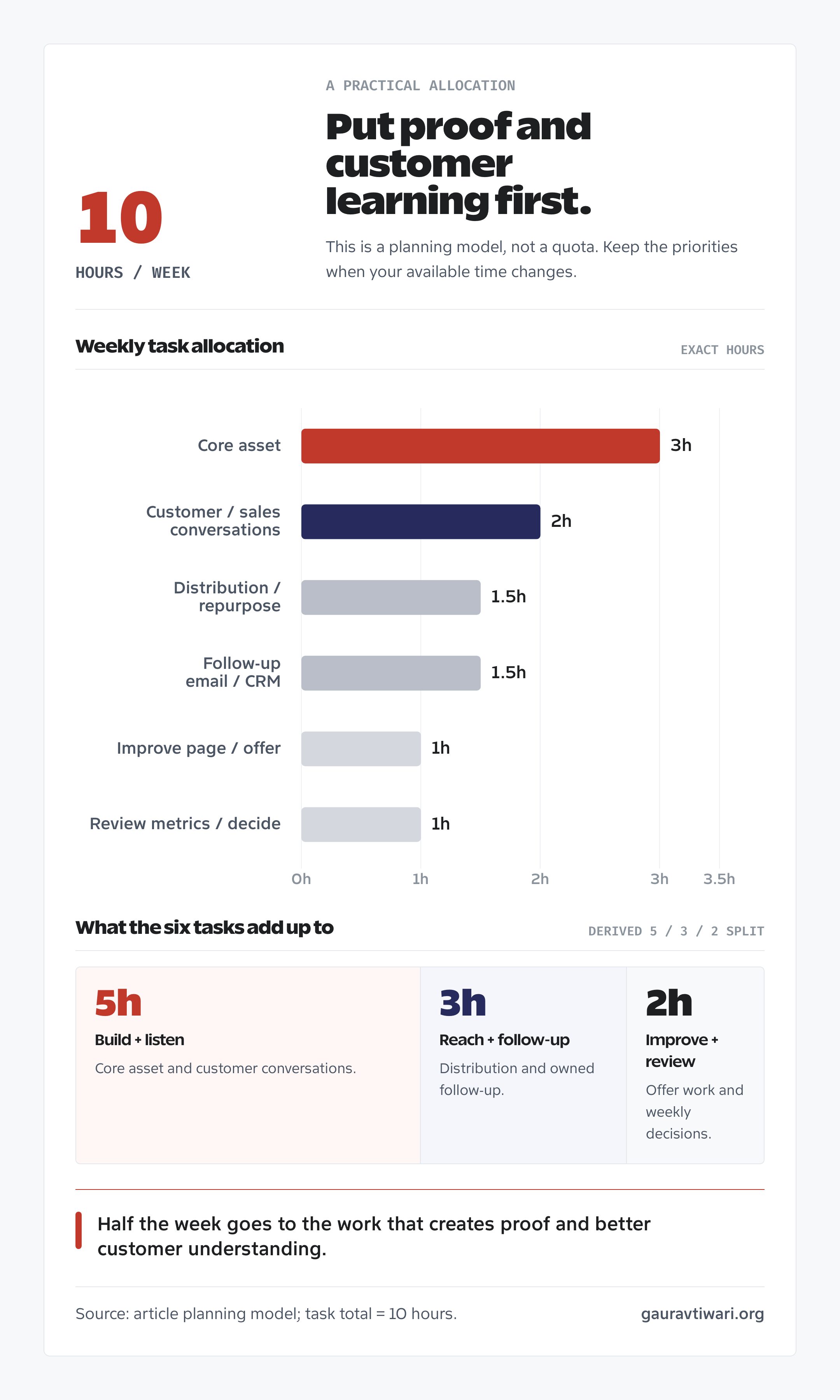
Don’t copy the hours blindly. If demand is strong but close rates are weak, move time from discovery to the offer and follow-up. If customers convert but nobody finds you, do the reverse. Use a small set of content marketing KPIs that connect activity to inquiries, sales, or another business result.
Which marketing channel should you choose?
Choose the channel where your buyers already think about the problem and where you can show up for six months. Search, referrals, targeted outbound, LinkedIn, YouTube, Google Business Profile, and paid ads can all work. The wrong channel is the one your audience ignores or you can’t sustain.
| Business model | Reasonable first test | Trust asset | Follow-up |
|---|---|---|---|
| Consultant or freelancer | Referrals, targeted outbound, or LinkedIn | Case study or diagnostic | Email or CRM |
| Creator or educator | Google Search or YouTube | Tutorial or work sample | Email list |
| Local service business | Google Business Profile and referrals | Reviews and before-and-after proof | Booking, email, or SMS |
| Ecommerce business | Google Shopping, Meta Ads, or a marketplace | Product demo and customer reviews | Email or SMS |
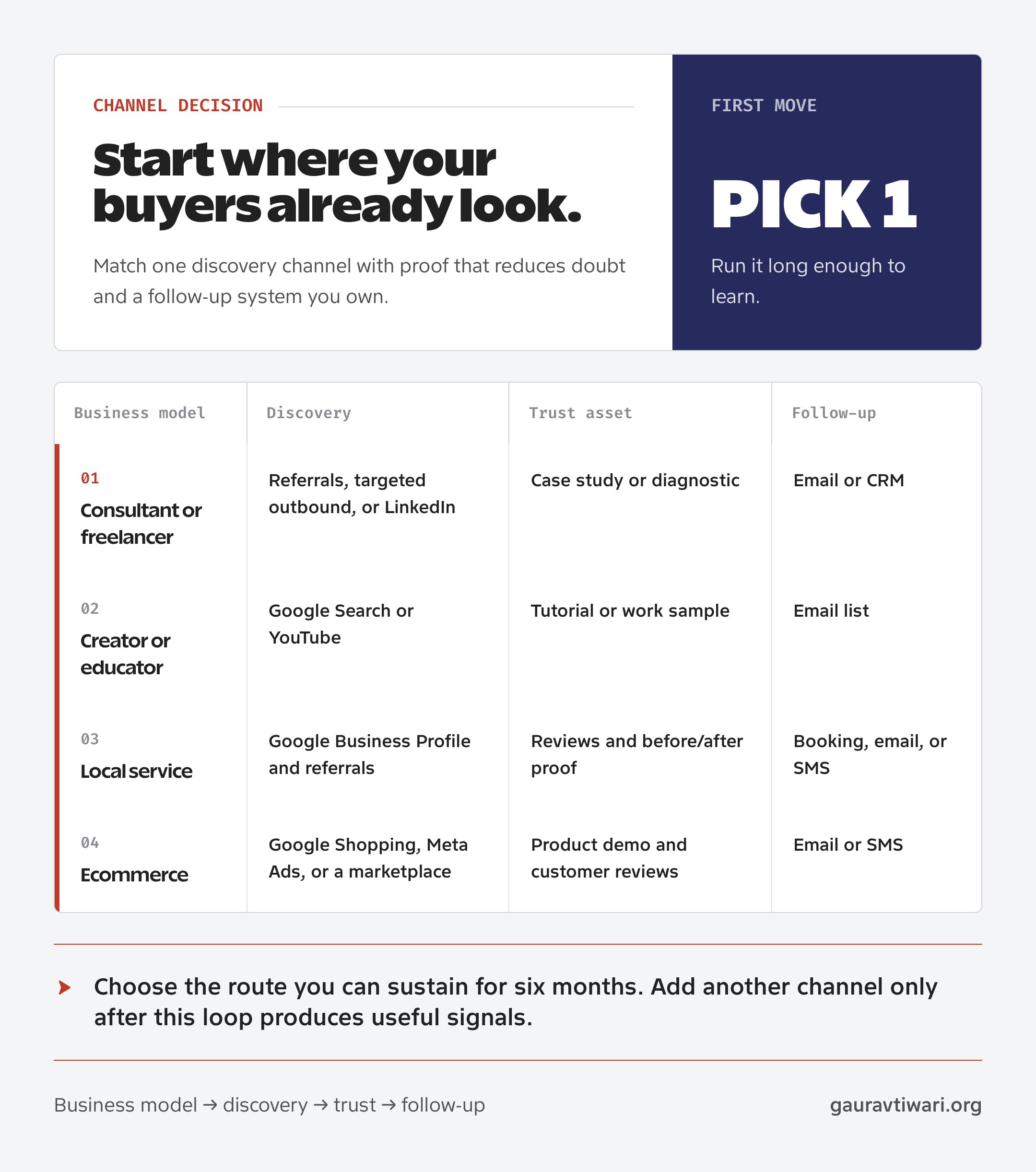
Good marketing for solopreneurs starts with buyer behavior, not the platform everyone else is posting on. Score each candidate from 1 to 5:
- Does my audience use it while thinking about this problem?
- Can I create the required format consistently?
- Can I reach people without a large existing audience?
- Does the channel help me build trust?
- Can I continue the relationship away from the channel?
- Can I measure an inquiry, sale, signup, or another useful action?
- Can I sustain it for six months?
Pick the highest-scoring channel. Keep one backup, not five.
Which five marketing trade-offs matter?
Marketing for solopreneurs is mostly a series of trade-offs: relevance over raw reach, one fast demand source plus one compounding asset, rented discovery feeding owned follow-up, sustainable quality over daily volume, and automation that protects human attention rather than replacing it.
| Decision | Default choice | Change it when |
|---|---|---|
| Reach or relevance | Choose relevant buyers | The category is unfamiliar and needs broad awareness |
| Speed or compounding | Use one of each | Cash flow or capacity makes one time horizon urgent |
| Rented or owned attention | Discover on rented channels, follow up on owned ones | The platform already gives you reliable repeat contact |
| Quality or frequency | Use a useful format you can sustain | Your cadence is too slow to produce feedback |
| Automation or personal contact | Automate movement, keep judgment human | The task is repetitive and needs no diagnosis |
Reach or relevance?
One hundred people with the problem, budget, and authority to act can matter more than 100,000 casual impressions. Choose broad reach when the category needs education. Choose relevance when you sell a specialized service, the sale requires trust, and your capacity is limited.
Fast demand or compounding assets?
Direct outreach, paid ads, and partnerships can create conversations quickly. Search content, email, communities, and referrals take longer but can keep working. Pair one short-term demand channel with one long-term asset instead of running five channels in each group.
Your content marketing plan should name the job of each asset. “Publish weekly” is a schedule, not a strategy.
Rented attention or owned follow-up?
Social platforms, marketplaces, search engines, and ad networks control their rules, reach, pricing, and account access. Use them for discovery, then give interested people a reason to visit your website, join a focused email sequence, use a tool, reply with a problem, or book the next step.
Quality or frequency?
One polished article every nine months is not a content system. A workable solo cadence might be one substantial asset every two weeks, one useful email, two to four distributions from the same idea, and one monthly review. Adjust the numbers to your capacity. Protect the system, not a calendar streak.
What should you automate?
Automate form routing, calendar confirmations, basic onboarding, reminders, tagging, and reporting. Keep diagnosis, sensitive sales questions, high-value follow-up, conflict, and strategic judgment human. Automation should create room for attention, not produce a larger volume of forgettable contact.
What should you cut at each budget?
The exact cuts change with the budget, but the rule stays the same: protect customer proof, follow-up, and the channel closest to demand. These $0, $500, and $2,000 examples are planning scenarios, not spending benchmarks.
| Monthly budget | Cut first | Protect |
|---|---|---|
| $0 | Every-platform posting, generic daily content, complicated funnels, and branding that delays customer conversations | Customer conversations, one proof asset, referral asks, a contact path, and a weekly review |
| $500 | Tiny ad budgets across several platforms, overlapping subscriptions, generic outsourced content, and premature automation | One bottleneck-removing tool, focused editing or design help, email infrastructure, and customer research |
| $2,000 | Scaling without conversion evidence, activity-only agency retainers, paid traffic to a weak page, and unused dashboards | Specialist help on the current bottleneck, distribution for proven assets, conversion work, and better customer proof |
Money should remove a proven bottleneck. It shouldn’t buy more activity just because the budget increased.
What should you stop next month?
Run a monthly stop-doing review before adding another tactic:
- Which activity produced qualified conversations?
- Which asset kept helping after publication?
- Which channel consumed time without producing a useful signal?
- Which follow-up should have been personal?
- Which repeated task should be automated?
- What will I stop next month?
The final question matters most. A plan that only adds work is not prioritization. If email is part of the system, use it to help or sell instead of filling an automation sequence. My guide to writing engaging email marketing content gives that follow-up a useful starting point.
Frequently asked questions
The right plan is the one you can repeat, measure, and improve without starving the work customers already pay you to do.
What is the best marketing strategy for solopreneurs?
The best strategy is one primary discovery channel, one trust asset, and one follow-up system. The channel depends on where your buyers look for help. Referrals, search, targeted outbound, LinkedIn, YouTube, and paid ads can all work when the offer and follow-up are clear.
How much time should a solopreneur spend on marketing?
Start with a protected weekly block you can sustain. The 10-hour plan in this guide is a planning model, not a requirement. If you have five hours, keep the same priorities: customer conversations, one trust asset, distribution, follow-up, offer improvement, and review.
Which marketing channel should a solopreneur choose first?
Choose the channel your buyers already use while thinking about the problem and that you can sustain for six months. A consultant might start with referrals or targeted outbound. A creator may start with Google Search, YouTube, or one social platform plus email.
Should a solopreneur use paid ads?
Use paid ads after the offer, landing page, follow-up, and measurement are working. Paid traffic can speed up learning and demand, but it also sends more people into a weak system. Fix conversion before increasing the budget.
What should a solopreneur automate first?
Automate repetitive movement of information: form routing, confirmations, reminders, tagging, basic onboarding, and reports. Keep diagnosis, strategic judgment, sensitive sales questions, and important relationship moments human. Automation should free attention for those conversations.
How many marketing channels should a solopreneur use?
One primary discovery channel, one owned follow-up system, and one supporting channel are enough for many one-person businesses. Add another channel only after the current loop produces useful signals and you have the time to maintain the new one.
Tell Google you want more of this.
Add Gaurav Tiwari as a preferred sourceOne tap, and this site shows up more often in your own Top Stories, AI Overviews and AI Mode. Remove it any time.