
 by
by
AI can produce a clean draft and still erase the person behind it. If you want to know how to train AI to write like you, stop feeding it more tone adjectives. Build a Voice DNA file from your writing, your edits, the choices you repeat, and the sentences you keep deleting.
The goal isn’t perfect imitation. It is a closer first draft that respects your judgment, rhythm, context, and factual boundaries. You should still edit it. But you shouldn’t have to rescue every paragraph from the same smooth, anonymous voice.
What is a Voice DNA file?
A Voice DNA file is a portable writing profile built from evidence. It records how you structure ideas, teach difficult concepts, disagree, recommend, qualify claims, and change gears across formats. It also carries anti-voice rules, corrected examples, truth boundaries, and a fixed test suite.
To train AI to write like you, you need to make those choices visible. The model can’t reliably repeat a judgment that exists only in your head.
The DNA metaphor has limits. Your writing isn’t biological or fixed. A better comparison is a style guide joined to a test suite: the guide describes the behavior, and the tests reveal whether the model can apply it under pressure.
The method has eight ordered steps:
- Collect writing samples that are genuinely yours.
- Label each sample by context and authenticity.
- Extract recurring choices and useful measurements.
- Write anti-voice rules with clear limits.
- Add good, bad, and corrected examples.
- Create smaller context modes.
- Protect truth, privacy, and authorship.
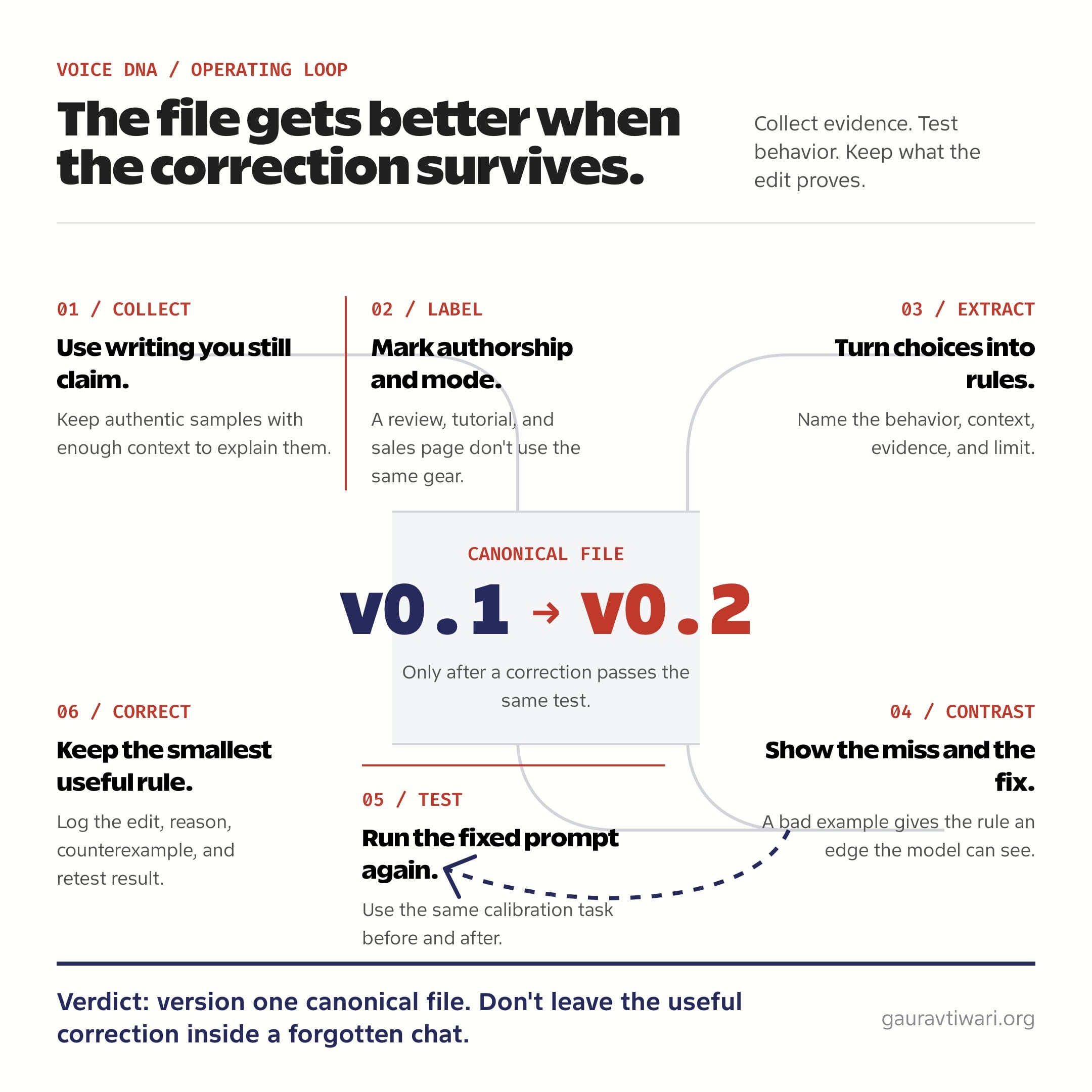
- Test, correct, and version the profile.
The downloadable Voice DNA kit includes a blank template for the manual route. If you want the faster route, the Voice DNA Generator assembles a first Markdown file locally in your browser.
Why a tone prompt still sounds generic
A tone prompt describes an impression when the model needs behavior. “Friendly, professional, clear, and engaging” can describe a lawyer, a fitness coach, a software company, or a bank. The words sound precise until you ask what any of them should change in the next sentence.
People searching for how to train AI to write like you often start with model settings. The larger failure happens earlier: the instruction describes the desired mood but hides the decisions that created it.
Here is the failure in miniature.
Generic instruction
Write in a friendly and professional tone. Be clear, conversational, and engaging.
Predictable output
In today’s fast-paced digital world, finding your unique voice is more important than ever. With the right approach, you can create engaging content that resonates with your audience.
Nothing is technically broken. That is the problem. The paragraph is competent, pleasant, and interchangeable.
A useful rule gives the model decisions it can make:
Open with the reader’s specific problem. Give the first useful answer within 100 words. Use contractions. Replace broad payoff words such as “resonates” with a result the reader can observe. When you recommend something, name the evidence and one limitation.
Now the model knows what to choose, what to reject, and where a recommendation needs a boundary.
| Approach | What it contains | What usually happens |
|---|---|---|
| Tone prompt | Adjectives and broad preferences | Output is polished but generic |
| Unlabeled sample dump | Several articles or documents | The model copies visible quirks and mixes contexts |
| Voice DNA system | Evidence, rules, contrasts, modes, boundaries, and tests | Output is more consistent and easier to diagnose |
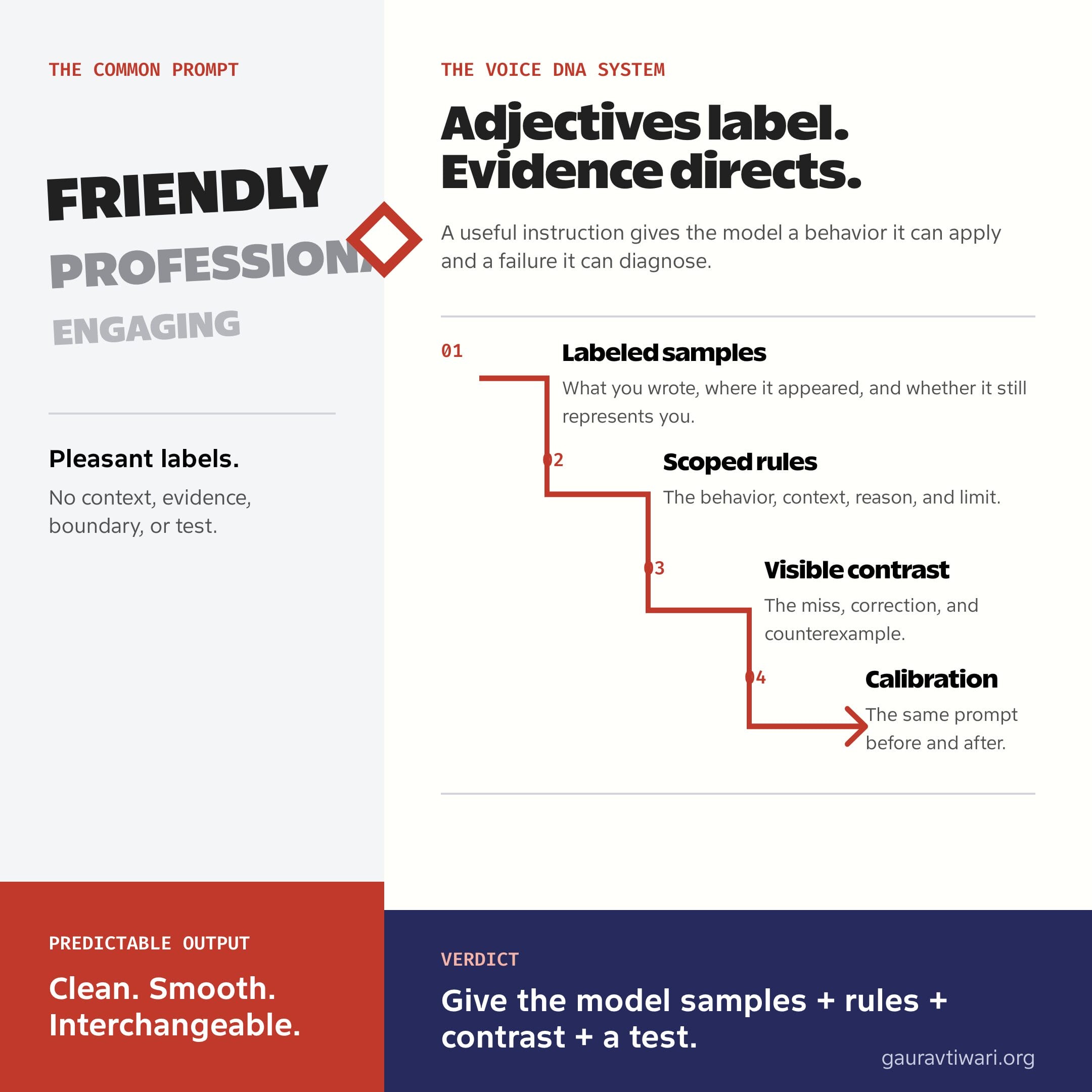
Uploading five articles is better than supplying five adjectives, but it leaves a labeling problem. The model doesn’t know which lines survived your editing, which article used a client’s house style, or which habit belongs only in a review. Samples become useful when you label them and translate repeated choices into rules.
How I compiled my own Voice DNA
My Voice DNA didn’t appear in one prompt-writing session. It grew through evidence, contrast, correction, and use. Each revision fixed a failure the earlier version couldn’t explain.
The first retained version covered the familiar parts:
- identity and audience
- personality and emotional range
- sentence construction and word choice
- pronouns, contractions, and confidence
- examples and a final self-check
That gave the system direction. Published writing then became the evidence base.
Six mode profiles came from the 30 largest live article exports available during the analysis. Three representative reviews supplied a separate baseline for sentence length, paragraph density, fragments, and conversational patterns. Those numbers are drift detectors, not quotas. A median can warn you that every sentence has become uniformly long. It shouldn’t force every sentence toward the median.
Repeated edits produced the anti-voice layer:
- Don’t lead with credentials.
- Don’t announce what the article will cover.
- Don’t use a vague payoff when you can name the result.
- Don’t force words such as “honest” or “real” into a sentence to signal trust.
- Don’t repeat a conversational phrase until it becomes a gimmick.
- Don’t turn researched evidence into invented first-person experience.
Then the missing pieces became obvious. “Teaching” was present as an adjective, but not as a method. The profile now starts from the reader’s misunderstanding, names a term and translates it, shows a failure before the fix, completes one worked example, and slows down when a skipped step would lose the reader.
The analytical layer changed the judgment too. It follows a simple movement: observe, compare, explain the mechanism, predict the human consequence, then judge. The authorial-intention layer goes one step deeper: select the details that matter, give each detail a consequence, trust the reader after the evidence lands, allow important sections more room, and keep the examples particular to the writer’s world.
Selective bolding became part of the system for the same reason. Bold text should form a second reading path through the article. It marks the claim, contrast, consequence, or action, not every keyword and brand name.
The last structural fix was canonicalization. One master Markdown file now holds the base profile. Supporting references and mode overlays point back to it. Five master copies for five assistants would start disagreeing after the next correction.
The Markdown kit includes the full public breakdown of how this profile was compiled.
Step 1: Collect writing samples that are actually yours
Start with five samples if you want a usable profile today. Build toward 10 to 20 when you write across several formats. Quality matters more than volume because one heavily edited or ghostwritten sample can teach the model the wrong person.
Choose writing that reveals decisions, not only sentence rhythm:
- A tutorial shows how you sequence an explanation and handle the missing step.
- A review shows how you compare evidence, state a preference, and mark a limitation.
- An email shows compression, warmth, and directness.
- A disagreement shows emotional control and how you concede a fair point.
- A personal note shows texture that formal work may hide.
Leave out samples that are mostly someone else’s wording. A heavily rewritten article may be useful content and poor evidence of your voice.
Score each candidate on five questions:
- Did I write most of it?
- Does it still sound like me?
- Does it represent a context I use often?
- Did my wording survive editing?
- Can I point to the choices I want repeated?
The kit’s sample collection checklist adds labels for context, audience, date, editing level, authenticity, and anything the model shouldn’t generalize.
Clean the files before uploading them anywhere. Remove passwords, private names, account details, hidden comments, document metadata, and client information that the writing task doesn’t need.
Step 2: Extract choices, not personality adjectives
Extraction asks, “What does this writer repeatedly do on the page?” It doesn’t pretend to diagnose a personality from a small corpus. The useful unit is a choice that another writer or model could repeat.
Look for patterns such as:
- where the first useful answer appears
- typical sentence and paragraph ranges
- where short sentences carry emphasis
- how the writer uses contractions and direct address
- which questions, fragments, parentheses, and ellipses survive editing
- common sentence openings and transitions
- how technical terms are named and translated
- how recommendations connect evidence to a limitation
- which facts, numbers, names, and examples change the decision
- how the piece closes and what action it leaves the reader with
Let me show you one small extraction.
Sample line
Redis is an in-memory data store. Think of it as a cheat sheet for your database. Instead of running the same queries again, WordPress keeps the result ready.
Weak observation
The writer is friendly and uses analogies.
Operational rule
Name the technical term first, then translate it with one familiar comparison. Return to the real mechanism before the analogy creates a false picture.
The operational rule tells the model what to do, in which order, and where the move can fail. “Friendly” tells it almost nothing.
Measurements can support the analysis. Count sentence length, paragraph length, contractions, first- and second-person use, repeated openings, and punctuation patterns. But keep those numbers descriptive. A contraction rate is a clue, not a target to hit in every paragraph.
In prompt engineering, a few paired inputs and desired outputs are called few-shot examples. OpenAI describes few-shot learning as giving a model a handful of examples so it can pick up the pattern. Anthropic also treats examples as one of the most dependable ways to steer tone, structure, and format.
The extraction prompts in the Markdown kit require a source quote, confidence level, context, and overcorrection risk for every proposed rule. That last field matters. A pattern can be true in three reviews and wrong in every condolence email.
Step 3: Build the Voice DNA file in layers
A maintainable profile separates durable voice behavior from task facts and platform settings. Without that separation, a temporary client deadline or product offer quietly becomes part of the “voice.”
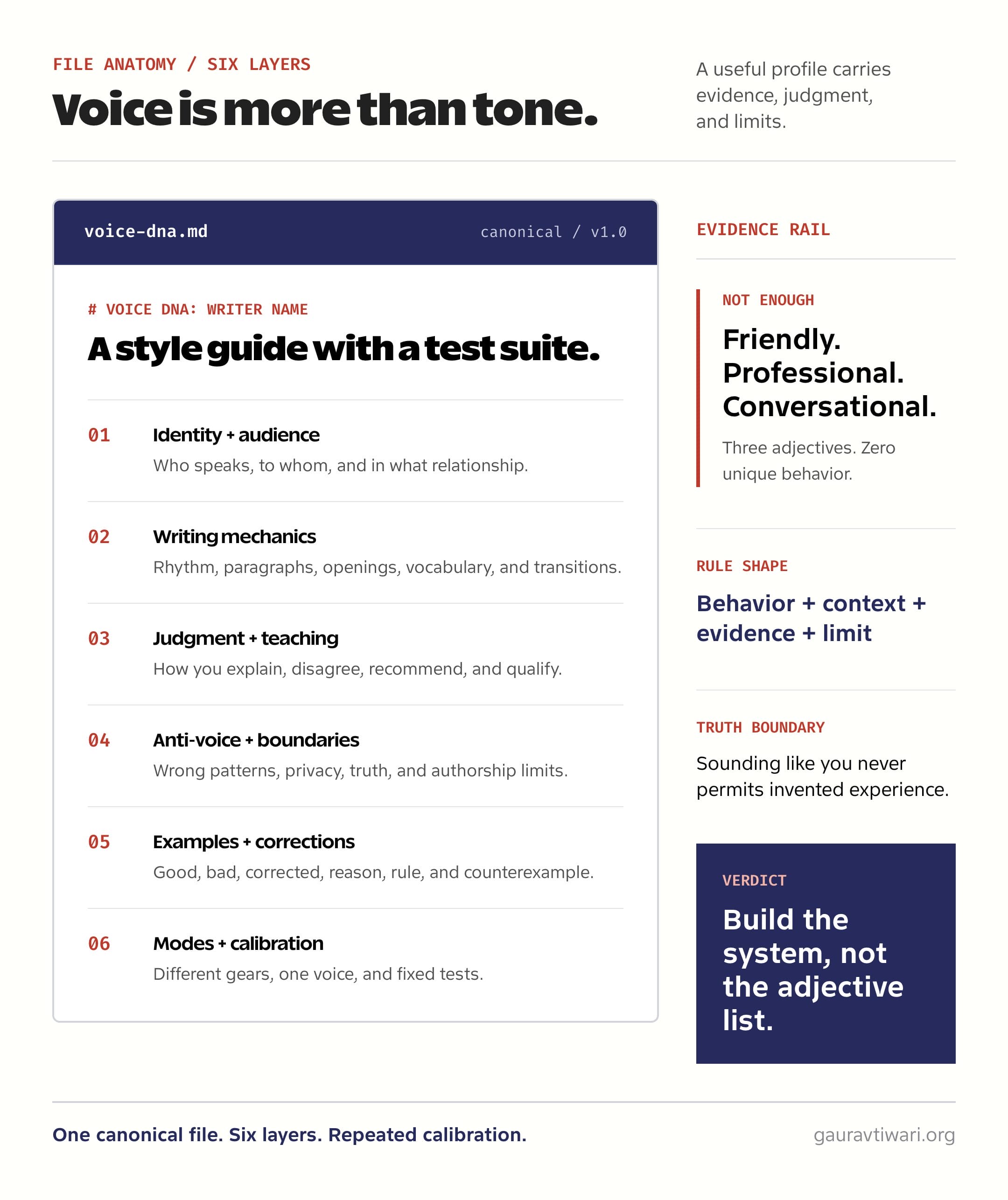
I now use seven durable layers:
- Identity and audience: Who is speaking, to whom, and in what relationship?
- Writing mechanics: Sentence rhythm, paragraph shape, transitions, vocabulary, and structure.
- Judgment: How observations become comparisons, mechanisms, consequences, and recommendations.
- Teaching: How the writer demonstrates, corrects misconceptions, and checks understanding.
- Authorship and truth: What may be claimed, inferred, assumed, or left as evidence needed.
- Authorial intention: What the writer notices, emphasizes, leaves uneven, and deliberately omits.
- Examples and tests: Good, bad, corrected, mode-specific, and calibration material.
Keep the working objects separate too:
| Object | Job | Changes when |
|---|---|---|
| Source library | Preserves labeled evidence | You add or retire samples |
| Canonical Voice DNA | Holds durable base rules | Evidence supports a lasting change |
| Mode overlay | Changes pace, proof, and structure | You add or adjust a format |
| Runtime prompt | Supplies the current task | Every request |
| Correction log | Records candidate and promoted rules | An edit reveals a repeated pattern |
The Markdown kit includes the blank template and a complete fictional example. Use the example to judge depth, not to copy its personality.
Step 4: Write anti-voice rules that don't overcorrect
Anti-voice describes a miss that can be grammatically correct and still unmistakably wrong for you. It works best when the rule names the behavior, the context, and the limit.
This is too broad:
Never sound salesy.
This is usable:
Don’t use urgency, inflated outcomes, or popularity as the main reason to act. On a sales page, make the value clear, then support it with fit, proof, a limitation, and a low-pressure next step.
Strong anti-voice sections cover the failures you actually remove:
- banned phrases and academic connectors
- generic openings and conclusion cliches
- repeated verbal tics
- unsupported certainty
- emotional registers that feel false
- structures the writer consistently cuts
- invented experience, opinions, or personal reactions
Add a counterexample to every rule that could become rigid. “Don’t use lists” is a bad rule if lists help readers scan steps and comparisons. A better rule is: default to connected prose, then use a list when the reader needs to scan actions, options, facts, or checks.
Step 5: Add good, bad, and corrected examples
Examples make an abstract rule visible. The strongest pairs differ for one clear reason, so the model can see which choice changed and why.
Bad
Discover your authentic voice with an all-in-one AI framework built to create engaging content at scale.
Corrected
Give the model five pieces you would still publish, then show it one edit you make repeatedly. That correction often teaches more than a page of adjectives.
The corrected version works because it does four concrete things:
- It gives the reader an action.
- It replaces inflated nouns with observable material.
- It makes a judgment instead of promising transformation.
- It teaches without flattening the sentence into a slogan.
For an important mode, collect three to five relevant and diverse examples. Anthropic’s prompt guidance recommends three to five structured examples for the strongest results.
OpenAI’s prompt-engineering guide also separates identity, instructions, examples, and context. That separation prevents an old example from being mistaken for a fact about today’s task.
Step 6: Create modes instead of cloning the voice
One writer needs several gears. A review shouldn’t move like a condolence email, and a technical tutorial shouldn’t carry the emotional intensity of a sales page. The base identity stays stable while pace, proof, structure, and emotional range change with the job.
| Mode | Pace | Proof | Special behavior | Common failure |
|---|---|---|---|---|
| Tutorial | Patient | High | Show the missing step and complete one example | Skipping what feels “obvious” |
| Review | Brisk | Highest | State the verdict early and include a limitation | Rewriting the feature page |
| Compact | Medium | Carry one idea and one action | Turning the email into an article | |
| Sales | Controlled | High | Connect fit, proof, risk, and next step | Inflated promises |
| Social | Energetic | Medium | Land one memorable point | Empty certainty |
| Technical explanation | Layered | High | Name, translate, demonstrate, and qualify | Definition without understanding |
A mode overlay can be short. Point it to the canonical profile, then define purpose, pace, evidence threshold, structure, emotional range, and the most common failure. Don’t duplicate the whole profile. Copies start drifting the moment one receives a correction.
Step 7: Protect truth, privacy, and authorship
A model can match your rhythm and still write something you never did, tested, felt, or believed. Voice accuracy does not grant factual authority. Your profile needs a claim boundary as clear as its style rules.
The non-negotiable rules are simple:
- No made-up product tests.
- No invented clients, projects, feelings, or preferences.
- No composite story presented as one event.
- No third-person source rewritten as “I found.”
- No confident recommendation without the evidence threshold you set.
Mark the evidence status at claim level. Confirmed means you observed it or have it on record. Inferred means the evidence points there but you are connecting the dots. Assumed means the claim remains a working guess. Plain labels protect the certain parts of the paragraph from the uncertain one.
Before each writing task, list the evidence available. When personal proof is missing, the model should use [EVIDENCE NEEDED], ask for the missing fact, narrow the claim, or keep it in third person.
This is why I don’t treat AI writing as a one-click publishing workflow. My AI article writer process for WordPress separates research, drafting, human editing, links, images, and SEO checks. Voice is one gate. Accuracy and authorship are separate gates.
Privacy needs the same precision. A browser-side tool can analyze local text without sending it to a model. The moment you upload samples to ChatGPT, Claude, Gemini, or another service, that platform’s data controls apply. Redact what the system doesn’t need.
Step 8: Run a fixed calibration test
A Voice DNA file isn’t finished because it looks detailed. It is useful when it produces safer, closer output across predictable tasks.
Start with a failure.
Test prompt
Explain “few-shot examples” to a smart beginner. Name the term, translate it, show one example, and state one limitation.
Failed output symptom
The answer defines the term correctly, but it jumps to a list of benefits, uses three abstract analogies, and never completes one example.
Smallest useful rule change
In teaching mode, complete one worked example immediately after the definition. Don’t move to benefits until the reader can see the mechanism.
Run the same prompt again. Change one meaningful rule at a time, or you won’t know which change fixed the result.
Score six dimensions from 1 to 5:
- Voice match
- Truth and authorship
- Rhythm
- Specificity
- Context fit
- AI-tell count
I use a 24/30 pass mark, with truth and authorship fixed at 5/5. The calibration suite in the Markdown kit tests email, explanation, recommendation, disagreement, technical definition, social writing, and bland-copy repair.
Turn corrections into scoped rules
Corrections are the best voice data you already produce. But an edit becomes reusable only after you explain the pattern behind it and test the limit.
This is the maintenance layer most explanations of how to train AI to write like you leave out. Without it, the same mistake returns under slightly different wording.
Record six things:
- The smallest original passage that shows the failure.
- Your correction.
- Why the original felt wrong.
- The new or updated rule.
- A counterexample that stops overcorrection.
- The retest result.
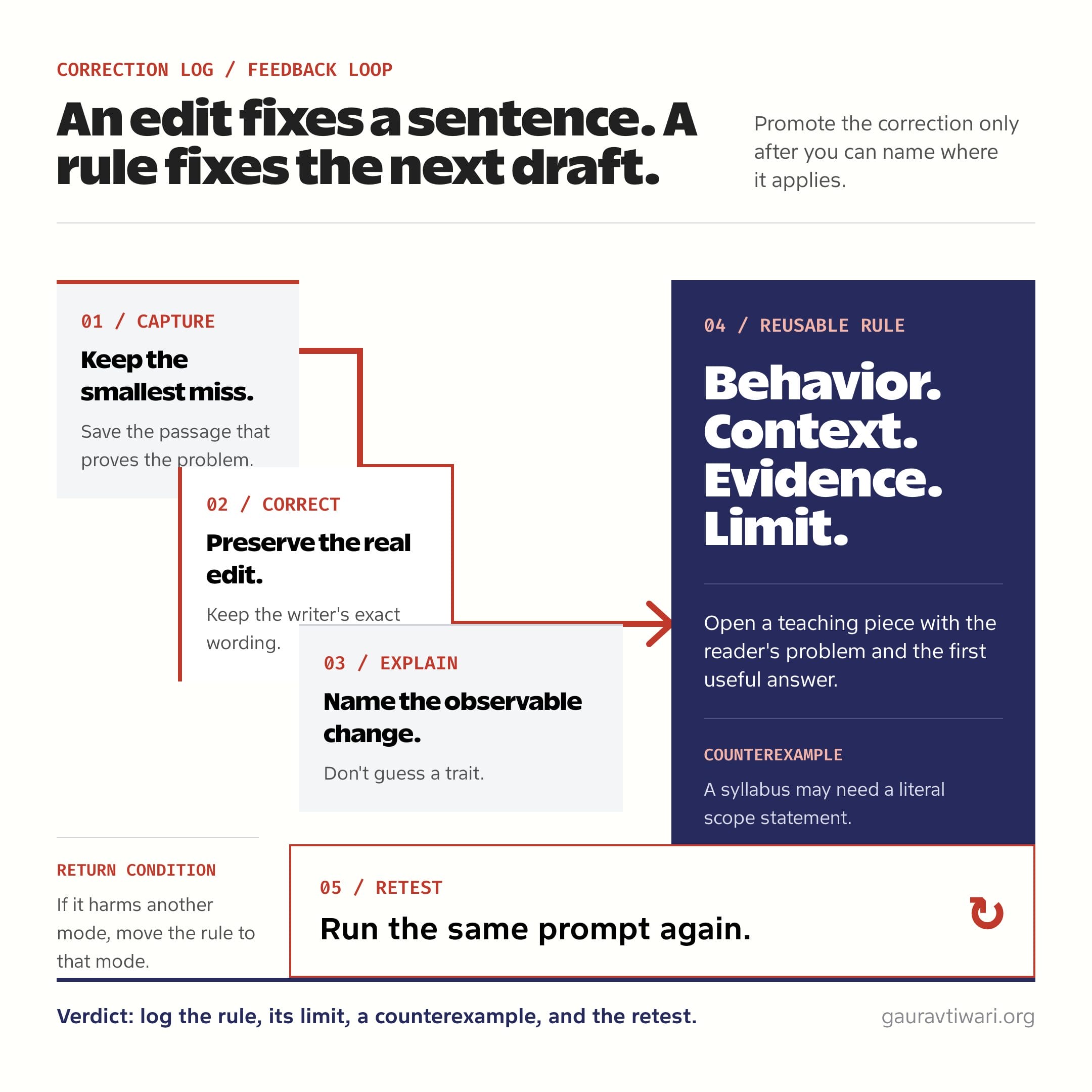
Suppose you remove “In this guide, we’ll explore…” from an opening. The reusable rule isn’t “never use the word guide.” It is: open a teaching piece with the reader’s problem and the first useful answer; don’t announce the section list. A course syllabus may still need a literal scope statement. That is the counterexample.
The kit’s correction log includes a worked entry and promotion rules. Its maintenance checklist helps you merge duplicates and keep mode-specific rules out of the base profile.
How to train AI to write like you across platforms
Keep the master profile in Markdown, then use the smallest delivery layer each platform needs. Product features will change. Your source file should survive those changes.
ChatGPT
Use ChatGPT Custom Instructions for short, account-wide preferences. OpenAI currently allows 1,500 characters on Free and Go plans and 5,000 on Plus, Pro, Business, Enterprise, and Education. Even the larger field suits a compact operating summary better than the full Voice DNA and example library.
Use a custom GPT when you need instructions plus uploaded knowledge. Put behavioral rules and boundaries in Instructions. Upload the Voice DNA and selected examples as Knowledge. GPTs don’t inherit saved memory, account Custom Instructions, or previous conversations, so each GPT needs the rules it depends on.
Claude
Use a Claude custom skill for reusable Voice DNA behavior. Put the operating instructions in SKILL.md, keep the canonical profile and selected examples as supporting files, enable the skill, and run the same calibration suite against it.
Keep project facts, goals, and constraints in Project instructions. Skills carry reusable procedures and supporting files. Projects carry the context and knowledge that belong to one body of work.
Gemini
Use Instructions for Gemini for short account-level preferences on supported personal accounts. Google says those instructions aren’t available inside features such as Gems, so don’t assume the account-level layer follows you there.
Use a Gem for a named writing workflow. Define persona, task, context, and response format, then add the Voice DNA under Knowledge. Preview it with the calibration suite and save the changes after previewing.
API workflows
Use a stable developer or system message with separate sections for identity, instructions, examples, context, and task. Retrieve the current canonical profile instead of pasting an old copy into application code.
The Markdown kit contains the platform setup guide and a compact runtime writing prompt for individual tasks.
Common Voice DNA mistakes
Most profiles fail in predictable ways. The problem is rarely a missing adjective.
They describe tone without evidence
“Warm and authoritative” doesn’t tell a model how to open, qualify a claim, show warmth, or recommend a tool. Add a behavior and an example.
They mix voice, facts, and task instructions
A durable profile shouldn’t contain this week’s offer, a client deadline, or an article outline. Put changing facts in project or task context.
They upload too many unlabeled samples
A large mixed corpus can teach the model the wrong context with more confidence. Ten labeled examples are easier to understand and maintain than 100 mystery files.
They turn measurements into quotas
“Median sentence length: 11 words” is a diagnostic clue. “Every sentence must be 11 words” produces a robot.
They forget the negative space
Without anti-voice, the model may preserve the topic and lose the writer. Show what you remove, why you remove it, and when the rule shouldn’t apply.
They make every format identical
Vocabulary and judgment can survive across modes. Pace, structure, proof level, and emotional intensity shouldn’t remain fixed.
They edit output but never update the profile
If you fix the same failure every week, the correction belongs in the log. Otherwise you keep paying the same editing tax.
They confuse a closer draft with finished writing
Voice DNA can improve a first draft. It can’t make weak evidence original or turn generated prose into lived experience. My comparison of AI content and human content for SEO reaches the same practical point: quality, originality, expertise, and intent matter more than the label on the tool.
What a good Voice DNA result looks like
A good profile doesn’t make editing disappear. It changes the kind of editing you do.
- The first draft starts closer to your normal structure.
- The model chooses the right gear for the format.
- Recommendations include evidence and a meaningful limitation.
- Missing personal proof is flagged instead of invented.
- Bad output can be traced to a weak rule or missing example.
- Corrections get smaller and more specific over time.
- The voice remains recognizable without becoming a costume made from visible tics.
That last point matters. If every paragraph repeats your favorite phrase, the model hasn’t learned your voice. It has learned the easiest part to parody.
The useful outcome is more time for judgment. A reliable profile can support the system in my guide to writing blog posts faster without sacrificing quality, but it can’t decide what only you know, believe, or have evidence to claim.
Build your first Voice DNA file
Start smaller than your ambition. Choose five samples, label them, extract only the patterns you can prove, and add one anti-voice rule, one corrected example, one truth boundary, and one calibration prompt.
If your immediate goal is to train AI to write like you, this small version is enough to test the method before you spend a weekend documenting everything.
That is enough for version 0.1.
Enter your email and I’ll send the template, sample checklist, extraction prompts, calibration suite, correction log, platform setup guide, and maintenance checklist.
The Voice DNA Workbook gives you more room to work through the method, while the two-page Quickstart keeps the first session compact.
Frequently Asked Questions
These answers cover the practical questions that come up when you build, test, and maintain a Voice DNA file.
What is Voice DNA for AI writing?
Voice DNA is a structured writing profile built from a writer’s samples, recurring choices, anti-voice rules, examples, context modes, truth boundaries, and calibration tests. It helps an AI produce a closer first draft without reducing style to broad adjectives.
How many writing samples do I need to train AI to write like me?
Five strong samples are enough for a minimum viable profile. Ten to 20 labeled samples give a more dependable picture across formats. Choose work that is genuinely yours, still sounds current, and reveals teaching, judgment, disagreement, and emotional range.
Can ChatGPT learn my writing style from uploaded files?
ChatGPT can use uploaded writing and instructions as context, but sample quality and labeling still decide what it learns. A custom GPT can combine instructions with knowledge files. Keep the canonical Voice DNA outside ChatGPT so you can update it once and reuse it elsewhere.
Should I use one Voice DNA file for every content type?
Use one base profile and small context overlays. The base holds stable voice, judgment, and boundaries. A tutorial, review, email, and sales page can then change pace, proof level, structure, and emotional range without becoming separate identities.
Does a Voice DNA file replace editing?
No. It should reduce generic rewrites and repeated corrections, but the writer still owns meaning, evidence, judgment, and final phrasing. A profile improves the starting point. It doesn’t transfer authorship to the model.
Is it safe to upload private writing samples to AI tools?
That depends on the service, account, and data controls you use. Remove secrets, private names, client information, hidden comments, and document metadata before uploading. Use redacted or fictional examples when the original material isn’t necessary.
Do I need fine-tuning to make AI write like me?
Most writers don’t need fine-tuning. A well-built Voice DNA file, a small set of relevant examples, and a fixed calibration process are easier to update and can work across several models. Fine-tuning may help at scale, but it doesn’t remove the need for clean data and evaluation.
How often should I update my Voice DNA profile?
Update it when the evidence changes: a correction repeats, a new format becomes common, a rule causes overcorrection, or your writing style shifts. Review the correction log regularly, but don’t add rules merely to satisfy a schedule.
Tell Google you want more of this.
Add Gaurav Tiwari as a preferred sourceOne tap, and this site shows up more often in your own Top Stories, AI Overviews and AI Mode. Remove it any time.