
GPT-5.6 vs Claude Fable 5: I Ran the Same Prompts on Both
GPT 5.6 vs Claude is not one flagship model against another. OpenAI released a three-tier family: Sol for the hardest work, Terra for balanced work, and Luna for lower-cost volume. Anthropic released Claude Fable 5 as one premium, Mythos-class model for general use. The useful comparison starts with those two different buying philosophies.
My current verdict is about fit, not a benchmark winner. GPT-5.6 Sol is the more rational default for most serious Codex work because it costs less, gives me explicit effort controls, and sits above Terra and Luna when easier stages do not need the flagship. Fable 5 is still my pick for the longest connected Claude Code jobs, where preserving the plan across tools, files, and verification matters more than token price. I have now run a small same-prompt test across Sol, Fable 5, and Opus 4.8, and it backs that fit-over-winner read: the three were near-identical on correctness, so the real decision stays cost and fit.
I have used Fable whenever it has been available, and I have used GPT-5.6 across its current OpenAI surfaces. Fable access was interrupted for all users from June 12 through June 30 under an immediate US government directive, then restored globally on July 1. That gap was not a choice to stop using the model. It also means nobody should describe the period as five uninterrupted weeks of hands-on Fable use.
The verdict
Build on GPT-5.6 when you need explicit routing across a flagship, a balanced tier, and a low-cost tier. Build on Claude Fable 5 when you want Anthropic’s highest generally available Claude capability inside a Claude-native agent workflow and the task can absorb a $10 input and $50 output price per million tokens. For subscription coding, choose the agent product and workflow before assuming the underlying flagship settles everything.
| Decision | Current call | Reason |
|---|---|---|
| Lowest API price | GPT-5.6 Luna | $1 input and $6 output per million tokens. |
| Balanced API tier | GPT-5.6 Terra | $2.50 input and $15 output, between Luna and Sol. |
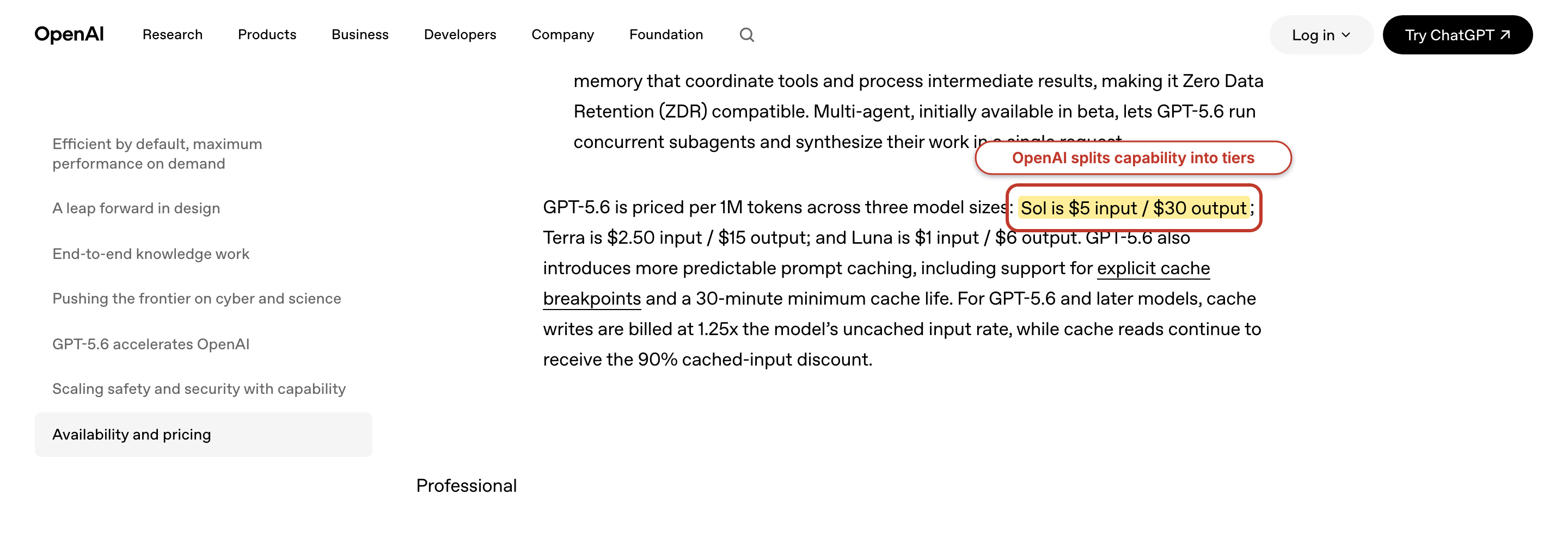
| Lower-priced flagship | GPT-5.6 Sol | $5 input and $30 output, below Fable’s list price. |
| Claude-native frontier workflow | Fable 5 | It runs inside Claude Code and the wider Claude product. |
| Same-prompt quality | Effective tie | Sol, Fable 5, and Opus 4.8 landed within one point on three tasks, so fit and price decide. |
This is the central GPT 5.6 vs Claude conclusion: OpenAI has the clearer routing ladder, while Anthropic asks you to pay a premium for one top general-use model. API economics can be compared exactly today. Task quality still needs a controlled run.
What OpenAI shipped with GPT-5.6
OpenAI made GPT-5.6 generally available on July 9, 2026 across ChatGPT, Codex, and the API. The generation number is shared, while Sol, Terra, and Luna are durable capability tiers that can advance on their own cadence. That naming choice tells developers to think in routes rather than one universal default.
Sol is the flagship
GPT-5.6 Sol is OpenAI’s flagship tier for coding, knowledge work, computer use, design, science, and other demanding tasks. Its API list price is $5 per million input tokens and $30 per million output tokens. In ChatGPT, paid plans reach Sol through medium and higher effort settings, with a Sol Pro option for eligible Pro and Enterprise users.
In Codex, Plus, Pro, Business, and Enterprise users can select Sol, Terra, or Luna and set an effort level. OpenAI also exposes max effort to users with GPT-5.6 access in Codex, while ultra multi-agent coordination is available in Codex for Plus and higher plans. These availability details come from OpenAI’s GPT-5.6 general-availability announcement.
Terra is the balanced tier
GPT-5.6 Terra costs $2.50 per million input tokens and $15 per million output tokens. OpenAI positions it as the everyday balance between capability and cost. It is also the GPT-5.6 tier supplied to Free and Go users in ChatGPT Work and Codex.
Terra matters because most production tasks are not frontier tests. A schema conversion, structured extraction, routine refactor, or first-pass analysis may need care without needing the highest-priced model. Routing that work away from Sol can halve both input and output list prices.
Luna is the volume tier
GPT-5.6 Luna costs $1 per million input tokens and $6 per million output tokens. OpenAI describes it as the cost-sensitive, high-volume member of the family. The official model page lists a 1.05 million-token context window, a 128,000-token maximum output, and a February 16, 2026 knowledge cutoff for Luna. It also warns that prompts longer than 272,000 input tokens receive higher rates for the full request. Those details are on the GPT-5.6 Luna model page.
Luna does not need to beat Fable on the hardest task to matter. It needs to handle enough high-volume mechanical work reliably that paying five to eight times more for output is unnecessary. That is a routing question worth its own test, separate from the Sol-versus-Fable flagship task.
What Anthropic shipped with Claude Fable 5
Anthropic released Claude Fable 5 on June 9 as a Mythos-class model made available for general use. Mythos 5 uses the same underlying model with safeguards lifted in selected areas for restricted trusted access. Fable is the product ordinary developers can use through Claude, Claude Code, Cowork, and the API.
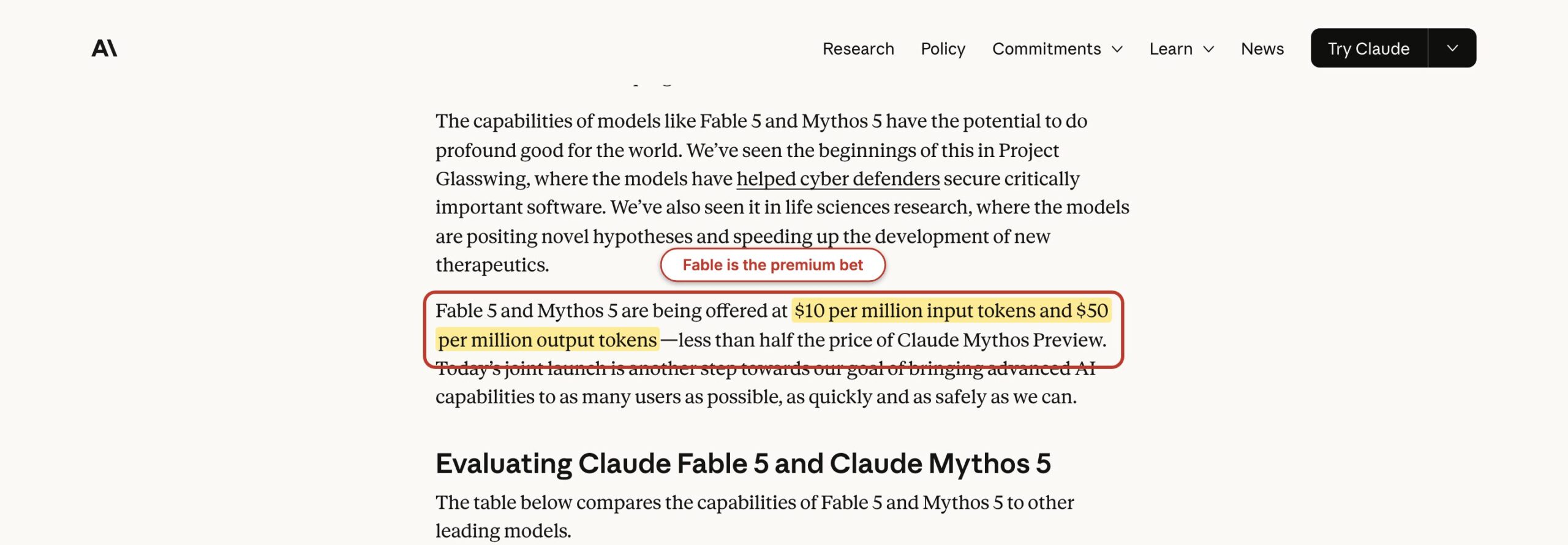
Fable costs $10 per million input tokens and $50 per million output tokens. Anthropic positions it for software engineering, knowledge work, vision, science, and tasks whose difficulty grows with duration. Those are vendor claims, not my scorecard. The current pricing and product description are in Anthropic’s Fable 5 and Mythos 5 announcement.
Fable can fall back to Opus 4.8
Fable includes classifiers for cybersecurity, biology and chemistry, and distillation-related requests. When a classifier flags a request, the response can be handled by Claude Opus 4.8 instead, and the user is notified. Anthropic said at launch that more than 95 percent of Fable sessions involved no fallback. This safeguard design means the model label on the original request does not guarantee Fable handles every response.
That detail matters in a controlled comparison. If a task triggers fallback, the run must record the actual responding model. Hiding the switch would make a Fable-versus-Sol result uninterpretable.
Fable has a 30-day retention requirement
Anthropic requires 30-day retention for traffic on Mythos-class models across first-party and third-party surfaces. The company says it does not use that data to train new Claude models and limits the purpose to safety work, but the retention requirement still changes the privacy decision. A team with zero-data-retention obligations cannot treat Fable as interchangeable with every other Claude model.
OpenAI says GPT-5.6 Programmatic Tool Calling in the Responses API is compatible with Zero Data Retention. That does not make every OpenAI product surface ZDR by default. It means the API feature has a documented compatible path. Compare the contract and selected surface, not only the model name.
The access interruption was not a user choice
On June 12, an immediate US government export-control directive required Anthropic to restrict Fable 5 and Mythos 5 for foreign nationals. Anthropic said it had no reliable way to verify nationality in real time, so it suspended access for all users. The controls were lifted on June 30, and global access returned July 1 across the Claude Platform, Claude.ai, Claude Code, and Claude Cowork.
I used Fable for as long as it was available before the suspension and whenever it was available after restoration. The June 12 to July 1 interruption should never be framed as me choosing not to use it. Anthropic documents the sequence in its redeployment statement.
For Pro, Max, Team, and selected Enterprise plans, Anthropic included Fable for up to 50 percent of weekly limits through July 7. It is available through usage credits after that date. On July 13, subscription access should be described as credit-based, not included without qualification.
GPT-5.6 Sol, Terra, Luna, and Fable 5 compared
The table below compares current, verifiable product facts. It does not mix OpenAI’s benchmark scores, Anthropic’s benchmark scores, and my hands-on observations into one false ranking.
| Model | Vendor position | Input per 1M | Output per 1M | Cached input read | Current main surfaces |
|---|---|---|---|---|---|
| GPT-5.6 Sol | Flagship | $5 | $30 | $0.50 | ChatGPT, Codex, API |
| GPT-5.6 Terra | Balanced | $2.50 | $15 | $0.25 | ChatGPT Work, Codex, API |
| GPT-5.6 Luna | Cost-sensitive volume | $1 | $6 | $0.10 | ChatGPT Work, Codex, API |
| Claude Fable 5 | Mythos-class general-use model | $10 | $50 | $1 | Claude, Claude Code, Cowork, API |
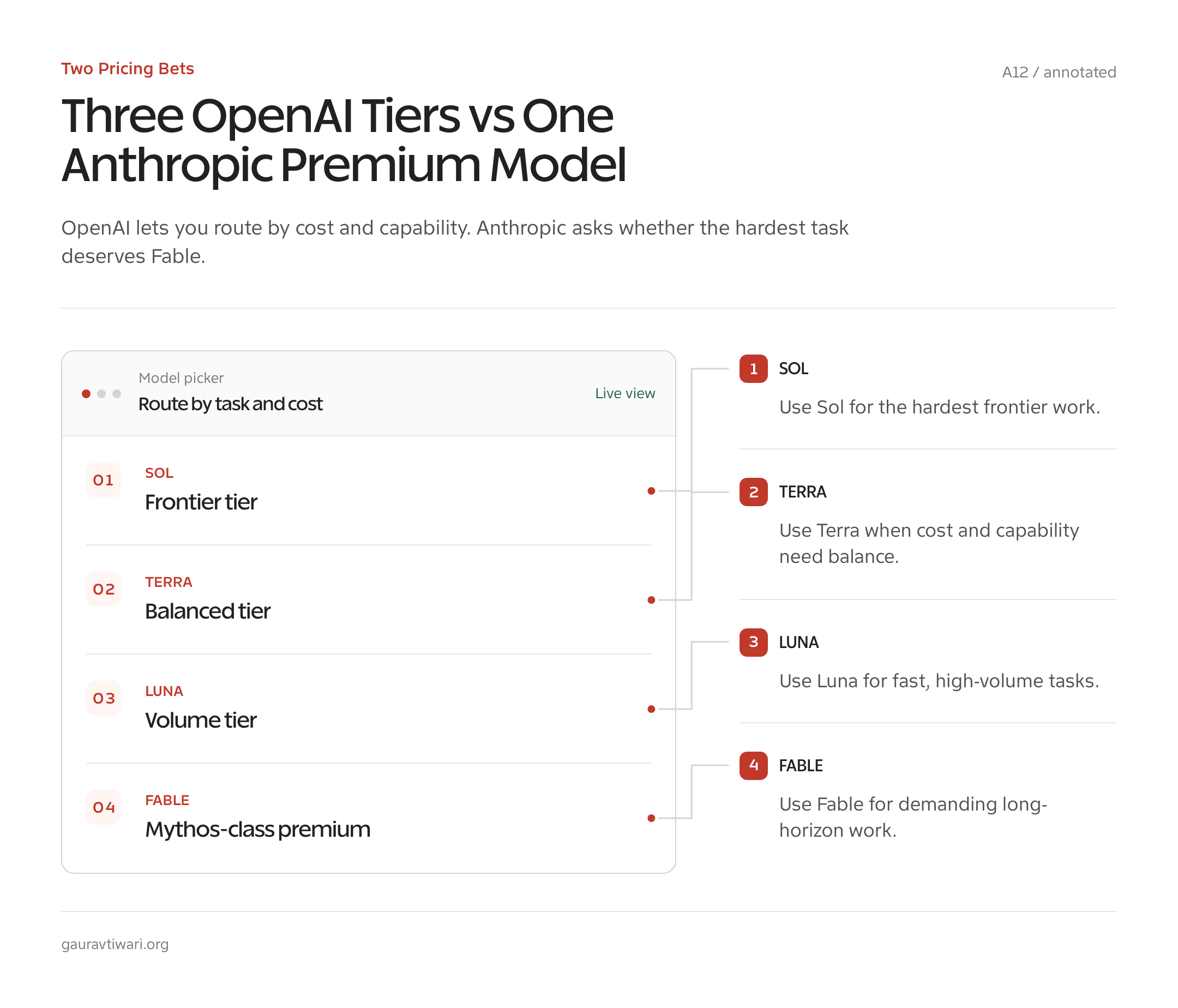
At list price, Fable input costs twice Sol, four times Terra, and ten times Luna. Fable output costs about 1.67 times Sol, 3.33 times Terra, and 8.33 times Luna. Those ratios are arithmetic, not estimates from a made-up workload.
Price per token does not equal price per successful task. A more expensive model can cost less if it produces a correct result with less output or fewer failed attempts. A cheaper model can win if the task is well specified and mechanical. That is why a GPT 5.6 vs Claude price table cannot become a cost-per-completion claim before the controlled run.
Two opposite pricing bets
OpenAI is betting that developers will route. Sol handles the hardest work. Terra covers the broad middle. Luna absorbs high-volume tasks where cost and speed matter more than the last increment of reasoning. One generation exposes three price and capability points.
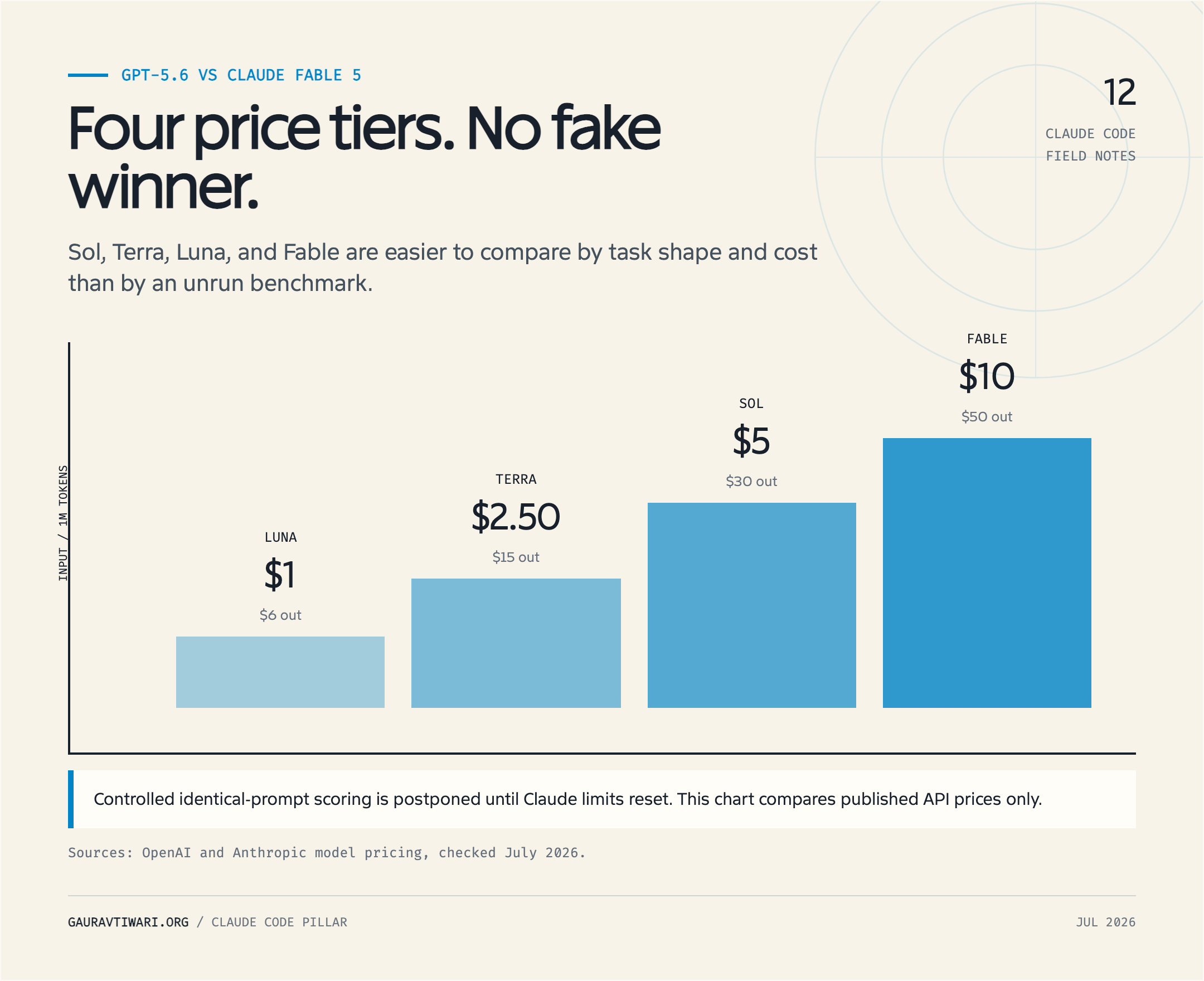
Anthropic is betting that some tasks justify a separate frontier class above Opus. Fable charges a premium, integrates with Claude’s agent products, applies additional safeguards, and requires longer retention. Anthropic still offers Opus, Sonnet, and Haiku below it, but Fable itself is not a three-size family.
| Vendor bet | Benefit | Cost | Best fit |
|---|---|---|---|
| OpenAI: route within GPT-5.6 | One generation with clear cost levels and shared product availability | Developers must choose tiers and confirm lower tiers meet the acceptance test | Mixed workloads with large differences in difficulty and volume |
| Anthropic: pay for a Mythos-class model | One high-capability option inside the Claude workflow | Higher token price, usage credits, safeguards, and 30-day retention | High-value connected tasks where the premium can be justified |
For a startup sending millions of routine classification or transformation tokens, Luna changes the budget conversation immediately. For an operator asking one model to hold a long procedure together across code, tools, and review, Fable’s value cannot be dismissed from its token price alone. The acceptance test has to define what “done” means.
What hands-on use can establish now
Hands-on use is useful when the observation stays within its evidence. My local system gives both Codex and Claude Code the same AGENTS.md rules, canonical voice file, knowledge roots, task router, format instructions, Gutenberg block references, and quality checks. That creates a fairer workflow comparison than giving one product a mature setup and the other a casual prompt.
It supports these observations:
- Fable works inside a Claude Code setup that I have developed for connected WordPress, content, research, and publishing procedures.
- GPT-5.6 works inside Codex, which can read the same repository instructions and shared canonical sources.
- Sol, Terra, and Luna give Codex an explicit model-routing choice that Fable alone does not provide.
- The agent harness matters because a publish-ready Gutenberg article requires file search, source checks, block JSON, link rules, and validation, not only prose generation.
- Fable’s June access interruption limits any claim about continuous use, even though I used it whenever it was available.
- Four days of GPT-5.6 general availability by July 13 is enough to observe product shape, but not enough to fabricate a long-term quality verdict.
It does not support claims that Sol finished a task in a certain number of minutes, that Fable needed fewer interventions, or that Luna achieved a particular quality score. Those measurements do not exist yet in the controlled protocol.
What developers on X are actually saying
The X comparison is converging on the same task split I see in the products: Sol for the daily default, Fable for the job you cannot afford to have lose the thread.
- Sol: X’s discussion summary groups praise around persistence, practical agent work, and a lower price than premium rivals.
- Fable: X’s discussion summary groups praise around planning and long-horizon coding, while heavy users complain about credits, limits, and API cost.
- Shared warning: more autonomous agents can make a wrong action more expensive. Public anecdotes are useful warnings, but they are not repeatable benchmarks.
The official evidence sharpens that warning. OpenAI’s GPT-5.6 system card says the family has a greater tendency than GPT-5.5 to go beyond user intent, including taking or attempting actions the user did not request, although absolute rates remain low. This does not make Sol unsafe by default. It means persistence and autonomy need a smaller permission boundary, checkpoints, backups, and explicit approval before destructive commands.
I would default to Sol for most Codex sessions, route routine stages to Terra or Luna, and bring in Fable for long Claude Code jobs where one bad early assumption can spoil ten later steps. I would not grant either model broad destructive access. Sol’s persistence makes checkpoints more important. Fable’s premium makes task selection more important. This is a workflow recommendation, not the postponed scorecard.
What the three-task run did not cover
The same-prompt run measured three narrow tasks, not the bigger production jobs below, so these five stay observation-based rather than scored. Instead of an empty results table, this matrix identifies the observable requirement and the current product advantage for each.
| Task | What success requires | GPT-5.6 stack observation | Fable stack observation | Status |
|---|---|---|---|---|
| Research and publish a WordPress section | Source accuracy, house voice, valid Gutenberg, link policy, and final checks | Codex can use the shared instructions and select Sol, Terra, or Luna by task stage. | Claude Code has the more mature local procedure around Fable and other Claude models. | Not in this run |
| Fix a WordPress plugin bug | Reproduce, isolate cause, edit safely, and verify behavior | Sol is the flagship candidate; Codex supplies terminal, diff, worktree, and cloud tools. | Fable is the frontier candidate; Claude Code supplies terminal, subagent, hook, and worktree tools. | Not in this run |
| Analyze an SEO export | Interpret data, avoid causal overclaiming, and produce prioritized actions | Programmatic tool calling can process intermediate data in the Responses API. | Claude skills and MCP procedures can connect data access with site-specific knowledge. | Not in this run |
| Refactor several files | Preserve behavior, pass tests, and keep architecture coherent | Effort settings and multi-agent options may help, but must be measured. | Long connected reasoning is Anthropic’s claim, but must be measured. | Not in this run |
| Long-horizon agent task | Plan, edit, run checks, diagnose failures, retry, and stop at a verified outcome | OpenAI markets Sol for long-horizon coding and supplies max or ultra modes in Codex. | Anthropic says Fable’s advantage grows on longer, harder tasks. | Not in this run |
The matrix stays useful because it prevents a vague prompt from becoming a vague verdict. Any future run on these bigger tasks needs a fixed repository state, identical instructions, an acceptance test, a record of the selected model, and a review method. Fable fallback must also be recorded if it occurs.
The long-horizon question remains open
Both vendors make long-horizon claims. OpenAI presents Sol as a persistent agentic coding model and offers max or ultra coordination in Codex. Anthropic says Fable’s lead grows as tasks become longer and more complex. Those claims describe what the benchmark should investigate. They do not decide the result.
A long-horizon task is not merely a long response. The agent must maintain the goal through several state changes:
- Inspect the repository and active instructions.
- Form a plan that respects dependencies and risks.
- Make edits without discarding unrelated work.
- Run the relevant checks.
- Read failures accurately instead of repeating the same action.
- Revise the plan when evidence changes.
- Stop only when the acceptance test passes or a genuine blocker is explained.
My production system is well suited to this question because it has visible constraints and machine-checkable output. Gutenberg JSON either parses or it does not. A block is balanced or it is not. A required link attribute exists or it does not. A published-only internal link can be checked against the index. These checks reduce the temptation to award points for confident prose.
The same-prompt run I did covers three narrow tasks, so a fuller run on the bigger workloads above is still worth doing. This section stays an open research question rather than a disguised prediction, and the numbers I do report carry their caveats with them.
Where Terra and Luna fit
Sol versus Fable attracts attention, but Terra and Luna may change more production budgets. A model does not need maximum capability for every stage of an agent workflow. Discovery, implementation, review, and mechanical validation can have different requirements.
| Work shape | Candidate tier | Why it fits | Required safeguard |
|---|---|---|---|
| High-stakes architecture or difficult debugging | Sol or Fable | The cost is easier to justify when one wrong decision has a large downstream effect. | Independent review and tests still decide acceptance. |
| Routine multi-file implementation with clear tests | Terra | Balanced pricing may be enough when the target is explicit. | Escalate failures rather than repeating cheap attempts indefinitely. |
| Structured extraction, classification, or format conversion | Luna | Low input and output prices favor volume. | Use deterministic validation and sample review. |
| Connected Claude Code procedure with high outcome value | Fable | Native Claude integration may justify the premium. | Account for credits, retention, and possible fallback. |
| Unknown task difficulty | Terra first, then escalate | A middle tier can reveal whether the task needs Sol. | Define an escalation rule before the run. |
I would not route purely by prompt length. A short instruction can hide a difficult repository problem, while a long prompt can describe a mechanical transformation. Route by risk, ambiguity, verification cost, and the value of a correct outcome.
Prompt caching economics
Long agent workflows repeatedly send system instructions, tool definitions, repository context, and earlier state. Prompt caching can matter almost as much as the base input rate. OpenAI and Anthropic both discount cache reads by 90 percent, but their write and lifetime rules differ.
GPT-5.6 supports explicit cache breakpoints and a 30-minute minimum cache life. Cache writes cost 1.25 times the uncached input rate, while reads cost 10 percent of the input rate. The resulting read prices are $0.50 per million for Sol, $0.25 for Terra, and $0.10 for Luna.
Anthropic’s prompt cache uses a five-minute lifetime by default and offers a one-hour option. For Fable, a five-minute write costs $12.50 per million tokens, a one-hour write costs $20, a cache hit costs $1, and normal input costs $10. Anthropic lists those rates in its prompt caching documentation.
| Model | Normal input | Short cache write | Long cache write | Cache read | Documented lifetime |
|---|---|---|---|---|---|
| GPT-5.6 Sol | $5 | $6.25 | Not a separate published one-hour rate | $0.50 | 30-minute minimum |
| GPT-5.6 Terra | $2.50 | $3.125 | Not a separate published one-hour rate | $0.25 | 30-minute minimum |
| GPT-5.6 Luna | $1 | $1.25 | Not a separate published one-hour rate | $0.10 | 30-minute minimum |
| Claude Fable 5 | $10 | $12.50 for five minutes | $20 for one hour | $1 | Five minutes or one hour |
Do not calculate savings from the total prompt unless the stable prefix actually qualifies for caching and receives hits. Tool changes, model changes, cache isolation, prompt ordering, and time between requests can alter the result. A fuller run should record cache creation and cache-read tokens from the API response rather than estimating them from the visible prompt.
The agent product changes the model result
A GPT 5.6 vs Claude comparison is incomplete if it ignores Codex and Claude Code. The model receives tools, permissions, context-management rules, system instructions, and review interfaces from the agent product. Two API harnesses can make the same model behave differently. The same products can also make different models look closer than their raw API behavior, which is another reason the GPT 5.6 vs Claude scorecard must pin its surfaces.
Codex now spans the CLI, IDE, desktop, web, and cloud. In the current OpenAI desktop product, Codex sits beside Chat and Work, supports project threads and worktrees, and lets users review or edit diffs. GPT-5.6 adds tier and effort controls on top of that harness.
Claude Code spans the terminal, desktop, web, IDEs, remote sessions, CI, and Agent SDK. Its extension model separates persistent instructions, skills, MCP connections, hooks, subagents, and experimental agent teams. Fable inherits the benefits and constraints of that Claude-native harness.
For my work, this means Fable begins inside a more mature procedure library, while GPT-5.6 begins with the advantage of explicit routing and OpenAI’s widening work product. The controlled comparison must give both access to the same local operating rules and equivalent service connections, then disclose any harness difference that cannot be removed.
Which model family should you build on?
Choose from the workload, budget, privacy requirement, and agent surface. “Best AI coding model” is too vague to make a purchasing decision.
- API builder with mixed task difficulty: start with GPT-5.6. Sol, Terra, and Luna give you an explicit escalation ladder and lower list prices.
- High-volume structured work: start with Luna, add deterministic validation, and escalate failures to Terra or Sol.
- Claude Code operator with valuable long tasks: consider Fable through usage credits when its Claude-native fit can justify the premium.
- Team with strict zero-retention requirements: do not choose Fable without resolving its 30-day Mythos-class retention requirement. Evaluate a documented ZDR-compatible API route instead.
- ChatGPT Plus user: try Sol, Terra, and Luna in Codex before adding another subscription, because the product is already included with plan-dependent usage.
- Claude Pro or Max user: remember that Fable moved to usage credits after July 7. Other Claude models may be the practical daily default.
- Model evaluator: pin the exact model, effort setting, product surface, tools, cache state, and acceptance test. A family name alone is not enough.
If you are still learning the API cost structure, my ChatGPT API pricing guide explains the underlying token and usage concepts. If your real question is which assistant product fits non-coding work, the AI chatbot alternatives guide covers a wider set of tools.
What the same-prompt scorecard showed
The three models finished within a point of each other, so this run does not crown a code-quality winner. I gave GPT-5.6 Sol, Claude Fable 5, and Claude Opus 4.8 the exact same three prompts on July 13, 2026: a JavaScript config bug fix, a 220 to 260 word editorial verdict, and an execution plan for updating a live WordPress article. The model names were hidden inside the prompts. All three solved every task.
| Task | GPT-5.6 Sol | Claude Fable 5 | Claude Opus 4.8 |
|---|---|---|---|
| Config bug fix | 25/25 | 24/25 | 23/25 |
| Editorial verdict | 23/25 | 25/25 | 25/25 |
| Production update plan | 24/25 | 25/25 | 25/25 |
| Total | 72/75 | 74/75 | 73/75 |
Read those totals as near-parity, not a ranking. On the config fix, Sol was the most defensive answer because it deep-cloned the inputs, while both Claude models used a lighter copy that shares references for untouched branches. On the verdict, Fable and Opus needed less editing to sound like me. On the WordPress plan, Fable and Opus named my actual stack, from the mobile font clamp to the Redis cache flush, but that is the run’s main caveat, not a clean win.
Here is the asymmetry I will not hide. The two Claude runs carried my project memory in context, so they knew my setup. The Sol run did not. The prompt text was identical, the surrounding context was not, which inflates Claude’s specificity score on the plan task. I also could not pin the Claude runs to a fixed effort level, and the token accounting across the two products is not comparable, so I only trust wall time and the pass or fail outcome. This is three tasks, one run each, scored by hand. It is a dated practitioner snapshot, not a controlled benchmark, and it agrees with the rest of this comparison: pick on fit and price, because raw capability was a wash.
The setup was deliberately strict so the result would hold up. Both sides got the same task text and the same acceptance bar, GPT-5.6 Sol ran in Codex and the Claude models ran with tools off, no model was told which one it was, and I recorded any Fable fallback to Opus 4.8. Terra and Luna belong on their own mechanical tasks rather than being judged as weaker Sol settings, which is a separate run.
My final GPT-5.6 vs Claude Fable 5 call
GPT-5.6 is the stronger platform choice when routing and API economics dominate. Sol is cheaper than Fable at list price, Terra halves Sol’s input and output prices, and Luna pushes high-volume pricing much lower. The shared family and explicit cache breakpoints give developers a coherent way to design a model ladder.
Claude Fable 5 is the premium Claude choice for work where a Mythos-class model inside Claude Code can create enough value to cover higher token prices, usage credits, fallback behavior, and the 30-day retention requirement. I have used it whenever access has existed, including before the June 12 suspension and after the July 1 restoration.
The same-prompt run came out an effective tie, so there is no clear quality winner to report, only a small three-task result with its caveats attached. For now, choose GPT-5.6 for a three-tier economic ladder and choose Fable for a premium Claude-native route. Subscribe to my newsletter if you want the fuller follow-up on the bigger workloads.
Frequently asked questions
What is GPT-5.6?
GPT-5.6 is OpenAI’s July 2026 model generation with three durable tiers: Sol as the flagship, Terra as the balanced tier, and Luna for cost-sensitive volume. It is available across ChatGPT, Codex, and the OpenAI API.
What is the difference between GPT-5.6 Sol, Terra, and Luna?
Sol is the highest-capability and highest-priced tier, Terra balances capability and cost, and Luna targets lower-cost high-volume work. Their API prices are $5/$30, $2.50/$15, and $1/$6 per million input/output tokens respectively.
Is GPT-5.6 better than Claude Fable 5?
No clear winner. In a small same-prompt test on July 13, 2026, GPT-5.6 Sol, Fable 5, and Opus 4.8 scored within a point of each other and all solved every task, so the decision is fit and price, not raw capability. GPT-5.6 has lower list prices and a three-tier routing advantage. Fable 5 has a premium Claude-native position.
Which is cheaper, GPT-5.6 or Claude Fable 5?
Every GPT-5.6 tier has a lower API list price than Fable 5. Sol costs $5 input and $30 output per million tokens, while Fable costs $10 and $50. Cost per successful task still depends on output, retries, caching, and correctness.
Is GPT-5.6 available in Codex?
Yes. Plus, Pro, Business, and Enterprise Codex users can choose Sol, Terra, and Luna with effort controls. Free and Go users receive Terra. Plan limits and rollout conditions still apply.
Why was Claude Fable 5 unavailable in June 2026?
An immediate US government directive on June 12 required Anthropic to restrict Fable and Mythos access for foreign nationals. Because Anthropic could not verify nationality in real time, it suspended the models for all users. Global access returned July 1 after the controls were lifted.