
 by
by

OpenAI charges for ChatGPT API usage based on tokens. Your prompt and the model’s response both contribute to the bill, and the rate depends on which model you choose. ChatGPT API pricing for GPT-6 Luna is $0.10 per million ordinary input tokens and $0.50 per million output tokens in Standard mode.
I’d start by evaluating GPT-6 Luna for focused, high-volume work and GPT-6.1 Sol for more demanding tasks. You should compare the cost of getting a usable result, including retries and reasoning, before paying Astra’s higher rate.
ChatGPT API Pricing
GPT-6.1 Sol is the newer Sol model, while Astra is OpenAI’s most capable model for demanding work. The OpenAI API charges separately for the input categories below and for output. All prices are USD per 1 million tokens, using Standard processing with no more than 272,000 input tokens.
| Model | API Model ID | Input | Cached Read | Cache Write | Output |
|---|---|---|---|---|---|
| GPT-6.1 Sol | gpt-6.1-sol | $2.00 | $0.10 | $2.50 | $10.00 |
| GPT-6 Astra | gpt-6-astra | $10.00 | $1.00 | $12.50 | $50.00 |
| GPT-6 Sol | gpt-6-sol | $2.00 | $0.20 | $2.50 | $10.00 |
| GPT-6 Luna | gpt-6-luna | $0.10 | $0.01 | $0.125 | $0.50 |
GPT-6.1 Sol keeps GPT-6 Sol’s ordinary input and output rates, but its cached reads cost 50% less. All 4 models support a 1,050,000-token context window and up to 128,000 output tokens. The full context window is larger than the threshold for base pricing.
- For prompts over 272,000 input tokens, OpenAI applies higher rates to the entire request, including output.
- Input, cached reads and cache writes become 2x their base rates. Output becomes 1.5x its base rate.
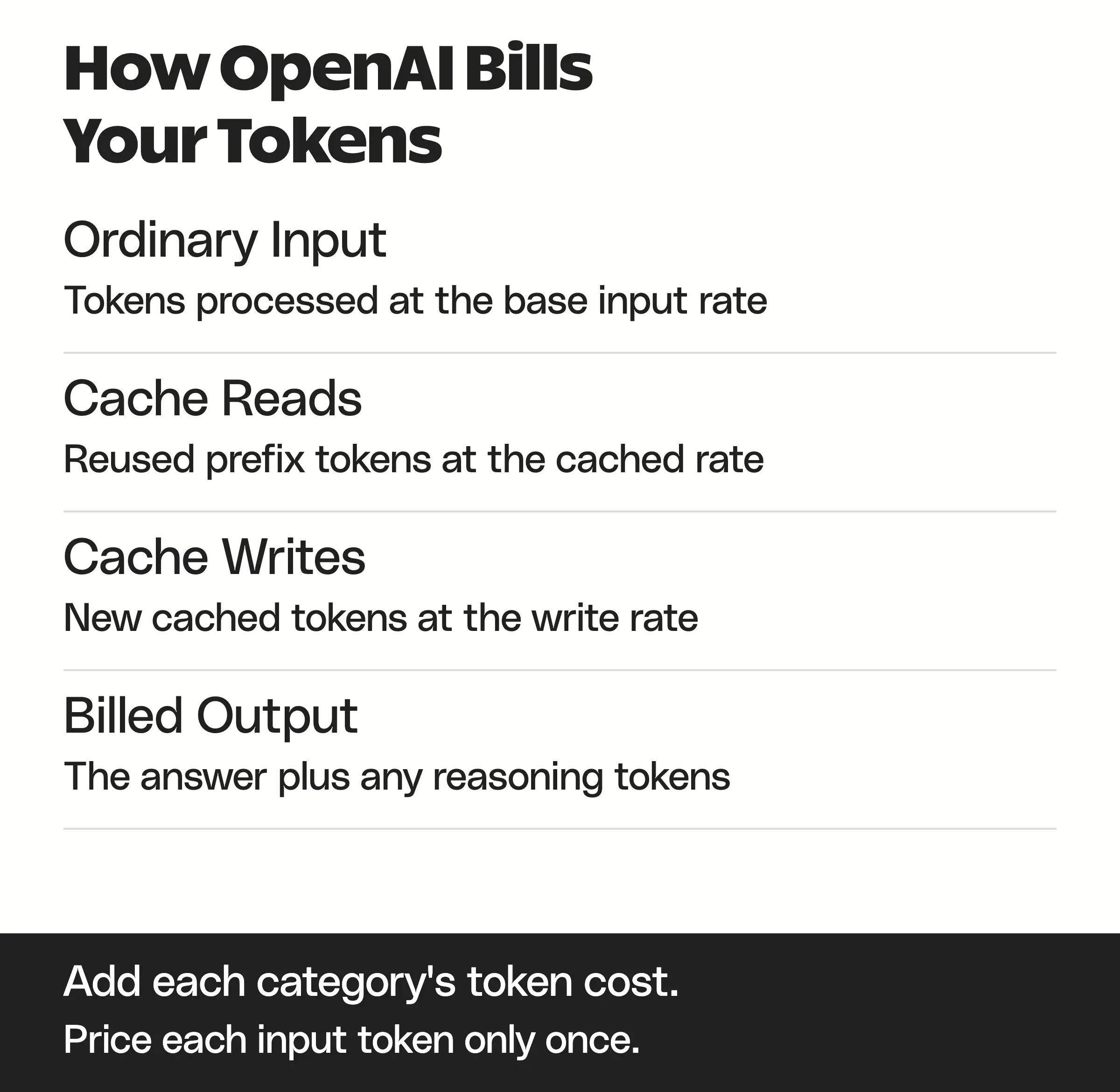
- A cache write uses its own input rate. You don’t add ordinary input pricing again for those same tokens.
| Model | Long-Context Input | Cached Read | Cache Write | Output |
|---|---|---|---|---|
| GPT-6.1 Sol | $4.00 | $0.20 | $5.00 | $15.00 |
| GPT-6 Astra | $20.00 | $2.00 | $25.00 | $75.00 |
| GPT-6 Sol | $4.00 | $0.40 | $5.00 | $15.00 |
| GPT-6 Luna | $0.20 | $0.02 | $0.25 | $0.75 |
Earlier models remain useful when an existing integration depends on them. These are ordinary input and output rates; cached-input rates and availability depend on the model.
| Earlier Model | Input / 1M | Output / 1M | Role |
|---|---|---|---|
| GPT-5.6 Sol | $4.00 | $20.00 | Earlier Sol generation; promotional rates through at least November 21, 2026 |
| GPT-5.6 Terra | $2.00 | $12.00 | Earlier mid-tier model |
| GPT-5.6 Luna | $0.20 | $1.20 | Earlier budget model |
| GPT-5.4 | $2.50 | $15.00 | Earlier general-purpose model |
| GPT-5.4 Mini | $0.75 | $4.50 | Smaller GPT-5.4 model |
| GPT-5.4 Nano | $0.20 | $1.25 | Small GPT-5.4 model |
| GPT-4.1 | $2.00 | $8.00 | Instruction following and coding |
| GPT-4.1 Mini | $0.40 | $1.60 | Smaller GPT-4.1 model |
| GPT-4.1 Nano | $0.10 | $0.40 | Low-cost, non-reasoning tasks |
| GPT-4o | $2.50 | $10.00 | Older general-purpose model |
| GPT-4o mini | $0.15 | $0.60 | Older budget model |
| o4-mini | $1.10 | $4.40 | Earlier reasoning model |
| o3 | $2.00 | $8.00 | Earlier reasoning model |
| o3 Pro | $20.00 | $80.00 | More compute for o3 reasoning |
| o1 | $15.00 | $60.00 | Older reasoning model |
GPT-4.1 Nano has a slightly lower output rate than GPT-6 Luna. That can matter for simple tasks where it already gives you acceptable results. A lower rate by itself doesn’t prove better value on tasks that require reasoning or more retries.
What Are Tokens?
A token is a piece of text the model processes. For English, 1 token is roughly 4 characters or 0.75 words, so a 1,000-word article is about 1,300 tokens. The actual count depends on the model’s tokenizer and the text. You can check a sample with OpenAI’s tokenizer.
- Input includes the instructions and context sent with each request. A growing conversation can resend a large amount of history.
- Output includes generated tokens. On reasoning models, billed output can include reasoning tokens you don’t see in the final answer.
- Word counts are estimates. Code and non-English text can have different token counts for the same visible length.
When you’re using AI tools in your marketing stack, the number of calls alone won’t tell you the cost. The amount of context each tool sends matters too.
The same distinction helps when you format blog posts for AI search: readable words and machine tokens measure different things.
API Cost Examples
For a hypothetical request with 1,000 ordinary input tokens and 300 billed output tokens, GPT-6 Luna costs $0.00025. The same token volume on GPT-6.1 Sol costs $0.005, or 20x as much. I’d use that comparison as a starting budget, then check whether the cheaper model meets the task’s requirements.
These are calculated examples using Standard short-context rates. They assume no cache reads or writes. Output means total billed output, including any reasoning tokens; tool fees and taxes are excluded.
| Example Task | Model | Input / Billed Output Tokens | Cost / Request | Cost / 1,000 Requests |
|---|---|---|---|---|
| Short classification | GPT-6 Luna | 500 / 50 | $0.000075 | $0.07 |
| Support reply | GPT-6 Luna | 1,000 / 300 | $0.00025 | $0.25 |
| Long answer | GPT-6 Luna | 500 / 2,000 | $0.00105 | $1.05 |
| Code explanation | GPT-6.1 Sol | 2,000 / 1,000 | $0.014 | $14.00 |
| Detailed analysis | GPT-6 Astra | 10,000 / 5,000 | $0.35 | $350.00 |
| Simple support reply | GPT-4.1 Nano | 1,000 / 300 | $0.00022 | $0.22 |
For requests without caching, token cost is (input tokens x input rate + billed output tokens x output rate) / 1,000,000. If caching applies, split input into ordinary tokens, cache reads and cache writes, then price each group once. Tool charges are added separately.
Estimate monthly API spend with editable model rates, token volumes, caching, batch discounts, scenarios, and a budget cap.
The workbook uses editable example rates. You should enter the current rates for your chosen model and processing mode before estimating your monthly budget. Cache-write charges, long-context premiums and tool fees need separate allowance.
ChatGPT Plus vs. API
ChatGPT Plus has a $20 monthly base price, while API-key usage is billed separately. A Plus subscription doesn’t include a general-purpose API credit balance. The cheaper option depends on your actual token volume and whether your work needs programmatic access.
- ChatGPT Plus suits interactive work in ChatGPT, subject to the plan’s usage limits. Model availability can differ between Chat, Work and Codex.
- The API suits your own application or WordPress integration, where software sends requests using your API key.
- GPT-6.1 Sol is available in the API, ChatGPT Work and Codex. Its release doesn’t mean it is available in ordinary Chat.
You can compare the ChatGPT plan options with your estimated API bill. If you only need occasional automated requests, GPT-6 Luna can cost far less than a monthly subscription.
How to Reduce API Costs
Model selection and context size usually offer the first opportunities to save. You should measure the cost per usable result, because retries can erase a cheap model’s advantage.
- Choose the smallest model that passes your checks. GPT-6 Luna is worth evaluating for focused volume. GPT-6.1 Sol is the next comparison for demanding work; Astra should justify its higher bill through better results on your tasks.
- Trim repeated context. You should send the relevant material rather than an entire archive. Keeping a prompt below the long-context threshold can avoid a higher rate on the full request.
- Reuse stable prompt prefixes. Prompt caching can reduce repeated input costs. GPT-6.1 Sol cache reads are 95% below ordinary input, but the initial write costs 1.25x. A cache that is written and never reused can increase spending.
- Cap output and reasoning appropriately. In the Responses API,
max_output_tokenscaps generated output, including reasoning. Allow enough room for both reasoning and a useful answer. - Use slower processing when the job allows it. Batch offers 50% lower input and output rates with a completion window of up to 24 hours. Flex also uses half-price rates for supported models, with availability and latency tradeoffs.
- Budget for faster modes. GPT-6 Fast mode costs 2x Standard. GPT-6.1 Sol Ultrafast costs 6x Standard, so faster completion needs to be worth the premium.
- Cache suitable finished responses. An application can reuse an answer when the same request has the same valid result. User permissions and changing information still need checking.
- Configure spend controls. OpenAI’s spend alerts and hard limits have different effects. An alert leaves traffic running. An enforced hard limit stops affected requests, but enforcement can lag slightly. Your application should handle the resulting errors.
Search and other built-in tools can add charges beyond text tokens. Regional processing can also add a premium. You should include those costs before treating a token-only estimate as the whole bill.
ChatGPT API Costs for WordPress
A WordPress site using your OpenAI API key pays the same model rates as any other application. The important difference is what the plugin sends and how many times it calls the model. Plugin subscriptions can add a separate charge.
WordPress 7.0 introduced the AI Client and Connectors infrastructure. Provider plugins connect it to AI services, and compatible plugins can use that shared connection. You still need a configured provider and support for the model and API features you choose.
- Rank Math Content AI uses its own credit system. Its credit price is a different bill from direct OpenAI token usage.
- AI Engine accepts provider API keys and offers chatbots and AI tools. Your provider usage and any premium plugin license are separate costs.
- AI Puffer supports AI workflows using your provider credentials. You should confirm which models its current integration accepts.
- AI Product Tools offers bulk product-content workflows for WooCommerce. Context per product, response length and retries determine the token bill.
Suppose your store sends 1,000 ordinary input tokens and uses 500 billed output tokens for each product description. At GPT-6 Luna’s base rates, 100 descriptions cost $0.035 in text tokens. That example excludes cache writes, tool calls and retries; a chatbot that repeatedly sends a long conversation can cost much more.
Before adding a key to a plugin, you should check whether it supports gpt-6.1-sol or gpt-6-luna and the Responses API where needed. GPT-6.1 Sol tool calling requires Responses; its Chat Completions support doesn’t include tool calling.
You can start with a small budget in your OpenAI dashboard and turn on hard-limit enforcement if you want requests to stop at that amount. An alert alone won’t do it.
OpenAI vs. Claude vs. Gemini
GPT-6.1 Sol and Claude Sonnet 5.5 have the same ordinary input and output rates. Price alone won’t tell you which gives the better answer for your application, and different tokenizers can bill different token counts for the same text.
| Model | Input / 1M | Output / 1M | Pricing Boundary |
|---|---|---|---|
| OpenAI GPT-6.1 Sol | $2.00 | $10.00 | Standard, input up to 272K |
| OpenAI GPT-6 Astra | $10.00 | $50.00 | Standard, input up to 272K |
| OpenAI GPT-6 Luna | $0.10 | $0.50 | Standard, input up to 272K |
| Claude Fable 5.1 | $10.00 | $50.00 | Base text rates |
| Claude Opus 5.5 | $4.00 | $20.00 | Base text rates |
| Claude Sonnet 5.5 | $2.00 | $10.00 | Base text rates |
| Claude Haiku 5.5 | $0.10 | $0.50 | Input up to 100K |
| Gemini 3.8 Flash | $0.75 | $3.75 | Promotional rates through December 31, 2026 |
| Gemini 3.5 Flash-Lite | $0.30 | $2.50 | Standard text rates |
| Gemini 3.1 Pro Preview | $2.00 | $12.00 | Input up to 200K |
The Claude pricing guide raises Haiku 5.5 to $0.50 input and $2.50 output for prompts over 100,000 tokens. Google’s pricing schedules Gemini 3.8 Flash at $1.50 input and $7.50 output from January 1, 2027. Gemini 3.1 Pro Preview rises to $4 input and $18 output above 200,000 input tokens.
For marketing automation tasks, I’d compare a small model against your actual inputs and check the failure cases before scaling it. You should compare total billed tokens and successful outcomes, including each provider’s caching rules and tool fees.
Frequently Asked Questions
How much does the ChatGPT API cost?
GPT-6 Luna costs $0.10 per million ordinary input tokens and $0.50 per million output tokens. GPT-6.1 Sol costs $2 input and $10 output; GPT-6 Astra costs $10 input and $50 output. These are Standard rates for prompts up to 272,000 input tokens. Cache reads, cache writes, larger prompts and tools can change the bill.
What is a token in the OpenAI API?
A token is a piece of text processed by a model. For English, 1 token is roughly 4 characters or 0.75 words. Exact counts depend on the tokenizer and the text. Reasoning tokens can be billed as output even when they do not appear in the final answer.
Is ChatGPT Plus or the API cheaper?
ChatGPT Plus has a $20 monthly base price and plan usage limits. API-key usage is billed separately. Occasional requests on a low-cost model can cost less than the subscription, while applications that need programmatic access should budget for the API. Model access can differ between Chat, Work and Codex.
How does OpenAI pricing compare to Claude and Gemini?
GPT-6.1 Sol and Claude Sonnet 5.5 both charge $2 input and $10 output per million tokens at their base rates. GPT-6 Luna and Claude Haiku 5.5 both start at $0.10 input and $0.50 output, but their large-prompt thresholds differ. Gemini 3.8 Flash charges promotional rates of $0.75 input and $3.75 output through December 31, 2026. Token counts and tool fees also affect the comparison.
Is the ChatGPT API free?
You should budget for paid OpenAI API usage and should not assume a new account receives trial credits. ChatGPT plan access does not provide a general-purpose API credit balance. Gemini offers a free tier for selected models, subject to its limits and data-use terms.
What is the cheapest AI API model available?
GPT-6 Luna is OpenAI’s current efficient model for focused volume at $0.10 input and $0.50 output per million tokens. Earlier models can have lower individual rates: GPT-5 Nano lists $0.05 input and $0.40 output, but is deprecated. GPT-4.1 Nano lists $0.10 input and $0.40 output. Availability and successful task completion matter more than the lowest input rate.
How much does the ChatGPT API cost for WordPress?
A WordPress integration using your OpenAI key pays the chosen model’s token rates. At GPT-6 Luna’s base rates, 100 hypothetical product descriptions with 1,000 ordinary input and 500 billed output tokens each cost $0.035. Plugin licenses, cache writes, tools and retries are extra. Model and endpoint compatibility must also be checked.
How do I reduce my OpenAI API costs?
Choose a model that meets your quality checks, trim context, reuse stable cached prefixes and cap billed output. Batch and Flex can cut base rates by 50% for supported work. Cache writes cost more than ordinary input, so reuse matters. Configure alerts and an enforced hard limit if needed; alerts alone do not stop API usage.
Tell Google you want more of this.
Add Gaurav Tiwari as a preferred sourceOne tap, and this site shows up more often in your own Top Stories, AI Overviews and AI Mode. Remove it any time.