
Claude Fable 5 Review: My Verdict, Interruptions Included
Claude 5 changed how much work I hand to Claude Code in one go. Claude Fable 5 has been my default whenever it has been available during this five-week test window, and my verdict is narrow but firm: use it for long, multi-step work where losing the thread is expensive. For quick edits, lookups, and single-file fixes, it is more model than you need.
At xhigh reasoning effort, Fable 5 is the first Claude model that has made the “give it the whole job” workflow feel dependable in my content and WordPress work. It plans further ahead, needs less steering, and keeps more constraints alive across a long task. The tradeoffs are just as clear: the API costs $10 per million input tokens and $50 per million output tokens, sensitive requests can fall back to Opus 4.8, and the extra thinking adds little to mechanical work.
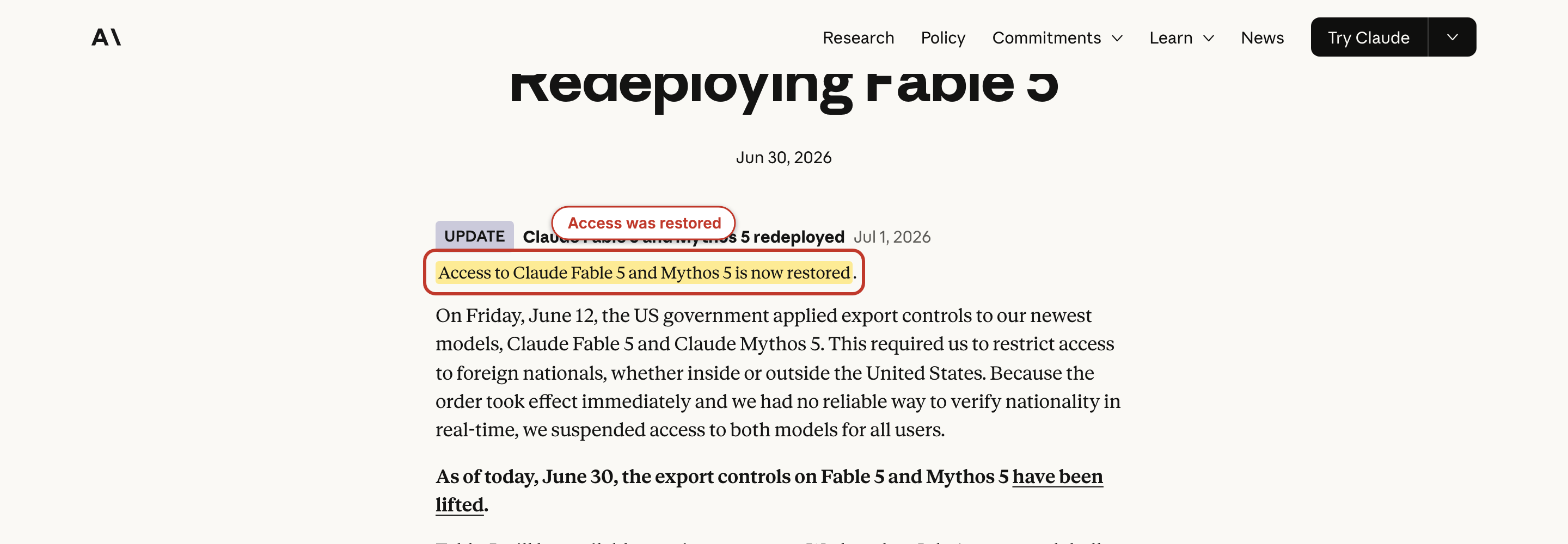
Verdict: Claude Fable 5 is worth making your Claude Code default if you delegate migrations, research, multi-file changes, or full production workflows. Keep Sonnet or Opus available for fast, bounded tasks. Anthropic launched Fable 5 on June 9, suspended it on June 12 after a US export-control directive, and restored global access on July 1. That interruption matters when you read any review claiming five uninterrupted weeks of use.
| Tested by | Gaurav Tiwari |
| Evaluation window | June 9 to July 13, 2026, with the June 12 to July 1 service suspension disclosed |
| Model and effort | Claude Fable 5 at xhigh effort |
| Primary environment | Claude Code |
| Work tested | Article production, WordPress development, SEO analysis, and publishing workflows |
| Pricing checked | July 13, 2026 |
| Best for | Long, connected jobs with many constraints |
| Avoid as default if | Most of your work is quick chat, small edits, or cost-sensitive API automation |
Pros
- Holds plans and constraints together across long Claude Code sessions
- Better fit for multi-file and multi-stage production work
- Available through Claude, the API, and major cloud platforms
- Reasoning effort can be raised for the jobs that justify it
Cons
- $10 input and $50 output per million API tokens
- Usage credits are required on subscription plans after the included window
- Safety classifiers can reroute or refuse benign technical requests
- Mandatory 30-day retention rules out some sensitive workloads
Quick comparison: Fable 5 is my pick over Opus 4.8 for a large job with many dependencies. Opus or Sonnet remains the better default for short work where response time and cost matter more than planning depth. Against GPT-5.6 Sol, Fable costs more on the API, while four days of GPT-5.6 availability isn’t enough evidence for me to claim a dependable winner.
What Is Claude 5 and Fable 5?
Claude Fable 5 is Anthropic’s first generally available Mythos-class model, a capability tier above Opus. For most users, Claude 5 currently means Fable 5, while Anthropic describes Fable 5 and Claude Mythos 5 as the same underlying model in two configurations: Fable has stronger safeguards for broad use, while Mythos removes some of those limits for vetted organizations working through Project Glasswing.
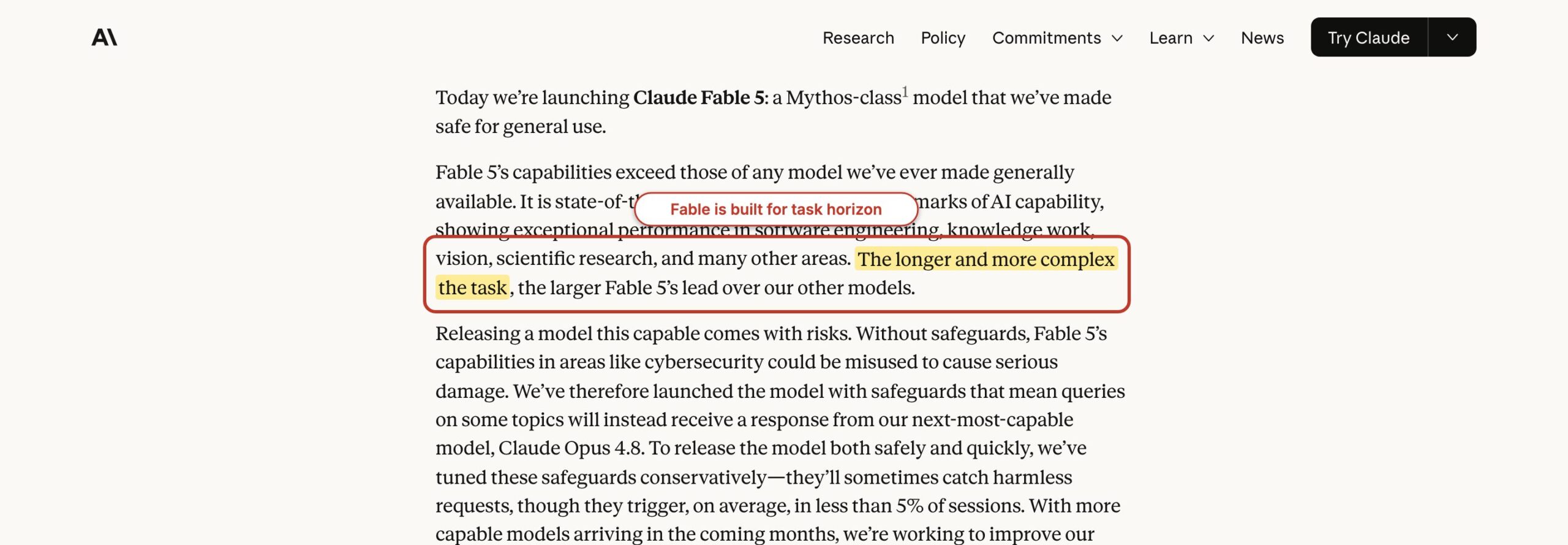
The naming in one sentence: Mythos-class is the tier, Fable 5 is the public safeguarded model, and Mythos 5 is the restricted configuration with some cyber, biology, or chemistry limits lifted.
This trips up people because Claude previously used Haiku, Sonnet, and Opus as both product names and capability levels. Claude 5 adds Mythos-class above Opus, but the model most customers can select is called Fable rather than Mythos. Think of Fable and Mythos as two doors into the same engine. The analogy stops at the door: the safety layer can change which engine actually answers a flagged Fable request, because Anthropic may route it to Opus 4.8.
The official launch description makes two claims worth separating. First, Anthropic says Mythos-class sits above Opus in capability. Second, it says Fable’s lead over earlier Claude models grows as tasks become longer and more complex. Those are vendor claims, not my benchmark results. My narrower observation is that the claim fits the kind of improvement I noticed in Claude Code: less steering on connected work, not a magical improvement on every prompt. You can read Anthropic’s Fable 5 and Mythos 5 announcement for the company’s evaluations and system-card links.
| Model | What it is | Who can use it | Safety behavior |
|---|---|---|---|
| Claude Fable 5 | Generally available Mythos-class model | Claude users, API customers, and supported cloud customers | Flagged requests may be refused or routed to Opus 4.8 |
| Claude Mythos 5 | Same underlying model with some safeguards lifted | Vetted Project Glasswing and trusted-access organizations | Fewer limits in approved cyber or scientific work |
| Claude Opus 4.8 | Previous top Opus-class model | Broad Claude access | Also serves as Fable’s fallback model |
Project Glasswing started as a restricted program for defensive cybersecurity. Mythos Preview arrived there in April 2026, followed by Mythos 5 in June. Fable 5 is the route Anthropic built to offer most Mythos-level capability to everyone else without opening the highest-risk cyber and life-science behavior to general use.
What Changed in My Daily Claude Code Work
Fable 5 changed the size of the job I am willing to hand over. With earlier Claude models, I tended to split research, planning, drafting, Gutenberg conversion, and validation into separate supervised passes. With Fable at xhigh effort, I am more comfortable giving Claude Code the full sequence and checking the evidence and output at the end of each meaningful stage.
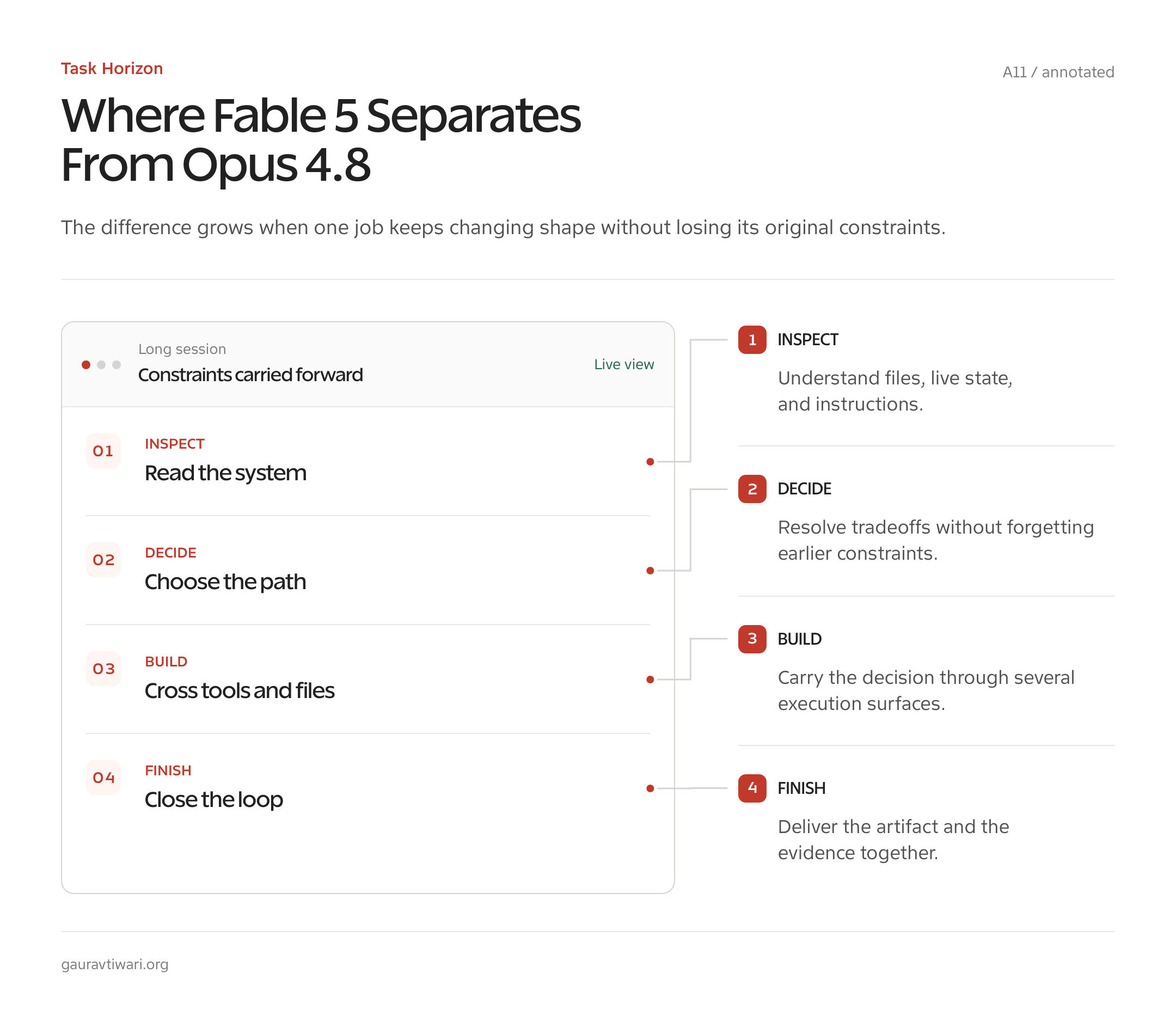
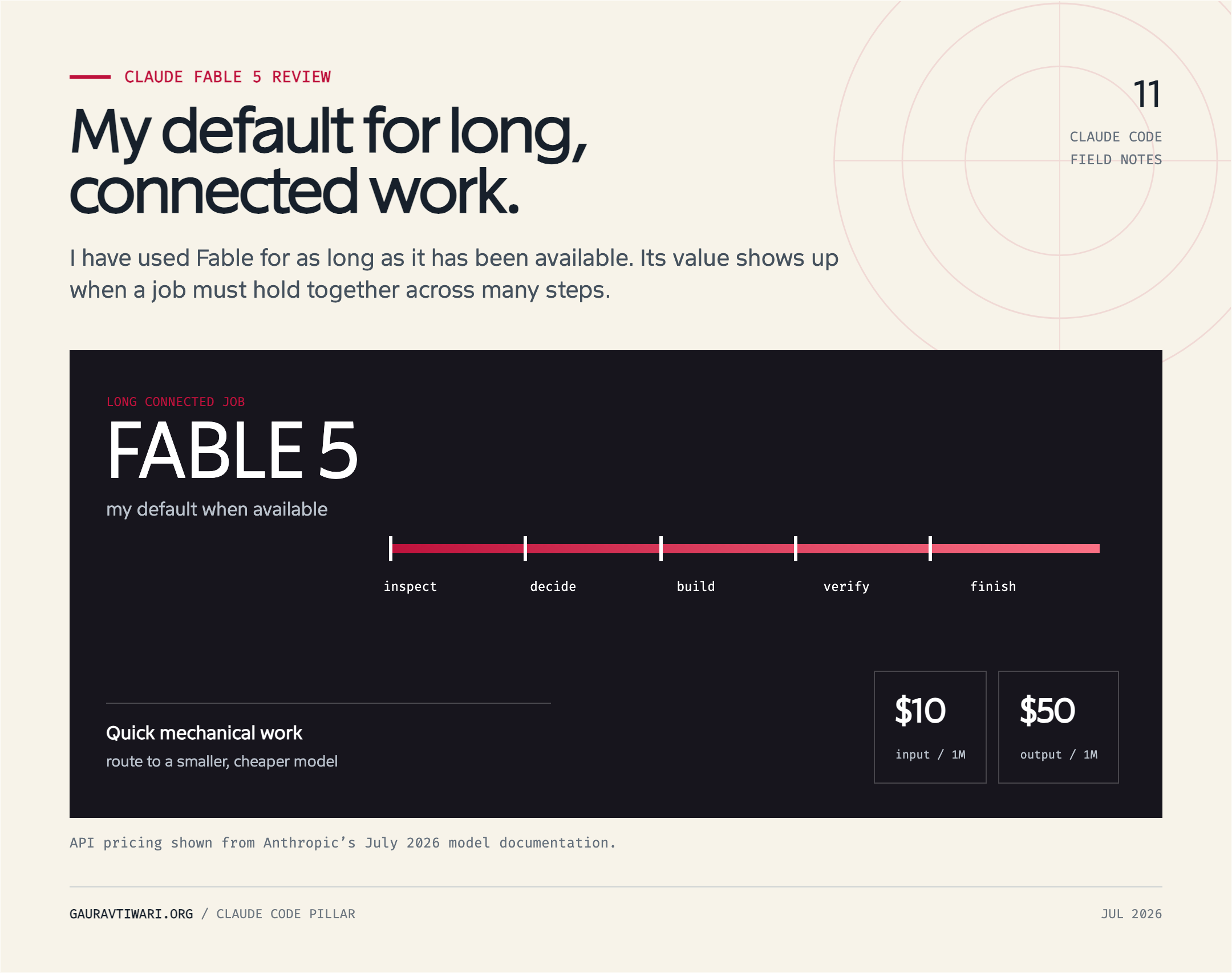
That distinction matters more than a prettier paragraph or a cleverer code completion. A long production job can fail while every individual step looks competent. The brief drifts away from the draft. The draft loses a publishing constraint. The Gutenberg conversion breaks a block comment. A later edit quietly removes a shortcode. Fable 5 has been better at keeping those dependencies connected in one working thread.
I Interrupt the Plan Less
The biggest improvement is planning depth. I still review plans before a risky action, but I spend less time correcting the sequence itself. Fable is more likely to inspect the source files, identify the fragile parts, and put verification after the mutation rather than treating a successful command as proof that the job is done.
My work makes that easy to see. A WordPress article isn’t only prose. It can contain ACF repeaters, HTML tables, shortcodes, internal links, SEO fields, media IDs, and block comments that must survive an update. The planning model has to understand both the editorial result and the serialization contract. That is where longer reasoning pays for itself.
I Hand Over Connected Work, Not Blind Authority
Better planning doesn’t mean I remove approval points. It means I place them where they catch meaningful risk. Claude Code can prepare a full article, inspect the published index, build valid Gutenberg blocks, and run local checks as one job. It still shouldn’t publish unless I explicitly authorize a WordPress change.
The same rule applies to site work. My WP-MCP workflow gives an AI assistant structured access to WordPress, but access isn’t judgment. Fable 5 is better at carrying the approval and verification rules through a long plan. I still treat the live site, REST readback, and rendered page as the evidence.
The Quality Gate Still Matters
Fable 5 doesn’t make generated copy publishable by default. It can still repeat a point, over-polish a sentence, or follow a bad premise with impressive discipline. My Stop Slop checks remain part of every serious draft because model quality and editorial quality are different problems.
Evidence boundary: This section reports my production use. It isn’t a controlled benchmark, and I don’t have a clean intervention-per-task dataset that supports a numeric claim. I would rather leave the number blank than manufacture precision around a strong qualitative change.
Claude Fable 5 vs Opus 4.8
Choose Fable 5 over Opus 4.8 when the task is long enough for planning failures to dominate. Choose Opus, Sonnet, or a faster mode when the task is bounded and obvious. Fable’s advantage in my work is selective: it shows up in orchestration, constraint retention, and multi-stage judgment, not in every isolated answer.
A useful way to decide is to ask where the job can go wrong. If one incorrect early assumption can poison ten later steps, spend the extra reasoning on Fable. If you can state the change in one sentence and verify it with one test, a smaller model usually gets you there with less waiting and lower cost.
| Work type | My default | Reason |
|---|---|---|
| Multi-file refactor or migration plan | Fable 5 | More value from long planning and cross-file constraint tracking |
| Research-to-Gutenberg article workflow | Fable 5 | Keeps source, voice, SEO, block, and validation rules connected |
| Single CSS or copy edit | Opus or Sonnet | The task is easy to state and easy to verify |
| Quick explanation or lookup | Sonnet | Faster response matters more than long-horizon planning |
| Sensitive cyber, biology, or chemistry request | Expect policy routing | Fable may refuse or move the request to Opus 4.8 |
There is another wrinkle: Opus 4.8 isn’t only an alternative in the model picker. It is part of Fable’s safety architecture. A request can begin under Fable and receive an Opus response after a classifier flags it. So a comparison that ignores the fallback is describing the model label, not always the model that answered.
How the Fable 5 Safety Fallback Works
Fable 5 uses separate safety classifiers to inspect requests and outputs in higher-risk areas. Anthropic says many flagged cybersecurity and biology requests are routed to Opus 4.8, while some requests are refused. The user isn’t charged Fable pricing for a rerouted request.
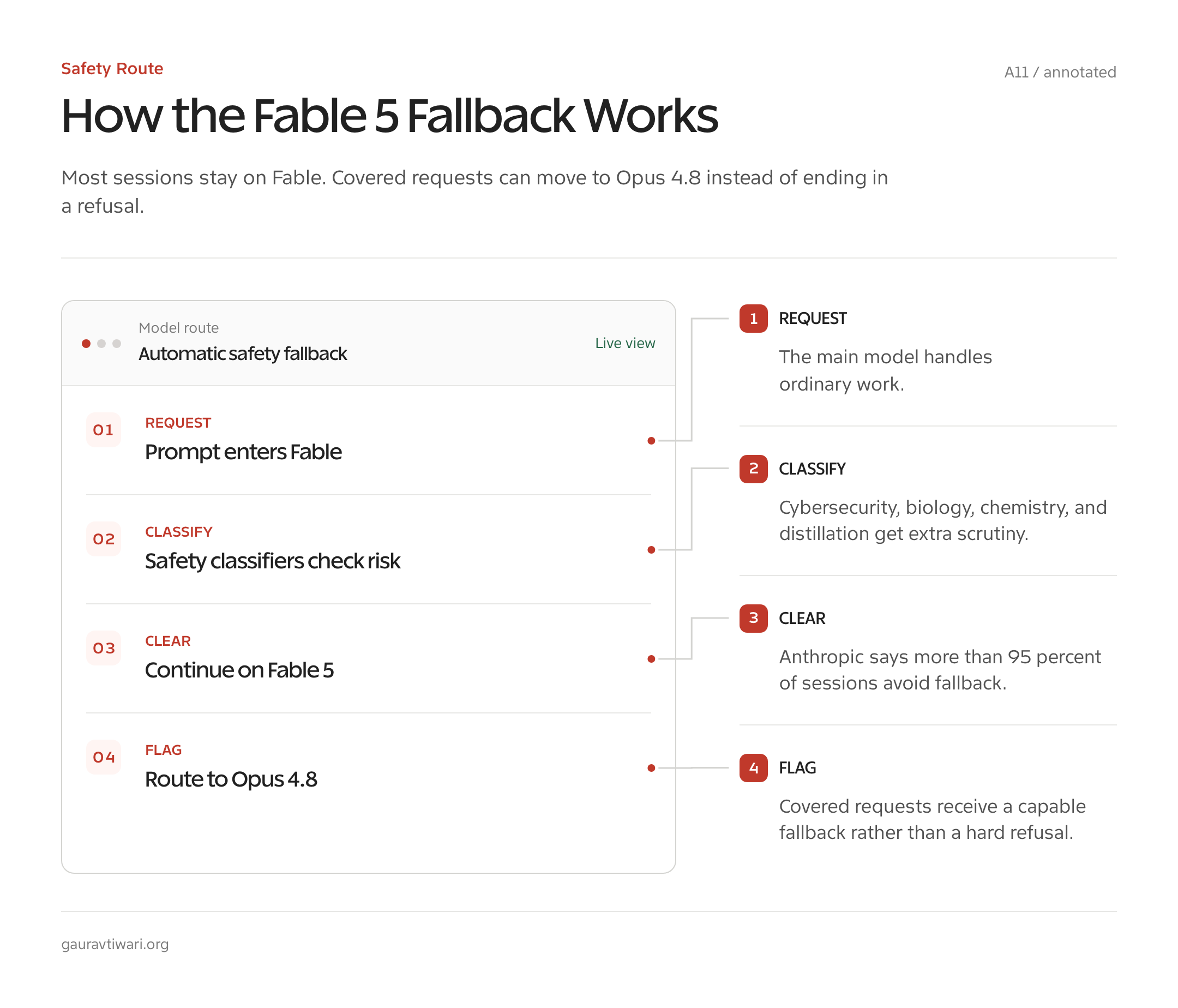
A classifier is a smaller automated system that decides whether a prompt or response crosses a risk boundary. Think of it as a security checkpoint before and during the main model’s work. The comparison has a limit: airport security follows public categories, while an AI classifier uses learned patterns and can misclassify a harmless coding or debugging request.
At launch, Anthropic said the fallback safeguards triggered in less than 5% of sessions on average. Do not treat that as a permanent July rate. After the June suspension, Anthropic trained a stricter cyber classifier and acknowledged that the change flags benign coding and debugging requests more often. The company says the updated classifier blocks the specific bypass behind the suspension in more than 99% of its tests.
That history changes the practical advice. If Fable refuses a reasonable security-related request, restate the defensive context and narrow the scope, but don’t try to bypass the safeguard. If the work is ordinary content, SEO, or WordPress maintenance, the fallback is less likely to shape your day. If your job is vulnerability research, malware analysis, molecular biology, or chemistry, it may shape the entire product experience.
The product also carries a privacy tradeoff. Anthropic’s current Fable 5 page requires 30-day data retention for safety monitoring. Anthropic says business data retained under this policy isn’t used to train new Claude models and is deleted after 30 days in almost all cases. If your contract or compliance policy requires zero data retention, Fable 5 is the wrong model until those rules change.
Claude Fable 5 Pricing and Value
Claude Fable 5 costs $10 per million input tokens and $50 per million output tokens through the Claude API. Prompt-cache reads get Anthropic’s existing 90% input discount, and US-only inference costs 1.1 times the standard input and output rates. This is a premium model with premium output pricing.
| Model | Input per 1M tokens | Output per 1M tokens | Best cost case |
|---|---|---|---|
| Claude Fable 5 | $10 | $50 | Hard jobs where fewer wrong turns offset the token premium |
| GPT-5.6 Sol | $5 | $30 | Frontier work where API price matters |
| GPT-5.6 Terra | $2.50 | $15 | Everyday work with a lower ceiling and lower bill |
| GPT-5.6 Luna | $1 | $6 | Fast, mechanical, high-volume tasks |
The rate table makes one thing plain: Fable output costs $20 more per million tokens than GPT-5.6 Sol, and five times Luna’s output rate. That doesn’t make Fable overpriced by itself. Cost per token is the wrong unit when a cheaper model sends a long job down the wrong path. But Fable has to earn its premium through fewer corrections, stronger first plans, or a finished result you can trust after verification.
On subscriptions, Anthropic currently lists Fable 5 for Pro, Max, Team, and Enterprise users. The July 1 redeployment included Fable for up to 50% of weekly limits through July 7 on eligible plans; after that date, Anthropic said continued use would require usage credits. Standard Enterprise seats also need credits enabled. Check your model picker and credit settings before assuming your normal Claude allowance covers a long xhigh session.
I would not make Fable the API default for every request. Route the work. Use the expensive model where a mistake compounds across stages, and use a cheaper model where the answer is easy to test. The same principle appears in my ChatGPT API pricing guide: token rates matter, but task routing decides whether the final bill is sensible.
Claude Fable 5 vs GPT-5.6 Sol
GPT-5.6 Sol is the sharper price challenge to Fable 5, but I don’t have enough comparable use to declare a model-quality winner. OpenAI released the GPT-5.6 family on July 9, 2026, four days before this review’s fact check. A four-day look at Sol isn’t equivalent to my longer Fable evaluation window.
The product strategies are already different. Anthropic sells Fable as one Mythos-class model whose effort can rise with the job. OpenAI splits GPT-5.6 into Sol, Terra, and Luna, then gives each tier its own effort controls and price. Anthropic asks you to choose how hard the frontier model should think. OpenAI asks you to choose both the model tier and the effort.
OpenAI’s official GPT-5.6 announcement prices Sol at $5 input and $30 output per million tokens, Terra at $2.50 and $15, and Luna at $1 and $6. It also makes the three models available in Codex and the API, with plan-dependent access in ChatGPT. On list price alone, OpenAI wins. On the work I trust Fable to carry today, my evidence still favors Fable because that is the model I have used longer in production.
A proper comparison needs the same tasks, fixed instructions, recorded interventions, elapsed time, token use, and independent scoring. Those completed Fable and Opus results are not in my test folder yet, so I am not turning an unfinished protocol into a benchmark table. Price is confirmed. My Fable experience is confirmed. A cross-model performance winner remains open.
What the X reaction gets right
The useful signal on X is a task split, not a clean winner. The recurring Sol reaction is that it feels like a practical daily model: persistent, capable in agent work, and cheaper than Fable at API list price. The recurring Fable reaction centers on planning and keeping long coding jobs coherent, followed quickly by complaints about credits, limits, and cost.
- X’s Sol discussion summary groups praise around persistence and practical everyday work.
- X’s Fable discussion summary groups praise around planning and long-horizon coding, with cost and usage limits as the main complaint.
- These are summaries of public reactions, not controlled measurements. They help identify what to test; they do not settle which model writes better code.
My opinion is firmer after reading that discussion. Sol is the more rational default when the acceptance tests are clear and its permissions are narrow. Fable is the premium model I would choose when one early planning mistake can damage ten later stages. I have used Fable for as long as it has been available, so that preference comes from more than launch-week excitement.
Sol’s persistence is not pure upside. OpenAI’s GPT-5.6 system card says the new models show a greater tendency than GPT-5.5 to go beyond user intent, including actions the user did not request, although the absolute rates remain low. I would give Sol narrow directories, checkpoints, backups, and an explicit approval gate for destructive commands. Sol wins the default economics. Fable earns its premium selectively. The controlled quality winner remains undecided.
How to Get Claude Fable 5
Claude 5 access is broad again after the July 1 redeployment. Fable 5 is available through Claude’s paid plans, Claude Code, the Claude API, and supported cloud marketplaces, but subscription usage and cloud-region availability can still differ.
- Claude Code: run
/model, select Fable 5, and choose a higher effort only when the task can use it. I use xhigh for long production jobs, not quick edits. - Claude.ai: Anthropic lists Fable 5 for Pro, Max, Team, and Enterprise users. Usage credits apply after the temporary included allowance ended on July 7.
- Claude API: call the model ID
claude-fable-5. Standard pricing is $10 per million input tokens and $50 per million output tokens. - Cloud platforms: Anthropic’s current product page lists Amazon Web Services, Google Cloud, and Microsoft Foundry. Check the region and retention setting before moving a production workload.
- Restricted Mythos access: Mythos 5 isn’t a normal model-picker upgrade. It remains tied to vetted Project Glasswing and trusted-access organizations.
Start with one job you already know well. Give Fable the full requirements, define the stop conditions, and inspect the plan before it edits anything. Then compare how much steering the task needs against your current model. That test tells you more about value than a public benchmark that has nothing to do with your work.
Who Should Use Fable 5?
The practical Claude 5 buyer is someone whose tasks fail through coordination rather than raw code or writing ability. The more dependencies, tools, files, and validation steps a job contains, the easier it is to justify Fable 5.
Developers Running Long Claude Code Tasks
Use Fable for migrations, repository-wide changes, debugging that crosses services, and work where the model must inspect before acting. Its planning depth is wasted on a one-line fix, but useful when the correct edit depends on a chain of earlier discoveries.
Content Teams With Strict Production Rules
Fable makes sense when an article has to satisfy a brief, current sources, house voice, internal-link rules, Gutenberg serialization, structured data, and local checks in one pass. If you only need a rough first draft, a smaller model is enough. The value appears when the constraints must survive all the way to a publish-ready file.
Operators Who Can Verify the Result
A stronger agent model increases the size of the change it can attempt. That raises the value of tests, readbacks, diffs, and browser checks. If you already have those gates, Fable can save supervision. If you cannot verify what changed, handing it a bigger job only creates a bigger unknown.
Who Should Skip Fable 5?
Skip Fable 5 as your default if your work is short, your API budget is tight, your data policy requires zero retention, or your subject routinely hits the model’s safety boundaries. Those aren’t edge cases. They are four common reasons to pick another model.
- Quick chat and single-file edits: Sonnet or Opus gets to a verifiable answer with less waiting.
- High-volume API jobs: Fable’s $50 output rate is hard to defend for classification, extraction, formatting, and other bounded tasks.
- Zero-retention workloads: Fable requires 30-day retention for safety monitoring.
- Cybersecurity, biology, and chemistry: false positives, refusals, or Opus 4.8 routing may interrupt legitimate work.
- Users without a test or review step: a longer autonomous run still needs evidence at the end.
If you are deciding between several assistants rather than models inside Claude, my published AI chatbot comparison covers the broader product tradeoffs. Fable’s strongest case is not casual chat. It is the workbench inside Claude Code.
My Claude Fable 5 Verdict
Claude Fable 5 stays as my Claude Code default for the long jobs. It has changed my delegation threshold: I am willing to hand over a connected production workflow, review the plan at the right points, and judge the completed evidence instead of steering every intermediate move.
I won’t use it for everything. The API premium is too large for mechanical work, the 30-day retention rule blocks some sensitive uses, and the stricter post-redeployment classifier may frustrate security researchers. Those limits aren’t footnotes. They define who should pay for Fable and who should stay with Opus, Sonnet, or a cheaper API model.
The next test is simple: can GPT-5.6 Sol match Fable’s long-task behavior at $5 input and $30 output per million tokens? I don’t have enough completed evidence to answer yet. Until I do, Fable is the model I trust for the difficult Claude Code work, and smaller models handle the rest.
I track model changes when they alter the work, not when a benchmark chart moves. Join my newsletter for the completed Fable versus GPT-5.6 test and the workflows that survive both.
Frequently Asked Questions
What is Claude Fable 5?
Claude Fable 5 is Anthropic’s first generally available Mythos-class model, a capability tier above Opus. It uses the same underlying model as Claude Mythos 5 but adds safety classifiers for broad public use. Anthropic positions it for long-running coding, agent, research, and knowledge-work tasks.
What is the difference between Claude Fable 5 and Mythos 5?
Fable 5 and Mythos 5 share the same underlying model. Fable has stronger safeguards and is available broadly. Mythos 5 has some cyber, biology, or chemistry safeguards lifted and remains restricted to vetted Project Glasswing and trusted-access organizations. Mythos isn’t a normal paid upgrade in the Claude model picker.
How much does Claude Fable 5 cost?
The Claude API price is $10 per million input tokens and $50 per million output tokens. Prompt-cache reads receive a 90% input discount. US-only inference costs 1.1 times the standard rates. On Claude subscriptions, Fable access is available to paid plans but uses usage credits after the temporary included allowance ended on July 7, 2026.
Is Claude Fable 5 available in Claude Code?
Yes. Open Claude Code, run /model, and select Fable 5 if your plan or usage credits provide access. Anthropic lists Fable for Pro, Max, Team, and Enterprise users. I use xhigh effort for long production tasks and switch to a smaller model for quick, bounded work.
Is Claude Fable 5 better than Opus 4.8?
Fable 5 is the better choice for long, multi-stage tasks in my Claude Code work because it holds plans and constraints together longer. Opus 4.8 can still be the better practical choice for short edits and quick answers. Anthropic also uses Opus 4.8 as the fallback when Fable’s safety classifiers flag a request.
Why does Fable 5 sometimes answer as Opus 4.8?
Anthropic routes some requests to Opus 4.8 when Fable’s safety classifiers flag higher-risk cybersecurity, biology, or chemistry content. The launch-era average was under 5% of sessions, but Anthropic made the cyber classifier stricter before the July 1 redeployment and says benign coding requests may now be flagged more often.
Does Claude Fable 5 require data retention?
Yes. Anthropic requires 30-day retention for Fable 5 traffic so it can monitor safety and investigate attacks. Anthropic says retained business data isn’t used to train new Claude models and is deleted after 30 days in almost all cases. Fable isn’t suitable for a workload that requires zero data retention.
Is Claude Fable 5 better than GPT-5.6 Sol?
I don’t have enough same-task evidence to declare a quality winner. Fable has the longer production-use record in my workflow, while GPT-5.6 Sol is cheaper at $5 input and $30 output per million tokens. A defensible answer needs completed runs with the same tasks, effort settings, interventions, token logs, and scoring.
Was Claude Fable 5 unavailable after launch?
Yes. Anthropic launched Fable 5 on June 9, 2026, suspended access on June 12 after a US export-control directive, and restored global access on July 1 after the controls were lifted and a stricter classifier was added. Reviews should disclose that interruption rather than describe the full five-week calendar window as uninterrupted use.