
Codex vs Claude Code: Same System, Same Rules, Different Jobs
Codex vs Claude Code becomes a much better comparison when both agents receive the same working knowledge. I run them against the same repository rules, the same voice file, the same publishing constraints, and the same source tree. That removes one common excuse from the result: one agent did not look better merely because it received the better prompt.
After deep use of both, my verdict is split by workload. Claude Code remains my preferred daily driver for connected, procedure-heavy work. Codex is strong for bounded implementation, parallel code tasks, review, and work that benefits from OpenAI’s wider ChatGPT and Codex product surface. Neither result leans on invented measurements.
The identical five-task product scorecard is still worth running, and I will not fill the gap with remembered timings, guessed costs, invented intervention counts, or vendor benchmark scores presented as my own. A small model-level same-prompt test I did run came out a near-tie. Beyond that, this comparison uses a capability matrix and named production-work observations that can be traced to the current system.
| Comparison basis | Both agents run in the same working directory with the same repository instructions and canonical supporting files. |
|---|---|
| Local evidence | AGENTS.md, CODEX.md, the writing workflow, Gutenberg and ACF rules, validation documents, and current Codex context symlinks. |
| Product evidence | Official OpenAI and Anthropic documentation current to July 13, 2026. |
| Excluded evidence | No session archives, project-history mining, made-up measurements, personal billing claims, or scores from tasks I did not run. |
The verdict up front
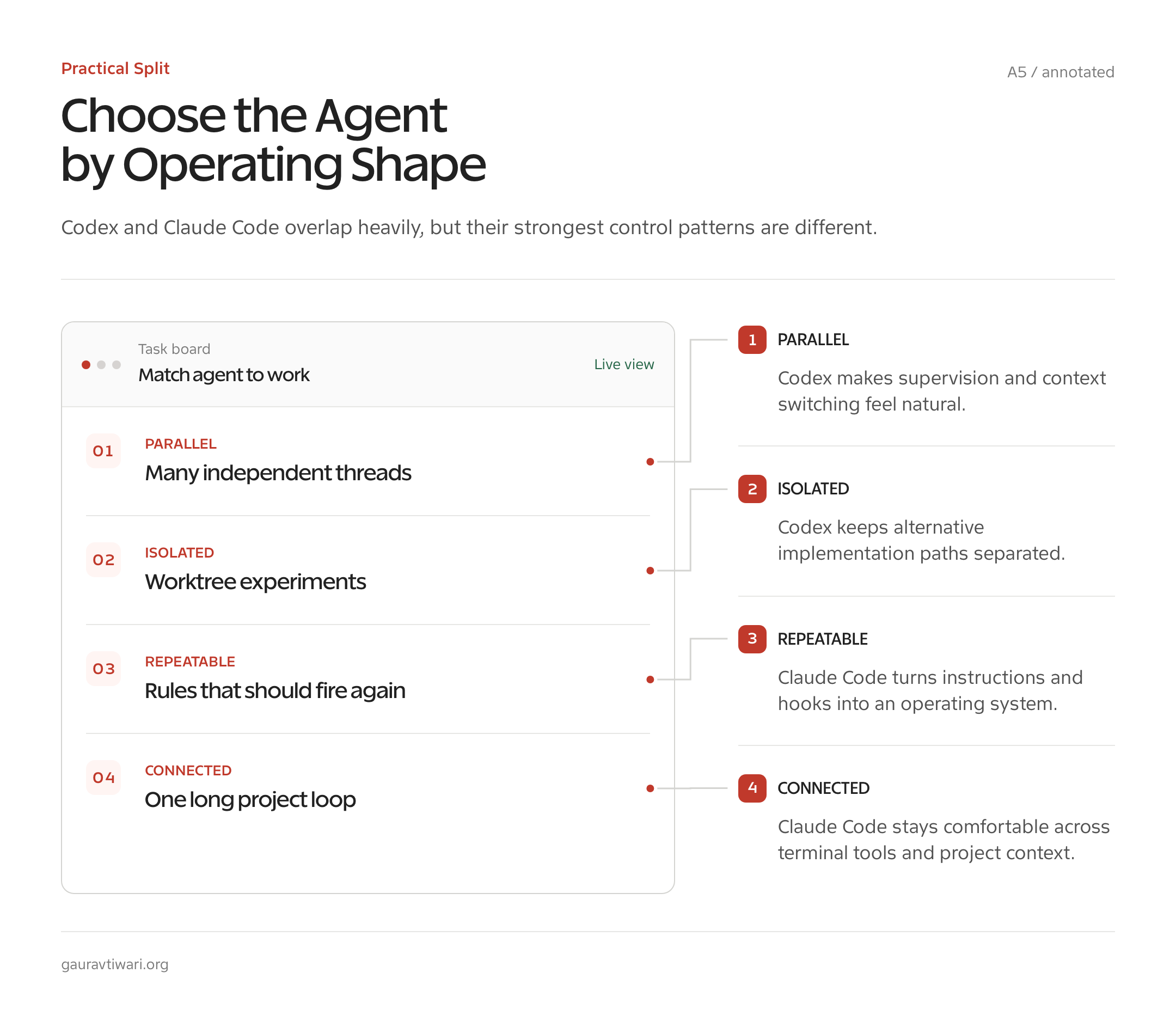
Choose Claude Code when your core work is a connected operating procedure: inspect the repository, load a specialized skill, call external tools, edit several artifacts, run validations, and preserve house rules from start to finish. Choose Codex when you want a strong coding agent across terminal, IDE, desktop, and cloud, especially if you already live in ChatGPT or want several isolated agents working on bounded tasks.
| Decision | Codex | Claude Code |
|---|---|---|
| Best fit in my work | Bounded coding, parallel implementation, review, and OpenAI-connected work | Multi-tool operations, publishing systems, automation, and long connected procedures |
| Primary instruction convention | AGENTS.md plus skills and configuration | CLAUDE.md plus skills and configuration |
| Current flagship route | GPT-5.6 Sol, with Terra and Luna choices | Claude Fable 5 through usage credits, plus other Claude models |
| Product breadth | CLI, IDE, desktop, web and cloud inside the wider ChatGPT product | CLI, IDE, desktop, web, remote sessions, CI and Agent SDK |
| My overall call | A serious second daily agent, not a fallback | My first daily agent for the work mix in this repository |
That is not a model-quality verdict. The controlled GPT-5.6 Sol versus Claude Fable 5 run has not happened. It is a workflow verdict based on how the products fit the work I can verify today.
What each agent actually is in 2026
Codex is OpenAI’s coding agent across a command-line tool, IDE extension, desktop application, web experience, and cloud execution. It can read and change files, run commands in a sandbox, review diffs, use skills, connect through MCP, and work in isolated threads or worktrees. OpenAI says Codex is included in Free, Go, Plus, Pro, Business, Edu, and Enterprise ChatGPT plans, with plan-dependent limits. The current access details are in OpenAI’s Codex plan guide.
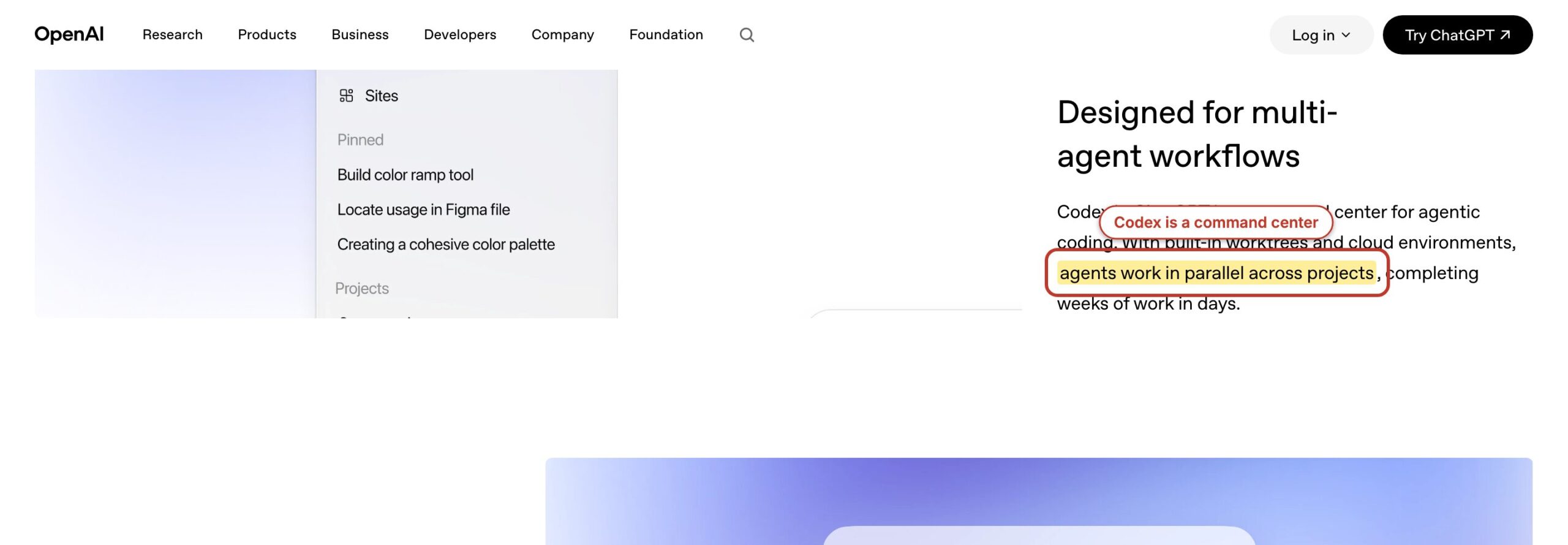
On July 9, OpenAI made GPT-5.6 generally available across ChatGPT, Codex, and the API. The same release put Sol, Terra, and Luna inside Codex for Plus and higher plans, while Free and Go receive Terra. OpenAI also introduced a new unified desktop application that brings Chat, Work, and Codex together. Codex still exists in the CLI, IDE, web, and cloud. A new desktop shell did not retire those surfaces.
Claude Code is Anthropic’s coding agent across the terminal, desktop Code tab, web, IDE integrations, remote sessions, CI, and its Agent SDK. It can use persistent project instructions, skills, plugins, MCP servers, hooks, subagents, and experimental agent teams. The desktop application adds visual diff review, parallel worktrees, an integrated terminal and editor, live previews, computer use, scheduled tasks, remote work, and phone dispatch. Anthropic documents the complete surface in its Claude Code Desktop guide.
The old shorthand that Codex is cloud-first and Claude Code is terminal-only is stale. Both are local and remote. Both have graphical and command-line interfaces. Both can parallelize work. The useful Codex vs Claude Code question is how their instruction systems, model families, automation layers, and surrounding products behave under your actual procedures.
My setup gives both agents one brain
The strongest part of this comparison is not a private benchmark. It is the visible architecture. The writing system keeps project rules in AGENTS.md. CODEX.md adds Codex-specific orientation without copying the whole constitution. Shared context, knowledge, memory, and voice files resolve to canonical locations rather than diverging into tool-specific snapshots.
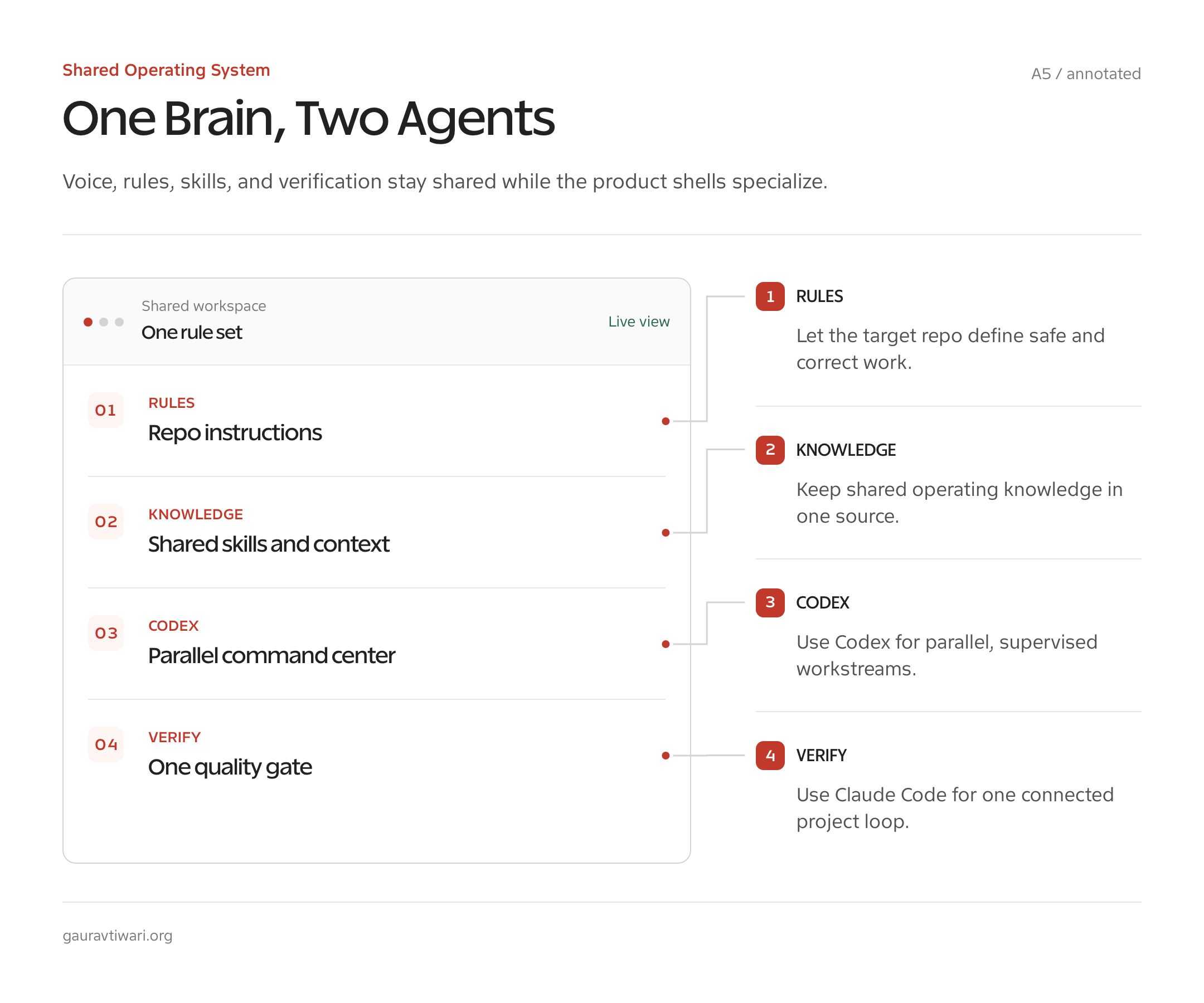
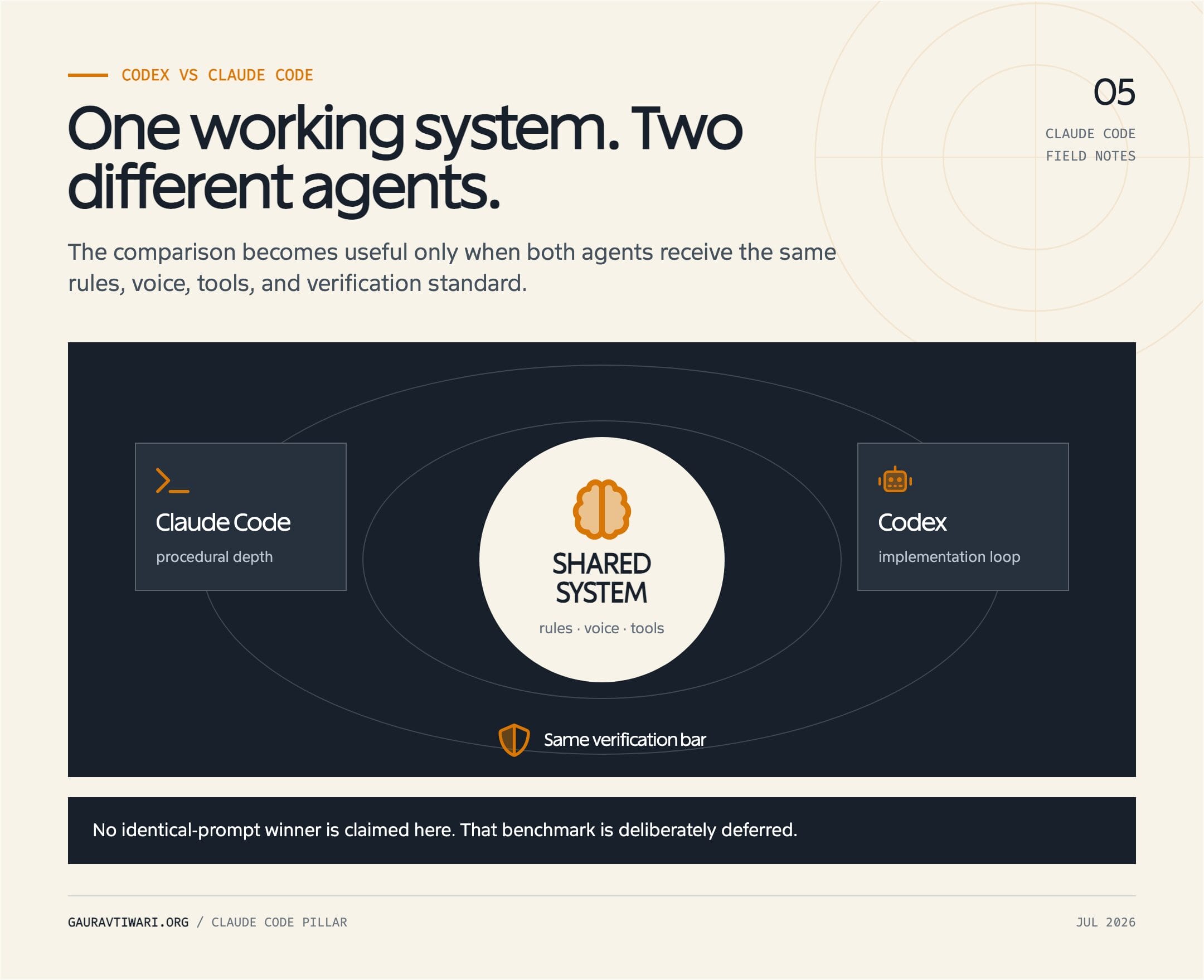
On this machine, ~/.codex/context points to the shared claude-sync/context directory. ~/.codex/knowledge points to claude-sync/knowledge. ~/.codex/claude-memory points to claude-sync/memory. The repository’s voice/voice-dna.md also resolves to the shared canonical voice file. Claude’s skill directory points to the same shared skill source. These links are current filesystem facts, not reconstructed session history.
| Shared layer | Codex access path | Canonical destination | Why it matters |
|---|---|---|---|
| Project operating rules | AGENTS.md | Repository file | Both agents receive the same non-negotiable instructions. |
| Codex delta | CODEX.md | Repository file | Product-specific notes do not fork the main rules. |
| Context | ~/.codex/context | claude-sync/context | Identity and business context remains canonical. |
| Knowledge | ~/.codex/knowledge | claude-sync/knowledge | Products, links, and reference knowledge do not drift. |
| Memory | ~/.codex/claude-memory | claude-sync/memory | Reusable corrections can be shared safely. |
| Voice | voice/voice-dna.md | claude-sync/context/voice-dna.md | Both agents write from the same source instead of imitating separate snapshots. |
The repository then supplies the task machinery. A comparison page has a format file. Article work has brief, research, and outline templates. Gutenberg output has ACF block references. Publishing has link and shortcode rules. Quality checks cover structure, evidence, voice, and AI-sounding filler. This is what “same context” means in practice. It is not the same two-paragraph prompt pasted into two chat boxes.
This parity does not make the products identical. It makes their remaining differences easier to see. If Codex and Claude Code read the same operating rules but one handles a particular workload more naturally, the difference is likely in the agent loop, tools, context handling, permissions, or product interface.
Capability matrix: five production workloads, no fake scores
The original plan called for five identical tasks scored on autonomy, correctness, speed, cost, and interventions. That five-task product run is still pending. It would be misleading to keep the table and replace missing measurements with impressions. The matrix below answers a different, useful question: what does each product’s current architecture contribute to these named workloads?
| Workload | Codex observation | Claude Code observation | Current call |
|---|---|---|---|
| WordPress publish pipeline | Can read the same plan, source rules, skills, block docs, link index, and validation instructions. Codex skills and MCP connections can carry the workflow beyond code. | My established skill, hook, MCP, and instruction stack is centered on procedure-heavy publishing work. | Claude Code has the workflow advantage today. No task score claimed. |
| Plugin or theme bug | Strong fit for a bounded repository change, terminal verification, diff review, and an isolated agent thread. | Strong fit for tracing behavior, applying a fix, running tests, and involving a focused reviewer subagent. | No general winner without the controlled bug task. |
| SEO data analysis | Can use MCP and app connections when the relevant service is available, then create code, documents, or reports in the same wider OpenAI product. | My current SEO procedures and service connections are already encoded as reusable Claude-oriented skills. | Claude Code wins setup maturity in my system, not model intelligence. |
| Multi-file refactor | Desktop threads, worktrees, cloud tasks, IDE review, and GPT-5.6 effort controls support parallel bounded implementation. | CLI, desktop worktrees, remote sessions, subagents, and experimental teams support isolated implementation and review. | Both qualify. A task-specific run would settle the rest. |
| Recurring automation | CLI, skills, plugins, MCP, automations, and sandbox rules provide the necessary parts. | Hooks, headless CLI, skills, plugins, MCP, and Agent SDK fit event-driven procedures directly. | Claude Code is my preferred route for the current system. |
This matrix contains observations I can defend without pretending they are measurements. It names where my setup is mature, where both products now have comparable pieces, and where an identical-task run is still required.
WordPress article work tests constraint retention
A publish-ready article in this repository must do more than sound good. It must preserve Gutenberg comments, emit valid JSON inside block delimiters, use one ACF TOC, flatten FAQ fields into the expected schema, avoid links in the first two paragraphs, retain shortcodes, use published-only internal links, and attach rel="nofollow" to official external links. It also needs current sources, a focus keyword, answer-first headings, and visible-word validation before FAQ fields.
I have used both agents for work at this depth. Claude Code has the advantage in my current setup because the procedures were developed around its instruction and skill model. Codex can read and apply the same files, which is exactly why it is a credible alternative. I would be lying if I converted that setup advantage into a quality score without a task-specific run, and the small model-level test I did run came out near-even.
A WordPress bug tests repository judgment
A proper bug task needs a reproducible failure, the relevant plugin or theme, a safe edit, and a verification step. Both agents can search definitions, change PHP or JavaScript, run tests and linters, and inspect the resulting diff. Codex’s isolated threads and worktrees make it easy to compare approaches. Claude Code’s subagents and hooks make it easy to separate investigation, implementation, and review.
The winner depends on the bug, repository, model, effort setting, and harness. Until both agents receive the same failure and acceptance test, “Codex is more correct” or “Claude Code needs fewer interventions” would be storytelling, not evidence.
SEO analysis tests connections and interpretation
SEO work exposes a different gap. The agent must reach the right data, understand the site’s content rules, distinguish a traffic change from a ranking diagnosis, and turn evidence into actions. The model is only one part of the job. MCP configuration, data permissions, skill instructions, and the site’s internal knowledge can matter more than a small reasoning difference.
Claude Code wins this category in my present setup because my reusable SEO and publishing procedures are already there. Codex supports MCP and reusable skills, so the gap is portable rather than permanent. The local architecture was deliberately designed to make that portability possible.
Refactors test planning, isolation, and review
Both products now have credible answers for parallel refactoring. Codex can run several agents in separate threads and worktrees, then show changes for review in the app. Claude Desktop also supports parallel sessions with worktree isolation, while remote sessions can span repositories. Claude Code’s agent teams add peer communication, but they remain experimental and carry more coordination cost than a focused subagent.
I use isolation when tasks are separable in practice. Splitting one tightly coupled refactor among many agents can create more merge and architecture work than it saves. Parallelism is not a score by itself. The result still has to preserve behavior and pass the same tests.
Automation tests whether instructions become repeatable behavior
Automation is where Claude Code keeps my preference. A reusable skill describes the procedure. An MCP server supplies an external connection. A hook enforces a lifecycle action. A headless command or SDK process lets the same operation run without an interactive desktop. Anthropic’s extension overview treats those as distinct, composable layers.
Codex is not missing the category. OpenAI’s desktop app includes skills, plugins, MCP connections, rules, sandboxing, and multiple agents. Skills can travel across the app, CLI, and IDE, while repository skills can be shared with a team. OpenAI describes that model in the Codex app announcement. My preference reflects the maturity of my own procedures, not an invented claim that Codex cannot automate.
Instructions, skills, hooks, and MCP compared
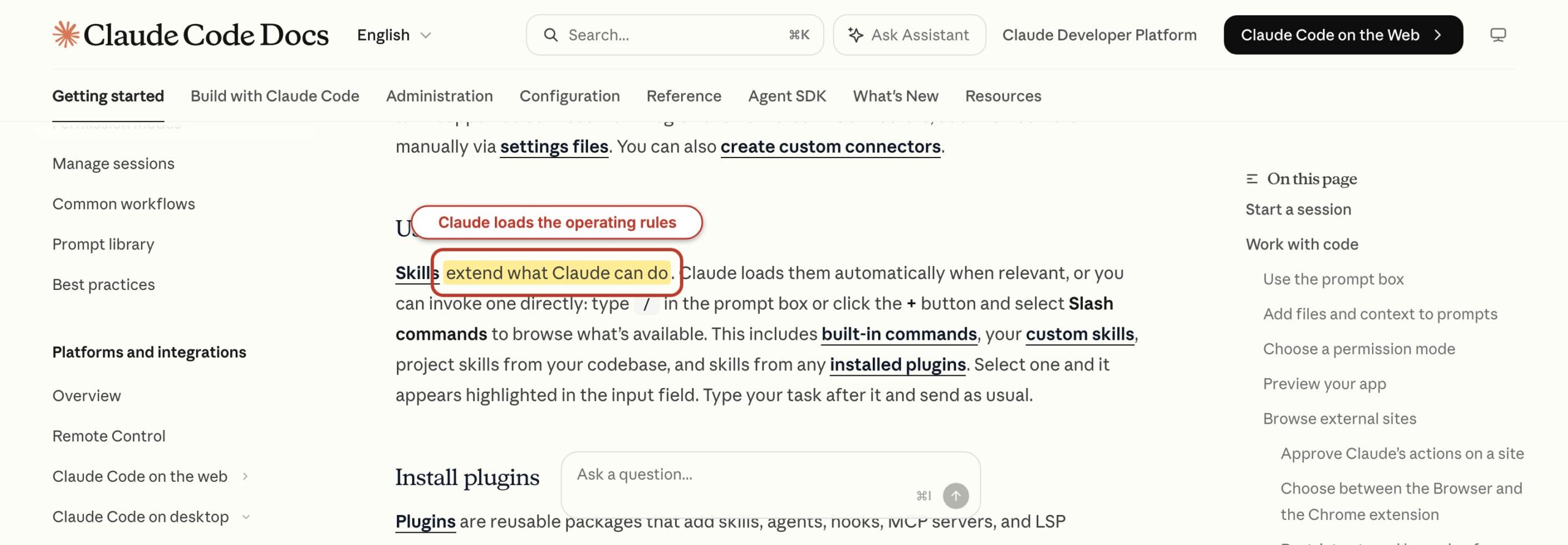
The extension contest is closer than many comparisons admit. Codex uses AGENTS.md as a repository convention and supports skills, plugins, MCP, rules, apps, and agent coordination. Claude Code uses CLAUDE.md and supports skills, plugins, MCP, hooks, subagents, and agent teams. Either can be taught a house style or connected to WordPress.
| Layer | Codex | Claude Code | How I use the shared system |
|---|---|---|---|
| Persistent repository rules | AGENTS.md | CLAUDE.md and repository guidance | AGENTS.md is the main project authority; product-specific files add only deltas. |
| Reusable procedure | Skills | Skills | Canonical skill sources are shared where practical. |
| External connections | MCP and connected apps | MCP and connectors | Credentials and service details remain outside article copy and source control. |
| Lifecycle automation | Rules, automations, and product hook support | Hooks that can run scripts, HTTP, prompts, or subagents | Claude’s hook model currently fits more of my established procedures. |
| Focused parallel work | Agents and subagents across local or cloud surfaces | Subagents with isolated context | Use the smallest worker that can return a verifiable result. |
| Peer coordination | Multi-agent app and cloud patterns | Experimental agent teams | Reserve for independent tasks that must exchange findings. |
There is one architectural lesson worth copying: keep durable project knowledge in files that do not belong to one vendor. My voice, format rules, published-link index, block documentation, and quality checks remain readable documents. Tool-specific configuration tells the agent how to reach them. That keeps a product switch from becoming a knowledge migration.
Codex vs Claude Code pricing
OpenAI includes Codex across ChatGPT Free, Go, Plus, Pro, Business, Edu, and Enterprise plans, but limits vary. Plus costs $20 per month. OpenAI now offers a $100 Pro tier with five times Plus capacity and a $200 Pro tier with twenty times Plus capacity. Credits can extend usage. The current ChatGPT pricing page is the safest place to check the plan available to you.
Claude Pro costs $20 monthly or $200 annually and includes Claude Code. Claude Max costs $100 for 5x Pro capacity or $200 for 20x. API usage is separate, and paid subscribers can purchase usage bundles. Claude Fable 5 moved to usage-credit access after July 7, so a Max subscription alone should not be described as unlimited Fable access. Anthropic maintains the current details on its pricing page.
| Option | Published US price | Agent access | Cost caveat |
|---|---|---|---|
| ChatGPT Plus | $20/month | Codex included | Usage limits and model consumption apply. |
| ChatGPT Pro 5x | $100/month | Higher Codex capacity | Five times Plus capacity is not unlimited use. |
| ChatGPT Pro 20x | $200/month | Highest individual capacity tier | Credits and rate-card rules still matter. |
| Claude Pro | $20/month or $200/year | Claude Code included | API use and Fable usage credits are separate. |
| Claude Max 5x | $100/month | Five times Pro capacity | Session and model limits still apply. |
| Claude Max 20x | $200/month | Twenty times Pro capacity | Heavy Fable use can require usage credits. |
The entry and heavy-use subscription prices line up closely. The surrounding value is different. A Codex vs Claude Code price decision also includes what you use outside coding. Codex sits inside ChatGPT plans that cover Chat, Work, and other OpenAI features. Claude Code sits inside Claude plans that cover Claude, Cowork, Research, and other Anthropic features. I would not choose between them using a fictional cost-per-task number from a product benchmark I have not run.
Model quality notes without a pretend benchmark
Codex currently offers the GPT-5.6 family. Sol is OpenAI’s flagship, Terra is the balanced tier, and Luna is the lower-cost tier. Plus and higher Codex users can choose among all three and set effort levels, while Free and Go users receive Terra. OpenAI also offers max effort and an ultra multi-agent mode in Codex for eligible plans. These are product facts from the GPT-5.6 release, not evidence that Sol wins my five tasks.
Claude Code offers Claude models, including Fable 5 through usage credits after July 7. Anthropic describes Fable 5 as its safeguarded Mythos-class model for general use, with some flagged requests routed to Opus 4.8. At launch, Anthropic said the fallback occurred in less than five percent of sessions on average. Fable also carries a 30-day retention requirement for Mythos-class traffic, which matters for sensitive code and data.
I have used Fable whenever it has been available. Access was suspended for everyone from June 12 until July 1 because Anthropic could not verify nationality in real time under an immediate US government directive. It was not a period when I chose another model instead. Anthropic’s redeployment statement documents the interruption and restoration.
Hands-on use can support bounded observations: Fable works naturally inside the Claude Code procedures I already maintain, while GPT-5.6 gives Codex a useful three-tier routing choice. A small same-prompt test I ran at the model level put Sol, Fable 5, and Opus 4.8 within a point of each other, which settles the model layer at a near-tie. It still cannot crown a product winner until both agents run the same tasks, context, acceptance tests, and review method.
Product shape matters as much as the model
OpenAI’s July desktop direction places Chat, Work, and Codex in one application. Codex adds project threads, worktrees, inline diff work, review, IDE handoff, skills, and cloud agents. This is useful when coding sits beside research, documents, connected apps, or a wider ChatGPT routine. The coding agent is one part of a broader work product.
Anthropic’s desktop direction places Claude Code beside Cowork and the rest of Claude while preserving a capable standalone CLI. The Code tab can arrange chat, diff, preview, terminal, file, plan, task, and subagent panes. Local, SSH, and cloud environments are available from the same product. The terminal remains the best surface for scripting, third-party providers, and Agent SDK work.
Neither agent is trapped in one interface. I still give Claude Code the edge for terminal-native operations and Codex the edge for an OpenAI-wide desktop workflow. If you judge only the CLI, you miss half of both products in 2026.
Who should choose Codex
Codex is the better first choice when one or more of these statements describe your work:
- You already pay for ChatGPT and want a capable coding agent included in the same plan.
- You want GPT-5.6 Sol for demanding work and Terra or Luna for lower-cost tasks inside one agent product.
- You regularly split bounded implementation across isolated threads, worktrees, or cloud tasks.
- You want to move between terminal, IDE, desktop review, and cloud delegation without changing your OpenAI account.
- You use ChatGPT for research or document work and want coding to sit beside those activities.
- Your team already treats AGENTS.md as the repository instruction standard.
Codex is also the more economical experiment if it is already included in a subscription you keep for other reasons. Start by giving it one bounded repository task with a clear acceptance test. Do not begin by asking it to run your entire company.
Who should choose Claude Code
Claude Code is the better first choice when your work looks like this:
- You live in the terminal and want the agent to operate through files, commands, permissions, and external services.
- You maintain repeatable procedures as skills, hooks, plugins, MCP connections, and project instructions.
- You need focused subagents that read large amounts of material without filling the main conversation.
- You want Claude-specific model behavior and the tightest integration with Claude Fable, Opus, Sonnet, or Haiku.
- Your work crosses code, WordPress operations, publishing, research, and service connections.
- You need a headless CLI or Agent SDK for automation beyond an interactive coding session.
This describes more of my working week, which is why Claude Code remains my first call. A developer whose week is dominated by bounded application changes may reasonably prefer Codex.
Run both without creating two systems
The simplest dual-agent pattern is one constitution with small adapters. Do not copy hundreds of lines between AGENTS.md and CLAUDE.md, then wonder why they disagree six months later. Keep shared truths in repository documents. Keep product-specific setup in product-specific files.
- Write one repository operating manual that states architecture, commands, safety rules, and acceptance checks.
- Link to format, quality, and reference files instead of inflating the always-loaded instruction file.
- Keep shared personal or business context in one canonical location.
- Use symlinks or documented pointers where both products need the same material.
- Add a small Codex or Claude delta only when a feature, command, or permission model differs.
- Give both agents the same target file and acceptance criteria when you eventually compare task performance.
- Record reusable corrections in the shared system, not only in a conversation.
This architecture is more valuable than choosing a permanent winner. Agents and models change faster than a good operating manual. The repository should outlive the current product release.
My final Codex vs Claude Code call
Claude Code remains my daily driver for the system shown here. Its skills, hooks, MCP patterns, subagent model, terminal behavior, and long-established procedures fit connected WordPress and content operations with less setup friction. Codex is not a toy, a backup, or a weaker imitation. It is a strong agent that now spans more surfaces and model tiers than older comparisons acknowledge.
If you already pay for ChatGPT, use Codex before buying another coding subscription. If you already run a mature Claude Code instruction and automation stack, do not migrate because of one launch chart. If your work justifies both, make them read the same brain and assign each the workload that fits its product shape.
A small identical-prompt test across Fable 5, Opus 4.8, and GPT-5.6 Sol came out a near-tie at the model level. At the product level the truthful answer is still a capability split, not a numeric winner. I will publish the fuller product follow-up through my newsletter when there is evidence worth reporting.
Frequently asked questions
Is Codex better than Claude Code?
Codex is better for some bounded coding, parallel implementation, and OpenAI-connected workflows. Claude Code is better for my multi-tool, procedure-heavy work. A small same-prompt test put the underlying models within a point of each other, and I have not run the full identical five-task product scorecard, so I do not claim a universal winner.
Does Codex come with ChatGPT Plus?
Yes. OpenAI includes Codex with ChatGPT Plus and several other plans, including Free, Go, Pro, Business, Edu, and Enterprise. Usage limits differ by plan.
Can Codex and Claude Code work on the same repository?
Yes. Keep shared project rules and acceptance checks in repository files, then add small product-specific configuration layers. Both agents can read ordinary documentation and work against the same source tree.
Which is cheaper for heavy use?
Both vendors publish $100 and $200 heavy-use individual tiers, but usage accounting, credits, model choice, and surrounding subscription features differ. A controlled workload is needed for a meaningful cost-per-result comparison.
Does Codex support MCP?
Yes. Codex supports MCP connections as part of its extension and tool system. The useful question is whether the service you need has a reliable server and the right permission scope.
Was GPT-5.6 Sol tested against Claude Fable 5 here?
A small same-prompt test put Sol, Fable 5, and Opus 4.8 within a point of each other at the model level, but that head-to-head belongs to my GPT-5.6 versus Claude Fable 5 comparison. This article compares the two products, Codex and Claude Code, on architecture and fit, using a capability matrix and current production-work observations without inventing benchmark results.