
 by
by
Shopify affiliate programs for bloggers can turn useful product content into long-term income, but only when the store, product, tracking, and payout terms are a good fit. The practical part matters more than the headline commission rate.
This page is about affiliate programs run by independent Shopify stores, not Shopify’s own program for referring new merchants. The model is straightforward: you recommend a store’s products, the store tracks the sale, and you earn the agreed commission.
The difficult part is choosing programs worth your time. If you’re new to the model, my affiliate marketing guide for beginners explains the wider setup. Here, the focus is narrower: how to evaluate Shopify store affiliate programs and build content that can keep earning after publication.
Why Shopify Affiliate Programs Work for Bloggers

Independent Shopify stores give bloggers access to products in tightly defined niches. That can be more useful than promoting the same marketplace links as everyone else, because the recommendation can match a specific reader and problem.
- Better niche alignment: A coffee blog can work with a specialty roaster. A fitness blog can promote a supplement or equipment brand. The tighter the match, the easier it is to write useful content around the product.
- More room to negotiate: Independent brands may offer custom rates, reader discount codes, product samples, or early access once an affiliate proves they can generate sales.
- Less direct competition: You aren’t always fighting thousands of affiliates using the same product page and the same generic pitch.
- Direct brand relationships: A smaller team may answer questions, provide product details, and help you plan promotions around launches or seasonal demand.
Keep the claim honest: Higher commissions are possible, but they are not guaranteed. Rates, cookie windows, exclusions, and payout schedules are set by each store.
How Shopify Affiliate Programs for Bloggers Work
When a store approves you, it gives you a unique referral link, a coupon code, or both. You place those assets in content. When a reader buys under the program’s attribution rules, the store records a commission and pays it on the stated schedule.
Referral link tracking
A referral link normally places a tracking cookie in the visitor’s browser. If the reader buys within the store’s cookie window, the affiliate platform can credit the sale to you. The exact window and attribution rules vary, so read the terms before writing the article.
Coupon code tracking
A coupon code can attribute the order without requiring the buyer to click your link at the moment of purchase. That makes codes useful in newsletters, videos, podcast mentions, and social posts. A reader discount can also give people a concrete reason to buy through your recommendation.
The strongest setup supports both methods. Links suit blog content, while codes capture buyers who encounter your recommendation somewhere else.
What Separates a Good Program From a Frustrating One
A good program is measurable. For Shopify affiliate programs for bloggers, you should be able to understand the terms, see the sales attributed to you, and know when approved commissions will be paid. A large commission percentage means little if the store cannot show the underlying numbers.
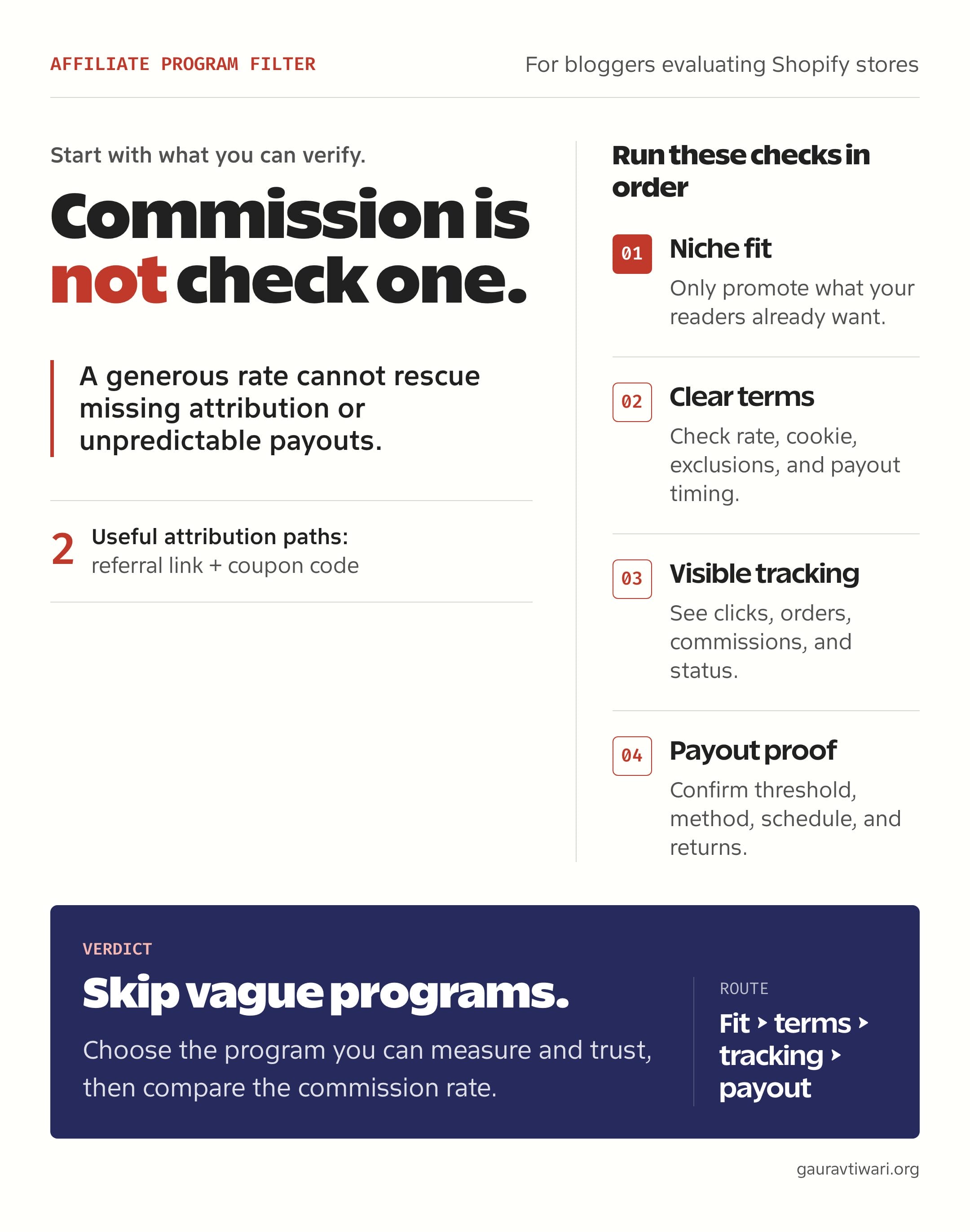
- A proper affiliate portal: You should be able to log in, generate links, review orders, and check pending and paid commissions without emailing someone for every update.
- Transparent commission terms: Confirm the rate, excluded products, returns policy, minimum payout, payment method, and whether the store can change terms without notice.
- Visible attribution: The dashboard should distinguish clicks, referred orders, approved commissions, reversals, and paid amounts.
- Dependable payouts: Know the schedule and the conditions that delay or cancel a commission.
- A workable cookie window: Longer windows give readers time to compare and return. Do not assume every Shopify store uses the same duration.
Skip the program if the terms are vague. You are about to spend hours creating content around someone else’s product. If the store will not explain tracking and payouts before you join, a high commission rate is not enough.
How Affilitrak Powers the Affiliate Experience
When you join a Shopify store that runs its program on Affilitrak which is one of the best tools for affiliate marketing on Shopify, you get the kind of self-serve setup described above.
Stores using Affilitrak can give affiliates a branded portal, often on the store’s own subdomain. From that portal, an affiliate can manage referral assets and monitor performance without chasing the merchant for a spreadsheet.
- Generate referral links for specific products
- Access an assigned coupon code
- Review referred sales and commission status
- Track the current commission balance
Affilitrak supports referral link and coupon code tracking. It also supports flexible commission structures, including tiers that can reward affiliates who generate more sales. The merchant still controls the actual rate, rules, and payout process, so check the individual store’s terms before you promote it.
A Practical Plan to Start Earning
The fastest route is to start with content that already has relevant traffic. You can add a well-matched product to a useful article, measure the response, and only then invest in a larger content cluster.
- Audit your existing content. Find posts that already attract readers with buying intent. If you need a wider monetization map, use my guide to monetizing a blog for profit as the starting point.
- Find stores that match your niche. Check brand footers, help centers, and partner pages. Shopify’s official Shopify Collabs guidance for creators explains how brand partnerships, affiliate sales, and payments work. Shopify currently says open creator signups are paused, but merchants can still send direct invitations and accept applications.
- Join programs with visible terms. Prioritize a real dashboard, clear commission rules, and a payout schedule you can verify.
- Add links where they help the reader decide. Product comparisons, use-case guides, tutorials, and problem-solving posts usually give the recommendation enough context. The FTC’s official endorsement guidance says material connections should be disclosed clearly. Follow the site’s disclosure system and place any required disclosure where readers can notice it.
- Use coupon codes outside the blog. Add the code to newsletters, videos, podcasts, and social posts when a clickable link is not practical.
- Track sales and cut what does not convert. Compare products, pages, clicks, and approved commissions. Put more work into the combinations that produce sales instead of adding links everywhere.
Can Shopify Affiliate Income Become Passive?
Shopify affiliate programs for bloggers can produce income for months after an article is published, but the work is front-loaded. You still have to choose the right product, create useful content, earn search traffic, and check that the offer remains accurate.
The income also needs maintenance. Products go out of stock, discount codes expire, commission terms change, and tracking links break. A short quarterly review protects pages that are already generating sales.
Shopify affiliate programs for bloggers work best when the recommendation is useful without the commission. Start with one relevant store, one article that already earns traffic, and one measurable offer. Prove the match before you build more content around it.
Frequently Asked Questions
What are Shopify affiliate programs for bloggers?
They are affiliate programs run by brands that use Shopify for their stores. A blogger promotes the brand’s products with a referral link or coupon code and earns a commission when a qualifying order is attributed under the program’s rules.
Is this the same as the Shopify Affiliate Program?
No. Shopify’s own affiliate program pays for referring new Shopify merchants. This article covers product affiliate programs operated by independent stores built on Shopify.
What commission rate should a blogger look for?
There is no universal rate. Compare the percentage with product price, conversion potential, returns, cookie duration, exclusions, and payout reliability. A smaller rate on a product your readers want can earn more than a large rate on a weak match.
Do Shopify affiliate programs use links or coupon codes?
Programs may use referral links, coupon codes, or both. Links suit blog posts and resource pages. Codes are useful in newsletters, videos, podcasts, and social posts where a reader may not click immediately.
How do I know whether a Shopify affiliate program is trustworthy?
Look for written terms, a self-serve portal, visible attribution, a clear payout schedule, contact details, and a return or cancellation policy. Avoid programs that hide the commission rules or cannot show how orders are credited.
Tell Google you want more of this.
Add Gaurav Tiwari as a preferred sourceOne tap, and this site shows up more often in your own Top Stories, AI Overviews and AI Mode. Remove it any time.