10 Best Gaming Affiliate Programs in 2026 (Commissions Compared)
Gaming affiliate programs pay well because the gaming industry generates massive revenue. If you run a gaming blog, YouTube channel, or streaming platform, affiliate commissions can become a significant income stream. I've researched the ten best gaming affiliate programs based on commission rates, cookie duration, product relevance, and payment reliability. Here are the programs that gamers can genuinely promote and earn from.
 by
by
You have a gaming blog, a Twitch channel, or a YouTube presence with a real audience. The content goes up on schedule. The income does not. Most gaming creators run into the same wall: the wrong affiliate programs paying pennies on the wrong products. Gear-only Amazon links pay 1-3 percent. Random game-key resellers vanish mid-campaign. Big publisher programs ghost your application unless you already have 100K subscribers.
I have run gaming affiliate programs across my own properties for the better part of a decade and watched the 2026 landscape change fast — Twitch took on competition from Kick, GameFly went DVD-only and quietly stopped paying affiliates, several subscription-box programs collapsed in 2024, and Humble Bundle plus Green Man Gaming have quietly become the highest-EPC storefronts for PC creators. The 10 programs below are the ones that pay reliably, approve real creators, and make sense in a gaming editorial calendar in 2026.
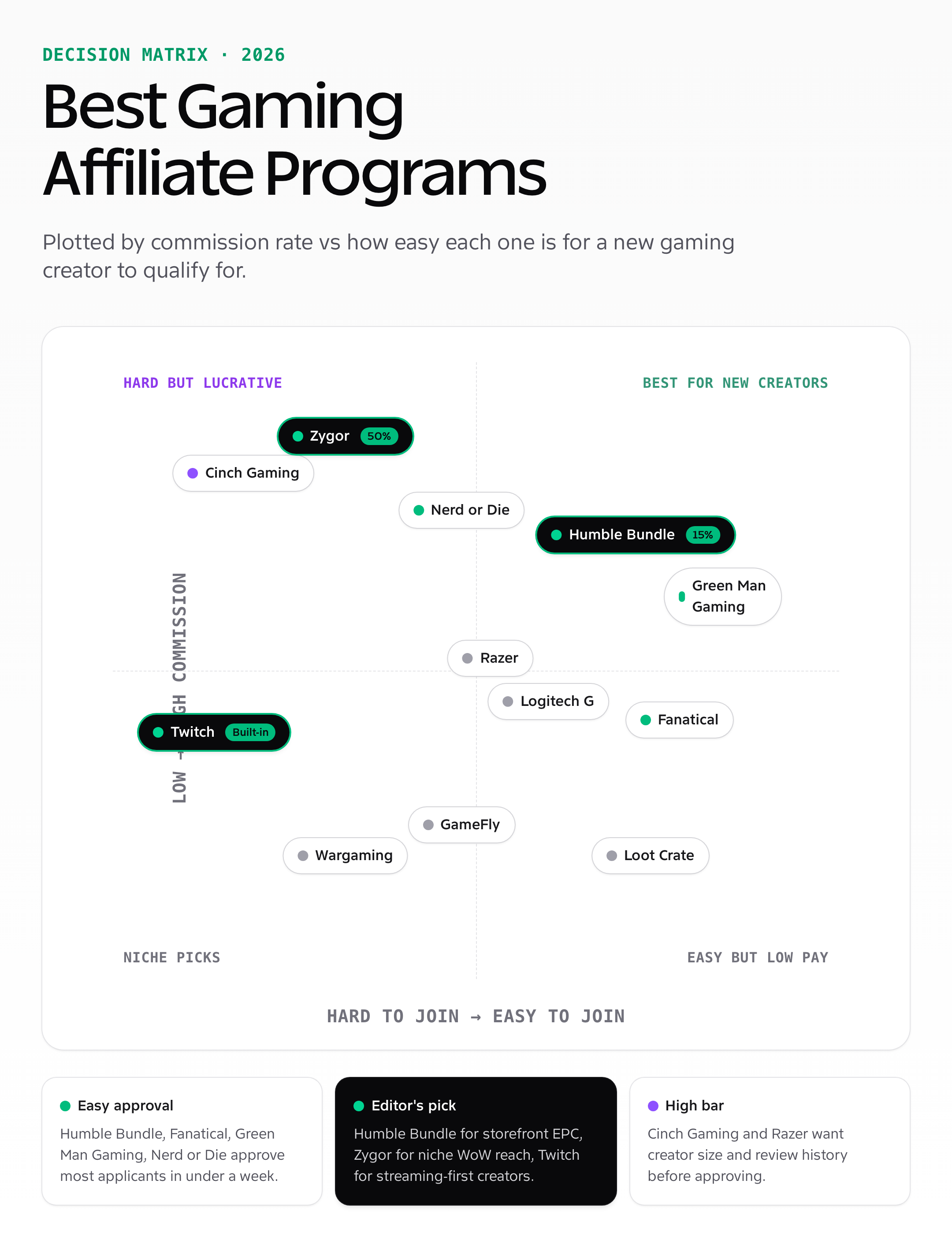
Quick verdict: If you stream, start with Twitch — the bits/subs revenue beats most external affiliates for streaming-first creators. If you run a PC gaming blog, Humble Bundle and Green Man Gaming are the highest-EPC storefronts. If you cover gear, Razer or Logitech G via Impact (better than the Amazon Associate route at 1-3%). For niche WoW/MMO content, Zygor pays 50 percent recurring. For zero-friction approval, Nerd or Die and Fanatical accept anyone with a public site or channel.
Best Gaming Affiliate Programs in 2026
Ten programs made the cut after running them across my own properties. Pricing and commission rates are current as of October 2026.
| Program | Best for | Commission (2026) | Cookie | Network |
|---|---|---|---|---|
| Twitch | Streamers, built-in monetization | 50% Bits, 50-70% Sub revenue | — | First-party |
| Humble Bundle | PC blogs, charity-tilt audience | ~15% bundle & store | 30 days | Impact (since 2024) |
| Razer | Gaming gear creators | 3-10% peripherals + software | 30 days | Impact / CJ |
| Logitech G | Sim, MMO, broad-PC creators | 4-10% catalog | 30 days | Impact |
| Fanatical | Game-key reviews, deals | 5% Steam keys + bundles | 30 days | Awin |
| Green Man Gaming | PC indie + AAA roundups | 5% storewide | 30 days | Awin / direct |
| Nerd or Die | Streamer overlays, alerts | 10-30% tiered | 30 days | First-party |
| Zygor Guides | WoW MMO niche | 50% recurring | 60 days | First-party |
| Cinch Gaming | Console FPS modding | ~10% on controllers | 30 days | First-party |
| Wargaming | WoT/WoWS streamers | Premium signup bonus | 30 days | First-party |
Twitch
Twitch is built-in monetization for streamers and the de facto first affiliate path for gaming creators. Become a Twitch Affiliate by hitting 500 minutes streamed, 7 unique broadcast days, average of 3 viewers, and 50 followers. Once approved you earn from Bits (cheers), subscriptions ($4.99 / $9.99 / $24.99 tiers, with Twitch taking ~50% historically though new contracts shift that to 50/50 or 70/30 for top streamers), and game-sale referrals through the Twitch storefront.
What is good: No external network needed; built into the platform you already broadcast on; storefront game referrals stack on top of subs/bits; live commerce is genuinely powerful for impulse buying. What is broken: Twitch storefront commission rates are not transparent and have shrunk multiple times since 2022; competition from Kick has not pulled rates back up; bits feel like a tax on viewers vs PayPal direct. Under the hood: Amazon-owned platform with first-party payments via Amazon Pay. Stream key + chat infrastructure via IRC variant. Storefront referrals fold into your monthly Twitch payout, not a separate ledger. What should be better: Bring back the bigger storefront cuts and make the rate card public — opaque pricing pushed creators to YouTube’s Super Chats and Patreon as alternatives.
Humble Bundle
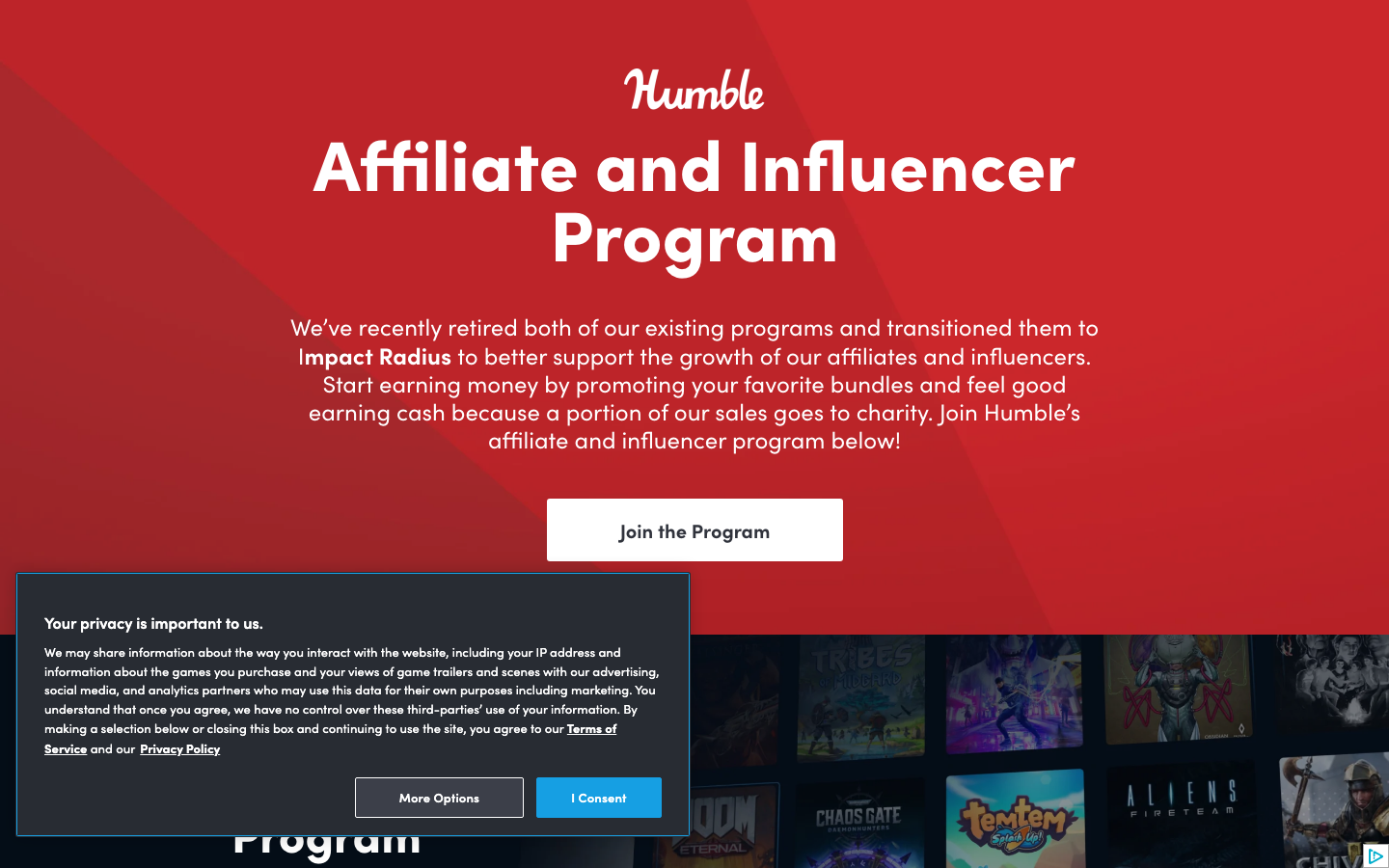
Humble Bundle Partners is the highest-EPC PC gaming storefront I have run in 2026. 15 percent commission on Humble Bundle purchases (game bundles, monthly Humble Choice subscription, store keys), a 30-day cookie window, and the brand carries an unusual amount of trust because of the charity tie-in. Approval is fast — usually under a week with a real site or channel. Payouts are via PayPal monthly, $25 minimum.
What is good: Best EPC of any PC-gaming storefront I have measured, charity-tilt brand converts better than utilitarian key resellers, monthly subscription product means recurring referral value, fast approval. What is broken: Bundle catalog rotates weekly so evergreen content goes stale fast; the Humble Choice tier has slimmed to fewer games than the heyday; some creators report unclear attribution windows on cross-device clicks. Under the hood: Migrated to Impact Radius in 2024 (from the legacy first-party program). Tracks bundle vs storefront vs Humble Choice subscription separately. Owned by Ziff Davis since 2017. What should be better: Add evergreen content categories — a “best of all bundles” deep-link API would let creators write content that does not rot in 7 days.
Razer
Razer runs a global affiliate program through Impact and CJ paying 3-10 percent on peripherals, laptops, and software. Headphones, keyboards, mice, and the Razer Blade laptops are the hero products. The 30-day cookie is industry-standard. Razer also has a separate Razer Amazon storefront route if you prefer the Associates network — it pays less (1-3% Amazon rates for electronics) but the conversion rate on Amazon is significantly higher.
What is good: Strong brand recognition that converts at well-above-average rates; broad product catalog from $40 mice to $4,000 laptops; Impact-managed dashboard is solid; payment is reliable monthly. What is broken: Approval bar is real — they want a public site or channel with gaming relevance; commission rate has crept down since 2023; some product categories (software like Razer Cortex) pay flat amounts that are hard to optimize for. Under the hood: Multi-network setup — Impact for North America, CJ for legacy creators, Awin in some EU markets. The dashboards do not unify spend across networks. What should be better: A unified creator portal across the three networks — Impact accounts cannot see CJ commissions, and creators leave money on the table because of it.
Logitech G
Logitech G is the broadest gaming-gear catalog you can affiliate with — 4-10 percent commissions on a list that runs from $20 webcams to $1,200 sim-racing wheels. Run via Impact in 2026, with a 30-day cookie and reliable monthly payouts. Logitech also includes self-purchase commissions in some periods, which is unusual for a major brand.
What is good: Catalog is huge so you can find a Logitech product to fit any gaming content piece, sim and racing creators have unmatched product depth (G29, G923, G PRO Racing Wheel), payments arrive on time. What is broken: Commission curve is shallow on lower-priced peripherals (a $40 mouse at 4% earns you $1.60); brand split between “Logitech” and “Logitech G” sometimes confuses tracking; gear refreshes are slow vs Razer. Under the hood: Impact-managed program with deep-linking widgets and an SKU-level commission table. Logitech’s ecommerce stack is Salesforce Commerce Cloud. What should be better: Bring back consistent self-purchase commissions on G PRO and Astro lines — the on-again-off-again policy makes content planning harder.
Fanatical
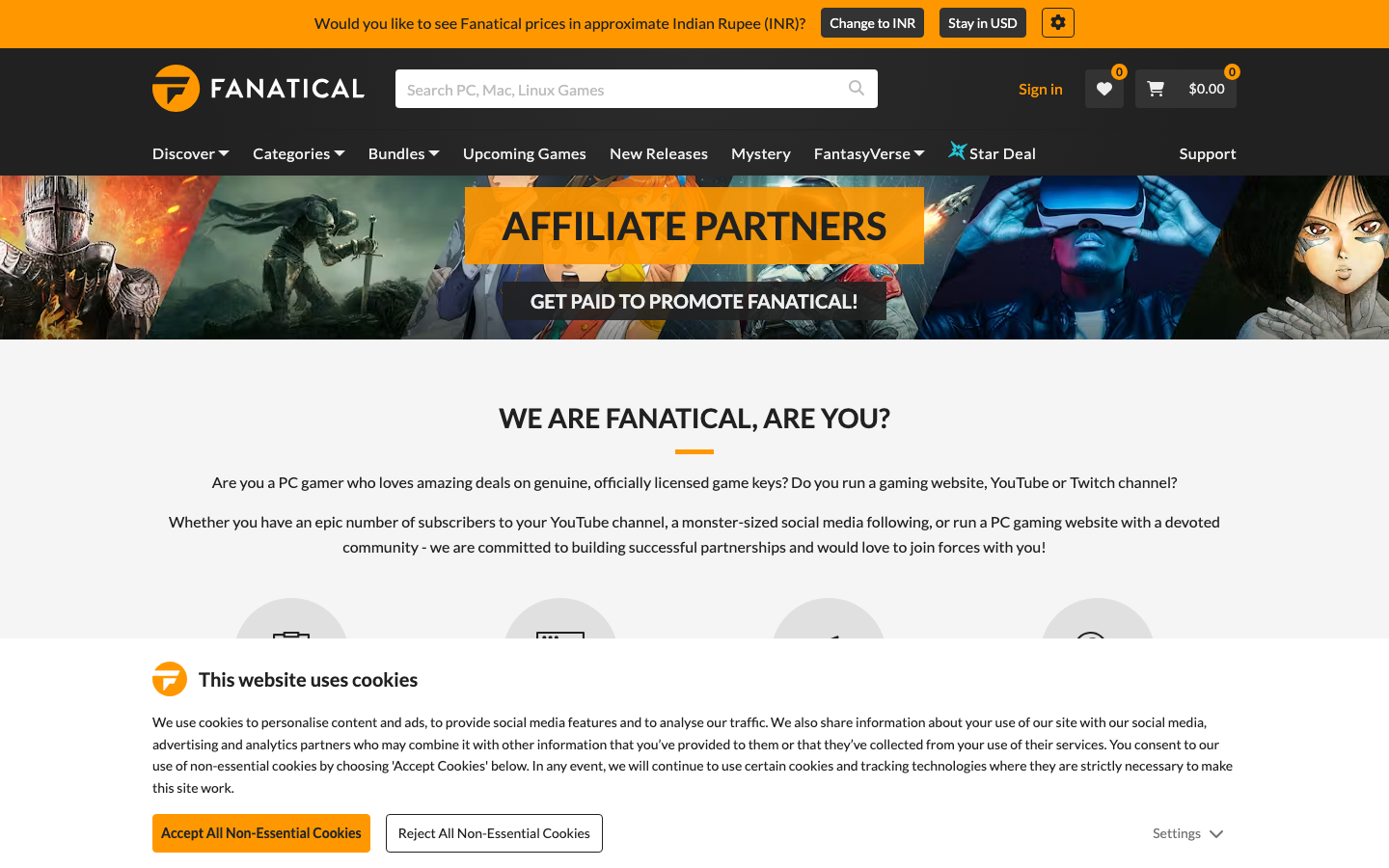
Fanatical sells officially licensed Steam keys at deep discounts and pays 5 percent affiliate commission via Awin. Bundle pricing rivals Humble. Approval is automatic for most applicants with a real site or channel. The 30-day cookie window means a deal post on Tuesday can still pay out on a key bought the following month.
What is good: Officially licensed keys (no grey market problem you get with G2A); easy automatic approval via Awin; bundle pricing is genuinely competitive; deep linking via Awin is straightforward. What is broken: Lower commission rate than Humble Bundle (5% vs 15%); Awin payment thresholds and FX fees eat into smaller balances; some bundles are very narrow — five C-tier games for $4.99 — and convert worse than mainstream titles. Under the hood: Awin-managed program. Backend is the Fanatical store with bundle generator. They source keys directly from publishers — verifiable in Steam’s authorized retailer list. What should be better: Move to a tiered commission structure — 5% on individual keys, 8-10% on bundles would reward content that sends bundle traffic.
Green Man Gaming
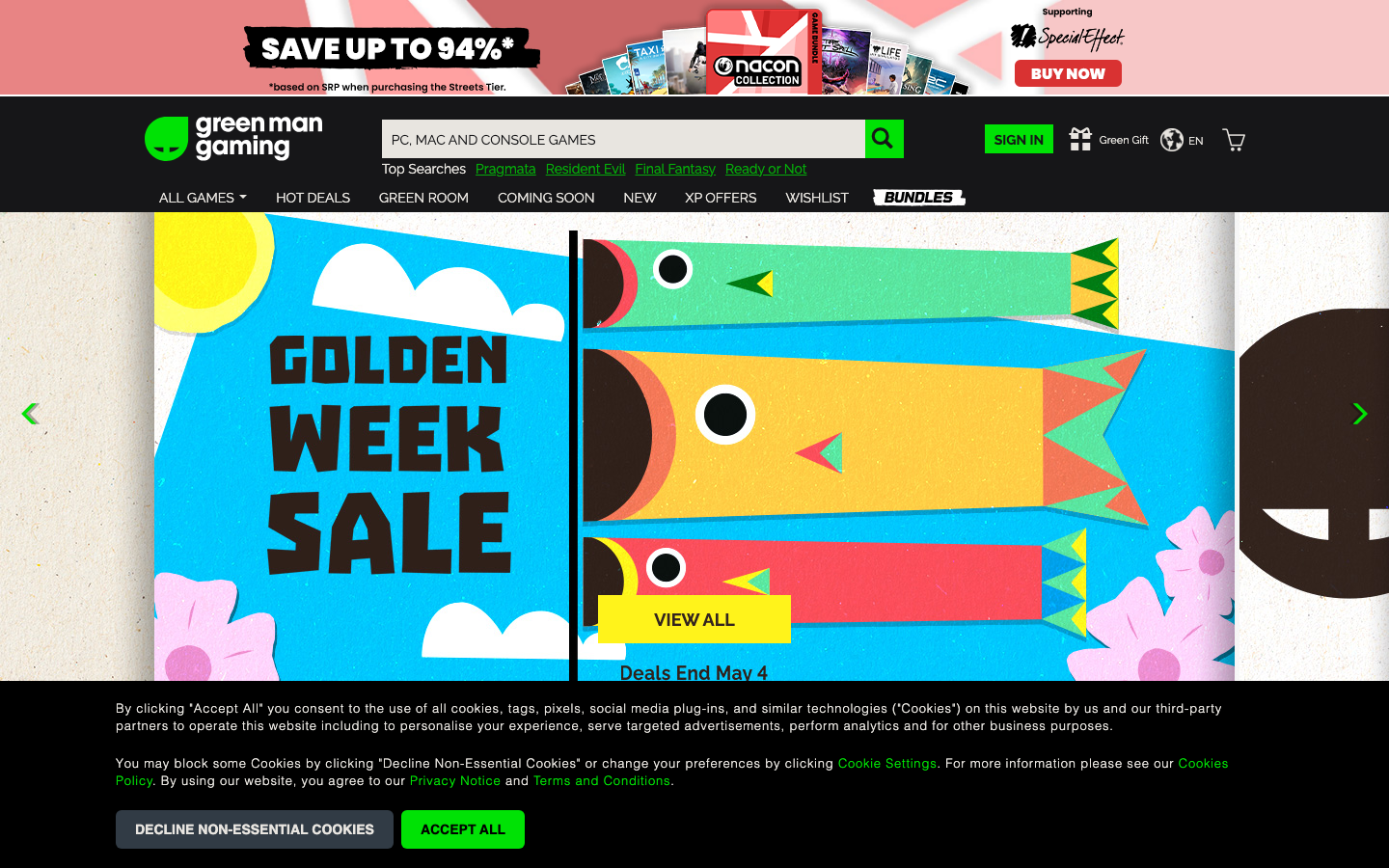
Green Man Gaming is one of the oldest official PC game key resellers — 5 percent commission storewide, biweekly payouts, dedicated affiliate dashboard. They sell Steam, Epic, Origin, Uplay, and Battle.net keys. Commission applies on full-priced AAA launches as well as deep discounts on the back catalog. Run direct with a sub-program through Awin in some regions.
What is good: Biweekly payouts (rare among gaming affiliate programs), legitimate publisher relationships, real-time commission tracking on the dashboard, deep-linking for any product page. What is broken: Same 5 percent rate as Fanatical means it is hard to differentiate on commission alone; XP rewards/loyalty currency for buyers can confuse attribution; the dashboard UI feels dated. Under the hood: Custom affiliate platform built in-house, with Awin as a parallel option in EU. Green Man is a PEGI-listed authorized reseller. What should be better: Add a tier system based on monthly volume; a creator pushing $5K of GMV per month should not be on the same 5% as someone doing $500.
Nerd or Die
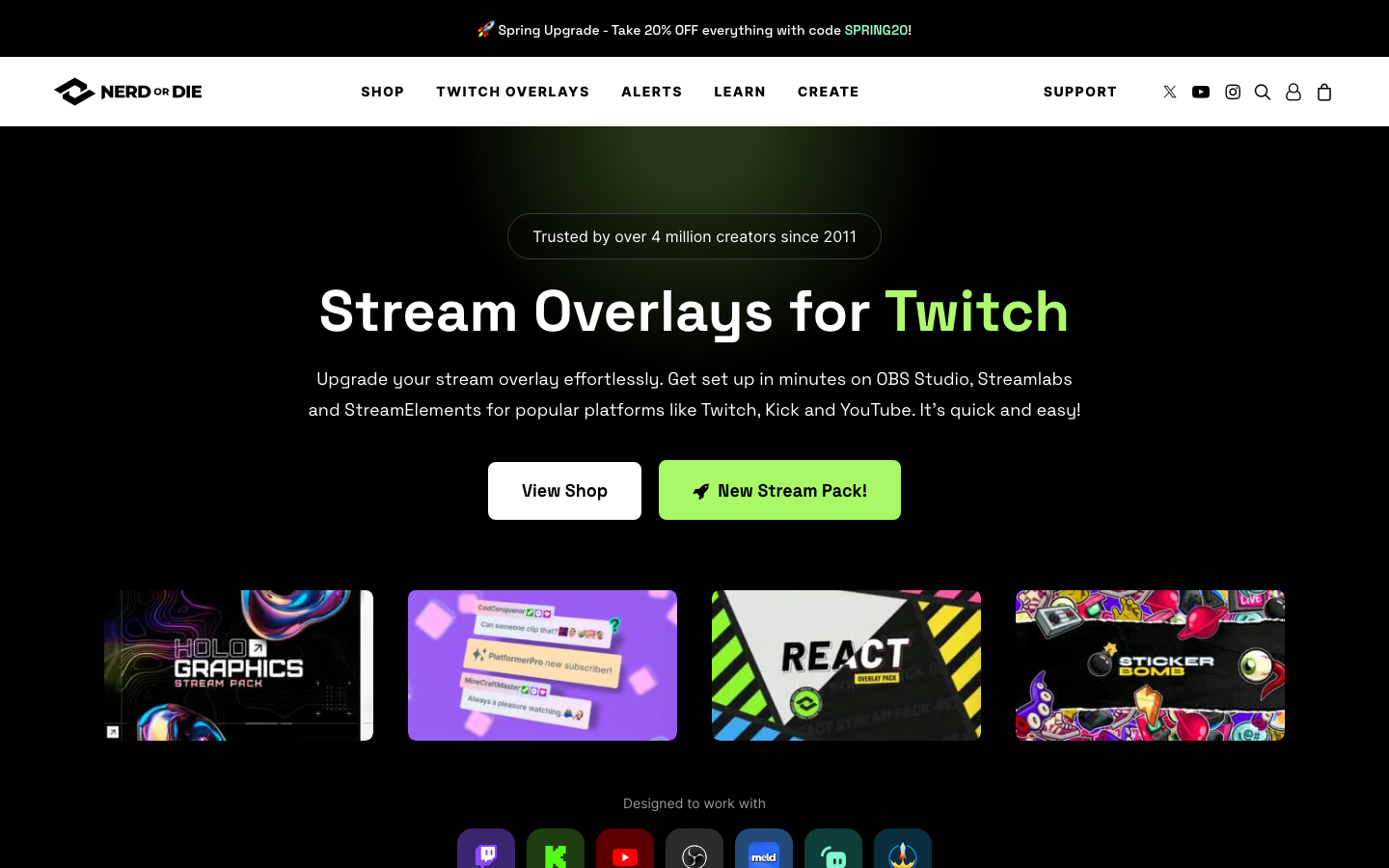
Nerd or Die makes the stream overlays, alerts, and StreamFX that half of Twitch is using — 10-30 percent tiered commissions with no application barrier. Anyone with a public site or channel can sign up. Tier 1 starts at 10 percent on the first $250 in sales per month; Tier 2 at 20 percent up to $1,000; Tier 3 at 30 percent above. Pays via PayPal monthly with a $50 minimum.
What is good: Zero-barrier approval (no traffic minimum), tiered structure rewards consistent volume, the products are evergreen (any new streamer needs an overlay), the audience overlap with gaming creators is essentially 1:1. What is broken: Smaller average order value than gear or game keys ($15-50 templates) so volume matters; some templates are time-bound to specific games and lose relevance quickly. Under the hood: Custom Shopify storefront on a first-party affiliate plugin (Refersion). Templates ship as After Effects + Streamlabs/StreamElements packs. What should be better: Add a “creator showcases” section so the affiliate dashboard surfaces which template a creator is actively using on stream — the social proof would push tier upgrades.
Zygor Guides
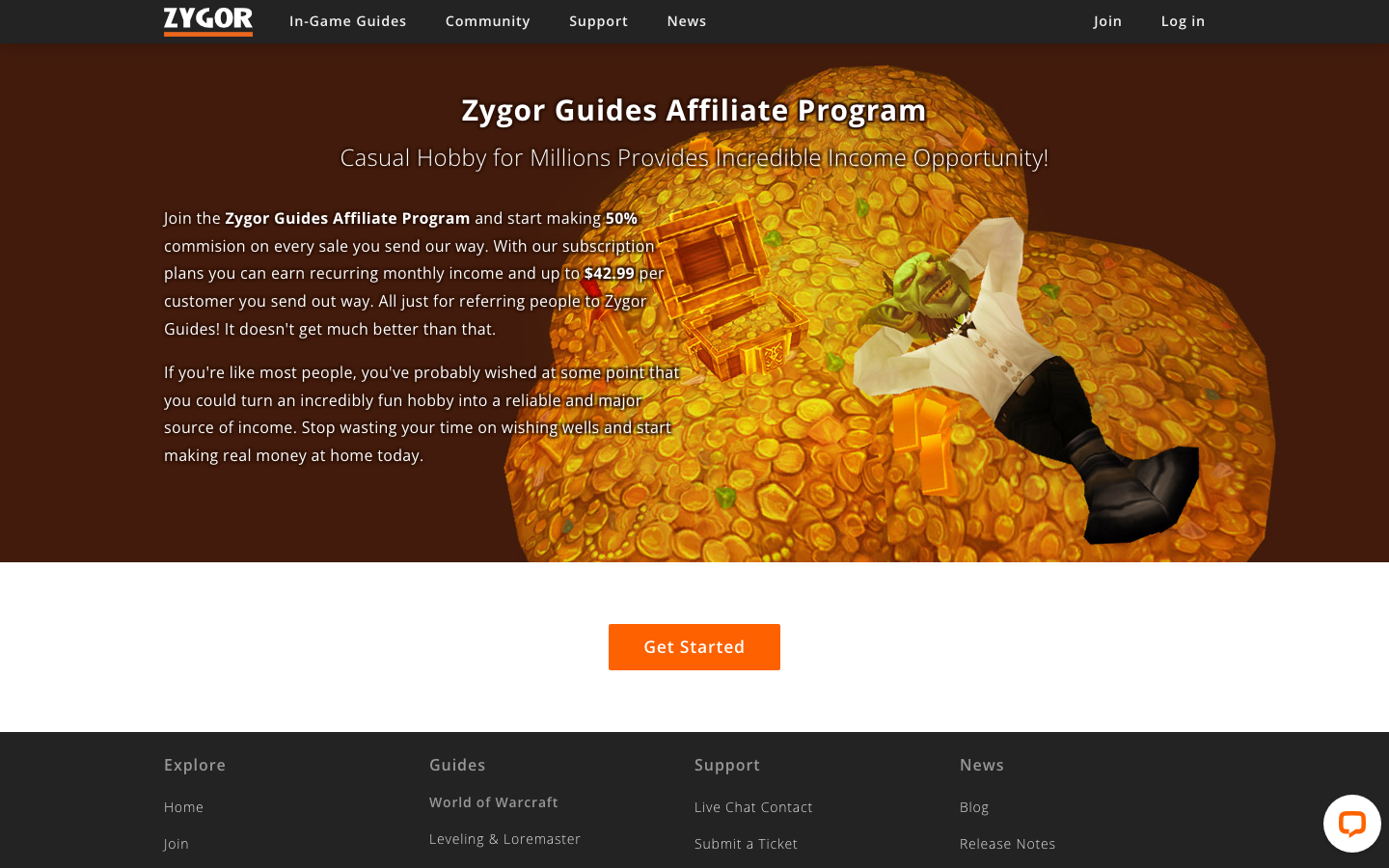
Zygor Guides pays 50 percent recurring commissions on World of Warcraft and Final Fantasy XIV addon subscriptions — the highest commission rate on this list. 60-day cookie window. The catch is the niche: Zygor only matters if your audience is MMO players, primarily WoW. If it is, this is the highest-paying gaming program you can run with no qualifying threshold to clear.
What is good: Highest commission rate of any program here (50% recurring, not one-time), 60-day cookie, accepts new affiliates without a traffic floor, recurring subscription model means a single referral keeps paying. What is broken: Niche is genuinely narrow (MMO players, mostly WoW); product is a leveling/questing addon so the value-prop is tied to the ebbs and flows of WoW expansions; some MMO players see in-game guides as crutches. Under the hood: First-party affiliate program with PayPal payouts. Backend is a custom referral system tied to the Zygor account ID, which means the cookie tracks across devices. What should be better: Add Final Fantasy XIV and Throne and Liberty content earlier in the launch cycle — Zygor is always 6-12 months late to non-WoW MMOs.
Cinch Gaming
Cinch Gaming makes modded controllers for competitive Call of Duty, Apex, and Fortnite — affiliate program is invite-leaning but pays solid percentages on premium hardware ($150-300 controllers). Custom paint jobs and creator-bundled SKUs make for high-converting content if your audience plays competitive FPS. They prefer creators with proven streaming reach.
What is good: High AOV (controllers run $150-300 so 10% beats $40 mice on absolute earnings), strong brand among competitive console players, creator collabs for custom paint jobs convert well. What is broken: Approval bar is unstated but real (under-followed creators get politely declined); product is hardware-only with no software complement; controller mods are sometimes restricted in tournaments which complicates the editorial pitch. Under the hood: First-party direct-to-consumer with custom paint shop. Affiliate dashboard is custom-built. Most controller hardware is Xbox and PS5 modded base controllers with custom paddles. What should be better: A public commission structure — invite-only programs that do not publish rates make creators chase rate cards instead of writing.
Wargaming
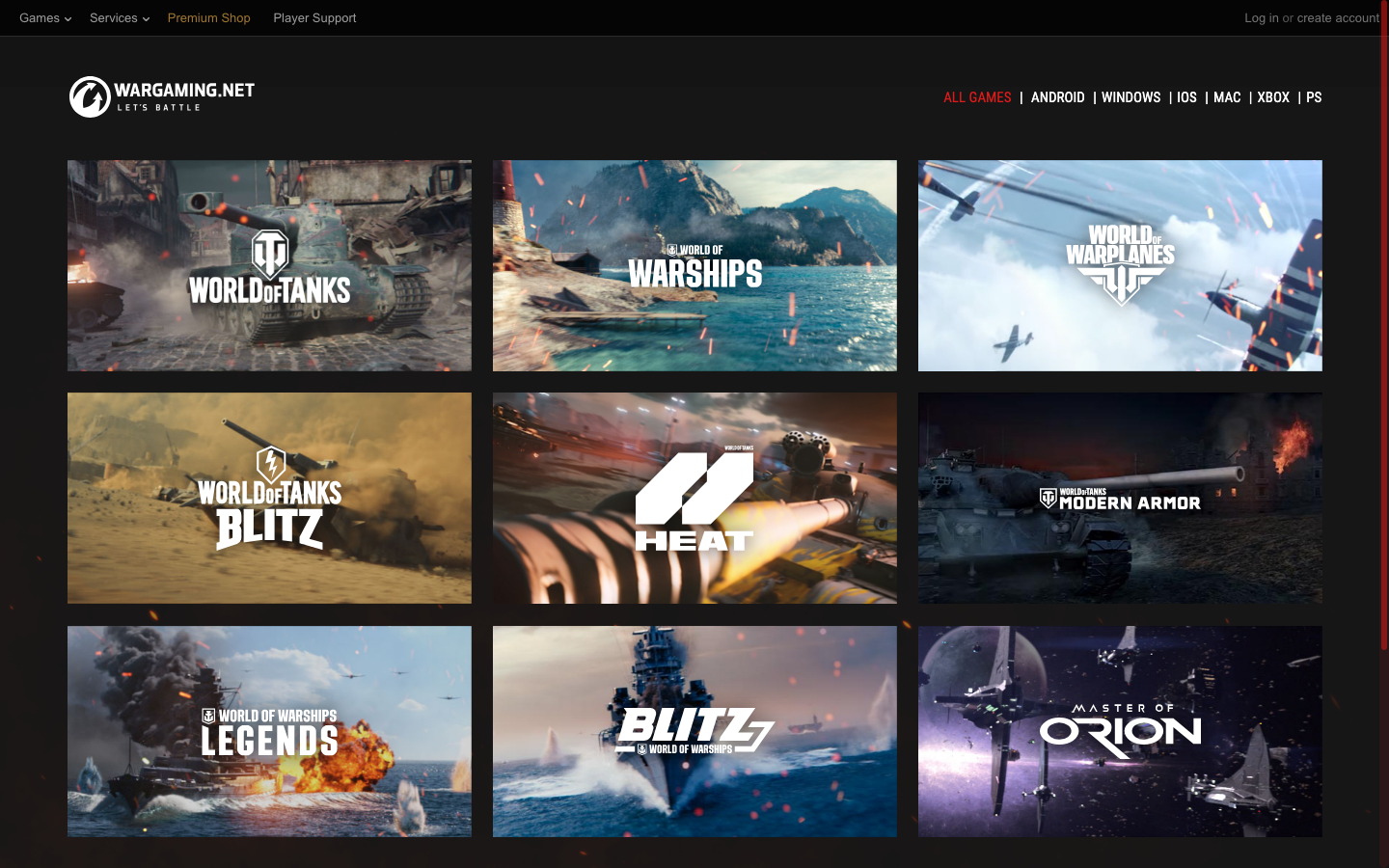
Wargaming runs the affiliate program for World of Tanks and World of Warships — premium-account signup bonuses, in-game gold rewards, and cash payouts for verified creators. Better suited to streamers covering tanks/warships than to general gaming bloggers. Regional rates vary (NA, EU, RU/CIS programs are tracked separately). The cookie is 30 days.
What is good: Real-money payouts plus in-game premium currency means even small audiences can extract some value, the WoT/WoWS communities are dedicated and high-converting, regional programs let you target the highest-paying market. What is broken: Regional fragmentation is a headache (NA program does not credit EU referrals); commission structure is bundled (not pure percentage); gameplay-only product means content has to be gameplay-led, not gear-led. Under the hood: First-party affiliate platform with regional sub-programs. Tracking ties referrals to the Wargaming account ID across the company’s game portfolio. What should be better: Unify the regional programs — a single creator dashboard for global referrals would save creators a half day of admin per month.
How to Pick a Gaming Affiliate Program
Pick by your content type, not by commission rate alone. Streamers default to Twitch first because the on-platform monetization stacks with anything you add. PC gaming bloggers should run Humble Bundle plus one gear program (Razer or Logitech G) — the two work together: storefront EPC plus gear authority. Niche MMO creators run Zygor Guides for the recurring tail. Console FPS streamers run Cinch Gaming for the AOV. Avoid running more than three programs at once — attribution gets messy and you stop optimizing any of them.
If you are new to all of this, read affiliate marketing for beginners first, then affiliate marketing fundamentals. Both walk through the cookie-window mechanics and the disclosure requirements that gaming creators routinely overlook.
The Call
Stop running 1-3 percent Amazon Associates links on a gaming site that could pay 5-15 percent direct. Pick two programs from this list — one storefront and one gear — and migrate your top-three highest-traffic posts in the next week. Watch the EPC for 30 days, keep what works, drop what does not. Most gaming creators leave $200-$1,500 a month on the table because they never benchmark beyond their first affiliate program.
See also: best affiliate marketing programs across all niches, affiliate marketing setup services.
Frequently Asked Questions
How much can you earn from gaming affiliate programs?
Earnings vary widely depending on the program and your traffic. Commissions range from 4% (Logitech) to 50% (Zygor Guides). CPA programs like GameFly pay $15-$20 per signup. Most gaming affiliates with a dedicated blog or channel earning consistent traffic can realistically make $500-$2,000 per month from 2-3 well-chosen programs.
What is the best gaming affiliate program for beginners?
Nerd or Die and Fanatical are the easiest to start with because they have no traffic requirements and no application barriers. Nerd or Die starts you at 10% commission with zero prerequisites, and Fanatical offers 5% on officially licensed game keys with a 30-day cookie window.
Do I need a website to join gaming affiliate programs?
Not always. Some programs like Twitch and Cinch Gaming work well for streamers and social media creators without a website. However, having a blog or website gives you more placement options for affiliate links and tends to generate more consistent, long-term revenue through search traffic.
What is a cookie window and why does it matter for gaming affiliates?
A cookie window is the period of time after someone clicks your affiliate link during which you still earn a commission if they make a purchase. For example, Fanatical has a 30-day cookie window, so if someone clicks your link and buys a game 20 days later, you still get paid. Longer cookie windows give you a better chance of earning commissions on higher-priced items where buyers take more time to decide.
Can I promote multiple gaming affiliate programs at the same time?
Yes, and you should. Most successful gaming affiliates promote 2-3 complementary programs. For example, you could pair Razer (hardware) with Fanatical (game keys) and Zygor Guides (gaming guides). This way, you cover different product categories without competing against yourself.
Which gaming affiliate programs pay recurring commissions?
Zygor Guides is the standout for recurring commissions, paying up to $42.99 per month per customer on subscription plans. Loot Crate also offers subscription-based products that can generate ongoing revenue. Recurring commissions are valuable because you keep earning from a single referral month after month.
How do I increase my conversion rate with gaming affiliate links?
Write honest, detailed reviews with specific pros and cons. Include screenshots, gameplay footage, or personal test results. Place affiliate links within helpful content rather than plastering them everywhere. Comparison articles (Product A vs Product B) and “best of” lists tend to convert best because readers are already in buying mode when they search for those terms.
Are gaming affiliate programs worth it compared to other niches?
Gaming is a strong affiliate niche because of the sheer volume of buyers and the range of products available, from $10 game keys to $1,800 gaming PCs. The audience skews younger and is comfortable buying online, which means higher conversion rates. Commission percentages can be lower on hardware (4-10%), but the high product prices and purchase frequency make up for it.
Tell Google you want more of this.
Add Gaurav Tiwari as a preferred sourceOne tap, and this site shows up more often in your own Top Stories, AI Overviews and AI Mode. Remove it any time.
Disclaimer: This site is reader-supported. If you buy through some links, I may earn a small commission at no extra cost to you. I only recommend tools I trust and would use myself. Your support helps keep gauravtiwari.org free and focused on real-world advice. Thanks. - Gaurav Tiwari