
 by
by
Most lead generation problems aren’t traffic problems. They’re handoff problems. A business runs ads, publishes content, adds a form, and collects names. Then nobody can say which person is worth calling, what happens next, or whether the campaign ever produced revenue.
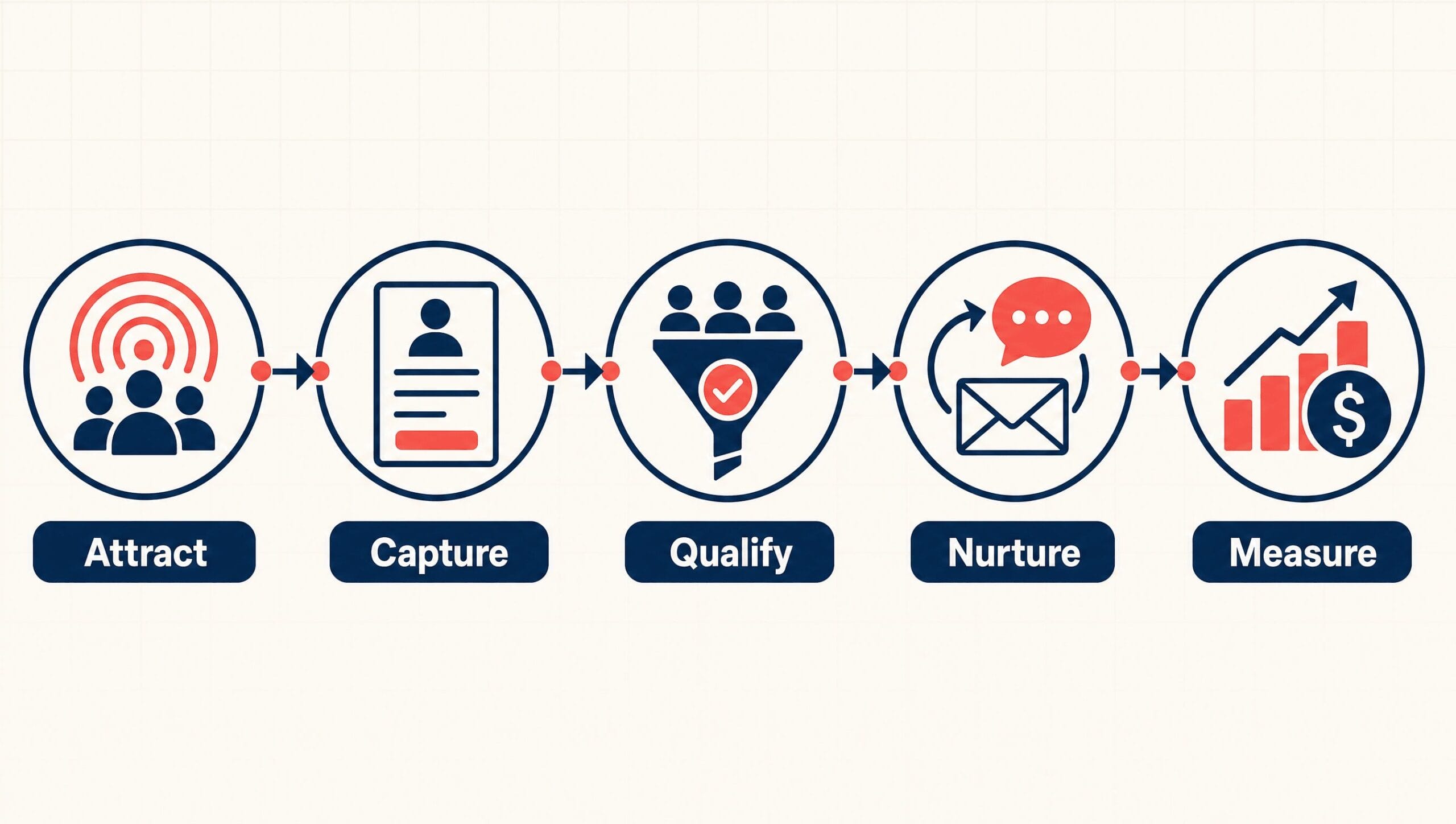
Lead generation works when five jobs operate as one system: attract the right people, capture useful context, qualify fit and intent, nurture the relationship, and measure the path to a customer. Miss one job and the funnel leaks, no matter how impressive the traffic chart looks.
What Is Lead Generation?
Lead generation is the process of turning identifiable interest into a qualified next step and tracking that person or account until it becomes revenue or is disqualified. A complete system attracts the right audience, captures permission and context, qualifies fit and intent, nurtures the relationship, and measures the result.
What Counts as a Lead?
A lead is a person or account that has shown identifiable interest and can move to a defined next step. A newsletter subscriber may be a lead for a creator. A product-qualified trial account may be a lead for a SaaS company. A homeowner requesting an inspection is a lead for a local contractor.
| Term | Practical meaning | Required next step |
|---|---|---|
| Visitor | An anonymous person consuming content or viewing an offer | Give the person a useful reason to identify themselves |
| Lead | An identifiable person or account with recorded interest | Capture context and qualify fit |
| Prospect | A lead that matches the target customer profile | Confirm need, timing, and buying process |
| Opportunity | A qualified deal with a realistic path to purchase | Advance the sale or disqualify it |
| Customer | A person or account that completed the purchase | Onboard, retain, and ask for referrals when earned |
Lead Generation vs Demand Generation and Sales
Demand generation creates attention and preference. Lead generation converts some of that attention into identifiable interest. Prospecting starts conversations with selected people or accounts. Sales turns qualified opportunities into customers. The four jobs support each other, but they aren’t interchangeable.
| Function | Main job | Typical action | Useful metric |
|---|---|---|---|
| Demand generation | Create awareness and preference | Publish research, videos, tools, or events | Qualified reach and engaged accounts |
| Lead generation | Capture identifiable interest | Offer a demo, quote, planner, assessment, trial, or consultation | Qualified lead rate |
| Prospecting | Open a conversation with a selected buyer | Send a relevant email, call, or introduction request | Positive reply or meeting rate |
| Sales | Turn a qualified need into a purchase | Discovery, proposal, negotiation, and close | Win rate, revenue, and sales cycle |
How Does the Lead Generation Process Work?
The lead generation process has five stages: attract, capture, qualify, nurture, and measure. Each stage needs an owner, a definition of done, and a number that shows whether the lead moved forward. The order is simple. The hard part is refusing to skip a stage.
- Attract: reach a defined buyer at a useful moment through search, content, ads, referrals, communities, events, or direct outreach.
- Capture: record identity, source, consent, and enough context to choose a next step.
- Qualify: judge fit, intent, timing, value, and any reason the lead should not enter sales.
- Nurture: answer the next objection, follow up on time, and move the lead toward a decision without sending the same sequence to everyone.
- Measure: connect source and campaign to qualified pipeline, customers, revenue, cost, and the time required to produce them.
Start With the Buyer and Offer
Lead generation starts with a specific buyer and a specific reason to respond. The channel comes later. If the offer doesn’t solve a live problem, moving it from Google Ads to LinkedIn won’t rescue it.
Define the Buyer Narrowly
For B2B, define the ideal customer profile at the account level and the buyer roles inside that account. Company size, industry, location, existing stack, buying trigger, and deal value matter. For B2C, define the consumer segment, situation, urgency, budget, location, and the person who influences the decision.
- Problem: what changed recently enough to make action likely?
- Desired result: what can the buyer do, save, avoid, or prove after choosing you?
- Evidence: what example, calculation, demonstration, or guarantee reduces doubt?
- Constraint: what budget, timing, location, authority, eligibility, or technical limit affects the decision?
- Next step: what is the smallest useful commitment for this stage of intent?
Match the Offer to Intent
A checklist is useful when the reader is diagnosing a problem. A calculator is better when the buyer is comparing economics. A demo fits someone evaluating software. A quote fits someone who knows the service they need. A consultation fits a complex problem that can’t be priced responsibly from three form fields.
Don’t gate every useful resource. A buyer shouldn’t have to surrender an email address to read a basic definition. Gate the asset when delivery, personalization, calculation, or ongoing access creates a fair exchange. My guide to lead magnets that convert covers format, delivery, placement, and testing in detail.
Which Lead Generation Channels Should You Use?
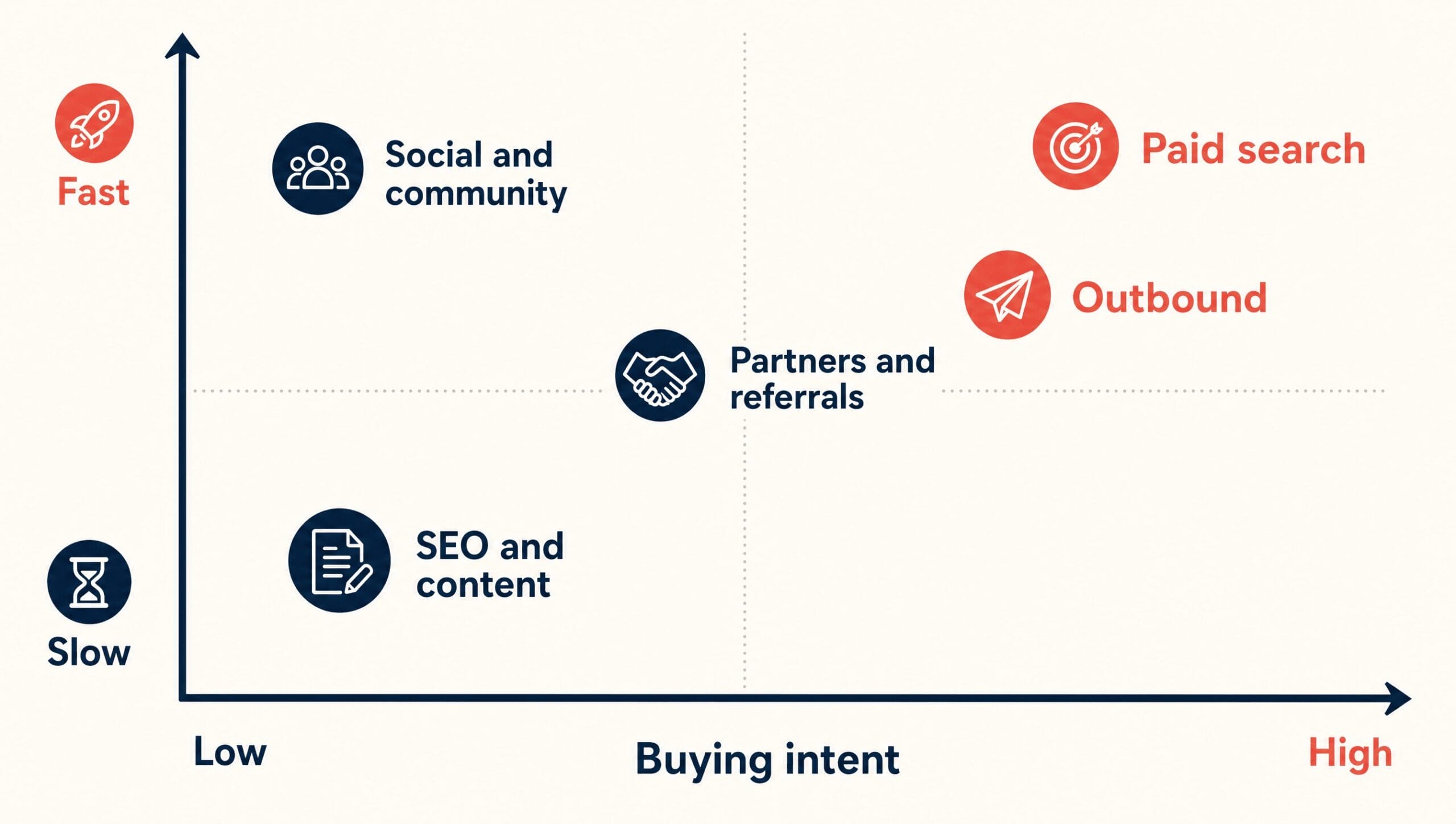
Choose lead generation channels by buyer intent, sales motion, economics, and your ability to follow up. Start with one demand-capture channel and one demand-creation channel. Add a third only when the first two produce data you can trust.
| Channel | Best job | Strength | Main risk |
|---|---|---|---|
| SEO and search content | Capture active research and recurring questions | Compounds and reveals intent | Slow feedback when the offer is unproven |
| Paid search | Capture commercial demand now | Fast, measurable query-level intent | Weak pages and poor follow-up burn budget fast |
| Social content | Create familiarity and distribute proof | Good feedback and audience access | Reach can be high while buying intent stays low |
| Outbound email and calling | Reach selected accounts or buyers | Works before organic demand exists | Bad data and generic messaging damage trust |
| Partners and referrals | Borrow trust and reach adjacent buyers | Often strong lead quality | Volume and timing are hard to control |
| Events and webinars | Teach, qualify, and create live interaction | Strong for complex decisions | Registration counts can hide weak attendance and pipeline |
| Communities | Learn buyer language and earn trust | High-context conversations | Promotion without contribution gets ignored |
Channel tactics change with the buyer, sales motion, and economics. Compare them in my B2B vs B2C lead generation guide.
Build the Capture and Consent Layer
The capture layer turns attention into a usable record. It includes the landing page, form, thank-you state, source data, consent record, routing rule, confirmation, and the first follow-up. The form is only one piece.
Ask Only What the Next Step Needs
Every extra field should earn its place by changing routing, qualification, or the next message. If a field won’t change what happens next, ask later. Progressive profiling is usually better than turning first contact into an application form.
- Store the original source, landing page, campaign, and UTM values.
- Show what the person will receive and when.
- Separate service inquiries from marketing consent.
- Route the lead to a named owner or queue.
- Send a confirmation that repeats the promised next step.
- Test validation, spam protection, mobile layout, and delivery.
For the WordPress capture layer, Core Forms can collect the enquiry, store the submission, and send notifications or a webhook. Your team still needs to define who responds and what happens next.
If your site runs on WordPress, use my WordPress lead generation setup guide for forms, landing pages, popups, and integrations. If traffic arrives but inquiries don’t, diagnose the leak with the website lead-generation checklist before buying more clicks.
Treat Consent as System Data
Email, phone, SMS, consent, and retention rules vary by jurisdiction and contact type. Review the FTC’s CAN-SPAM guidance and the UK ICO’s B2B marketing guidance. Store the basis, wording, time, source, and withdrawal state. This is an operating checklist, not legal advice.
How Do You Qualify a Lead?
Qualify a lead by checking fit, intent, timing, potential value, and disqualifiers. A lead score can help order the queue, but it can’t replace a shared definition of what should enter sales and what should stay in nurture.
| Signal | Question | Example |
|---|---|---|
| Fit | Can this buyer use, afford, and benefit from the offer? | Right industry and team size, or a serviceable location |
| Intent | What behavior shows active evaluation? | Requested pricing, returned to a comparison page, or started a trial |
| Timing | When does the buyer need a result? | This month, this quarter, or “researching for later” |
| Value | Can the likely revenue justify acquisition and sales effort? | Expected order value, contract value, gross margin, or repeat potential |
| Disqualifier | What should stop the handoff? | Unsupported location, no required integration, student request, or impossible deadline |
MQL, SQL, PQL, and Opportunity
A marketing-qualified lead, or MQL, meets marketing’s fit and engagement threshold. A sales-qualified lead, or SQL, has been accepted as worth direct sales attention. A product-qualified lead, or PQL, has shown buying intent through product use. An opportunity is a qualified deal with a credible purchase path.
Define the transition in plain language. “Visited pricing twice” isn’t enough on its own. “Matches the ICP, requested a demo, needs the capability this quarter, and accepted a meeting” is.
A simple score beats a fake scientific model. Start with 0 to 10 points for fit and 0 to 10 for intent. Send high-fit, high-intent leads to sales. Nurture high-fit, low-intent leads. Suppress low-fit contacts from sales even when they click often.
Nurture Leads Without Losing the Handoff
Lead nurture should move a person to the next reasonable decision, not send a fixed number of emails. The sequence changes with source, intent, fit, objections, and the amount of human help the purchase needs.
- Immediate confirmation: repeat the request, owner, and expected response time.
- Fast human follow-up: prioritize high-fit, high-intent inquiries while the problem is live.
- Objection content: send proof, comparisons, process, pricing context, security details, or examples that match the decision.
- Behavior rules: change the next message when a lead books, replies, buys, becomes inactive, or is disqualified.
- Closed-loop handoff: sales must accept, reject, or return the lead with a reason marketing can use.
For implementation, see my lead management practices and lead data management guide.
How Do You Calculate Lead Generation Results?
Calculate lead generation from revenue backward, not from form fills forward. Start with customers and gross profit, then trace opportunities, qualified leads, total leads, and traffic. This shows which conversion rate or cost actually limits growth.
| Metric | Formula | What it reveals |
|---|---|---|
| Visitor-to-lead rate | Leads / visitors x 100 | Offer and capture-page performance |
| Lead-to-qualified rate | Qualified leads / leads x 100 | Targeting and lead quality |
| Qualified-to-opportunity rate | Opportunities / qualified leads x 100 | Handoff and discovery quality |
| Close rate | Customers / opportunities x 100 | Sales execution and offer fit |
| Cost per lead | Campaign cost / leads | Raw acquisition efficiency |
| Cost per qualified lead | Campaign cost / qualified leads | Channel quality after qualification |
| Customer acquisition cost | Sales and marketing cost / new customers | Full acquisition economics |
| Revenue per lead | Revenue from cohort / leads in cohort | Expected value of a new lead |
A Worked Funnel Example
Assume a campaign attracts 5,000 visitors and costs $10,000. It produces 250 leads, 75 qualified leads, 30 opportunities, and 9 customers. If the average first-year revenue is $4,000, the campaign creates $36,000 in first-year revenue.
- Visitor-to-lead rate: 250 / 5,000 = 5%
- Lead-to-qualified rate: 75 / 250 = 30%
- Campaign CAC before other sales costs: $10,000 / 9 = $1,111.11
- First-year revenue-to-campaign-cost ratio: $36,000 / $10,000 = 3.6x
Replace these illustrative numbers with your costs, margin, refund rate, repeat rate, sales effort, and time to revenue. A strong revenue ratio can still hide weak economics.
Enter your email and I’ll send the editable workbook with funnel formulas, channel scoring, UTMs, follow-up SLA, and weekly metrics.
What Does a Lead Generation Stack Need?
A lead generation stack needs seven functions: traffic data, capture, source tracking, contact storage, automation, communication, and revenue reporting. You don’t need seven separate tools. You need every function covered without losing the original source or the follow-up owner.
| Function | Minimum setup |
|---|---|
| Analytics | Google Analytics 4 plus ad-platform conversion tags where used |
| Capture | Fast landing page and accessible form |
| Source tracking | UTM fields, landing page, referrer, and campaign ID |
| CRM | One contact record, stage, owner, next action, and activity history |
| Automation | Confirmation, assignment, reminder, and status-change rules |
| Communication | Email plus the buyer’s preferred response channel |
| Reporting | Weekly source-to-qualified-lead and customer report |
Lead Generation Examples by Business Model
Each example connects buyer intent, offer, capture, qualification, next step, and revenue.
B2B SaaS
A finance software company publishes an invoice-error calculator for operations teams. The result page explains the cost, asks for company context, and offers a tailored demo. Account fit plus calculator input determines routing. The core metric is qualified pipeline per target account, not total downloads.
Local Service Business
A roofing company uses local search pages and Google Ads for repair and replacement queries. The form asks for postcode, job type, urgency, and contact preference. Service area and urgency determine routing. The useful metric is booked inspection cost and completed-job revenue by source.
High-Consideration B2C
A training institute uses course pages, comparison content, webinars, and counseling calls. The form records course interest, start date, location, and contact consent. Readiness and eligibility determine the next step. The metric is enrolled-student revenue after refunds, not webinar registrations.
Travel Agency
A travel agency separates destination research from quote intent. Early-stage visitors receive itineraries and cost planners. High-intent visitors request a quote or planning call. Destination, timing, group size, and budget guide routing. The full travel agency lead generation plan shows how the model changes for long research windows.
Build Your Lead Generation System in 30 Days
You can build the first usable version of a lead generation system in four weeks. Keep the scope narrow: one buyer, one offer, one primary channel, one capture path, one owner, and one weekly report.
- Week 1, economics and buyer: define the customer, trigger, value, gross margin, acquisition ceiling, qualification rules, and disqualifiers.
- Week 2, offer and capture: build the landing page, form, thank-you state, source fields, consent wording, and the promised asset or appointment.
- Week 3, routing and nurture: connect the CRM, assign an owner, write the confirmation and first follow-ups, set the response SLA, and test every status change.
- Week 4, launch and measure: launch one channel, inspect every lead manually, fix data gaps, and review source, quality, response time, pipeline, customers, and cost.
Don’t automate judgment before you understand the leads. The first 20 to 50 records should teach you which fields matter, which reasons cause rejection, which questions predict a sale, and where the handoff fails. Automate the pattern after the pattern is visible.
Why Do Lead Generation Systems Fail?
Lead generation systems fail when a team optimizes one visible stage and ignores the handoffs around it. More traffic can’t fix a weak offer. A shorter form can’t fix bad targeting. Faster follow-up can’t turn an unqualified contact into a buyer.
- Buying traffic before fixing conversion: paid clicks expose the same page and routing leaks faster.
- Collecting leads without a qualification definition: marketing celebrates volume while sales rejects the queue.
- Leaving ownership vague: “sales will follow up” is not a person, a deadline, or a status.
- Reporting only CPL: cheap leads can produce expensive customers when qualification and close rates collapse.
- Breaking source continuity: the CRM stores the contact but loses the first landing page, campaign, or referral.
Frequently Asked Questions
What is lead generation in digital marketing?
Lead generation in digital marketing turns online interest into an identifiable next step. Search, content, ads, social media, email, webinars, and landing pages can attract demand. Forms, trials, quotes, planners, and consultations capture it. A CRM then records source, qualification, follow-up, opportunity, and revenue.
What are the five stages of lead generation?
The five stages are attract, capture, qualify, nurture, and measure. Attract reaches the right buyer. Capture records identity and context. Qualify checks fit and intent. Nurture moves the lead toward a decision. Measure connects the original source to pipeline, customers, revenue, cost, and time.
What is the difference between a lead and a prospect?
A lead is an identifiable person or account that has shown interest. A prospect is a lead that also matches the target customer profile. The distinction matters because interest alone does not justify sales time. Qualification checks whether the person can use, afford, and benefit from the offer.
Which lead generation channel should a small business start with?
Start with the channel closest to proven buyer intent. Local and high-intent services often begin with Google search, referrals, and a strong landing page. A new B2B offer may start with direct outreach and partner introductions. Choose one channel you can run for 30 days and trace to qualified leads.
How do you calculate lead generation ROI?
Calculate lead generation ROI as attributable gross profit minus sales and marketing cost, divided by that cost, multiplied by 100. Use gross profit rather than revenue when fulfillment costs are material. Track cohorts long enough to include refunds, repeat purchases, sales effort, and the delay between lead capture and cash.
What information should a lead generation form collect?
A lead generation form should collect only what changes the next step. Most forms need identity, contact method, request or offer, and source data. Add location, company, role, timeline, budget, or eligibility only when those fields change routing or qualification. Record consent separately from the service inquiry.
Is buying a lead list a good lead generation strategy?
No. A purchased list gives you contact data, not permission or demonstrated interest. Accuracy, deliverability, compliance, and fit can all be weak. Build a selected prospect list from legitimate sources when outbound is appropriate, verify the data, document the lawful basis, and send relevant messages with a clear opt-out.
How long does lead generation take to work?
Lead generation can produce responses within days through referrals, paid search, and targeted outreach, but a reliable system takes longer. SEO, partnerships, and audience building may need months. Judge a channel after enough qualified opportunities and customers have matured, not after an arbitrary number of days or form fills.
Need Help With Your Lead Generation System?
If you want an outside review of your offer, capture path, qualification, handoff, and measurement, request a lead-generation system audit.
Tell Google you want more of this.
Add Gaurav Tiwari as a preferred sourceOne tap, and this site shows up more often in your own Top Stories, AI Overviews and AI Mode. Remove it any time.