by
by
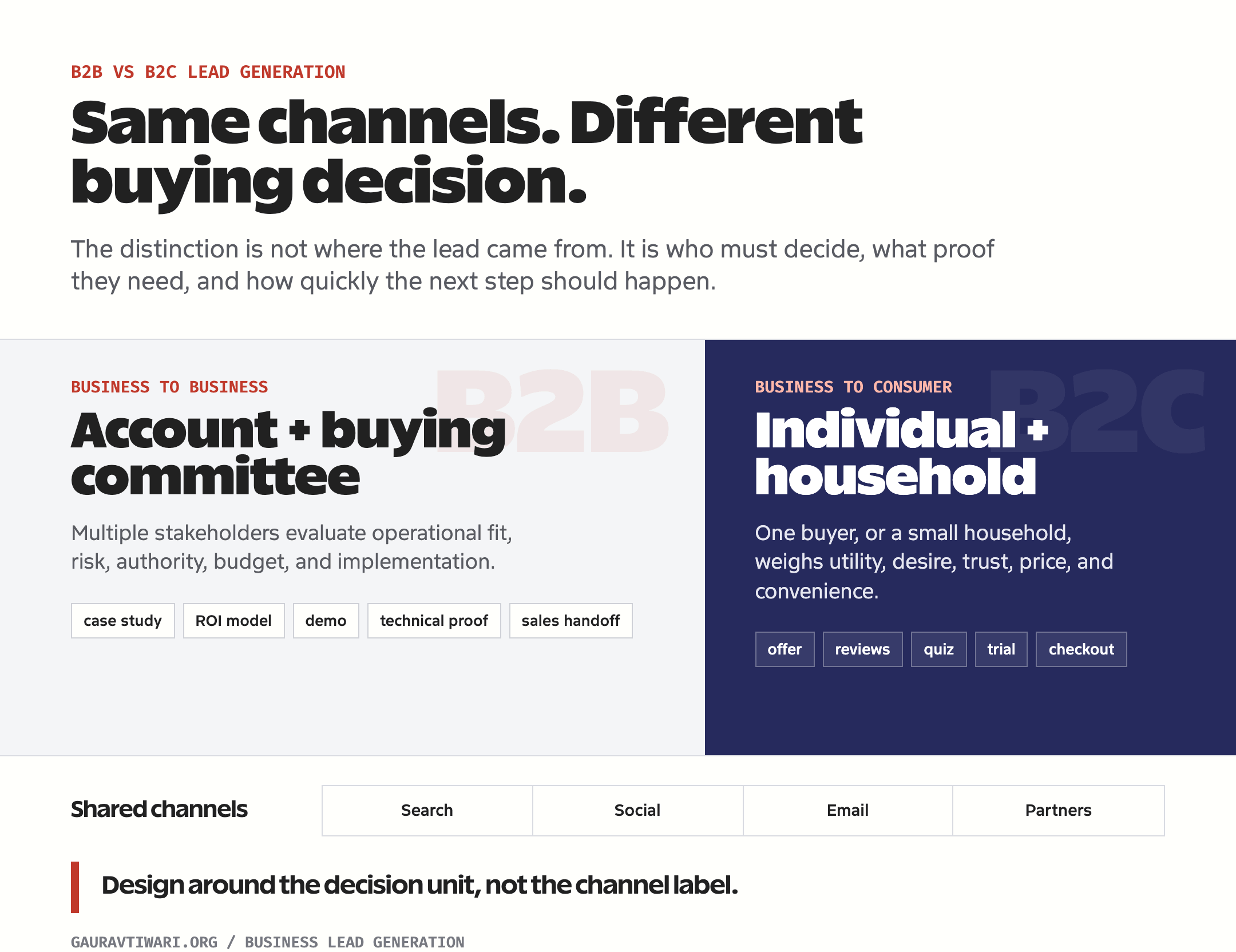
B2B vs B2C lead generation isn’t a choice between LinkedIn and Instagram. Both models can use search, content, email, referrals, ads, events, and direct conversations. What changes is the buying unit, evidence, qualification, handoff, timing, and amount you can spend to win a customer.
Start with the purchase, not the platform. If several people must approve a high-value contract, build for accounts, proof, and sales follow-up. If one person can buy in minutes, reduce friction and make the next step immediate. High-consideration consumer purchases sit between those extremes.
B2B vs B2C Lead Generation at a Glance
| Decision | B2B lead generation | B2C lead generation |
|---|---|---|
| Buying unit | Account plus one or more stakeholders | Individual, household, or a small influencer group |
| Typical next step | Demo, assessment, discovery call, trial, or proposal | Quote, booking, consultation, sample, trial, or purchase |
| Evidence | ROI, integration, security, process, risk, and stakeholder proof | Outcome, convenience, trust, price, reviews, availability, and fit |
| Qualification | Account fit, role, need, timing, authority, and commercial value | Need, readiness, location, eligibility, budget, and purchase intent |
| Handoff | Marketing to sales or account owner | Marketing to checkout, booking, counselor, advisor, or local team |
| Volume and value | Often lower volume with higher potential contract value | Often higher volume with lower value per transaction |
| Main metric | Qualified pipeline and won revenue by account | Revenue, bookings, orders, or enrolled customers by lead cohort |
The real dividing line: B2B lead generation prepares a group decision inside an account. B2C lead generation prepares an individual decision, even when family members, advisers, or financing influence it.
Who Is the Buyer?
B2B starts with account fit. B2C starts with the consumer’s situation.
B2B: Account Fit Comes First
An ideal customer profile describes the company before it describes a contact. Industry, size, location, current system, compliance needs, buying trigger, expected value, and implementation limits help decide whether the account is worth attention.
Then map roles. A marketing manager may discover the tool, an operations lead may own the problem, IT may check integration, finance may test the numbers, and an executive may sign. One lead form doesn’t mean one-person demand.
B2C: The Situation Comes First
A consumer segment should describe a live situation, not a vague demographic. Someone comparing universities, planning a wedding, replacing a roof, booking a family holiday, or choosing health insurance has a different deadline, risk, and evidence need.
Age and location can matter, but behavior and circumstance usually explain more. A parent may fill an education form while the student uses the service. A homeowner may research while a spouse approves the budget. Design the follow-up for the decision, not just the submitter.
How Do B2B and B2C Offers Differ?
| Intent | B2B offer | B2C offer |
|---|---|---|
| Diagnose | Maturity assessment, audit, benchmark, cost model | Quiz, checklist, eligibility check, cost estimator |
| Compare | ROI calculator, architecture guide, vendor checklist, workshop | Buying guide, comparison, sample, itinerary, price range |
| Evaluate | Demo, proof of concept, trial, security review | Consultation, free class, test drive, trial, appointment |
| Buy | Discovery, proposal, commercial terms, implementation plan | Quote, booking, application, checkout, financing step |
Discounts are not the default B2C answer. They attract price-sensitive demand and can train buyers to wait. A useful planner, availability check, personalized estimate, or consultation often creates a stronger next step. The right format depends on the problem, and my lead magnet guide covers design and delivery.
Which Channels Work for B2B and B2C?
Most channels can work for both models. The job assigned to the channel matters more than the label. Search captures intent. Social creates familiarity and distributes proof. Email follows up. Referrals transfer trust. Direct outreach opens a selected conversation.
| Channel | B2B use | B2C use |
|---|---|---|
| Search and SEO | Category education, integration questions, comparison, vendor evaluation | Local intent, product research, symptoms, cost, availability, comparison |
| Paid search | High-intent demo, service, software, and competitor terms | Local service, quote, booking, product, and urgent-need terms |
| Account research, expert content, events, introductions, selected outreach | Useful when the consumer decision is tied to career, education, finance, or professional identity | |
| Instagram, YouTube, and short video | Demonstration, founder proof, employer brand, product education | Discovery, demonstration, trust, social proof, and aspiration |
| Account nurture, event follow-up, business case, stakeholder proof | Welcome, education, abandoned inquiry, reminder, replenishment, reactivation | |
| Outbound | Selected accounts with a relevant trigger and clear role | Usually limited to consented follow-up, local service, existing relationships, or regulated use cases |
| Partners and referrals | Agencies, consultants, technology partners, associations | Creators, local businesses, communities, professionals, existing customers |
If your B2B motion needs prospect data, compare the B2B lead finder platforms for agencies after defining the account and trigger. A bigger database won’t fix a weak list definition.
How Should Forms and Consent Change?
B2B forms usually need more routing context. B2C forms usually need less friction. Both need honest expectations, source capture, consent records where required, and a tested handoff.
B2B Form Fields
A B2B demo form may ask for work email, company, role, team size, use case, timeline, and current system. Each field must change qualification or routing. If company size doesn’t affect the next step, don’t ask it on first contact.
B2C Form Fields
A B2C form often needs name, contact method, location, product or service interest, and timing. Ask eligibility, budget, household, travel, health, or financing questions only when the answer changes the result and the page has earned enough trust.
Email, SMS, calling, consent, and retention rules vary by jurisdiction and contact type. Review the FTC’s CAN-SPAM guidance and the UK ICO’s B2B marketing guidance, document your basis, and seek legal advice when warranted.
How Do You Qualify B2B and B2C Leads?
| Signal | B2B example | B2C example |
|---|---|---|
| Fit | Industry, company size, region, stack, use case | Location, need, eligibility, product fit, service type |
| Intent | Demo request, pricing return, trial use, stakeholder engagement | Quote request, appointment, cart, availability check, repeat visit |
| Timing | Project this quarter, contract renewal, active migration | Immediate need, event date, intake date, planned purchase window |
| Value | Contract value, seats, expansion, gross margin | Order value, repeat rate, margin, add-ons, referral potential |
| Disqualifier | Unsupported integration, wrong market, no commercial need | Outside service area, ineligible, unavailable date, wrong budget |
How Should Nurture and Handoff Work?
B2B nurture helps several stakeholders reach a shared business decision. B2C nurture helps an individual act at the right moment with enough confidence. Both need a clear owner, a response promise, and rules that stop irrelevant messages after the lead advances or opts out.
B2B Nurture
Send material that can travel inside the account: ROI assumptions, security notes, implementation steps, comparison criteria, stakeholder FAQs, and a recorded demonstration. A champion needs help explaining the decision to finance, IT, legal, users, and leadership.
B2C Nurture
Use confirmations, reminders, availability, proof, comparisons, financing or payment context, and the next appointment or purchase step. High-intent B2C leads often need fast human follow-up. Lower-intent leads need useful education without daily pressure.
My lead management guide covers response rules, scoring, handoff, automation, CRM use, and pipeline hygiene for both models.
Which Metrics Matter?
B2B lead generation should be judged by qualified accounts, opportunities, pipeline, won revenue, sales cycle, CAC, and payback. B2C lead generation should be judged by qualified inquiries, purchases or bookings, revenue per lead, CAC, repeat value, refunds, and time to purchase.
Enter your email and I’ll send the editable Lead Generation System Planner with B2B and B2C funnel formulas, channel scoring, UTMs, SLA, and weekly metrics.
Two Worked Lead Generation Plans
These plans show how the choices combine from offer to revenue.
B2B SaaS Plan
- Buyer: finance operations teams replacing spreadsheet invoice checks.
- Offer: invoice-error cost calculator and tailored demo.
- Channels: search content, selected paid search, partner webinars, and trigger-based outbound.
- Capture: work email, company, role, invoice volume, current process, and timing.
- Qualification: account fit, error cost, buying trigger, implementation need, and stakeholder access.
- Handoff: high-fit calculator results route to an account executive; lower-intent accounts enter a proof sequence.
- Metric: qualified pipeline and won annual contract value by source.
High-Consideration B2C Plan
- Buyer: parents comparing job-focused training programs for a student.
- Offer: course comparison, eligibility check, fee planner, and counseling appointment.
- Channels: search, YouTube demonstrations, school partnerships, referrals, and remarketing.
- Capture: course interest, location, start date, contact preference, and marketing consent.
- Qualification: eligibility, timing, location, budget path, and counseling readiness.
- Handoff: ready leads route to a counselor; research-stage leads receive course proof and deadline reminders.
- Metric: enrolled-student revenue after refunds by lead cohort and source.
When the Usual B2B and B2C Rules Break
Purchase complexity can matter more than the B2B or B2C label. A self-serve business tool may be bought by one person with a card in five minutes. A consumer purchase such as a university course, mortgage, medical procedure, home renovation, or destination wedding can involve months of research, several influencers, financing, and a human adviser.
When B2B Behaves Like Self-Serve B2C
Low-cost software, templates, training, and small business services may not need a sales handoff. If the buyer can understand, try, approve, and pay alone, emphasize product pages, trials, clear pricing, onboarding, and in-product signals. Offer human help and route larger accounts separately.
When B2C Behaves Like Consultative B2B
High-consideration consumer decisions may need qualification, appointments, documentation, several follow-ups, and role-specific evidence. Map the decision-makers, time, proof, and margin-supported human attention. The goal is a confident, eligible buyer reaching the right specialist, not a fast checkout.
What About Hybrid Businesses?
A hybrid business can run B2B and B2C lead generation in one CRM, but it should not force both into one undifferentiated funnel. Separate the offers, landing pages, forms, qualification, owners, stages, nurture, and reports.
- Use a visible B2B or B2C offer choice when the same brand serves both.
- Keep separate lifecycle stages if “qualified” means something different.
- Assign business accounts and consumer inquiries to different owners or queues.
- Store one contact record when the same person appears in both motions, but keep purpose and consent history distinct.
- Report revenue, cost, and conversion by motion before combining totals.
Build the Right Business Lead Generation Plan
Choose the model by answering seven questions: who buys, who influences, what triggers action, what evidence reduces risk, what next step fits the intent, what qualifies the lead, and how much gross profit can support acquisition and follow-up.
Then build one path end to end. A working B2B path can be one target account, one useful assessment, one landing page, one qualification rule, and one account owner. A working B2C path can be one consumer situation, one quote or booking offer, one fast form, one service rule, and one response queue.
Frequently Asked Questions
What is the main difference between B2B and B2C lead generation?
B2B lead generation identifies an account and the people involved in a business purchase. B2C lead generation identifies an individual or household with a consumer need. B2B usually needs account qualification and stakeholder proof. B2C usually needs lower friction, fast service, and a direct path to booking or purchase.
Is B2B lead generation more expensive than B2C?
B2B lead generation often has a higher cost per lead because the audience is smaller, targeting is narrower, and sales follow-up takes more work. A higher CPL can still be healthy when contract value and margin support it. Compare customer acquisition cost, payback, and gross profit, not CPL alone.
Which channels are best for B2B lead generation?
B2B lead generation commonly uses search, expert content, LinkedIn, email, events, partners, referrals, and selected outbound. The best starting channel is the one closest to a proven buying trigger. Use search for active category demand, partners for transferred trust, and outbound for selected accounts before organic demand is mature.
Which channels are best for B2C lead generation?
B2C lead generation often uses search, local SEO, paid social, video, email, referrals, creators, marketplaces, and partnerships. Choose by intent and purchase type. Google search fits urgent or comparison-led needs. Video and social fit demonstration and discovery. Referrals work when trust matters more than reach.
Do B2C businesses need lead scoring?
Yes, when inquiry volume exceeds the team’s ability to respond equally. Universities, clinics, insurers, travel agencies, and home-service businesses can score location, eligibility, urgency, value, and behavior. The score should improve service and routing. It should not hide buyers behind an unexplained model.
Can one company run both B2B and B2C funnels?
Yes. One CRM can support both motions, but the company should separate offers, pages, forms, stages, routing, nurture, and reports. A training company can sell courses to individuals and corporate programs to employers. The contact record may be shared, while purpose, consent, qualification, and opportunity data remain distinct.
How should B2B and B2C lead generation be measured?
Measure B2B with qualified accounts, opportunities, pipeline, win rate, sales cycle, CAC, payback, and won revenue. Measure B2C with qualified inquiries, purchase or booking rate, revenue per lead, CAC, repeat value, refunds, and time to purchase. Both models should connect source and campaign to revenue.
Tell Google you want more of this.
Add Gaurav Tiwari as a preferred sourceOne tap, and this site shows up more often in your own Top Stories, AI Overviews and AI Mode. Remove it any time.