
How to Turn Customer Reviews Into Business Opportunities
Customer reviews are the highest-return, lowest-cost growth asset most businesses own, yet only ~5% of companies reply to them. Here is the 18-year system I use to turn each review type into social proof, product fixes, ad copy, search stars, and case studies, with the 2026 data on why response rate now drives revenue.
 by
by
Customer reviews are business assets, not just stars and praise, and the brands that grow fastest treat every review like a small piece of working capital.
Here is the short version. A review is social proof you can publish, a research note you can act on, ad copy you did not have to write, and a ranking signal Google reads. Most businesses collect customer reviews and stop there. The money is in what you do next.
I have run this play on my own products and across client sites for 18 years. Below is the exact system: how to get more reviews on purpose, how to answer the good and the ugly ones, how to mine them for product and marketing wins, how to turn them into content and ad copy, and how to wire review schema so stars show up in search. No fluff, no faking anything.
The verdict: customer reviews are the highest-return, lowest-cost growth asset most businesses own, and almost nobody works them fully. Roughly 93% of buyers say reviews shape what they purchase, yet only about 5% of businesses reply to the reviews they already have. That gap is the whole opportunity. If you ask on purpose, respond like a human, and recycle the wins into marketing, your customer reviews stop being feedback and start being a channel.
Proof, before the advice: 18 years running this on my own products and 850+ clients. The numbers that hold up in 2026: 93% of consumers say online reviews influence their purchase (Capital One Shopping), businesses that reply to reviews average about 35% more revenue than those that don’t (Opensend), and review signals carry roughly 16 to 20% of Google’s local pack ranking weight (Whitespark, Local Search Ranking Factors). Replying isn’t manners. It’s measurable money.
What changed in 2026: consumers now expect a reply, and they expect it fast. 89% expect a response to their review, two-thirds want a negative review answered within 72 hours, and 19% expect a same-day reply (up from 6% a year earlier). Review management used to be optional. It’s now a baseline customers measure you against.
Why Customer Reviews Are Business Assets, Not Vanity Metrics

It is 2025 and word of mouth still drives clicks and conversions harder than almost any paid channel. The difference now is that word of mouth is digital, public, and permanent. One review on Google can sit at the top of your brand search for years.
That is why a review is worth more than the rating it carries. A single honest line like “the setup took ten minutes and I was charging clients by the afternoon” cuts through ads, calms a buyer on the fence, and does it in the customer’s own voice. People trust people. They do not trust your headline.
So treat reviews the way you treat any asset. Collect them deliberately, store them where you can find them, and put them to work in more than one place. A five-star review that lives only on a third-party site and never touches your homepage, your ads, or your sales emails is money left on the table. If you care about conversion rate optimization, reviews are the cheapest lever you own.
How to Get More Reviews on Purpose
Most businesses do not have a review problem. They have an asking problem. Happy customers rarely write reviews unprompted, so you have to ask, and you have to ask well. Three things decide whether the ask works: the request itself, the timing, and the automation behind it.
The ask. Keep it personal and specific. “Would you leave a quick Google review?” converts far worse than “You mentioned the onboarding saved you a week. Would you drop that in a Google review so other owners see it?” Name the win they already told you about. Give them the sentence to start with.
The timing. Ask at the peak of the relationship, not at a random point in the month. The peak is the moment value lands: the first successful result, the delivered project, the support ticket you closed in an hour. That is when the customer feels it, and feeling drives writing.
The automation. Do not chase reviews by memory. Trigger the request off an event in your system. Common triggers that work:
- Order delivered or project marked complete fires a review email three days later.
- A support ticket rated 4 or 5 stars triggers a Google review link automatically.
- A repeat purchase, since a second order is proof they liked the first.
- A milestone inside your product, like the hundredth task done or the first month finished.
Send one well-timed link, not a campaign. Point people straight to the platform you care most about, usually Google, with a direct link that opens the review box. Every extra click you remove lifts your response rate. Wire these triggers into whatever already tracks your customers. A CRM like HubSpot, or FluentCRM if you run on WordPress, can fire the review request automatically off a closed deal or a delivered order. A simple system like this can take a business from a trickle of reviews to a steady flow without you lifting a finger each time.
How to Respond to Good and Bad Reviews
Responding to reviews is free, public, and most of your competitors are bad at it. That is your opening. The review mistake that costs the most is silence: 3 in 4 businesses never reply to a negative review, and 68% of negative reviews go completely unanswered (Wiser Review). Meanwhile 56% of consumers have changed their opinion of a business based purely on how it answered a review (BrightLocal). Every reply is read by the next ten prospects deciding whether to trust you, so write for them, not just the reviewer.
For good reviews, do not stop at “Thanks!” Reinforce the specific win and quietly restate your value. If someone praises fast support, reply with “Glad we got you back up in under an hour, that response time is the whole point for us.” Now every future reader learns your support is fast, from a third party, with your confirmation.
For bad reviews, the formula is calm, accountable, and forward-looking. Acknowledge the specific problem, take responsibility without excuses, say what you are doing about it, and move the heated part offline. Something like “You are right that the export was slow last month. We shipped a fix on the 14th and I would like to get you set up properly, can you email me directly?” A graceful reply to a one-star review often converts better than ten five-star reviews, because it proves how you behave when things go wrong. Never argue in public. Never get defensive. The audience is not the angry customer, it is everyone watching.
Mining Reviews for Product and Marketing Insight
Reviews are the cheapest customer research you will ever run, and you do not have to schedule a single call. Read them in bulk and patterns jump out that no survey will surface.
Mine them on two axes. First, product and service. The critical reviews, the “I wish this had” and “it almost worked but” lines, are a free roadmap. They tell you exactly what to fix, add, or cut, in order of how often customers raise it. Tag every complaint and count them. The complaint that shows up nine times is your next sprint, not the one loud reviewer who emailed the CEO.
Second, language. The exact words customers use to describe the win are gold for your marketing. If five reviewers independently call your tool “the thing that finally got my inbox to zero,” that is your next headline, handed to you. Pulling real customer phrasing into your copy is one of the most underused moves in content marketing, because it matches how buyers already think and search.
Keep the loop running. Track sentiment over time, watch which complaints fade after a fix and which ones persist, and feed the findings back to whoever owns the product. Do this for a quarter and you will out-position competitors who are still guessing what customers want.
Turning Reviews Into Content, Social Proof, and Ad Copy
You do not need an Amazon-sized ad budget to run great campaigns. Sometimes all you need is one real user story, repackaged for the channel it is going to live on.
Take a strong review, pull the sharpest line, and adapt it to the platform. The same review becomes three different assets:
- Short and visual for Instagram, the quote on a clean card with the customer’s first name.
- Detailed for blog posts and emails, the full story with context and a result.
- Punchy for homepage sliders and a banner ad, just the outcome in six words.
Then place social proof where decisions happen. Drop a relevant review next to the call-to-action button, beside the pricing table, and right above the lead form. The lift is real: showing five or more reviews on a product page can raise conversion by up to 270% versus showing none (research cited by WiserNotify), and 78% of shoppers back away from a product with visibly negative reviews. “Sign up now” works far better when it sits under “here is what another owner got, want the same?” Visitors who see others winning hand over an email with far less hesitation, and they arrive warm instead of cold.
For paid ads, customer language usually beats anything a copywriter invents, because it carries built-in credibility. Run the customer’s own sentence as your primary ad text and let your polished version be the control in the test. In my experience the real quote wins more often than not.
Review Schema: How to Get Stars in Search Results
Review schema is the structured data that makes star ratings appear under your link in Google search. Those gold stars lift click-through rate noticeably, often by a double-digit percentage, because they pull the eye and signal trust before anyone clicks. The SEO payoff runs deeper than stars: review signals account for roughly 16 to 20% of local pack ranking weight in 2026, and Google now weighs review velocity, your response rate, and the keywords inside review text, with the last 90 days counting far more than your all-time history (Local Search Ranking Factors). Even AI search leans this way. ChatGPT, Perplexity, and Google AI Overviews pull from the same review and citation signals when they recommend a business, so reviews increasingly decide whether a machine names you at all.
Here is the honest, rules-respecting version. Google shows review stars for eligible page types like products, services, software, books, and recipes, using Review or AggregateRating schema. It does not show self-serving review stars for a plain company homepage, and faking ratings is a fast way to earn a manual penalty. So apply review schema on the pages that genuinely host reviews, with markup that matches what a visitor actually sees on the page.
On WordPress the cleanest path is a plugin that adds Review or AggregateRating schema, paired with real on-page reviews. If you are already comfortable adding structured data, the same skills you use for FAQ schema in WordPress carry straight over to review markup. Validate every page in Google’s Rich Results Test before you celebrate, because schema that does not validate shows nothing.
Turning a Detractor Into a Case Study
The single highest-return move in this whole article is turning a detractor into a case study. A customer who left a hard review and then watched you fix it is the most convincing reference you will ever have, because their skepticism is on the record.
The play is simple. When you resolve a real complaint, ask the customer if you can write up what went wrong and how you fixed it. Most say yes, because people who complain usually wanted to keep using you, they were just frustrated. Tell the full story: the problem, your response, the resolution, and where they are now. A redemption story out-converts a flawless testimonial, because buyers do not believe perfect, they believe recovered.
This also feeds your support and sales pipeline. Store these recovery stories where your team can reach them, the same way a good CRM stores customer history. If you are not sure how that fits together, a CRM can help your small business keep every complaint, resolution, and follow-up in one place, which is exactly what you need to spot a case study before it slips away.
The Review Platforms That Actually Matter
Not all review platforms carry the same weight, and spreading yourself across all of them is a mistake. Pick the one or two that your buyers actually read before they buy.
Google Business Profile is the default starting point for almost every local and service business. It shows up in Maps, in the local pack, and in branded search, and it directly influences whether someone calls you. If you do nothing else, get this one steadily filling with real reviews.
Beyond Google, go where your category lives, because review marketing only works where your buyer actually looks. The average shopper checks about six review sites before choosing a business (Capital One Shopping), so concentration beats spray. Software buyers read G2 and Capterra. Hospitality lives on TripAdvisor and Yelp. Trades trust Houzz and local directories. E-commerce leans on Trustpilot and on-product reviews. A niche platform with fifteen detailed reviews from real buyers often outperforms a hundred generic stars somewhere your audience never visits. Concentrate your asks on the two platforms that match your buyer, and let the rest fill in on their own.
Review Type to Opportunity: A Quick Map
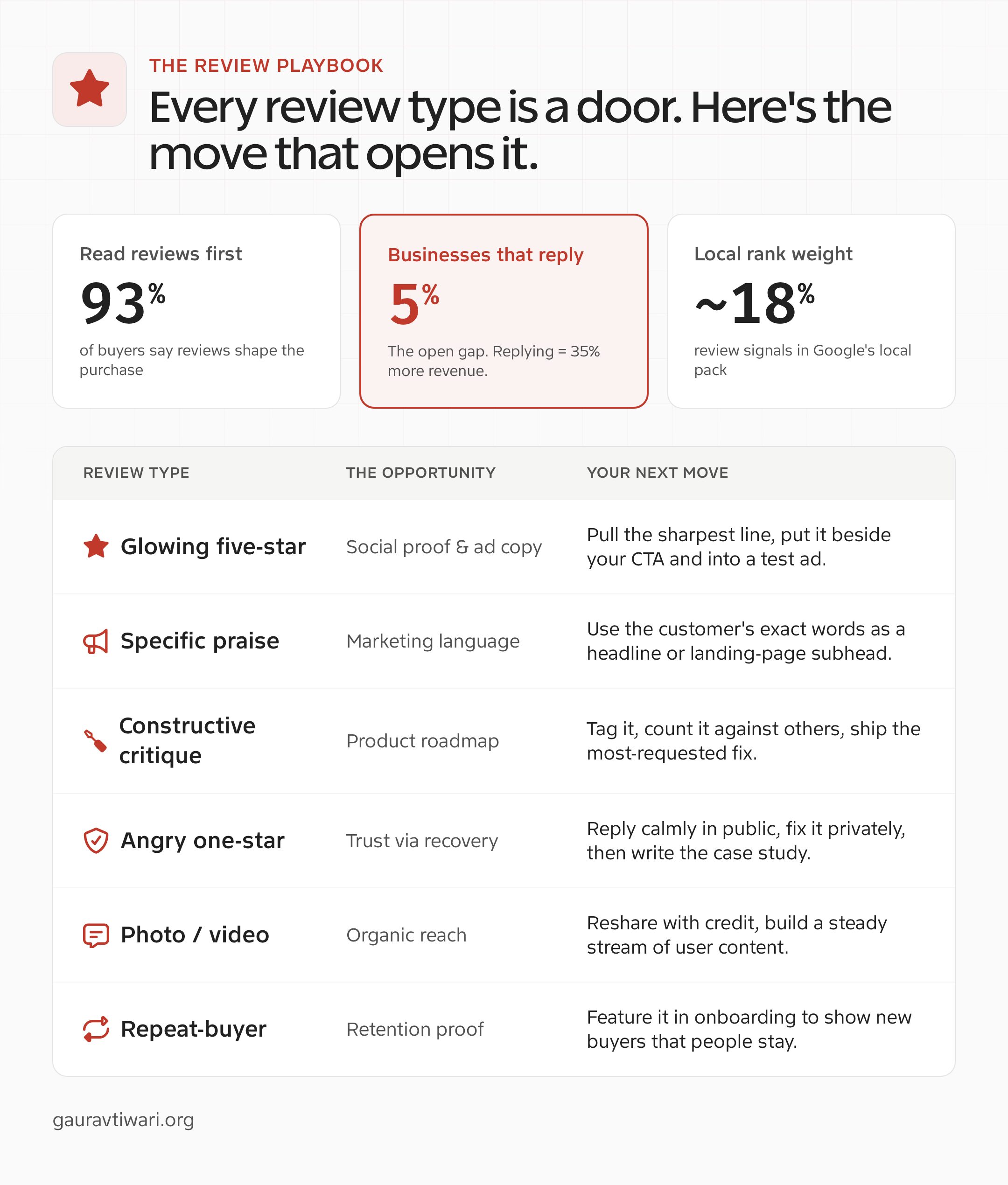
Different reviews open different doors. Here is how I map each type to the opportunity it hands you, so you know what to do the moment one lands.
| Review type | The opportunity | Your next move |
|---|---|---|
| Glowing five-star | Social proof and ad copy | Pull the sharpest line, put it beside your CTA and into a test ad. |
| Specific feature praise | Marketing language | Use the customer’s exact words as a headline or landing-page subhead. |
| Constructive criticism | Product roadmap | Tag it, count it against others, ship the most-requested fix. |
| Angry one-star | Trust through recovery | Reply calmly in public, fix it privately, then write the case study. |
| Photo or video review | Organic reach | Reshare with credit, offer a small reward, build a steady UGC stream. |
| Repeat-buyer review | Retention proof | Feature it in onboarding to show new buyers that people stay. |
My Honest Verdict
Here is the honest verdict after running this for years. Reviews are the highest-return, lowest-cost growth asset most businesses own, and almost nobody works them fully. They are not a magic switch. You will not turn one testimonial into a flood of sales, and a single bad review will not sink you either.
What actually compounds is the system. Ask on purpose, respond like a human, mine the feedback for real fixes, repackage the wins into content and ads, mark up the right pages with schema, and turn your hardest critics into your most believable proof. Do that consistently and reviews stop being something that happens to you and become something you run.
So pick one move from this article and start today. Set up a single automated review request, or reply to every open review on your Google profile this week. Every review, good or bad, is a door to something bigger. You just have to open it.
Tell Google you want more of this.
Add Gaurav Tiwari as a preferred sourceOne tap, and this site shows up more often in your own Top Stories, AI Overviews and AI Mode. Remove it any time.