
 by
by
Successful bloggers rarely build durable businesses from pageviews alone. The 15 people in this guide used publishing to earn repeat attention, learn what readers needed, and then build the thing that actually pays: software companies, media properties, courses, agencies, books and communities they control.
Every profile below follows the same standard: acquisition reports, official company pages, independent market measurements and dated founder disclosures, all checked in late August 2026. Where revenue, ownership or audience figures could not be traced to a source, they are labeled private or left out rather than presented as facts.
This is not a ranking of the richest bloggers. It is a set of case studies: what each person published, which business followed, what can be verified, and what transfers to a blog you might build.
Successful Bloggers at a Glance
One verified milestone per person beats a column of guessed net worths. Confidence grades: A means an independent transaction record or third-party dataset, B means a current company or founder disclosure, C means reputable secondary reporting. All statuses were checked in late August 2026.
| Blogger | Started | Primary business | Verified milestone | Status | Confidence |
|---|---|---|---|---|---|
| Syed Balkhi | 2009 (WPBeginner) | Awesome Motive software suite | Software on 30M+ websites, 2026 | Active | B |
| Arianna Huffington | 2005 (HuffPost) | Media company, then Thrive Global | $315M AOL acquisition, 2011 | Exited; runs Thrive Global | A |
| Matt Mullenweg | 2002 (ma.tt) | WordPress and Automattic | WordPress on 40.7% of websites, Aug 2026 | Active | A |
| Gary Vaynerchuk | 2006 (Wine Library TV) | VaynerMedia, books, investing | Wine Library $4M to $60M sales | Active | B |
| Tim Ferriss | 2007 (tim.blog) | Books, podcast, investing | 1B+ podcast downloads | Active | B |
| Seth Godin | 2002 (daily blog) | Books, workshops, speaking | Nearly 10,000 daily posts; 20 bestsellers | Active | B |
| Neil Patel | 2008 (QuickSprout) | NP Digital agency and tools | 4.2M monthly tool users | Active | B |
| Michael Arrington | 2005 (TechCrunch) | Media exit, then Arrington Capital | TechCrunch sold to AOL, 2010 | Exited; invests | A |
| Brian Clark | 2006 (Copyblogger) | StudioPress, Rainmaker, newsletters | StudioPress sold to WP Engine, 2018 | Exited; runs Further | A |
| Ramit Sethi | 2004 (IWT blog) | Premium courses and media | Netflix series, April 2023 | Active | A |
| Pete Cashmore | 2005 (Mashable) | Media company | ~$50M Ziff Davis acquisition, 2017 | Exited, 2018 | A |
| Pat Flynn | 2008 (SPI) | SPI Media courses and community | 47M+ podcast downloads | Active | B |
| Rand Fishkin | 2004 (SEOmoz) | Moz, then SparkToro | $1,299,500 raise from 35 investors, 2018 | Active | B |
| Darren Rowse | 2004 (ProBlogger) | Courses, ebooks, photography site | 8,000+ post archive; 300K+ community | ProBlogger slower; DPS active | B |
| Marie Forleo | 2000s (newsletter, then MarieTV) | B-School education business | 80,000+ B-School graduates | Active | B |
How I Chose and Checked These 15
Five rules decided who stays on this list:
- A blog or publication materially preceded the business.
- The person’s founder or operator role is documented.
- At least one meaningful milestone can be verified against a primary source.
- Current status was checked on a stated date, not assumed from reputation.
- Private estimates are labeled as estimates and never treated as audited facts.
One disclosure the usual lists skip: this is an editorial selection, not a market survey. 13 of the 15 people are men, and the sample is overwhelmingly English-language and US-centered, heavy on marketing and tech. It shows what blog-led businesses can become, not what the global blogging industry looks like. For wider coverage, the best Indian bloggers and best personal blogs lists cover creators these case studies leave out, and Gatilab tracks the wider market in its blog rankings hub.
One more habit worth stealing before the profiles: keep 6 money numbers separate. An acquisition price is what a buyer paid once. Revenue is what a business earns in a year. A valuation is what a stake was priced at on paper. Founder proceeds are what the person kept, and they are almost never disclosed. Audience size is reach, not income. And assets under management belong to a fund’s investors, not the founder. Most bad blogger lists blur all 6 into “net worth.” The profiles below keep them apart.
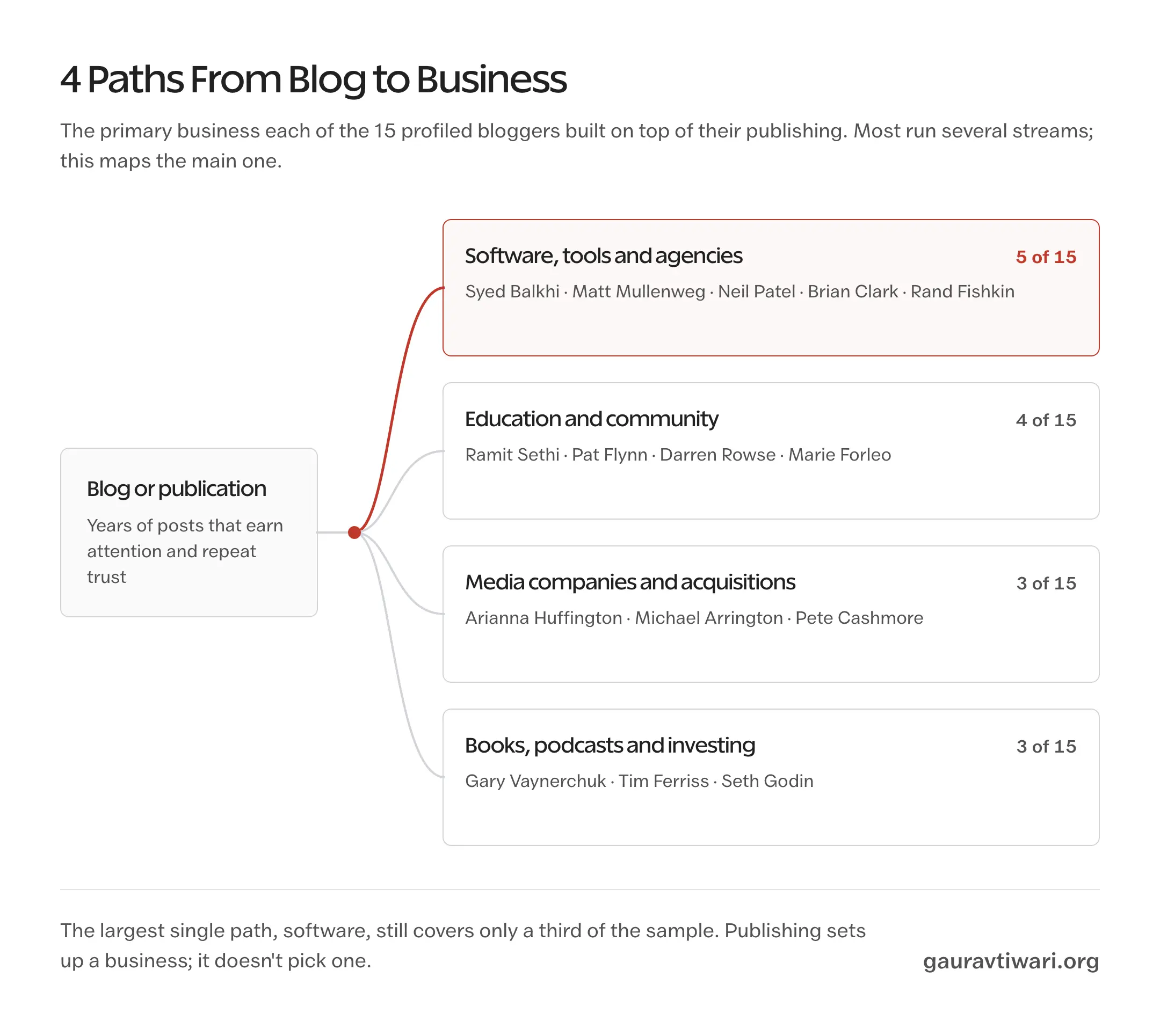
Media Companies and Acquisitions
3 of the 15 turned a publication itself into the product and sold it. Their numbers are the cleanest on this page, because acquisitions leave records.
Arianna Huffington
Arianna Huffington co-founded The Huffington Post in 2005 and built it into the first commercially run, digitally native outlet to win a Pulitzer Prize, for David Wood’s Beyond the Battlefield series in 2012. AOL bought the company in February 2011 for $315 million, about $300 million of it in cash.
What she personally kept was never disclosed. The 30 percent stake and $100 million payout that net-worth sites still repeat were debunked by Forbes at the time, which put her stake closer to 14 percent. The acquisition price is the verified milestone, and it is a company number, not founder income. She left in 2016 to build Thrive Global, a behavior-change company, and has written 15 books. The lesson: a publication can be built to sell, and the founder’s name can be worth a second company after the exit.
Michael Arrington
Michael Arrington launched TechCrunch in 2005 and made it Silicon Valley’s paper of record, coverage that decided which startups got seen, funded and copied. AOL acquired it in September 2010 for a price that was never officially disclosed, reported around $25 million at the time, with estimates running higher once earn-outs were counted.
He left in 2011 and converted press access into deal flow. Arrington Capital described itself as managing over $1 billion in digital assets back in 2021; its current site drops the fund-size claim and counts more than 200 early-stage crypto investments instead, so the billion stays a dated self-description. TechCrunch itself changed hands again in March 2025, sold by Yahoo to Regent on undisclosed terms. The lesson is access: the blog gave him first look at every hot company, years before most funds got the meeting.
Pete Cashmore
Pete Cashmore started Mashable from his bedroom in Aberdeen in 2005, at 19, and rode the social web into one of the most-read tech publications of the 2010s. Ziff Davis acquired it in late 2017 for around $50 million, a hard markdown from the $250 million valuation investors had set 2 years earlier.
He stepped away at the end of 2018, and his later Web3 project has gone quiet, its site no longer serving a page. Mashable runs on as a Ziff Davis brand reporting 18 million average monthly unique visitors, 274 million annual pageviews and 33 million social followers. One widely repeated claim gets its subject wrong: the 18 percent revenue decline reported for late 2025 belonged to Ziff Davis’s whole technology and shopping segment, home to CNET and PCMag too, not to Mashable alone. The lesson cuts both ways. A bedroom blog became a global brand before its founder turned 30, and a media property’s price can still fall 80 percent when the growth story cools.
Software, Tools and Agencies
The largest group, 5 of 15, built software or client services on the demand their tutorials surfaced. The blog told them exactly which product to build next.
Syed Balkhi
Syed Balkhi launched WPBeginner from a college apartment in 2009 as a plain WordPress tutorial blog. Awesome Motive, the company that grew around it, now reports software running on more than 30 million websites, with a team of over 330 people across 50-plus countries and no outside funding. WPForms alone reports 6 million sites, AIOSEO another 3 million.
Revenue stays private. The $46.5 million figure that circulates online comes from a third-party estimate site, dates to 2023 and contradicts the company’s own current team numbers. Balkhi’s own 2025 review describes a record year: 6 product launches, the aThemes acquisition and the largest stock buyback in company history. The playbook is the cleanest on this list. Tutorials surface reader problems, and each plugin, WPForms, MonsterInsights, OptinMonster, was built to answer one of them. The blog is the demand-research department; the products are the business.
Matt Mullenweg
Matt Mullenweg has blogged at ma.tt since 2002 and co-created WordPress at 19. As of August 29, 2026, W3Techs measures WordPress on 40.7% of all websites and 58.9% of sites with a known CMS. Both figures sit below the 43.6% peak recorded at the start of 2025, so the honest description is dominant and slipping, not growing.
Automattic, his company behind WordPress.com, WooCommerce and Tumblr, was valued at $7.5 billion in an August 2021 share buyback, a dated private-market number rather than a current one, and it cut 281 people, 16% of staff, in April 2025 during the long WP Engine dispute. None of that valuation is personal wealth. The claim that survives every caveat is still enormous: 2 of every 5 websites run software that began as a blogging tool. The lesson: open publishing infrastructure compounds longer than any single publication can.
Neil Patel
Neil Patel co-founded Crazy Egg and KISSmetrics, then made his own name the publication. NeilPatel.com reports 9 million blog visits a month, his YouTube channel 1.3 million subscribers, and Ubersuggest and AnswerThePublic count 4.2 million monthly users. Company-reported numbers, all of them, which is why his confidence grade reads B.
The business behind the blog is NP Digital, a performance agency reporting more than 1,000 employees, 500-plus clients and operations in 28 countries. The $100 million revenue figure often attached to him traces to award-show coverage rather than any company disclosure. The model is volume with a funnel attached: publish more useful search content than anyone can match, then route the traffic into the agency and into accessible SEO tools for small businesses.
Brian Clark
Brian Clark launched Copyblogger in 2006 and wrote much of the playbook content marketers still run. The business era reads best as a dated timeline: StudioPress and the Genesis themes went to WP Engine in June 2018, Rainmaker Digital Services went to Nimble Worldwide in May 2019, Tim Stoddart acquired Copyblogger in 2019, Brian sold his remaining interest in 2023 by his own account, and Darrell Vesterfelt took majority ownership in 2026.
None of those transaction values were disclosed, so no eight-figure claims appear here. Today he runs Further, a newsletter about navigating midlife, and Leading Expert, a community for expertise-based business owners. The lesson sits in the timeline itself: a blog about effective writing attracted exactly the audience that would buy themes, software and training, and each piece the audience funded was sellable on its own.
Rand Fishkin
Rand Fishkin started the SEOmoz blog in 2004 inside his mother’s consultancy and grew it into Moz, the SEO industry’s reference brand, with Whiteboard Friday as appointment viewing for a decade. The peak public number is dated and specific: $47.4 million in GAAP revenue in 2017, from the company’s own disclosure. And Domain Authority, the score the industry still quotes, is a Moz metric built by the team, not any single inventor.
SparkToro, the audience-research company he co-founded in 2018, is the counter-model, and it is not bootstrapped. It raised $1,299,500 from 35 accredited investors on deliberately unusual terms, with no board seats, reached breakeven in fall 2020 after spending roughly two-thirds of the raise, and by mid-2023 had returned investors’ original capital in full. His book Lost and Founder documents the Moz years with rare candor. The lesson: a funding structure can be designed to match the business you actually want to run, not the one investors usually demand.
Syed, Neil, Brian and Rand followed the same sequence: publish around one painful problem, watch which questions repeat, then build the product those questions describe. If you are starting out, work from a content marketing strategy that names what you will eventually sell.
Education and Community Businesses
4 of 15 monetize by teaching: courses, memberships and communities. Their numbers are mostly company-reported, so the grades here run B rather than A.
Ramit Sethi
Ramit Sethi started I Will Teach You To Be Rich as a Stanford student in 2004, and the blog’s name became a book, then a media brand. The 2020s milestones are mainstream and verifiable: How to Get Rich, an 8-episode Netflix series released on April 18, 2023, and Money for Couples, published December 31, 2024, which hit the bestseller lists in early 2025 alongside the podcast of the same name.
His pricing is widely misreported. Current public pages show Earnable without a listed price and a Rich Life membership at $49 a month, not the $2,000-to-$12,000 range older articles repeat, and course revenue is private. GrowthLab, once framed as a second business, now simply redirects to the main site. What stands without any private number is the positioning lesson: he charges premium prices in a niche that races to the bottom on them, and the free material is confident enough to make the paid path credible.
Pat Flynn
Pat Flynn was laid off from his architecture job in the 2008 downturn and turned Smart Passive Income into the most transparent business-education brand of its era, publishing monthly income reports that let readers inspect revenue line by line. The format, not the old totals, was the innovation: it made the economics of online business checkable.
Today the flagship number is scale, not disclosure: the podcast, now co-hosted with Liz Wilcox, reports more than 47 million downloads. SPI Media runs courses, the SPI Pro community of over 1,200 entrepreneurs and a newsletter past 100,000 subscribers. His YouTube audience needs separating, because lists keep merging it: the business channel holds about 485,000 subscribers, while Deep Pocket Monster, his Pokémon channel, holds 2.37 million. The bigger audience is the hobby, not the business school. The lesson: one teaching idea, repackaged across formats, each format feeding a product for a different stage of the reader’s journey.
Darren Rowse
Darren Rowse went full-time on blogging in 2004, founded ProBlogger and helped popularize professional blogging as a career, with his book of the same name as the handbook. The current site claims are modest and checkable: an archive of more than 8,000 posts and a community of over 300,000 bloggers.
Status needs honest splitting. ProBlogger’s blog has slowed, with its most recent post dated June 2024, while Digital Photography School, the quieter site he launched in 2006, was still publishing new tutorials in August 2026 and has long earned the larger share of his income through courses, ebooks and affiliate marketing. The 5 million monthly visitors and 1 million social followers still circulating come from an old, undated speaker bio, so treat them as history. The lesson: the boring second site with buyers outlasted the famous first site with fans.
Marie Forleo
Marie Forleo built MarieTV and its surrounding publishing into the front door for an education business that Oprah Winfrey blurbed into the mainstream, calling her a thought leader for the next generation. The core numbers come from her own program page: B-School counts more than 80,000 graduates from over 130 countries.
Around the flagship sit Everything Is Figureoutable, her number-1 New York Times bestseller from 2019, a podcast, and a YouTube channel just past 1 million subscribers, though new episodes have slowed in 2026. Company revenue is private. The lesson is offer continuity: the free show teaches the worldview, and the paid program sells the structured path through it, one enrollment window at a time.
Books, Podcasts and Investing
The last 3 never sold a company built on the blog. They converted publishing into authority, and authority into books, shows and deal flow.
Gary Vaynerchuk
Gary Vaynerchuk started Wine Library TV in 2006, a daily, deliberately unpolished video blog about wine that ran like talk radio with tasting notes. By his own bio, the family business grew from $4 million to $60 million in annual sales during his tenure. Content did the marketing, but the store, the ecommerce operation and the email list did the selling, which is why “purely through content” oversells the story.
VaynerMedia followed in 2009 and is private. The only staffing figure in his own bio, more than 800 employees, describes the company around 2018, and no current revenue figure is public. The documented exits are real: Resy to American Express in 2019, Empathy Wines to Constellation Brands in July 2020, plus Crush It! and 4 more bestselling books. The lesson: attention is an asset only when it has somewhere to go, an agency, a book, a product line.
Tim Ferriss
Tim Ferriss launched tim.blog alongside The 4-Hour Workweek in 2007. His own about page keeps the claims tight: 5 number-1 New York Times and Wall Street Journal bestsellers, the book translated into 35-plus languages, and The Tim Ferriss Show as the first business-interview podcast past 100 million downloads, now past 1 billion.
The blog tested ideas, the books packaged them, the podcast compounded the audience, and the audience opened investing doors: early positions in Uber, Facebook, Shopify, Duolingo and Alibaba, per his bio. The lesson is format expansion without position drift. 19 years across 3 formats, one recognizable project: deconstructing how excellent performers actually work.
Seth Godin
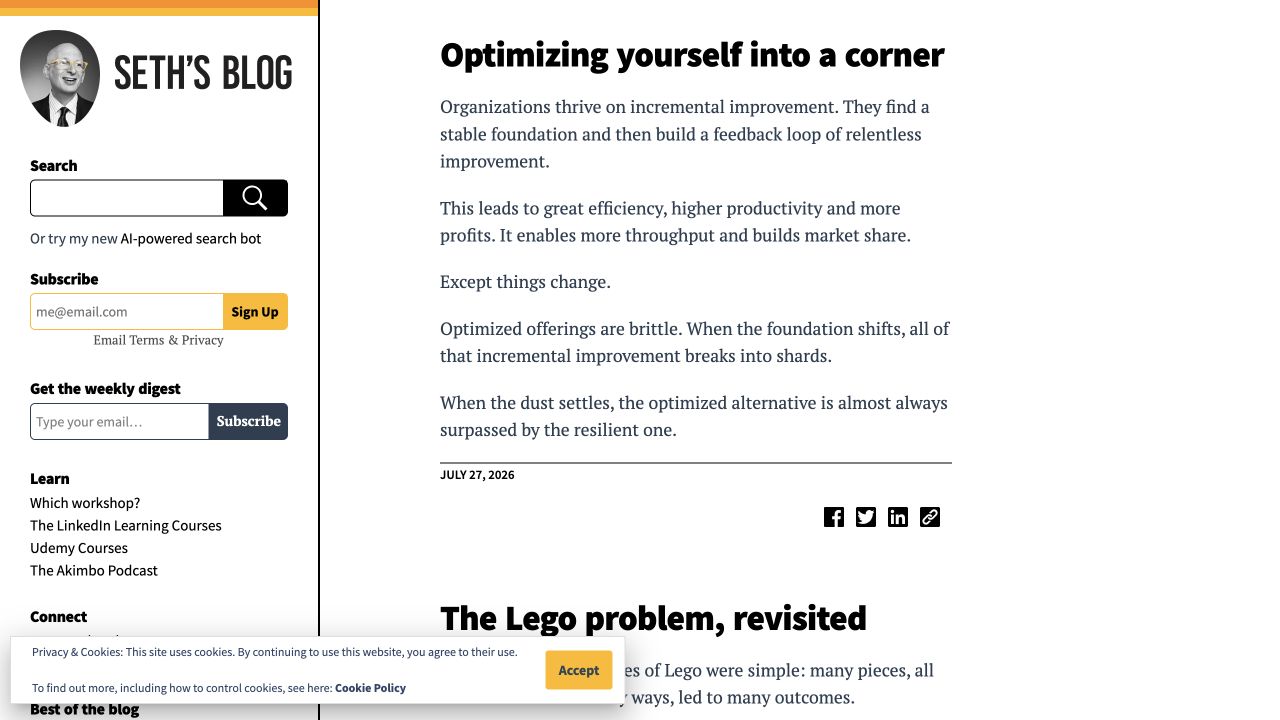
Seth Godin has published every day since 2002 and is, in his own words, approaching 10,000 posts. His books page counts 20 titles, all bestsellers. Before the blog there was a real exit: Yoyodyne, his permission-marketing company, sold to Yahoo in 1998 for a reported $29.6 million.
The blog carries no ads and sells nothing directly. It works as an authority engine that keeps the books, speaking and workshops warm. One status detail lists like this usually miss: the altMBA, the workshop program he created in 2015, was sunsetted along with Akimbo’s other projects in 2024. The lesson is cadence attached to a recognizable idea, compounded for decades, with the products living beside the blog rather than inside it.
What the 15 Cases Actually Show
Classify each person by the primary business their publishing fed, and the sample splits 4 ways. This is an editorial classification, not a claim that anyone runs a single revenue stream.
| Primary model | Who | Count | Share |
|---|---|---|---|
| Software, tools or agency | Syed Balkhi, Matt Mullenweg, Neil Patel, Brian Clark, Rand Fishkin | 5 | 33.3% |
| Education or community | Ramit Sethi, Pat Flynn, Darren Rowse, Marie Forleo | 4 | 26.7% |
| Media company or acquisition | Arianna Huffington, Michael Arrington, Pete Cashmore | 3 | 20.0% |
| Books, podcasts or investing | Gary Vaynerchuk, Tim Ferriss, Seth Godin | 3 | 20.0% |
Software and services form the largest category, and they still cover only a third of the sample. Blogging did not produce one predictable business structure. It produced attention and trust, and each founder converted those into a different owned asset.
A few patterns do repeat, stated at the strength the evidence supports. The durable businesses sell something the creator owns rather than renting attention to advertisers. Almost everyone here holds a direct line to the audience, through email, community or subscription, that no algorithm can revoke. Niche depth beat breadth: WPBeginner is WordPress, Copyblogger is content marketing, Moz was SEO. And the founder brand usually outlived the publication brand, which is why Arianna Huffington and Brian Clark could each start again after selling.
The formats moved, the position stayed. Tim Ferriss shifted his center of gravity from blog to podcast, Gary Vaynerchuk from video blog to agency, Pat Flynn from written income reports to video and community. If blogging as a career is the question, this flexibility is most of the answer.
What These Examples Cannot Prove
A list of 15 winners cannot establish that their shared habits caused their success. That deserves saying plainly, because most articles on this topic imply the opposite.
Survivorship bias sits under every profile. Plenty of failed blogs followed the same practices, published consistently for years and still never found a business; those blogs do not get listicles written about them. Most of this sample launched in the 2000s, when search, social reach and inbox attention were far cheaper than they are under 2026 conditions. Several benefited from first-mover advantage that cannot be repeated: there was exactly one moment to become the definitive WordPress tutorial site or Silicon Valley’s startup paper of record. And access to capital, existing networks, geography and plain timing all did quiet work that a case study cannot isolate.
Read the profiles as existence proofs: this transition is possible, along these paths. Not as a recipe with guaranteed portions.
Blogging in 2026: What’s Changed
Search traffic is less dependable: SparkToro’s 2026 clickstream analysis found that 68.01% of Google searches in its panel ended without a click. A randomized AI Overviews field experiment found a 39.8% reduction in outbound organic clicks when an overview appeared. Google disputes the broad decline narrative and says aggregate organic clicks are relatively stable. The safe conclusion is narrower: build email, products, community, podcast or video so one discovery channel cannot decide the whole business.
Survey data is humbler than the predictions. Orbit Media’s 2025 survey of 808 content marketers found 21% reporting strong results from blogging and 60% some results, while 49% now publish original research, up from 25% in 2018. The previous edition found bloggers who update older posts 2.5 times as likely to report strong results. Self-reported, but it matches this sample: durable publishers update old work, differentiate with evidence and own their audience. More current numbers live in these blogging statistics.
AI lowered the cost of average content. That makes first-hand evidence, original data, strong editing and a recognizable point of view more valuable. A percentage about who uses AI does not help you choose what to publish. Evidence another page cannot reproduce does.
Monetization moved beyond pageviews. The creators in this sample use software, courses, books, agencies, memberships, media, affiliates and speaking. The pattern is the move from rented attention to an offer the creator controls, supported by monetization strategies that do not depend on one traffic source. If you start one thing alongside your blog this year, make it an email list: an audience you can reach without waiting for a ranking.
Every year brings new “blogging is dead” predictions, and every year the survey data above shows a minority of publishers still reporting strong results. The model that actually died is publishing alone with no offer behind it. If you are adding real evidence, building demonstrated expertise and diversifying your income streams, blogging remains one of the cheapest businesses to start.
FAQs on Successful Bloggers
Who is the most successful blogger?
It depends on the measure. By verified exit value, Arianna Huffington’s $315 million HuffPost sale leads this sample; by software scale, Matt Mullenweg’s WordPress runs 40.7% of the web; by audience durability, Seth Godin’s daily blog is approaching 10,000 posts.
How do successful bloggers make money?
Mostly not from the blog itself. In this sample the money sits in software, agencies, courses, books, podcasts, media exits and investing, with the blog acting as the audience and trust layer.
Is blogging still profitable in 2026?
It can be, but usually as the front end of a business rather than an ad-revenue machine. Orbit Media’s 2025 survey found only about 1 in 5 bloggers reporting strong results, and the creators here all monetize through owned offers.
How long does building a blogging business take?
The businesses in this sample took years, and most launched in the 2000s under easier discovery conditions. Plan in years, and treat any promise of fast blog income with suspicion.
Do successful bloggers earn mainly from advertising?
Rarely. Almost every case here moved from rented attention to owned products, services or media assets, because display advertising alone caps out early.
What is the difference between blog revenue and company valuation?
Revenue is what a business earns in a period; a valuation is what investors priced a stake at, on paper, on a specific date. Automattic’s $7.5 billion figure is a 2021 buyback valuation, not income, and neither number is a founder’s personal wealth.
Can a personal blog become a software or media company?
Yes, and this sample shows both routes: WPBeginner grew into Awesome Motive’s software suite, while The Huffington Post and TechCrunch became acquisition targets. The common step was years of publishing that proved demand first.
What to Copy From These 15 Bloggers
A successful blogger is not the one with the most pageviews. Across these 15 cases, it is the person who used publishing to find out what an audience would pay to solve, then built the thing that solves it and kept ownership of the result.
Do not copy the outcomes. Copy the sequence: publish around one painful problem, earn repeat attention, learn what readers will pay for, and build the offer that evidence describes. The businesses differ, but that movement repeats in all 4 groups above.
If you are starting now, begin with the mechanics of starting a blog properly, and study the amateur blogging mistakes that end most blogs before any business can appear. The platforms these 15 started on have changed. The sequence they followed has not.
Tell Google you want more of this.
Add Gaurav Tiwari as a preferred sourceOne tap, and this site shows up more often in your own Top Stories, AI Overviews and AI Mode. Remove it any time.