
27 Personal Blogs Worth Reading in 2026
 by
by
A personal blog is a site where one identifiable person’s voice sits at the center of everything published. The best of them still feel unmistakably human. You know who is speaking, what they care about and why the site exists at all.
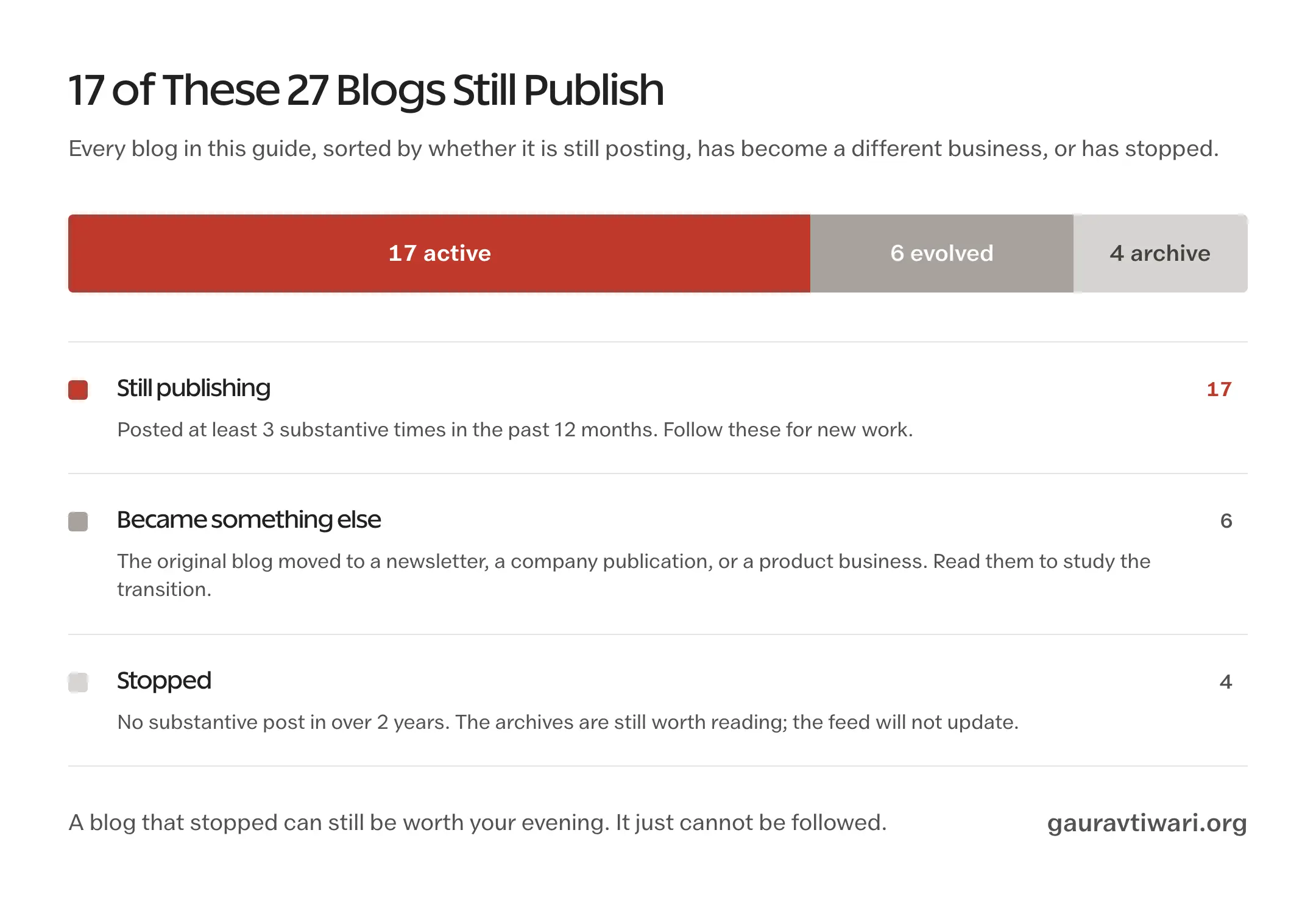
There are 27 of them below, sorted by what each one is actually doing now. 17 are still publishing. 6 grew into businesses or moved to a newsletter. 4 have stopped, though their archives are worth an evening.
Every entry carries the writer’s name, the subject and the most recent post visible on the site in late August 2026. Traffic is not the sort order, because a traffic estimate cannot see originality or trust, and it flattens a one-person diary against a media company. Start at the top for something new to read this week. Drop to the archives when you want writing that has already proved it lasts.
What Makes a Blog Personal
The full test is that one identifiable person’s voice, experience and judgment stay central to the editorial identity. Everything else about a blog can change without breaking that.
Cookie and Kate passes it. The Neil Patel blog does not, though both are good at what they do. One is written by the person whose name is on the door. The other runs on an agency masthead with 12 staff bylines. A blog can be commercial, employ people and make serious money while staying personal. What it cannot do is lose the person.
| Personal blog | Company publication |
|---|---|
| One identifiable voice | Multiple rotating authors |
| The writer’s own experience | An organization’s editorial plan |
| Author identity leads | Brand identity leads |
| Subject boundaries flex with the writer | Formal categories and commercial goals |
Status matters just as much, because being told to follow a site that stopped posting in 2020 wastes your time. Active means at least 3 substantive posts in the past year. Archive means nothing substantive in 2.
Personal Blogs at a Glance
Writer, subject and most recent published post for all 27, current as of late August 2026.
| Blog | Writer | Main subject | Latest post | Status |
|---|---|---|---|---|
| Kottke.org | Jason Kottke | Links and commentary | August 27, 2026 | Active |
| The Marginalian | Maria Popova | Books, science and meaning | August 29, 2026 | Active |
| Simon Willison’s Weblog | Simon Willison | AI and software | August 28, 2026 | Active |
| The Bloggess | Jenny Lawson | Humor and mental health | August 28, 2026 | Active |
| Cookie and Kate | Kathryne Taylor | Vegetarian recipes | August 27, 2026 | Active |
| Wolf’s Gaming Blog | Baden Ronie | Games and hardware | August 29, 2026 | Active |
| Sincerely Jules | Julie Sariñana | Style and lifestyle | August 27, 2026 | Active |
| Tech Savvy Mama | Leticia Barr | Parenting and technology | August 26, 2026 | Active |
| Pinch of Yum | Lindsay Ostrom | Food | August 26, 2026 | Active |
| Zen Habits | Leo Babauta | Habits and simplicity | late August 2026 | Active |
| David Lebovitz | David Lebovitz | Food and Paris | July 31, 2026 | Active |
| Going Zero Waste | Kathryn Kellogg | Sustainable living | July 27, 2026 | Active |
| Austin Kleon | Austin Kleon | Creativity and books | August 19, 2026 | Active |
| Derek Sivers | Derek Sivers | Philosophy and business | August 18, 2026 | Active |
| Tim Ferriss | Tim Ferriss | Performance and interviews | August 21, 2026 | Active |
| Selective Potential | Tieka Knight | Michigan, style and travel | August 13, 2026 | Active |
| The Art of Non-Conformity | Chris Guillebeau | Life and work | Weekly, per the site | Active |
| Neil Patel | NP Digital staff | Marketing | August 26, 2026 | Became a business |
| Skint Dad | Ricky and Naomi Willis | UK family money | August 28, 2026 | Became a business |
| Seasons in Colour | Jenny Kakoudakis | Interiors | August 29, 2026 | Became a business |
| Barefoot Blonde | Amber Fillerup Clark | Lifestyle and nature | July 23, 2026 | Became a business |
| Dad and Buried | Mike Julianelle | Parenting humor | June 17, 2026 | Became a business |
| The Dad Dude | Terran Williams | Faith and books | March 25, 2026 | Became a business |
| Hyperbole and a Half | Allie Brosh | Illustrated memoir | September 20, 2020 | Archive |
| Love That Max | Ellen Seidman | Disability parenting | August 11, 2023 | Archive |
| Dad or Alive | Adrian Kulp | Fatherhood | June 23, 2024 | Archive |
| Gala Darling | Gala Darling | Self-love and mindset | May 12, 2021 | Archive |
Active Personal Blogs
All 17 of these were publishing in late August 2026. They run in order of most recent post, which is a calendar and not a ranking, so read across the whole set rather than treating the top as a winner.
Kottke.org
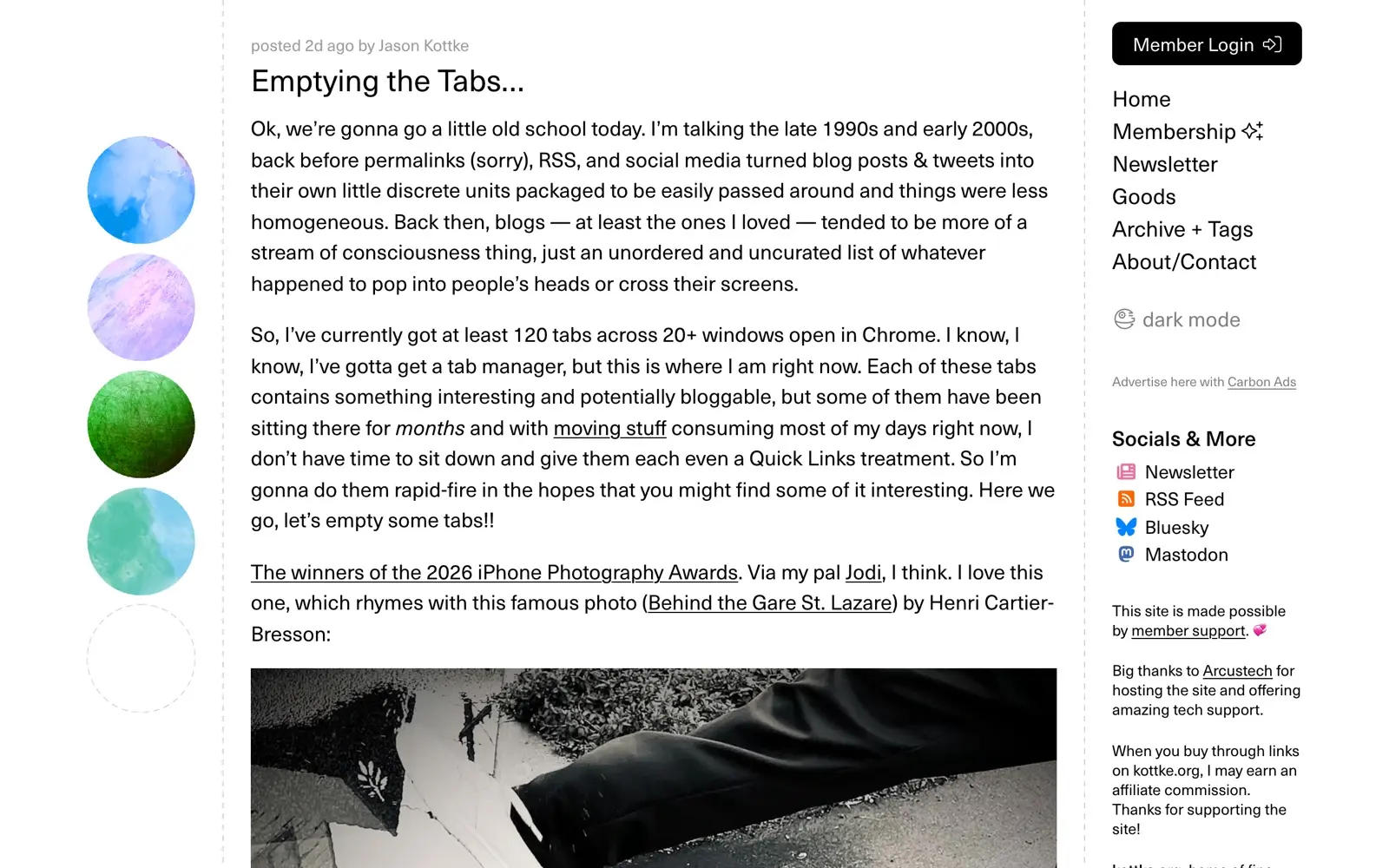
Jason Kottke has run kottke.org since 1998, which makes it the longest continuously published personal blog most people can name. The format never changed: short posts pointing at something interesting, with a line or two on why it matters. In 2025 he published 2,142 posts across 262 days.
The range is the appeal. A single week takes in CTE research, pigeon magnetoreception, a Weird Al concert and the mathematics of rivers. His recurring “Emptying the Tabs” link-dumps are the purest sample of what the site is. Members fund it, from $3 a month, and the writing stays free for everyone. Every byline in August 2026 was his.
Start with a recent “Emptying the Tabs” post to see the rhythm, then use the archive, which is genuinely 27 years deep.
The Marginalian
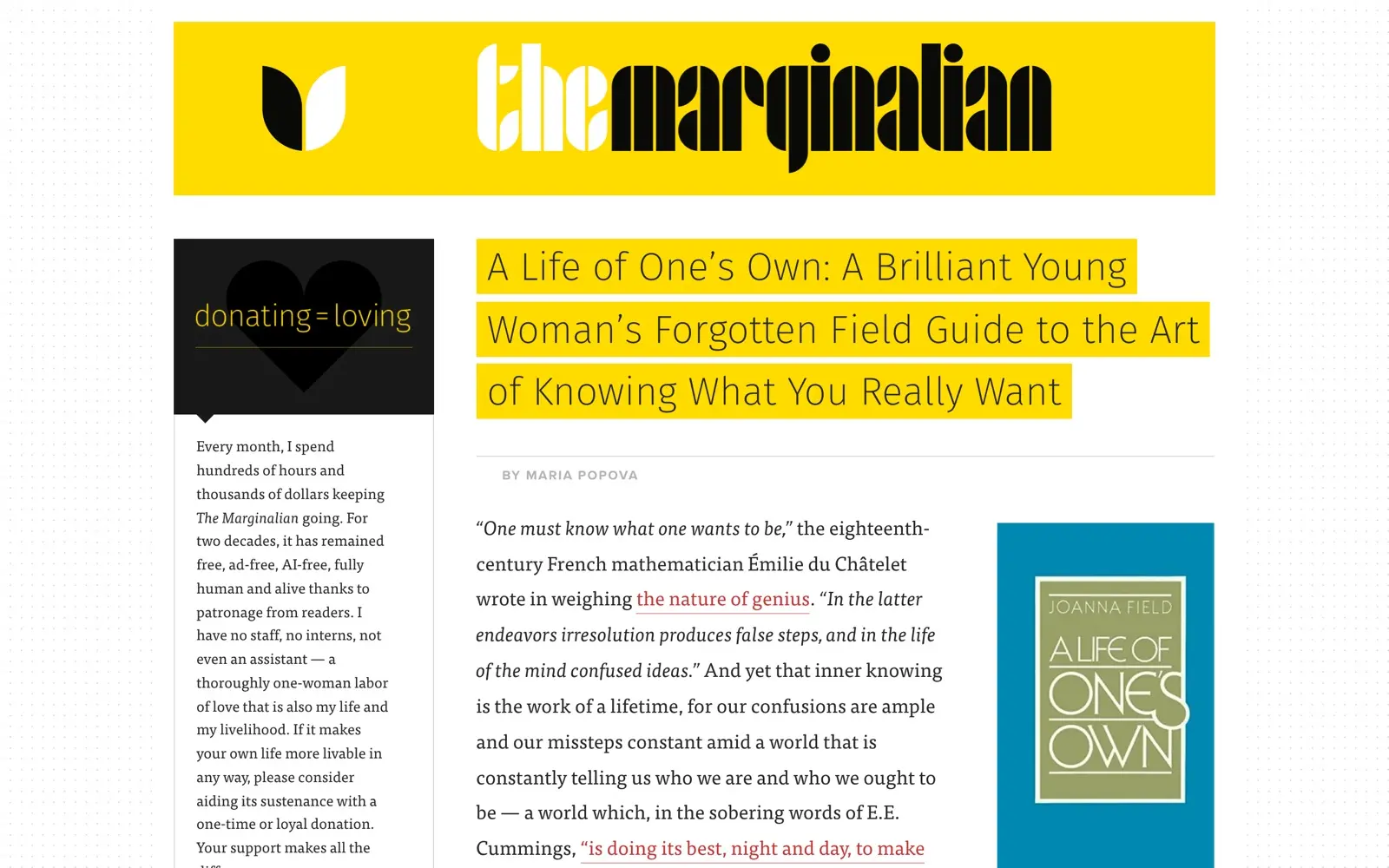
Maria Popova has been writing this since 2006, when it was called Brain Pickings, and renamed it The Marginalian on its fifteenth anniversary in October 2021. Her own description is worth quoting: “a thoroughly one-woman labor of love that is also my life and my livelihood.”
Each essay braids a book, a life and an idea into something you finish slower than you started. Recent pieces cover a forgotten field guide to knowing what you want, a wordless picture book about nature, and the resilience of letting go. The site runs on reader donations and carries the standing promise “free, ad-free, AI-free, fully human since 2006.”
It asks for real attention. Posts run long, and skimming defeats them. Read one properly rather than five quickly.
Simon Willison’s Weblog
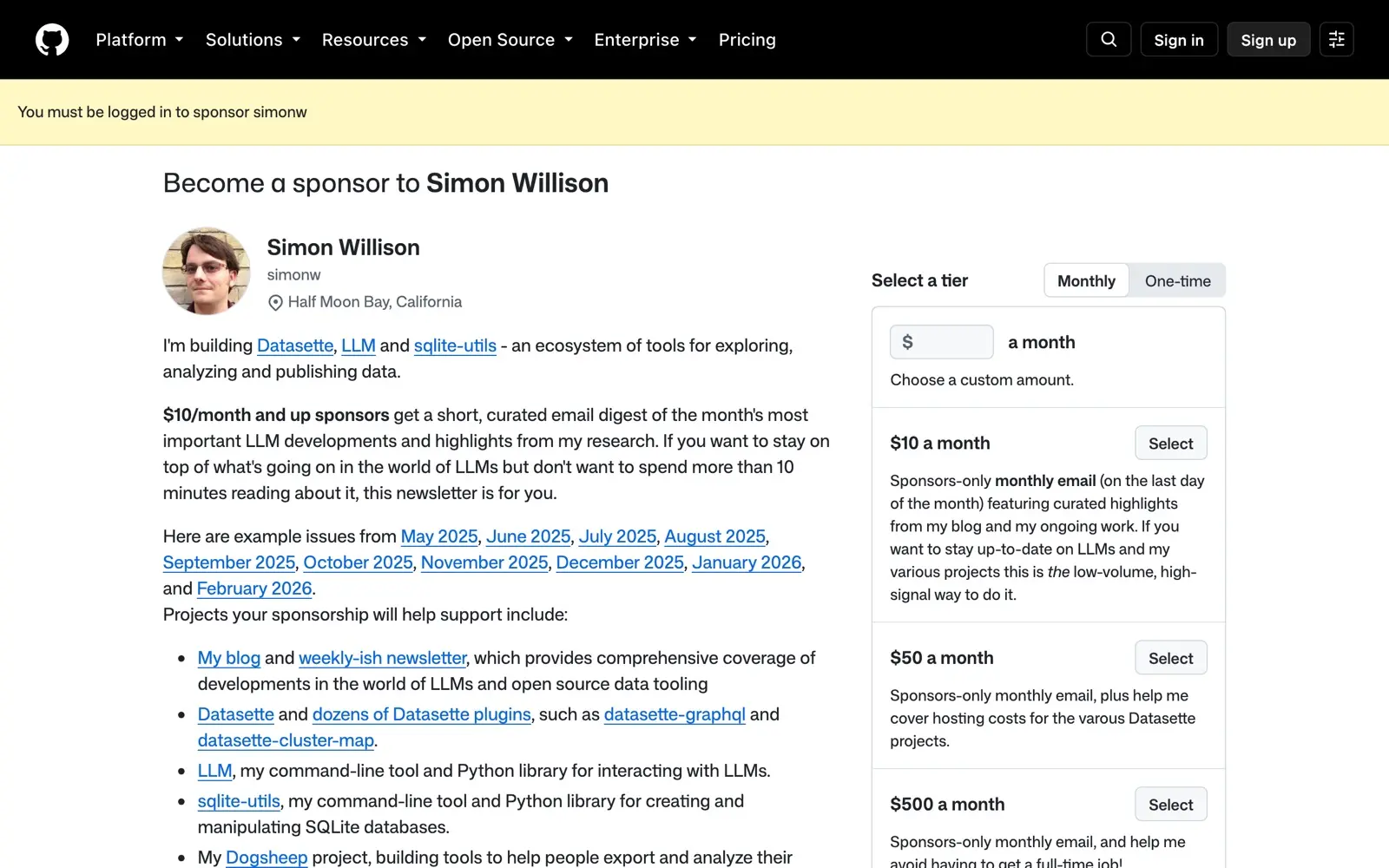
Simon Willison co-created the Django web framework and built Datasette, and he has blogged at simonwillison.net since 2002. He is now the most useful running commentary on large language models available anywhere, partly because he actually builds with them daily and shows his work.
He posts most days, often several times, splitting long-form entries from links, quotes and TILs. August 2026 alone covered breaking a coding agent’s auto mode, a new Qwen release, EVE Online’s Python 3 migration and executables that are secretly SQLite databases. Funding is disclosed and mixed: GitHub Sponsors, weekly banner sponsorships and EthicalAds, with a stated editorial-independence policy.
Start with “Your executable is a SQLite database” for the register. The volume is the one catch, since a week away leaves a lot to scroll.
The Bloggess
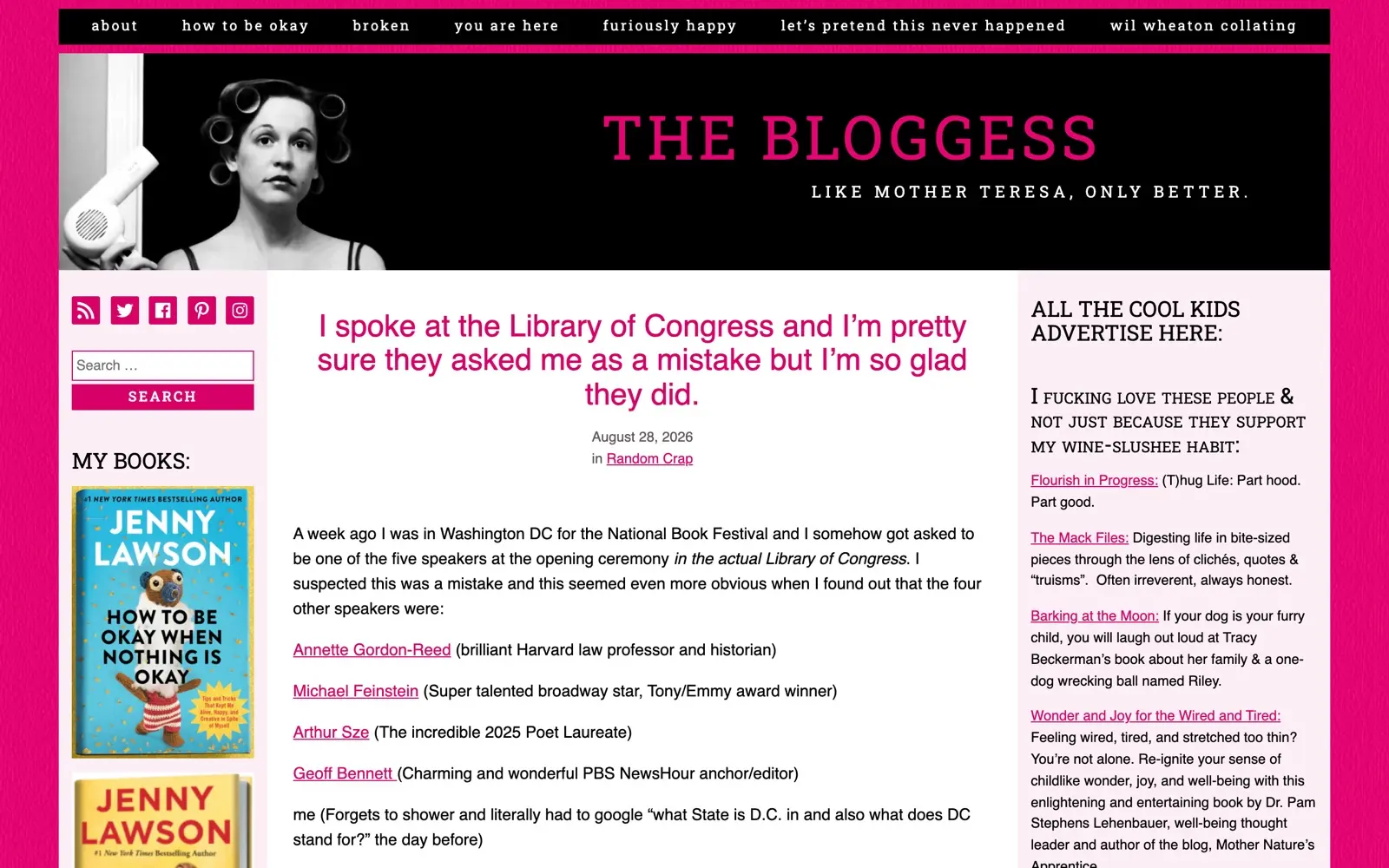
Jenny Lawson writes the funniest honest thing on the internet about depression, anxiety and living in a body that does not cooperate. Her on-site archive reaches back to 2007 and she describes it as dark humor mixed with brutally honest stretches of mental illness.
Recent posts move between serotonin and MTHFR variants, her cats Purrsy and Rolly, and a piece about speaking at the Library of Congress titled, in full Lawson fashion, a suspicion that they asked her by mistake. She publishes 2 to 4 times a month. Her books are the business, and she owns Nowhere Bookshop in San Antonio.
Start with any post whose title is already a paragraph. If mental-health writing is not what you came for, this is not the entry for you.
Cookie and Kate
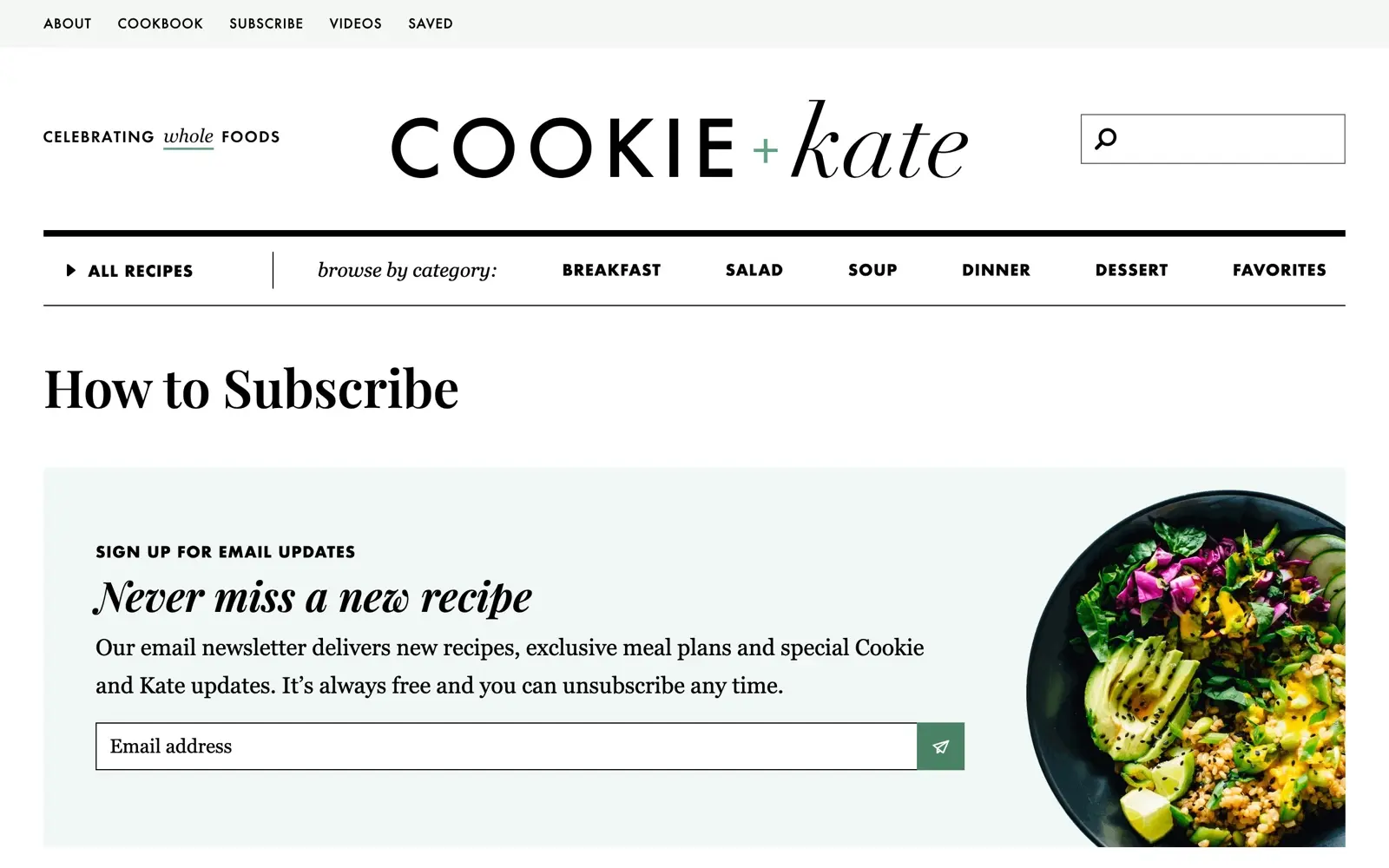
Kathryne Taylor has published vegetarian recipes since 2010 on a site named for herself and her dog Cookie. It is the strictest single-author operation on this page: every post in the current feed carries her byline, with no contributor roster and no guest bylines.
The recipes are tested to a standard that shows. Recent posts run hemp milk, gluten-free almond flour blueberry muffins, cilantro lime sauce and chickpea fries. The site stays legible under its display advertising, which is harder than it sounds in the food category. Her cookbook Love Real Food carries the same approach.
Start with the granola or the panisses. Everything is vegetarian, so this is the wrong list if you want meat recipes.
Wolf’s Gaming Blog

Baden Ronie, who goes by Wolf, publishes daily and often several times a day, which is remarkable given the site’s footer states plainly that it is run by one person. Scottish, homeschooled, and open about living with cystic fibrosis, he writes game news, reviews, hardware tests and the occasional board game piece.
The money picture is worth stating accurately, because it explains the independence. By his own accounting the site earns around $8 a month from unobtrusive ads, plus voluntary reader donations from a pound upward, plus review code and hardware from publishers, with occasional guest posts he labels as such.
There is no formal disclosure or ethics page, so the independence rests on his stated intent and the near-absence of commercial pressure rather than a published policy.
Sincerely Jules
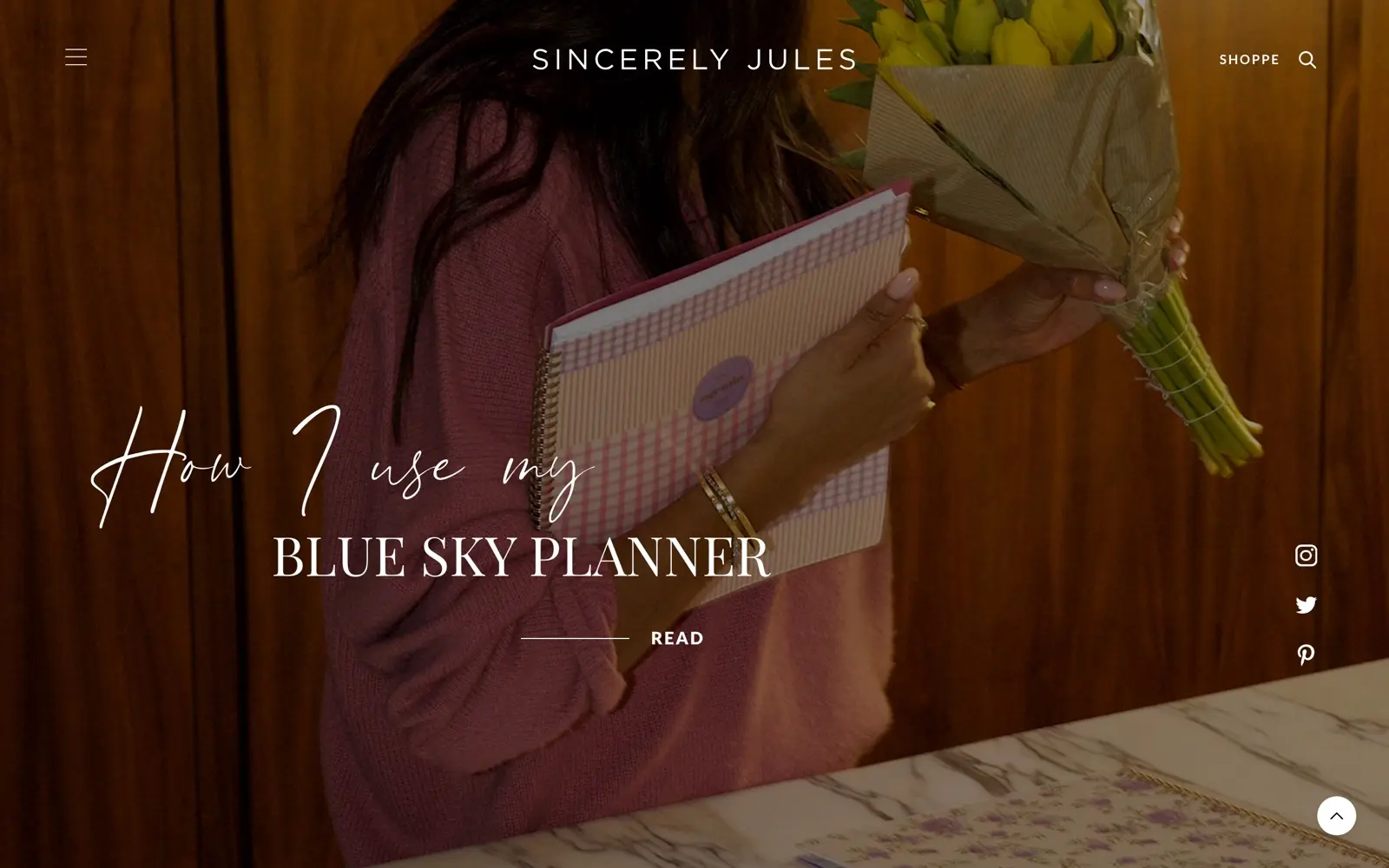
Julie Sariñana launched Sincerely Jules in 2009 while studying visual communications at FIDM, and it became one of the templates the entire fashion-blogging generation copied. It still publishes roughly weekly: outfit guides, wellness, travel dispatches from Paris, and planning and organization posts.
The photography carries it. Recent posts cover her planner system, a self-care routine and a Paris travel set. There is a shop selling her own designed pieces alongside favorites.
Two things to read carefully. Brand-integrated content is clearly present while per-post disclosure is not, so assume commercial intent behind product-centered posts. And the about page’s line about 12 years and 5.7 million followers is stale copy dating to roughly 2021.
Tech Savvy Mama
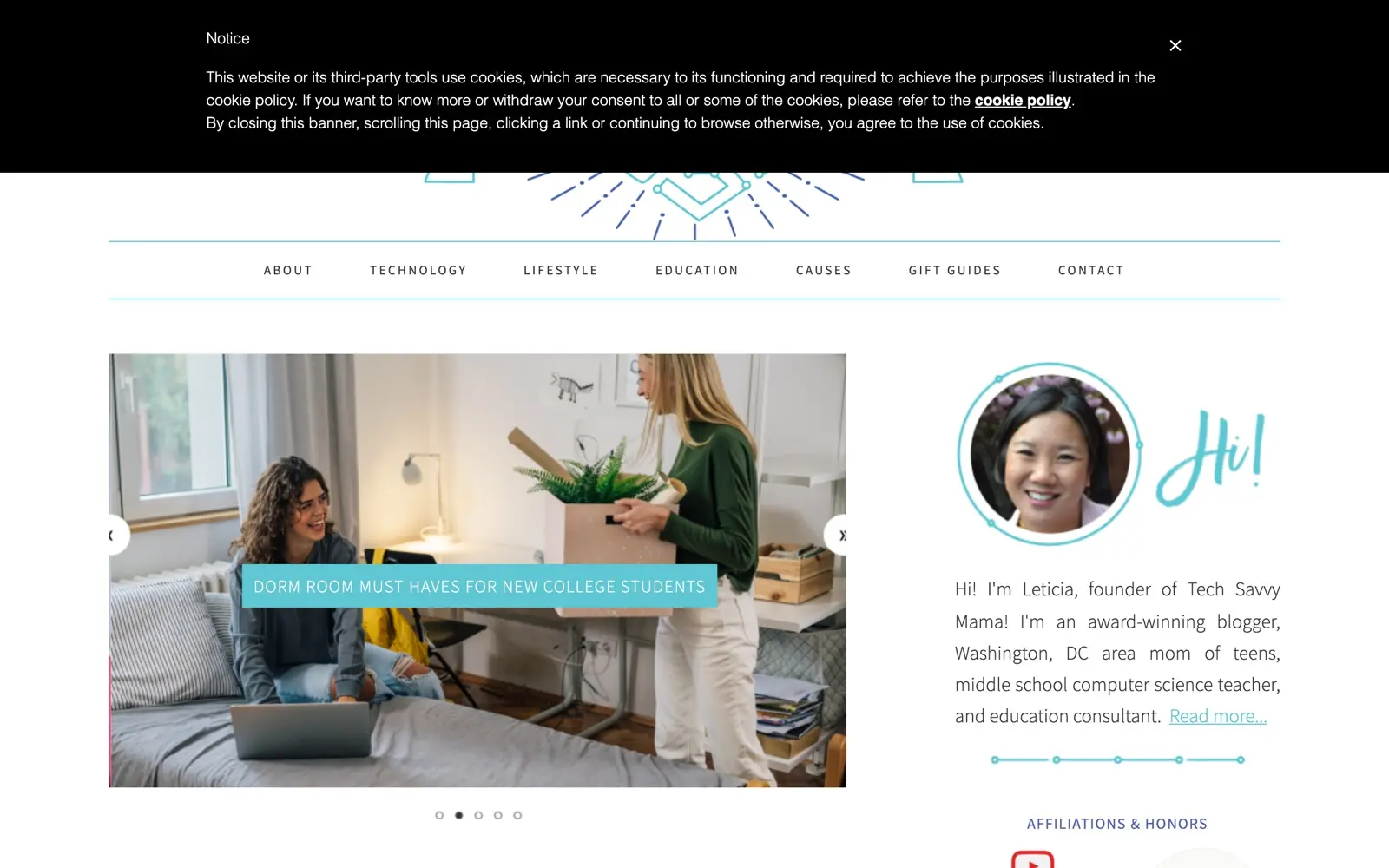
Leticia Barr started Tech Savvy Mama in 2008 and still runs it, which in the parenting-blog category is close to geological. She is a former middle school computer science teacher with a master’s from Tufts and another from Johns Hopkins in school administration and technology leadership, and she now consults, writes a Parents.com column and advises the YouTube Kids Parents Panel.
Current output covers education, family travel, apps, STEM and college prep. Sponsored reviews are a real part of the mix and she discloses them in-post, which is more than most of the category manages.
The site’s contributor page still lists her husband Jim and daughter Emily, but it is undated and stale, and recent posts are hers alone. Read the family contributions as history.
Pinch of Yum
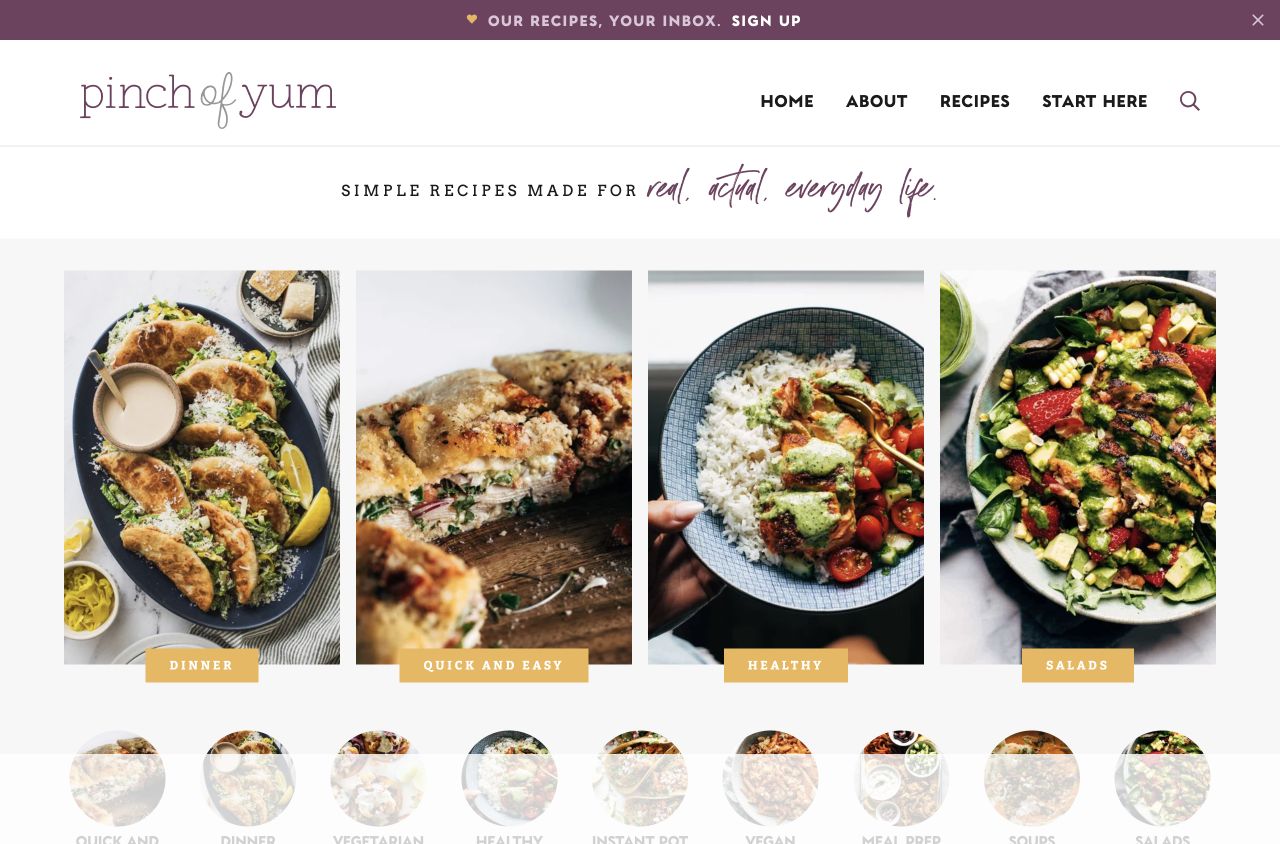
Lindsay Ostrom started Pinch of Yum in 2010 as a hobby while teaching fourth grade, and it is now the most-copied recipe operation on the web. It is worth being precise about what it has become: a professional recipe publication, still single-byline, supported by a team of three including her husband Bjork.
The current feed is recipes and almost nothing else. The travel, motherhood and home-renovation material that older roundups describe is archive depth now, not current output. Photography and instruction quality are the reason it outranks everything.
The wider business is instructive: Food Blogger Pro teaches the method, and Clariti sells the analytics. Start with any weeknight chicken recipe to see how tightly the format is engineered.
Zen Habits
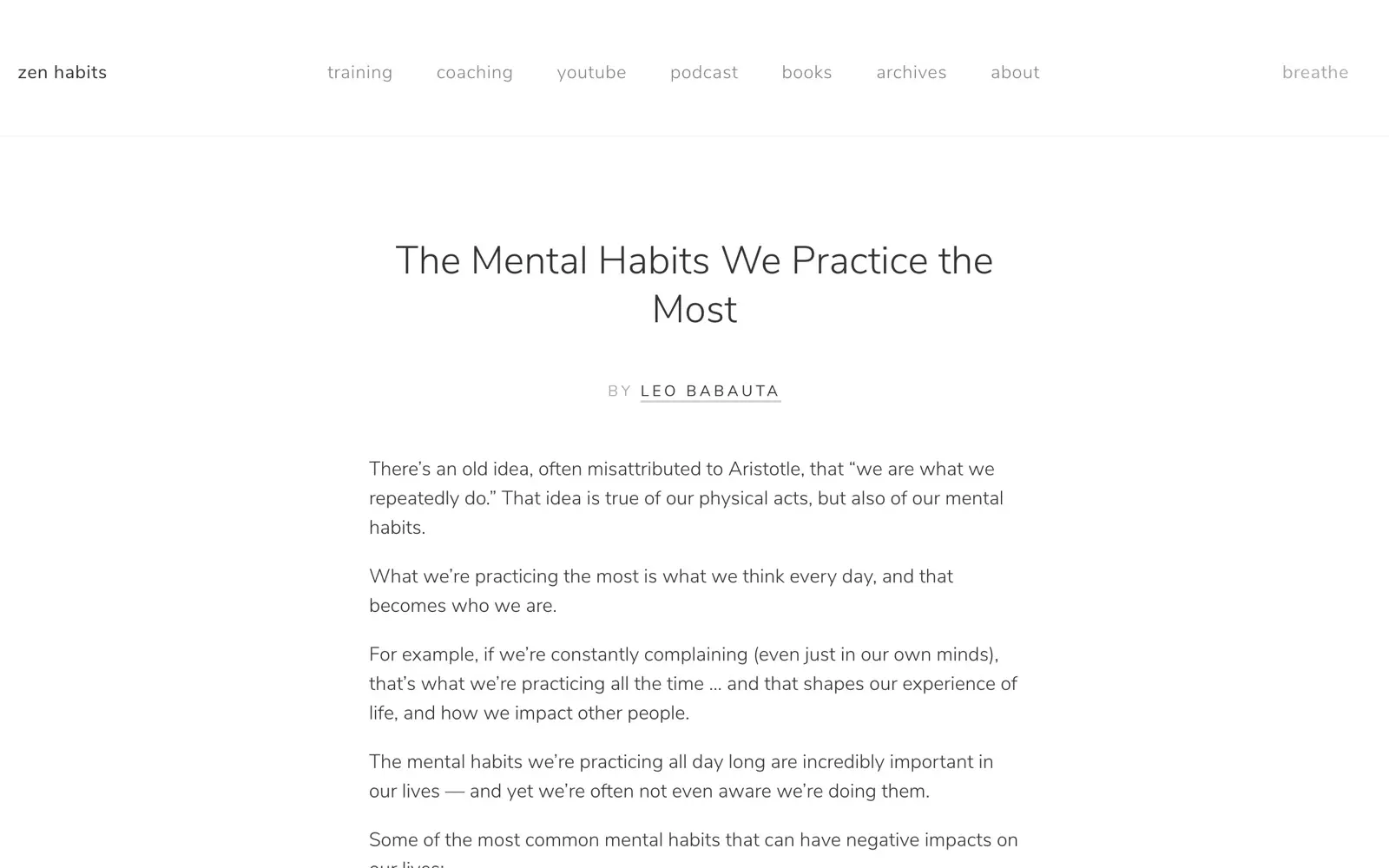
Leo Babauta started Zen Habits in 2007 and still posts weekly on habits, fear, focus and living with less. He famously released the blog and his Zen to Done ebook into the public domain in January 2008, which tells you most of what you need to know about the operating philosophy.
Recent posts cover the mental habits we repeat, solitude, and a health challenge. He lives in Northern California with his wife and their 2 teenage kids, with 4 adult children besides, 6 in all. His about page claims over a million readers, which is his figure rather than an audited one.
One practical quirk: the site publishes no visible dates and its RSS feed is broken, so recency has to be inferred. He now sells training, coaching and courses alongside the free archive.
David Lebovitz
David Lebovitz cooked at Chez Panisse for 13 years before starting this site in 1999 alongside his first cookbook, and the professional grounding shows in recipes that actually work. He writes from Paris, mixing recipes with travel notes and comic dispatches on French bureaucracy.
Saveur named it Blog of the Decade in 2019, a genuinely independent award rather than a self-claim. Recent posts run cherry jam, a chocolate olive oil spread video with Deb Perelman, and summer fruit galettes. Over 700 recipes sit free on the site.
The center of gravity has shifted to his reader-supported Substack, free to read with a paid tier, so the blog now updates more slowly than its archive depth suggests.
Going Zero Waste
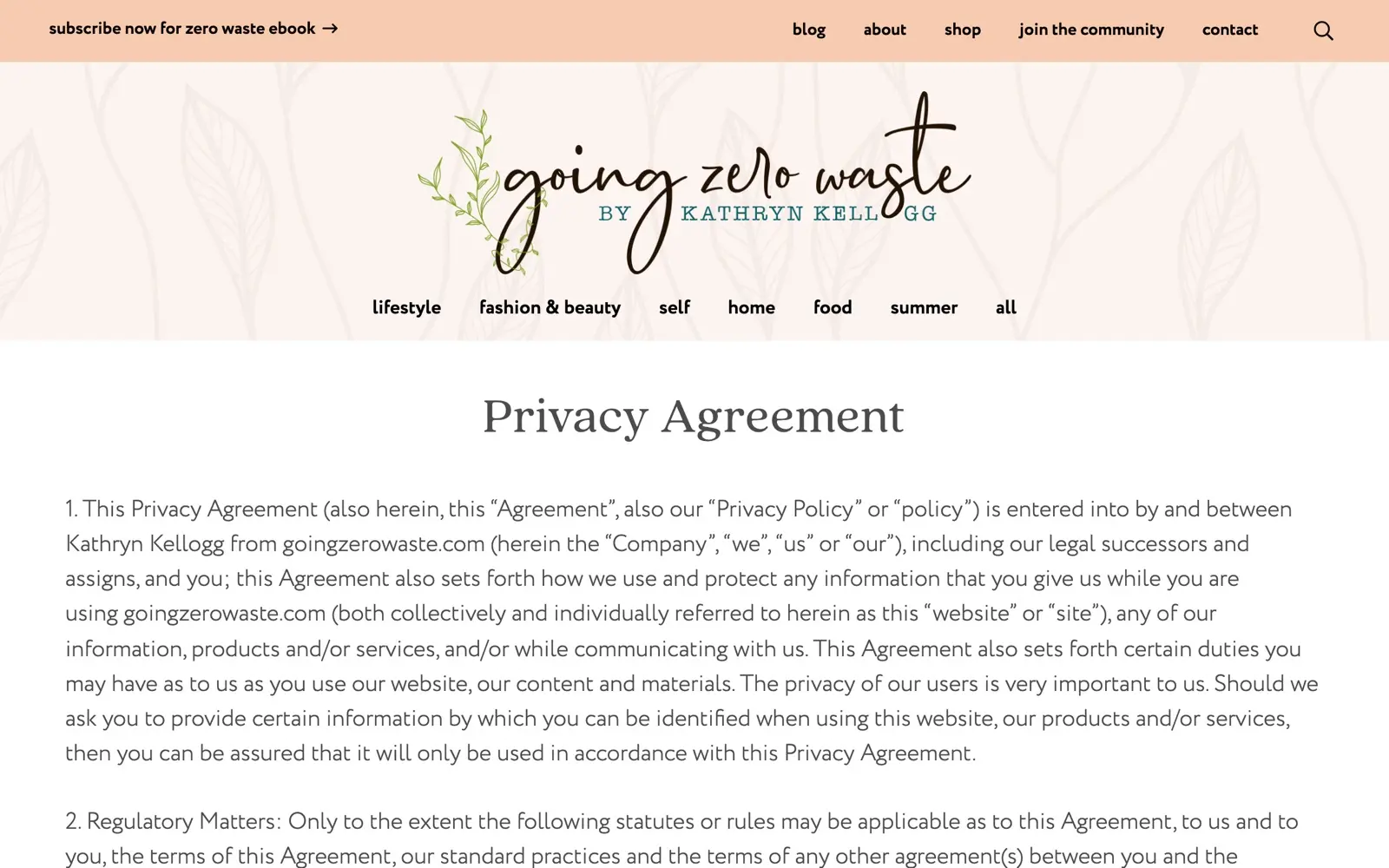
Kathryn Kellogg came to low-waste living through cost and health rather than environmental idealism, which is exactly why the advice stays practical. She is National Geographic’s spokesperson for plastic-free living and a trained actor who still does theatre, a detail her own bio leads with.
The scope has widened well past jars and swaps. Current posts cover grocery bills, meal planning to stop food waste, reducing plastic exposure with a baby, and a probiotic marketed around binding microplastics. Call it non-toxic living and household economics with zero waste as the heritage frame.
It runs on Mediavine display advertising with affiliate links and a disclosure policy, and the cadence has slowed to roughly monthly. The supplement-review direction is worth reading with the usual scepticism about wellness claims.
Austin Kleon
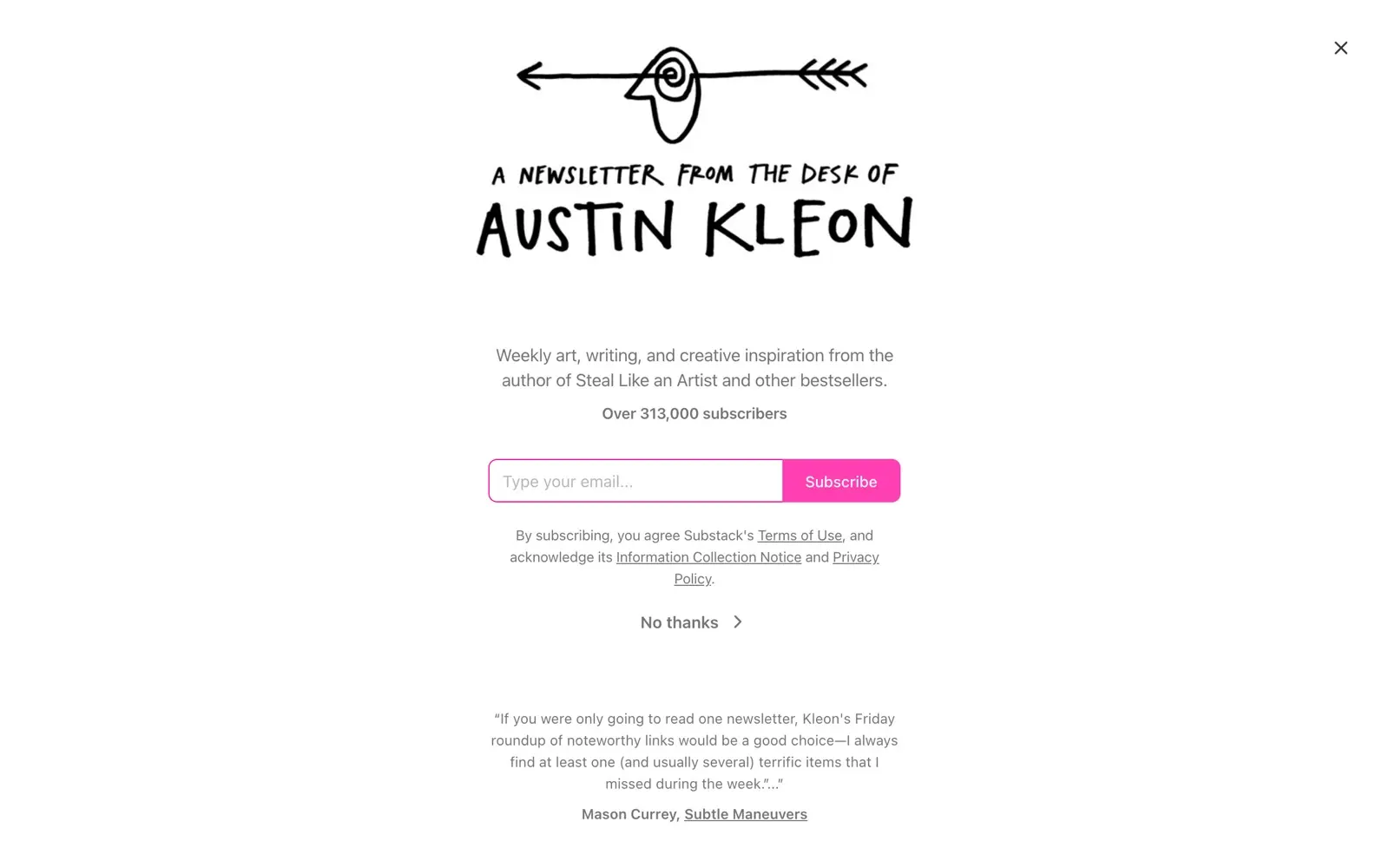
Austin Kleon calls himself a writer who draws, and the blog is where the drawing thinks out loud. He has posted at austinkleon.com since around 2005, and his books, Steal Like An Artist and the ones after it, have sold over 2 million copies in more than 35 languages.
Posts arrive in bursts a few times a month: an ongoing typewriter interview series with people like George Saunders, mixtapes assembled on a drive up the California coast, reading notes, studio process. It is a working artist’s notebook rather than a productivity blog.
Amazon affiliate income keeps it free, which he states outright. The weekly newsletter is the better subscription if you want the highlights instead of the full feed.
Derek Sivers
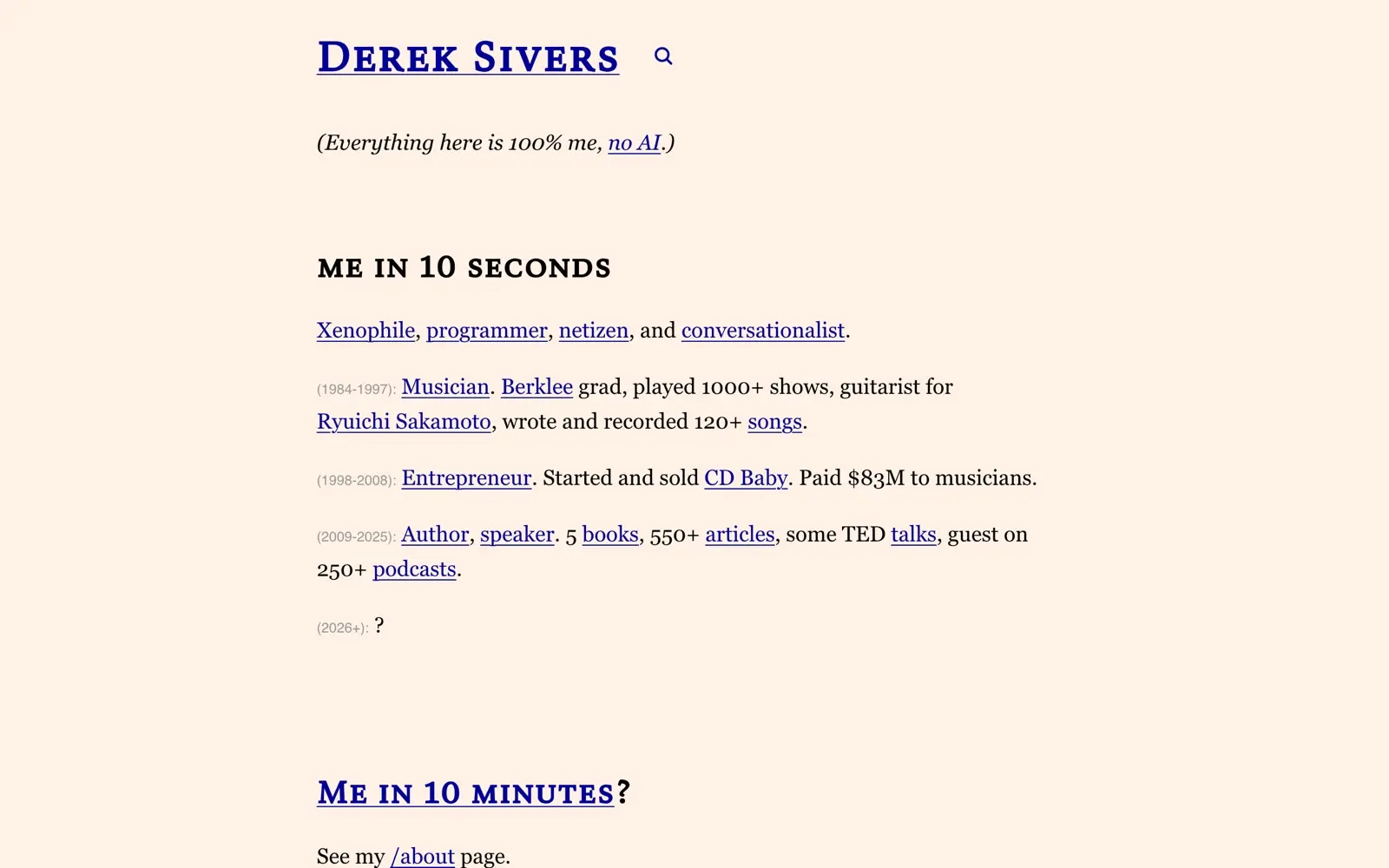
Derek Sivers sold CD Baby in 2008 and has written at sive.rs since roughly 2009, in posts so short they read like corrections to something you believed that morning. Recent titles: building without predicting, reframing death, preparing your no and keeping it handy, being offline 23 hours a day.
The site itself is the argument. He self-hosts on his own server with open-source tools, runs no ads and no sponsors, and disables comments in favor of email, on the grounds that a real reply is too personal for a public box.
Output is sparse, roughly 13 posts so far in 2026, arriving in clusters. Books are the business, and he has publicly tracked hundreds of thousands in book proceeds donated to charity.
Tim Ferriss
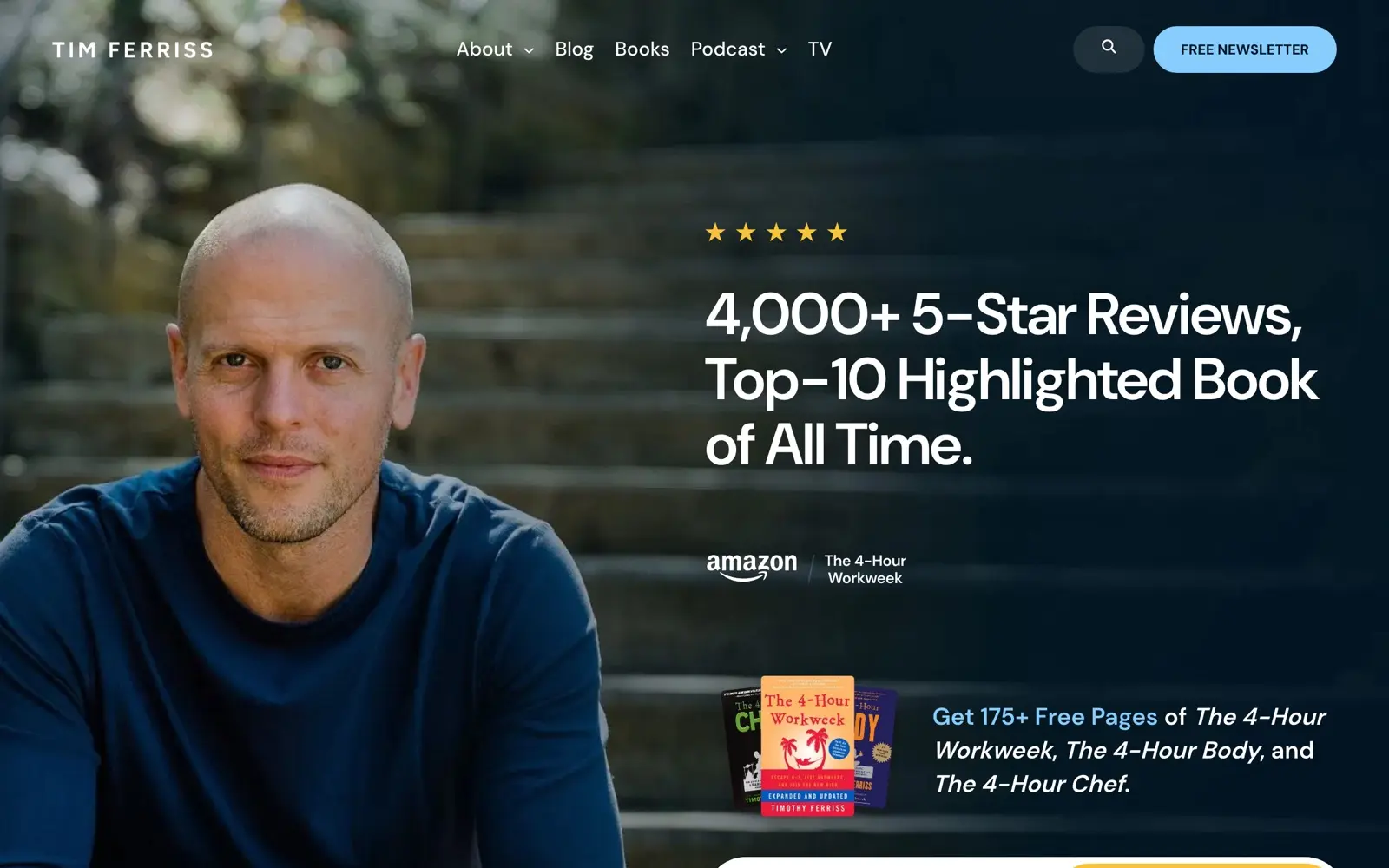
Tim Ferriss launched tim.blog in 2007 alongside The 4-Hour Workweek, and his about page counts 5 number-one New York Times and Wall Street Journal bestsellers plus a podcast past a billion downloads, the first business interview show to clear 100 million.
Set expectations correctly, though: this is now a podcast companion site. Almost every post is an episode or its transcript, and original written essays appear about once a month. The recent ones are worth it, including a piece on differentiating in the age of AI and another asking whether AI has already killed how-to nonfiction.
Start with the essays rather than the transcripts. Sponsorships fund the podcast, and the 5-Bullet Friday newsletter remains the highest-signal way in.
Selective Potential
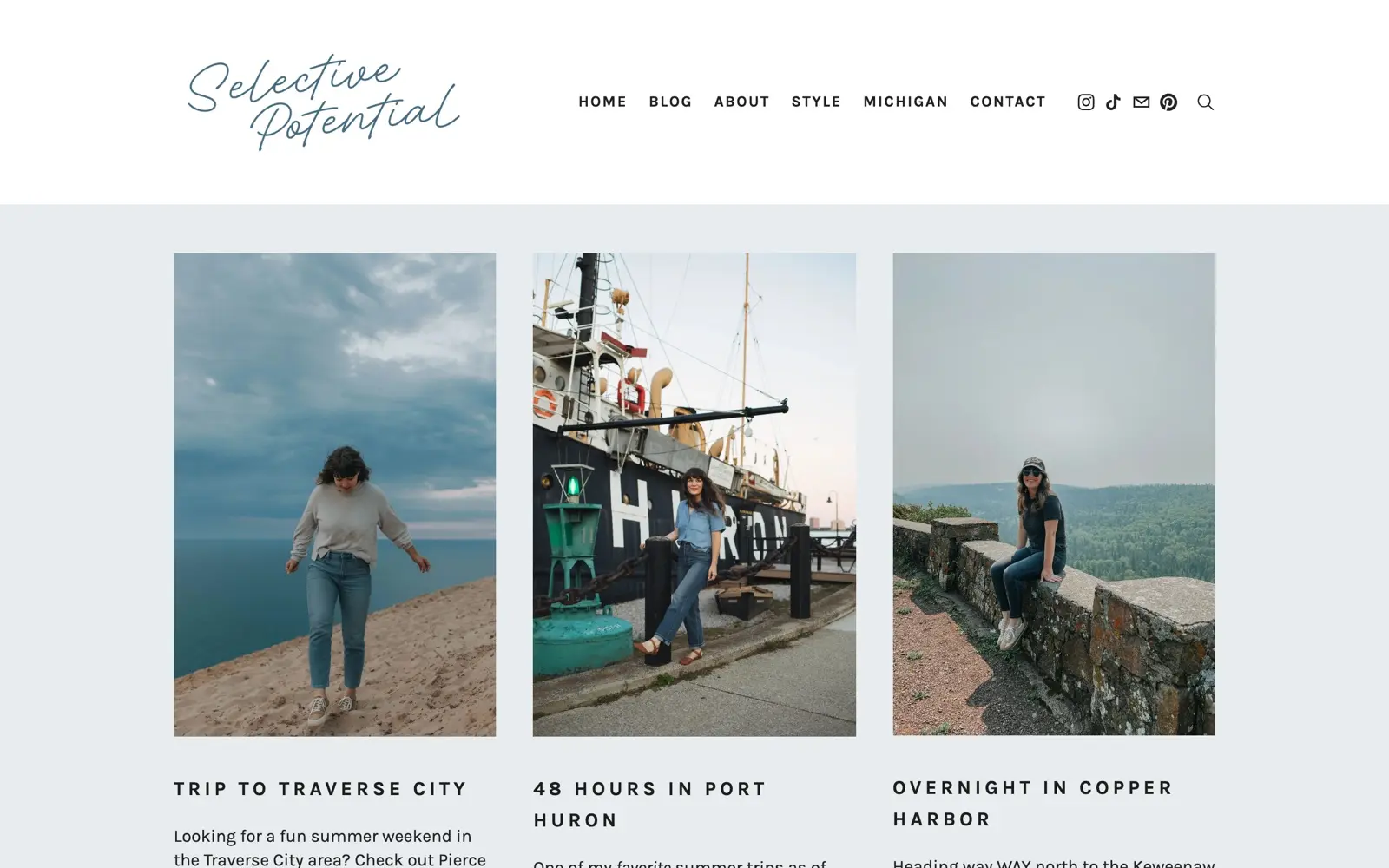
Tieka Knight has kept Selective Potential going as an actual personal blog, which is now the rare thing. She writes from Grand Rapids about outfits, weekends in the Upper Peninsula, her dog Winny, and a project she started at 24: visiting every lighthouse in Michigan.
She has reached 112 of them, with 33 to go, and has deliberately refused to rush it. Recent posts cover a west Michigan weekend, the Portage Lake North Pierhead light and lilac season. Roughly one post a month, each one photographed properly.
Study this one to see what a personal blog still looks like in 2026. Brand partnerships and affiliate links exist without a formal disclosure statement.
The Art of Non-Conformity
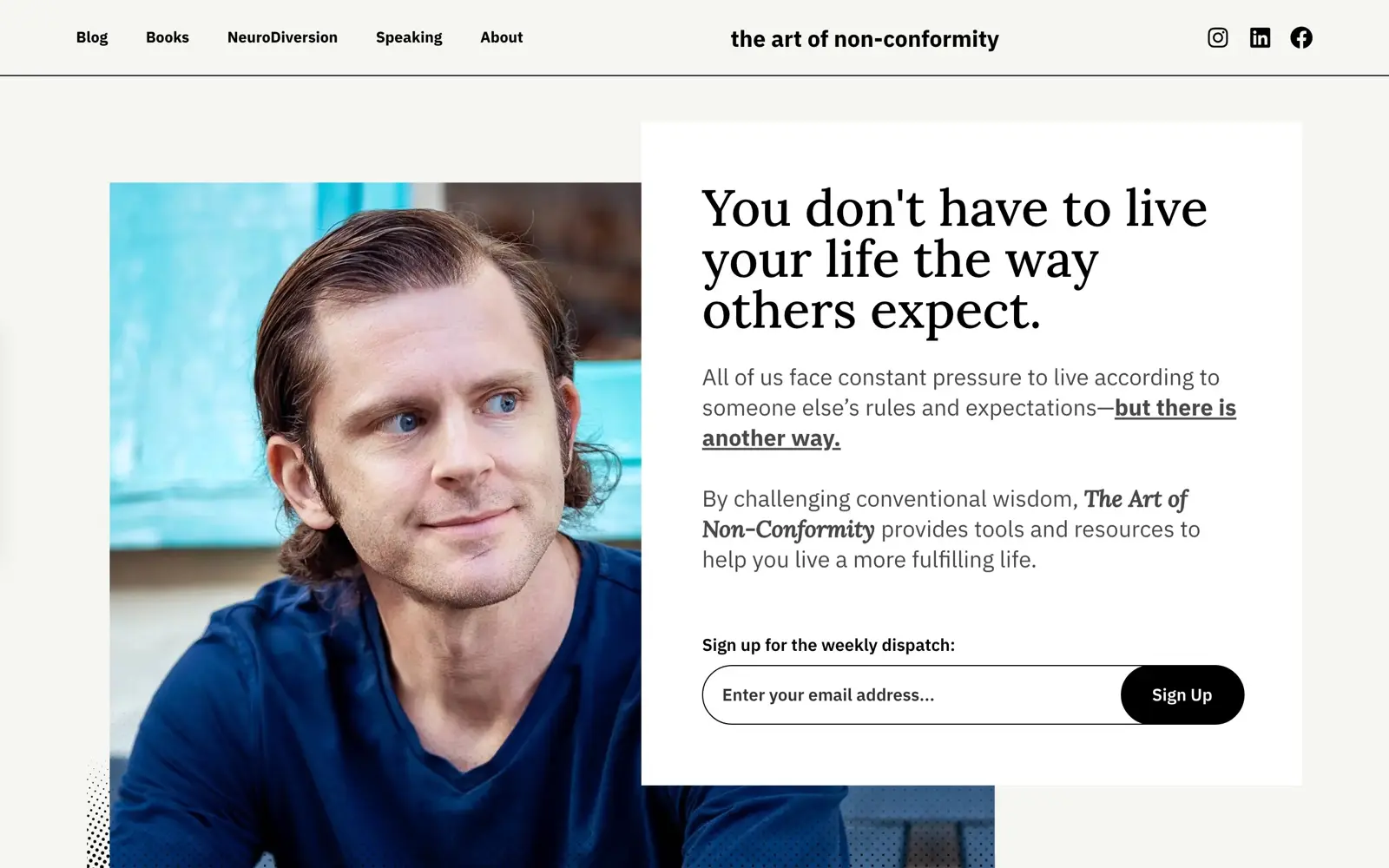
Chris Guillebeau‘s site carries the banner “Published Every Week Since 2008” and now reads as an essay and book hub organized around life, work and travel. The recent material has shifted noticeably toward time anxiety, mental health and neurodivergence, alongside the older entrepreneurship writing.
One caveat comes with that claim. The site was rebuilt as a static site and displays no post dates anywhere, not on the posts and not in the RSS feed, so the weekly cadence is his word rather than something a reader can check.
His verifiably daily output is Side Hustle School, at episode 3528 on August 29, 2026. Start with “Time Anxiety” or “Regret is an Unreliable Emotion.”
The useful move with any of these goes beyond reading them. Pick one whose format you could sustain for 5 years, then work out what it is actually built on: the cadence, the recurring post shapes, the thing it refuses to cover. That reverse-engineering is worth more than any list of blogging tips, including the ones in the best blogging courses.
Personal Blogs That Became Something Else
These 6 no longer work the way a personal blog does. Some grew into companies, some moved to a newsletter, one simply vanished. Each transition is worth studying, because it shows what happens to an audience when the format around it changes.
Neil Patel
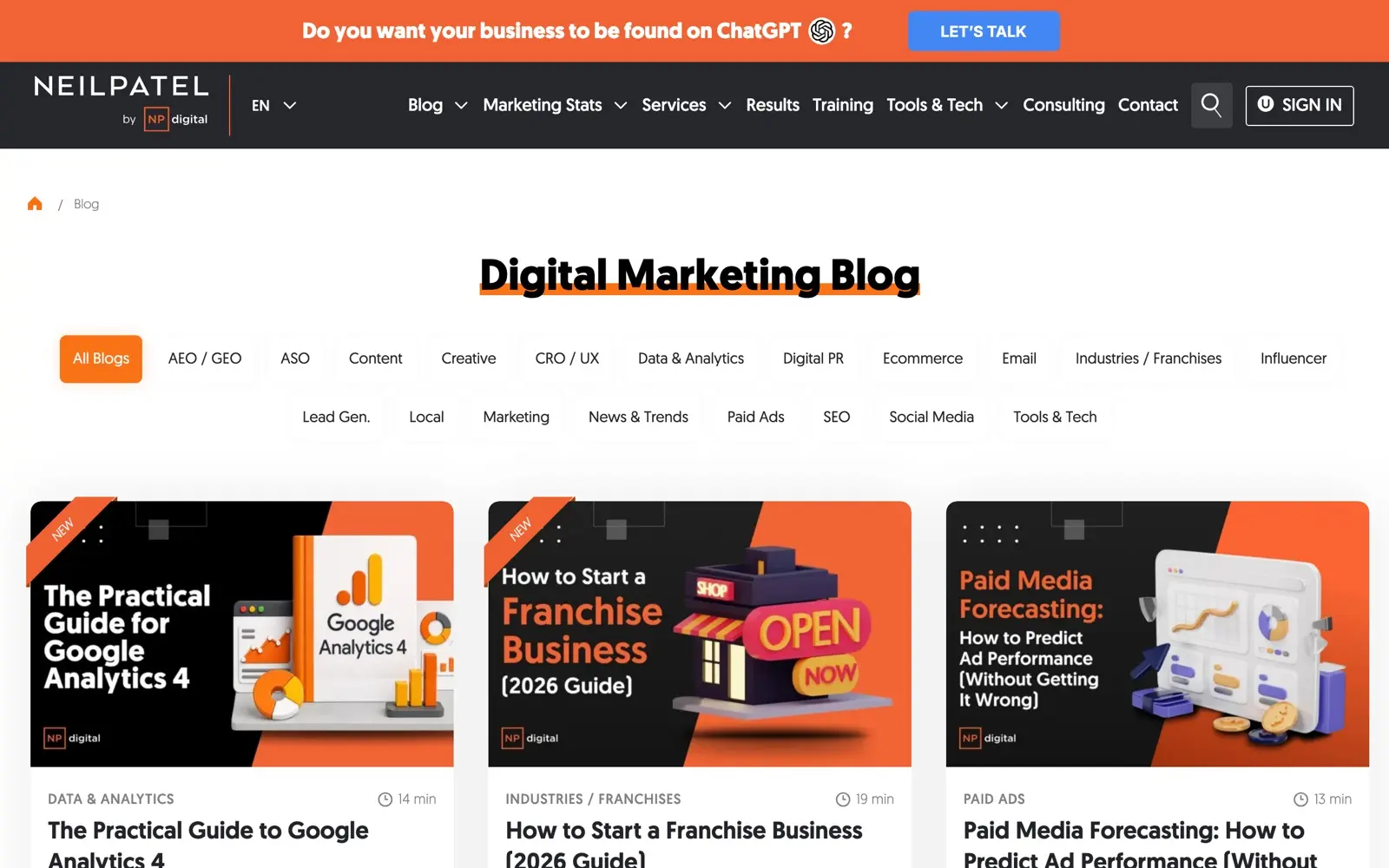
Neil Patel still bylines some posts, but the blog now runs on an agency masthead: 12 distinct author slugs on the first index page alone, with staff titles attached, including Nicole Leite, Kimberly Campbell, Nikki Lam and Jeff Durante.
It publishes every 2 or 3 days on SEO, AI search, paid media and analytics, and it exists to feed NP Digital’s agency services and the Ubersuggest and AnswerThePublic tools. The content is genuinely detailed.
Read it as a company publication with a person’s name on the door. That is not a criticism of the writing, but it does mean you are reading a marketing team rather than a marketer’s notebook.
Skint Dad
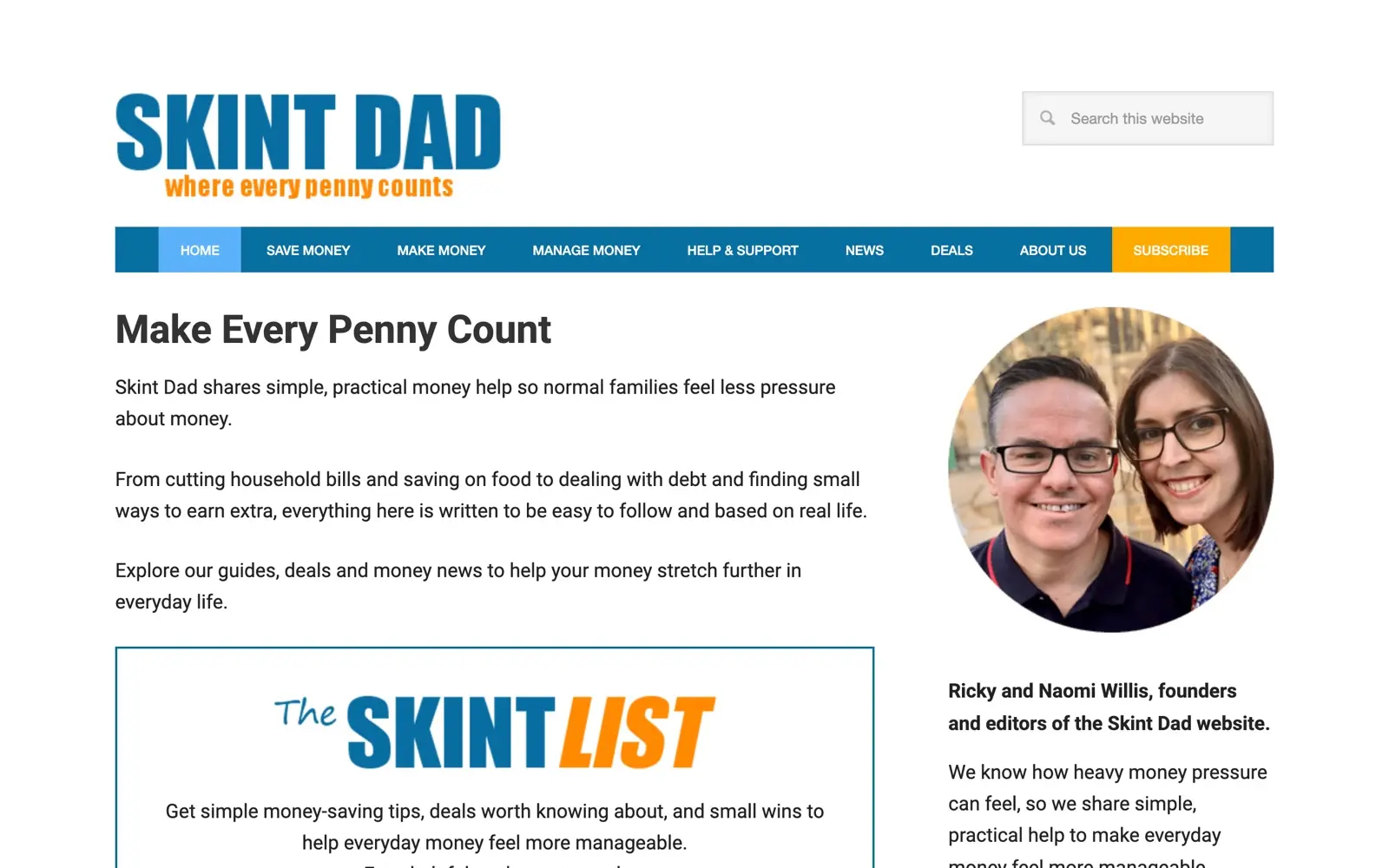
Skint Dad is a husband-and-wife operation. Ricky Willis founded it in 2013 after struggling with debt, and Naomi Willis is co-founder and editor. Both carry bylines today, and the business runs through Skint Media Limited.
It covers UK money-saving, benefits, scams and side income. Two things to be precise about. The 300,000 figure that circulates refers to combined community membership across their Facebook groups, per their own join page, not monthly visitors. And the Financial Blog of the Year win at the Headline Money Awards is dated 2016 by their own records.
Output has slowed to roughly monthly and the news desk has been dormant since January 2026. Affiliate links are disclosed properly, and the best personal finance blogs list covers the wider UK and US field.
Seasons in Colour
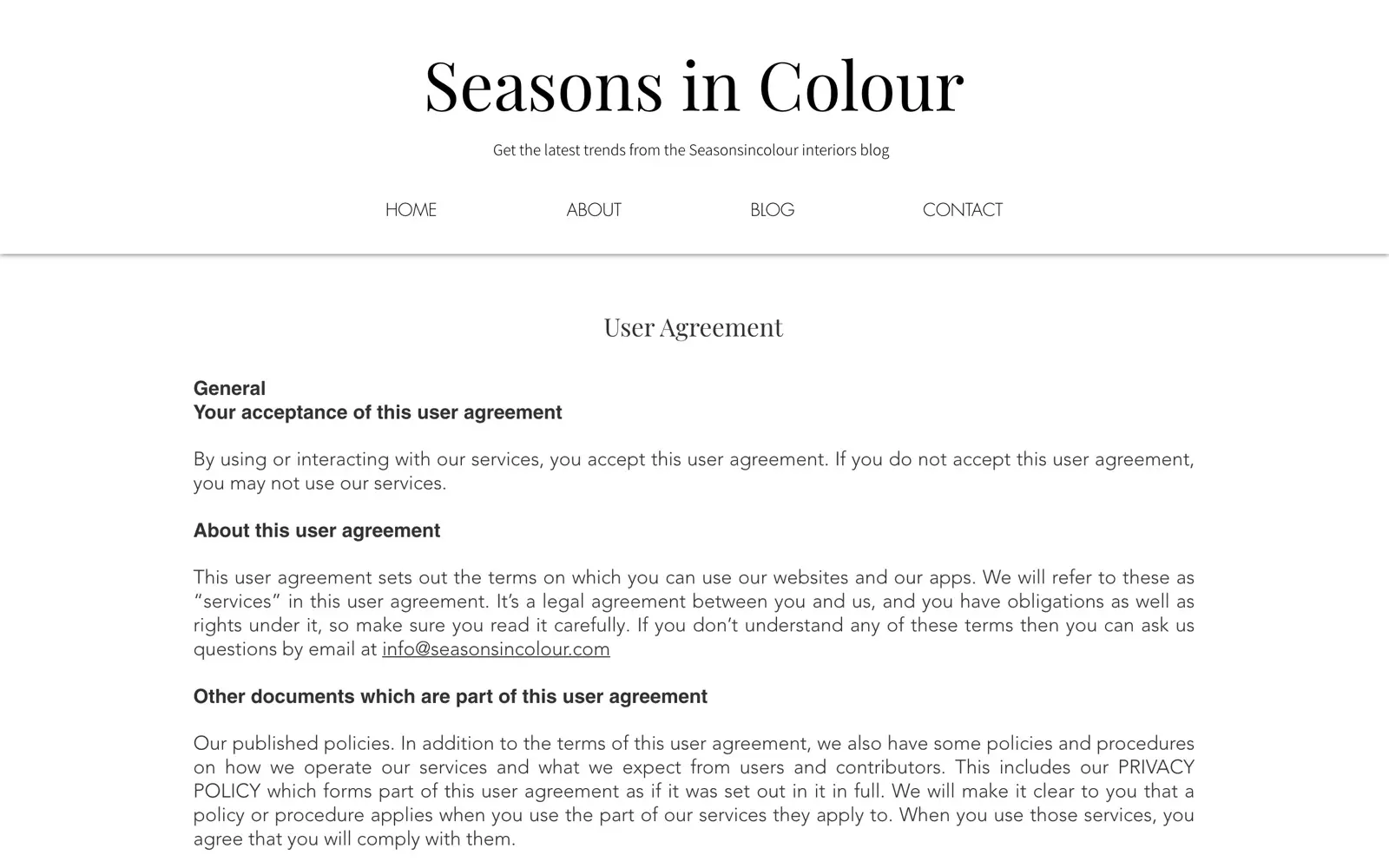
Jenny Kakoudakis launched Seasons in Colour in 2015 while documenting her own renovation, and won Best Colour Inspiration Blog at the 2016 Amara Interior Blog Awards.
It publishes multiple times a day now, and that volume comes with a warning. Alongside genuine interiors writing on paint, kitchens and outdoor entertaining, the recent feed carries pieces on home golf simulators, average dog-bite settlements and premises liability law, which read as commercial placements rather than personal design writing.
Sponsored work is disclosed at policy level and there is a Sponsored category, though individual posts carry no inline disclosure. Read the interiors material and skip the rest.
Barefoot Blonde
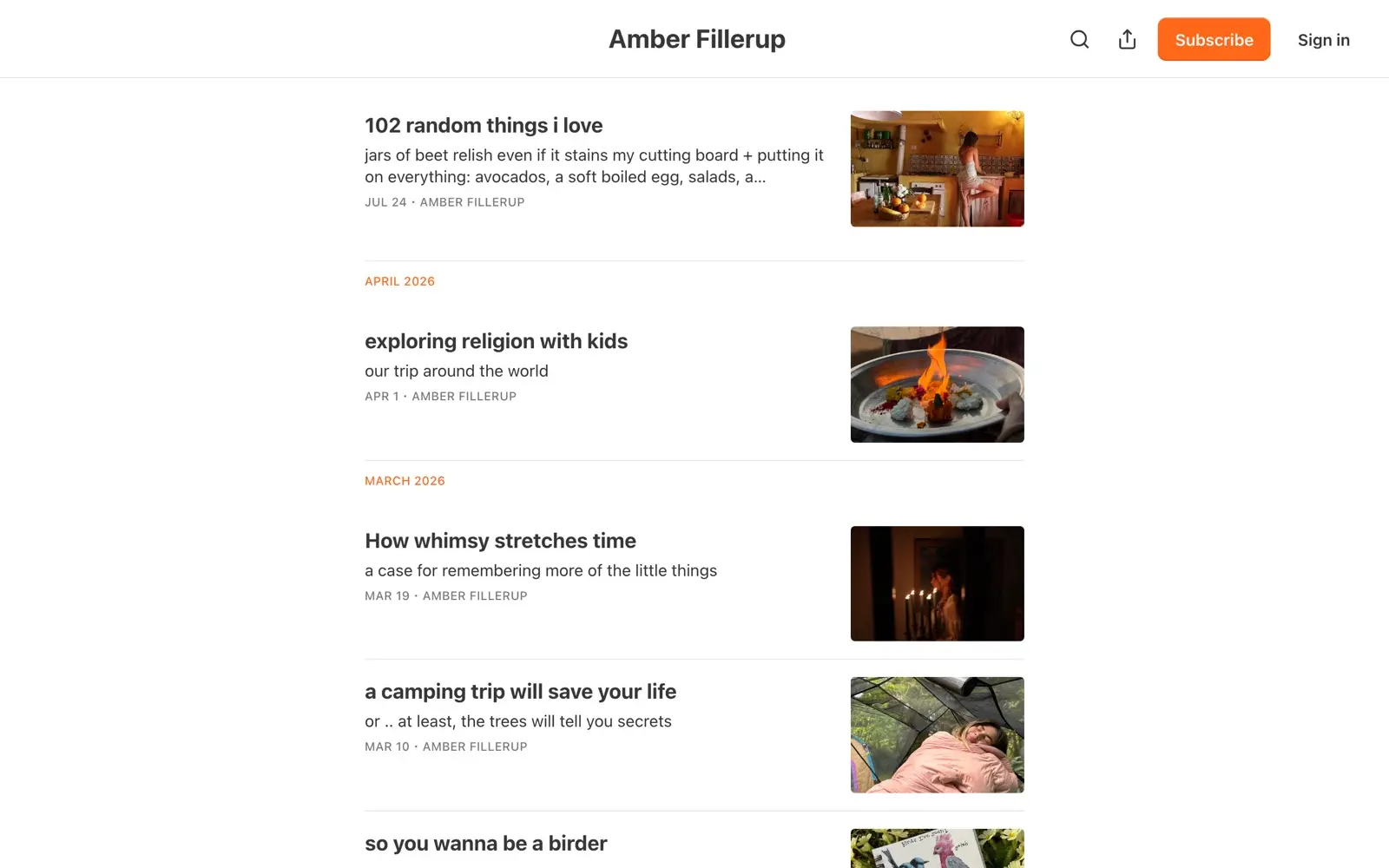
Amber Fillerup Clark built Barefoot Blonde from 2010 into one of the biggest fashion blogs of its era, then converted the audience into products: Barefoot Blonde Hair extensions in 2016, and the haircare line Dae in 2020, which reached Sephora within months.
The blog itself is gone, and the ending is a genuine cautionary tale. Both the original blog domain and the hair brand’s domain have lapsed out of her control and now serve unrelated third-party content, so the only safe destinations left are her newsletter and Dae. Her own product site still sends visitors to the lost address.
Her writing lives on a free Substack with over 18,000 subscribers, roughly 5 posts in 2026, about intentional living, birding, camping and parenting. The lesson: own the domain renewal like you own the business.
Dad and Buried
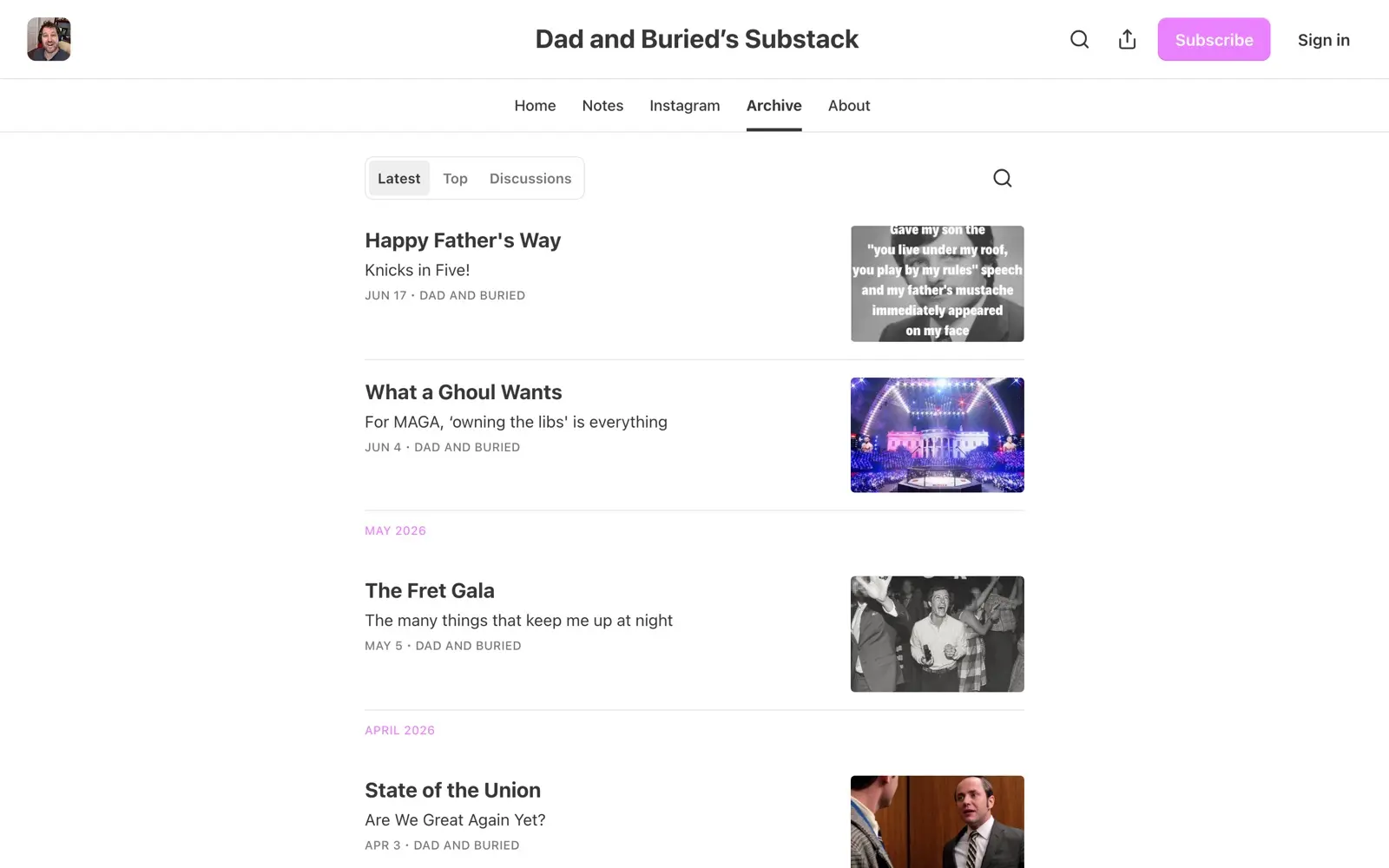
Mike Julianelle spent a decade as the sharpest anti-sentimental voice in parenting blogging, mocking his own parenting, his kids and himself from Brooklyn. Both formats he was known for have since closed: the podcast ended in August 2023 after 121 episodes, and the blog stopped in January 2024.
The writing moved to a Substack newsletter with over 1,000 subscribers, publishing roughly monthly and mixing family humor with sharply political commentary. His largest live channel is Instagram, where the account runs to several hundred thousand followers.
His book Dad Truths arrived in April 2024. Follow the newsletter rather than the blog, and expect politics alongside the parenting. For writers still working that beat, the best dad blogs list covers who is currently publishing.
The Dad Dude
The Dad Dude was a Cape Town parenting blog written by Terran Williams, a father of 5, with his wife Julie as an occasional guest. It no longer exists: the domain’s DNS now points at localhost, so every link to it fails.
Williams moved on entirely rather than rebranding. He now writes at terranwilliams.com as an author and church leader, pioneering a new church and a wider movement, and publishing on biblical interpretation and the role of women in church leadership. His best-known book is How God Sees Women, from 2022.
He posts occasionally, twice so far in 2026. The parenting writing is not coming back, and he seems entirely at peace with that.
The pattern across all 6 is the same: the audience outlived the format. If you want the longer version of that story, the case studies in successful bloggers who built real businesses follow the same transitions with the financial detail attached.
Classic Archives Worth Reading
These 4 have stopped. No new posts are coming, so none of them can be followed. The writing is still good, and in 2 cases genuinely important.
Hyperbole and a Half
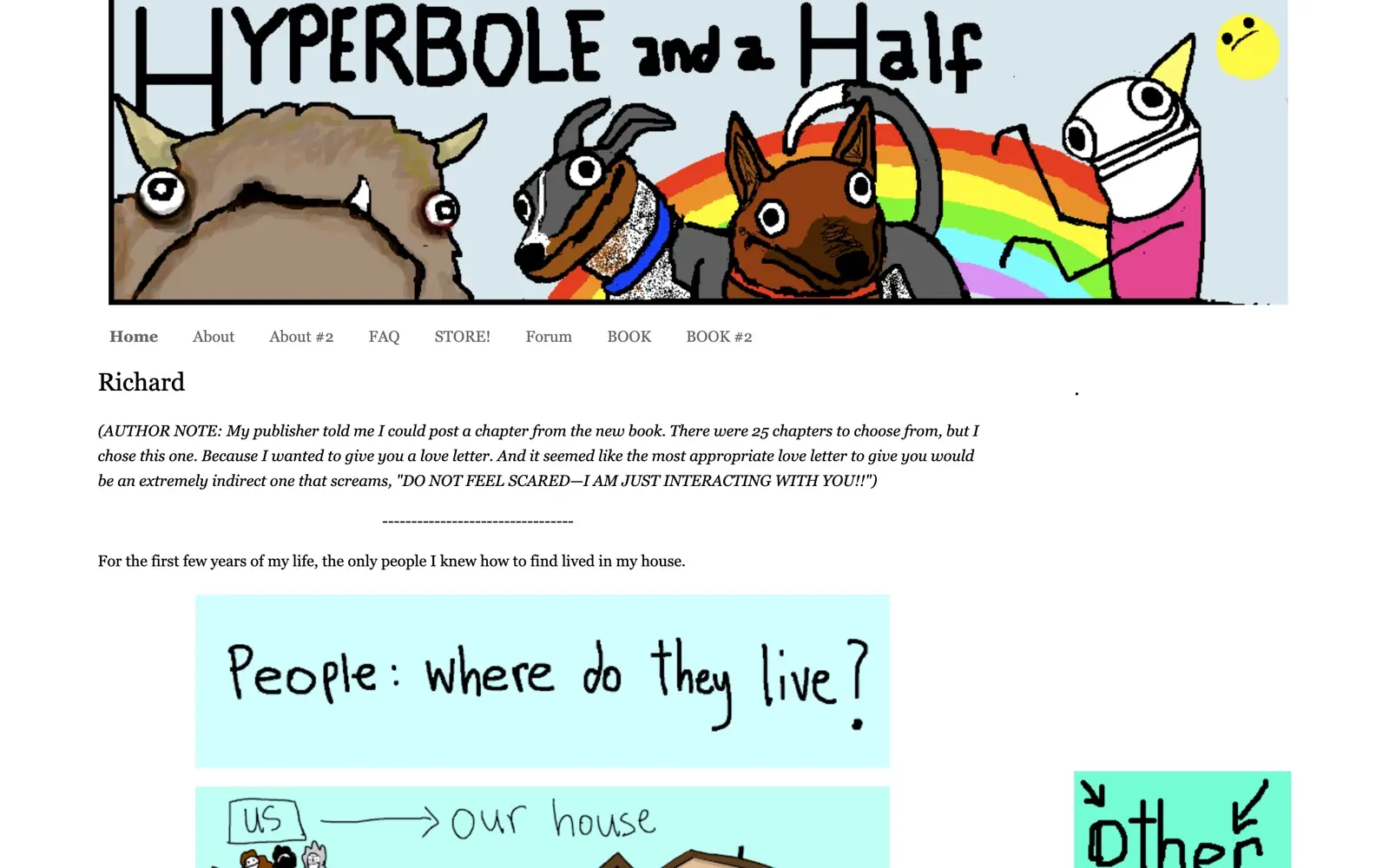
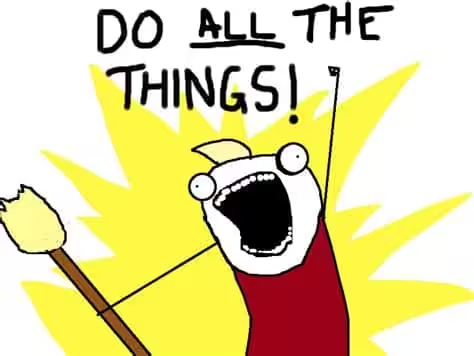
Allie Brosh‘s crudely drawn, precisely written comics about childhood, dogs and depression are the most influential thing on this list. Her two-part account of depression did more to explain the condition to people who had never had it than most clinical writing manages, and the panels captioned CLEAN ALL THE THINGS, from a June 2010 post about failing at adulthood, became one of the internet’s defining memes.
The blog stopped in September 2020, when she posted a chapter from her second book, Solutions and Other Problems. There has been nothing since, and she has said she prefers books to blogging.
Read it front to back as a finished work. The archive is complete and it holds up entirely.
Love That Max
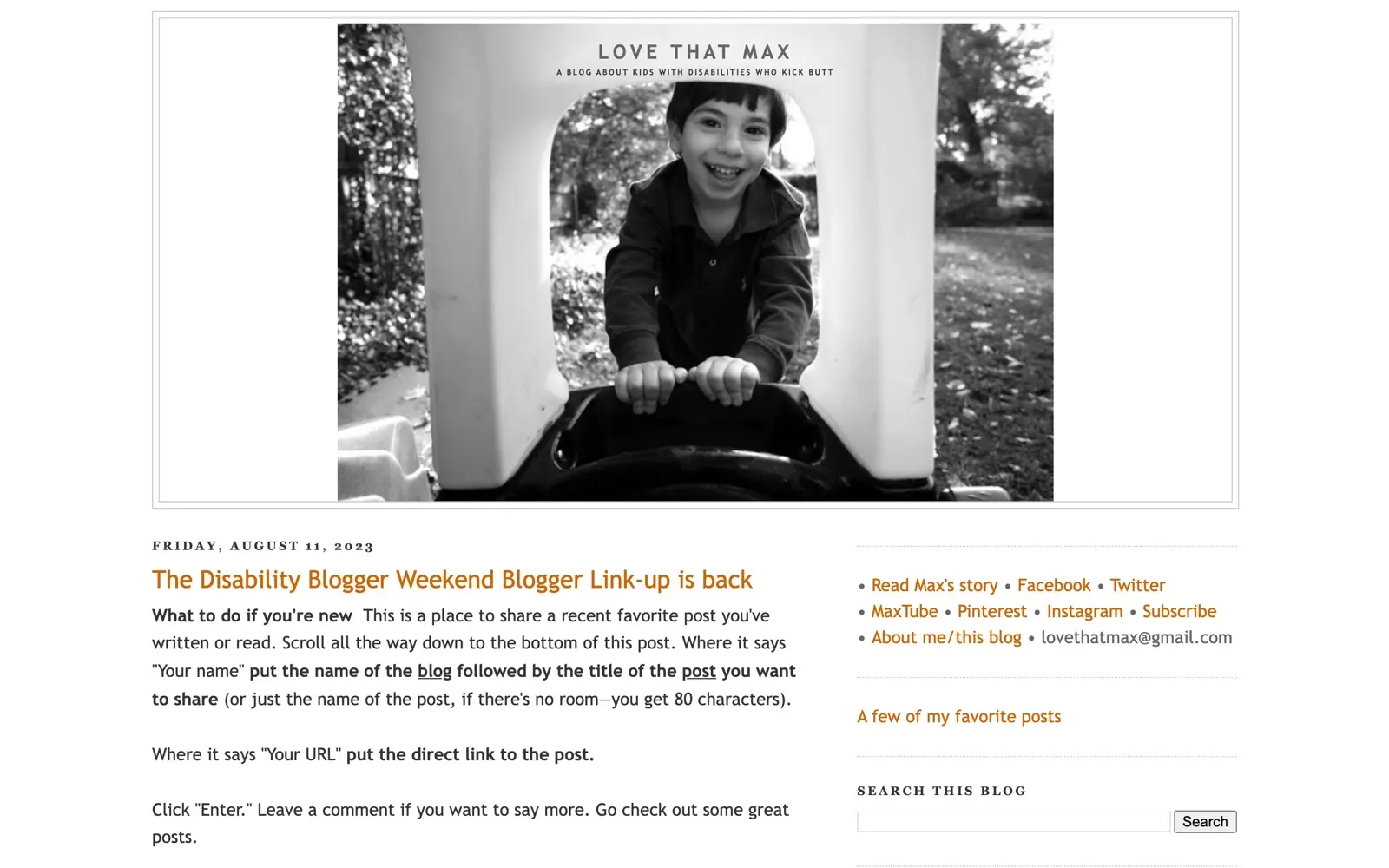
Ellen Seidman wrote Love That Max from 2009 to 2022, naming it for her son Max, who has cerebral palsy, and built the most useful public archive on raising a child with disabilities that any parent had at the time. The final posts in 2023 were community link-ups rather than essays.
What made it work was refusing both available scripts, the tragedy story and the inspirational one, in favor of the specific and often funny reality. The archive covers therapy, school advocacy, medical systems and the ordinary business of a family.
She now runs a content consultancy and has recently been an executive editor across several national magazines. Read the archive as a resource; there will not be new posts.
Dad or Alive
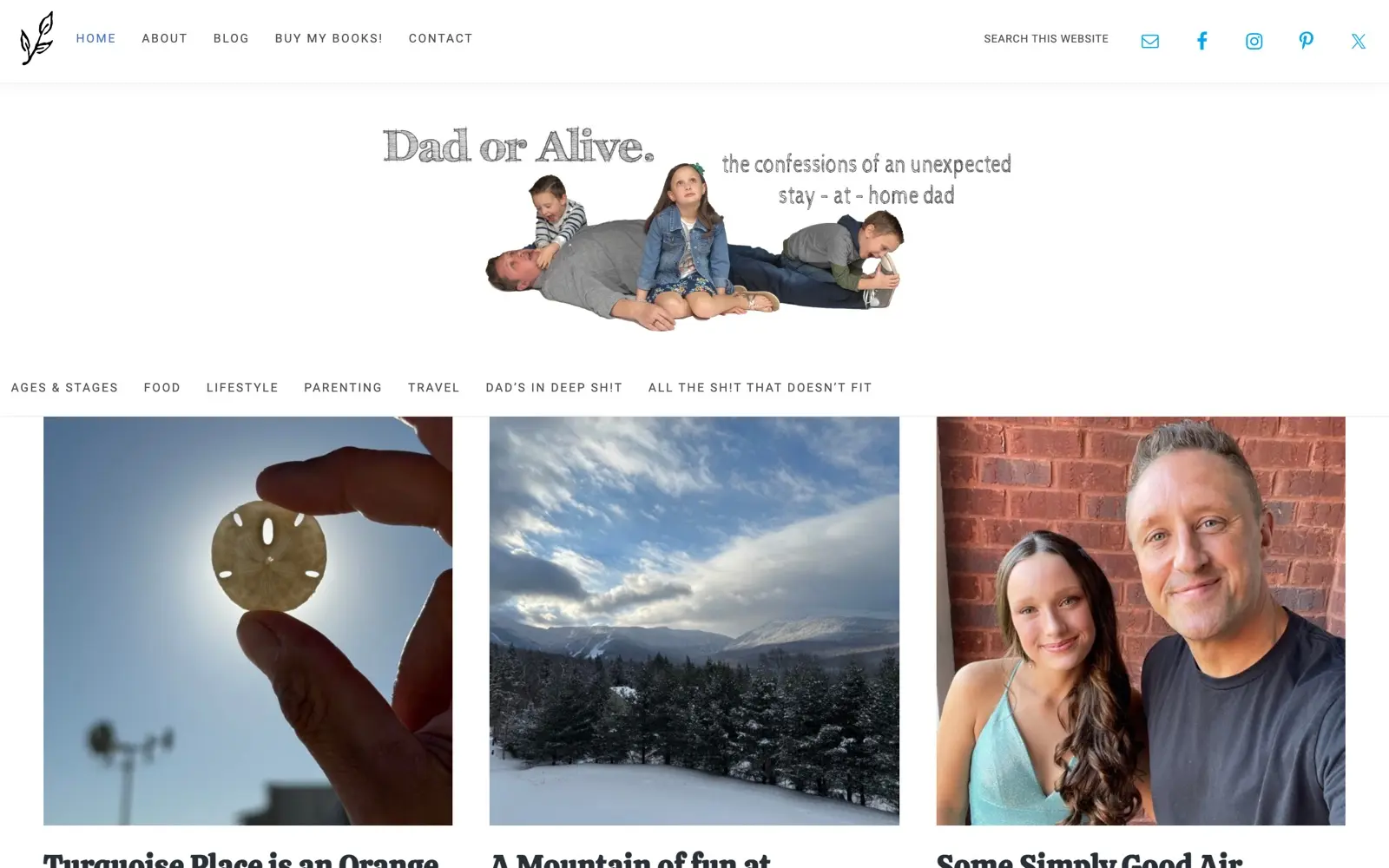
Adrian Kulp went from booking comedy for CBS and running development for Happy Madison to being a stay-at-home father, and wrote about the whiplash with more honesty than the genre usually allows. The blog produced 6 books, including a pregnancy handbook aimed at first-time fathers.
It is effectively finished: roughly 3 posts in 5 years, the last in June 2024, and the final entries were travel pieces. Kulp has moved into audio and music production in Nashville.
One number attached to his name deserves a caveat. The claim that his books sold a quarter of a million copies traces entirely to his own author bio, repeated verbatim across his press pages, with no publisher or trade confirmation behind it.
Gala Darling
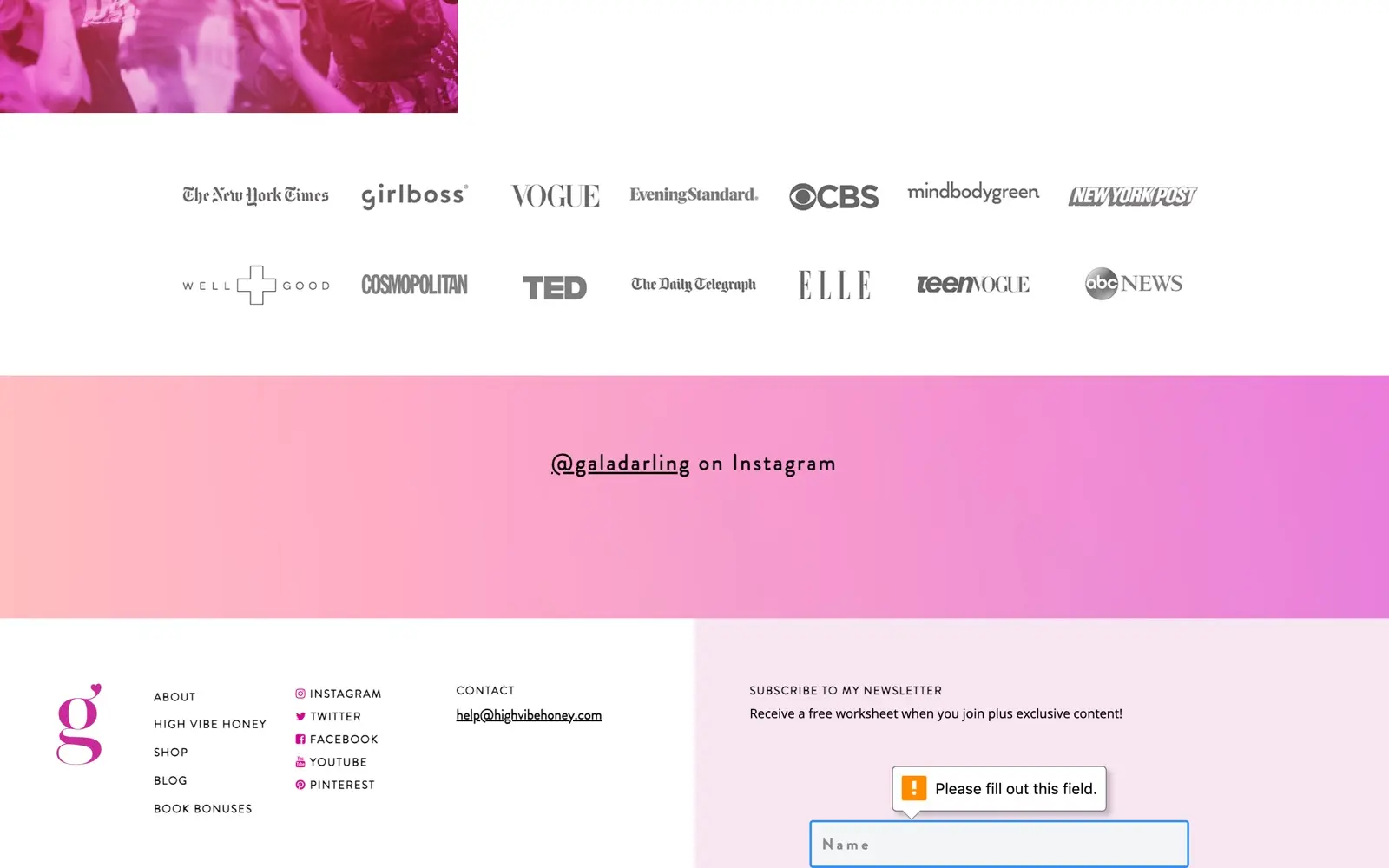
Gala Darling started in fashion and beauty in the late 2000s, then turned the blog toward radical self-love, writing openly about depression and eating disorders in a register the lifestyle category mostly avoided. The archive is the reason to visit.
The blog stopped in May 2021, with 2020 as its last full year. The site itself is very much alive, but it now sells programs and memberships built around tapping, money mindset and self-love rather than publishing new writing.
Worth reading as a record of how a personal blog becomes an information-product business. Note that the site’s /blog/ path currently errors, so the homepage is the way in.
What the Active Blogs Have in Common
Set the 17 that are still going beside the 10 that are not, and a few things line up. None of them is a growth tactic.
- A voice you could identify with the byline removed. This is the whole asset, and it is the one thing a summary cannot reproduce.
- A subject narrow enough to return to. Michigan lighthouses, vegetarian recipes, language models. Narrow topics generate posts for years; broad ones run dry.
- A cadence the writer can actually hold. Monthly and sustainable beats weekly and abandoned, and the archives here are mostly stories of cadence collapse.
- A direct line to readers. Newsletters and memberships rather than search traffic alone. Every survivor has one.
- Ownership of the domain. Barefoot Blonde is the warning here, with 2 brand domains lapsed out of the founder’s control and now serving unrelated content.
What does not correlate is traffic. The most-read sites on this page are not the most personal ones, and 2 of the best writers here publish monthly to audiences a fraction the size of the agency publications.
How to Start Your Own Personal Blog
Every blog here began with one person publishing something nobody asked for. Ellen Seidman was a mother with a newly diagnosed son. Lindsay Ostrom was teaching fourth grade. Kathryn Kellogg was broke. The technical setup is the easy part now, and the complete guide to starting a blog covers it end to end.
The hard part is choosing a subject you will still want in year 3, and then actually publishing through the stretch where nobody is reading. If you want a sense of what that looks like in other markets, the best Indian bloggers list covers writers this page does not reach, and Gatilab tracks the broader market in its blog rankings hub.
FAQs on Personal Blogs
What is a personal blog?
A personal blog is a publication where one identifiable person’s voice, experience and judgment stay central to the editorial identity. That is what separates it from a company publication, where the brand leads and the authors rotate.
Which personal blogs are still active in 2026?
17 of the 27 in this guide were still publishing when I checked them in late August 2026, including Kottke.org, The Marginalian, Simon Willison’s Weblog, Cookie and Kate and Wolf’s Gaming Blog. The rest either became businesses or stopped.
What is the difference between a personal blog and a company blog?
A personal blog carries one person’s voice and their own experience; a company blog serves an organization’s editorial plan with multiple authors. Neil Patel’s site is the clearest example of the crossover, since it now runs on an agency masthead.
Are personal blogs still worth reading?
Yes, and arguably more than before, because a named person with a real point of view is now the scarce thing. The blogs here that still work are the ones offering something a search summary cannot reproduce.
Can a personal blog make money?
Several here do, through very different models: display advertising, cookbooks, affiliate links, reader memberships, courses, product lines and agency services. Kottke.org runs on reader memberships, while Cookie and Kate runs on display ads and a cookbook.
How often should a personal blogger publish?
Consistency beats frequency. Simon Willison posts most days and Selective Potential posts monthly, and both work because the cadence is sustainable for the writer and predictable for the reader.
Should I use my name or a brand name for a personal blog?
A brand name travels better if you ever sell or hire; your own name travels better if the voice is the product. Barefoot Blonde is the cautionary case, since the brand domains eventually left the founder’s control while her own newsletter did not.
Are personal blogs different from Substack newsletters?
Increasingly they overlap, and several writers here have moved from a blog to Substack. The trade is real: newsletters reach an inbox you own, while a self-hosted blog gives you control over the domain, the archive and the design.
Which personal blog should a beginner study?
Selective Potential for what an unhurried personal blog still looks like, Cookie and Kate for a single-author site built into a real business, and Kottke.org for what 27 years of consistency compounds into.
Final Remarks
The blogs that lasted are not the ones that chased the algorithm. They are the ones where a specific person kept showing up with something specific to say, often to a small audience, for longer than was reasonable.
There is an honest limit to any list like this one. Which sites still publish and who writes them are facts. Whether a particular voice lands for you is not, and no amount of sorting will settle it. Read 3 of the active ones properly this week.
Then, if one of them makes you want to write something, that is the actual recommendation.
Tell Google you want more of this.
Add Gaurav Tiwari as a preferred sourceOne tap, and this site shows up more often in your own Top Stories, AI Overviews and AI Mode. Remove it any time.