
Easy Ways to Earn Money in College: 12 Real Side Incomes Ranked
 by
by
Easy ways to earn money in college should pass two tests: the work must pay after hidden time and expenses, and it should not damage the degree you are paying to earn. Surveys, cashback apps, and vague “passive income” schemes usually fail one or both.
For dependable cash, start with a campus job or tutoring. For higher earning potential, build one portfolio skill such as writing, web development, design, or video editing. The ranked list below uses current U.S. wage data where a comparable occupation exists, then separates that benchmark from what a beginner can safely plan.
How to read the numbers: The latest national wage release available is the U.S. Bureau of Labor Statistics’ May 2025 Occupational Employment and Wage Statistics. It reports employee wages, not guaranteed freelance rates for students. The table uses the medians as reference points, then show a transparent eight-billable-hours-per-week calculation.
12 ways to earn money in college, ranked by evidence and upside
The top five have a national occupational benchmark and build a reusable portfolio or reputation. The middle options can be dependable but are local or project-specific. The bottom options hide unpaid time, expenses, or loss risk.
| Rank and option | Best available pay evidence | What to verify first | Career value |
|---|---|---|---|
| 1. Web development / coding tasks | BLS median: $44.54/hour | Can you scope and finish one small job? | Very high |
| 2. Freelance writing | Writers and authors: $36.98/hour median | Is editing and research time billable? | High |
| 3. Video editing | Film and video editors: $36.26/hour median | How many revision rounds are included? | High |
| 4. Graphic design | Graphic designers: $30.27/hour median | Does the brief include source files and revisions? | High |
| 5. Tutoring | Tutors: $20.84/hour median | Preparation, cancellation, and platform fees | High |
| 6. Federal Work-Study | School-set hourly rate | Award eligibility and available jobs | Medium to high |
| 7. Other campus jobs | Local posting | Schedule fit and commuting time | Medium |
| 8. Research or lab assistance | Department or grant rate | Required skills and term commitment | High in-field |
| 9. Voiceover work | Project quote, not a reliable hourly rate | Audition time, usage rights, equipment | Medium |
| 10. Transcription | Pay per audio minute or project | Convert difficult audio into real working hours | Low to medium |
| 11. Delivery or retail shifts | Local wage minus work expenses | Vehicle, fuel, insurance, travel, and tips | Low |
| 12. Surveys, task apps, or speculative schemes | No dependable benchmark | Withdrawal rules, deposits, and data use | Very low |
This ranking does not make every skilled option easy. It says the hour has a better chance to pay you twice: once in cash and again in proof you can use after graduation. By contrast, delivery, surveys, and dropshipping can consume time without producing a useful portfolio.
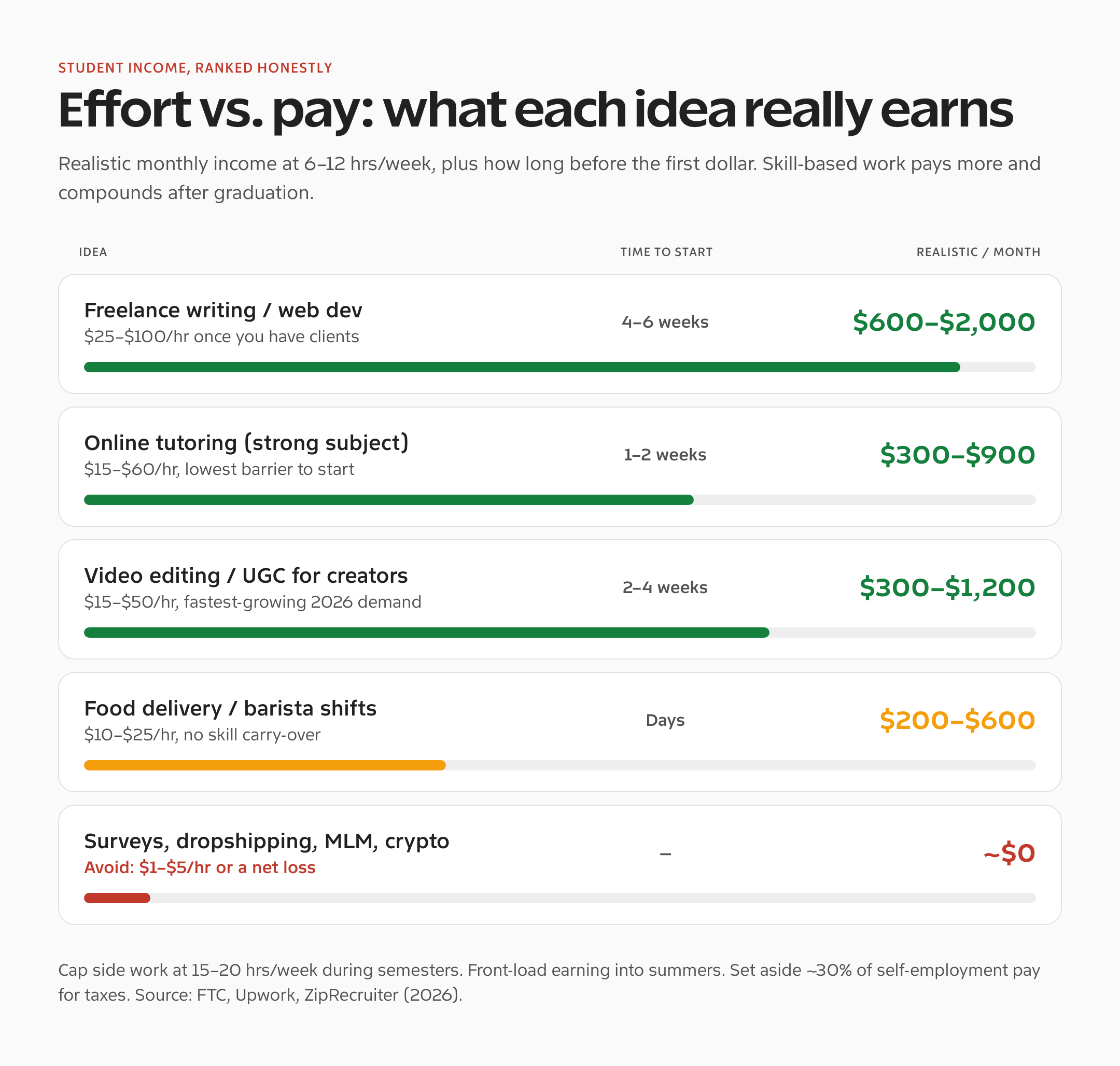
What Current Wage Data Actually Tells You
A national median is not a starting quote. It is a reference for the mature occupation. A beginner may earn less, spend part of the week finding work, and lose part of gross income to fees, tools, travel, and tax.
| Skill | BLS median hourly wage | Gross at 8 billable hours/week | What the model excludes |
|---|---|---|---|
| Web development | $44.54 | $1,542/month | Prospecting, revisions, tools, tax |
| Writing | $36.98 | $1,281/month | Research, editing, unpaid pitching |
| Video editing | $36.26 | $1,256/month | Rendering, storage, revision rounds |
| Graphic design | $30.27 | $1,049/month | Briefing, concepts, source-file handoff |
| Tutoring | $20.84 | $722/month | Lesson prep, cancellations, platform fees |
- To gross $500 a month at eight billable hours a week, you need about $14.43 per hour.
- At six billable hours a week, the same target needs about $19.25 per hour.
- At four billable hours a week, it needs about $28.87 per hour.
- Billable is the important word. Time spent pitching, commuting, preparing, revising, and chasing payment still consumes your week.
For U.S. students with financial need, Federal Work-Study is worth checking before a marketplace. StudentAid.gov says jobs are part time, paid through a regular paycheck, and limited, so eligible students should apply early.
How AI Changed Student Side Work in 2026
AI made first drafts cheaper. It did not make judgment, subject knowledge, debugging, revision control, or client accountability cheap. That shifts the best student work away from raw output and toward verified outcomes.
- Writing: sell research, interviews, editing, and factual accuracy, not generic words.
- Coding: sell a working fix with tests and handoff notes, not generated snippets.
- Design: sell a coherent system and production-ready files, not a single template.
- Video: sell pacing, story, audio cleanup, captions, and controlled revisions.
- Tutoring: teach the reasoning and diagnose mistakes. Do not submit AI answers for the student.
The analytical takeaway is simple: tools compress production time, so buyers move the value test toward quality control. If your offer is only “I can make a first draft,” software is the competitor. If your offer is “I will deliver a correct result and stand behind it,” the work remains defensible.
How to actually start each high-rate option
Do not open five profiles and wait. Build proof, define a small offer, and contact a narrow buyer group. The first goal is one completed project with a clear before-and-after result.
Freelance writing
Choose one subject you can research responsibly. Publish three samples that show explanation, evidence, and editing. Then send 20 tailored pitches over two weeks to small businesses or publications in that field. Quote by scope and revision count, not by a rate you copied from someone else. If you want to own the audience as well as the samples, use the same work to become a successful blogger.
Web development and coding tasks
Build three small projects with readable setup instructions: a form workflow, an API integration, and a real bug fix are stronger than another tutorial clone. Sell fixed, bounded jobs first. A WordPress repair or a Shopify customization is easier to scope than “build my app.” Put part of steady income aside only after expenses and taxes; this beginner guide explains how to invest a slice of it in index funds.
Online tutoring
Start with the subject and level you can teach without bluffing. Offer one diagnostic lesson, a four-session package, and a written cancellation rule. Track preparation time as well as teaching time. A $25 lesson that needs an hour of preparation is not a $25 hourly rate.
Graphic and web design
Create five focused examples around one buyer type, such as student clubs, local restaurants, or small newsletters. State the deliverables, formats, revision rounds, and deadline in writing. The portfolio should show the problem, constraint, and final system, not just polished screens.
Video editing
Use legitimate tools such as DaVinci Resolve or an editor you already know. Make three samples from footage you own or have permission to use. Quote by finished length, source-footage limit, captioning, and revision rounds. A 60-second video can take longer than a ten-minute interview when the brief requires heavy motion graphics.
Balancing Studies and Income Without Guessing
There is no universal safe weekly limit. Course load, health, travel, and the type of work matter. Use a two-week capacity test before taking a second client.
- Start at eight work hours a week. Include prep, travel, admin, and client messages.
- Protect fixed academic commitments first. Put classes, labs, study blocks, sleep, and exams on the calendar before paid work.
- Track four failure signals. Missed deadlines, falling grades, lost sleep, and skipped classes mean the workload is already too high.
- Negotiate exam periods before accepting the work. A good client or campus supervisor should know the reduced-capacity weeks.
- Raise rate before hours. Once demand is steady, improve scope and pricing instead of filling every free slot.
The Tax Conversation Nobody Has With College Students
Side income can create filing, recordkeeping, and estimated-payment duties. Rules depend on country, employment status, expenses, and the current tax year.
- United States: The IRS says net self-employment earnings of $400 or more generally require Schedule SE. This threshold is net earnings, not a promise that no other filing rule applies.
- India: Keep invoices and expense records, then check the current assessment-year rules through the Income Tax Department e-Filing portal. Do not assume Section 44ADA applies to every freelance activity.
- United Kingdom: GOV.UK says self-employment and miscellaneous receipts of £1,000 or less can fall within the trading income allowance, subject to the detailed rules.
- Everywhere: Separate gross receipts from profit. Save invoices, platform statements, fees, equipment costs, and travel records from the first payment.
This is a planning checklist, not personal tax advice. If the income becomes regular or crosses a filing threshold, use the official guidance for your country or ask a qualified tax professional.
What to Skip, No Matter How Attractive It Sounds
Skip any offer whose economics depend on deposits, recruitment, hidden unpaid time, or a guaranteed-return story.
- Task and survey apps: calculate pay only after screening, waiting, failed withdrawals, and data collection time.
- Reshipping jobs: receiving and forwarding packages can involve stolen goods and identity theft.
- Pay-to-work offers: legitimate employers do not require a deposit to release wages.
- Speculative trading: crypto or day trading is risk-taking with capital, not a predictable college income.
- Recruitment-led schemes: if earnings depend more on recruiting friends than selling a useful product to outside customers, walk away.
The FTC’s task-scam warning describes the common pattern: simple online tasks create fake earnings, then the operator asks you to deposit real money. Never pay to get paid.
Protecting your attention is part of protecting your money. The same decision discipline appears in these success principles for students: choose work that strengthens the person you are trying to become.
What to Do This Week
The best easy ways to earn money in college are the ones you can test without betting the semester. Pick one option. Write the smallest sellable offer in one sentence. Build one proof sample, send five specific applications or pitches, and record every minute spent. At the end of the week, calculate effective hourly pay using total time, not just paid time.
Keep the option only when it fits your studies and improves cash, skills, or career proof. If client demand grows into a real operation, these small business ideas that actually make money can help you choose the next step. The goal is not to grind through college. It is to leave with a degree, useful work, and better options.
Frequently asked questions
What’s the most realistic way to earn money in college?
The most reliable first option is usually a part-time campus or work-study role because the employer already understands a student schedule. Tutoring is the strongest flexible alternative when you can teach a subject well. Freelance writing, design, coding, and editing can pay more, but client acquisition makes the first month less predictable.
Can I earn $500 a month in college without quitting studies?
Yes, but do the math before accepting work. At eight billable hours per week, $500 a month requires about $14.43 per hour before taxes, platform fees, travel, and unpaid admin. If your work pays less, you need more hours or a higher-value skill.
Is online tutoring worth it for college students?
Online tutoring can be worthwhile when you know the subject, can explain it clearly, and account for lesson preparation plus platform fees. The U.S. Bureau of Labor Statistics reported a $20.84 median hourly wage for tutors in May 2025, but that employee benchmark is not a guaranteed student freelance rate.
Should I start a YouTube channel or blog to earn in college?
Start a channel or blog if it builds a portfolio, audience, or skill you want even before it earns. Monetization has no dependable deadline. Use client work or a campus job for near-term cash and treat publishing as a longer-term asset.
How do I balance studies and a college side job?
Start with an eight-hour weekly ceiling for two weeks. Track sleep, missed deadlines, class attendance, and grades. Add hours only when those stay stable, and agree on lighter work during exam periods before accepting a client or job.
Tell Google you want more of this.
Add Gaurav Tiwari as a preferred sourceOne tap, and this site shows up more often in your own Top Stories, AI Overviews and AI Mode. Remove it any time.