
25 Personal Finance Blogs Worth Reading in 2026
 by
by
The best personal finance blog for you depends on which country’s rules your money lives under. A US credit-card guide is useless for an Indian salary, a UK savings comparison will not match American tax treatment, and an early-retirement diary is not investment advice in any jurisdiction.
So this guide sorts 25 publications by country and by the job you need done, and says for each one who writes it, whether anyone qualified reviews it, how it earns money and when it last published. 3 are written for India, 2 for the UK, and the rest are American.
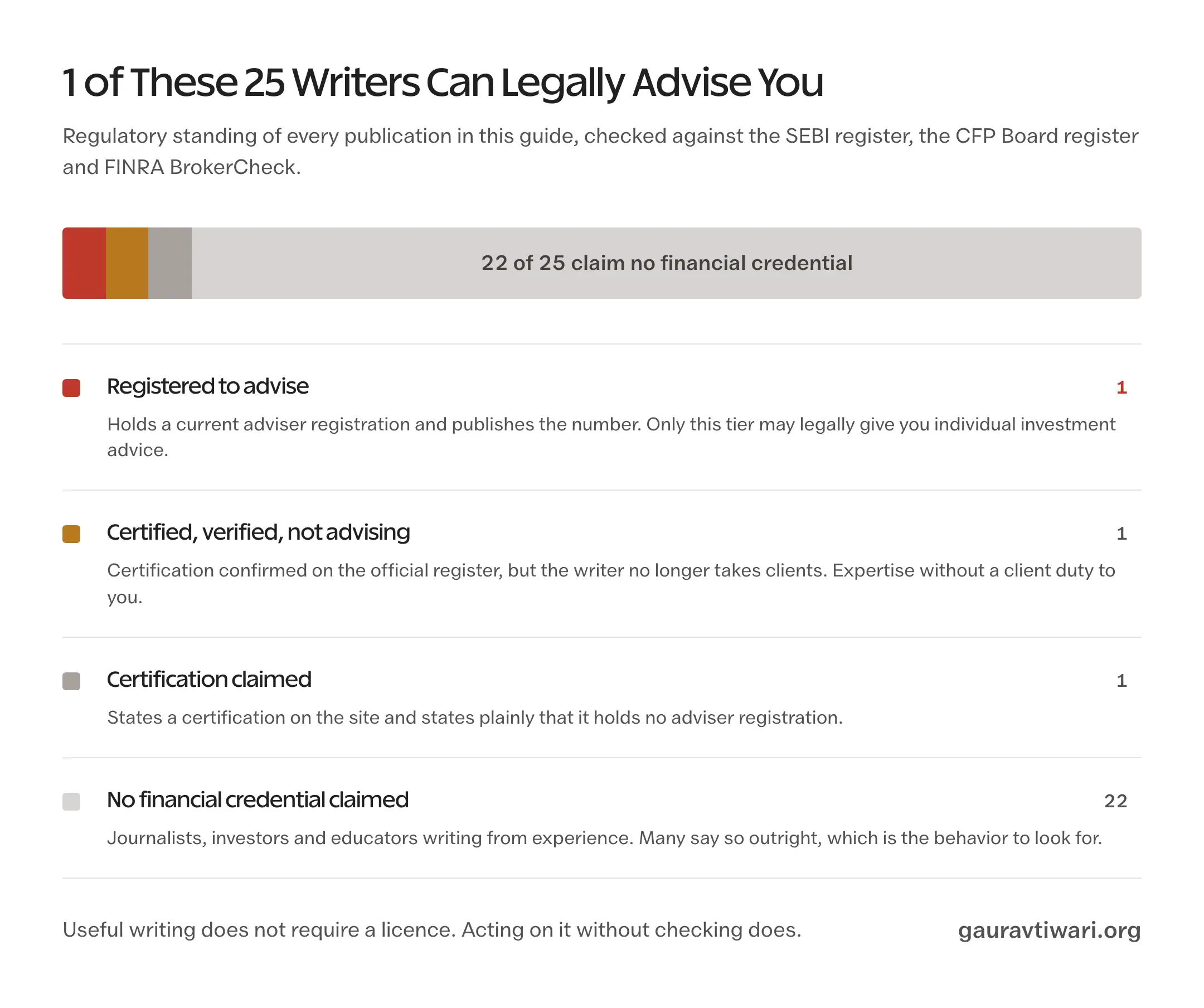
Only 2 of the 25 are run by someone holding a current financial licence. That is not a criticism, because plenty of the best writing here comes from journalists and ordinary investors showing their working. It does mean the difference between education and advice is worth keeping in view, and the last section explains how to check anything before you act on it.
Personal Finance Blogs at a Glance
Writer, country, business model and most recent published post for all 25, current as of late August 2026. Audience and income figures quoted anywhere in this guide are self-reported by the publications themselves.
| Publication | Country | Type | Best for | Latest post | Expertise | Earns from | Main limit |
|---|---|---|---|---|---|---|---|
| Freefincal | India | Research publication | Mutual funds and retirement | Aug 29, 2026 | IIT Madras professor | Courses, calculators | Technically dense |
| BasuNivesh | India | Adviser-run blog | Fee-only planning | Aug 10, 2026 | SEBI RIA, CFP | Fee-only planning | Posts a few times a month |
| ReLakhs | India | Founder-led blog | Tax, insurance, inheritance | Aug 24, 2026 | CFP, not SEBI registered | Display ads | Irregular cadence |
| MoneySavingExpert | UK | Editorial company | UK deals and consumer rights | Aug 28, 2026 | Newsroom of about 65 | Affiliate only | UK rules only |
| Monevator | UK | Investing blog | ISAs, platforms, UK portfolios | Aug 28, 2026 | None claimed | Ads, affiliate, membership | Pseudonymous writers |
| My Money Blog | US | Personal blog | Bank and brokerage offers | Aug 27, 2026 | Self-directed investor | Affiliate | Offers expire fast |
| Budgets Are Sexy | US | Personal blog | Money behavior | Aug 24, 2026 | None claimed | Ads, affiliate | No disclaimer |
| Best Wallet Hacks | US | Founder-led team | US banking and taxes | Aug 24, 2026 | None financial | Ads, affiliate | Rates move fast |
| Family Money Adventure | US | Founder-led blog | Family money and travel | Jul 12, 2026 | Finance writer | Affiliate, sponsorship | Publishes rarely |
| Addicted to ROI | US | Personal blog | Real estate investing | Jul 25, 2026 | Investor, not adviser | Membership, software | State-specific tax |
| Early Retirement Earl | US | Personal blog | Starting FIRE late | Jul 1, 2026 | None claimed | Affiliate | Self-reported results |
| Mr. Money Mustache | US | Personal blog | Spending philosophy | Apr 16, 2026 | None claimed | Limited affiliate | Aggressive frugality |
| Afford Anything | US | Podcast and courses | Tradeoff thinking | Podcast Aug 18, 2026 | Financial journalist | Course, sponsorship | Blog paused |
| Of Dollars and Data | US | Analysis blog | Evidence-led investing | Aug 25, 2026 | COO, Ritholtz | Books | US market data |
| A Wealth of Common Sense | US | Analysis blog | Investor behavior | Aug 28, 2026 | CFA | Books, podcast | Not for beginners |
| The Budgetnista | US | Education brand | Structured beginner learning | Jun 10, 2026 | Educator, not licensed | Courses, membership | Blog paused |
| The Penny Hoarder | US | Commercial publisher | Everyday saving ideas | Aug 28, 2026 | Staff writers | Affiliate, lead gen | Clearlink owned |
| DollarSprout | US | Commercial publisher | Side hustles | Dec 19, 2025 | 28 contributors, CPA CFO | Affiliate | Stopped publishing |
| The White Coat Investor | US | Commercial publisher | High earners and doctors | Aug 28, 2026 | MD, 19 columnists | Courses, referrals, ads | US doctors only |
| Good Financial Cents | US | Commercial publisher | Investing and insurance | Aug 18, 2026 | CFP, verified | Affiliate, courses | Affiliate rankings |
| Frugalwoods | US | Consulting business | Frugality archive | Dec 13, 2023 | Not licensed | Consulting | Blog dormant |
| The Fioneers | US | Coaching business | Slow FI | Oct 20, 2025 | None financial | Coaching, retreats | Blog dormant |
| Dear Debt | US | Archive | Debt and mental health | Podcast ended 2023 | Writer, not licensed | Affiliate | No longer updated |
| Champagne and Capital Gains | US | Archive | High earner anxiety | Jan 9, 2022 | Anonymous | None disclosed | 4 years stale |
| Brave Saver | US | Archive | Money psychology | Mar 4, 2021 | Finance writer | None disclosed | 5 years stale |
Personal Finance Blogs for India
Indian readers are badly served by most finance blog roundups, which list American sites and leave you to work out that none of it applies. These 3 are written for Indian rules, in rupees, and they occupy 3 genuinely different positions on the regulatory map.
That distinction matters more than any writing-quality judgment. BasuNivesh is registered with SEBI and may advise individuals. Freefincal refuses to advise anyone and publishes analysis instead. ReLakhs states outright that it holds no SEBI registration and tells readers to consult a registered adviser. All 3 declare their position clearly, which is the behavior to look for.
Freefincal

Dr. M. Pattabiraman is an associate professor of physics at IIT Madras, and Freefincal reads like it: hypotheses, data, and conclusions that sometimes contradict what the mutual fund industry would prefer. He has published since May 2012, now daily, on Indian mutual funds, the NPS, EPF, retirement math and portfolio construction.
The line that matters most is his own: “We do not offer any individual investment advice.” He publishes analysis and calculators and then routes anyone wanting advice to a list of fee-only planners. SEBI’s Investor Protection and Education Fund advisory committee recommended 9 of his calculators for the regulator’s own investor education site, which is about as close to independent validation as an Indian personal finance publisher gets.
Self-reported reach is 6.34 million article views in 2025. The limitation is density: the writing assumes you will follow a spreadsheet, and a complete beginner may need something gentler first.
BasuNivesh

BasavaRaj Tonagatti is the only writer in this guide who is legally permitted to give individual investment advice in India, and he publishes the registration to prove it. His site carries a dedicated disclosures page listing SEBI Registered Investment Adviser number INA000019053, BASL membership 2154, and his role as principal officer of BasuNivesh Fee Only Financial Planners.
He is fee-only, and says so plainly: no commissions, no product sales, no distribution income. He is also a CFP. The route there is worth knowing, because it explains the tone: he started as a car mechanic in Mumbai, moved through a BPO and insurance sales from 2008, then rebuilt as a fee-only adviser. He has written since 2011, now a few times a month, on EPF and EPS rules, index funds and Indian retirement planning.
One practical warning he publishes himself: impostors use his brand and logo to pitch fake tips and guaranteed returns. Use the official domain only. Registration guarantees process, not returns.
ReLakhs

Sreekanth Reddy writes the clearest Indian explainers on the topics families actually get wrong: who inherits what when there is a nominee but no will, how Sovereign Gold Bonds are taxed, what an insurance policy really covers. He has run a financial counseling and property consultancy practice since 2009.
Be precise about his standing, because he is. His own disclaimer states that he is not a SEBI registered investment adviser. He holds the CFP certification and says he sells no financial products, and the site runs on display advertising rather than commissions. That combination, opinionated writing plus no product to push, is rarer in Indian personal finance than it should be.
Publishing is irregular, roughly every week or two. The disclaimer lives on its own page rather than under each article, so treat every tax and insurance detail as something to check against current official rules before acting.
UK Personal Finance
The UK is the worst-served major market in roundups like this one, usually represented by a single entry or by American sites with a token currency note. These 2 cover the split that actually matters: one does consumer money, meaning deals, rates, bills and rights, and the other does long-run investing inside British accounts.
MoneySavingExpert

MoneySavingExpert is not a blog and has not been one for years. It is a UK consumer journalism operation with a newsroom of roughly 65 staff, roughly two-thirds of them editorial, publishing daily on energy price caps, savings rates, benefits, banking and consumer rights.
Martin Lewis founded it and remains executive chair, though he stopped being editor in 2015 and now fronts the weekly email rather than running the desk. MoneySupermarket, now MONY Group plc, bought the site in 2012 for up to £87 million, and the sale came with a legally binding editorial code that bars display advertising and subscriptions entirely. Income is affiliate only, and where an affiliate link appears the site commits to showing an unpaid link to the same product wherever practicable.
The limitation is jurisdictional and total. Energy caps, ISAs, council tax bands and Premium Bonds have no equivalent outside the UK, so almost none of the actionable content transfers.
Monevator

Monevator has been publishing UK investing writing for close to 20 years, on a fixed rhythm of Tuesday, Thursday and Saturday, and the Saturday post is a links roundup that has run for years. Recent subjects give the flavour: how cash-like assets behave inside a stocks and shares ISA, FX hedging options for retail investors, what the tightening buy-to-let rules do to a landlord’s arithmetic. This is British content written for British accounts, not American content with the currency swapped.
The writers are pseudonymous. The founder writes as The Investor, his long-time co-writer as The Accumulator, and regulars publish as The Engineer, Finumus and Frugalist. No real names appear anywhere on the site, which has been the policy from the start rather than an oversight, and it means you cannot check a credential even if you want to.
They tell you that themselves, which is why the site still earns a place here. The standing line is that they are not authorised to give personal financial advice, repeated across the site and inside the membership pages, alongside a plain statement that capital is at risk. Income comes from display advertising, affiliate commission and membership at £3 or £8 a month, all disclosed on the about page.
US Personal Finance Blogs
These 6 are written by identifiable people about their own financial decisions, which is the original form of the genre and still the most useful when the writer is honest about what they do not know.
My Money Blog

Jonathan Ping has published since 2004, which makes this 22 years of continuous personal finance writing, and it is still several posts a week. He covers bank and brokerage bonuses, savings and Treasury rates, credit cards and self-directed investing, with a monthly interest-rate roundup that is genuinely useful if you park cash in the US.
He claims no credentials and states the boundary in 1 line: “I am not your financial advisor.” The writing is a retail investor showing his own reasoning, which is the honest version of what most finance blogs pretend to be.
The catch is shelf life. A large share of posts are time-sensitive US bank bonuses and promotional rates that expire, and he earns affiliate commissions on many of them. Check the date on anything before acting, and confirm terms with the bank.
Budgets Are Sexy

J. Money has written about money since 2008 in a voice nobody else in the category has managed to copy: informal, funny, and unembarrassed about the parts that went badly. He sold the site to The Motley Fool in 2019, bought it back in May 2022, and writes every current post himself.
Cadence is now light, 1 to 3 posts a month. The famous net worth series is history rather than a live feature: it ran monthly from about $58,700 in January 2008 to $1,131,601 in August 2019 and then stopped. Reading that arc end to end is still the best argument on the internet for tracking a number over a decade.
It carries no financial-advice disclaimer and no disclosure page, and the writing is behavioral rather than technical. Come for motivation and honesty about money habits, not for tax or investment specifics.
Best Wallet Hacks

Jim Wang founded Wallet Hacks and still writes most of it, now with a small named masthead including a blog manager, a managing editor and several regular contributors. Output runs 2 to 4 posts a month on US banking, brokerage bonuses, insurance and taxes, and the newsletter reports over 25,000 subscribers.
It contains the single best sentence any site in this guide has written about itself: “Your finances are too important to leave to internet articles written by unknown people. Instead, follow a variety of bloggers, bounce new ideas off a trusted source, and verify your decisions with a fee-only financial planner when you can.” A site that actively limits its own authority is a site worth more trust, not less.
Nobody on the masthead holds a financial license, and the model is advertiser and affiliate supported. Rates and card terms move fast, so verify at the source.
Family Money Adventure

Kevin and Barb Payne write about money in the context it actually gets spent in: a family with kids, a Disney trip to budget for, and an adoption to fund. Kevin is a freelance personal finance writer with bylines at Bankrate, Credible and Fox Money, and the site mixes credit-card and savings reviews with family travel and personal essays.
Recent output is thin, 2 posts since March 2026, both product reviews. The advertising disclosure is prominent and properly worded, naming the affiliate networks and stating that compensation may affect where links appear.
No financial license is claimed, and no not-financial-advice disclaimer appears, only advertising and editorial disclosures. Treat the credit-card content as what it is, an affiliate comparison written by a family that uses the cards.
Addicted to ROI

Jennifer Beadles bought her first property in 2007, her first rental in 2008, and has written since 2016 about US real estate investing in specifics: cost segregation, the short-term rental rules, real estate professional status, renovating a rental you have never physically seen. Her newsletter reports over 26,000 investors.
Her disclaimer is the most direct in this guide, and worth quoting in full: “No. I am an investor who writes. Nothing here is advice, it is just what worked, and what did not, for me. Talk to a CPA and an attorney before you act on anything I describe.” Every page footer repeats the shorter version: education and community, not financial or tax advice.
Two things to hold in view. The site says the only thing she sells is what she writes, while also running a paid membership and several software products. And US real estate tax strategy is unusually state-dependent, so the CPA line is not a formality.
Early Retirement Earl

Earl Owens is 52, spent 32 years in corporate retail, and left the six-figure job around 2024 to work part-time on his own terms. He writes for people who started late, which is most people, and publishes his own numbers including a live options trade log.
He is careful in the right places. Three separate disclaimers name the credentials he lacks: not a CFP, not a CPA, not a licensed adviser. His headline figures are self-reported and unaudited, and worth reading with that in mind, including roughly $78,000 in options premiums in a year using a wheel strategy. His stated $2 million net worth also sits above what his own published table adds up to.
Options income is the part to treat most carefully. A strategy that produced premiums during one market period is not a strategy that reproduces for a different person in a different market.
Financial Independence and Early Retirement
Mr. Money Mustache

Pete Adeney retired at 30 in 2005 and has spent since 2011 arguing, in roughly 540 posts, that most middle-class spending is a choice rather than a necessity. Calling it an index-fund blog undersells it badly. The archive covers bikes and car-free living, housing and DIY renovation, grocery costs, consumer psychology, tariffs and macroeconomics, and he has described it as secretly an environmental blog.
The most recent post is April 16, 2026, on the math behind Social Security, and the cadence now runs 4 to 6 posts a year. The forum remains busy. He famously walked away from around $4,000 a month in credit-card referral income to protect the site’s independence, and monetization is now limited to selective affiliate links and a single AdSense unit in the footer.
Two honest limits. His disclaimer page covers privacy and affiliates but contains no financial-advice caveat at all. And the frugality is genuinely aggressive; plenty of households cannot compress spending the way the writing assumes.
Afford Anything

Paula Pant built a large audience on 1 idea, that you can afford anything but not everything, and the tradeoff framing holds up better than most personal finance slogans. She is a financial journalist and a Knight-Bagehot fellow at Columbia, and the site reports over 70,000 subscribers.
Read it as a podcast now rather than a blog. The show publishes 2 or 3 episodes a week and passed episode 742 in August 2026, while the blog has not carried a new post since December 2025. The business is a twice-yearly real estate course plus a community and podcast sponsorships.
Two cautions. No not-financial-advice disclaimer appears anywhere on the site, which is unusual for a publication this size. And the homepage still advertises enrollment for a cohort that has already passed, so treat course dates as something to confirm directly.
Data-Led Investing Writing
Both of these are written by people who work inside an asset management firm and publish under standing disclosures saying so. Read them for how to think about market history and your own behavior, not for what to buy.
Of Dollars and Data

Nick Maggiulli publishes every Monday without fail, and the method is always the same: take a claim people repeat about money, run the actual numbers, and report what comes out even when it contradicts him. A recent post is titled “Why I Was Wrong to Be Bearish on U.S. Stocks,” which tells you most of what you need to know about the editorial standard.
He is chief operating officer at Ritholtz Wealth Management and the author of Just Keep Buying and The Wealth Ladder. The blog is free, carries no display advertising, and his disclaimer states plainly that the content is not professional advice and reflects his own opinions rather than his employer’s.
It is US market data throughout, in dollars, against US accounts and US tax treatment. The reasoning travels; the specific numbers do not.
A Wealth of Common Sense

Ben Carlson has written since 2013 at close to daily cadence, plus the Animal Spirits podcast with Michael Batnick. The subject is investor behavior more than investment selection: why people sell at the wrong time, what market history actually shows, how to think about housing and inflation without panicking.
He is a CFA charterholder and director of institutional asset management at Ritholtz Wealth Management, and has written several books including Don’t Fall For It, a history of financial scams that doubles as useful self-defense reading. Standing disclosures state the content is personal opinion and not the firm’s official view.
US-centric, and not a beginner’s budgeting resource. If you have no emergency fund yet, start elsewhere and come here when you have money invested and nerves to manage.
Money Education and Behavior
The Budgetnista

Tiffany Aliche taught preschool in Newark for a decade before building the most structured financial education platform aimed at women in the US. Her book Get Good with Money was a New York Times bestseller, and the free Get Good With Money Challenge reports over 2 million participants.
The credential that matters here is not a license, and she says so: “Tiffany ‘The Budgetnista’ Aliche is not a lawyer, accountant, credit analyst or investment broker.” Stating the boundary that plainly is a trust signal, not a weakness. Her real authority is legislative: New Jersey bill A1414, signed in January 2019 and widely called the Budgetnista Law, made financial literacy education mandatory for the state’s middle schoolers.
Treat it as an education brand rather than a blog. Posts ran weekly through June 10, 2026 and have paused since, and the platform is heavily commercial, with paid memberships, courses and an adviser-matching service.
Large Commercial Finance Publications
These 4 are companies rather than personal blogs, and every one of them earns from the products it writes about. They publish at a volume no individual can match, and their rankings sit closer to the commercial engine than the prose does. Both facts are worth holding at once.
The differences between them are in ownership and disclosure, not in scale. Two are founder-owned and two answer to a parent, and the quality of the disclosure varies more than the quality of the writing does.
The Penny Hoarder

The Penny Hoarder publishes several staff-written posts a day on earning, saving, Social Security, credit and everyday cost-cutting, and the library is genuinely large and practical. It reports 12 to 17 million monthly readers and 1.2 million email subscribers, both company figures.
Ownership is the thing to know before you read it as independent advice. It was acquired in 2020 by SYKES through its digital marketing subsidiary Clearlink, and describes itself today as a Clearlink company. Clearlink is a performance marketing business, which makes affiliate and lead generation the parent company’s core competence rather than a sideline.
It surfaces the weakest reader-facing disclaimer of anything in this guide, with no plain-language not-financial-advice statement on the homepage or about page. Useful for ideas, not for product selection without independent checking.
DollarSprout

DollarSprout covers side hustles, online business, passive income and money-making apps across a team of 28 named contributors, with a CPA as chief financial officer. It was founded in 2015 by Jeff Proctor and Ben Huber and is owned by VTX Capital, LLC in Virginia.
The disclaimer is explicit that nothing here substitutes for professional financial advice, and it tells readers to seek that advice before acting. Its earning content is the strongest part; the app and product recommendations are affiliate-driven and should be evaluated one at a time.
Publishing has stalled, with nothing new since December 2025. The evergreen pages remain, but this is an archive being maintained rather than a live publication.
The White Coat Investor

Jim Dahle is a practicing emergency physician who started writing in 2011 because doctors finish training with a large income, a larger debt, and no financial education at all. The site publishes something new most days and holds more than 2,500 posts on the problems that pattern creates: the backdoor Roth, physician mortgages, disability cover, refinancing six figures of student loans, and how to read a first employment contract.
It is much larger than a personal blog now. A roster of 19 named columnists, most of them physicians, publishes alongside 8 named freelance finance writers, and guest posts carry a byline and a bio. The business around it sells books, CME-accredited courses, an annual conference and an insurance brokerage, and runs a paid referral network across mortgages, student loans, advisers and contract review.
That volume of commercial relationship would normally be the warning. Here it is the reason to trust the page, because the disclosure runs at the level of the individual article. A recent piece on holding bitcoin opens with the author declaring he co-founded the company whose services the article discusses, and an editor’s note naming that same company as a scholarship sponsor at a stated dollar tier. Almost nobody in this category discloses that specifically.
The limits are worth stating. Dahle’s credentials are medical rather than financial, so nothing here carries an adviser registration, and every account, tax break and loan programme discussed is American. If you are not a high earner inside the US tax system, most of the arithmetic will not transfer.
Good Financial Cents

Jeff Rose is the most independently verifiable expert in this guide. He is a CFP whose certification is current and in good standing on the CFP Board register, with no discipline or bankruptcy disclosures, and his CRD number 4572469 matches records at FINRA and the SEC. He founded an RIA in 2011 and sold it in 2019, so he is a publisher who holds the certification rather than a working adviser.
The site publishes current guides on investing, banking and insurance, backed by a stated money expert review board, and updates its comparison pages frequently. It is affiliate-supported and states so.
Two caveats. The review board is named but its members are not listed, and the standing disclaimer still references the advisory firm he sold in 2019. Product rankings on any affiliate-funded site deserve a second opinion.
Blogs That Became Businesses
Each of these built an audience through writing and then turned it into a paid service. The archives are still valuable, and the current offer deserves the same scrutiny as any other financial product.
Frugalwoods

Elizabeth Willard Thames wrote one of the defining frugality and homesteading archives of the 2010s, and the reader case study series, where households published their real numbers for public critique, is still worth reading end to end. The final case study ran on September 29, 2023 and the last post in December 2023.
The site today is a consulting storefront. The homepage sells personalized financial advice and customized plans at $1,500 to $5,500, while the FAQ states that she is not a licensed financial advisor, certified public accountant or investment adviser, and her background is a non-profit career rather than finance. She frames the work as education that helps people manage their own money, and excludes investing, crypto and real estate from scope.
The consulting page has also said it is closed to new clients since May 2024, so the homepage is selling something the service page says is unavailable. Read the archive, and treat the paid offer with the same scrutiny you would give any unlicensed financial service.
The Fioneers

Jess and Corey argue for what they call Slow FI, spending some of the financial freedom you accumulate along the way rather than deferring every good thing until a retirement date. By their own account they coined the term in 2019, and the framing has genuinely changed how a chunk of the FI community talks.
The most useful thing about them is a sentence most FI writers would never publish: they have not reached financial independence yet, and say so on the about page. That honesty is the reason to read them.
The blog has been quiet since October 2025 and the business is now coaching, courses and residential retreats at $1,650 to $2,050 a person. The footer discloses affiliate and advertising relationships but not the more relevant conflict, which is that the same audience reading the advice is the audience buying the programs.
Classic Archives Worth Reading
These 3 stopped publishing. Nothing here is current enough to act on, and the writing about how money actually feels has not been bettered since.
Dear Debt

Melanie Lockert paid off $81,000 in student loans and wrote Dear Debt, a book built from letters people wrote to their own debt. The blog began in 2013 and the archive remains the best writing anywhere on the emotional weight of owing money, as opposed to the arithmetic of it.
She later hosted the Mental Health and Wealth Show, which ran from 2020 to 2023 and covered the overlap between money stress, anxiety and depression with unusual care. Those episodes are an archive now, and her current work is freelance writing, speaking and coaching, with bylines at Business Insider and Student Loan Planner.
If debt is affecting your mental health, this writing helps, and it is not treatment. Speak to a doctor or a crisis line as well; in India, Tele-MANAS is free on 14416, and elsewhere your local emergency number applies.
Champagne and Capital Gains

An anonymous American attorney wrote this between roughly 2018 and 2022 about the specific tension of earning well and still feeling behind: high income, high expectations, expensive city, and a nagging sense that the lifestyle was outrunning the plan. The monthly goal posts are an honest record of that.
The final post, in January 2022, is titled “Permanent Writer’s Block and the Pandemic,” which is its own kind of ending. Nothing has appeared since.
Read it as a period piece rather than a current source. The author is anonymous, so no credential can be checked, there is no disclaimer, and the student loan and tax details are 4 years stale.
Brave Saver

Elyssa Kirkham wrote Brave Saver for people the mainstream advice tends to shame, under the tagline “personal finance for fearless (but not flawless) people.” Her best work connects money to the things that actually drive it: internalized sexism and women’s finances, budgeting avoidance, the shame that conventional advice reliably produces.
The last post ran on March 4, 2021. The site is still online and unaltered, with no ads, affiliates or disclosures of any kind, which in this category is close to remarkable.
It is a psychology archive, not a current guide. The student loan and pandemic-era material has been overtaken, but the writing about why people avoid their own numbers has not aged at all.
How to Check Financial Advice Before Acting on It
The reason this guide labels every entry with a country, an owner and a money model is that those 3 facts determine how much weight a piece of financial writing can carry. 5 checks cover most of the risk.
- Check the jurisdiction first. If an article names a specific account, tax break or product, ask which country’s rules it assumes. Most personal finance writing online is American.
- Find the person, then the registration. A named author with a verifiable number beats an anonymous house byline. Indian advisers appear on the SEBI register, US planners on the CFP Board register, and US advisers under a CRD number at FINRA BrokerCheck.
- Read how the site earns. Affiliate income is not disqualifying, and undisclosed affiliate income is. Look for whether the disclosure explains that compensation can affect placement.
- Date every volatile number. Interest rates, sign-up bonuses, card terms and tax thresholds move constantly. Verify them at the provider, not in the article.
- Separate what happened to them from what should happen to you. A published result is one person’s outcome in one market with one tax position and one risk tolerance.
Anything promising a specific income within a specific window deserves the most scepticism, whatever the source. So does any return figure presented as a reliable expectation rather than a historical range.
Nothing in this guide is financial advice, and none of these publications knows your income, obligations or risk tolerance. Use them to understand your options and to ask better questions, then take a decision that involves real money to someone qualified and regulated in your own country.
FAQs on Personal Finance Blogs
Which personal finance blog is best for India?
Freefincal for research-led analysis of mutual funds and retirement, and BasuNivesh if you want a writer who is also a SEBI registered investment adviser. ReLakhs is the clearest on tax, insurance and inheritance questions.
Can I follow a US finance blog if I live in India?
Use it for concepts, not instructions. Compounding, asset allocation and behavior travel across borders, while 401(k) rules, IRAs, credit scoring and deposit insurance do not. Anything naming a specific account type, tax break or product is written for another country’s rules.
How do I check whether a finance writer is qualified?
Look for a named person, a stated credential and a registration number you can verify with the regulator. In India, check a SEBI adviser number on the SEBI register; in the US, check a CFP on the CFP Board register and an adviser CRD on FINRA BrokerCheck.
Is a finance blog a substitute for a financial adviser?
No. A blog publishes general information for everyone; an adviser gives a recommendation based on your income, obligations, risk tolerance and goals, and carries a duty for it. Most of the writers here state that distinction themselves.
Are affiliate-supported finance blogs trustworthy?
They can be, provided the disclosure is visible and the ranking logic is explained. The signal to watch is not whether a site earns commission but whether it will still tell you when a product is wrong for you.
How current does banking and investment information need to be?
Interest rates, account bonuses and card terms can change within weeks, so verify those against the provider before acting. Tax and regulatory articles need checking against the current year’s official rules.
What is the difference between financial education and financial advice?
Education explains how something works and leaves the decision to you. Advice tells you what to do given your specific circumstances, and in most countries requires registration.
Which blogs are best for financial independence?
Mr. Money Mustache for the spending philosophy, Afford Anything for tradeoff thinking, and The Fioneers for a slower version that does not defer everything to a retirement date.
Are any of these blogs written by licensed professionals?
Very few. BasuNivesh is a SEBI registered investment adviser and Jeff Rose of Good Financial Cents holds a current CFP certification. Most of the others are journalists or experienced individuals who state plainly that they are not licensed.
Final Remarks
The writing that holds up in this category has 1 quality in common, and it is not expertise. It is a willingness to name the limits of what the writer knows. The best entries here say plainly that they are not licensed, that a result was theirs alone, or that you should check with someone qualified before acting.
Treat that as your filter. A blog that tells you what it cannot do has told you something true about everything else on the page.
Start with the section matching where you live. Then, before any money moves, run the 5 checks above, and read how to teach yourself personal finance if you want a structured way to build the underlying knowledge first.
Tell Google you want more of this.
Add Gaurav Tiwari as a preferred sourceOne tap, and this site shows up more often in your own Top Stories, AI Overviews and AI Mode. Remove it any time.