by
by
Conversational writing is the craft of writing the way you talk: short sentences, contractions, direct address, and a real human voice instead of stiff corporate prose. After publishing 2,000+ articles and rewriting hundreds of client pages, my verdict is simple. If you want people to actually finish what you wrote, and you want AI engines to quote you, write conversationally. The formal, throat-clearing style loses on every metric that matters in 2026.
That’s not a stylistic preference, it’s where reading behavior and search both moved. When I rewrote a 9th-grade-level page down to a 6th-grade conversational tone, time on page climbed and bounce dropped, the same pattern Nielsen Norman Group measured across its 2026 testing. Below, I’ll show you what conversational writing is, the attributes that make it work, where it backfires, and the exact techniques I use to write conversationally without sounding sloppy.
The evidence standard: a lower reading grade or warmer tone is not automatically better. Compare two versions with the same readers and task, then record comprehension, completion, errors, and confidence. Keep the conversational edit only when it improves understanding without weakening accuracy.
The search reality: clear answers, descriptive headings, named entities, and explicit limitations make a passage easier for people and machines to interpret. That does not make conversational tone a documented ranking factor, and no universal word count guarantees a citation. Write for understanding first.
To quote Illan Gonen, lecturer in Modern Hebrew language at Columbia University: “The internet has broken the old barrier between written and spoken language, giving birth to a third option: conversational writing.”.

Concern over grammatical correctness in the written language can push us away from human dialogue, where engagement prevails and little attention is paid to the construction of phrases or the use of verbs, pronouns and words.
That’s one reason why so many consider the Internet to be a cold and robotic place – and most of the time, they’re not wrong. But as Gonen notes, that may all be about to change.
Table of Contents
The new dynamic of conversational writing
Gonen is not advocating for the abandonment of linguistic norms, but rather suggesting that we meet them halfway with more colloquial expressions. After all, the writing behind User Experience (UX) is drafted by humans and should imply a one-to-one dialogue, as if there were a real person behind every device screen.
This “real person”, usually an Artificially Intelligent robot, should behave as if it has already interacted with the real world and anticipate which options the user may choose as if it were a real employee with past experience in the area.
Creating more natural and realistic tools, such as a flowchart creator, lets us build the flow of the dialogue, accounting for all possible destinations. Let’s look at this conversation with a chatbot below:
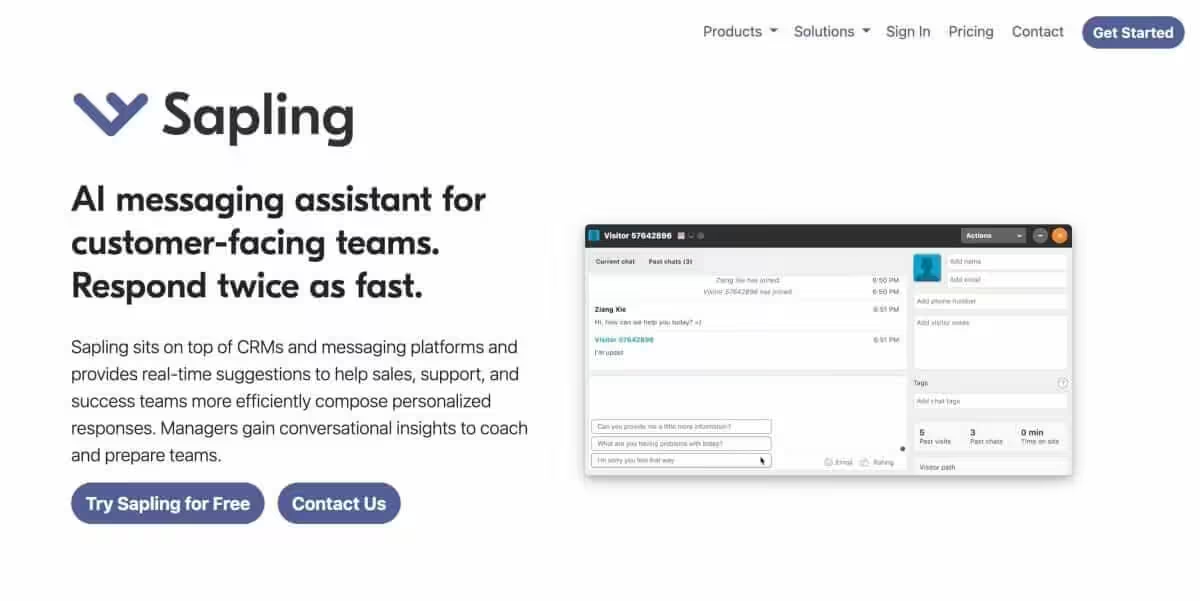
Conversational interfaces have reduced the user experience to lines of text. With bots, UX becomes conversational, products speak, and characters now flow both ways. Every bot has a voice, which means that every bot needs a personality.
Jess Thoms
You don’t need to be playful if this behavior doesn’t match your brand’s identity. But humanized dialogue is important, no matter how simplistic. Every company and designer has their own methodology or form for creating these conversational experiences.
It’s hard to tell whether this is an AI or a real person chatting with the customer, right?
Conversational writing attributes
The words written on an interface are the instruments of our conversation. The more human they appear, the better the user experience and the understanding between the two dialogue participants.
According to Paul Pangaro, professor of the Practice at the Human-Computer Interaction Institute:
… an interface is a technology that connects participants (human or machine). Conversation is a series of exchanges through which we understand each other, and that builds an evolving relationship (living together). Since we need conversation in order to collaborate on intentions and actions, the quality and history of those exchanges matter (a lot).
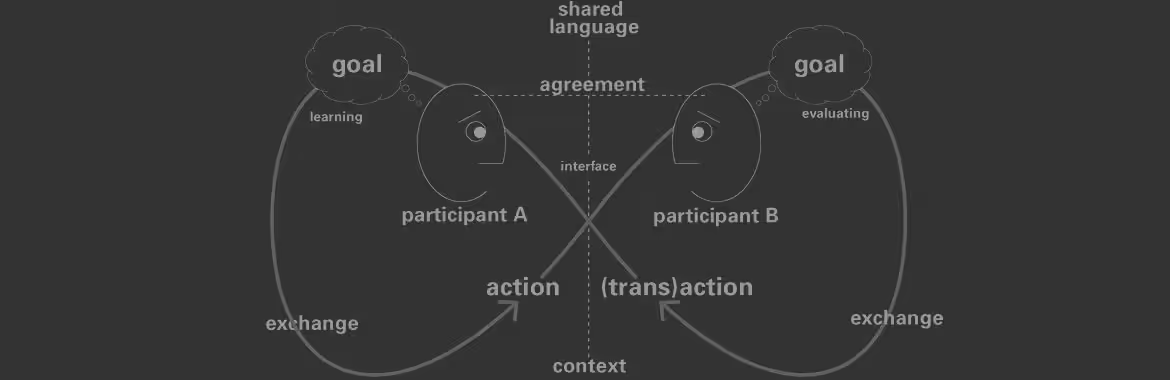
Below, you will find some tips to build a human dialogue with your users throughout your digital products, services, chatbots and communications in general.
Objectivity
Being human doesn’t mean being wordy – your texts should only say enough to convey all the necessary information. They should be objective and clear, and use simple language, with no unnecessary adjectives.
Remember that a conversation is a punctual exchange of information between people, or between people and machines, to achieve a common goal. “A product succeeds because it solves a problem for people. This sounds very basic, but it is the single most important thing to understand about building good products”, to quote writer and former product designer Julie Zhuo. And the same is true for UX.
Clarity
Don’t make your user think. Use simple language and words that everyone can understand, regardless of region, social class and education. Try to figure out the natural language of users in the digital environment.
A text with a high rate of terms which are unfamiliar to the reader makes it impossible for them to interpret its meaning.
Persuasion
Conversational writing should provoke interest in the user, leading them to the desired action (i.e., clicking on a link, downloading a document, commenting and sharing, etc.).
Persuasive design seeks to document and utilize our cognitive biases and similar insights from psychology into persuasive patterns so that they can be more easily applied to product design. By documenting recurring solutions, based on psychology, that have solved common design problems, persuasive patterns are standard reference points for the experienced product designer.
Anders Toxboe
Consistency
Voice usage and standardization are important in UX. Company names must be written in a standard way, as should area names, calls to action, instructions, capitalization, etc. And don’t forget that “voice” and “tone” are not the same thing.
Voice reflects the brand’s core identity. Tone, on the other hand, should reflect the context and situation in question: is it neutral, happy or sad?
“Yay, your payment has been approved”… or “something went wrong”? You can’t communicate both pieces of information in the same way, because they will not be perceived in the same way by the user. So consistency is all about displaying different aspects of your brand’s identity according to the context – like a trustworthy friend.
Formal vs conversational: the same idea, rewritten
The fastest way to learn conversational writing is to watch a formal line get rewritten. Same meaning, very different reading experience. Here are the moves I make most often, drawn straight from my own editing passes. If you want a faster workflow for producing copy like this, I broke it down in my guide on how to write blog posts faster.
| Technique | Formal version | Conversational rewrite |
|---|---|---|
| Contractions | It is not necessary to do this. | You don’t have to. |
| Direct address | Users should configure the settings. | Set this up before you start. |
| Active voice | The form is submitted by the customer. | The customer submits the form. |
| Short sentences | In the event that an error occurs, the system will, after a delay, retry. | If it fails, the system retries. |
| Plain words | Utilize this functionality to facilitate onboarding. | Use this to get started. |
| Questions | The benefits are outlined as follows. | So what do you actually get? |
None of this lowers the quality of your ideas. It lowers the friction between your idea and the reader’s brain. That friction is exactly what readability scores measure, and it’s why a conversational writing style tends to outperform formal copy on engagement. If you’re building copy that also has to rank, pair these moves with the structure I cover in how to create high-quality content that ranks in SEO.
Other crucial attributes
- Natural, polite and grammatically correct writing.
- Ask questions, without overdoing it.
- Use the active voice instead of the passive voice.
- Use connecting words whenever possible.
- Speak directly to users.
- Use prepositions, articles and connecting words to sound more natural:
Conversational flowchart
Conversational writing involves an exchange between two or more people, and it takes place via some key elements:
It doesn’t matter whether we’re communicating face-to-face, in a store, or through a screen on an e-commerce platform. Every interaction should be perceived in human terms, and that is only possible through dialogue.
Where conversational writing is the wrong choice
Conversational writing wins for blog posts, product UX, marketing copy, and most explainer content. It is the wrong default for a handful of contexts where precision and authority outrank warmth. Knowing where to stop is part of writing conversationally well.
- Legal and contract language. Terms of service, privacy policies, and contracts need exact, unambiguous wording. A casual rephrase can change legal meaning. Keep it formal and let a lawyer review it.
- Technical specifications and standards. API references, safety documentation, medical dosing, and engineering specs reward precision over personality. Ambiguity here causes real damage.
- Academic and scientific writing. Journals and formal research expect a measured, impersonal register. Conversational tone reads as unserious in that setting.
- High-stakes regulated communication. Financial disclosures, compliance notices, and official government text are held to a precise standard where a friendly tone can read as evasive.
Even inside these, you can still cut jargon and shorten sentences. You just keep the register formal. The skill is matching tone to context, which is the same judgment I apply when planning a full editorial calendar in my content marketing strategies guide.
Measure Understanding, Not “Conversational” Style
Conversational writing works when the intended reader can understand and act without decoding the writer. A friendly tone is not the goal by itself. The U.S. government’s plain language guidance defines clear content around a specific audience and recommends testing whether that audience understands it.
Readability scores can help compare two drafts, but they do not measure truth, expertise, persuasion, or accessibility. Flesch Reading Ease uses sentence length and syllables per word. A writer can game the score with short, vague sentences and still confuse the reader.
| Check | How to measure it | What a weak result tells you |
|---|---|---|
| First-pass comprehension | Ask five target readers to explain the main point without looking back | The opening or key terms are unclear |
| Task success | Give readers the real task and record completion, errors, and help requests | The content sounds friendly but does not support action |
| Retrieval | Ask readers to locate one price, limitation, step, or decision rule | Headings and information hierarchy are weak |
| Readability delta | Compare the same passage before and after editing with the same tool | Sentences may be too long or vocabulary unnecessarily complex |
| Accuracy | Have a subject expert check claims, definitions, conditions, and examples | Simplification removed something the reader needs |
A Reproducible Edit Test
- Freeze the source: keep the facts, offer, and page design unchanged.
- Edit one passage: lead with the answer, replace abstract nouns with verbs, define unavoidable terms, and remove sentences that repeat the point.
- Test both versions: randomly give each version to similar readers and ask the same comprehension and task questions.
- Record the result: completion, errors, time, confidence, and the words readers misunderstood.
- Keep the stronger version: conversational tone wins only when understanding or action improves without losing accuracy.
For a small qualitative check, five readers per version will not establish a population-wide percentage. It can still expose repeated confusion. If four people stumble on the same term, fix the term before buying more traffic.
My standard: write as if you are explaining the problem to one capable person who is busy, not ignorant. Keep the technical detail that changes the decision. Remove the performance of expertise.
How I write conversationally without sounding sloppy
The fear with conversational writing is that it slides into careless. It doesn’t have to. Here’s the routine I run on every draft to keep it warm and tight at the same time.
- Read it out loud. If a sentence is hard to say in one breath, I cut it.
- Replace every formal connector (“furthermore,” “in order to,” “utilize”) with the plain spoken version.
- Add contractions everywhere they’d appear in speech, then check that none change the meaning.
- Open at least one section with a real question the reader is already asking. AI engines extract those answers cleanly.
- Run a readability check and aim for a 6th to 8th-grade reading level for most marketing content.
That’s the whole system. Conversational writing isn’t dumbing down your work, it’s removing the distance between you and the person reading it. Do it consistently and you give readers a better chance of understanding the point and acting on it. Search and AI systems may also find clear, self-contained statements easier to interpret, but that is not a guaranteed ranking or citation outcome. If you want to produce this kind of content at scale without burning out, my workflow for how to create content efficiently for marketing success walks through the full pipeline I use.
Tell Google you want more of this.
Add Gaurav Tiwari as a preferred sourceOne tap, and this site shows up more often in your own Top Stories, AI Overviews and AI Mode. Remove it any time.