
SEO for Lawyers: A Practical Guide to Ranking Higher in Search Results
 by
by
SEO for lawyers is the work of making a firm verifiable for a specific legal problem in a specific location. Accurate office data, useful practice-area pages, named lawyer credentials, compliant reviews, and a working intake path matter more than a traffic chart. A ranking is useful only when it produces a qualified consultation and, eventually, a suitable signed matter.
I would manage legal SEO as an intake system with three linked measures: search visibility, inquiry quality, and signed-case economics. Legal information can affect rights, deadlines, safety, and money, while professional-conduct and confidentiality rules constrain the marketing. This guide keeps those limits inside the strategy instead of treating compliance as a final copy edit.

Table of Contents
The Verdict on SEO for Lawyers
Here is the short version. For most firms, SEO for lawyers is a local visibility job first and a content job second. Build an accurate Google Business Profile, create one useful page for each practice area, show who is responsible for the legal content, and make it easy for a prospective client to verify the firm. That sequence serves both the person making a high-stakes decision and the search systems trying to identify a trustworthy local result.
This plan fits solo and small firms that want durable local discovery and can measure intake by source. There is no honest universal ranking timeline. A new office or practice area that needs qualified inquiries immediately should test Local Service Ads first, while the local and practice-page foundation is being built.
How SEO for Lawyers Actually Works in 2026
SEO for lawyers still starts with a simple question: can Google and a prospective client verify that this firm is a relevant, legitimate choice for this legal problem in this location? The search page may include ads, a map, an AI-generated summary, directories, and ordinary results. A firm therefore needs consistent entity information and useful pages, not a trick for one result type.
Google explicitly says its systems are designed to prioritize helpful, reliable, people-first content and asks whether a page provides original analysis, clear authorship, and enough information for a reader to achieve a goal. It also says E-E-A-T is not one standalone ranking factor. For a legal site, the practical translation is clear: publish jurisdiction-specific explanations, identify the responsible lawyer, support factual claims, and remove generic pages that leave the reader searching again. See Google’s people-first content guidance.
The operating model is layered. Use the Business Profile for local discovery, practice-area pages for specific problems, attorney and office information for verification, and measurement for deciding what to improve. Do not build the plan around an unverified “percentage of legal queries” or a third-party ranking-factor chart. Your own calls, qualified form submissions, signed matters, and Search Console query data are the numbers that should drive the next quarter.
What my 15-page legal-content cohort showed
I checked every currently published post in this site’s Legal category that recorded Google web-search impressions in both of two equal 182-day windows. The baseline ran from July 27, 2025 to January 24, 2026; the comparison ran from January 25 to July 26, 2026. The sample contained 15 pages.
| Metric | First 182 days | Second 182 days | Change |
|---|---|---|---|
| Impressions | 5,491 | 7,437 | +1,946 (+35.4%) |
| Clicks | 9 | 9 | No change |
| CTR | 0.16% | 0.12% | -0.04 percentage points |
| Weighted average position | 76.1 | 72.1 | 4.0 positions better |
| This lawyer-SEO page | 27 impressions, 0 clicks | 19 impressions, 1 click | -29.6% impressions; very small sample |
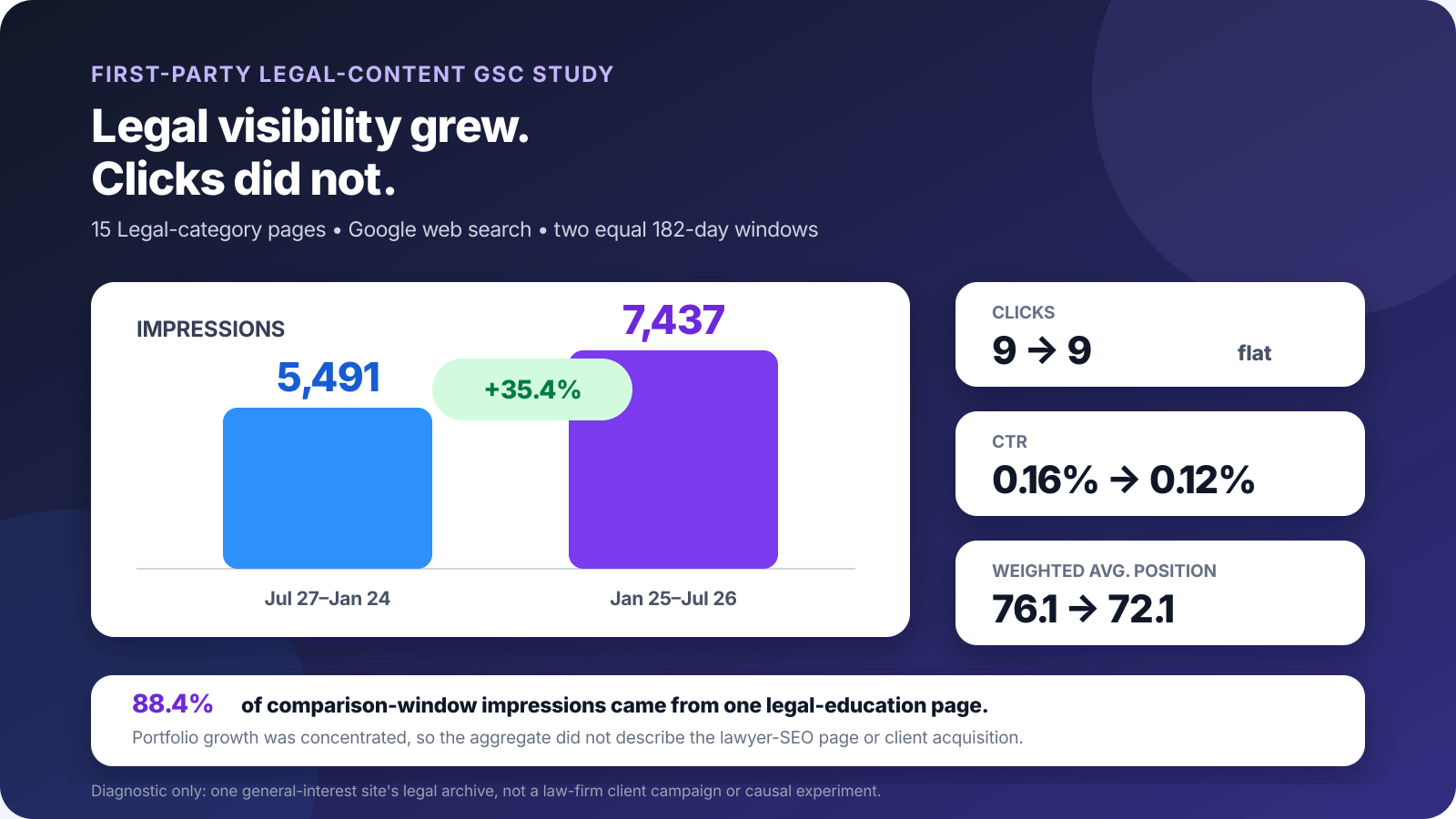
The aggregate looks healthier than the acquisition reality. Impressions rose 35.4%, but clicks stayed at nine. One legal-education page generated 6,577 of 7,437 comparison-window impressions, or 88.4%. The portfolio trend therefore says more about one education query cluster than about law-firm leads.
The lawyer-SEO page itself moved from 27 impressions and zero clicks to 19 impressions and one click. Its weighted average position improved from 78.2 to 73.6, but those denominators are too small for a performance claim. The honest result is that the page had little search exposure in either window.
This is a descriptive content cohort, not a law-firm client campaign or controlled experiment. The sample mixes education, careers, consumer law, and law-firm marketing. Search demand, content, indexing, and result layouts changed, and Search Console can omit rows for privacy and internal limits.
- Segment intent: report legal education separately from local client-acquisition pages.
- Keep denominators: one click is not a 5.26% success story when it came from 19 impressions.
- Connect intake: label calls and forms by landing page, then record qualified consultation and signed matter.
- Inspect concentration: show the top page’s share so one winner cannot hide a weak portfolio.
Priority 1: Google Business Profile and the Local Pack
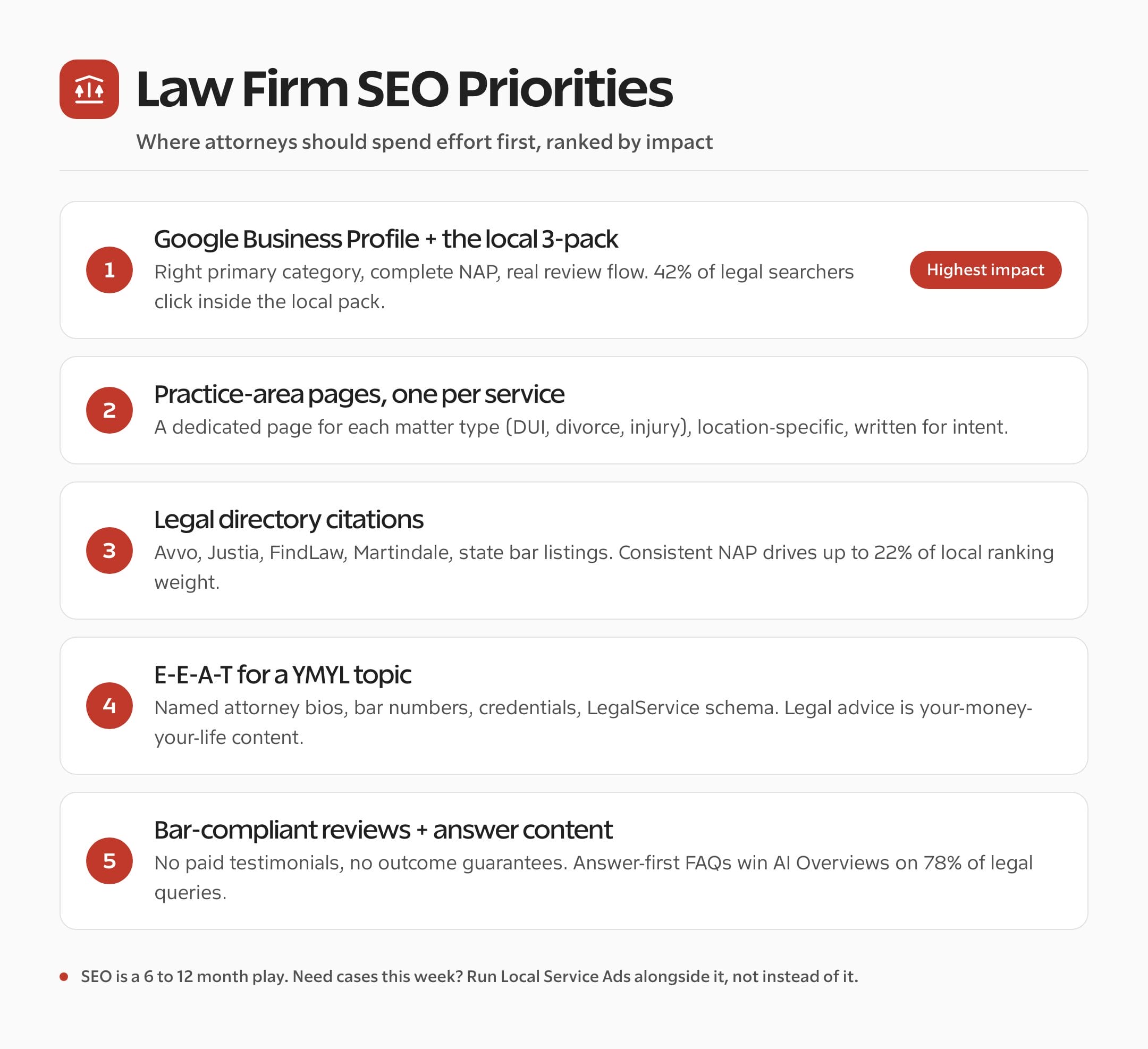
Your lawyer Google Business Profile is the foundation of the local-search work because it supplies the firm information shown in Google’s local results. Google’s own rules require the profile to represent the real-world business accurately, use the fewest categories needed to describe it, and avoid duplicate profiles. Start with those rules before you chase optimization tactics. Read the official Business Profile guidelines.
Get the primary category right
Choose the most specific category that accurately describes the main practice. A personal injury firm should not use a broad category merely to appear for more searches, and a mixed-practice firm should not create duplicate profiles for every service. Google’s guidance says to use as few categories as possible and to describe what the business is, not every service it offers. Record the choice, then judge it by qualified calls and signed matters rather than map impressions alone.
Nail NAP consistency
Keep the firm’s name, office address, phone number, website, hours, and practitioner details accurate across the site, the Business Profile, state-bar records, and major directories. Small formatting differences are less important than contradictory facts, stale offices, shared phone numbers, or duplicate profiles. For individual practitioners, follow Google’s separate practitioner-profile rules and do not list a virtual office unless it meets the staffing and signage requirements.
Build a real review flow
Ask clients for honest reviews only when doing so is permitted in your jurisdiction and does not compromise confidentiality. Google allows a business to share a review link and respond to reviews, but prohibits incentives offered in exchange for a review, a revision, or removal. Never confirm representation or reveal facts about a matter in a public response. Google’s review policy explains the boundary.
Priority 2: Practice-Area Pages Built for Intent
A homepage rarely answers every practice-specific question. Create a dedicated page when the firm genuinely handles the matter and the searcher needs a distinct explanation, evidence, and next step. A multi-location firm should create a city-service page only when that office and service are real and the page can add location-specific value. Swapping city names across templates creates duplication, not local expertise.
Each page needs the same bones: a clear headline that matches the search, an honest explanation of how that matter works in your state, the questions clients actually ask, your relevant case experience, and a single obvious next step. This is where good content that genuinely ranks pays off, because legal searchers read carefully before they call. Thin, templated pages get ignored by both clients and Google.
Match the words to the intent. “Pedestrian accident lawyer” is a long-tail phrase with less competition and a more qualified caller than the broad “accident lawyer.” Solid keyword research tells you which of these phrases people in your city actually type, and tools like Semrush surface the long-tail variants worth a dedicated page.
Priority 3: Legal Directories and Citations
Legal directories can help a prospective client verify a lawyer’s identity, jurisdiction, practice areas, and contact information. That makes accurate profiles useful even without attaching an invented percentage to their ranking value. Prioritize the state bar and a small number of established legal directories, keep material facts current, and track whether a listing sends qualified traffic or calls before paying for an upgrade.
| Directory | Why it matters for attorneys | Priority |
|---|---|---|
| Avvo | High-authority legal directory with attorney ratings and Q&A; widely used by consumers to compare attorney profiles. | Essential |
| Justia | Strong domain authority and a free profile; offers attorney profiles and legal information. | Essential |
| FindLaw | Large consumer-facing legal directory owned by Thomson Reuters; broad reach in competitive markets. | High |
| Martindale-Hubbell | Peer-rated directory respected for credibility signals and peer information. | High |
| State & local bar listings | Authoritative, trusted local citations can help a client verify licensing and location. | Essential |
Treat your Avvo and Justia profiles as live pages, not set-and-forget listings. A complete profile with your bar number, practice areas, and a current photo does more for visibility than a half-filled one, and it gives prospective clients another place to verify material details.
Priority 4: E-E-A-T for a YMYL Topic
Legal information can affect a person’s safety, rights, and financial stability, so trust is not decorative. Google says its systems give more weight to signals aligned with strong E-E-A-T on topics that can significantly affect people, while also making clear that E-E-A-T itself is not one specific ranking factor. Build for the underlying need: let a reader identify the lawyer, check the jurisdiction, understand the limits of the page, and distinguish general information from legal advice.
Concretely: put named attorney bios on the site with real photos, bar admissions, bar numbers, and education. Attribute practice-area pages to the lawyer responsible for them. Add LegalService and Attorney schema so search engines can read your credentials as structured data. Keep your contact details, office address, and hours unmistakable. These are the same trust foundations that make any SEO-friendly website work, but for a YMYL legal site they are non-negotiable rather than nice-to-have.
Reviews and Bar Advertising Rules You Cannot Ignore
Legal marketing is constrained by the rules in the jurisdiction where the lawyer practices. The ABA Model Rules are a starting point, not a substitute for the controlling state rule. Model Rule 7.1 prohibits false or misleading communications, including a material omission that makes the overall statement misleading.
Model Rule 7.2 allows communication through any media but limits compensation for recommendations, restricts unsupported specialist claims, and requires the name and contact information of at least one lawyer or firm responsible for the communication. That is why a results page, testimonial, referral arrangement, or “specialist” label needs a legal review, not just an SEO review.
The FTC adds a separate consumer-protection layer. Its Consumer Reviews and Testimonials Rule took effect on October 21, 2024 and covers fake reviews, sentiment-conditioned incentives, undisclosed insider reviews, company-controlled review sites presented as independent, review suppression, and fake social indicators. The FTC can seek civil penalties for knowing violations. Use the FTC Q&A as the operational checklist, then apply the stricter of the FTC rule, platform policy, and your jurisdiction’s professional-conduct rules.
When a Law Firm Should Run Ads Instead of SEO
SEO is useful when the firm can invest in durable visibility, but it is the wrong tool for immediate demand. Use paid acquisition when a new firm, office, or practice area needs qualified inquiries before organic discovery has developed. Keep referral and relationship channels in the plan too. The two retired law-marketing pages treated every channel as a separate strategy; the better approach is to give each channel one job and one business measure.
| Channel | Best job | Evidence to inspect | Main risk |
|---|---|---|---|
| Google Business Profile and local SEO | Capture location-based demand | Qualified calls, directions, consultations, and signed matters by office | Incorrect or duplicate profiles |
| Practice-area SEO | Answer specific legal problems over time | Qualified inquiries and signed matters by landing page | Thin or templated jurisdiction pages |
| Local Services Ads | Generate eligible local leads quickly | Charged leads, disputes, qualified consultations, and signed matters | Budgeting from lead volume without intake quality |
| Search ads | Test high-intent queries and landing pages | Search terms, qualified calls, cost per signed matter | Broad matching and weak negative-keyword control |
| Referrals and professional networks | Build high-trust introductions | Source recorded in intake and signed-matter rate | Undisclosed or noncompliant referral arrangements |
| LinkedIn and educational media | Demonstrate expertise to professional audiences | Relevant conversations and assisted conversions | Publishing generic commentary with no client value |
Criminal-defense intake deserves a separate operational note. A person facing arrest, bail, or a court deadline may search outside office hours and needs to know the jurisdiction, charge type, response window, and next step immediately. Build charge-specific pages only when the firm genuinely handles those matters, and route calls to an intake process that can respond. A ranking without a functioning response system is not a marketing win.
Google Local Services Ads are available for criminal, DUI, family, immigration, personal injury, and other legal categories in eligible U.S. markets. Google’s current documentation says leads can arrive by call or message, advertisers pay for leads, and firms must complete category- and location-dependent screening that may include license, business-registration, insurance, background, and review requirements. Check the current eligibility list before budgeting around the channel.
Choose the mix from intake data. If a channel creates many calls but few qualified consultations, fix targeting or stop it. If referrals sign at a higher rate, invest in the relationships and service quality that produce them. Use ads for speed, SEO for durable discovery, and referrals for trust, but make all three answer to cost per qualified lead and cost per signed matter.
What SEO for Lawyers Costs and How Long It Takes
There is no defensible universal price for law-firm SEO. Cost depends on the number of offices and practice areas, the quality of the existing site, local competition, compliance review, content production, and whether the firm already has accurate profiles and tracking. A price table without those inputs creates false precision.
| Work package | Evidence of completion | Business measure |
|---|---|---|
| Local foundation | Verified profile, accurate office and practitioner data, duplicates resolved | Qualified calls and booked consultations by location |
| Practice-area pages | Jurisdiction-specific pages reviewed by a named lawyer | Qualified inquiries and signed matters by page |
| Reputation system | Compliant request process and confidentiality-safe responses | Review velocity, response rate, and referral quality |
| Authority and citations | Accurate bar and directory profiles plus relevant earned mentions | Referral traffic and assisted conversions |
| Measurement | Search Console, call tracking, form attribution, and intake disposition | Cost per qualified lead and cost per signed matter |
Ask every provider for a 90-day work plan, named deliverables, access to the firm’s own accounts, and reporting that connects search activity to intake outcomes. Do not accept a guaranteed ranking or a forecast built only on traffic. Track queries and landing pages in Google Search Console, then connect that data to calls, forms, qualified consultations, and signed matters.
If you run a law firm and want help with local search visibility, I offer SEO services. For firms that also need profile cleanup, my Google Business Profile optimization service covers the local side, while the schema markup service can help search systems read accurate organization, person, and service information. Schema supports understanding, but it does not replace proof.
Frequently Asked Questions
How long does SEO for lawyers take to work?
There is no fixed timeline. A correct profile or indexing problem can improve quickly, while competitive practice-area visibility may take months. Set a 90-day implementation plan, measure qualified inquiries, and evaluate signed matters over a longer window instead of accepting a guaranteed ranking date.
Is local SEO or content more important for a law firm?
Start with accurate local business information, then build the practice-area content a prospective client needs to make a decision. A profile without useful pages is thin, and excellent pages attached to incorrect office data are hard to trust. The two systems reinforce each other.
Which legal directories should my firm use?
Start with the applicable state bar and a small set of established directories such as Avvo, Justia, FindLaw, and Martindale-Hubbell. Keep licensing, location, practice areas, and contact details accurate. Pay for an upgrade only when referral data shows qualified value.
Can lawyers pay for reviews or testimonials?
Do not buy fake reviews or condition an incentive on positive sentiment. Google prohibits review incentives, and the FTC rule covers fake reviews, sentiment-conditioned incentives, undisclosed insider reviews, suppression, and other deceptive practices. A lawyer must also follow the controlling professional-conduct and confidentiality rules in each jurisdiction.
Should a law firm use SEO or ads?
Use ads when the firm needs immediate demand and can track intake quality. Use SEO to build durable local and practice-area visibility. Many firms need both, but the correct split depends on cost per qualified lead and cost per signed matter, not clicks alone.
Do AI-generated search answers change legal SEO?
They make source quality and entity clarity more important, but they do not justify unsupported AI-visibility statistics. Publish accurate, answer-first legal information with clear authorship, jurisdiction, review dates, and primary sources, then measure the search surfaces that actually send qualified traffic.
Tell Google you want more of this.
Add Gaurav Tiwari as a preferred sourceOne tap, and this site shows up more often in your own Top Stories, AI Overviews and AI Mode. Remove it any time.