by
by
I’ve audited the digital marketing spend of 30+ law firms across personal injury, family law, immigration, and corporate practice. The pattern is consistent: most firms spend 60% or more of their digital budget on channels that don’t drive case-quality leads. Display ads, broad social media campaigns, agency-managed SEO with no conversion attribution — all of it generates activity reports that justify the next invoice but rarely sign cases.
Effective digital marketing for law firms is narrower than most agencies admit. There are five channels that consistently work, the rest is noise. This guide is the channel hierarchy, budget benchmarks by practice type, and the compliance landmines that cost firms more than the marketing itself when ignored.
The law firm channel ROI hierarchy
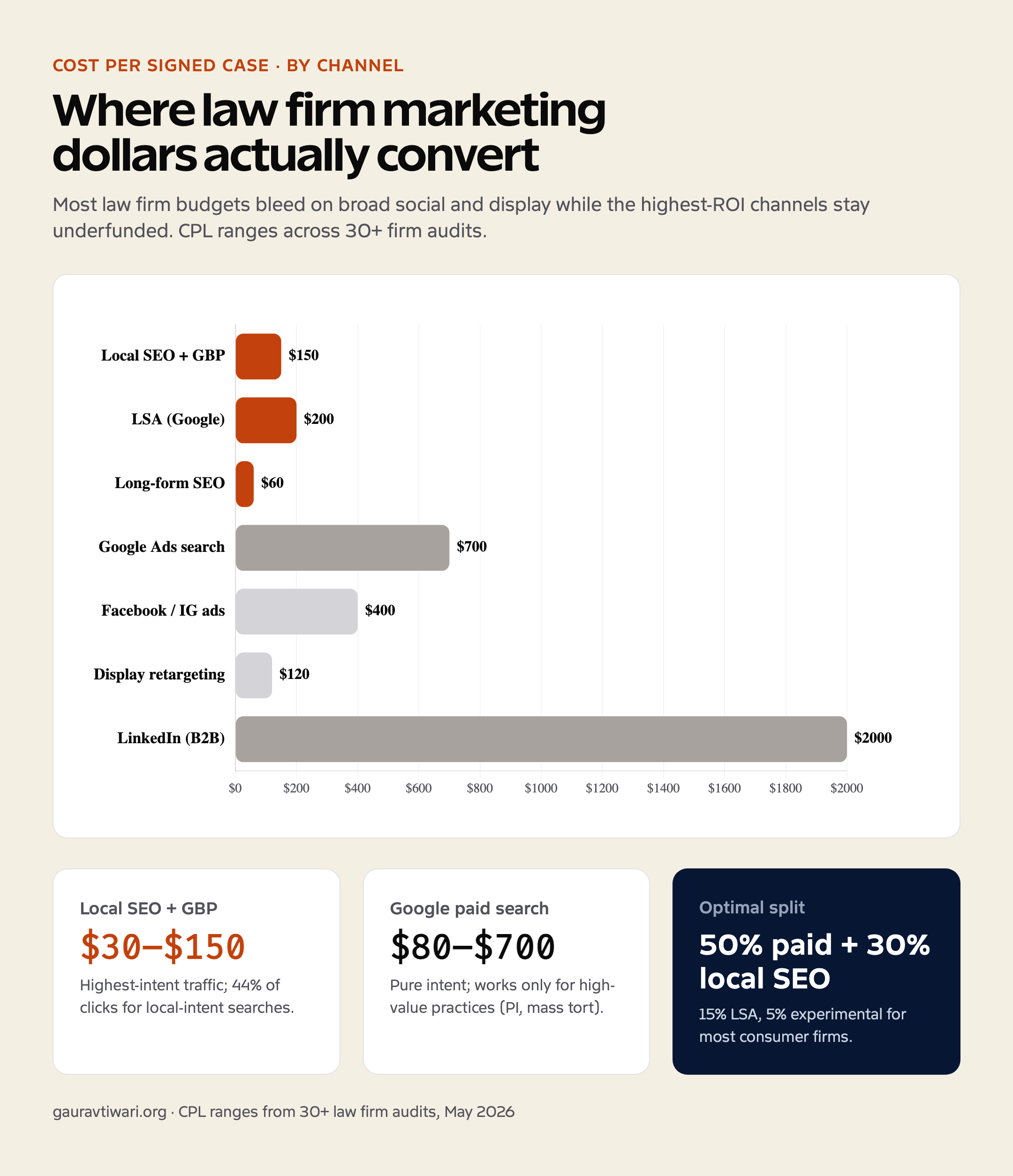
Not all digital channels deliver equally for legal services. The buying journey for legal help is unusually fast (someone with a problem this week wants a lawyer this week) and unusually high-intent. That makes channels with strong intent signals dramatically more valuable than awareness channels.
| Channel | Typical CPL | Lead quality | Best for practice type |
|---|---|---|---|
| 1. Local SEO + Google Business Profile | $30–$150 | Highest — intent + locality match | All consumer practices |
| 2. Google Ads (search, exact match) | $80–$700+ | High — pure intent | PI, mass tort, immigration, divorce |
| 3. Long-form SEO content | $15–$60 amortized | Medium-high — informational + research-stage | All; compounds over years |
| 4. Local Service Ads (LSA) | $20–$200 | Highest — pre-screened by Google | Most consumer practices in US metros |
| 5. LinkedIn (organic + ads) | $200–$2,000 | High for B2B | Corporate, M&A, employment, IP, tax |
| Facebook/Instagram ads | $80–$400 | Medium — awareness, weak intent | Family law, estate planning (life-event triggers) |
| Display retargeting | $40–$120 | Medium — only re-engages existing intent | Long-cycle B2B practices |
| TikTok / Reels | n/a | Very low for direct conversion | Brand-building only; not lead gen |
| Cold email | $15–$80 if compliant | Medium for B2B | Corporate — check ABA Rule 7.3 first |
For the firms I work with, the optimal allocation usually lands at 50% paid search + LSA, 30% local SEO and content, 15% LinkedIn (B2B practices) or Facebook/Instagram (consumer life-event practices), and 5% experimental. Anything outside that range usually means the firm is over-investing in awareness or under-investing in intent capture.
Local SEO is the foundation (and most firms underinvest)
The Google Local Pack (the map + 3 listings that show above organic results) gets 44% of clicks for local intent searches according to BrightLocal’s 2025 study. For “personal injury lawyer near me” or “divorce attorney [city]”, that’s the most valuable digital real estate that exists.
The Google Business Profile (GBP) optimization checklist that lifts most firms 2–3 ranking spots in 90 days:
- NAP consistency. Name, address, phone match exactly across GBP, your website, Avvo, Yelp, FindLaw, state bar directory, Justia. Inconsistencies confuse Google’s local ranking algorithm.
- Practice-area-specific GBP categories. Set primary and secondary categories precisely (e.g., “Personal injury attorney” + “Car accident lawyer” + “Wrongful death attorney”). Most firms pick “Lawyer” and stop.
- Review velocity. 3–5 new reviews per month signals active engagement to Google. The total count matters less than recent flow. Set up an automated post-case review request workflow.
- Photos updated monthly. Office, team, courthouse arrivals (with consent), case wins (anonymized). Google rewards profiles with fresh visual content.
- Q&A section seeded. Most firms ignore the Questions section. Pre-populate it with the 8–12 questions clients actually ask before retaining you.
- Posts weekly. Use GBP Posts for case results (in compliant jurisdictions), legal updates, community involvement.
Paid search economics for law firms
Legal CPCs are the highest in Google Ads. “Mesothelioma attorney” can clear $1,000 per click. “DUI lawyer [city]” runs $40–$300. The math only works for high-value practice areas where a single retained case justifies hundreds or thousands in click spend.
| Practice area | Avg case value | Sustainable CPL | Run paid search? |
|---|---|---|---|
| Mass tort / mesothelioma | $50K–$1M+ | $2,000–$10,000 | Yes — aggressive bidding |
| Personal injury (auto) | $15K–$200K | $300–$2,000 | Yes |
| Immigration (employment-based) | $5K–$25K | $200–$800 | Yes |
| Family law / divorce | $5K–$50K | $150–$700 | Yes — in select metros |
| Criminal defense | $3K–$25K | $100–$500 | Yes for high-value cases |
| Estate planning | $1K–$5K | $30–$120 | Maybe — SEO usually wins |
| Wills / minor matters | $300–$1,500 | $15–$60 | No — SEO + LSA only |
| Pro bono / nonprofit | $0 | $0 | Organic only |
The discipline that separates profitable from unprofitable Google Ads accounts: tight match types (no broad match without strict negatives), call tracking (CallRail or CTM) to attribute phone leads back to keyword, and weekly negative keyword review. Without all three, 30–50% of spend goes to junk traffic.
Content marketing for legal trust (and rankings)
Legal content is YMYL (Your Money Your Life) in Google’s quality framework, which means E-E-A-T signals matter more than for almost any other topic. Author credentials, attorney bio pages, citations to actual statutes and case law, and clear disclaimers all influence rankings.
The content types that actually pay back for law firms:
- Practice-area pillar pages. One deeply comprehensive page per practice area (3,000–6,000 words) covering process, fees, timeline, FAQs. These rank for high-intent queries.
- Geographic landing pages. “Personal injury lawyer in [neighborhood]” if you actually serve those neighborhoods. Don’t fake it — Google catches doorway pages.
- Case-result pages. Where compliance allows, anonymized case results build trust and rank for case-type-plus-jurisdiction queries.
- Long-form FAQ articles. “How long does a [case type] take in [state]?” content captures research-stage searches.
- Attorney bio pages. Each attorney needs a real bio page with credentials, awards, education, and at least one published article.
Compliance: ABA, state bar, and the disclaimers that aren’t optional
The biggest unforced error I see in law firm marketing: copy that violates state bar advertising rules. The rules vary by state but the common requirements:
- “Attorney advertising” disclaimer on every paid ad and most state bar interpretations of website pages.
- No guarantees of results. “We win 95% of our cases” is generally prohibited in most states. Past results disclaimer required: “Past results do not guarantee future outcomes.”
- No comparative superlatives like “best” or “top” without verifiable basis (some states prohibit even with basis).
- Testimonial restrictions. Florida bar prohibits client testimonials on certain platforms; New York requires specific disclaimers; California requires disclaimer on dramatized re-enactments.
- Specialization claims. Most states prohibit “specialist” claims unless certified by an ABA-approved board.
Hire a lawyer-marketing attorney to review your copy once before launch and once annually. Cost: $500–$2,500. Cost of a state bar disciplinary investigation triggered by an ad: tens of thousands plus reputational damage. The ROI is obvious.
Realistic digital marketing budgets by practice type
| Firm size + practice | Monthly digital budget | Allocation hint |
|---|---|---|
| Solo practice, transactional (estates, wills) | $1,500–$3,500 | 70% local SEO + LSA, 20% content, 10% paid search |
| Solo PI / criminal defense | $3,000–$8,000 | 50% paid search, 30% local SEO + LSA, 20% content |
| Small firm (3–10 attys), consumer | $8,000–$25,000 | 50% paid search, 25% SEO/content, 15% LSA, 10% test |
| Mid-size consumer firm | $25,000–$80,000 | 40% paid, 30% SEO/content, 15% LSA, 15% video/social |
| PI firm with mass tort exposure | $80,000–$500,000+ | 60% paid, 25% LP/landing-page testing, 15% retargeting |
| Boutique B2B (corporate, M&A) | $5,000–$20,000 | 50% LinkedIn + content, 30% SEO, 20% events/PR |
For broader marketing context that applies beyond legal, see my backlink strategies, social media marketing, and formatting content for AI search guides.
Frequently asked questions
What digital marketing channels work best for law firms?
Local SEO (Google Business Profile + reviews) drives the highest-intent traffic. Long-form content for awareness. Paid search for high-value practice areas (PI, family, immigration). LinkedIn for B2B practices. Avoid TikTok and Instagram unless you’re in an unusually visual niche.
How much should a law firm spend on digital marketing?
Solo practitioners: $1,500–$5,000/month covering SEO, paid ads, and basic content. Mid-size firms: $10,000–$30,000/month. Personal injury and class-action firms routinely spend $50,000+ because case values justify the CPL.
Are PPC ads worth it for lawyers?
Yes for high-value practice areas where a single signed case is worth $5,000+. Personal injury, mass tort, immigration, and divorce see strong ROI on Google Ads despite the high CPCs ($30–$300+ per click). Lower-value practice areas are usually better served by SEO.
How long does law firm SEO take to work?
6–12 months to see meaningful organic traffic, 12–24 months to dominate a competitive city-level market. Local pack rankings can move faster (weeks) with consistent review acquisition and Google Business Profile optimization.
Do law firms need to be on social media?
LinkedIn yes — for thought leadership, referrals, and lateral recruiting. Facebook for community-focused practices. Twitter/X is optional unless you want media exposure. Instagram and TikTok pay off only with a content-creator-grade commitment, which most firms can’t sustain.
Tell Google you want more of this.
Add Gaurav Tiwari as a preferred sourceOne tap, and this site shows up more often in your own Top Stories, AI Overviews and AI Mode. Remove it any time.