
 by
by
Every subscription business loses customers. The real damage happens when you don’t know why they’re leaving, so you keep patching the wrong leak. To reduce churn in a physical-product subscription, you fix two failures at once: the customers who decide to quit, and the good customers a billing system quietly drops without anyone choosing anything. Most founders pour effort into the first group and ignore the second, which is where the cheapest customer retention wins hide.
Here’s the verdict before the tactics. The single highest-ROI lever to reduce subscription churn isn’t a fancy win-back campaign or a discount. It’s fixing involuntary churn, the failed-payment leak that accounts for 20 to 40 percent of all subscriber losses and recovers at up to 70 percent with decent dunning. Get that right first, then layer on cancellation surveys, pause flows, and cohort tracking. That order matters because the payment fix costs almost nothing and returns the most.
Proof and bottom line: I’ve run retention for box subscriptions and built billing flows for client stores doing recurring revenue across WooCommerce and Stripe. Across those accounts, the pattern held every time. Median B2B SaaS annual churn sits at 3.5 percent, split 2.6 percent voluntary and 0.8 percent involuntary (Recurly, 2025). Involuntary churn from failed payments runs 20 to 40 percent of total losses, and smart retry logic recovers around 68 to 70 percent of those failed payments versus roughly 23 percent with a single retry attempt. Acquiring a replacement customer costs 5 to 25 times more than keeping one. Fix billing, then behavior.
What changed for 2026: Involuntary churn moved from a backend afterthought to the first thing serious operators fix. Recurly’s 2025 data shows card updaters, intelligent retries, and dunning workflows delivering an average 16x ROI, and AI-timed dunning now recovers 30 to 50 percent more failed payments than fixed retry schedules. The old advice to “improve onboarding first” still holds, but it’s no longer where the fastest money is.
The One Churn Lever Most Founders Miss: Involuntary Billing Failure
Start here, because this is where good revenue dies for no reason. Involuntary churn happens when a paying customer leaves because of an expired card or a temporary bank glitch, not because they wanted to go. They never opened a cancellation flow. They never read a survey. The card just declined, the system gave up, and the relationship ended in silence. Nearly a third of all subscription losses are involuntary, driven by failed card payments and billing friction rather than any loss of interest in the product.
The reason this lever wins is pure economics. You don’t have to win anyone back, change the product, or out-argue a cancellation. You only have to recover a payment the customer already intended to make. About 42 percent of failed payments trace to expired cards, which an account updater fixes automatically before the charge ever fails. Route everything else through a structured dunning sequence: gentle, branded emails with a one-tap link to update payment details, spaced over several days rather than fired all at once.
If you run on WordPress, this is mostly configuration, not engineering. WooCommerce Subscriptions handles automatic retries and dunning emails out of the box, and pairing it with the WooCommerce Stripe gateway adds card-updater support so expired cards refresh on their own. Turn on automatic retries, set a sane retry schedule (try three to five attempts across roughly a week), and write dunning emails that read like a helpful nudge instead of a debt notice. Handle the failures cleanly and you keep accounts that would otherwise have been lost to nothing more than a system error.
Churn Types and the Fix That Actually Moves Each One
Not all customer churn responds to the same treatment, and matching the wrong fix to the wrong cause is how teams waste a quarter. Voluntary churn is a decision you can argue with. Involuntary churn is a mechanical failure you repair. Delivery churn is an expectations problem. Here’s the map I use when auditing a subscription before touching anything.
| Churn type | What causes it | The fix that works | Typical recovery |
|---|---|---|---|
| Involuntary (failed payment) | Expired cards, bank declines, no card updater | Account updater, smart retries, dunning emails | Up to 70% recovered |
| Inventory overload | Customer has too much product, forced to cancel | Skip-a-month and pause-up-to-90-days flows | 12 to 15% of at-risk saved |
| Price or value doubt | Perceived cost outweighs delivered value | Downsell offer plus unboxing value reset | Varies by offer strength |
| Billing surprise | Unexpected renewal charge, chargeback | Pre-renewal reminder with next-box preview | Cuts chargebacks sharply |
| Early-life drop-off | Weak first 90 days, onboarding gap | Cohort tracking plus timed onboarding flows | Targets the 44% that quit early |
Read this table top to bottom as a priority order, not a menu. The involuntary row sits first because it’s the cheapest to fix and the most addressable. Everything below it asks you to change a customer’s mind, which is harder and slower than fixing a declined card.
Implement Strategic Cancellation Surveys to Reduce Voluntary Churn
When a subscriber decides to cancel, don’t let them walk out the door without collecting data. A short, targeted survey at the exact moment of exit gives you the raw intelligence you need to fix systemic issues. Skip the generic exit form. Offer specific choices: price, delivery frequency, product overload, lifestyle change. Exit surveys combined with a smart cancellation offer cut voluntary churn by 12 to 15 percent, one of the highest-return, lowest-cost interventions you have at the moment of cancellation intent.
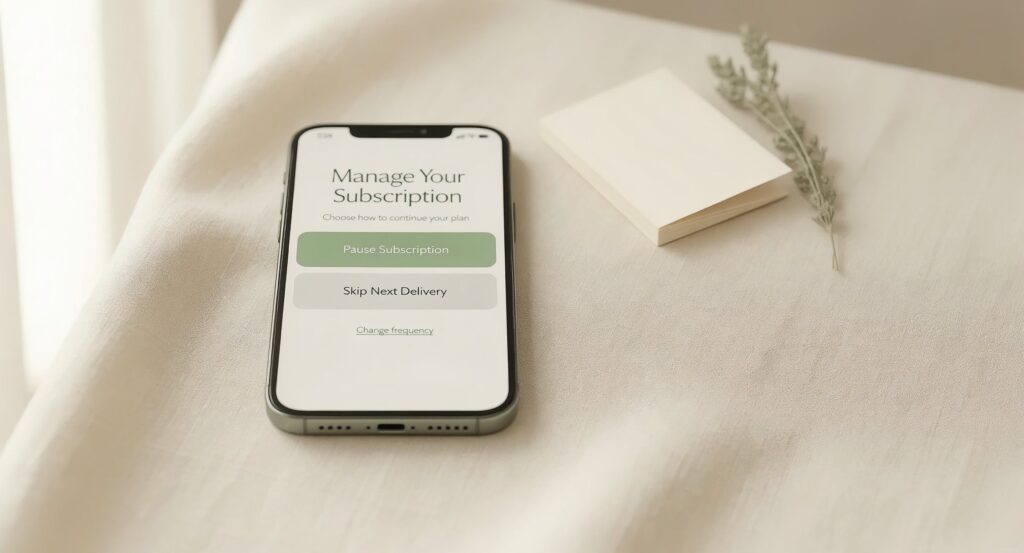
This data tells you whether product value is dropping or whether your delivery intervals are misaligned with how people actually use the items. If you see a spike in cancellations from product accumulation, trigger a downsell or a pause option on the spot. Surface the survey before the final confirm button, and tie each answer to an offer: too much product gets a pause, too expensive gets a smaller tier, wrong cadence gets a frequency change. With this feedback in hand, you’re not guessing about what’s moving your churn rate.
Establish Total Delivery Transparency
Uncertainty kills subscription relationships faster than almost anything else. Subscribers need to know exactly when their card will be charged and when the package will arrive. A clear schedule shuts down buyer anxiety and cuts support tickets, which removes one of the quiet reasons people cancel just to regain a feeling of control.
Clear documentation also acts as a shield against buyer remorse. The BloomsyBox flower delivery subscription framework is a good example of this done well, displaying clear delivery windows and flexible modification rules to reduce consumer hesitation. When people feel completely in control of their delivery cadence, they rarely feel the urge to cancel. Send a charge-day reminder, a shipped notification, and a delivered confirmation, and the entire cycle stops feeling like a black box. If you’re also working on getting more positive signal from happy subscribers, the same transparency makes it easier to turn customer reviews into business opportunities instead of fielding surprise complaints.
Deploy Flexible Skip and Pause Flows
Sometimes subscribers love your brand but have too much inventory on hand. Forcing a binary choice between staying or canceling almost always ends in a lost customer. The customer doesn’t want to leave forever. They want a break, and if the only button you give them is “cancel,” they’ll press it.
Give them a clean path to take a break and you preserve the relationship. Make these alternatives prominent in the account UI, sitting right next to the cancel link rather than buried two menus deep:
- A one-click button to skip the upcoming month
- A temporary pause option for up to ninety days
- A simple way to change shipment frequency
Giving people these choices prevents permanent churn by accommodating their changing schedules. A paused subscriber is still a customer. Businesses that offer pause features alongside tiered pricing and loyalty perks sustain a renewal-invoice-paid rate above 95 percent, because the off-ramp doubles as a retention tool.
Elevate Retention via the Unboxing Experience
Retention doesn’t live entirely in dashboards and entry flows. It also lives on your subscriber’s kitchen counter. The moment someone opens their delivery is one of the highest-leverage psychological touchpoints you have for reinforcing perceived value. A flat, forgettable box quietly chips away at the reasons they signed up.
Thoughtful tactile presentation can reset perception during subscription fatigue, the slow drift where a customer stops noticing what they’re paying for. Optimize the inside of the parcel around three things:
- Rotating insert themes to break predictable delivery fatigue
- Premium instructions that help the customer get more from each item
- Upcoming curation previews printed directly on the packaging
The goal is to make the customer feel something at the moment of opening, because a felt experience is far harder to cancel than a line item on a credit card statement.
Automate Proactive Renewal Reminders
Surprise billing statements trigger immediate cancellations and chargebacks. A friendly notification a few days before renewal builds trust and gives the customer a sense of control over their spending. The reminder isn’t a courtesy. It’s a chargeback shield, because a customer who expected the charge rarely disputes it.
This proactive communication is also your chance to remind subscribers of the value coming in the next package. Highlight an upcoming feature or an exclusive item in their next delivery. Turning a billing reminder into a preview turns a potential cancellation trigger into a retention tool. The same email that says “you’ll be charged Friday” can also say “here’s the limited item shipping in this box,” which reframes the charge as anticipation instead of dread.
Track Cohorts to Catch Churn Before It Spikes
To understand subscription health, you have to look past monthly averages, because a single blended churn rate hides where the bleeding actually starts. The reality is that forty-four percent of all subscription cancellations occur within the first ninety days of enrollment. If most of your loss is early-life, no amount of late-stage win-back will fix the real problem.
Segmenting subscribers by signup month shows exactly where the customer experience breaks down. If a specific cohort drops off in month two, your onboarding probably needs work. Tracking these timelines lets you deploy targeted email flows right before the historical danger zone hits, so you intervene a week before the cliff instead of after the customer is gone. This is the same discipline that powers good conversion rate optimization: measure the funnel stage by stage, then fix the specific step that leaks.
Stabilize Your Subscription Ecosystem
Plugging the leaks in your subscription funnel takes a mix of clear billing, flexible user controls, and honest measurement, in that order of payoff. Fix involuntary churn first because it’s the cheapest, recover the highest share of revenue you’re already owed, then give people real off-ramps so a busy month doesn’t become a permanent goodbye. Eliminate billing friction, hand customers the power to pause, and watch your retention numbers climb on their own.
Retention compounds in a way acquisition never does, which is why it deserves the first hour of your week, not the last. If you want the front half of that funnel to feed this work, my guides on SaaS marketing and effective customer acquisition for startups pair naturally with everything here. Keep the money you’ve already earned, then go earn more.
Tell Google you want more of this.
Add Gaurav Tiwari as a preferred sourceOne tap, and this site shows up more often in your own Top Stories, AI Overviews and AI Mode. Remove it any time.
Disclaimer: This site is reader-supported. If you buy through some links, I may earn a small commission at no extra cost to you. I only recommend tools I trust and would use myself. Your support helps keep gauravtiwari.org free and focused on real-world advice. Thanks. - Gaurav Tiwari