
 by
by
SaaS marketing is the work of getting people to try, keep paying for, and recommend software they rent instead of buy. That rented-not-owned detail changes everything. You are not selling a one-time purchase, you are selling a relationship that renews every month, which means free trials, product-led onboarding, and churn live at the center of the job instead of at the edges.
Here is the part most guides bury. SaaS marketing lives or dies on retention, not acquisition. A normal business can win a customer once and bank the sale. A SaaS business wins a customer who can leave with two clicks at the end of the month, so the real number is lifetime value (LTV) measured against what you paid to acquire that customer (CAC). If people churn faster than they pay back, more marketing just burns cash quicker.
I have spent 18 years building and marketing software products and client sites, and the pattern repeats. The teams that grow are not the ones with the loudest ad budgets. They are the ones who turn a free trial into a habit and keep monthly churn low. This guide walks through what makes SaaS marketing different, the funnel, product-led versus sales-led growth, the channels that actually move the needle, the metrics that tell the truth, and the mistakes that quietly kill good products.
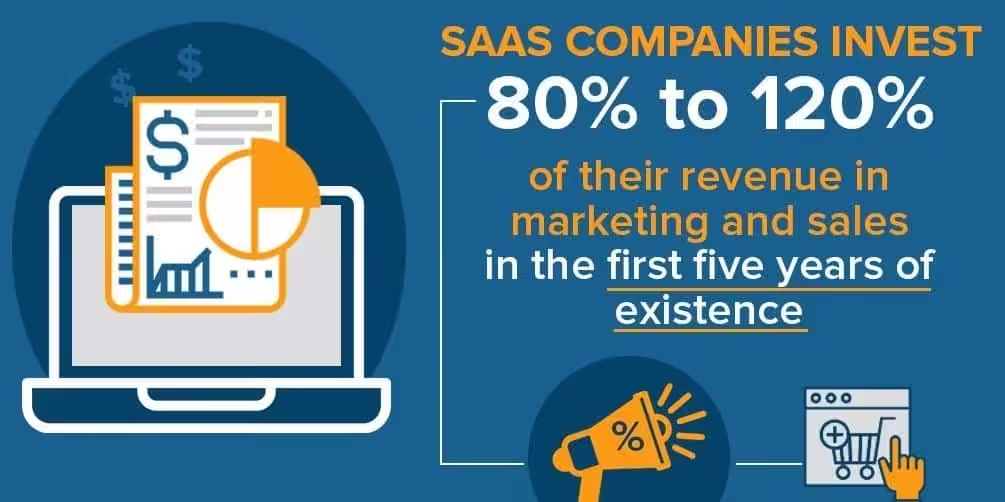
Proof and verdict, up front: I have spent 18 years building and marketing software products, WordPress plugins running on 7,500-plus sites, and client products for brands like HubSpot and Canva. The pattern never changes. A healthy SaaS keeps its LTV to CAC ratio near or above the 2026 median of 3.2 to 1, recovers acquisition cost in roughly 8 to 9 months, and grows on retention before it grows on ads. If you only fix one thing this quarter, fix activation and churn, not your ad budget. Product-led teams now grow about 50% faster while spending 39% less on sales and marketing, which is exactly why this guide puts the trial-to-habit loop ahead of everything else.
What Is SaaS Marketing?
SaaS marketing is the process of promoting and selling subscription software, where the goal is recurring revenue rather than a single transaction. In plain terms, SaaS means “software as a service“, and that means software you access over the web and pay for on a monthly or yearly plan, instead of buying a boxed license once.
The purpose is to create awareness among your target audience, earn enough trust to start a trial, and then prove enough value that people keep their subscription active. Sales is never finished. Every renewal is a small re-sell.
It differs from traditional marketing because there is no physical product to put on a shelf. You are selling an outcome and an ongoing experience, so the messaging has to make the value obvious fast, and the product itself has to keep delivering after the credit card is charged.
What Makes SaaS Marketing Different From Normal Marketing
SaaS marketing is different because revenue is recurring, the product is the main sales tool, and churn can quietly undo all your acquisition work. Get these three right and growth compounds. Get them wrong and you have a leaky bucket no ad budget can fill.
- Recurring revenue, not one-off sales. A customer who pays $50 a month is worth far more over two years than over one purchase, so retention math drives every decision.
- The product does the selling. Free trials and freemium let people experience value before they pay. This is product-led growth (PLG), and it is why onboarding is a marketing channel, not just a support task.
- Churn is the silent killer. If 5% of customers cancel every month, you lose roughly half your base in a year. Acquisition has to outrun that leak before you ever see net growth.
- Long sales cycles for bigger plans. A team buying an annual enterprise seat needs proof, security answers, and a champion inside the company, so content and trust-building matter more than a clever ad.
That last point is why I tell every small SaaS founder the same thing. Before you spend a rupee on ads, make sure a new signup hits an “aha” moment in the first session. If they do not, marketing just fills a bucket with a hole in it.
The SaaS Funnel, Stage by Stage
The SaaS funnel is the path a prospect takes from first visit to paying, retained customer, and the modern version maps closely to the AARRR framework: Acquisition, Activation, Retention, Referral, and Revenue. It is also called the sales funnel, but for SaaS the stages after the sale matter just as much as the ones before it.
Whatever tactics you choose fall somewhere inside this funnel. Here are the stages that matter most.
- Acquisition (traffic). People who land on your site from search, content, ads, or referrals.
- Sign-up. Visitors who hand over an email to start a free trial or freemium account.
- Activation. The moment a new user reaches their first real win inside the product. This is the make-or-break stage most teams ignore.
- Revenue (conversion). Trial or free users who upgrade to a paid plan.
- Retention and referral. Customers who keep paying and bring others in. This is where lifetime value is actually earned.
Product-Led Growth vs Sales-Led Growth
Product-led growth (PLG) lets the product sell itself through free trials and freemium, while sales-led growth (SLG) uses demos, reps, and human follow-up to close deals. Most successful SaaS companies use a blend, and the right mix depends on your price point.
A simple rule I use: the lower the price and the faster the value, the more product-led you should be. The higher the price and the more complex the setup, the more you need humans in the loop.
- Go product-led when a single user can sign up, get value in minutes, and pay with a card. Think Slack, Calendly, or most $10 to $50 a month tools. Your “sales team” is the onboarding flow and the activation email sequence.
- Go sales-led when deals run into thousands per year, multiple stakeholders sign off, and setup needs help. Here, demos, case studies, and a real conversation close the gap that a trial alone cannot.
| Dimension | Product-Led Growth (PLG) | Sales-Led Growth (SLG) |
|---|---|---|
| Best price point | $10 to $50 a month, card checkout | Thousands per year, multi-stakeholder deals |
| Who does the selling | The product, onboarding flow, activation emails | Demos, reps, case studies, human follow-up |
| Time to value | Minutes, inside a free trial or freemium plan | Days to weeks, with guided setup |
| Primary metric | Activation rate and product qualified leads (PQLs) | Pipeline, win rate, sales cycle length |
| 2026 signal | 58% of SaaS firms now run PLG; PQLs convert near 25% vs 9% without | Still wins complex enterprise buys where 81% of buyers self-research first |
| Cost to scale | Lower; usage data arrives early | Higher; headcount grows with revenue |
For a small SaaS, I almost always recommend starting product-led. It is cheaper to scale, it gives you usage data early, and a good free trial is the most honest sales pitch you can offer.
The SaaS Marketing Channels That Actually Work
The channels that consistently move SaaS growth are content and SEO, free trials and freemium, email onboarding, paid acquisition, and partnerships or referrals. Successful strategies vary across industries and product types, but these five do the heavy lifting for most teams.
Below is how each channel works and where it fits, starting with the one with the best long-term return.
| Channel | Why it works for SaaS | 2026 economics | Best fit |
|---|---|---|---|
| Content and SEO | Compounds for years, builds trust before a sales conversation | Organic CAC near $205, about 40% cheaper than paid and converting roughly 110% better | Every SaaS; start here |
| Free trial and freemium | The product becomes the pitch; usage data feeds everything else | PQL-driven trials convert near 25% vs 9% without a PQL model | Self-serve, fast time-to-value tools |
| Email onboarding and lifecycle | Turns signups into activated, paying habits and cuts early churn | Highest ROI per dollar once activation is fixed | All trial and freemium products |
| AI search and community | Buyers now ask ChatGPT and peers before Google; 82% of B2B tech queries trigger AI answers | Community influences 40%-plus of buying decisions at low CAC | Teams competing on discovery and reputation |
| Paid acquisition | Fast, predictable reach you can switch on and off | Paid CAC near $341; median CAC up 14% year over year | Scale only after payback is under a year |
| Referrals and partnerships | Lowest-CAC growth once customers already love the product | Compounds on top of a strong retention base | Products with real word-of-mouth |

| Metric | What it measures | Healthy benchmark |
|---|---|---|
| CAC (Customer Acquisition Cost) | Total sales and marketing spend divided by new customers won in a period | Should be recovered well inside the customer lifetime; lower is better |
| LTV (Lifetime Value) | Total revenue you expect from a customer before they churn | LTV to CAC ratio of 3:1 or higher; the 2026 cross-segment median sits near 3.2:1 |
| Monthly Churn Rate | Percentage of customers who cancel each month | Under 5% for SMB SaaS; 1% to 2% is excellent |
| CAC Payback Period | Months of subscription revenue needed to earn back acquisition cost | Under 12 months; the 2026 B2B SaaS median runs about 8 to 9 months, and under 6 is strong |
| Conversion Rate | Visitors or trials that complete the desired action (signup or upgrade) | Varies; trial-to-paid of 15% to 25% is solid |
| ROI (Return on Investment) | Profit earned against money spent on a channel | Positive and trending up per channel |
Two of these deserve a closer look because they decide your fate.
Churn rate is the rate at which customers stop paying. According to Tomasz Tunguz, even large SaaS companies see a 6% to 10% yearly churn, and a high rate is an early alarm that your product or onboarding has a gap. Because retention is so central, it is worth studying how to reduce churn in product subscriptions before you scale spend.
CAC payback period tells you how many months it takes to earn back what you spent acquiring a customer. It is the metric I check first, because it decides whether you can grow without running out of cash. If you want the full breakdown, I wrote a dedicated guide on CAC payback, the SaaS metric that tells you if you can afford to grow. Use tools like Google Analytics or product analytics to measure traffic quality and these numbers accurately.
Common SaaS Marketing Mistakes To Avoid
The most common SaaS marketing mistakes are scaling ads before fixing activation, ignoring churn, running too many strategies at once, and treating onboarding as a support job instead of a growth channel. I have watched each one stall a promising product.
- Pouring money into acquisition while churn leaks out the back. If customers cancel faster than you can replace them, more spend just speeds up the loss.
- No guided onboarding. A free trial without a clear path to the first win wastes most of your signups.
- Running every channel at once. Spreading a small team across SEO, ads, email, and partnerships at the same time means none of them get done well. Pick one or two and go deep.
- Chasing vanity traffic. Raw visits can mislead. Focus on the quality and source of each lead and on trial-to-paid conversion, not page views.
- Skipping the strategy step. As Morris Chang put it, “without strategy, execution is aimless.” Decide your audience, positioning, and pricing before you market.
You can also learn a lot by studying the companies that got it right. The most successful SaaS brands of recent years all nailed activation and retention before they scaled spend, so it is worth reverse-engineering their onboarding and pricing.

Where a Small SaaS Should Focus First
If you run a small SaaS, focus first on activation and retention, then layer content and SEO on top, and only buy paid traffic once your funnel converts and your churn is under control. That order is deliberate, and it is the advice I give every founder who asks.
When a SaaS should not market yet: if you have not hit product-market fit, hold off on scaled marketing. The tell is simple. New users sign up, poke around, and leave within a week, and the people who do stay cannot explain why they would miss the product if it vanished. Pouring marketing into a leaky product just buys you a bigger crowd watching the same churn. Before you spend on acquisition, get 10 to 20 customers who would be genuinely upset to lose the tool, watch your monthly churn settle into the low single digits, and confirm a repeatable activation moment. Until then, your real marketing job is customer development, not campaigns. Marketing amplifies fit. It cannot manufacture it.
Here is the sequence I would follow.
- Fix activation. Make sure a new free-trial user reaches a real win in their first session. Nothing else matters until this works.
- Plug the churn leak. Add lifecycle email, proactive support, and a reason to stay each month.
- Build content and SEO. Start the compounding channel early, because it takes months to pay off and never stops once it does.
- Add referrals. Once people love the product, give them an easy, rewarded way to bring others.
- Scale paid last. When CAC payback is under a year and churn is low, paid ads become an accelerator instead of a money pit.
Do this in order and your SaaS marketing turns into a system that compounds. Skip the early steps and you will spend the rest of the year buying customers who quietly leave. Get the trial-to-habit loop right first, keep churn low, and let content and referrals carry the growth that paid ads alone never can.
Tell Google you want more of this.
Add Gaurav Tiwari as a preferred sourceOne tap, and this site shows up more often in your own Top Stories, AI Overviews and AI Mode. Remove it any time.