
 by
by
The easiest free way to reduce PDF file size depends on the device and the document. For an ordinary non-sensitive file, a browser tool like PDF24 or Smallpdf does the job in a minute. On a Mac or a current iPhone, Apple Preview compresses locally with nothing uploaded. For offline Windows work there’s PDF24 Creator, and for repeatable batches there’s Ghostscript, which I benchmark with real files further down.
One honest sentence before the tools: large reductions come from downsampling or recompressing the images inside a PDF, so they are not lossless, whatever the tool’s marketing says. The realistic goal is minimal visible quality loss; compressing a PDF without losing quality at all is only true of structural cleanup, and the benchmark below shows how little that saves. Keep the original, save the compressed copy under a new name, and check it before sharing, and however you phrase the search, shrink, minimise, suppress, decrease, or just get the PDF size down, the same handful of tools does the work.
The 3 kinds of PDF compression
Every compressor on this page does one or more of these 3 things. Knowing which one you’re asking for is most of the decision:
| Type | What changes | Typical result |
|---|---|---|
| Structural cleanup | Recompresses streams, removes unused objects, deduplicates content | Modest savings, no intentional image degradation |
| Visually acceptable compression | Downsamples or recompresses images while keeping reading quality | Often large savings, technically lossy |
| Aggressive compression | Heavy downsampling, strong JPEG, flattening | Small files, visible degradation, lost features |
A text-only report and a scanned book respond completely differently to the same tool, which is why no single winner exists and why my benchmark below shows a preset making a file larger.
Free PDF compressors compared
| Tool | Platform | Processing | Free limit | Compression controls | Main tradeoff |
|---|---|---|---|---|---|
| Smallpdf | Browser | Cloud, deleted after 1 hour | 2 compressions/day, files to 5 GB | Basic free; Moderate and Strong paid | Strongest modes cost money |
| iLovePDF | Browser | Cloud, deleted within 2 hours | 2 files per task, 200 MB each | Extreme, Recommended, Less | 2-file batches on free |
| PDF24 Tools | Browser | Cloud (Germany), deleted after 1 hour | No task limits | DPI, image quality, structural options | Ads; server upload |
| PDFgear | Browser + desktop | Cloud (AWS, US) or offline desktop | 100 MB online; desktop unstated | 3 levels | Inconsistent published deletion timing |
| Adobe Acrobat online | Browser | Cloud | Files to 2 GB | High, Medium, Low | Pushes an Acrobat account |
| Apple Preview | Mac, current iPhones | Fully local | None | One filter (Mac), size slider (iPhone) | Output quality varies by file |
| PDF24 Creator | Windows | Fully offline | None | Full compression profiles | Windows only |
| Ghostscript + qpdf | Any, command line | Fully local | None | Presets, flags, scripts | Rewrites the PDF; validate output |
Limits and retention times come from each vendor’s current pricing, help, and security pages, checked August 26, 2026. They change; the linked official pages are the authority.
Best free browser compressors
Smallpdf
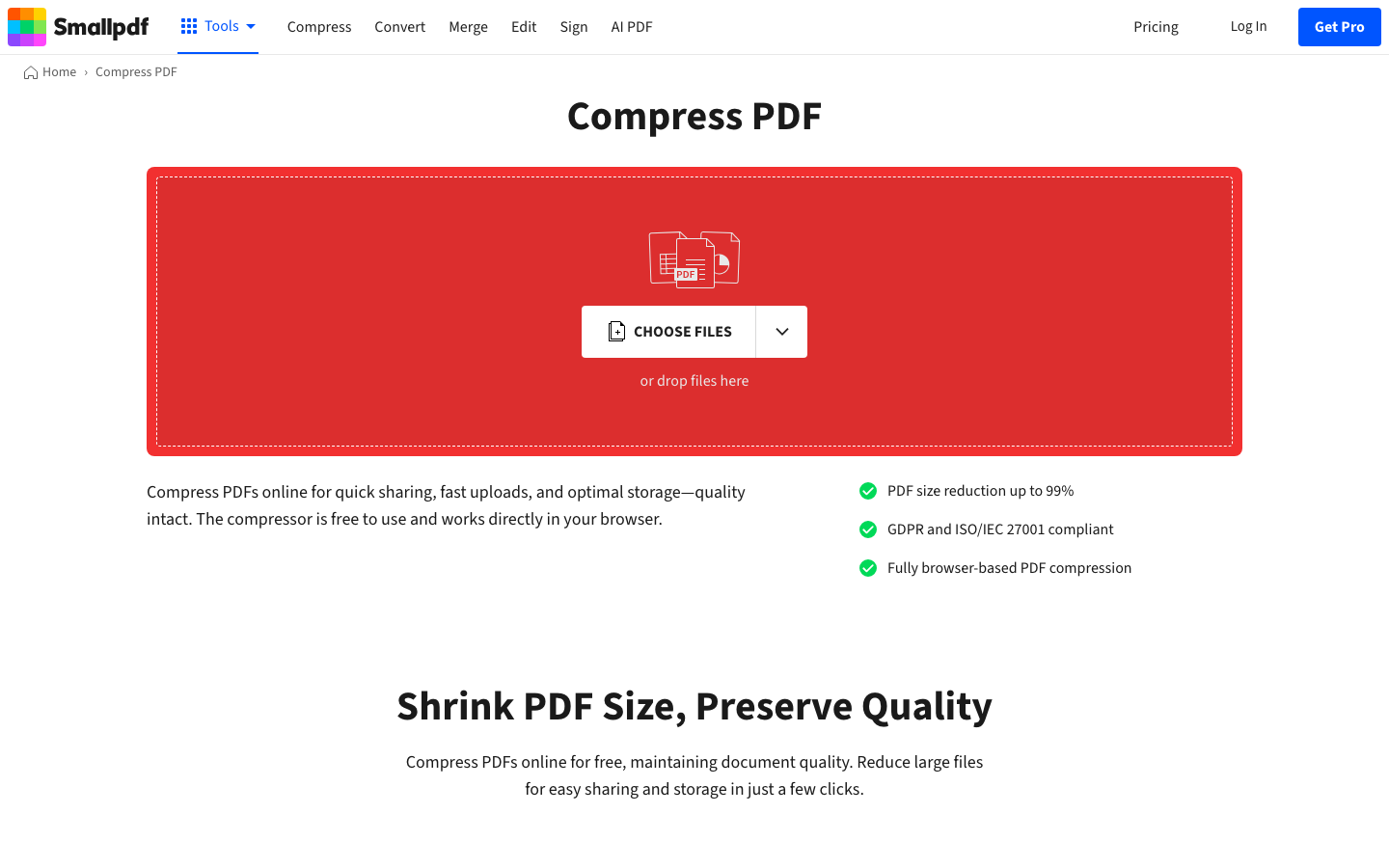
Smallpdf remains the cleanest occasional-use option: drop the file, download the result. The free plan currently takes files up to 5 GB and allows 2 compressions a day, with only the Basic level free; Moderate and Strong compression sit behind Pro. Files are deleted after 1 hour, transfers run over TLS, and the company holds GDPR and ISO/IEC 27001 credentials.
Pick it when you have one ordinary PDF and no patience for settings. The 2-a-day cap and paid stronger modes are the whole catch.
iLovePDF
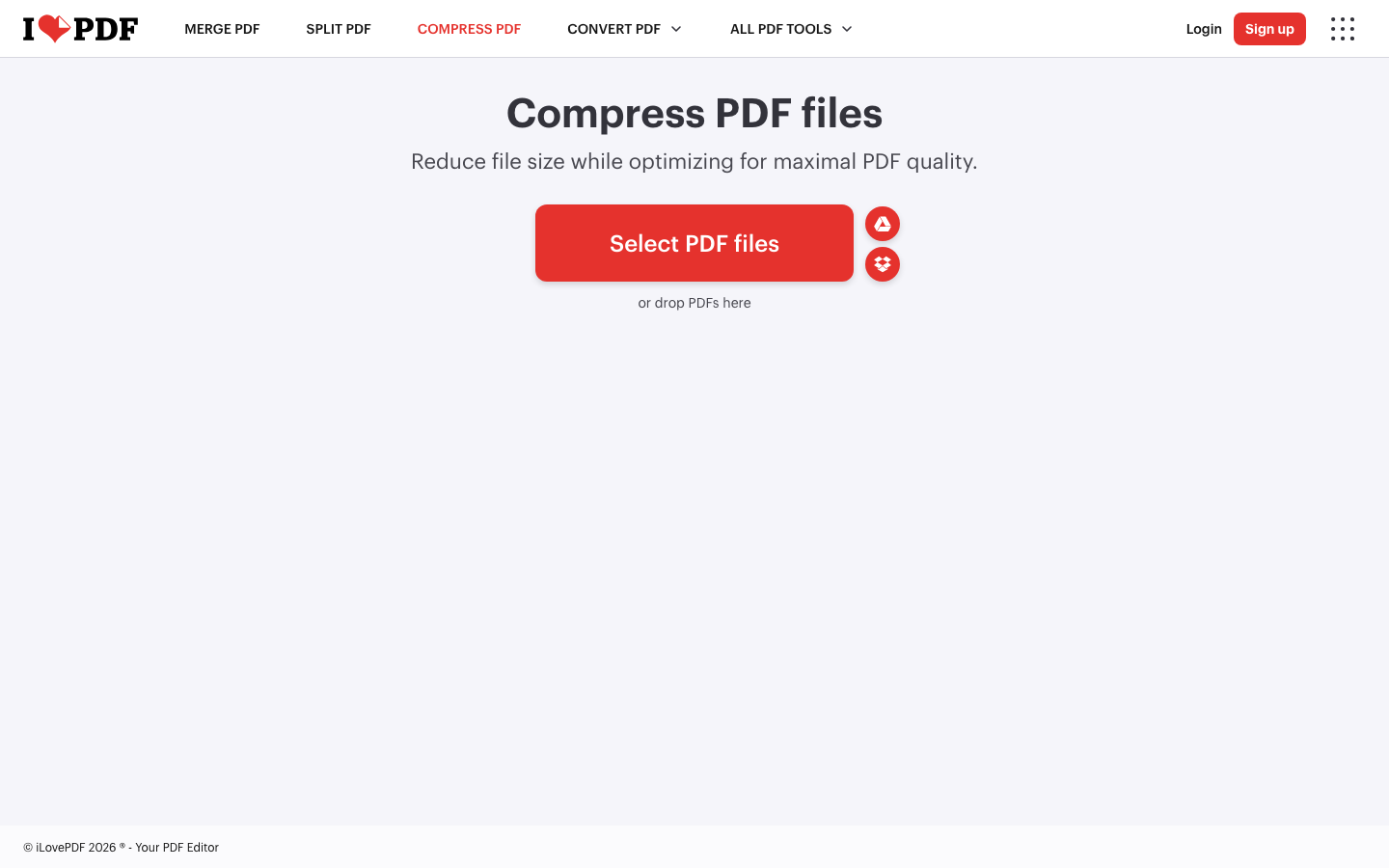
iLovePDF gives you 3 quality choices free, Extreme, Recommended, and Less Compression, and its current free compression task takes up to 2 files at up to 200 MB each, far beyond the 25 MB folklore that older articles still repeat. Uploads are deleted within 2 hours, and the company states it does not inspect file contents.
The 200 MB ceiling makes it the browser pick for long scanned documents that other free tiers reject.
PDF24 Tools
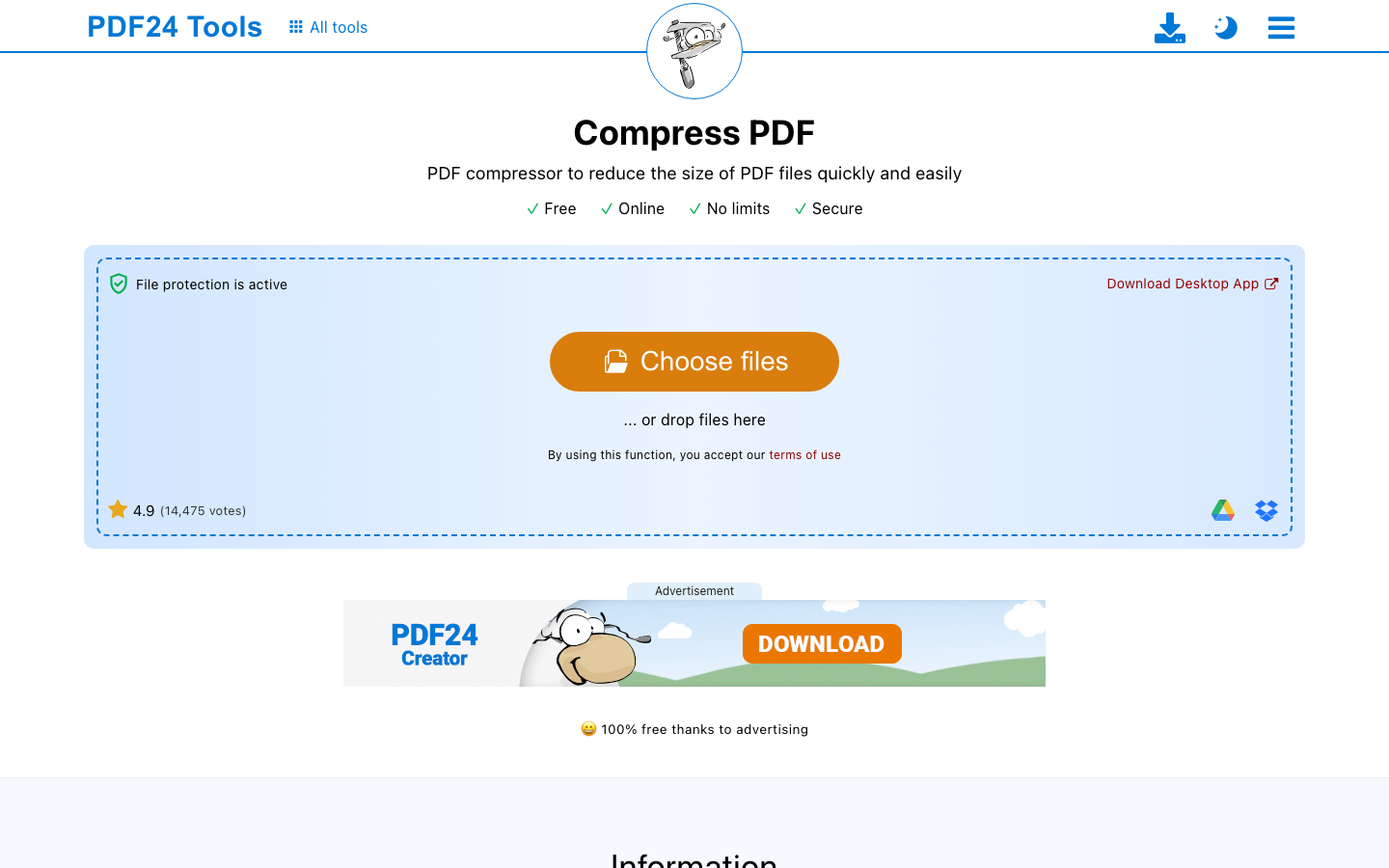
PDF24 Tools is the control-panel option: no registration, no task limits, and real knobs, target DPI, image quality, and structural switches for deduplicating streams, subsetting fonts, stripping metadata, flattening forms, and removing annotations. Processing happens on servers in Germany with deletion after 1 hour.
Its sibling, PDF24 Creator, is a free offline Windows application that keeps files on your machine entirely. The two share a brand, not a processing model: Tools uploads, Creator doesn’t. For Windows users with recurring compression work, Creator is the best free answer there is.
PDFgear
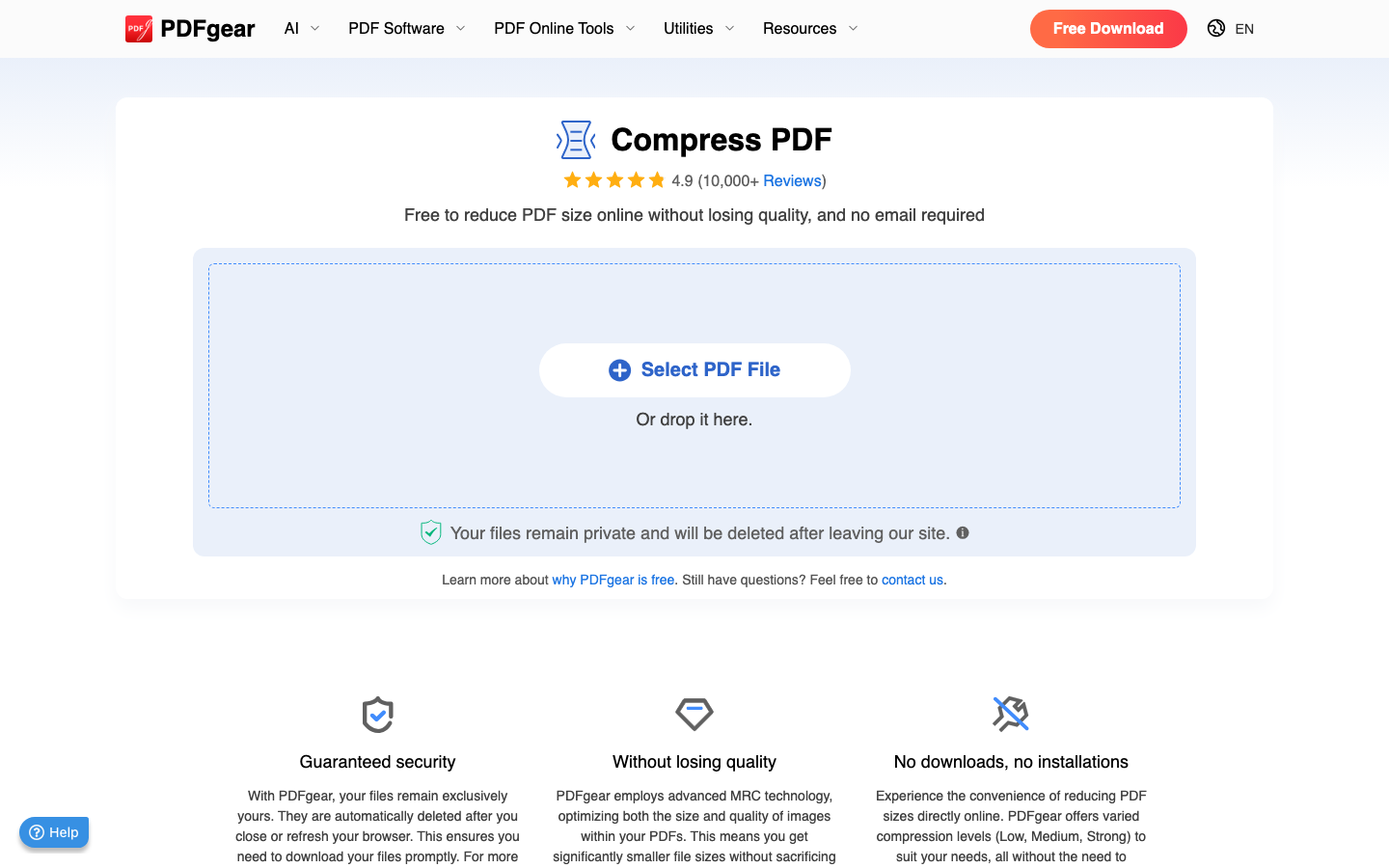
PDFgear offers 3 compression levels with no signup, a 100 MB limit on the online tool, and genuinely free desktop apps with no stated size limit that work offline. Online files are processed on AWS servers in the United States, and the vendor’s own pages give inconsistent deletion timings, 20 minutes, on browser close, and immediately after download, across the same page, which is worth knowing rather than guessing about.
PDFgear also ships AI features elsewhere in the product; if a file is confidential, use its offline desktop app or read the current privacy terms before uploading. For everyone else, the desktop version quietly being free with no limit is the story.
Adobe Acrobat online
Adobe’s online compressor handles files up to 2 GB with High, Medium, and Low settings, in the browser and on mobile. It’s a competent default from the company that owns the format; the main annoyance is how hard the flow steers you toward an Acrobat account and trial.
How to reduce PDF file size on a Mac
Preview compresses locally, free, with nothing uploaded:
- Open the PDF in Preview.
- Choose File > Export.
- In the Quartz Filter menu, choose Reduce File Size.
- Save under a new name, keeping the original.
Apple’s own documentation warns that quality and resulting size vary, and in practice the built-in filter is aggressive on image-heavy files. Current Preview also offers separate export options, a linearized PDF, screen-optimized images, and JPEG image saving, so the old one-filter-no-choices description undersells it. If you compress PDFs on a Mac weekly and want per-file control, PDF Squeezer (₹1,299 on the Indian Mac App Store, $19.99 in the US) or PDF Expert ($79.99 a year, or a $139.99 lifetime Mac license) are the paid upgrades; for occasional use, Preview plus a browser tool covers it.
How to reduce PDF file size on iPhone
Clearing up a mistake this article used to make, along with half the internet: the Files app’s Compress command creates a ZIP archive. The PDF inside that ZIP is byte-for-byte the same PDF, so nothing was optimized. Unzip it and you’re back where you started.
The real built-in route on current iOS versions is Apple’s Preview app: open the PDF in Preview, choose Export, select PDF, and drag the file-size slider to trade size against quality, all processed on the phone. On older iPhones without that workflow, use one of the browser tools above in Safari, or PDFgear’s app. Android has no system compressor; PDF24 or iLovePDF in Chrome is the practical answer there.
Ghostscript and qpdf: the command line, with a real benchmark
Ghostscript rewrites the entire PDF through its own engine. That makes it scriptable and powerful, and it also means the output is a rebuilt document: metadata, annotations, structure tags, and other non-visible information may not survive, there’s no guarantee the file even gets smaller, and no preset is lossless, including /prepress, whatever older guides claim. Ghostscript’s own documentation says the closest output to the original usually comes from omitting the preset entirely.
Instead of quoting percentages from nowhere, here’s what current Ghostscript 10.07.1 and qpdf 12.3.2 actually did on macOS to 2 of my own LaTeX-produced book PDFs, both text-and-math documents with few raster images:
| Command | 858 KB textbook PDF | 264 KB notes PDF |
|---|---|---|
| gs -dPDFSETTINGS=/screen | 119 KB (86% smaller) | 121 KB (54% smaller) |
| gs -dPDFSETTINGS=/ebook | 119 KB (86% smaller) | 143 KB (46% smaller) |
| gs -dPDFSETTINGS=/printer | 126 KB (85% smaller) | 155 KB (41% smaller) |
| gs -dPDFSETTINGS=/prepress | 1,050 KB (22% larger) | 152 KB (42% smaller) |
| gs, no preset | 899 KB (5% larger) | 152 KB (42% smaller) |
| qpdf –object-streams=generate –recompress-flate | 857 KB (under 1% smaller) | 245 KB (7% smaller) |
3 lessons fall straight out of that table. The /prepress preset made one file 22% larger, so treat every claim that it’s the lossless or highest-quality choice as wrong. The /screen and /ebook results were identical on the textbook because the savings came from rebuilding fonts and streams, not images, and your file will behave differently from mine. And qpdf’s structural cleanup, real lossless-style optimization, saved almost nothing on files that were already tightly built, which is the honest ceiling of lossless work on a well-made PDF.
The workhorse command, with the warning built in: run it on a copy, then check fonts, links, bookmarks, and print output before using the result.
gs -sDEVICE=pdfwrite -dPDFSETTINGS=/ebook -dNOPAUSE -dQUIET -dBATCH -sOutputFile=output.pdf input.pdfFor structural cleanup without intentional image degradation, qpdf is the safer tool:
qpdf --object-streams=generate --recompress-flate --compression-level=9 input.pdf output.pdfOne correction for the record: PDFsam Basic, often recommended in lists like this one, does not compress PDFs at all. It splits, merges, rotates, extracts, and mixes; compression lives in the paid PDFsam Visual. Use PDF24 Creator or the commands above for free offline compression instead.
How to reach a target file size
There is no universal minimum. A short text document may drop below 500 KB easily; a scanned book, portfolio, or illustrated report may stay at several megabytes unless you accept visibly worse images. Portals that demand 1 MB or 2 MB uploads are asking for image degradation on anything scanned, and that’s a tradeoff, not a tool failure.
- Under 5 MB: usually reachable for most documents with a Recommended or Medium setting.
- Under 2 MB: text documents yes; scans need stronger image compression and a quality check afterward.
- Under 1 MB: practical for mostly-text PDFs; expect visible loss on scans and photo-heavy decks.
- Under 500 KB or 100 KB: realistic only when the original is small and mostly text. For a scan, rescan at lower resolution or accept aggressive settings.
For scanned PDFs specifically, the biggest lever isn’t the compressor, it’s the scan: reducing the scan resolution to 150 or 200 DPI in grayscale usually beats any post-hoc compression of a 600 DPI color scan.
Why PDF files get large, and the fix nobody uses
The usual culprits: high-resolution photos or scanned pages, the same image embedded repeatedly, full font files instead of subsets, embedded source or editing data left behind by the exporting app, incremental saves stacked on incremental saves, OCR layers, transparency, and unused objects. Images are usually most of the bytes, which is why image handling decides the outcome.
The fix nobody uses: compress the source, not the PDF. If the Word, PowerPoint, Pages, or InDesign file still exists, resize the photos to the dimensions actually used, keep logos and diagrams as vectors, subset fonts on export, delete hidden slides and comments, and export a fresh PDF with the screen or print preset you actually need. One clean export beats 3 rounds of recompression, and recompressing an already-compressed PDF stacks artifacts on artifacts.
What compression can break
A compressed PDF can look right and work wrong. Before distributing one, check:
- Searchable and selectable text, and OCR accuracy on scans
- Hyperlinks, internal navigation, and bookmarks
- Fillable form fields and any calculations
- Annotations, comments, and attachments
- Embedded fonts and special characters
- Accessibility tags and reading order
- Print dimensions and color, especially CMYK artwork
- Digital signatures: rewriting a signed PDF can flag it as modified or invalidate the signature. Compress before signing, or work from an unsigned copy.
And the one rule that prevents every disaster on this list: never overwrite the original. Save the reduced-size PDF under a new filename and open it in a second reader before sending it anywhere.
Are online compressors safe for confidential files?
It depends on the document, not on a slogan. The mainstream tools publish real retention terms: Smallpdf and PDF24 delete after 1 hour, iLovePDF within 2, and PDF24 processes in Germany while PDFgear uses AWS in the US with inconsistent published timing. A short retention window reduces exposure; it does not make a consumer upload tool appropriate for regulated or contractual material. Match the route to the document:
| Document | Recommended route |
|---|---|
| Public brochure or handout | Any browser compressor |
| Resume or application PDF | Browser or offline, depending on the personal details inside |
| Client work under NDA | Offline tool (Preview, PDF24 Creator, Ghostscript) |
| Signed agreement | Compress before signing, never after |
| Medical, financial, payroll, or identity records | Offline, or an organization-approved enterprise service |
| Print-ready artwork | Re-export from the source with printer-approved settings |
| Recurring business batches | Local scripted workflow (Ghostscript or qpdf) |
Frequently asked questions
Can I compress a PDF without changing any content?
Only through structural cleanup, the qpdf route, which recompresses streams and removes unused objects without touching image data. On a well-made PDF that typically saves little; in my benchmark it saved under 1% on one file and 7% on another. Every large reduction involves changing image data.
Why did compression make my PDF blurry?
The tool downsampled or recompressed the page images, which is how large reductions work. Rerun it with a gentler setting, PDF24’s DPI controls or iLovePDF’s Less Compression, or accept the original size. For scans, a lower-resolution rescan usually looks better than heavy post-compression.
Why did my PDF get larger after compression?
Because compressors rebuild the file, and rebuilding can cost more bytes than it saves. Ghostscript’s /prepress preset made one of my test files 22% larger. If a tool grows your file, try a different preset or tool, and keep the original.
How do I make a PDF smaller than 1 MB?
Mostly-text PDFs get there with any Recommended or Medium setting. Scanned or photo-heavy PDFs need aggressive image compression and a quality check afterward, and some simply can’t reach 1 MB intact. There is no tool that hits a target size without a quality trade on image-heavy files.
Can every PDF be compressed below 500 KB?
No. That’s realistic when the original is relatively small and mostly text. A scanned book or an illustrated report may stay in the megabytes unless you accept visible degradation or rescan at lower resolution.
Does compressing a PDF remove searchable text?
Real text layers usually survive, but OCR layers on scans can be damaged by aggressive processing, and Ghostscript’s rebuild can drop structure and tags. Always test text selection and search on the compressed copy before sharing it.
Will compressing a PDF invalidate its digital signature?
It can. A signature is tied to the document’s exact state, and rewriting the file can make readers report it as modified after signing or invalidate it outright. Compress before signing, or compress an unsigned copy.
How do I compress a PDF offline?
Apple Preview on a Mac, PDF24 Creator on Windows, PDFgear’s desktop apps, or Ghostscript and qpdf on the command line. Offline is the right default for anything confidential.
How do I compress a PDF on an iPhone without creating a ZIP?
Use Apple’s Preview app on current iOS: open the PDF, choose Export, select PDF, and adjust the file-size slider. The Files app’s Compress command only makes a ZIP archive around the unchanged PDF.
Does PDFsam Basic compress PDFs?
No. PDFsam Basic splits, merges, rotates, extracts, and mixes pages. Compression is part of the paid PDFsam Visual. For free offline compression, use PDF24 Creator, Apple Preview, or Ghostscript.
Is PDF24 Creator available on Mac?
No, it’s Windows-only. Mac users get the same offline result from Preview’s export filter, and command-line users can install Ghostscript with Homebrew for scriptable compression on any platform.
What’s the difference between Ghostscript, qpdf, and an online compressor?
qpdf does structural cleanup without touching images, small and safe. Ghostscript rewrites the whole document with configurable image handling, powerful and worth validating. Online compressors run mostly lossy image optimization on a server, convenient for non-sensitive files within each tool’s limits.
Which compressor should you use?
- One ordinary file, right now: Smallpdf or PDF24 in the browser.
- A long scan over 100 MB: iLovePDF’s 200 MB free limit.
- Control over DPI and quality: PDF24 Tools.
- Anything confidential: offline only, Preview on Mac, PDF24 Creator on Windows, PDFgear desktop, or the command line.
- On a Mac or current iPhone: Apple Preview, free and local.
- Recurring batches: Ghostscript with /ebook on copies, validated before use, or qpdf for safe structural cleanup.
Match the tool to the document, keep the original, and check the output. That’s the entire craft. For the rest of the browser toolkit, merging, splitting, and converting, see the no-install PDF toolkit, and students juggling study PDFs will find more in the best PDF apps for students. Best of luck.
Sources
Free limits, retention windows, and pricing come from each vendor’s current official pages: Smallpdf’s compress and security pages, iLovePDF’s pricing and security help, PDF24’s tool and Creator pages, PDFgear’s comparison page, Adobe’s online compressor page, Apple’s Preview and iPhone support documentation, Ghostscript’s VectorDevices documentation and optimization guidance, qpdf’s manual, PDFsam’s product pages, and the PDF Expert and Mac App Store pricing pages, checked August 26, 2026. The Ghostscript and qpdf benchmark numbers are from runs of gs 10.07.1 and qpdf 12.3.2 on macOS against 2 of my own book PDFs, with commands shown above so you can reproduce them on your files.
Tell Google you want more of this.
Add Gaurav Tiwari as a preferred sourceOne tap, and this site shows up more often in your own Top Stories, AI Overviews and AI Mode. Remove it any time.