
 by
by
You measure a table with a ruler marked in millimeters and get 1.5 meters. Your calculator, dividing that by three, insists the answer is 0.5000000 meters. But your ruler never knew the table to seven decimal places, so six of those digits are fiction. Significant figures are the rule set that stops you from claiming precision your measurements never had, and they are one of the first things every physics, chemistry, and engineering student has to get right.
This guide is a complete student reference. It covers what significant figures are, how precision differs from accuracy, the five counting rules with worked examples, how rounding works, and the arithmetic rules for carrying significant figures through multiplication, division, addition, and subtraction. There is a decision flowchart, a colour-coded cheat sheet, quick-reference tables, an upgraded calculator that counts and rounds for you, and a downloadable PDF at the end.
What Are Significant Figures?
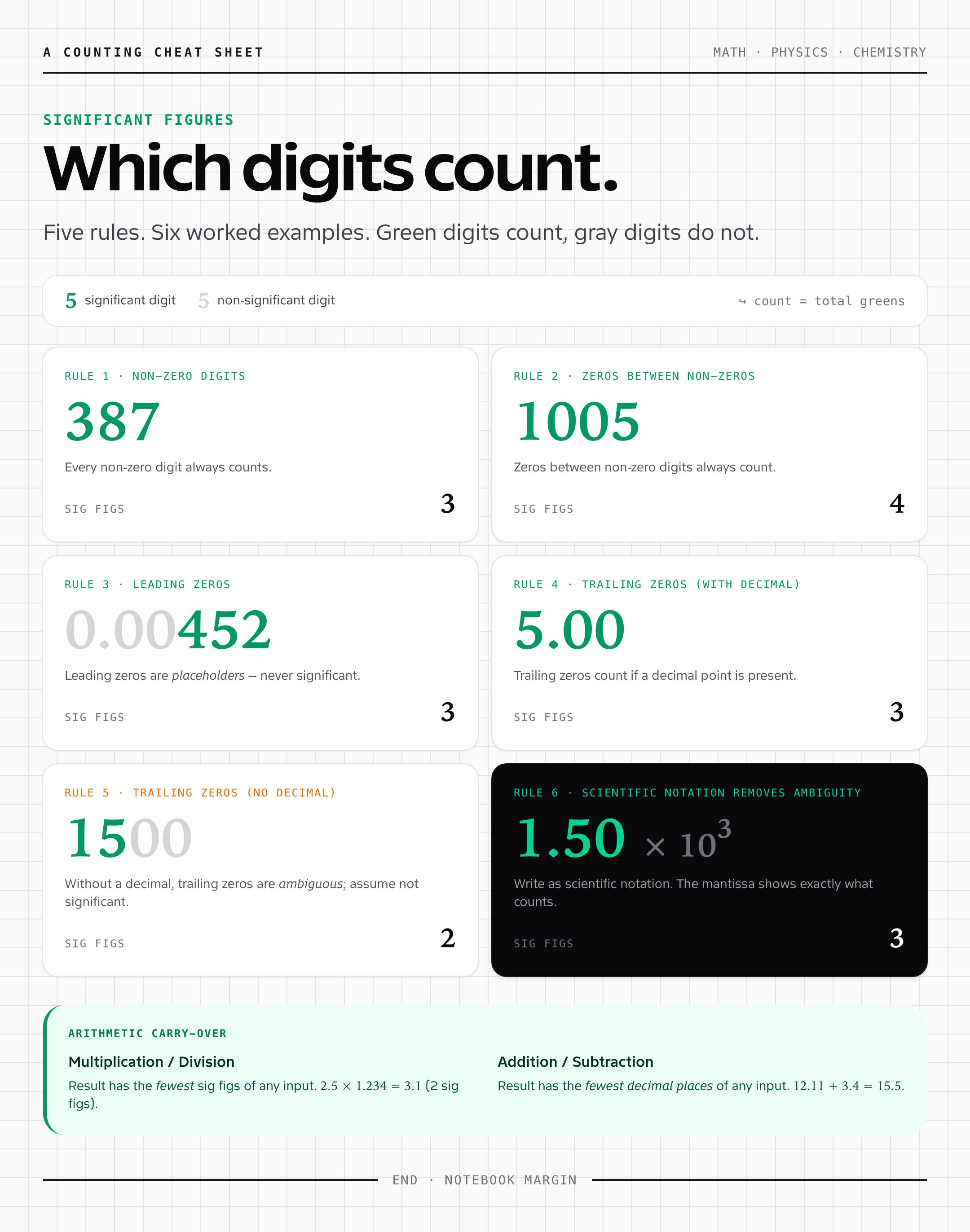
Significant figures (also called significant digits or sig figs) are the digits in a measured value that carry real information about its precision. They include every non-zero digit, any zeros trapped between non-zero digits, and any trailing zeros that sit after a decimal point. The placeholder zeros that only fix the size of a number, like the leading zeros in 0.0025, are not significant.
The core idea is honesty about precision. A measured number is a claim: writing 4.60 grams says you are confident to the nearest hundredth of a gram, while 4.6 grams only claims the nearest tenth. The count of significant figures is how you communicate that confidence to anyone reading your work, and getting the count right keeps a calculation from inventing precision at the end that no instrument supplied at the start.
This matters everywhere numbers come from measurement. In a chemistry titration, a physics lab, or an engineering tolerance, the significant figures travel with the number and cap how precise the final answer is allowed to be. For a broader tour of how numbers behave, see my overview of numbers in mathematics.
Precision vs Accuracy
Students mix these up constantly, and significant figures only make sense once they are separated. Accuracy is how close a measurement is to the true value. Precision is how close repeated measurements are to each other. They are independent: you can be precise and wrong, or accurate on average but scattered.
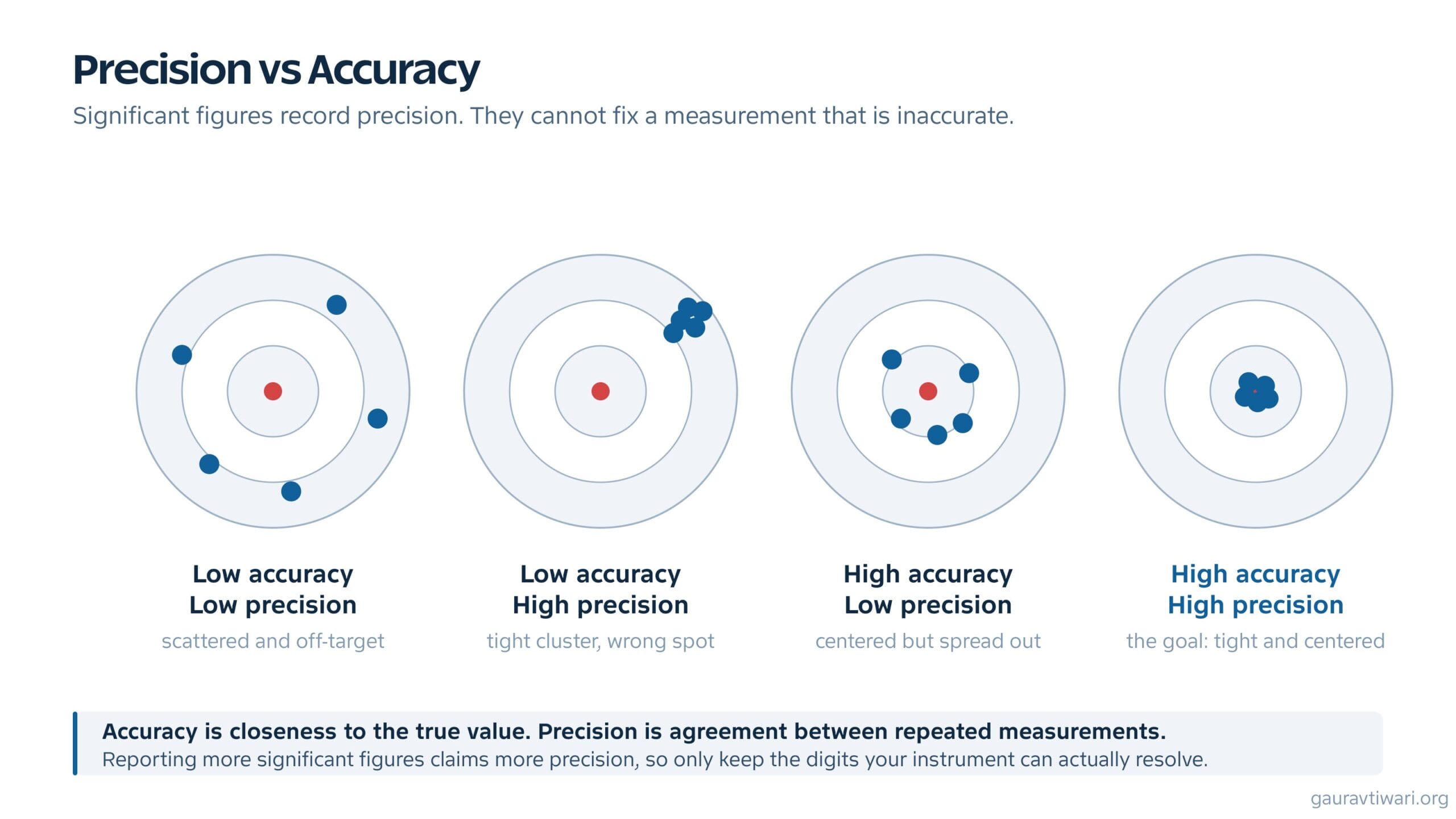
Significant figures are a statement about precision only. A number written to five significant figures claims fine precision, but it can still be badly inaccurate if the instrument was miscalibrated. That is the trap: reporting extra digits makes a measurement look more trustworthy without making it any closer to the truth. The honest rule is to keep exactly the digits your instrument can resolve, and no more.
This distinction runs through all of measurement science. My study note on units and measurements covers the surrounding vocabulary of error and uncertainty in more depth.
The Rules for Counting Significant Figures
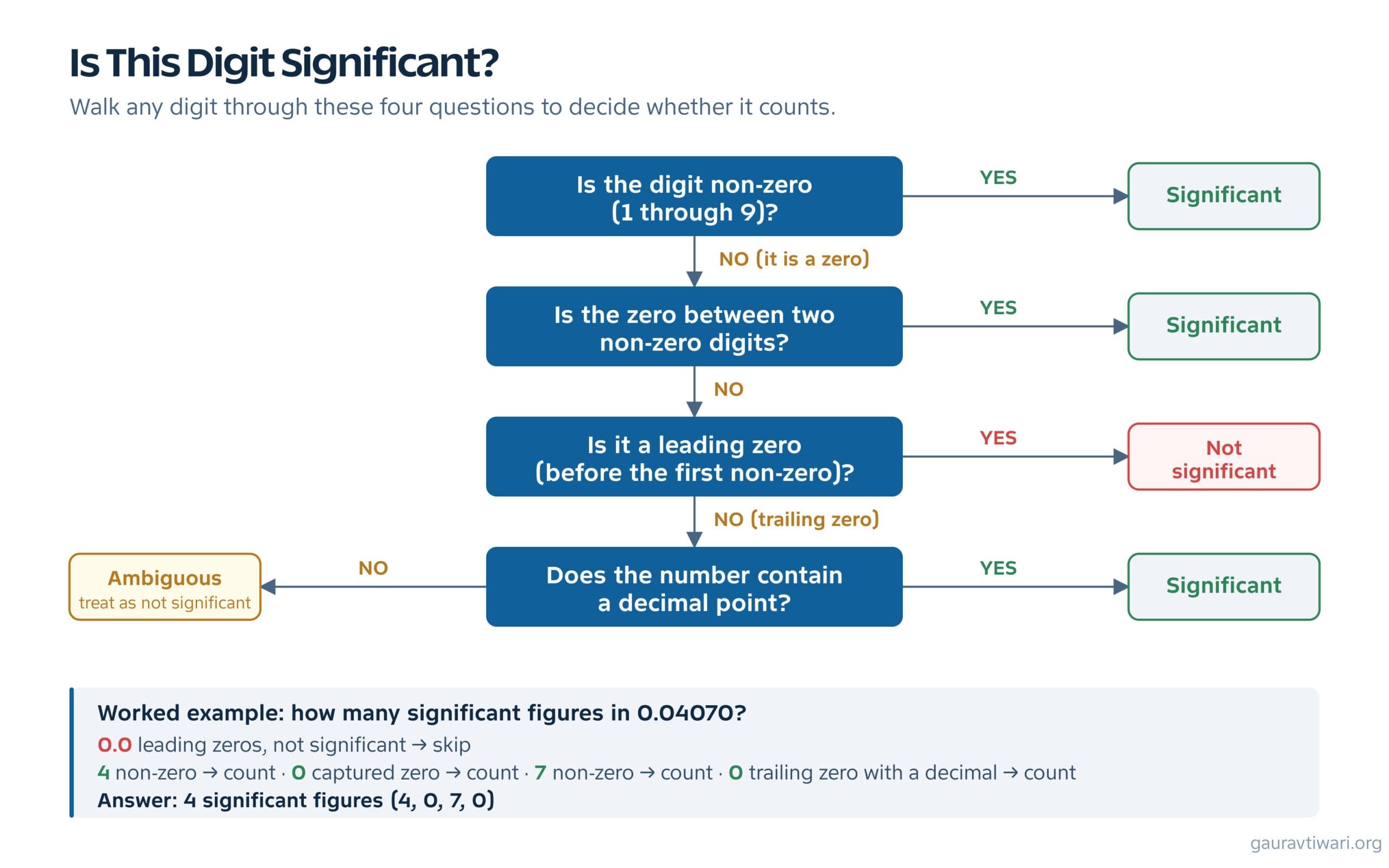
There are five rules, and every number you will ever meet is covered by them. The flowchart below turns the rules into four yes/no questions you can run any digit through.
| # | Rule | Example | Sig figs |
|---|---|---|---|
| 1 | All non-zero digits are significant | 48.29 | 4 |
| 2 | Zeros between non-zero digits (captive zeros) are significant | 50079 | 5 |
| 3 | Leading zeros are never significant | 0.000012 | 2 |
| 4 | Trailing zeros after a decimal point are significant | 0.0001200 | 4 |
| 5 | Trailing zeros with no decimal point are ambiguous, treated as not significant | 120000 | 2 |
Rule 5 is the one that causes arguments, because 120000 could genuinely mean two significant figures or six depending on the instrument. The standard convention is to treat trailing zeros without a decimal point as not significant, which is why scientific notation exists: writing \( 1.2 \times 10^5 \) fixes it at two significant figures, and \( 1.20000 \times 10^5 \) fixes it at six. No ambiguity survives once you use scientific notation.
Here are the five rules applied across a range of numbers so you can see each one working:
| Number | Significant figures | Which digits count |
|---|---|---|
| 48.29 | 4 | 4, 8, 2, 9 (all non-zero) |
| 7.003 | 4 | 7, 0, 0, 3 (captive zeros count) |
| 0.00420 | 3 | 4, 2, 0 (leading zeros out, trailing zero in) |
| 5000 | 1 | 5 only (trailing zeros, no decimal) |
| 5000. | 4 | 5, 0, 0, 0 (decimal point makes them count) |
| 0.030040 | 5 | 3, 0, 0, 4, 0 |
| \( 6.022 \times 10^{23} \) | 4 | 6, 0, 2, 2 (mantissa only) |
That last row is Avogadro\’s number, a staple of every chemistry course. My study note on Avogadro\’s number shows why the mantissa carries the significant figures and the power of ten does not.
Significant Figures in Scientific Notation
Scientific notation writes a number as a mantissa between 1 and 10 multiplied by a power of ten:
$$ N = m \times 10^{e}, \qquad 1 \le |m| < 10 $$
The rule is simple and worth memorizing: only the mantissa carries significant figures. The power of ten is just a scale factor and never counts. This is exactly why scientists prefer it. Every digit you write in the mantissa is significant, so the ambiguity of rule 5 disappears completely.
| Ordinary form | Scientific notation | Sig figs |
|---|---|---|
| 0.0000546 | \( 5.46 \times 10^{-5} \) | 3 |
| 1200 (2 sf) | \( 1.2 \times 10^{3} \) | 2 |
| 1200 (4 sf) | \( 1.200 \times 10^{3} \) | 4 |
| 93000000 | \( 9.3 \times 10^{7} \) | 2 |
| 299792458 | \( 2.998 \times 10^{8} \) | 4 (rounded) |
If you want to practise converting numbers into and out of this form, my standard form calculator handles the conversion both ways.
Rounding to Significant Figures
Rounding to a set number of significant figures is a three-step routine. First, count from the left to your target number of significant figures. Second, look at the very next digit. Third, drop everything from that digit onward, rounding the last kept digit up if the dropped part is 5 or more, and leaving it alone if it is less than 5.
- Locate the last significant digit you want to keep, counting from the first non-zero digit.
- Look at the next digit. If it is 5 or greater, round up. If it is 4 or less, round down (leave the kept digit unchanged).
- Replace dropped whole-number digits with zeros as placeholders, and simply delete dropped decimal digits.
Worked through a single number, rounding 3.14159 to successive precisions:
| Round 3.14159 to | Look at next digit | Result |
|---|---|---|
| 4 sig figs | 5 (round up) | 3.142 |
| 3 sig figs | 1 (round down) | 3.14 |
| 2 sig figs | 4 (round down) | 3.1 |
| 1 sig fig | 1 (round down) | 3 |
One subtlety worth knowing: when the digit you drop is exactly 5 with nothing after it, many science courses use round half to even (banker’s rounding) to avoid a systematic upward bias. Under that convention 2.5 rounds to 2 and 3.5 rounds to 4, always toward the nearest even digit. For everyday coursework the simpler round-half-up rule is fine, but it is good to know the even rule exists.
Significant Figures in Calculations
This is where significant figures earn their keep, and where students lose the most marks. The rule you apply depends on the operation, and multiplication/division uses a different rule from addition/subtraction. Round only at the very end, never at intermediate steps, to avoid compounding rounding error.
Multiplication and Division
The result keeps as many significant figures as the input with the fewest significant figures. Count sig figs in each factor, take the smallest count, and round the answer to that many.
$$ 4.56 \times 1.4 = 6.384 \longrightarrow 6.4 $$
Here 4.56 has three significant figures and 1.4 has two, so the smaller count wins and the answer is rounded to two significant figures: 6.4. The calculator’s 6.384 is technically dishonest because 1.4 never justified that much precision.
Addition and Subtraction
This rule is different: the result keeps as many decimal places as the input with the fewest decimal places. You count decimal places here, not significant figures.
$$ 12.11 + 0.3 + 1.014 = 13.424 \longrightarrow 13.4 $$
The term 0.3 has just one decimal place, so the sum is rounded to one decimal place, giving 13.4. It does not matter that 1.014 has four significant figures; the least precise decimal place sets the limit.
The two rules side by side, since mixing them up is the single most common sig-fig error:
| Operation | What you count | Answer matches the input with the fewest |
|---|---|---|
| Multiplication | Significant figures | significant figures |
| Division | Significant figures | significant figures |
| Addition | Decimal places | decimal places |
| Subtraction | Decimal places | decimal places |
These carry-over rules are essential once measurements feed into formulas. They show up constantly in physics, for instance throughout the kinematic equations where measured distances and times combine into velocities and accelerations.
Exact Numbers: When Sig Figs Do Not Apply
Not every number in a calculation is a measurement, and exact numbers have unlimited significant figures. They never limit the precision of a result. Three kinds of exact numbers come up often:
- Counted quantities. If you count 24 students in a room, that is exactly 24, not 24 plus or minus anything. It has infinite significant figures.
- Defined constants. There are exactly 100 centimeters in a meter and exactly 12 items in a dozen. These definitions carry no measurement uncertainty.
- Integer factors in formulas. The 2 in \( C = 2\pi r \) is exact; only the measured radius and the value you use for \( \pi \) limit the precision.
So when you multiply a measured 3.7 cm radius by the exact factor 2, only the 3.7 (two significant figures) constrains the answer. The exact 2 sits out of the sig-fig accounting entirely.
Common Mistakes to Avoid
- Rounding at every step. Rounding intermediate results compounds error. Carry a guard digit or two through the whole calculation and round only the final answer.
- Using the sig-fig rule for addition. Addition and subtraction follow the decimal-places rule, not the significant-figures rule. Counting sig figs on a sum is the classic error.
- Counting leading zeros. The zeros in 0.0047 are placeholders. They locate the decimal point and are never significant.
- Treating exact numbers as measurements. A counted or defined number never limits precision. Do not let a factor of 2 drag your answer down to one significant figure.
- Ignoring the ambiguity of trailing zeros. If you mean 1500 to three significant figures, write \( 1.50 \times 10^3 \). Left as 1500 it reads as two.
Significant Figures Calculator
Enter any number to count its significant figures instantly. Add a target number of significant figures to round it, and the calculator also returns the scientific notation, E-notation, and decimal-place count. It accepts ordinary decimals and scientific-notation input like 1.2e5.
Quick Reference Cheat Sheet
| Situation | Rule |
|---|---|
| Non-zero digits | Always significant |
| Zeros between non-zero digits | Always significant |
| Leading zeros | Never significant |
| Trailing zeros with a decimal point | Significant |
| Trailing zeros without a decimal point | Ambiguous, treated as not significant |
| Scientific notation | Only the mantissa counts |
| Multiplication and division | Match the fewest significant figures |
| Addition and subtraction | Match the fewest decimal places |
| Exact (counted or defined) numbers | Infinite significant figures; never limit the result |
Frequently Asked Questions
What are significant figures?
Significant figures are the digits in a number that carry real measurement information: all non-zero digits, any zeros between non-zero digits, and any trailing zeros after a decimal point. Leading zeros and ambiguous trailing zeros without a decimal point are not significant. They tell you how precise a measured value is.
How do I count significant figures quickly?
Start from the first non-zero digit on the left and count every digit to its right, including captive zeros and trailing zeros that follow a decimal point. Skip leading zeros entirely. For a number like 0.04070 you skip the leading zeros and count 4, 0, 7, 0, giving four significant figures.
What is the difference between significant figures and decimal places?
Significant figures count all meaningful digits in a number, while decimal places count only the digits after the decimal point. The value 0.0520 has three significant figures but four decimal places. Multiplication and division use significant figures; addition and subtraction use decimal places.
Are trailing zeros significant?
It depends on the decimal point. Trailing zeros after a decimal point are significant, so 2.500 has four significant figures. Trailing zeros in a whole number with no decimal point are ambiguous and conventionally treated as not significant, so 2500 reads as two. Use scientific notation to remove the ambiguity.
What is the significant figures rule for multiplication and division?
The answer keeps as many significant figures as the factor with the fewest significant figures. For example, 4.56 (three sig figs) times 1.4 (two sig figs) gives 6.384 on a calculator, which you round to 6.4 to match the two significant figures of the least precise input.
What is the rule for addition and subtraction?
The answer keeps as many decimal places as the term with the fewest decimal places. For example, 12.11 + 0.3 + 1.014 = 13.424, which rounds to 13.4 because 0.3 has only one decimal place. Note that this rule counts decimal places, not significant figures.
Do exact numbers have significant figures?
Exact numbers, such as counted quantities (24 students) or defined values (100 cm in a meter), have infinite significant figures and never limit the precision of a result. Only measured values constrain how many significant figures your final answer can have.
Why are significant figures important?
They keep a calculation honest about precision. A measurement records only as much detail as the instrument can resolve, and significant figures stop the arithmetic from inventing extra precision at the end. In physics, chemistry, and engineering, reporting too many digits overstates the reliability of your result.
Download This Guide as a PDF
Prefer to study offline? The full guide is available as a printable PDF, with every rule, table, and worked example laid out for revision or the lab. Grab it below.
Enter your email and I'll send the PDF straight to your inbox. Free and print-friendly.
Significant figures reward a little discipline: count from the first non-zero digit, keep the rules for multiplication and addition straight, round only at the end, and reach for scientific notation whenever trailing zeros get ambiguous. Get those habits down and your answers will always claim exactly as much precision as your measurements earned, no more and no less.
Tell Google you want more of this.
Add Gaurav Tiwari as a preferred sourceOne tap, and this site shows up more often in your own Top Stories, AI Overviews and AI Mode. Remove it any time.
Browse more in Mathematics · Physics.