by
by
The best SpyFu alternatives depend on what you are replacing. Competitor ad research, backlink analysis, technical audits and daily rank tracking are different jobs, and I would choose the tool that handles your main job well rather than the one with the longest feature list.
So start with the reports you open most, the country you target and the limits you actually hit. A low starting price tells you very little when the report you need sits in another subscription or a higher tier, and switching costs more than the subscription itself once you count the exports, the overlap month and the learning curve.
SpyFu has also changed more than most comparison pages admit. Every paid plan now includes a site audit and its AI tools start at Pro + AI, so the first question is whether you need to switch at all. The seven paid alternatives below are grouped by the job each one does, followed by eight free resources for individual tasks.
SpyFu Alternatives at a Glance
Find your main research job in the table, then jump to that tool. The plan column matters more than the price, because several of these tools put the feature you want one tier above their entry plan.
| Tool | Research job | Plan that covers it | Billing basis | Main limitation | Official pricing |
|---|---|---|---|---|---|
| Semrush | SEO and PPC research in one platform | SEO plan, plus the Advertising toolkit for ad research | Monthly or annual; toolkits billed separately | Ad research is a separate toolkit; historical data starts at Pro+ | Semrush plans |
| Ahrefs | Organic and backlink research | Lite for core research; Standard for Content Explorer | Monthly or annual | Tracked keywords update weekly by default | Ahrefs pricing |
| SE Ranking | Daily rank tracking and client SEO | Core; Agency Pack for white label | Monthly or annual | Agency features and AI search tracking are add-ons | SE Ranking pricing |
| Mangools | Simple keyword research | Basic or Premium; Agency for daily tracking | Monthly or annual | No competitor ad-history research | Mangools plans |
| Serpstat | Keyword clustering and technical research | Team for JavaScript rendering and AI tools | Monthly or annual | The Individual plan leaves out rendering and AI | Serpstat plans |
| Ubersuggest | Low-cost keyword and site research | Individual for one site | Monthly, annual or lifetime | Prices change by region; lifetime plans are non-refundable | Ubersuggest pricing |
| Similarweb | Traffic and market context | Competitive Intelligence | Monthly or annual | Short history on entry plans; ad research costs more | Similarweb plans |
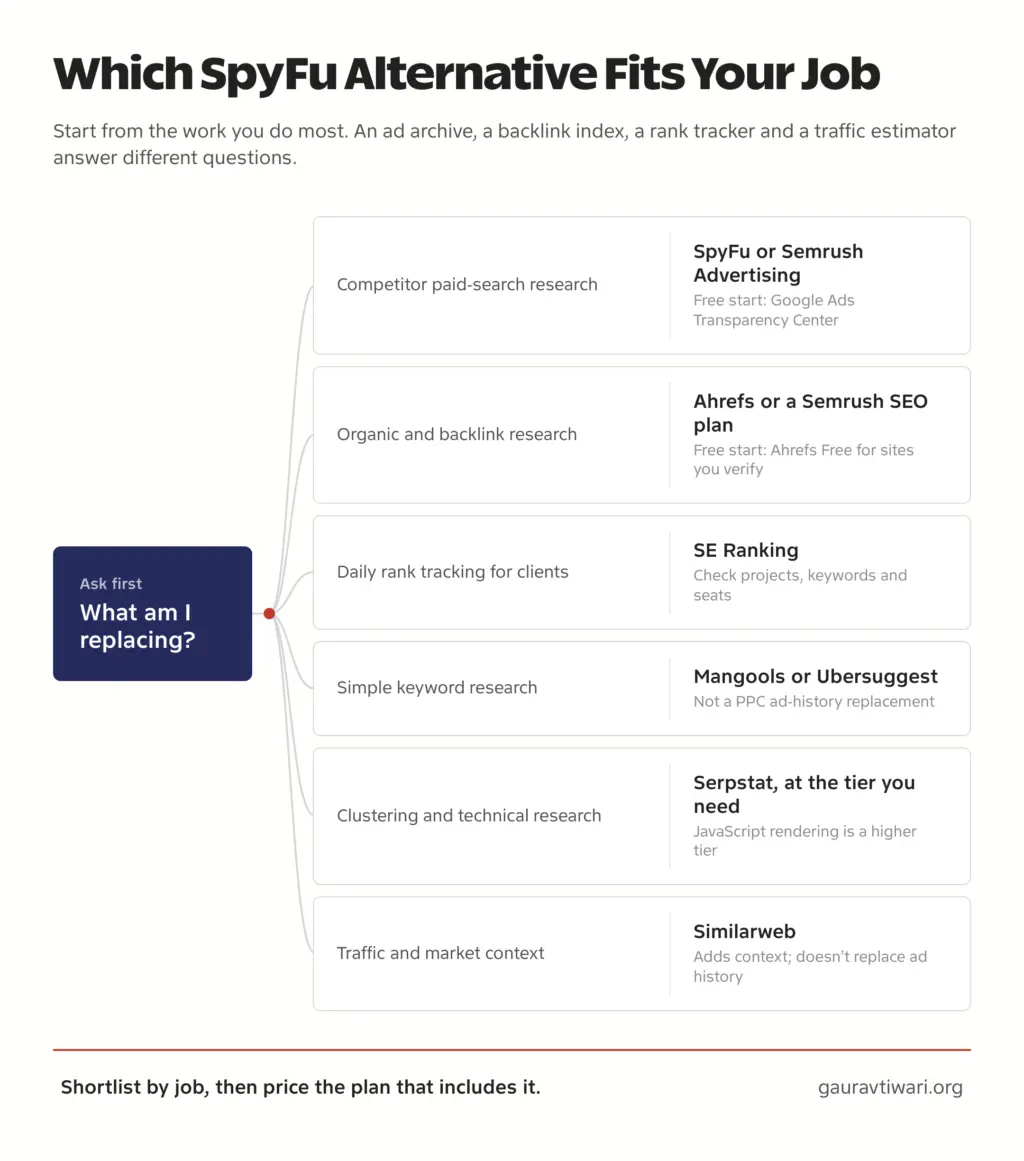
If you only need part of what SpyFu does, the free resources below may cover it without another subscription.
Free download: the SEO Playbook 2026
The complete system in one 57-page ebook: SEO, AEO, and GEO. How search actually works now, the technical base, content that ranks, links that hold, getting cited by AI, and the 90-day cadence that makes it all compound. The SEO Audit Checklist and Guest Posting Swipe File are included as appendices.
Enter your email and I’ll send the PDF straight to your inbox.
What to Check Before Replacing SpyFu
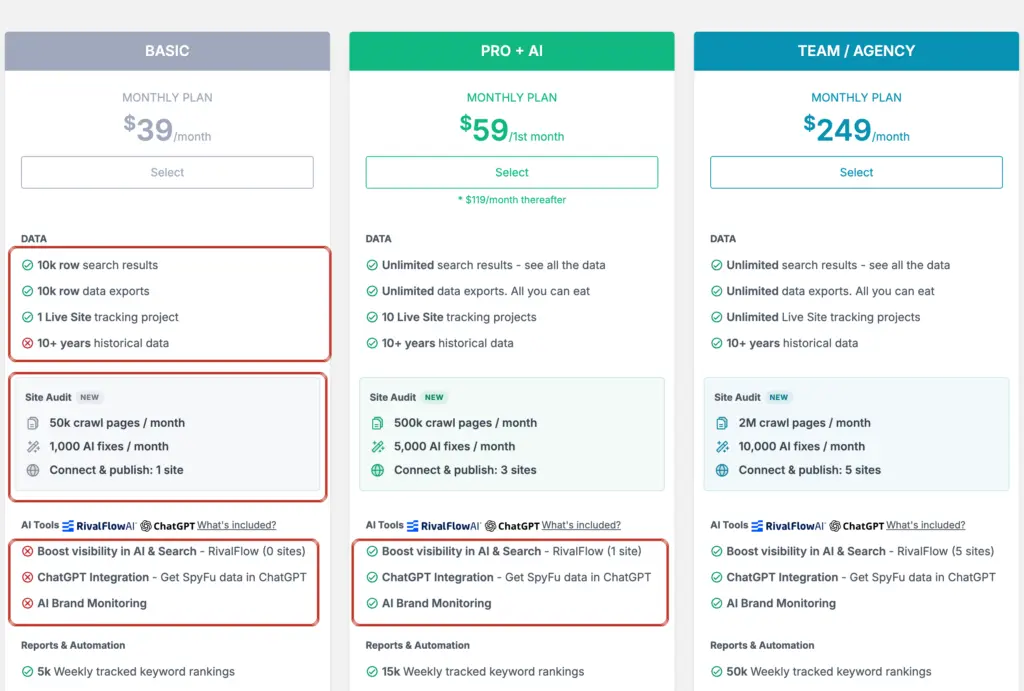
Many SpyFu comparisons in 2026 still describe a keyword-spy tool with no audits and no AI. That is no longer accurate. SpyFu’s current pricing page lists three paid plans, and the differences between them matter more than the differences between SpyFu and some of its rivals:
- Basic costs $39 a month, or $29 a month billed annually. It returns and exports up to 10,000 rows per search, tracks one site and leaves out the 10+ years of historical data.
- Pro + AI costs $59 for the first month and $119 a month after that, or $89 a month billed annually. It removes the row limits and adds the historical data and the AI tools.
- Team/Agency costs $249 a month, or $187 a month billed annually, with 5 users and unlimited tracking projects.
- Every paid plan includes the new Site Audit, from 50,000 crawled pages and 1,000 AI fixes a month on Basic.
- RivalFlow, the ChatGPT integration and AI brand monitoring are built for Pro + AI and above; on Basic they are missing or limited.
- Tracked keyword rankings update weekly on every plan.
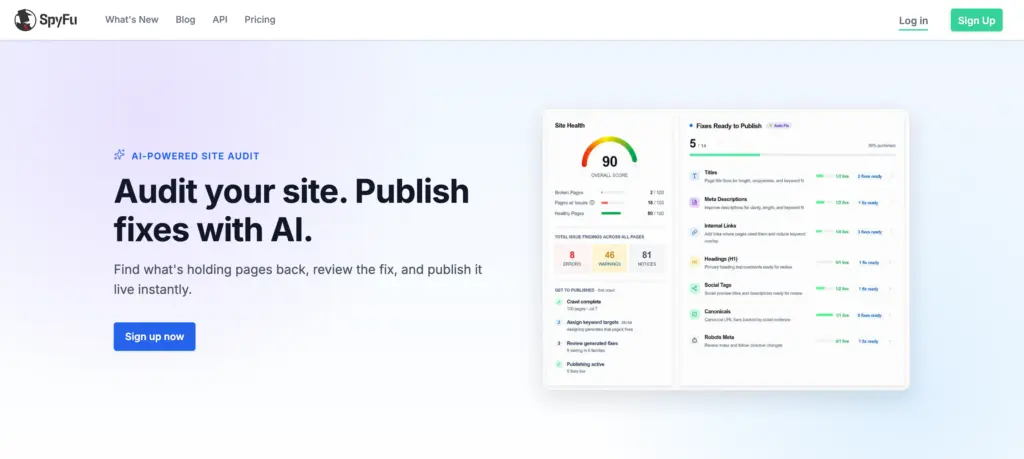
SpyFu’s Site Audit crawls your site, scores its health and drafts fixes for titles, meta descriptions, internal links and headings that you can review and publish. So “SpyFu has no audits” is no longer a reason to leave. Whether its audit is good enough for your site is a separate question, and one I would answer with a crawl of your own domain before paying for a second tool.
Two more facts change the decision for readers outside the US. SpyFu collects data in 32 countries, including India, the UK, Canada and Australia, but a listed country is not the same as equal depth, so test your own keywords there. And every budget, cost-per-click and traffic figure in SpyFu, as in every tool on this page, is an estimate built from observed data.
When to Stay With SpyFu
I would keep SpyFu when competitor paid-search research is your main job and its reports already answer your questions. Its PPC history, ad copy archive and Kombat comparison are still its core strengths, and Pro + AI now covers audits and AI visibility work too.
Switching makes sense when you can name a specific gap: you need daily rank tracking, deeper backlink data, a country SpyFu doesn’t cover well, or a workflow another tool handles better. A longer feature list alone is not a gap. Paying more for capabilities you won’t use is just a more expensive way to do the same research.
Paid SpyFu Alternatives
These seven tools solve different tasks, so they are grouped by what they replace. For each one I have noted the plan that actually includes the feature, because the entry plan rarely does everything the marketing page shows.
Semrush
Semrush: Your Unfair Advantage for Growing Brand Visibility
Semrush is the leading platform to grow and measure brand visibility across AI search, SEO, PPC, social, and more.
Semrush is the tool I would shortlist when you want SEO and PPC research in one platform. Its organic research, backlink analytics, Site Audit and daily Position Tracking sit in the main plans, and its Advertising toolkit covers competitor ads, ad history and PPC keyword research.
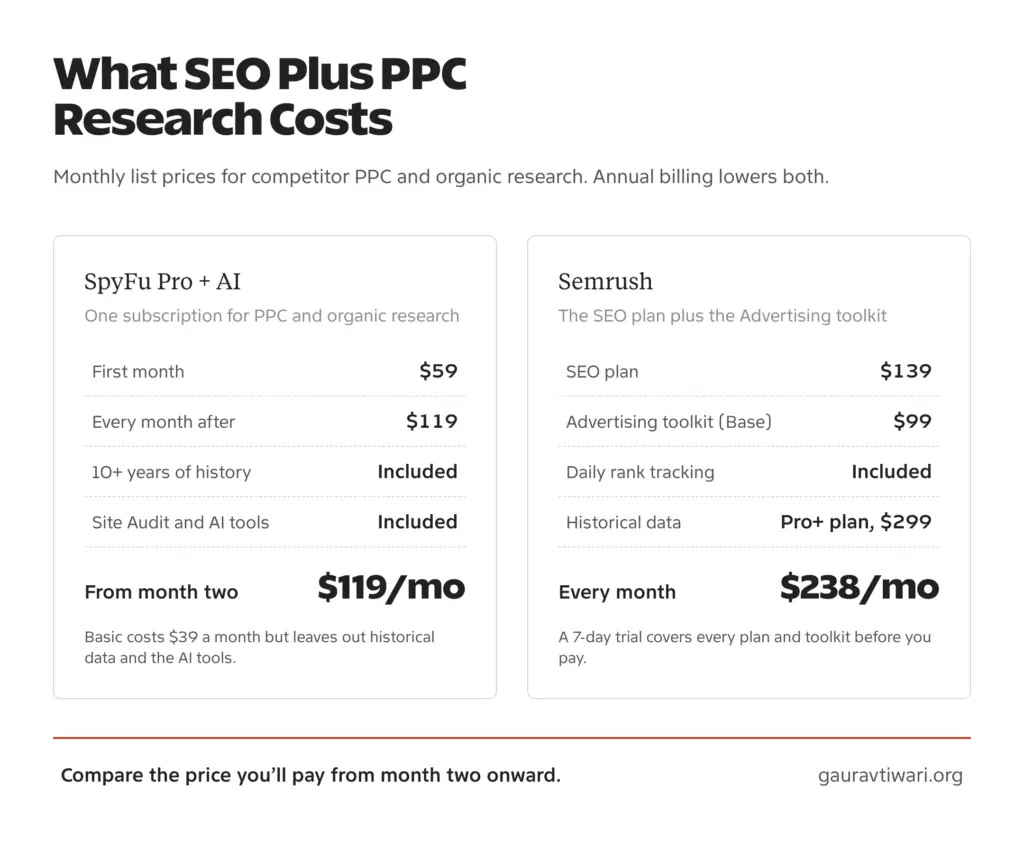
The catch is packaging. Semrush’s current plans are SEO at $139 a month, Starter at $199, Pro+ at $299 and Advanced at $549, and historical data starts at Pro+. The Advertising toolkit is a separate subscription from $99 a month. So a fair comparison with SpyFu’s combined PPC and SEO research is two subscriptions, not one.
- Best for: teams that want SEO, PPC, content and local research in one account
- Plan to check: SEO plan for organic work; Advertising toolkit for competitor ads; Pro+ for historical data
- Trial: 7 days on every plan and toolkit
- Limitation: the bill grows quickly once you add toolkits, seats and history
If you want the deeper walkthrough, my Semrush review covers the platform report by report.
Ahrefs
Ahrefs: AI Marketing Platform Powered by Big Data
We help marketers drive visibility across AI search, SEO, content, and social, with the largest AI and search databases online.
Ahrefs is the alternative I would pick for organic and backlink research and outreach. Site Explorer, Keywords Explorer and its backlink index are the reasons people pay for it, and they answer questions SpyFu’s PPC-first reports don’t try to.
Ahrefs pricing starts with Starter at $29 a month, then Lite at $129, Standard at $249 and Advanced at $449. Match the tier to the report you need: Content Explorer starts at Standard, and the lower tiers have tighter limits on history and credits.
- Best for: organic competitor research, content gaps and link prospecting
- Plan to check: Lite for core research; Standard for Content Explorer
- Rank tracking: weekly by default on every plan
- Limitation: no PPC ad-history archive like SpyFu’s
SE Ranking

SE Ranking: AI SEO Software That Gets Results
SE Ranking is a trusted AI SEO tool that pays for itself. Get accurate data, actionable insights, and automated reports. Powerful tools, simple execution.
SE Ranking belongs in this comparison for readers who need daily rank tracking and a broad SEO toolkit without Semrush’s price. Core costs $129 a month, or $103.20 a month billed annually, and tracks 2,000 keywords daily across 10 projects.
The bill depends on your workload. Growth costs $279 a month for 5,000 daily keywords and 30 projects, the Agency Pack for white-label reports adds $69 a month on annual billing, and AI search tracking is a separate $89 add-on. Price your actual projects and seats before calling it the cheaper option.
- Best for: freelancers and agencies running daily client rank tracking
- Plan to check: Core, plus the Agency Pack for client reporting
- Trial: 14 days, no card needed
- Limitation: its strength is tracking and audits, so test its PPC research against SpyFu on your own competitors
Mangools
Juicy SEO tools you will love – Mangools
Mangools SEO tools package. Productive keyword research, SERP analysis, rank tracking and backlink analysis thanks to super easy to use tools.
Mangools is the simpler choice when you mainly need keyword research and don’t want a large platform. KWFinder, SERPChecker, SERPWatcher, LinkMiner and SiteProfiler cover keyword ideas, SERP checks, rank tracking and basic link research.
Its current plans are Basic at $30.50 a month, Premium at $40.50 and Agency at $70.50, with much lower annual rates. Basic and Premium update tracked rankings weekly; only Agency tracks daily. Every plan now bundles AI search tracking, and the refund window is short at 48 hours.
- Best for: bloggers and small sites doing their own keyword research
- Plan to check: Basic or Premium; Agency for daily rank tracking
- Limitation: not a replacement for SpyFu’s competitor ad research
Serpstat
Serpstat is worth a look for keyword clustering, competitor research and technical audits at a mid-range price. Individual costs $69 a month, or $50 a month billed annually, and Team costs $129 a month, or $100 billed annually.
The tier matters here more than anywhere else on this list. JavaScript rendering in the Site Audit, the AI tools, the API and the ChatGPT and Claude integration all start at Team, so the $50 figure you see in comparisons does not include them.
- Best for: SEO teams that cluster large keyword sets and audit JavaScript-heavy sites
- Plan to check: Team, if you need rendering or AI features
- Trial: 7 days
- Limitation: the Individual plan leaves out the features most people compare it on
Ubersuggest
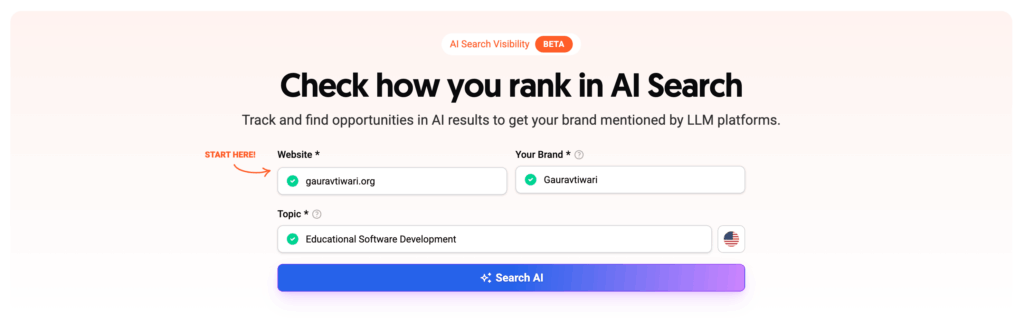
Ubersuggest is the low-cost entry point for keyword research, domain overviews, site audits and basic backlink data. It also has an AI search visibility check for brands, which is a different job from writing content with AI.
Prices change by region, so check the price shown for your country. Ubersuggest also sells lifetime plans, and its lifetime terms make them one-time and non-refundable, with the 7-day trial available only on monthly plans. Tracked rankings update weekly.
- Best for: beginners and small sites on a tight budget
- Plan to check: Individual for one site; the lifetime plan only after reading its terms
- Limitation: smaller data sets and no deep PPC history
Similarweb
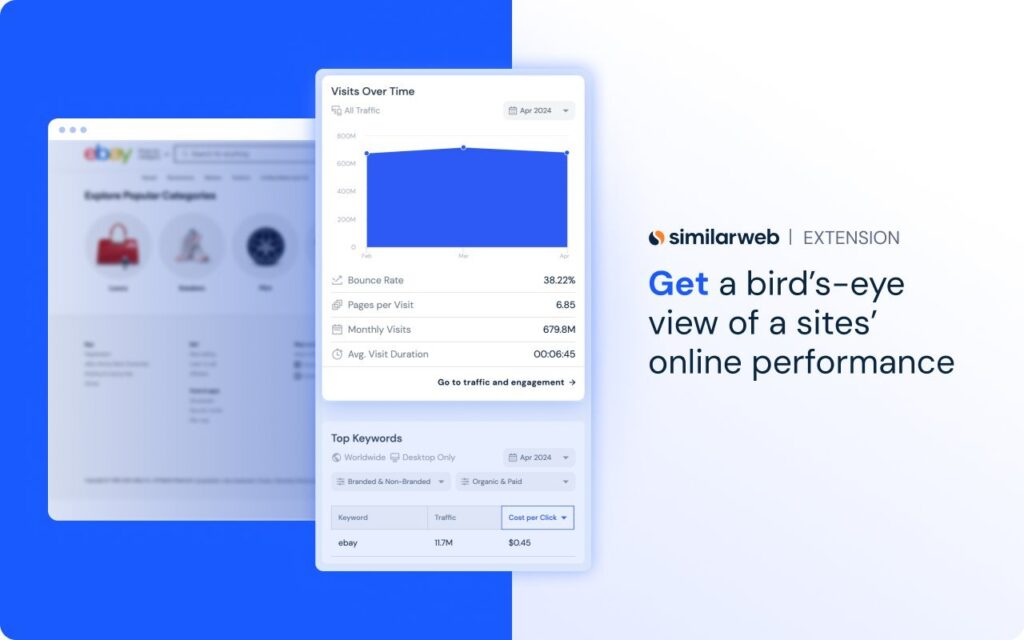
Similarweb answers a different question from SpyFu. SpyFu shows which keywords a competitor buys or ranks for; Similarweb estimates a site’s total traffic, its channel mix and how it compares with the market.
Its self-serve Competitive Intelligence plan costs $199 a month, or $125 a month billed annually, with 3 months of history. Adding SEO, AEO and rank tracking takes it to $399 a month, and the ads module to $649. I would run it alongside a PPC research tool.
- Best for: market research, competitive benchmarking and channel analysis
- Plan to check: Competitive Intelligence; the Ads plan only if ad research is the goal
- Limitation: short history on entry plans, and its figures are estimates
Free Resources for SEO and PPC Research
Free tools can replace individual tasks, but none of them recreates a complete historical competitor database. The first three help with PPC research; the rest cover your own search data, trends and technical checks. My guide on how to build a keyword list shows how they fit into a full workflow.
Google Ads Transparency Center
The Google Ads Transparency Center lets you search any advertiser or website and see its published Google ads by date, region and format. Before paying for an ad-research subscription, I would start here.
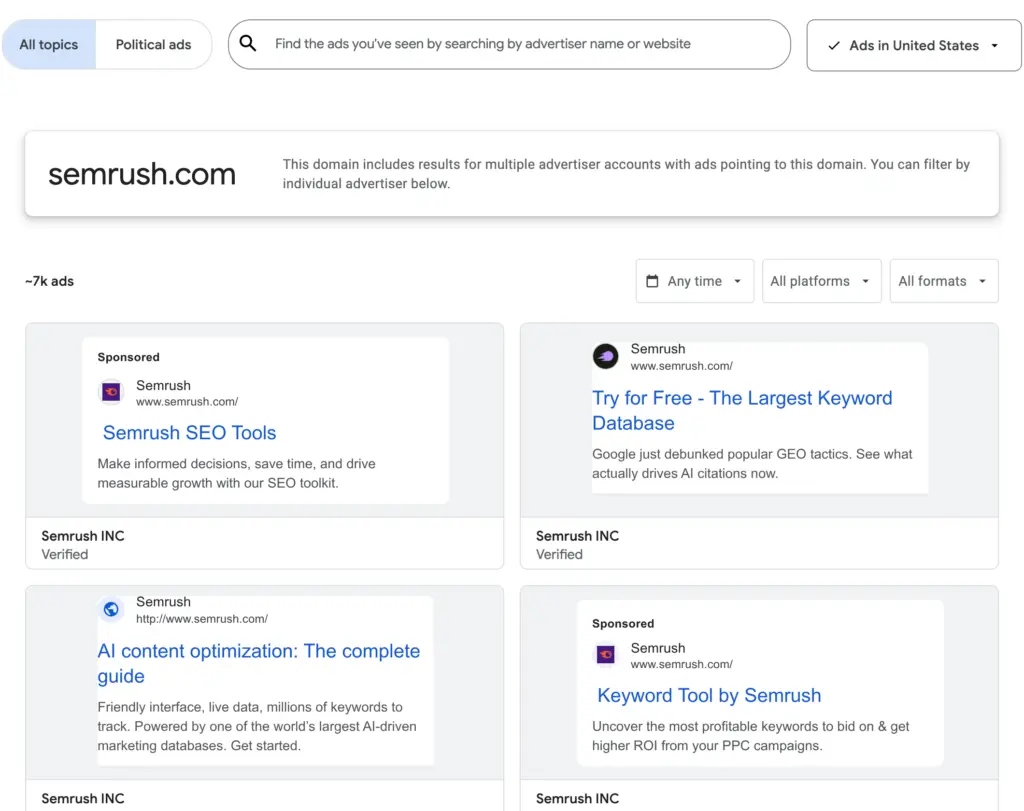
An ad creative shows the message only. It doesn’t show whether the ad converts, what it costs or which keywords trigger it, so use it to form research questions.
Google Keyword Planner
Research Keywords for Campaigns with Keyword Planner | Google Ads
Get your ads to the right customers with Google Ads Keyword Planner. Learn how to do keyword research and get strategic suggestions for your campaign.
Google Keyword Planner is useful for building a campaign keyword list with estimated searches, costs and forecasts. Google’s own documentation calls them estimates, and access needs a Google Ads account with setup completed.
Use it for discovery and planning. It is not a competitor ad archive, so pair it with the Transparency Center when you need to see what rivals are running.
Google Ads Auction Insights
If you already run Google Ads, Auction insights compares your eligible campaigns with the other advertisers appearing in the same auctions: impression share, overlap and outranking share. It only works for your own campaigns with enough activity, but for those it is real auction data.
Google Search Console
Google Search Console shows your own site’s clicks, impressions, queries and indexing. It is the most accurate organic data you can get for your domain, and it never shows a competitor’s numbers.
Google Trends
Google Trends compares relative interest and seasonality before you choose topics or campaign timing. Its numbers are normalized interest, not absolute search volume, so use it for direction and timing.
Ahrefs Free
Ahrefs Free gives you limited Site Explorer and Site Audit access for websites you verify, with no card and no time limit. It is a good way to see your own backlinks and technical issues, while competitor research stays limited.
Screaming Frog SEO Spider
The free edition of Screaming Frog SEO Spider crawls up to 500 URLs per crawl for technical checks such as broken links, redirects and missing metadata. JavaScript rendering, scheduling and unlimited crawls need the paid licence.
Bing Webmaster Tools
Bing Webmaster Tools reports your Bing search performance and includes keyword research and backlink data, including a comparison with up to two other sites. Here is how to set up Bing Webmaster Tools if you haven’t yet.
A practical free workflow for a new PPC campaign looks like this: check rivals’ messaging in the Transparency Center, build the keyword list in Keyword Planner and check seasonality in Trends. Use Search Console and a crawler to improve your own site. It won’t show which competitor ads are profitable, but it covers a lot of what people buy SpyFu for.
How to Compare Coverage and Data Freshness
No SEO tool has one universal update frequency. A tracked keyword, a newly found backlink, a competitor’s keyword list and an ad observation each refresh on their own schedule, so compare the report you will actually use.
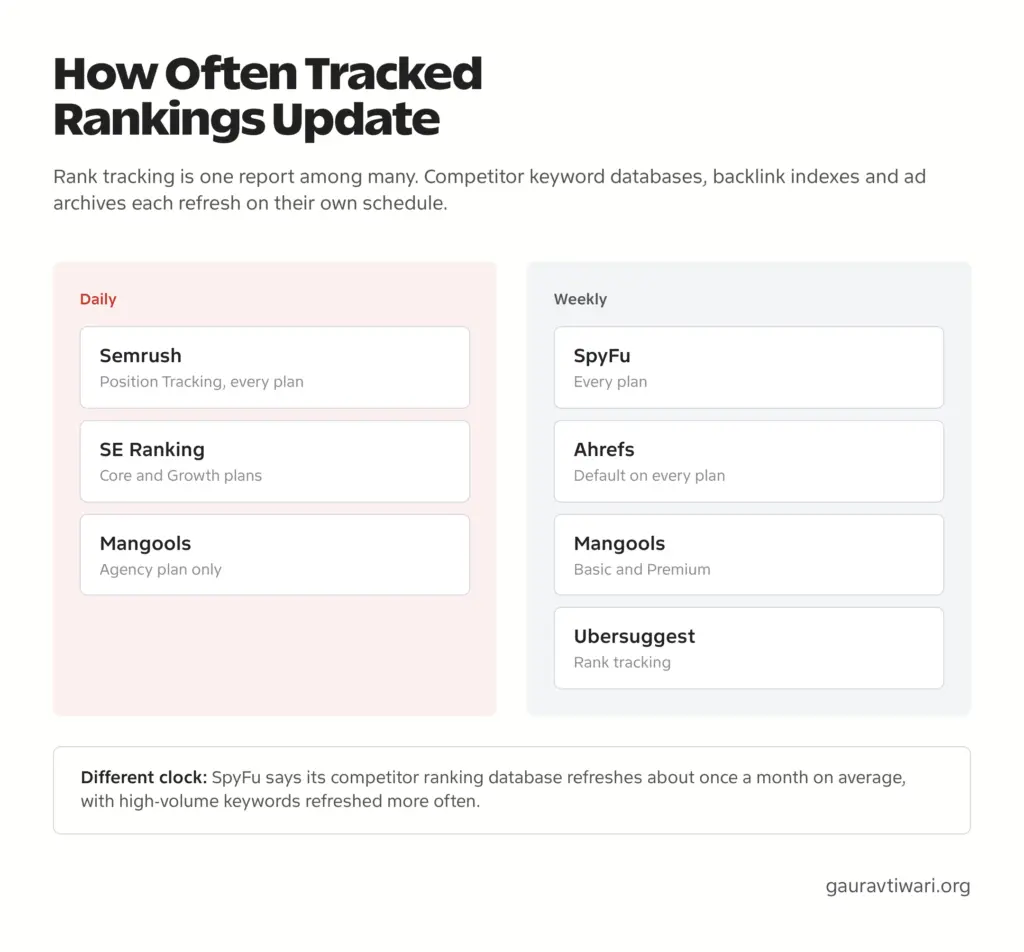
SpyFu, for example, tracks your keywords weekly but says its competitor ranking database refreshes about once a month on average, with high-volume keywords refreshed more often. Semrush updates Position Tracking daily. For PPC bidding decisions, your own campaign data and Auction insights beat any organic ranking table.
The fair way to compare is a small test on your own market. This is how I would run one before committing to an annual plan:
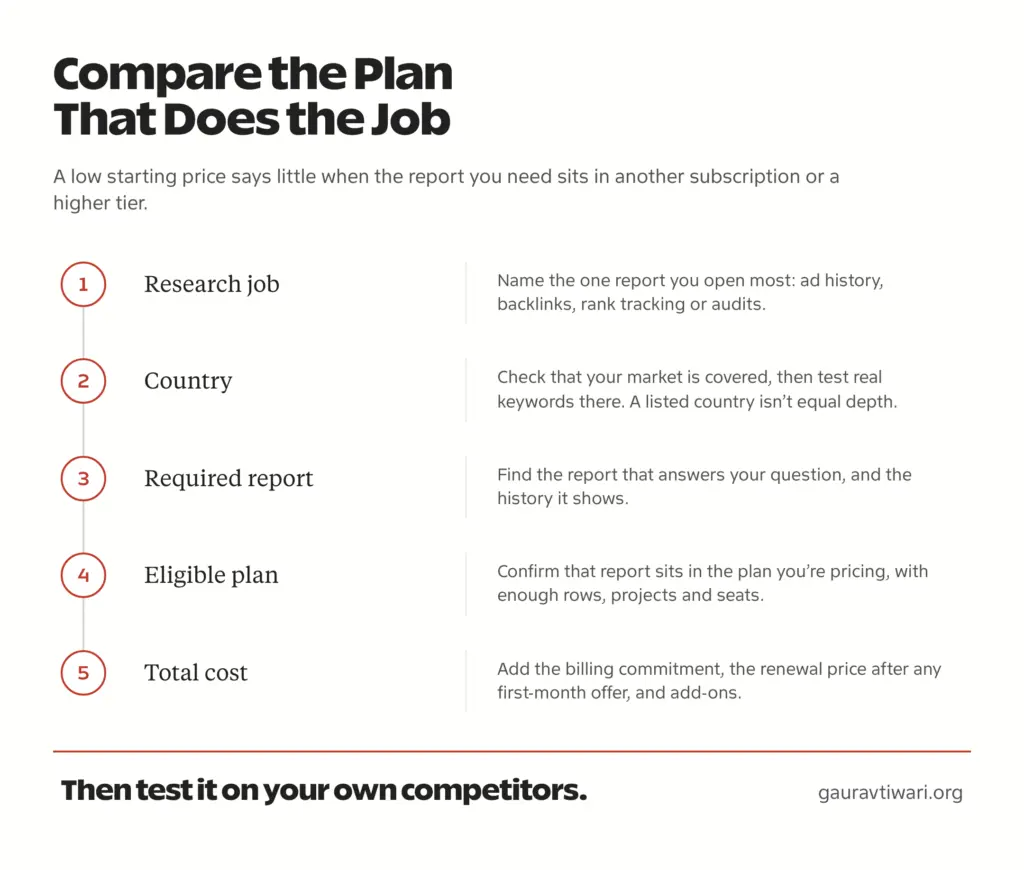
- Pick three competitor domains and about 20 keywords you care about, in the country you actually target.
- Run the same domains and keywords through SpyFu and the alternative on the same day, with the same country and device settings.
- Record what each tool found that was useful: an ad example, a content gap, a referring page or a technical issue.
- Note the row limits, history and exports you hit on the plan you would buy.
- Price that plan for a full year, including renewal, extra users and add-ons.
Count useful findings, because the length of a result list says little about accuracy. An empty result only means the tool didn’t find it in that test.
AI Features
Don’t reduce this decision to “has AI” versus “doesn’t.” Content optimization, AI brand monitoring, generated copy and querying your data through ChatGPT solve different problems, and most tools put them above the entry plan. SpyFu’s AI tools start at Pro + AI, Serpstat’s at Team and Semrush’s AI prompts at Starter.
If your goal is to measure AI visibility, check whether the tool shows the prompts and sources behind its score. If it is writing help, the AI SEO tools roundup covers dedicated options.
How to Move Your SpyFu Workflow
Moving between SEO tools takes more than cancelling one subscription. These are the steps I would follow, in order:
- Export keyword lists, competitor lists and reports while your plan still allows it. Basic caps exports at 10,000 rows per search.
- Save the country, device, date and match settings with each export, because a number means little without them.
- Rebuild competitor comparisons in the new tool using its own report names. Most tools have something like SpyFu Kombat, under a different name.
- Check whether historical rank data can be imported. Keep the old exports as a reference even when it can’t.
- Overlap the two tools only as long as the test needs. A trial or a single month is usually enough.
- Confirm renewal and cancellation terms. SpyFu offers a 30-day money-back guarantee and lets you cancel without a contract; annual plans elsewhere may not refund unused months.
FAQs on SpyFu Alternatives
What is the best SpyFu alternative in 2026?
It depends on the job. I would shortlist Semrush for a broad SEO and PPC platform, Ahrefs for organic and backlink research and SE Ranking for daily rank tracking. Check the plan that includes the report you need, then test it on your own competitors.
Are there free SpyFu alternatives?
There are free tools for parts of the workflow. The Google Ads Transparency Center shows competitors’ ads, Keyword Planner helps plan campaigns and Search Console reports your own organic data. None of them replaces a full historical competitor database.
Does SpyFu have a site audit now?
Yes. Every paid SpyFu plan includes Site Audit, from 50,000 crawled pages and 1,000 AI fixes a month on Basic. That makes audits available, not necessarily better than a dedicated crawler, so test it on your own site.
Does SpyFu work for India?
India is one of the 32 countries SpyFu collects data in. A listed country is not the same as complete coverage, so test your own keywords and competitors in the India database before relying on it.
Is every SpyFu plan unlimited?
No. Basic returns and exports up to 10,000 rows per search and leaves out historical data. Pro + AI and Team/Agency remove the row limits, though other quotas such as tracked keywords and audit pages still apply.
Does Ahrefs track rankings daily?
Not by default. Ahrefs updates tracked keywords weekly on every plan. Semrush and SE Ranking track daily, and Mangools does so only on its Agency plan.
Can a research tool show a competitor’s exact ad spend?
No. Budgets, costs and traffic in SpyFu and its alternatives are estimates built from observed data. Use them as research signals, not as the advertiser’s real spend or profit.
Which SpyFu alternative is cheapest?
There is no useful single answer, because a free own-site tool, an annual keyword plan and a monthly competitor-ad platform give you different access. Compare the cheapest plan that completes your task, at its renewal price.
Should I cancel SpyFu before testing a replacement?
I would export what your plan allows, test the replacement on the same domains and keywords, and check your renewal date first. SpyFu’s 30-day money-back guarantee helps if you have only just subscribed.
Choose the Tool That Answers Your Research Question
I would switch from SpyFu only after naming a specific gap: a missing report, weak coverage in your country, an export limit or a workflow another tool handles better. Compare that one task on the same domains, country and dates before paying for a longer commitment.
Free resources can cut how much paid software you need, and a broader subscription can also make sense. The goal is evidence you can use, at a price you will still be happy to pay in month two. For more options across the whole workflow, my list of the best SEO tools covers the broader toolkit.
Tell Google you want more of this.
Add Gaurav Tiwari as a preferred sourceOne tap, and this site shows up more often in your own Top Stories, AI Overviews and AI Mode. Remove it any time.
Disclaimer: This site is reader-supported. If you buy through some links, I may earn a small commission at no extra cost to you. I only recommend tools I trust and would use myself. Your support helps keep gauravtiwari.org free and focused on real-world advice. Thanks. - Gaurav Tiwari