
 by
bySemrush
Pros
- 55+ tools covering every aspect of digital marketing in one platform
- Industry-leading keyword database with 28.8 billion keywords
- Best competitive analysis toolkit available
- Content marketing suite helps plan, write, and distribute content
- Site Audit catches technical issues other tools miss
- 7-day free trial with full access to all tools
Cons
- Entry plan at $139/month is expensive for solo bloggers
- Interface has a learning curve due to the number of tools
- Lower plans have tight daily search limits
- Some tools like Social Media toolkit feel basic compared to dedicated alternatives
Summary
Semrush is the most comprehensive SEO and digital marketing toolkit I’ve used across 90+ client projects. With 55+ tools covering keyword research, competitive analysis, content marketing, site audits, and social media, it genuinely replaces 4-5 separate subscriptions. The entry SEO plan at $139/month is steep for beginners, but for professionals and agencies, it pays for itself within weeks.
Price: USD 139 /month
Try Semrush Free for 7 DaysPicking an SEO toolkit means betting real money on data you can’t verify before you pay. Most reviews dodge that by listing every feature and calling it a day. This one tells you exactly when Semrush is worth $139 a month and when it’s a waste.
Semrush has been the first tab I open on a new SEO job since 2018. This Semrush review is the honest version of what all that daily use taught me, updated for the plan overhaul that retired the old Pro, Guru, and Business tiers.
Verdict: Get Semrush if you’re a professional marketer, content creator, or agency. With 55+ tools it replaces 4-5 separate subscriptions (Moz, BuzzSumo, SpyFu, a rank tracker) and pays for itself within weeks. Skip it if you’re a beginner on a tight budget, only need rank tracking, or won’t use most of a toolkit this broad.
How I tested: I’ve used Semrush since 2018 on 90+ client projects at Gatilab, my content marketing agency. Every screenshot, number, and opinion below comes from real campaigns, not a marketing deck. I still pay for it today.
| What’s great | What’s not |
|---|---|
| 55+ tools cover SEO, content, PPC, and social in one login | Entry SEO plan ($139/mo) is steep for solo bloggers |
| Industry-leading keyword and backlink database (28.8B keywords) | Real learning curve because there are so many tools |
| Best-in-class competitive research and Site Audit | Lower plans have tight daily search and tracking limits |
| 7-day full-access free trial, cancel anytime | Trial needs a credit card; not mobile-friendly |
- Semrush vs Ahrefs: Semrush wins on breadth (55+ tools vs ~15, plus content and PPC). Ahrefs wins on backlink depth and a cleaner interface for link-focused work.
- Semrush vs Moz: Semrush has a bigger database, faster updates, and far more tools. Moz is simpler and cheaper, but I dropped it once Semrush covered the same ground.
- Semrush vs Mangools: Mangools is the budget pick for beginners. Semrush is the pro platform you grow into.
Free download: the SEO Playbook 2026
The complete system in one 57-page ebook: SEO, AEO, and GEO. How search actually works now, the technical base, content that ranks, links that hold, getting cited by AI, and the 90-day cadence that makes it all compound. The SEO Audit Checklist and Guest Posting Swipe File are included as appendices.
Enter your email and I’ll send the PDF straight to your inbox.
Semrush review overview
| Product | Semrush |
| Pricing | SEO: $139/mo | Starter: $199/mo | Pro+: $299/mo | Advanced: $549/mo (up to 17% off annual) |
| Best for | SEOs, content marketers, agencies, startup owners, growth hackers |
| Used for | SEO, keyword research, competitor analysis, content marketing, site audits |
| Free trial | 7-day full-access trial (credit card required) |
| Discount | Up to 17% off on annual plans |
| My rating | 4.7 / 5 |
What Semrush actually does
Semrush is an all-in-one digital marketing platform with 55+ tools spanning SEO, content marketing, competitive research, PPC, and social media. Think of it as your entire marketing stack behind one login.
I use it daily for keyword research, competitor analysis, site audits, and content planning. For an agency like Gatilab, it replaced separate Moz, BuzzSumo, and SpyFu subscriptions, saving money and the hassle of tool-switching.
The pace of shipping is part of why it stays ahead of Ahrefs and Moz. In the last two years alone they’ve added AI content tools and an AI Visibility tracker that monitors brand mentions in ChatGPT and Perplexity. They also acquired Backlinko in 2022, which now powers much of their academy and education content, and Semrush itself now operates as an Adobe company.
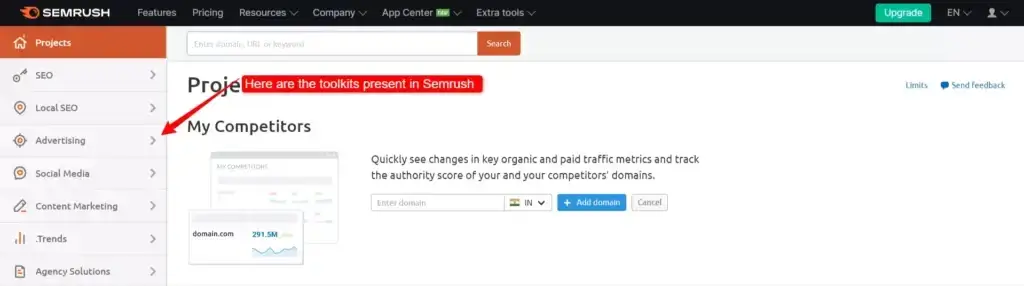
Inside, Semrush is really a bundle of toolkits: the SEO toolkit (keyword research, competitive research, backlinks), a Content Marketing toolkit, Advertising, Social Media, Local SEO, .Trends for market research, and Agency Solutions. Whatever your focus, there’s a toolkit for it, plus free extras like the SEOquake extension and Semrush Sensor.
That structure matters for how you should read the rest of this review. You will almost never use all 55 tools. I lean hardest on five: Domain Overview, Keyword Magic, Site Audit, Position Tracking, and the SEO Content Template. The other 50 are there when a specific job needs them, a local listing audit, a PPC keyword pull, a brand-mention sweep. The breadth is insurance, not a daily to-do list, and judging Semrush by tools you’ll never open is the most common mistake I see in reviews.
Who should not use Semrush
Let me save some of you the trial signup. Semrush is overkill, or just the wrong fit, in three situations:
- You’re a beginner on a tight budget. If your marketing spend is under $100/month, the $139 entry plan will hurt. Start with Mangools or Ubersuggest and graduate to Semrush when SEO is actually making you money.
- You only need rank tracking. Paying $139/month for one feature makes no sense. A dedicated rank tracker costs a fraction of that.
- You won’t use a toolkit this broad. Semrush earns its price when you use the competitive research, content, and audit tools together. If you’ll only ever touch one or two, you’re paying for 50 tools to use two.
There’s also a softer case for waiting. If you’re brand new to SEO, the sheer number of tools can paralyze more than it helps. You’ll click into Keyword Magic, then Backlink Audit, then the content suite, and learn a little of everything and a lot of nothing. Beginners are usually better served by learning the fundamentals on a simpler tool first, then switching to Semrush when they know exactly which tools they need.
Everyone else, especially professionals juggling several tools, is exactly who Semrush is built for. The rest of this review is for you.
Why I keep paying for it
It genuinely replaces 4-5 tools
This is the real argument. A serious blogger or marketer typically stacks separate subscriptions: Mangools for SEO (~$18.85/mo), Frase or Jasper for content ($19-$99/mo), and ContentStudio for social ($49/mo). That’s $87-$167 a month across three logins. Semrush at $139 lands in the same range and gives you far more tools, all talking to each other. That consolidation, not any single feature, is why it’s worth it for pros.
The hidden saving is context-switching. When your keyword data, competitor research, content brief, and rank tracking live in one place, you stop exporting CSVs between tools and re-pasting domains. On a typical client audit that used to eat a full afternoon across three apps, I now spend maybe 90 minutes inside Semrush. Multiply that across 90+ projects and the subscription is the cheapest line item in the workflow.
The data is deep and fresh
Semrush runs one of the biggest databases on the web: 28.8B keywords across 142 geo databases, 808M+ domain profiles, and trillions of backlinks, updated constantly. No third-party SEO data is perfect, but for competitive comparison it’s as reliable as anything I’ve used.

Where this shows up in practice is trust. When I tell a client their competitor gets 40,000 organic visits a month, I need that number to be in the right ballpark, and over seven years Semrush’s estimates have lined up well enough with the real Search Console data I later see on those accounts. It tends to run conservative, undershooting actual traffic by 20-30%, which I’d take over a tool that flatters everyone with inflated figures.
The dashboard is finally easy to navigate
Older Semrush was cluttered. The current layout keeps every toolkit in a clean left sidebar, and you build projects per domain (yours or a competitor’s) to pull authority score, organic traffic, and audit data into one place. Support is solid too: contact form replies in about two hours when I’ve needed it, email within a working day.
Competitive research
If I had to justify the subscription with one toolkit, this is it. Drop in any domain, yours or a rival’s, and Semrush returns its organic keywords, traffic estimates, backlink profile, and paid ads in under a minute.
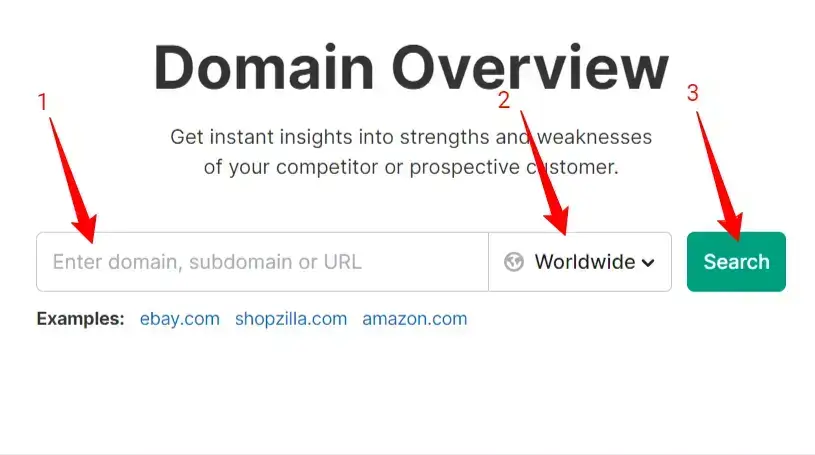
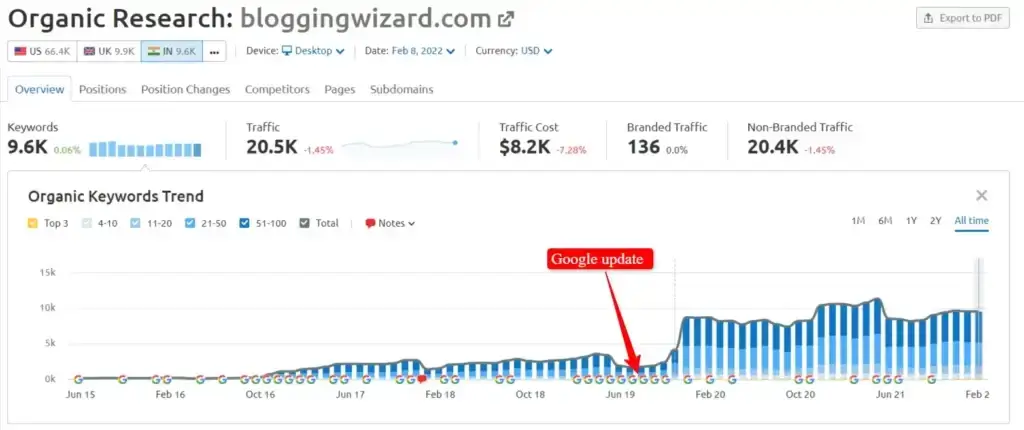
The Domain Overview tool gives the 30-second read on any site: authority, traffic trend, top keywords by intent, and a side-by-side compare for up to three competitors. The Organic Research tool goes deeper, surfacing a rival’s top pages, position changes, and the keywords driving their traffic.
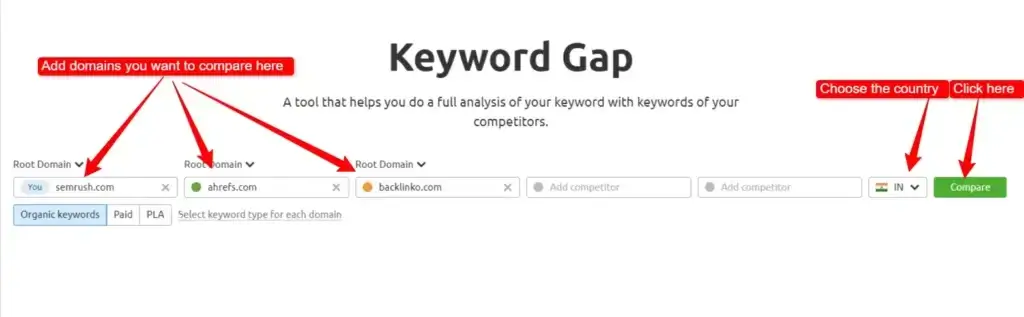
Pair that with the Keyword Gap and Backlink Gap tools (up to four competitors at once) and you get a literal list of keywords and links your competitors have and you don’t. That’s a content and outreach roadmap, not just a report.
Traffic Analytics deserves a mention too. It estimates a competitor’s total visits, traffic sources, top pages, and the user journey across their site, the kind of intel you used to need Similarweb for. It’s an estimate, not analytics-grade truth, but for sizing up a market or a rival before you pitch, it’s close enough to act on.
Keyword research and Keyword Magic
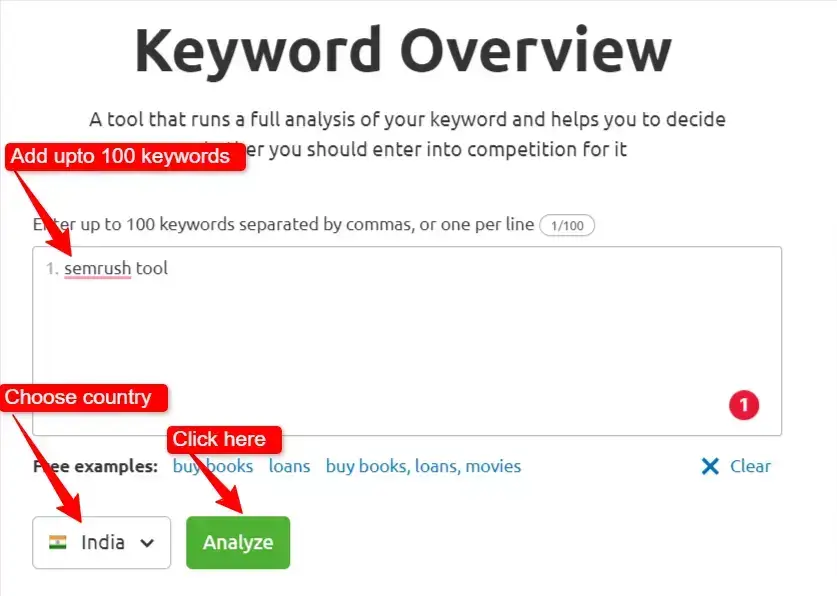
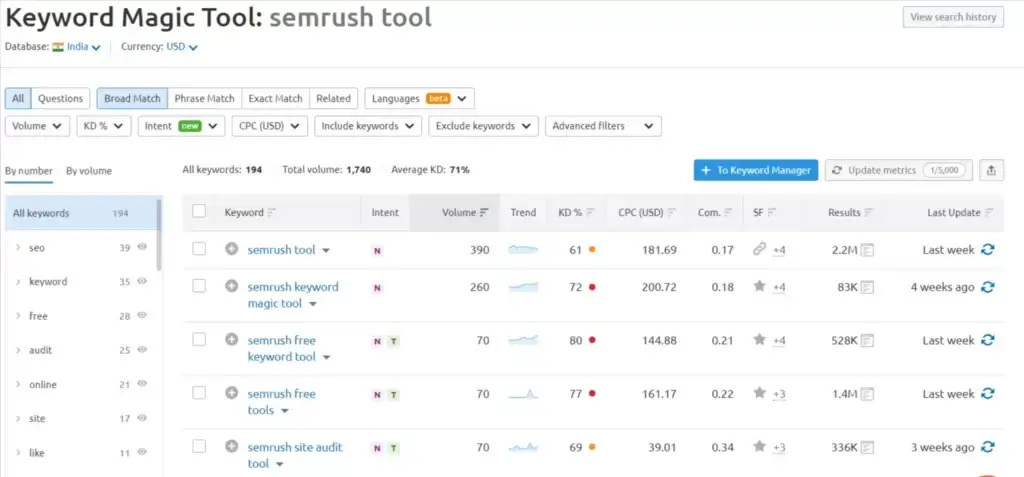
The keyword toolkit is one of the strongest I’ve used. Keyword Overview takes up to 100 keywords at once and returns volume, intent, trend, CPC, and difficulty in a single view, no manual cross-checking.
The Keyword Magic Tool is the workhorse: 28.8B keywords, up to 20 million ideas per seed, and 142 geo databases. The filters are what make it: switch to the Questions tab for FAQ fodder, set word count for long-tail, and sort by difficulty to find low-hanging keywords fast. A Keyword Manager stores up to 1,000 keywords per list with live metric updates.
In practice, my keyword workflow is: seed term into Keyword Magic, filter to KD under 30 and volume over 200, switch to the Questions tab for subheadings, then send the keepers to a Keyword Manager list. From there the SEO Content Template tool turns the list into a brief. It’s the single fastest keyword-to-outline path I’ve found in any tool.
Backlink building and cleanup
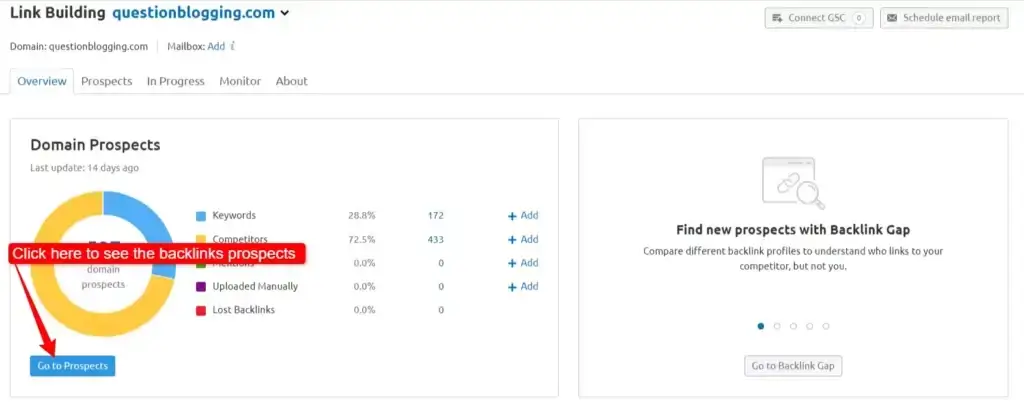
Two jobs here, both handled well. Link building starts with Backlink Analytics (authority score, referring domains, new and lost links, plus a competitor view to spot links you’re missing). The Link Building Tool then turns that into an outreach pipeline: add your domain, keywords, and competitors, and it hands you prospects you can accept, reject, or move to an in-progress list.
The Backlink Audit tool is the other half. It scores your backlinks for toxicity and sorts them into whitelist, remove, and disavow buckets. You export the disavow list as a TXT file and upload it straight to Google Search Console. Connect Search Console for more accurate data. This is the exact workflow I use to clean up client sites that got hit by spammy links.
I’ve used this on real recoveries. One client came to me after a previous agency built dozens of spammy directory links and their rankings tanked. The Backlink Audit flagged the toxic domains, I exported the disavow file, uploaded it to Search Console, and within two months the worst of the drop reversed. Could you do this with a free tool? Partly. But the toxicity scoring and one-click sorting turned a multi-day slog into an afternoon.
Site Audit, on-page SEO, and rank tracking
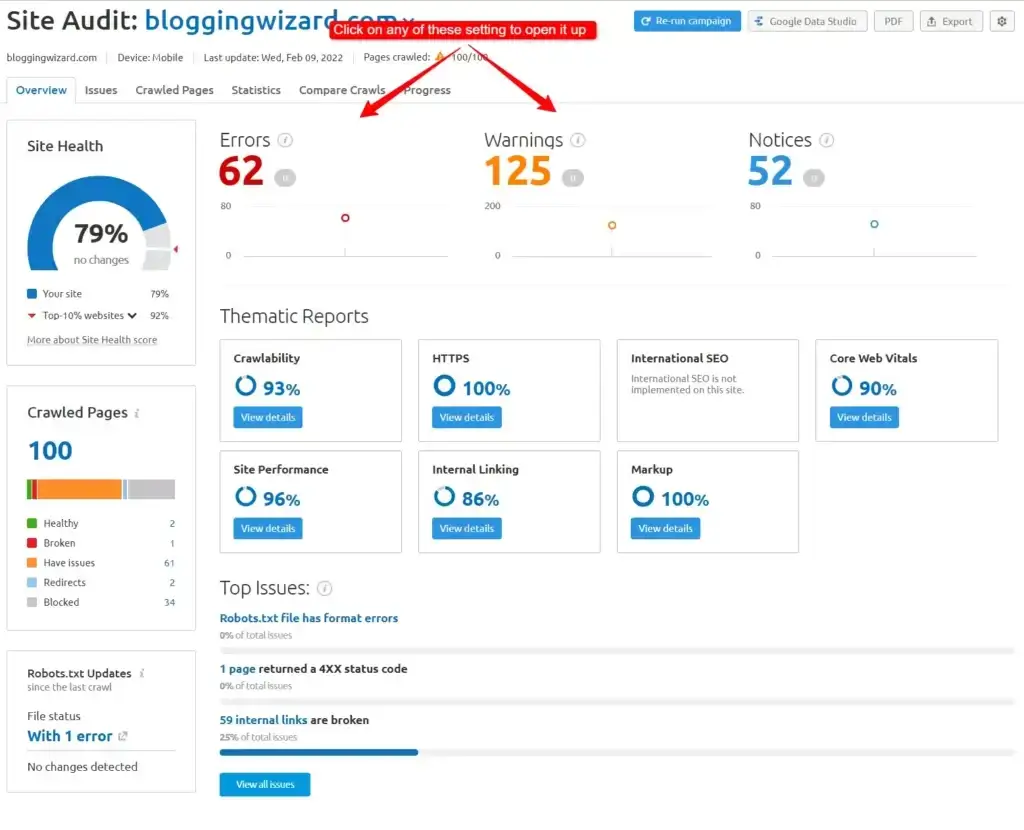
The Site Audit tool is genuinely better than the Ahrefs equivalent. Semrush crawls your site and reports a health score plus prioritized issues across internal linking, HTTPS, and Core Web Vitals, each with a “why and how to fix it” explainer.
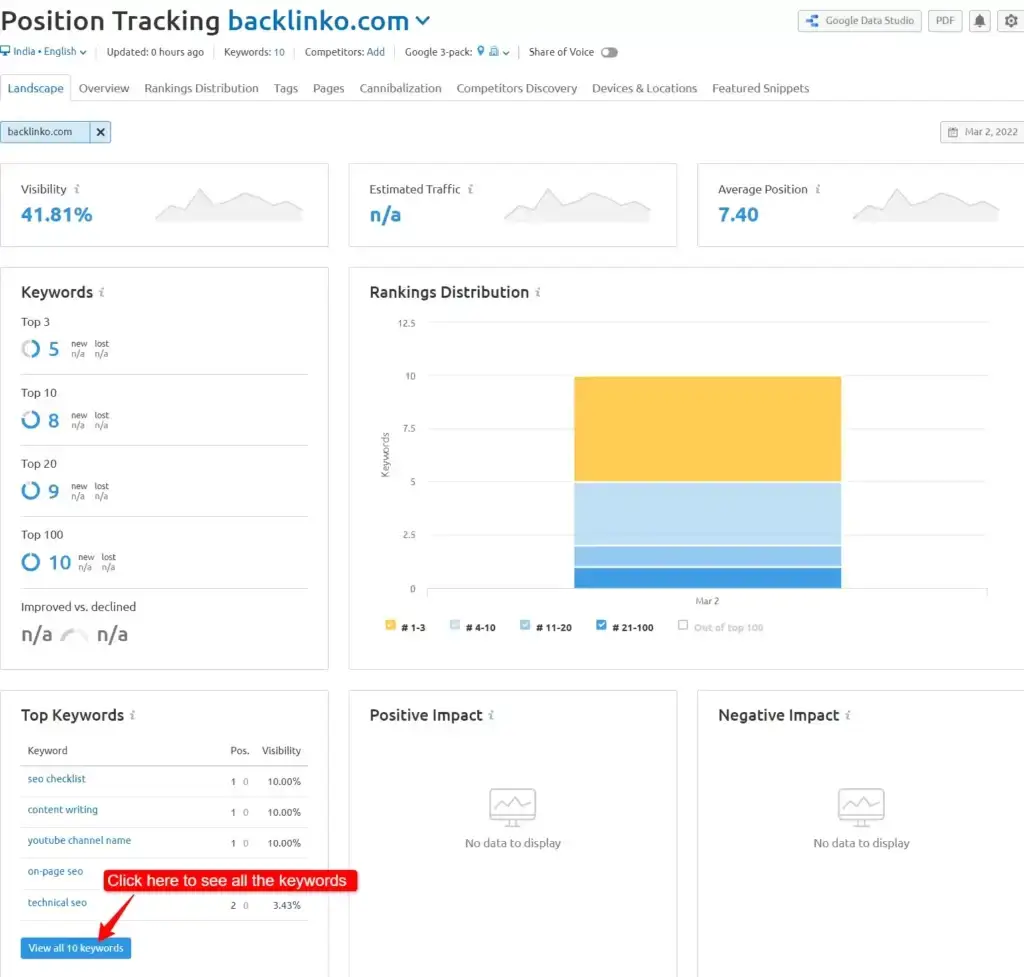
The On-Page SEO Checker pulls in your pages (auto, manual, or via Search Console) and returns specific optimization ideas: content, backlinks, semantic, and ready-to-do tasks. Position Tracking then watches your keywords by search engine, device, and location, flags cannibalization, and highlights featured-snippet opportunities, my favorite part of it.
Two details I rely on. The Site Audit re-crawls on a schedule, so you can watch a health score climb as you fix issues, useful proof to show clients. And Position Tracking’s daily updates on the Pro plan mean you catch ranking drops within a day instead of a week, which matters when a Google update hits and you need to react fast.
Content marketing tools
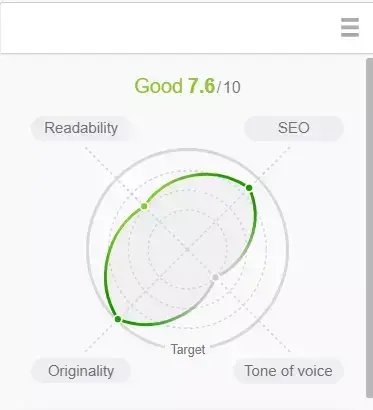
Few SEO tools ship a real content suite. Semrush’s has six: Topic Research, SEO Content Template, SEO Writing Assistant, Brand Monitoring, Post Tracking, and Content Audit. The SEO Writing Assistant scores your draft on SEO, originality, tone, and readability (aim for 7+); the Content Audit flags thin and outdated pages to fix. I lean on these constantly. Full walkthrough in my Semrush content marketing guide.
The Topic Research tool is the unsung one. Give it a seed topic and it maps out subtopics, common questions, and headline angles people are actually searching, which is how I break out of writing the same five articles every competitor already has. Combined with the Content Audit flagging which old posts to refresh, it turns content planning from guesswork into a queue.
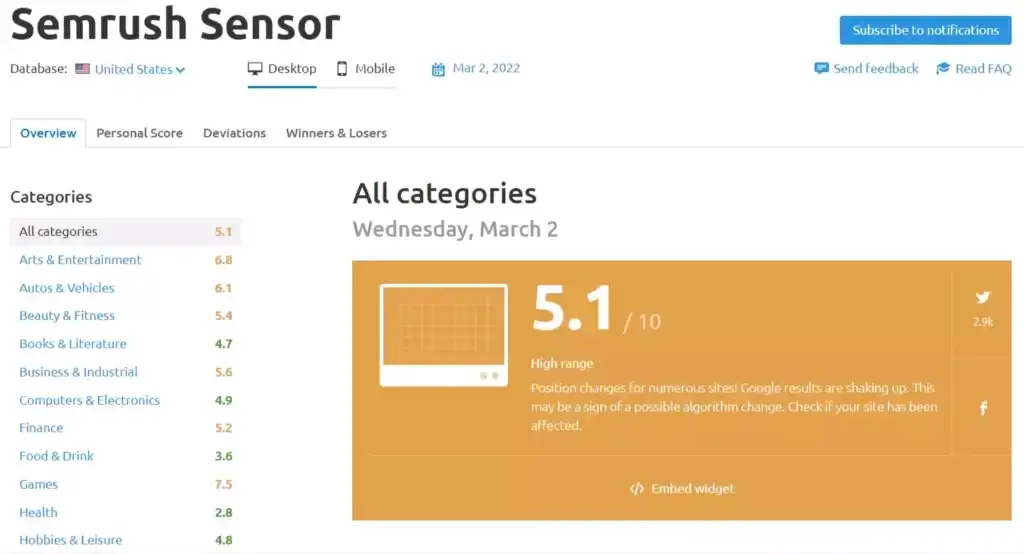
Beyond these, you also get a Social Media toolkit (poster, tracker, analytics, ads), the .Trends market-research add-on, Semrush Sensor for tracking Google algorithm volatility, plus extras like the Marketing Calendar, Prowly, and Sellzone. It’s a lot, which is the whole point and the whole learning curve.
The SEO Content Template is the one I’d miss most. Feed it a target keyword and it analyzes the current top-ranking pages, then tells you the semantically related terms to include, a target word count, readability band, and which sites to earn backlinks from. It turns a blank page into a data-backed brief in about two minutes. For an agency producing content at volume, that consistency is worth more than any single keyword metric.
Semrush pricing
Semrush retired the Pro, Guru, and Business plans this year. The lineup is now SEO, Starter, Pro+, and Advanced, and every tier folds AI-search visibility tracking in alongside the classic toolkit. Annual billing still saves up to 17%, and I still recommend annual if you’re committed to SEO.
| Plan | Monthly | Annual (per month) | Websites | Keywords tracked | Best for |
|---|---|---|---|---|---|
| SEO | $139 | $117.33 | 5 | 500 | Bloggers, freelancers, solo SEOs (the old Pro, renamed) |
| Starter | $199 | $165.17 | 5 | 500 | Small teams adding AI-visibility prompt tracking and MCP access |
| Pro+ | $299 | $248.17 | 15 | 1,500 | Content teams (adds historical data + content optimization, the old Guru’s slot) |
| Advanced | $549 | $455.67 | 40 | 5,000 | Agencies and multi-site owners (adds API and share of voice) |
For most solo bloggers and freelancers, SEO is plenty: it’s the old Pro plan with a new name and AI-search reports added. Upgrade to Pro+ when you need the content toolkit, historical keyword data, or more than five projects, the ground Guru used to cover. Advanced is for agencies tracking thousands of keywords across many client sites. Starter is the odd one: the same limits as SEO, but with prompt-level AI-visibility tracking and MCP access, for teams that care about AI search before they need more projects. My one real gripe stands: the plan structure is still more confusing than it needs to be, and the rename made it worse before it made it better.
Is the price fair? For a hobby blog, honestly no, $139 is a lot when you’re not yet earning from search. For anyone billing clients or running a content business, it’s trivial. One recovered client ranking or one competitor gap turned into a published cluster pays for a year of the SEO plan. The math only looks bad if SEO isn’t yet making you money, which is exactly why the “who should skip it” list above matters.

Is there a free Semrush plan?
Yes, though Semrush barely markets it. The free plan gives you one demo project and 10 reports a day across the core tools. Enough to kick the tires. The better option is the 7-day free trial with full access (credit card required, cancel anytime).
How the 7-day free trial works
The trial is the smartest way to decide, because no review can tell you whether the data feels right for your specific niche. Signing up takes two minutes: head to the trial page, create an account, pick a plan, and add a card. You’re charged nothing for seven days and can cancel from the billing settings with one click.
If you only have a week, here’s the order I’d run things to actually stress-test it. Day one, pull a Domain Overview on your three biggest competitors and skim the Keyword Gap. Day two, run a full Site Audit on your own site and fix the top three issues. Day three, build one content brief with the SEO Content Template and Keyword Magic. By day four you’ll know whether Semrush belongs in your stack, well before the card gets charged.
One word of caution echoed in user reviews: the plan auto-renews into a paid annual or monthly subscription when the trial ends. Set a calendar reminder for day six if you’re undecided. Cancelling is painless, but only if you remember to do it.
What other users say
It’s not just me. Semrush holds strong ratings on Capterra and Trustpilot, and the praise and complaints line up with mine: users love the breadth and data, and wish it were cheaper and simpler.
The recurring complaint in the one and two-star reviews is billing and the learning curve, not data quality. That tracks with my experience: the tool is powerful but unforgiving for newcomers, and the auto-renewing annual plan catches people off guard. Go in knowing that and you avoid the two things most unhappy users run into.

I tweeted my own appreciation after the first two weeks, and brands like monday.com have public case studies showing real ranking gains with it.

Semrush vs Ahrefs vs Moz
These three come up in every SEO-tool decision, so here’s the honest head-to-head from someone who has paid for all of them.
| Semrush | Ahrefs | Moz | |
|---|---|---|---|
| Tools | 55+ (SEO, content, PPC, social) | ~15 (SEO and backlink focused) | ~10 (SEO basics) |
| Keyword database | 28.8B (Google focus) | 28.7B, 217 locations | Smaller, US-leaning |
| Backlink index | Trillions, very large | Best-in-class freshness | Solid but smaller |
| Content tools | Full 6-tool suite | Content Explorer only | Minimal |
| Interface | Powerful, busy | Cleanest of the three | Simplest |
| Entry price | $139/mo | $129/mo | $99/mo |
Semrush vs Ahrefs is the real fight. Ahrefs has the edge on backlink data freshness and a cleaner interface, and its keyword index covers more search engines than just Google. But Semrush wins on sheer breadth: the content suite, social tools, PPC research, and .Trends have no Ahrefs equivalent. My setup is Semrush as the daily driver and an Ahrefs seat for deep link audits when a client needs it.
Semrush vs Moz isn’t close anymore. Moz is gentler and a bit cheaper, and its Domain Authority metric is still an industry shorthand. But the database is smaller, updates are slower, and you’ll outgrow the feature set fast. I moved my last Moz workflow into Semrush years ago and never looked back. Moz is fine as a first paid tool; it’s not where serious work ends up.
The short version: choose Ahrefs if backlinks are your whole game, Moz if you want the simplest on-ramp, and Semrush if you want one platform that does all of it well enough to cancel the others.
Semrush alternatives
Semrush isn’t the only option, and for some readers it isn’t the right one. Here are the three I’d actually recommend, depending on your budget and needs.
Mangools
Mangools bundles five focused SEO tools, KWFinder, SERPChecker, SERPWatcher, LinkMiner, and SiteProfiler, in a clean, beginner-friendly dashboard. Annual pricing starts at $18.85/month, a fraction of Semrush, and the bundle now includes their AI Search Watcher for prompt tracking. There’s a free account to test with and a 48-hour money-back guarantee. If you only need core SEO and a tight budget, start here.
What you give up is breadth and database size. Mangools is great for finding low-competition keywords and basic competitor checks, but there’s no content suite, no PPC research, and the backlink index is shallower. It’s the tool I recommend to every beginner who tells me Semrush feels overwhelming and expensive, which is most of them.
Serpstat

Serpstat covers SEO and PPC with a solid keyword database and competitive analysis, at a lower price point than Semrush. Plans run $50 to $410 a month, with up to 27% off on annual billing and a 7-day free trial. A solid middle ground between Mangools and the big two.
It’s the least known of the four but punches above its price, especially for PPC marketers who want keyword and competitor data without the Semrush bill. The trade-off is a smaller database and fewer polished extras. Worth a free look if the $139 entry price is your only objection to Semrush.
Ahrefs
Ahrefs is Semrush’s closest competitor and my pick for pure backlink work. Its 28.7B-keyword index spans 217 locations (Semrush focuses on Google), and its backlink data is excellent. It has fewer tools overall and no real content or social suite. Plans start at $129/month; the old $7 trial is gone, but Ahrefs Webmaster Tools is free for verified sites you own. I use Semrush as my daily driver and Ahrefs for deep link analysis.
FAQs
Is Semrush worth the price in 2026?
If you run a content-driven business or manage SEO for clients, Semrush pays for itself within the first month. I use it across 90+ client projects at Gatilab and the competitive research alone saves more time than the subscription costs. For hobby bloggers on a tight budget, start with the free plan or consider Mangools as a more affordable alternative.
Can I use Semrush for free?
Yes. Semrush offers a free plan with limited access (one demo project and 10 reports per day). You can also get a 7-day free trial with full access to all tools. Credit card is required for the trial.
Is Semrush better than Ahrefs?
Semrush offers more tools overall (55+ vs Ahrefs 15+), including content marketing, social media, and PPC tools. Ahrefs has a stronger backlink index and a more intuitive interface for link-focused SEO. I use Semrush as my primary tool and Ahrefs for backlink analysis when needed.
What is the current pricing of Semrush?
Semrush has four plans: SEO at $139/month, Starter at $199/month, Pro+ at $299/month, and Advanced at $549/month. Annual billing saves up to 17%. The SEO plan covers most individual bloggers and marketers.
Can I use the Semrush free trial without a credit card?
No, Semrush requires a credit card for the 7-day free trial. You can cancel anytime before the trial ends without being charged. The free plan (limited but no card needed) is another option.
Does Semrush have an affiliate program?
Yes, Semrush runs its affiliate program through Impact Radius. They offer $200 per new subscription sale and $10 per trial signup.
Is Semrush good for beginners?
Semrush has a learning curve because of its 55+ tools. Start with the Keyword Magic Tool, Site Audit, and Position Tracking, then expand from there. Their academy and blog content are excellent for learning.
How does Semrush calculate website traffic?
Semrush estimates organic traffic by multiplying the average CTR for each ranking position by the keyword search volume. It typically underestimates real traffic by 20-30%, but it is very useful for competitive comparison.
What is Semrush One?
Semrush One bundles AI-powered SEO tools including AI visibility tracking across Google AI Overviews, ChatGPT, and Perplexity. Plans start at $199/month for Starter, $299/month for Pro+, and $549/month for Advanced. These are now the standard tiers on the Semrush pricing page, not a separate product.
Does Semrush slow down my website?
No. Semrush is a cloud-based SaaS tool. It does not install anything on your website and has zero impact on performance. The Site Audit crawler runs on Semrush servers, not yours.
For the affiliate side, read the Semrush affiliate program review. For broader comparisons, see the best SEO tools guide.
Final verdict
After seven years and 90+ client projects, my verdict is simple. Semrush is worth every dollar if you’re serious about SEO and content marketing. I use it daily, I’ve recommended it to more clients than any other tool, and I haven’t found a tool that matches its breadth. The competitive research alone justifies the price.
Is it perfect? No. The pricing tiers are confusing, the interface takes weeks to feel natural, and beginners genuinely should start cheaper. But none of that changes the core math: for a working marketer or agency, Semrush replaces a stack of tools, saves hours every week, and turns competitor guesswork into a plan. That’s the bar a $139 tool has to clear, and it clears it.

- Get Semrush if you run a content-driven business, manage SEO for clients, need competitive intelligence, or want to consolidate several marketing tools into one platform.
- Skip Semrush if you are a beginner under $100/month (use Mangools), only need rank tracking, or won’t invest the time to learn it.
Start with the 7-day free trial. That’s enough time to run a site audit, do competitor research, and test the keyword tools. You’ll know within a few days whether it’s the right investment.
Tell Google you want more of this.
Add Gaurav Tiwari as a preferred sourceOne tap, and this site shows up more often in your own Top Stories, AI Overviews and AI Mode. Remove it any time.
Disclaimer: This site is reader-supported. If you buy through some links, I may earn a small commission at no extra cost to you. I only recommend tools I trust and would use myself. Your support helps keep gauravtiwari.org free and focused on real-world advice. Thanks. - Gaurav Tiwari