
 by
by
Generative engine optimization is the practice of improving whether a brand, page, or fact appears in AI-generated answers. My working GEO playbook treats it as an extension of SEO: build a source worth retrieving, make its evidence easy to verify, and measure citations instead of assuming that Google rankings transfer automatically.
My stance has become sharper as the category has grown. GEO is a useful strategy label, but it is not a permission slip to invent new technical requirements. Google’s May 2026 guidance says its generative search experiences still use the same SEO foundations and do not need special AI schema, an llms.txt file, artificial content chunking, or an AI-only rewrite.
That does not make GEO meaningless. It changes where the useful work sits. The value is in source quality, distribution beyond Google, citation-aware formatting, entity clarity, and measurement across prompts. The value is not in renaming ordinary on-page SEO and charging three times as much.

What generative engine optimization means
Generative engine optimization, or GEO, improves how content is selected, synthesized, and cited by systems that generate answers. These include Google AI Overviews, Google AI Mode, ChatGPT Search, Perplexity, Claude, Microsoft Copilot, and other retrieval-augmented assistants.
The term came into wider use after researchers introduced “Generative Engine Optimization” in a 2023 preprint later presented at KDD 2024. Their GEO-Bench benchmark covered 10,000 queries and found that tactics such as adding citations, quotations, and statistics could improve source visibility in generated responses, with gains of up to 40% in the benchmark.
That “up to” matters. A controlled benchmark is not a promise that adding three statistics to a WordPress post will raise real-world ChatGPT visibility by 40%. The paper is evidence that source presentation can affect generative visibility. It is not a universal ranking-factor list.
| Discipline | Primary outcome | Best use |
|---|---|---|
| SEO | Search visibility and qualified clicks | Technical access, intent, authority, user experience |
| GEO | Mentions and citations in generated answers | Source eligibility, evidence, retrieval, measurement |
| AEO | Direct answer extraction | Definitions, steps, tables, concise answer-first passages |
| LLM SEO | Visibility in LLM-based products | Crawler policy, prompt tracking, citations, brand/entity clarity |
I use GEO as the umbrella for the AI-search work and SEO as the foundation. AEO and LLM SEO describe specific parts of the same operating system.
How generative engines choose sources
Generative engines choose sources through retrieval, ranking, synthesis, and citation. The model does not simply “know” a page and repeat it. Search-connected products can issue related queries, retrieve candidate pages, evaluate passages, assemble an answer, and cite some of the material used.
Google calls the related-search step query fan-out. One complex question can trigger multiple searches across subtopics and data sources. This helps explain why a page can be relevant to the original prompt yet lose to a more specific source retrieved for one sub-question.
Four conditions shape source selection:
- Eligibility: the page can be crawled, indexed, rendered, and shown as a normal search result or fetched by the product’s crawler.
- Relevance: the page answers the specific question or one of its sub-questions.
- Trust: the claim is supported by evidence, authority, consistency, and a clear source identity.
- Usability: the system can isolate the passage, table, definition, or fact without misreading it.
Keywords still matter because they communicate topic and intent. Entities matter because they communicate relationships. Evidence matters because it gives the engine something attributable. None of these works alone.
What the GEO paper gets right, and where people overreach
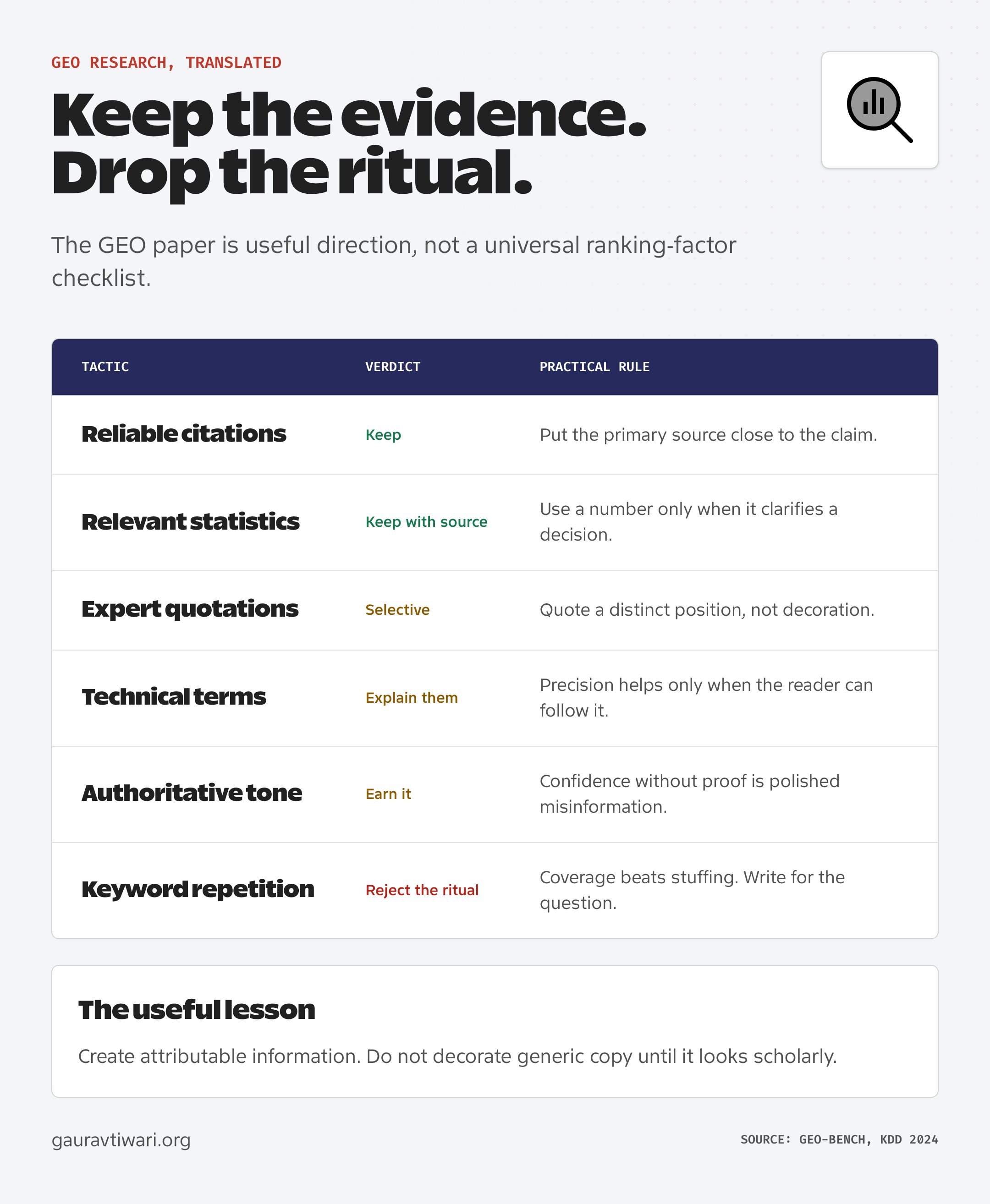
The original GEO research is directionally useful. It tested methods including authoritative language, keyword adjustment, statistics, source citations, quotations, simplified language, fluency improvements, technical terms, and combinations of tactics.
My practical reading looks like this:
| Tactic | Practical verdict | Why |
|---|---|---|
| Cite reliable sources | Keep | Makes claims auditable and improves reader trust |
| Add relevant statistics | Keep with a source | Useful when the number clarifies a decision |
| Add expert quotations | Use selectively | Strong when the quote adds authority or a distinct position |
| Improve fluency | Keep | Helps people and parsers, but it is not a standalone growth lever |
| Use technical terms | Explain them | Precision helps; unexplained jargon narrows the audience |
| Add keywords | Use naturally | Exact-match repetition is not a substitute for coverage |
| Sound authoritative | Earn it | Confidence without proof is just polished misinformation |
| Simplify language | Usually helpful | Clear writing improves extraction and comprehension |
| Combine tactics | Best approach | Evidence, clarity, and structure reinforce each other |
The cargo-cult version of GEO takes the benchmark as a recipe: insert a statistic, a quote, and a citation into every section. That produces awkward content and encourages decorative evidence.
The better lesson is that engines prefer passages with attributable information. Your job is to create genuinely attributable information, not to decorate generic copy until it looks scholarly.
My six-layer GEO playbook
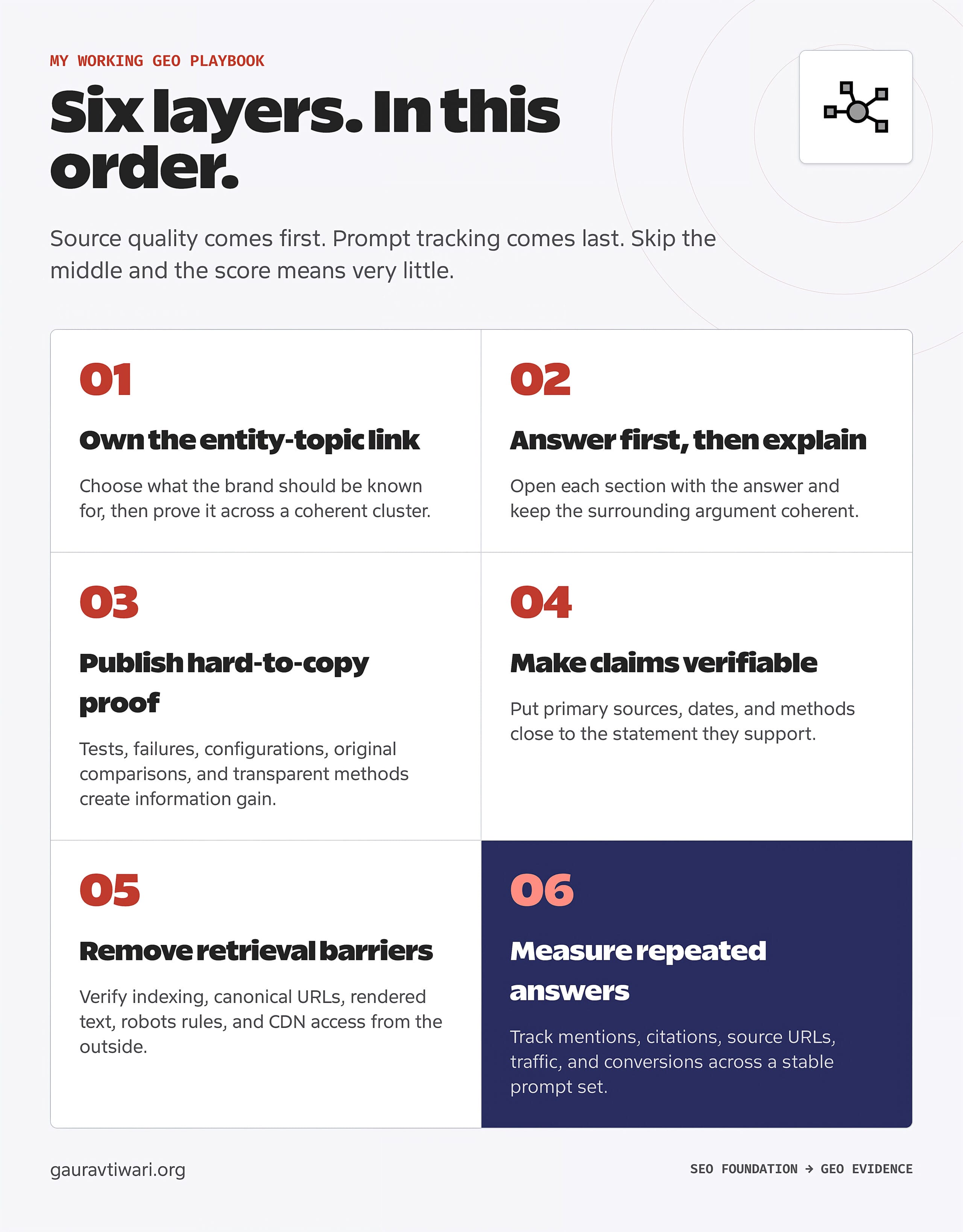
My GEO playbook has six layers. Each layer fixes a different failure mode, and the order matters.
Layer 1: own a specific entity-topic relationship
Decide what you want the brand to be known for and prove that entity relationship across the site. A WordPress performance consultant can build authority around caching comparisons, Core Web Vitals, CDN configuration, and plugin testing. Publishing one generic “what is GEO” page will not create the same association.
Use a consistent brand name, author identity, organization details, About page, service pages, and topic clusters. Link related published pages where the connection helps the reader. Avoid creating several pages for the same intent.
This cluster follows that rule. The existing GEO-versus-SEO page owns the comparison query. This pillar owns the implementation framework. The LLM SEO guide goes deeper on crawlers and citations. The AI visibility tracking workflow owns measurement.
Layer 2: build answer-first content without writing fragments
The first paragraph under each H2 should answer the heading. Then the section should add conditions, tradeoffs, examples, and evidence. Use the AI search content optimization checklist before you publish.
For example, “Does GEO replace SEO?” deserves a direct “No” followed by the reason. It does not need a 150-word history of search before reaching the answer.
Answer-first is not the same as chunk-first. Google’s current guidance says special AI chunking is unnecessary. Write coherent sections that work for a human reader. My guide to formatting blog posts for AI search shows how I apply this without turning the article into fragments. Use short definitions and tables only where the information benefits from them.
Layer 3: publish information competitors cannot copy cheaply
Information gain comes from evidence, not word count. Useful first-party assets include:
- a test setup and result;
- a configuration with a reason for each choice;
- an original comparison table;
- customer or site data you have permission to publish;
- a failure and the diagnostic path that found it;
- a decision framework built from repeated work.
My current AI visibility data is deliberately modest. Across two July 2026 snapshots, one FlyingPress-versus-WP-Rocket prompt produced every citation to gauravtiwari.org. That is not a sweeping GEO victory. It is a clue that my strongest retrievable authority currently sits in a narrow WordPress performance topic.
That clue is actionable. I can update the cited pages, strengthen related performance content, and expand the prompt set around adjacent questions. Honest small data can guide better work than a fabricated large case study.
Layer 4: make important claims easy to verify
Name the source close to the claim. Link to primary documentation when it is available. Include dates for changing policies, products, prices, and measurements. Explain how you got a first-party number.
For technical topics, prefer documentation from Google, OpenAI, Anthropic, Perplexity, standards bodies, or the original research paper. A vendor blog summarizing another vendor’s documentation is a weaker citation.
Use schema to describe visible content accurately. Article, Organization, Person, Product, and other supported types can reduce ambiguity. Google says special AI markup is not required, so do not invent it.
Layer 5: remove retrieval barriers
Verify the live response, not just the WordPress editor. The page should return a successful status, use the intended canonical URL, render the core content, appear in the sitemap where appropriate, and avoid accidental noindex or robots blocks.
Crawler policies require more care than a single “allow AI” switch:
- OpenAI separates OAI-SearchBot, GPTBot, and ChatGPT-User.
- Anthropic separates Claude-SearchBot, ClaudeBot, and Claude-User.
- Perplexity separates PerplexityBot and Perplexity-User.
- Google-Extended affects certain Gemini uses but does not control Google Search inclusion or ranking.
CDN bot protection can block a crawler even when robots.txt allows it. Test from the outside and review server logs when the logging pipeline is reliable.
Layer 6: measure repeated answers and business value
Track a stable prompt library across engines, countries, and languages. Record brand mentions, linked citations, cited URLs, competitors, sentiment where useful, and answer position.
Then connect those observations to outcomes: AI referral sessions, branded searches, assisted conversions, leads, or sales. A citation that never reaches the right audience may still build brand familiarity, but it is not automatically revenue.
Repeat the measurement on a schedule. A single answer is a sample. Four to eight weekly snapshots are enough to begin seeing persistence, but not enough to declare a permanent ranking.
GEO for Google AI Overviews and AI Mode
For Google, GEO is SEO applied to a generative result. The company says pages need to be indexed and eligible to show a normal snippet, with no extra technical requirement for AI Overviews or AI Mode.
Google’s guidance emphasizes unique, non-commodity content, good page experience, accessible text, matching structured data, high-quality images and video, and accurate Merchant Center or Business Profile data where relevant. It also says you do not need special AI files, artificial chunking, or an AI-specific rewrite.
That removes several popular distractions. The practical Google checklist is:
- Confirm indexing and snippet eligibility.
- Satisfy the query with a clear, complete answer.
- Add distinctive evidence or experience.
- Keep important content available as text.
- Use valid schema that matches the page.
- Maintain strong images, videos, and business data where the query calls for them.
- Review Search Console, including the Generative AI performance report if it is available to your property.
Google began rolling out that Generative AI report to a subset of Search Console properties in June 2026. It adds visibility into AI feature performance, but it should complement normal query, page, click, and conversion analysis.
GEO for ChatGPT, Perplexity, and Claude
ChatGPT, Perplexity, and Claude introduce crawler and interface differences, but they do not reverse the source-quality principles.
For ChatGPT Search, check OAI-SearchBot access and distinguish mentions from linked citations. For Perplexity, inspect which sources receive numbered citations and which passages are repeatedly used. For Claude, review Claude-SearchBot access and track the same prompt over time instead of assuming one answer is stable. My LLM SEO guide covers those crawler and robots decisions in detail.
Engine-specific optimization should begin with observation. If Perplexity cites a comparison table while ChatGPT cites the detailed review, that is a useful pattern. If one engine never completes the prompt in your tracker, that is a data-quality issue, not a zero ranking.
Do not create a different version of the same article for every engine. Maintain one strong canonical source and improve the parts the evidence says are weak.
What a legitimate GEO engagement includes
A legitimate GEO engagement improves sources and measurement. It does not sell guaranteed placements inside probabilistic answer systems.
I would expect the scope to include:
- an AI-search baseline with documented prompts, engines, locales, and dates;
- technical eligibility checks for indexing, rendering, canonicalization, crawler access, and structured data;
- entity and topic-gap analysis;
- updates to pages with existing authority or commercial value;
- creation of first-party assets that competitors cannot cheaply reproduce;
- internal-link and cluster cleanup to prevent cannibalization;
- repeated mention and citation tracking;
- reporting tied to leads, conversions, and qualified traffic.
Be cautious if the proposal leads with llms.txt, mass AI content, hidden schema, guaranteed ChatGPT rankings, or a proprietary visibility score that does not reveal the prompt set. Those are easy outputs to sell because they avoid the harder work.
What the work should produce
The work should remain usable after the consultant leaves. I would want a prompt library with ownership, a page-to-intent map, a technical eligibility report, prioritized content briefs, updated pages, a source inventory, and a repeatable measurement sheet or dashboard.
A good content brief names the exact claim the page must earn, the first-party proof available, the competing published URL, and the prompts used for validation. It does not stop at “add more E-E-A-T.”
A good technical report separates blockers from preferences. Accidental noindex, a broken canonical, inaccessible text, or a CDN challenge is a blocker. Adding another schema type to an already valid article is usually a preference. The priority list should reflect that difference.
A good monthly report connects visibility to actions. It should tell you which page earned persistent citations, which competitor became more visible, which source domain shaped the answers, and which three edits deserve the next cycle.
What the engagement cannot guarantee
No provider controls the generated answer, the model update schedule, the search index, or the citations selected for every user. GEO can improve eligibility, source quality, and probability. It cannot reserve a permanent position.
It also cannot fix a weak offer. If an AI engine mentions the brand but the landing page is unclear, the added visibility may not convert. Content, product positioning, reputation, and conversion paths still matter.
How to measure GEO
Measure GEO at three levels: answer visibility, source visibility, and business impact.
| Level | Core metrics | What it tells you |
|---|---|---|
| Answer visibility | Mention rate, answer position, sentiment | Whether the brand appears and how it is framed |
| Source visibility | Citation rate, cited URL share, competitor source share | Whether your pages are used as evidence |
| Business impact | Referral sessions, branded search, leads, revenue | Whether visibility helps the organization |
My first two snapshots produced three then four ChatGPT prompt mentions out of 14 tracked prompts, with one then two citations. That is a baseline. I need more weeks, more complete engine responses, and working log data before I can claim a durable trend.
The absence of server-log AI rows also prevents a second common mistake: equating crawls with citations. A crawler can fetch a page and never use it. An engine can cite a page through a search index without a neat, identifiable bot hit in the log window. Keep retrieval, citation, and traffic as separate measurements.
The tools I use for GEO measurement
I use Semrush as the primary paid layer when I need daily prompt tracking, competitor comparisons, AI-readiness checks, and normal SEO data in the same account. I keep a manual prompt sheet beside it because a vendor score cannot explain every answer, citation choice, failed run, or conversion.
For site-side evidence, Google Search Console, analytics, and server logs answer different questions. Search Console shows Google demand, analytics shows visits and conversions, and logs can confirm crawler requests when the bot is identifiable. My AI visibility tracking guide shows the complete three-layer setup and the 14-prompt baseline behind it.
If you are choosing the software layer first, use my best AI SEO tools comparison to separate research tools, WordPress execution, content optimizers, and AI-visibility trackers. Do not buy three overlapping dashboards before the prompt library exists.
A GEO-ready article template
A GEO-ready article is a useful editorial template, not a special machine format. I use this sequence for substantial guides:
- Problem and stance: state the reader’s problem, the direct answer, and the opinion the page will defend.
- Definition: explain the main term in language that works outside the article.
- Mechanism: show how the system or decision actually works.
- Evidence: add first-party results, primary sources, or a transparent method.
- Implementation: give ordered steps, a decision table, or a practical checklist.
- Tradeoffs: identify when the advice fails, costs more, or should not be used.
- Measurement: explain how the reader knows the change helped.
- FAQ: answer distinct follow-up questions without repeating the article.
This structure produces extractable passages because the editorial logic is clean. It also prevents a common SEO failure: a long article that defines the term six times but never tells the reader what to do.
The template still needs a distinct point of view. For this page, the stance is that GEO is an accountable extension of SEO, not a secret technical discipline. Every section either supports that claim or helps the reader apply it.
Common GEO mistakes
Most weak GEO programs fail before the crawler reaches the page.
Publishing more content before resolving overlap
Two pages targeting the same concept split internal signals and make it unclear which URL should represent the topic. Map the intent first. Keep comparison pages, implementation guides, tutorials, and service pages distinct.
Treating citations as traffic
A citation can build authority without a click. It can also appear in an answer no buyer sees. Track referrals and conversions separately, then decide what value the citation has for the business.
Mistaking crawler activity for demand
A training or indexing bot can request hundreds of pages without representing active user questions. Separate search crawlers, training crawlers, user-triggered fetches, and human referrals in the log report.
Optimizing unsupported claims
Adding precise numbers, quotations, and authoritative language can make a claim look citable. It does not make the claim true. Start with the source and method, then decide how to present it.
Buying a dashboard before defining prompts
The platform cannot decide which customer questions matter. If the prompt library is generic, the resulting score will be generic too. Define the buying stages, product categories, comparisons, objections, and branded questions before automating collection.
A 30-day GEO implementation plan
You can test GEO without rebuilding your site or buying an enterprise platform.
Week 1: establish the baseline
Choose 10 to 20 prompts tied to real customer questions. Record results across two or three engines. Audit indexing, canonical tags, robots rules, and existing cited pages.
Week 2: improve five high-potential pages
Pick pages with organic traction, links, conversions, or first-party evidence. Rewrite weak section openings, add missing proof, improve tables, and repair entity ambiguity.
Week 3: strengthen the cluster
Publish or update one companion page for a distinct intent. Add internal links only where the destination is live and useful. Merge or re-scope overlapping pages.
Week 4: repeat and review
Run the same prompts again. Compare mentions, citations, cited URLs, and competitors. Check referral traffic and conversions. Write down what changed and what did not.
One month will not prove a permanent result. It will tell you whether your measurement works, whether the engines can retrieve your sources, and which pages deserve another cycle.
To make that four-week cycle easier to run, I built the practical workbook I wish most GEO guides included.
Free GEO Audit + Prompt Tracker Workbook
The workbook is designed to be used each week. It gives you a weighted audit, a repeatable prompt log, a source inventory, and a 30-day plan with tasks, owners, evidence, and status.
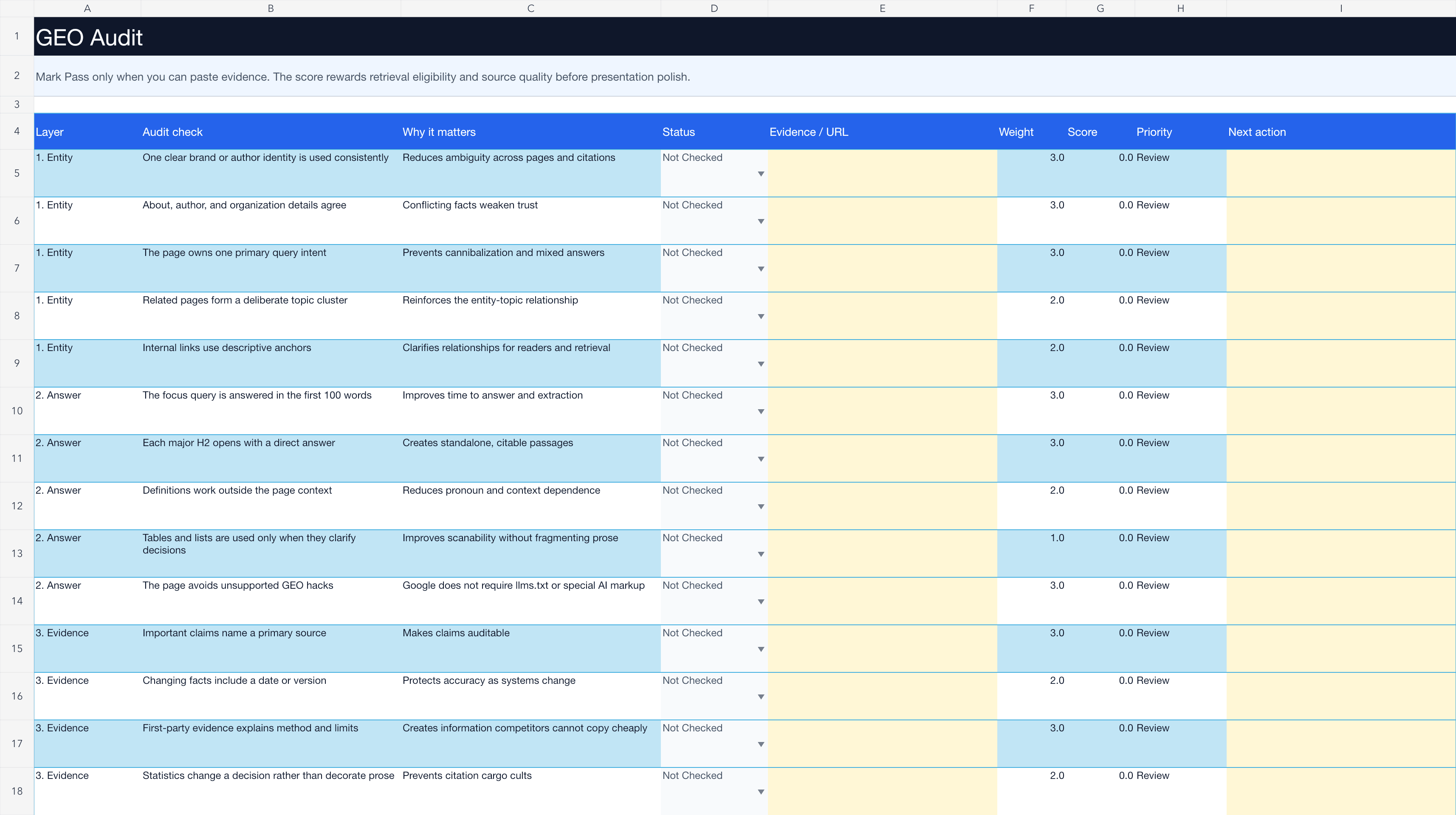

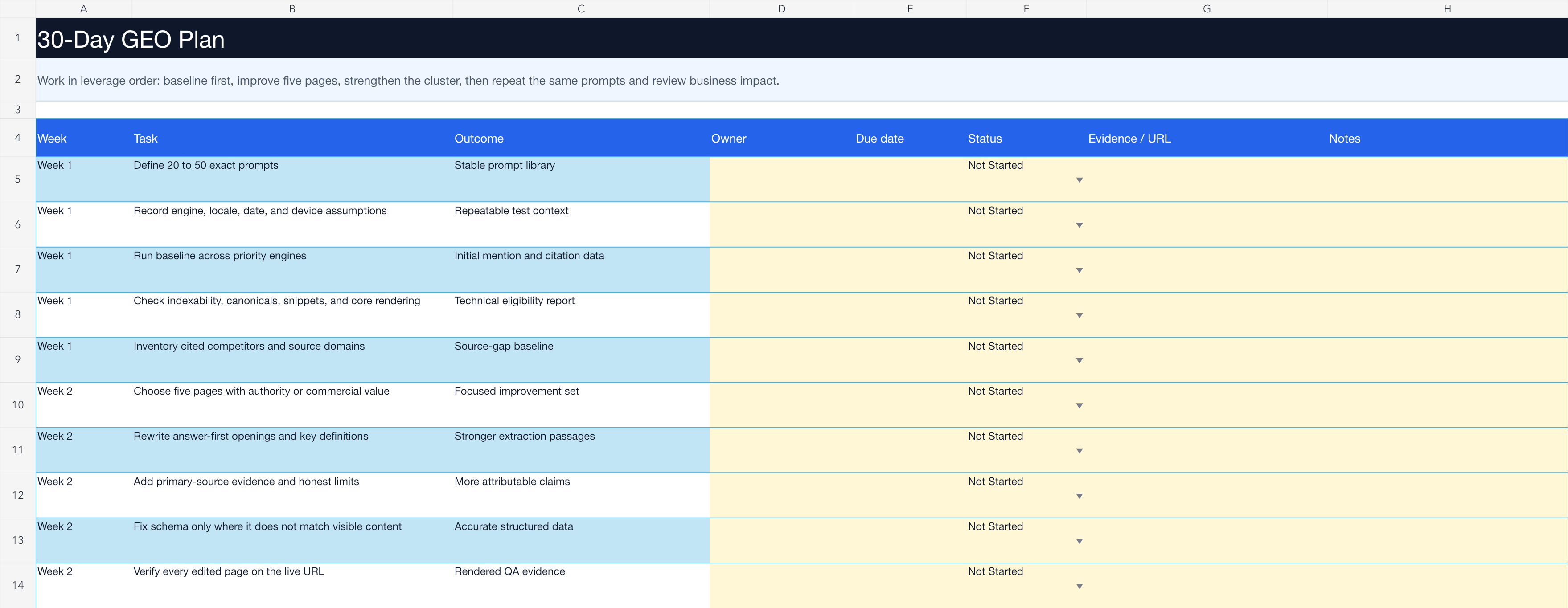
Enter your email and I’ll send the Excel workbook with a weighted GEO audit, prompt tracker, source inventory, and 30-day action plan.
My recommendation
Treat generative engine optimization as an accountable extension of SEO. Build clear sources, publish evidence, allow the retrieval paths you want, and measure repeated answers.
Ignore the parts of the market that require you to believe AI search has a secret technical checklist. Google’s own documentation undercuts that pitch. The original GEO research supports better source presentation, not superstition.
If you want a measurement-first implementation, see my AI search optimization and GEO services. I would rather show you a small defensible baseline than a large dashboard full of invented certainty.
Frequently asked questions
Generative engine optimization is the process of improving whether a brand, page, or claim is retrieved and cited in AI-generated answers. It combines SEO fundamentals with citation-aware content, crawler policy, entity clarity, and prompt-level measurement.
GEO adds generative-answer visibility and citation measurement to SEO. It does not replace indexing, relevance, authority, page experience, or technical access. Google treats optimization for its AI search features as part of normal SEO.
GEO is the broader practice of gaining visibility in generative engines. AEO focuses on making direct answers easy to extract. In practice, answer-first writing, definitions, tables, and evidence support both.
Source presentation can influence visibility. The GEO-Bench research found gains of up to 40% for some tactics in its benchmark. Real-world results vary by engine, query, domain, competition, and measurement method, so no tactic guarantees a citation.
The cost depends on scope. A small site can start with a spreadsheet, 10 to 20 prompts, and five page updates. Agencies and large brands may pay for daily multi-engine tracking, content production, technical remediation, and reporting. Ask for the prompt set and expected work before accepting a price.
Allow at least four weekly snapshots to establish an early direction. Technical fixes can affect eligibility quickly, while authority, new content, and persistent citation gains can take months. Avoid providers that promise a fixed ChatGPT rank by a fixed date.
Tell Google you want more of this.
Add Gaurav Tiwari as a preferred sourceOne tap, and this site shows up more often in your own Top Stories, AI Overviews and AI Mode. Remove it any time.