
 by
by
LLM SEO is the work of making your content easy for answer engines to retrieve, understand, trust, and cite. Most of it is still good SEO. The difference is that you are optimizing for a generated answer as well as a blue-link result.
I would not build a separate content department around it. I would add a small AI-search layer to the publishing system you already have: clearer answers, stronger evidence, crawl access, and measurement across repeated prompts. That is enough to expose most of the real opportunities without buying into the “rank number one in ChatGPT” nonsense.
My own tracking makes the limitation obvious. I checked 14 prompts across ChatGPT, Google AI Mode, and Google AI Overviews on July 1 and July 8, 2026. ChatGPT’s brand-mention rate moved from 21.4% to 28.6%, while Google produced no brand mentions in this small sample. Both weeks, the only citation win came from a narrow query about FlyingPress versus WP Rocket. Two snapshots are a baseline, not proof of a trend.
That is the right way to approach LLM SEO: make restrained changes, measure honestly, and resist turning a noisy answer system into a fake rank tracker.
What LLM SEO is, and what it is not
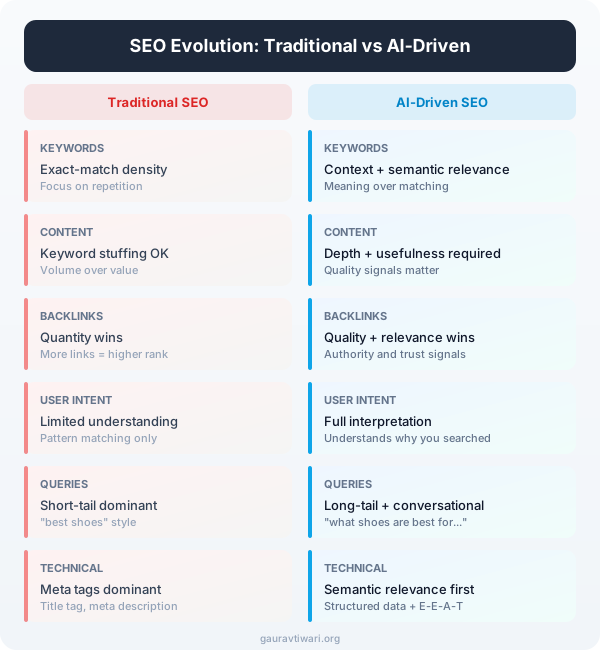
LLM SEO is the practice of improving how often a website or brand appears in AI-generated answers and citations. It covers content quality, source eligibility, entity clarity, answer structure, and measurement across systems such as ChatGPT Search, Perplexity, Claude, Google AI Overviews, and Google AI Mode.
It is not a replacement for technical SEO, content quality, links, or brand authority. Google says the fundamentals for its generative search experiences remain the same as regular Search. Its July 2026 guidance explicitly says you do not need AI-specific rewrites, special schema, an llms.txt file, or artificial “chunking” to qualify for AI features.
That clarification matters. Plenty of LLM SEO advice starts with a made-up technical requirement and works backward to a service pitch.
| Term | Practical meaning | What it changes |
|---|---|---|
| SEO | Earn visibility and clicks in search results | Indexing, relevance, quality, authority, user experience |
| LLM SEO | Earn mentions and citations in generated answers | Retrieval access, source clarity, extractable evidence, prompt tracking |
| GEO | Improve visibility in generative engines | Usually the broader strategy label for LLM SEO work |
| AEO | Make answers easy for answer systems to use | Direct responses, definitions, lists, tables, and structured facts |
The generated layer also changes how people move from a question to a product. A person can ask an assistant how to build a website and receive a summarized recommendation before visiting a builder. Traditional SEO strategies still determine whether the underlying pages are accessible, relevant, and trustworthy enough to enter that recommendation set.
I treat these as overlapping views of the same system. My GEO versus SEO comparison goes deeper on the strategic differences. If someone needs four disconnected audits for SEO, GEO, AEO, and LLMO, the terminology has started doing more work than the strategy.
How AI search engines find and cite content
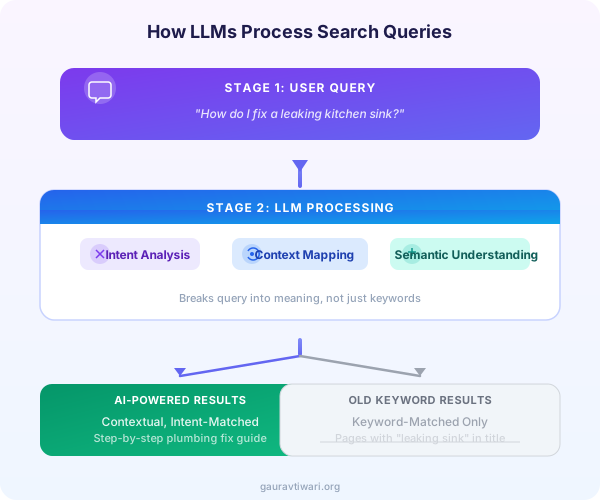
AI search engines generally use a retrieval-and-generation flow: interpret the question, run related searches, retrieve candidate documents, synthesize an answer, and attach citations when the product supports them. Google calls part of this process “query fan-out,” where one request can trigger several related searches across subtopics and data sources.
The exact pipeline differs by engine, but three source paths matter:
- Search indexes: Google AI features rely on Google Search systems. ChatGPT Search and Microsoft Copilot also use search and partner indexes.
- Dedicated search crawlers: OpenAI identifies OAI-SearchBot for search, Anthropic identifies Claude-SearchBot, and Perplexity identifies PerplexityBot.
- User-triggered fetches: ChatGPT-User, Claude-User, and Perplexity-User can request pages when a person asks the assistant to open or inspect a URL.
Training crawlers are a separate choice. OpenAI documents GPTBot for model training, while Anthropic documents ClaudeBot for training. You can allow search retrieval while blocking training where the provider supports separate user agents. Do not copy a blanket robots.txt block from a viral thread without checking which bot it affects.
The practical implication is simple: a page must first be eligible to appear. Then it must give the system a reason to select it over the other eligible pages.
What AI bots fetched from my server
I cannot publish a credible AI-bot fetch table yet. When I checked the log-analysis database for this update, the tables contained zero AI-bot request rows. That means I have no defensible fetch count for GPTBot, OAI-SearchBot, ClaudeBot, Claude-SearchBot, or PerplexityBot.
This is a useful failure, not a number to hide. Before server logs can support an LLM SEO claim, the collection layer needs to prove four things:
- requests are reaching the origin rather than disappearing at the CDN;
- user agents are classified without merging search, training, and user-triggered bots;
- requested URLs and timestamps are stored consistently;
- bot hits can be separated from mentions, citations, referral visits, and conversions.
A crawler hit proves only that an agent requested a URL. It does not prove that the page entered an answer, earned a citation, or influenced a sale. Once the tables contain enough rows, I can report bot, page, fetch frequency, response status, and any captured query context. Until then, the honest number is zero recorded rows.
What my citation tracking actually shows
My first-party data is small, but it is useful because it shows how quickly a broad claim can collapse under measurement.
I tracked 14 commercial and informational prompts using brand variants for Gaurav Tiwari and gauravtiwari.org. The July 1 snapshot contained 42 answer checks across ChatGPT, Google AI Mode, and Google AI Overviews. The July 8 snapshot contained 40 completed checks because two Google responses were missing.
| Metric | July 1, 2026 | July 8, 2026 |
|---|---|---|
| Prompts tracked | 14 | 14 |
| Completed answer checks | 42 | 40 |
| ChatGPT prompts with a brand mention | 3 | 4 |
| ChatGPT brand-mention rate | 21.4% | 28.6% |
| Google AI Mode brand mentions | 0 | 0 |
| Google AI Overview brand mentions | 0 | 0 |
| Citations to gauravtiwari.org | 1 | 2 |
Every citation came from the same prompt: “FlyingPress vs WP Rocket.” The cited comparison page appeared in both snapshots, and my FlyingPress review joined it in the second. Prompts such as “GEO vs SEO” and “how to get cited by AI search engines” produced no brand mention or citation.
That result gave me a more useful priority than a generic GEO score. I already have a narrow authority pocket around WordPress performance comparisons. The sensible move is to strengthen that pocket, then test whether adjacent pages begin to appear. It would be foolish to describe four mentions as sitewide AI visibility.
The nine LLM SEO changes worth making
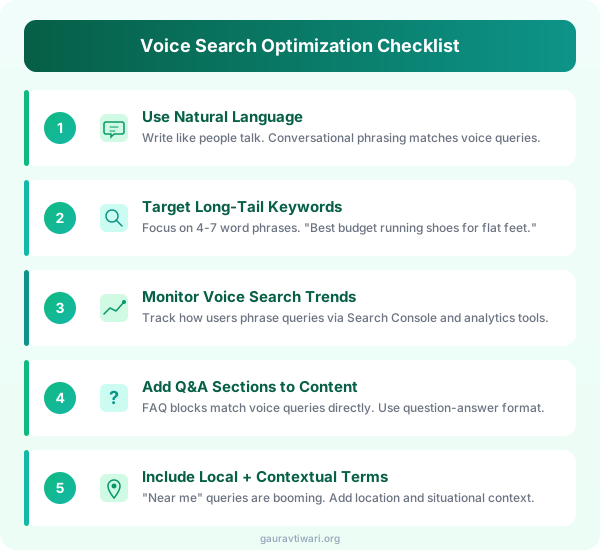
The best LLM SEO changes improve the page for human readers and search systems at the same time. I would start with these nine.
1. Answer the heading immediately
Open each major section with a direct answer. A reader should not have to cross three setup paragraphs before learning what the section means.
This is not an instruction to write robotic one-sentence chunks. Google specifically warns that AI-specific chunking is unnecessary. Write a complete answer first, then explain the context, exception, and evidence in normal prose.
2. Replace generic claims with verifiable details
Names, dates, versions, prices, standards, and measured results make a passage easier to verify. “An AI bot” is vague. “OAI-SearchBot is OpenAI’s search crawler” is a claim a reader can check against OpenAI’s documentation.
Numbers need sources or a reproducible method. A precise invented statistic is worse than a careful qualitative statement.
3. Add first-party evidence with boundaries
Publish what you tested, how you tested it, and where the test stops being representative. My two snapshots are useful because the prompt list, engines, dates, and counts are explicit. They are not a six-month study.
This is where a smaller publisher can beat a large generic guide. You may not have the strongest domain, but you can show the configuration, error, before-and-after measurement, or decision that the generic guide cannot.
4. Create extractable assets
Use a table when the reader is comparing categories. Use a numbered list for a process. Use a short definition when a term is ambiguous. My guide to formatting blog posts for AI search shows the editorial pattern in more detail. These formats help people scan and make discrete claims easier to quote.
Do not turn every paragraph into a card, bullet, or definition box. Extractability works when the structure matches the information.
5. Make the entity relationship obvious
AI systems need to understand who did what. Name the product, company, person, standard, and source instead of relying on pronouns for an entire section.
Your About page, author profile, organization details, consistent brand name, and focused topic cluster all help reduce ambiguity. Schema can reinforce information already visible on the page, but it cannot manufacture authority.
6. Keep the page crawlable and indexable
Check canonical tags, robots directives, HTTP status, internal links, and rendered content. If the useful answer only appears after a broken script runs, retrieval systems may never see it.
Review crawler policies separately. OpenAI, Anthropic, and Perplexity publish different search, training, and user-fetch agents. Decide what you want to allow, document it, and re-check after changes.
7. Build topical depth instead of isolated pages
One page cannot own an entire subject. A useful cluster might include a concept page, an implementation guide, a measurement tutorial, a comparison, and a service page. Each page should own a distinct intent and link to published companions naturally. When two pages overlap or one becomes stale, it may need to be pruned and updated instead of competing with a new URL.
That is why I keep the existing GEO-versus-SEO comparison focused on the decision query and use this page for LLM citation mechanics. Two near-identical “complete guides” would compete with each other and confuse readers.
8. Earn corroboration beyond your own site
An excellent page can still lose when every claim about the brand comes from the brand. Independent reviews, expert roundups, community discussions, documentation, and news coverage give retrieval systems other sources that can confirm who you are and what you do.
Do not turn this into a directory-submission spree or fake forum campaign. Start with places your buyers already trust. Contribute something worth referencing, correct inconsistent company details, and earn mentions through useful work. Third-party corroboration is slower than adding schema, but it is much harder for a competitor to copy.
9. Track prompts, citations, and business outcomes
Monitor the questions buyers ask, whether your brand appears, which URLs get cited, and whether those appearances lead to qualified visits, branded searches, leads, or sales. A visibility score without a prompt list is nearly meaningless.
Run repeated snapshots. AI answers vary, so a single screenshot proves only that one answer existed at one moment.
How the engines differ in practice
The engines share source-quality fundamentals, but their interfaces and crawlers create different operational checks.
ChatGPT Search
For ChatGPT Search, allow OAI-SearchBot if you want pages included in search answers. OpenAI documents GPTBot separately for training and ChatGPT-User for user-initiated requests. Track both brand mentions and linked citations because ChatGPT can mention a company without linking to its site.
Perplexity
Perplexity is citation-forward, so source URLs and citation position are especially useful. Perplexity documents PerplexityBot for search indexing and Perplexity-User for user-triggered actions. Its documentation says the user agent may not follow robots.txt in the same way as the indexing bot, so treat the two separately.
Claude
Anthropic identifies Claude-SearchBot for search quality, Claude-User for user requests, and ClaudeBot for model training. Claude visibility should be measured with the same repeated-prompt discipline, but do not assume a crawler hit means a citation or that a citation means referral traffic.
Google AI Overviews and AI Mode
Google’s AI features sit on top of Google Search systems. There are no extra technical requirements beyond being indexed and eligible for a normal snippet. In June 2026, Google began rolling out a Generative AI performance report in Search Console to a subset of properties. Use it if your property has access, but keep normal Search Console queries, landing pages, and conversions in the same review.
Robots.txt: block training without blocking search
Robots.txt decisions should follow your publishing goals. If you want search visibility but do not want model-training crawling, use the provider’s separate user agents where available.
| Provider | Search crawler | Training crawler | User-triggered fetch |
|---|---|---|---|
| OpenAI | OAI-SearchBot | GPTBot | ChatGPT-User |
| Anthropic | Claude-SearchBot | ClaudeBot | Claude-User |
| Perplexity | PerplexityBot | Not described as a training bot | Perplexity-User |
Google-Extended controls whether Google content can help improve certain Gemini systems; Google says it does not affect inclusion or ranking in Google Search. That is different from Googlebot, which still needs access for Search and AI features built on Search.
After changing robots.txt, test the live file and the exact page. OpenAI says its systems may take about 24 hours to adjust after a robots update. CDN rules, bot protection, and firewall challenges can also override what the file appears to allow.
How to measure LLM SEO without fooling yourself
Use a small, stable prompt set before expanding. A useful starter set has 10 to 20 prompts across problem, comparison, recommendation, and brand questions.
For each prompt and engine, record:
- whether the brand appears;
- whether the domain receives a linked citation;
- which URL is cited;
- the brand’s order in the answer;
- named competitors;
- answer date, country, and language;
- referral sessions and conversions where available.
Calculate mention rate as prompts with a brand mention divided by completed prompt checks. Calculate citation rate separately. A brand can be discussed without being cited, and a page can be cited without a prominent brand mention.
Do not compare a US-English ChatGPT sample with a worldwide Google sample and call the difference a ranking change. Keep engine, locale, prompt wording, and schedule stable enough that the trend means something.
If you need the full setup, my AI visibility tracking workflow explains the measurement layers, reporting formulas, and when a paid platform becomes worth the cost. Until that companion is published, start with a spreadsheet and the method above.
How I audit an existing page for LLM SEO
An LLM SEO audit should end with page-level edits, not a vague visibility grade. I review the live page in this order.
First, I confirm that the page owns a distinct intent. If another published URL answers the same question with the same format, I merge, redirect, or re-scope before polishing either page. Cannibalization is not cured by adding more entities.
Second, I test the reader’s path through the page:
- Does the opening state the useful answer within the first 100 words?
- Does each H2 open with a complete response?
- Are important claims supported by a primary source or first-party method?
- Can a table, definition, or process be understood outside the surrounding paragraph?
- Are dates, versions, and prices current?
- Does the article name its limitations and who should not follow the advice?
Third, I inspect the source path. I check the canonical URL, robots meta, HTTP response, rendered text, sitemap inclusion, internal links, crawler policies, and CDN behavior. If the page is technically unavailable, copy editing will not make it citable.
Finally, I map the page to prompts. A comparison article should be tested against comparison and recommendation questions, not only its focus keyword. The test tells me whether the page’s real authority matches the query family I assigned to it.
This process is intentionally close to a normal content update. The distinction is that I also inspect retrieval agents, citation patterns, and prompt-level outcomes.
LLM SEO tactics I would skip
Some popular tactics cost time without improving the source.
- Mass-producing near-duplicate Q&A pages: this creates index bloat and weakens the topic cluster.
- Adding unsourced statistics for “citation density”: an invented number is a liability, even if an engine repeats it.
- Forcing an exact keyword into every heading: generated systems expand queries and evaluate passages; awkward repetition does not create authority.
- Publishing an
llms.txtfile as the main deliverable: Google says it is not required, and major engines do not offer a universal ranking benefit for it. - Blocking every AI user agent with one copied rule: search, training, and user fetches are not the same activity.
- Reporting one screenshot as a ranking: a screenshot is an example, not a time series.
I am not against experiments. I am against presenting an experiment as a standard before it has survived measurement.
What I would do first
Start with five pages that already have organic traction or clear first-party evidence. Rewrite weak section openings, add one original asset to each page, verify crawler access, and track 10 buyer prompts for four weeks.
Do not create 100 thin “AI-optimized” pages. Do not add an llms.txt file and declare victory. Do not pay an agency for a secret schema type that Google does not require.
The honest LLM SEO service is boring in the best way: strong research, distinctive evidence, clean technical access, careful editing, and repeated measurement. Those fundamentals survive product changes because they improve the source, not just the trick.
If you want help building that system, see my AI search optimization and GEO services. I start with what the data can support, then improve the pages most likely to earn a real mention or citation.
Frequently asked questions
Publish a crawlable, authoritative page that directly answers a question, includes verifiable evidence, and is eligible for retrieval by OAI-SearchBot. Then track repeated prompts to see whether ChatGPT mentions the brand and cites the page. There is no guaranteed submission or number-one position.
LLM SEO adds retrieval, citation, and prompt-level measurement to normal SEO. The content still needs technical access, relevance, quality, authority, and a good user experience. Google describes optimization for its generative features as part of SEO, not a separate technical system.
Block GPTBot if you do not want OpenAI’s training crawler to access your site. Do not confuse it with OAI-SearchBot, which supports search visibility, or ChatGPT-User, which fetches pages on a user’s request. Set each policy deliberately.
Valid schema helps search systems understand information already present on a page, but Google says no special AI schema is required. Use relevant Article, Organization, Product, or other supported markup. Do not add schema that does not match visible content.
There is no general evidence that major search products require or reward llms.txt. Google explicitly says it is unnecessary for its AI search features. You can experiment with it, but fix indexing, content quality, evidence, and internal linking first.
Choose a fixed prompt set, run it across the same engines and locales on a schedule, and record mentions, linked citations, cited URLs, competitors, and position in the answer. Judge four-week trends, not one screenshot.
Sources
- Google’s AI optimization guide
- OpenAI crawler documentation
- Anthropic crawler documentation
- Perplexity crawler documentation
Tell Google you want more of this.
Add Gaurav Tiwari as a preferred sourceOne tap, and this site shows up more often in your own Top Stories, AI Overviews and AI Mode. Remove it any time.