
 by
by
AI visibility tracking measures whether your brand appears in generated answers, which pages earn citations, and whether those appearances produce useful traffic or conversions. Those are different signals. Combining them into one polished mystery score hides more than it reveals.
You do not need an expensive platform to start. A stable prompt set, a spreadsheet, citation checks, and normal analytics will answer the first useful question: “Are we appearing for the questions our buyers ask?” Pay for automation when manual collection becomes the bottleneck, not before you know what deserves tracking.
I started with 14 prompts and two weekly snapshots on July 1 and July 8, 2026. The result was not a victory chart. ChatGPT mentioned my brand for three prompts in the first snapshot and four in the second. Google AI Mode and Google AI Overviews produced no brand mentions in the completed checks. One FlyingPress-versus-WP-Rocket prompt accounted for every citation to my site.

For a paid system, Semrush AI Visibility Toolkit is now my primary recommendation. It is not the cheapest option, and its $99 monthly Base plan only tracks one domain and 25 daily prompts. I recommend it because those AI-search signals sit beside the SEO, competitor, backlink, and content data that already inform the next decision. If you only have 10 prompts and one small site, keep the spreadsheet.
That small dataset taught me the most important rule in AI search visibility: track trends and source details, not screenshots.
What AI visibility actually means
AI visibility is the measurable presence of a brand, product, person, or website in AI-generated answers. A complete view separates mentions, citations, fetches, and downstream traffic.
| Signal | Definition | What it proves |
|---|---|---|
| Brand mention | The answer names the brand | Awareness inside that answer |
| Citation | The answer links or attributes a claim to a URL | The page was used or surfaced as a source |
| Bot fetch | A known AI user agent requested a page | Retrieval activity, not inclusion in an answer |
| Referral visit | A person clicked from an AI product | Measurable site traffic |
| Conversion | The visit produced a lead, sale, signup, or other goal | Business value |
A mention without a citation can still influence awareness. A citation without a click can still build trust. A bot fetch proves neither. Keep the signals separate, then connect them when the evidence allows it.
The three-layer AI visibility tracking stack
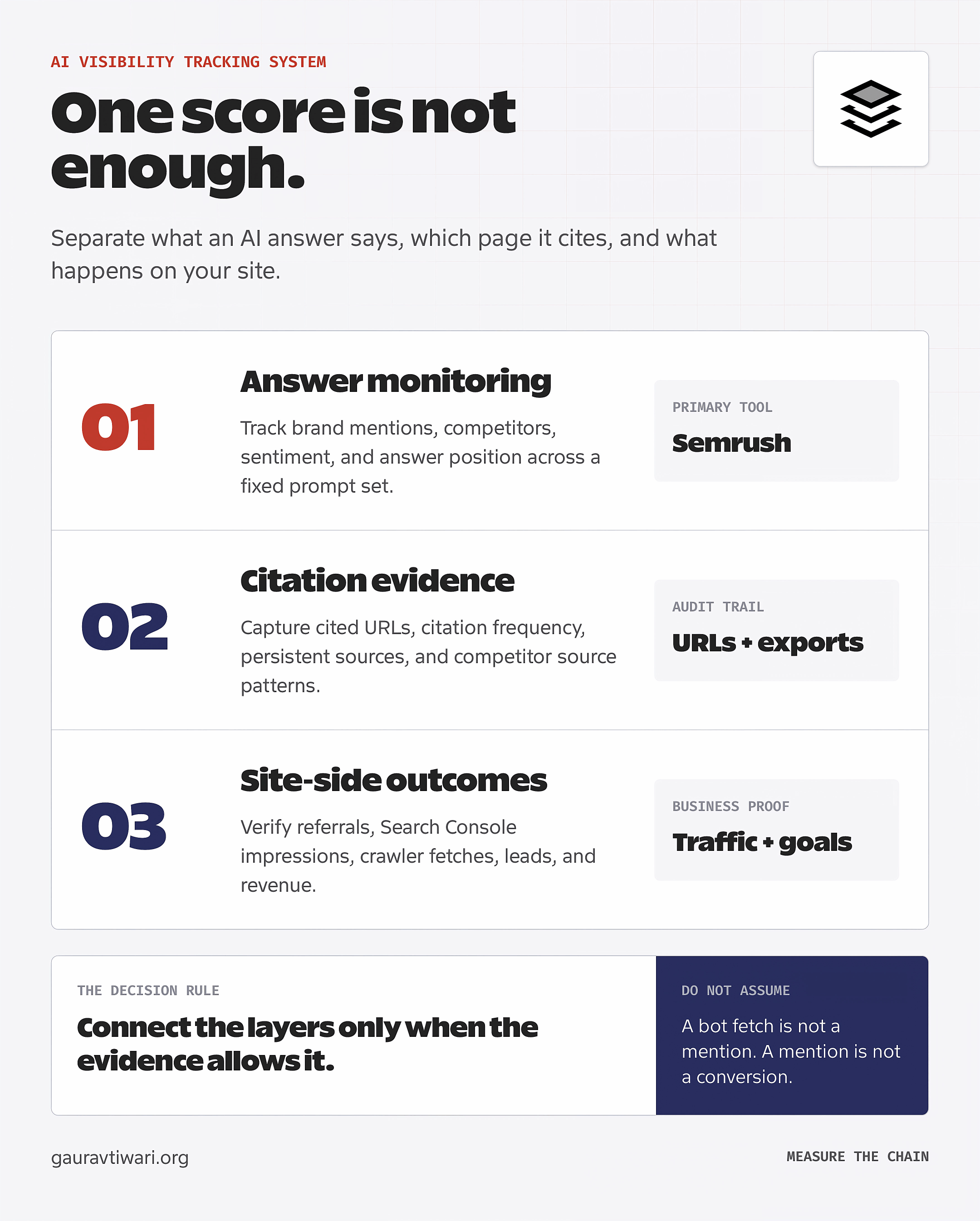
A practical stack has three layers: repeated prompt monitoring, citation reporting, and site-side observation. Each answers a different question.
Layer 1: answer monitoring
Run the same prompts across selected AI engines and record whether the brand appears, where it appears, which competitors appear, and how the answer describes them.
This is the core visibility layer. It works manually for a small prompt set and becomes a job for software when you need daily runs across many brands, countries, or models.
Layer 2: citation monitoring
Capture the URLs cited in each answer, not just the brand names. Citation data tells you which pages and third-party sources support the answer.
This layer reveals a useful distinction: a competitor may win the brand mention while an industry publication wins the citation. Your response differs depending on which one happened.
Layer 3: site-side observation
Use analytics and server logs to identify AI referrals, known crawler requests, user-triggered fetches, and landing pages. This validates activity on your own property.
My current log-analysis database has no AI-bot request rows, so I am not using it to claim fetch trends. That is exactly how the layer should work: it either supplies evidence or it does not. A blank dashboard is not permission to improvise numbers.
Why Semrush is my primary AI visibility tool
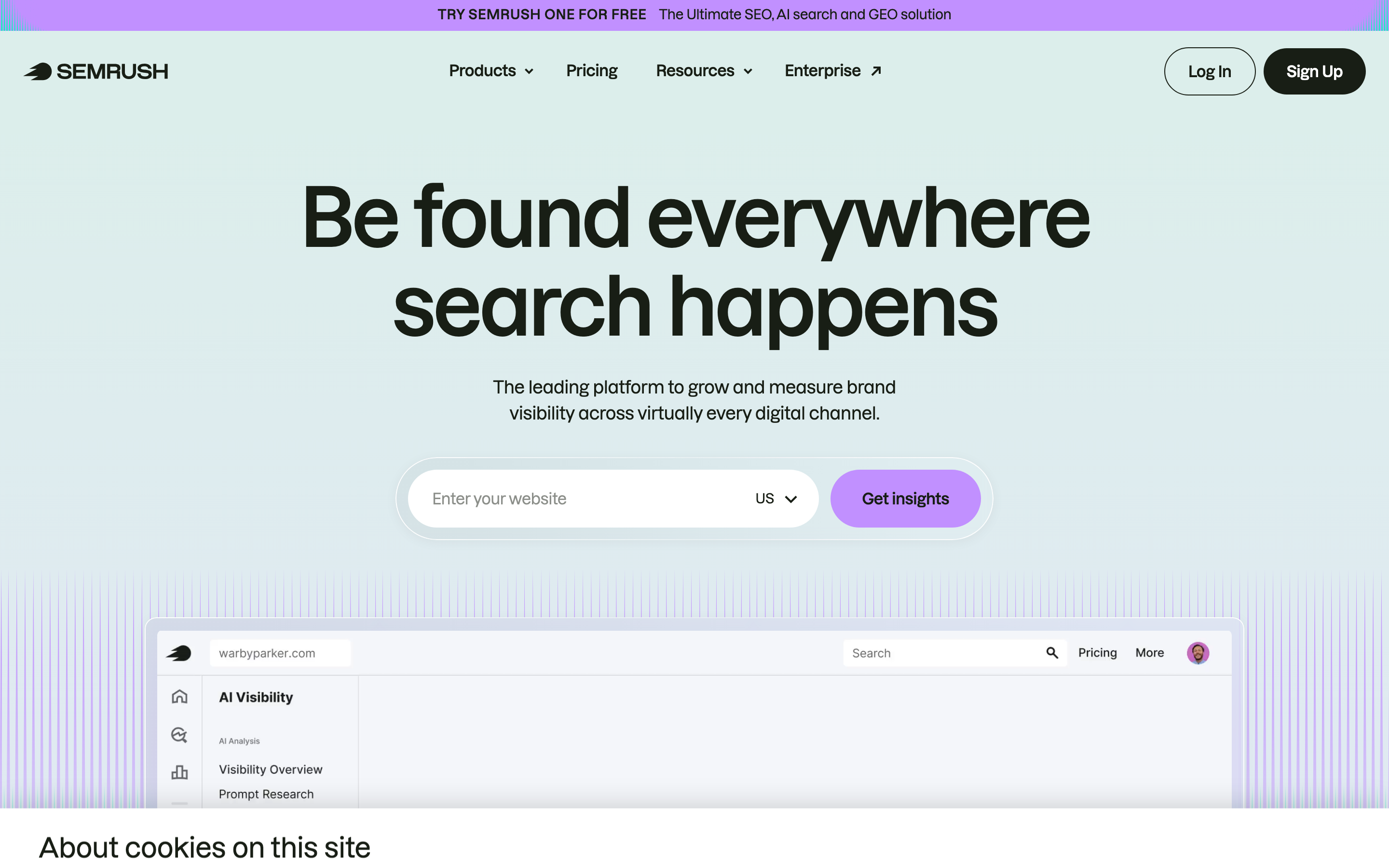
Semrush is the best paid starting point for an SEO team that wants AI visibility tracking without creating a second disconnected reporting system. Its AI Visibility Toolkit tracks prompt-level brand performance while the wider Semrush platform supplies the keyword, backlink, competitor, technical, and content context needed to act on the result.
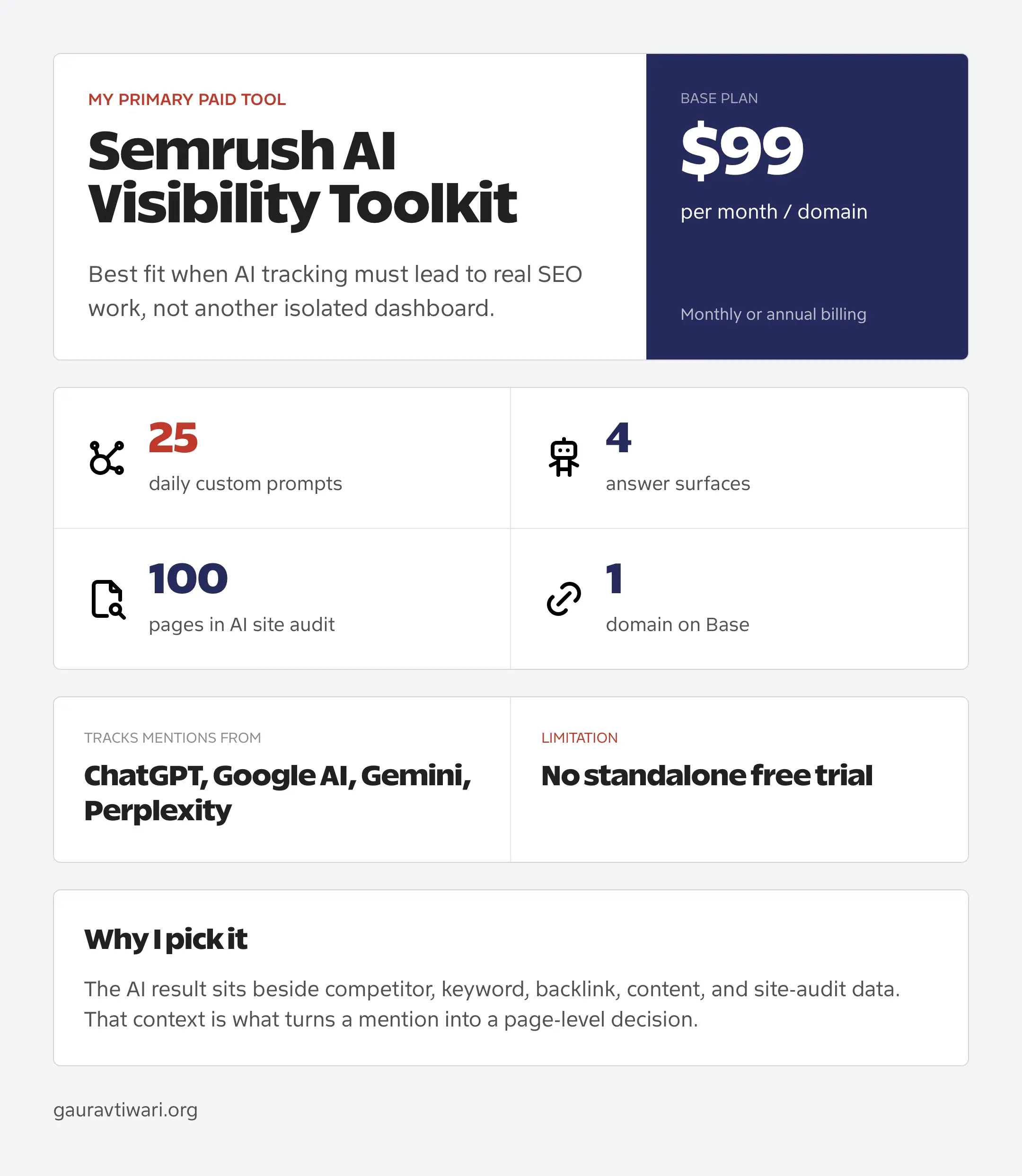
The current Base plan has clear boundaries:
- Price: $99 per month for each domain, the same on monthly and annual billing.
- Prompt tracking: 25 custom prompts checked daily.
- Answer surfaces: ChatGPT, Google AI, Gemini, and Perplexity, though the daily Prompt Tracking report does not include Perplexity.
- Site audit: AI-search readiness checks for up to 100 pages.
- Account scope: one domain, with extra users and reports sold separately.
- Trial: no standalone free trial for the AI Visibility Toolkit.
That last point matters. Do not click through expecting a free AI-tool trial because you have seen a Semrush trial promoted for its classic SEO plans. The standalone AI Visibility Toolkit is a separate subscription.
I have used Semrush across SEO projects for years, and I still think its biggest advantage is context, not the dashboard itself. A mention-rate change becomes useful when I can inspect the cited page, the competing domains, the backlinks behind those sources, and the search demand around the topic in the same working environment. My detailed Semrush review covers the broader platform, pricing, and the parts I actually use.
Use Semrush first when:
- you already run SEO work in Semrush;
- you need daily prompt tracking for one or more commercial brands;
- competitors, cited sources, sentiment, and share of voice matter to the report;
- the team needs one place to move from visibility data to page-level SEO work.
Skip it for now when:
- you are still testing fewer than 20 prompts;
- one monthly snapshot is enough;
- you need complete raw-answer control through an API;
- $99 per domain costs more than the reporting time it saves.
Layer 1: track brand mentions in AI answers
Start with prompts, not keywords. AI search questions are often longer, comparative, and shaped around a decision.
Step 1: build a prompt library
Use four prompt types:
- Problem prompts: “How do I improve Core Web Vitals on WordPress?”
- Category prompts: “What are the best WordPress performance plugins?”
- Comparison prompts: “FlyingPress vs WP Rocket for a WooCommerce site”
- Brand prompts: “Is Gaurav Tiwari reliable for WordPress SEO advice?”
Tie each prompt to a real customer question, service, product, or page. Avoid vanity prompts no buyer would ask.
Step 2: define brand variants and competitors
Track the full name, domain, product names, common abbreviations, and misspellings that matter. Add three to five direct competitors for share-of-voice comparisons.
For my tracker, the brand variants include “Gaurav Tiwari,” “gauravtiwari.org,” and “gauravtiwari.” That catches domain citations and natural brand mentions without matching every occurrence of a common first name.
Step 3: hold the conditions steady
Record the engine, model or product, country, language, prompt wording, and date. Run on a fixed schedule.
AI answers vary. If you change the prompt, country, and engine every week, you cannot tell whether the brand moved or the experiment changed.
Step 4: record answer-level details
For every completed prompt, capture:
- brand mentioned: yes or no;
- brand order or position in the answer;
- linked citation: yes or no;
- cited URLs;
- competitors mentioned;
- sentiment or description when it affects a buying decision;
- failed or incomplete response.
Never count a failed request as a zero mention. Track completion rate so data-collection problems do not look like visibility losses.
Layer 2: track citations and build reports
Citation tracking identifies which sources support generated answers and how often your domain appears among them. It is more useful than a brand score when your goal is to improve specific pages.
I use a local reporting script with DataForSEO’s LLM Mentions API to turn mention and citation data into client-readable documents and spreadsheets. The current LLM Mentions coverage documents ChatGPT and Google AI Overviews, with ChatGPT data limited to US English. Coverage changes, so the report should always name the endpoint, engine, locale, and collection date. My LLM SEO guide explains the crawler and citation mechanics behind this report.
A monthly citation report should include:
- total completed answer checks;
- brand mention and citation rates;
- cited URLs by frequency;
- prompts that produced citations;
- competitor mention and citation share;
- new and lost citations since the previous period;
- examples of answer context;
- data limitations and failed checks.
Do not paste 200 raw answers into a slide deck and call it analysis. The useful part is the decision: which source should be improved, which prompt cluster is unwinnable today, and which third-party publication shapes the category narrative.
Layer 3: watch what AI bots fetch
Server logs show which known user agents requested your pages. They can reveal indexing crawlers, training crawlers, and user-triggered fetches, but the identities and policies differ.
| Provider | Search/indexing | Training | User-triggered |
|---|---|---|---|
| OpenAI | OAI-SearchBot | GPTBot | ChatGPT-User |
| Anthropic | Claude-SearchBot | ClaudeBot | Claude-User |
| Perplexity | PerplexityBot | Not described as training | Perplexity-User |
Build log rules from official documentation, not a stale user-agent list copied from a tool. Keep IP verification where the provider publishes ranges or reverse-DNS guidance. CDN security products can spoof the picture by blocking, challenging, or rewriting requests before they reach the origin.
For each verified bot bucket, report:
- requests by day;
- unique pages fetched;
- top paths;
- status codes;
- cache response where available;
- crawl spikes after publishing;
- user-triggered requests separately from indexing crawls.
Do not infer a prompt from a crawler request unless the log actually contains a reliable query or referrer. Most bot hits do not reveal the human’s question.
Google’s Generative AI performance report reached every Search Console property on August 31, 2026, so use it as site-side evidence instead of trying to reverse-engineer every visit. The report shows impressions for Google AI Overviews and AI Mode, with filters for pages, countries, dates, and devices, but no clicks or query data. It is still only one part of the picture: it does not replace prompt tracking in ChatGPT, Gemini, or Perplexity.
The four metrics worth reporting
Four metrics give a clear early view without pretending AI answers behave like fixed search rankings.
1. Mention rate
Mention rate = completed prompt checks with a brand mention / total completed prompt checks × 100
Calculate it by engine and across the whole tracked set. In my July 1 ChatGPT snapshot, three of 14 prompts mentioned the brand, or 21.4%. On July 8, four of 14 did, or 28.6%. Two points are not a trend, but the formula makes the baseline explicit.
2. Citation rate
Citation rate = completed prompt checks with a citation to your domain / total completed prompt checks × 100
In my data, the domain received one citation in the first ChatGPT snapshot and two in the second. The counts matter more than a polished percentage because the sample is small.
3. Share of AI voice
Share of AI voice = your brand mentions / all tracked competitor mentions × 100
Define whether you count one mention per answer or every placement. Use the same competitor set over time. If the tool will not reveal its calculation, label the score as vendor-defined rather than comparing it with your own formula.
4. Cited-page concentration
Cited-page concentration = citations earned by your top cited page / all citations to your domain × 100
My current concentration is extreme because one comparison topic accounts for every observed citation. That is both a strength and a risk. It shows a retrievable authority pocket, but the visibility disappears if that one topic falls out.
Free and paid AI visibility tools compared
The right tool depends on prompt volume, engine coverage, countries, reporting needs, and team size. Prices and limits change quickly, so verify the vendor page before buying.
| Option | Current entry point | Best for | Main limitation |
|---|---|---|---|
| Spreadsheet + manual checks | Nearly free | First 10-20 prompts and methodology testing | Slow, inconsistent, hard to scale |
| Semrush AI Visibility Toolkit | $99/month per domain | SEO teams that need AI tracking plus competitor and search context | 25 prompts and one domain on Base; no standalone trial |
| DataForSEO LLM Mentions API | Usage-based API | Custom reports and controlled data workflows | Requires code and currently narrower product coverage |
| Otterly.AI | From $29/month | Small teams that want automated daily monitoring | Prompt and engine limits vary by plan/add-on |
| Peec AI | From $95/month | Marketing teams tracking daily multi-engine visibility | Costs rise with prompt, model, and project volume |
| Profound | Free 7-day trial, then custom Enterprise | Enterprise brands that want visibility plus content and agent workflows | No self-serve brand plan; the trial runs 50 fixed prompts on 3 engines |
The lower entry prices hide important differences:
- Otterly.AI: starts at $29 per month for 15 prompts on ChatGPT, Google AI Overviews, Perplexity, and Microsoft Copilot, with Google AI Mode, Gemini, and Claude as paid add-ons.
- Peec AI: starts at $95 per month, or $80 billed annually, with 50 prompts, three selected models, one project, and one country.
- Profound: no longer lists self-serve brand plans. Brands get a free 7-day trial with 50 fixed prompts on ChatGPT, Gemini, and Google AI Overviews, then a custom Enterprise plan. Agency plans start at $99 per month plus $399 for each client workspace.
- DataForSEO: charges by API use and is better for custom reporting, but its documented LLM Mentions coverage is currently narrower than Semrush’s interface.
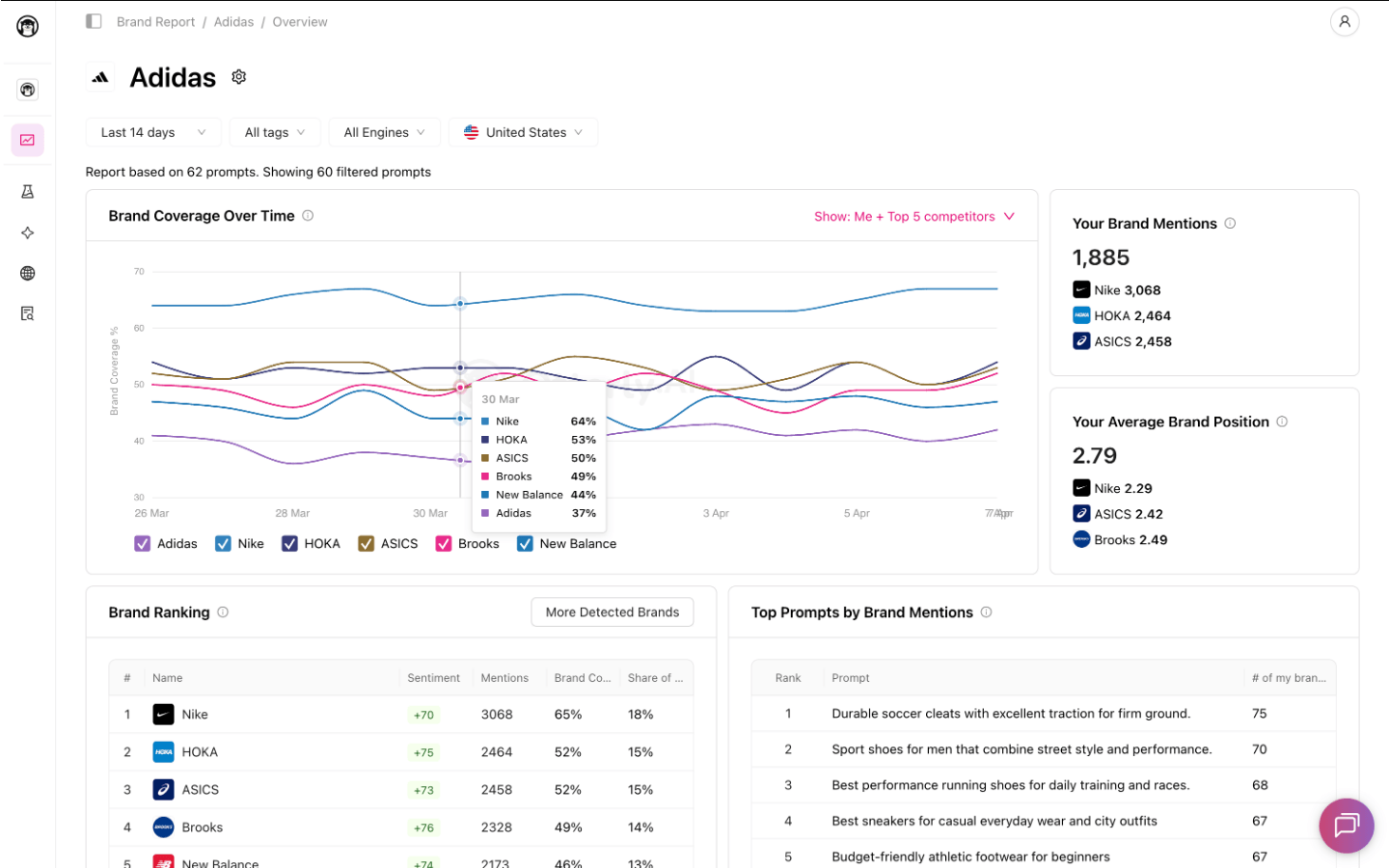
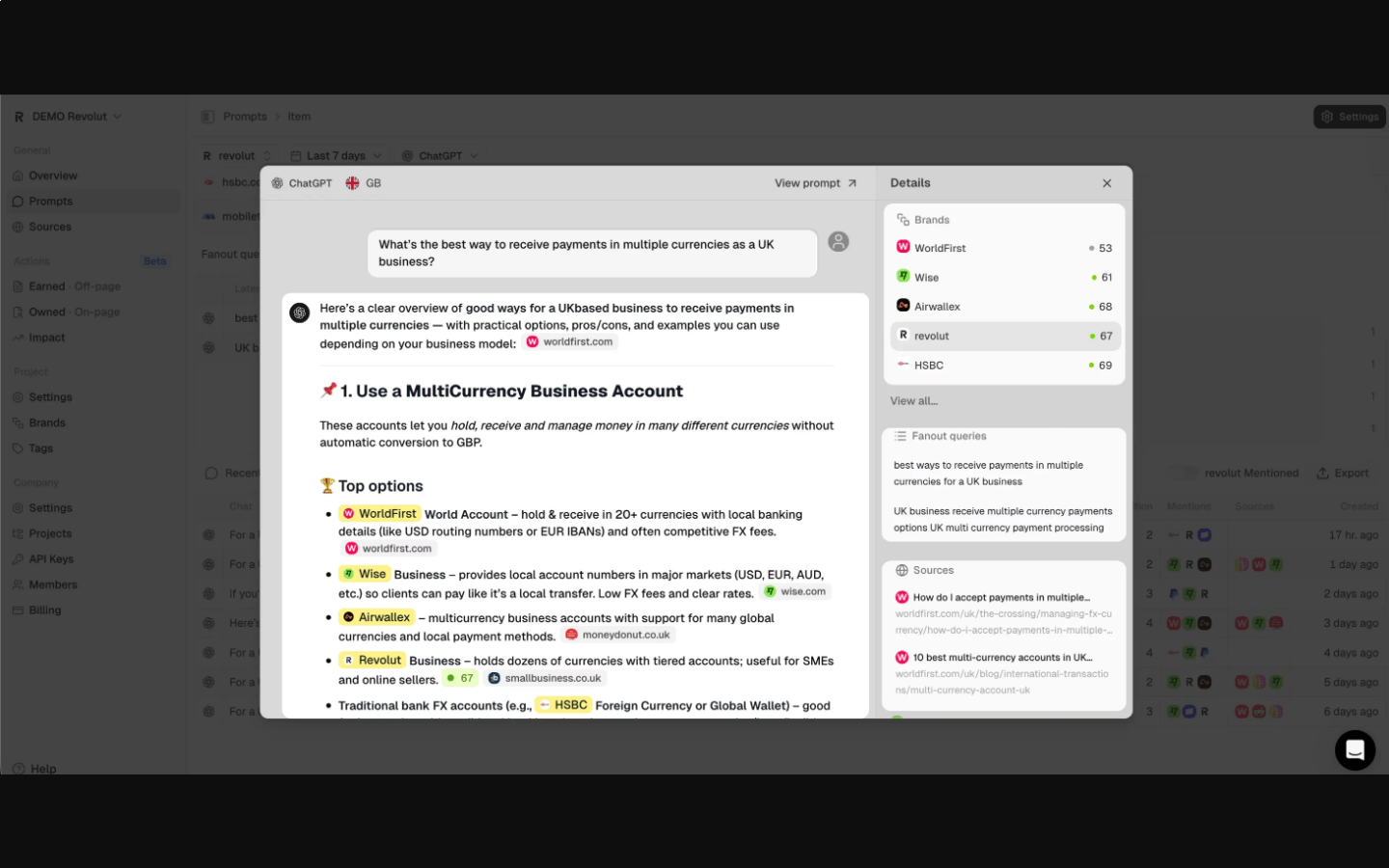
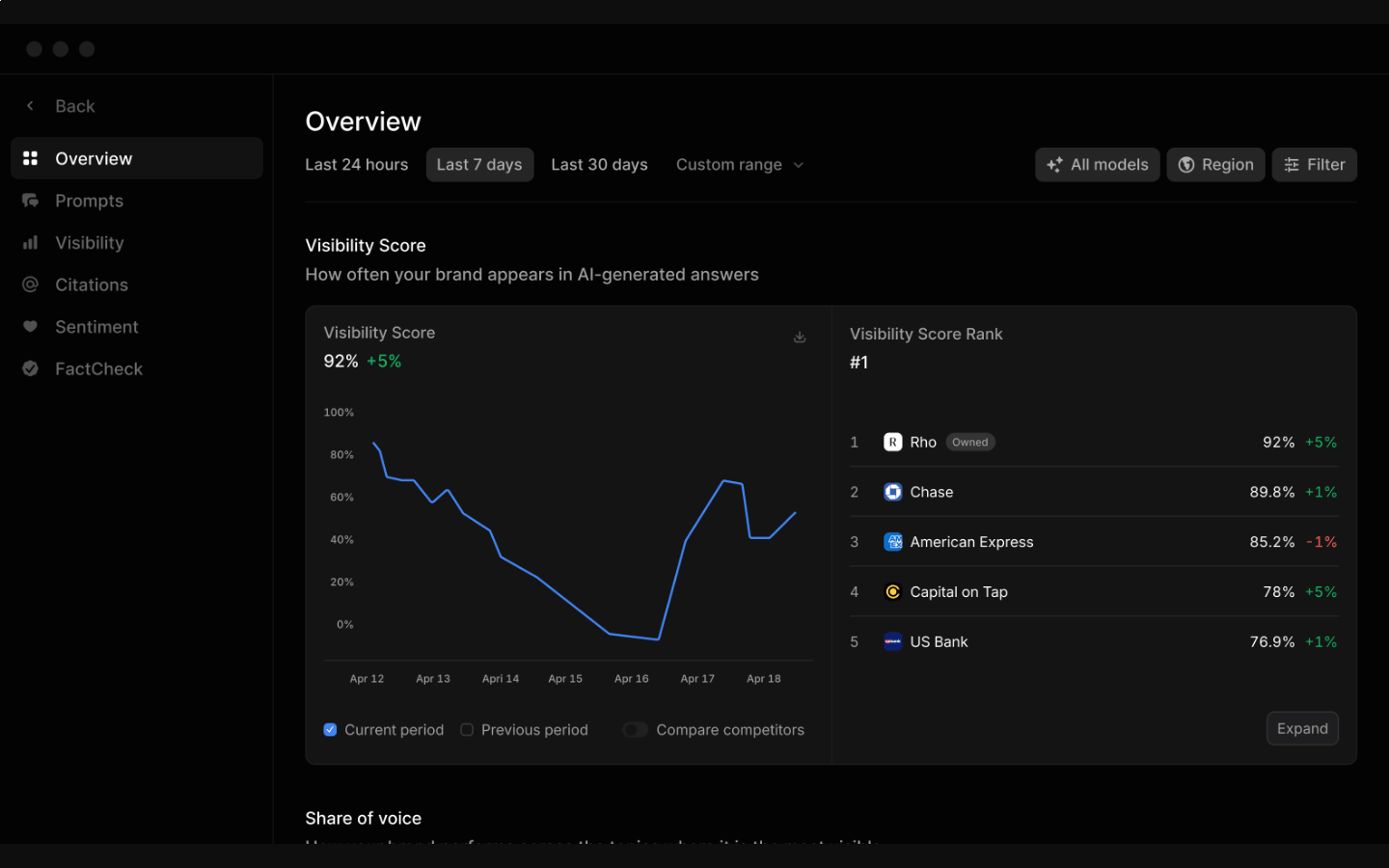
DataForSEO LLM Mentions API is API-first, so there isn’t an equivalent brand dashboard to screenshot. The useful evidence is the endpoint documentation, request parameters, and returned data you turn into your own report.
My recommendation is simple:
- use a spreadsheet until you understand the prompt set;
- use an API when you need custom collection or reports;
- choose Semrush when daily tracking, competitor analysis, and existing SEO context save more time than the subscription costs;
- consider a specialist platform when its exact model, country, or enterprise-reporting coverage fits better.
Do not choose by the largest engine logo grid. Choose by whether the exact engine, locale, prompt count, history, exports, and calculation method fit your reporting job.
What two weekly snapshots taught me
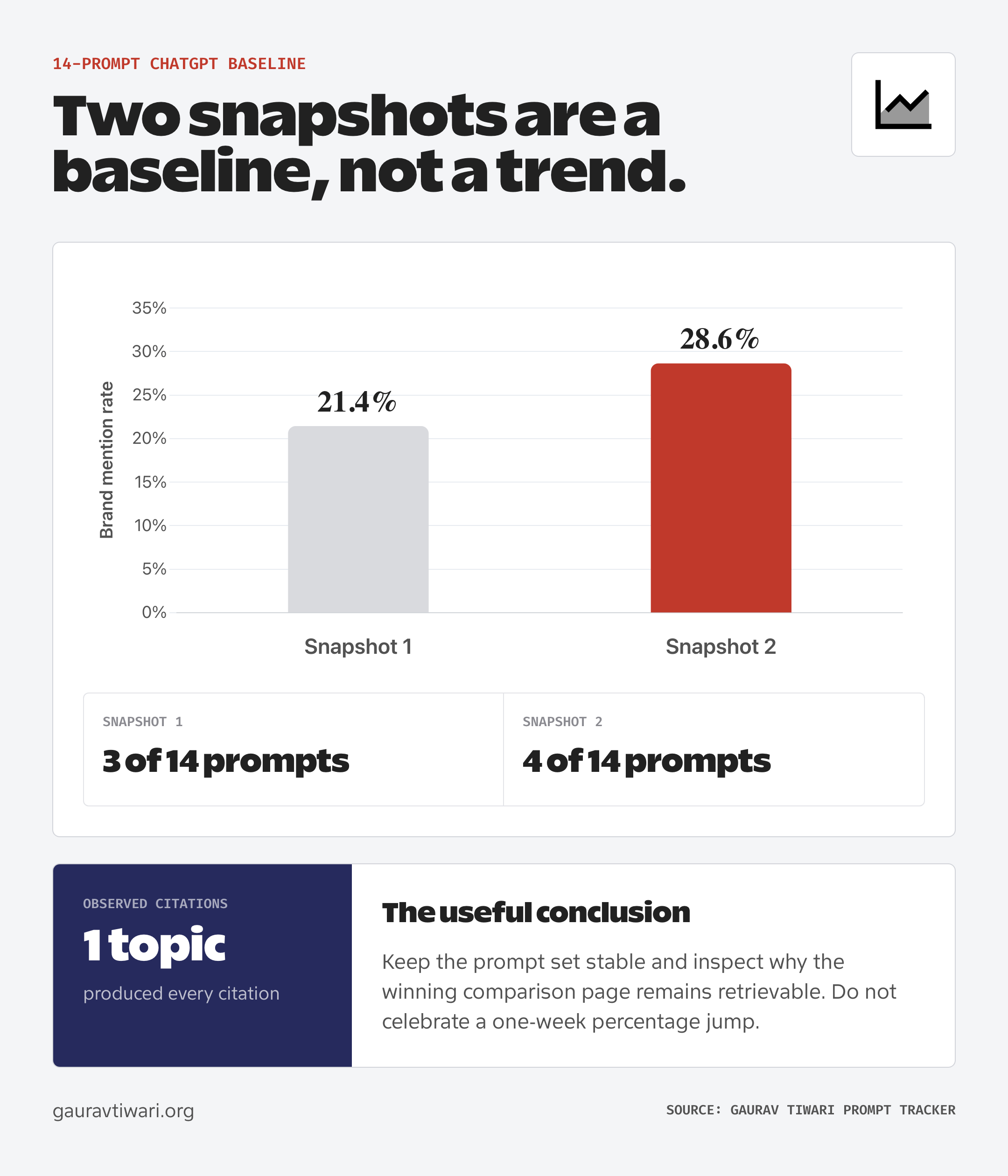
Two weekly snapshots cannot prove growth. They can reveal measurement errors and early concentration.
My July data taught me five things:
- ChatGPT was the only tracked engine with brand mentions in this small set.
- One comparison prompt produced every citation.
- The main comparison page stayed cited across both weeks.
- A related FlyingPress review appeared as a second citation in week two.
- Broad GEO prompts produced no brand visibility despite an existing GEO comparison article.
The wrong response would be to celebrate a 33% increase from three mentions to four. The denominator is too small, the answers are variable, and only one week passed.
The useful response is to keep the prompt set stable, inspect why the performance-comparison pages win, update them with restraint, and strengthen the surrounding WordPress performance cluster. At the same time, the GEO-versus-SEO topic needs clearer first-party evidence before it can reasonably compete for its own prompts. My guide to formatting blog posts for AI search shows how I turn that evidence into clearer, retrievable sections without flattening the article into robotic answer blocks.
A reporting cadence that does not waste time
Run a small site weekly and report monthly. Daily data creates noise unless the brand has enough prompts, markets, and active campaigns to justify it.
A clean monthly review takes this order:
- Confirm completion rate and data quality.
- Compare mention and citation rates by engine.
- Identify new, lost, and persistent cited URLs.
- Review competitor gains and the sources behind them.
- Connect AI referrals to leads or other goals.
- Choose three page-level actions for the next month.
Keep raw answers for audit, but summarize decisions in the report. A good report should tell the editor which page to improve on Monday morning.
The spreadsheet I would use for the first month
One row per prompt-engine-date combination is enough. Use columns for prompt ID, prompt text, engine, country, language, run date, completion status, brand mention, answer position, citation present, cited URL, competitors, sentiment note, and raw-answer location.
Keep a separate prompt sheet with the prompt owner, funnel stage, target page, business priority, and reason for tracking. This prevents the reporting sheet from turning into an unowned list of interesting questions.
Add formulas only after the raw fields are consistent. Mention rate should count completed checks. Citation rate should use exact-domain matching. Competitor share should use a fixed competitor set. Leave failed requests visible instead of deleting them.
At the end of each month, freeze a copy of the raw data. AI answers and vendor interfaces change, so an editable live dashboard is not a complete audit trail.
How to handle noisy or contradictory results
When one engine mentions the brand one week and drops it the next, do not immediately rewrite the page. Check data quality, answer completion, prompt wording, locale, and cited competitors first.
I use three labels:
- Persistent: present in at least three of the last four comparable snapshots.
- Emerging: new in one or two snapshots and supported by a relevant cited page.
- Volatile: appears and disappears without a stable source pattern.
These are working reporting labels, not industry standards. Their purpose is to stop one unusual answer from driving a content sprint.
If a citation persists, inspect the cited passage and the neighboring content. If a competitor persists, inspect the third-party sources that support it. If the result is volatile across every brand, increase the sample before changing strategy.
My recommendation
Start AI visibility tracking before you start an expensive GEO program. A baseline protects you from buying activity that cannot be measured.
Use 10 to 20 decision-oriented prompts, two or three engines, one locale, and weekly snapshots for a month. Record mentions and citations separately. Add site-side logs only when the collection is verified. Then decide whether a paid tool will save enough time to justify itself.
If the baseline proves useful and you want daily tracking connected to normal SEO work, choose Semrush AI Visibility Toolkit. If the baseline remains quiet or the prompt set is still changing, keep the spreadsheet. Software cannot rescue a weak measurement design.
If you want me to build the baseline and improve the pages it identifies, see my AI search optimization and GEO services. The work starts with measurement because a confident strategy built on missing data is still a guess.
Frequently asked questions
Run a fixed set of relevant prompts in ChatGPT on a schedule and record whether the exact brand or domain appears. Use several weekly snapshots because answers vary. For larger sets, use an AI visibility platform or API.
AI visibility is the measured presence of a brand, product, person, or website in AI-generated answers. It can include mentions, citations, answer position, sentiment, referral traffic, and conversions.
Track prompt-level mentions and position in the answer, but avoid treating the number like a fixed Google rank. Keep prompt, engine, locale, and schedule stable, and analyze trends across repeated runs.
They are worth it when automated collection, competitor tracking, daily history, exports, and multi-market reporting save more time than the subscription costs. For fewer than 20 prompts, manual tracking is often enough to establish the method.
Yes, especially for teams already using Semrush for SEO. Its AI Visibility Toolkit tracks 25 daily prompts across ChatGPT, Google AI, Gemini, and Perplexity on the Base plan, then connects the result to competitor, keyword, backlink, content, and site-audit work. The limitation is cost: Base is $99 per month for one domain on monthly or annual billing, with no standalone free trial.
Track a stable set of buyer questions, then review brand mentions, cited pages, competitors, sentiment, and share of voice by topic. Export a monthly snapshot and pair it with Search Console, analytics, and conversion data. A visibility score alone does not show whether the right page earned attention or whether that attention produced business value.
Weekly is enough for most small and midsize sites. Report monthly so random answer variation does not drive editorial decisions. Use daily tracking for active campaigns, large prompt sets, or brands with meaningful AI-search demand.
Yes. Add a fixed competitor set and record mentions, position, sentiment, and cited sources for each completed prompt. Keep the set consistent so share-of-voice comparisons remain meaningful.
Sources
- Semrush AI Visibility Toolkit pricing
- Semrush AI Visibility Toolkit limits and setup
- Semrush AI Visibility metrics
- Google Search Console Generative AI performance report
- DataForSEO LLM Mentions API
- Otterly.AI pricing and product information
- Peec AI pricing
- Profound pricing
- OpenAI crawler documentation
- Anthropic crawler documentation
- Perplexity crawler documentation
Tell Google you want more of this.
Add Gaurav Tiwari as a preferred sourceOne tap, and this site shows up more often in your own Top Stories, AI Overviews and AI Mode. Remove it any time.
Disclaimer: This site is reader-supported. If you buy through some links, I may earn a small commission at no extra cost to you. I only recommend tools I trust and would use myself. Your support helps keep gauravtiwari.org free and focused on real-world advice. Thanks. - Gaurav Tiwari