by
Lemon Squeezy is shutting down. It closed new sign-ups on November 16, 2026, and it will stop processing every payment, subscription renewals included, on March 31, 2027.
If your store runs on it, you have about 4 months to choose from the Lemon Squeezy alternatives and move, and the migration alone takes 4 to 8 weeks. The harder part is what Stripe’s official replacement, Stripe Managed Payments, leaves behind:
- license keys and file delivery
- affiliates and storefronts
- PayPal, including existing PayPal subscriptions
- sellers based in India and other countries outside Stripe’s list
So the replacement you need depends on what you sell. I sell my own WordPress plugins from India through a checkout on my own site, so I have faced the same choice you are facing now. As I see it, the whole decision is whether you rent a merchant of record again or own your checkout.
This is where I’d move, depending on what you sell:
- SaaS in a supported country, with no license keys: Stripe Managed Payments. It is the official path, and migrating stores pay 1.5% instead of 3.5% until December 1, 2027.
- WordPress plugins and themes: Freemius if you want someone else to handle sales tax and VAT, or Easy Digital Downloads or FluentCart if you’d rather own the checkout.
- Software with license keys already in use: Dodo Payments, which imports your active Lemon Squeezy keys.
- The lowest flat fee: Creem, at 3.9% + 40¢ with nothing extra for international cards.
- A business based in India: Dodo Payments, Creem, Polar, Paddle or Freemius. Stripe Managed Payments isn’t open to you.
Lemon Squeezy Alternatives Compared

Here is every option in one table. A merchant of record is the legal seller of your product, so it collects and files sales tax and VAT for you. With your own checkout, a WordPress plugin takes the payment and the tax work is yours.
The fee column shows what each one takes from a single $99 sale paid with a US card.
| Option | Type | Fee on a $99 Sale | License Keys | PayPal | Sellers in India | Moving From Lemon Squeezy |
|---|---|---|---|---|---|---|
| Stripe Managed Payments | Merchant of record | $6.64 ($4.66 on the migration rate) | No | No | No | Official tooling from December 2: products, customers and card subscriptions |
| Dodo Payments | Merchant of record | $4.36 | Yes | Yes (3% extra) | Yes | Products, customers, coupons, active license keys and card subscriptions |
| Creem | Merchant of record | $4.26 | Yes | No | Yes | Products, discounts, customers and webhooks |
| Polar | Merchant of record | $5.45 on Starter, $4.16 on Pro | Yes | No | Yes | Products and prices now; subscriptions still being worked out |
| Paddle | Merchant of record | $5.45 | No | Yes | Yes | General migration service |
| Freemius | Merchant of record | $7.73 ($10.00 for WordPress products) | Yes | Yes | Yes | Free managed migration with licenses and subscriptions |
| FastSpring | Merchant of record | By quote | Yes | Yes | Ask sales | Through its sales team |
| Gumroad | Merchant of record | $10.40 | Yes | Yes | Yes | Manual |
| Payhip | Handles EU and UK VAT, US and Canada sales tax | $8.12 on the free plan | Yes | Yes | Yes | Manual |
| Easy Digital Downloads | Your own checkout | $3.17 to Stripe, plus the plugin license | Yes | Yes | Yes, with Razorpay or PayPal | Manual |
| FluentCart | Your own checkout | $3.17 to Stripe, plus the plugin license | Yes, in Pro | Yes | Yes, with Razorpay or PayPal | Manual |
| WooCommerce | Your own checkout | $3.17 to Stripe, plus extensions | With an add-on | Yes | Yes, with Razorpay or PayPal | Manual |
| SureCart | Your own checkout | $6.04 on the free plan, $3.17 on a paid plan | Yes | Yes | Yes, with Razorpay | Manual |
| Core Forms | Your own checkout | $3.17 to Stripe, plus the plugin license | Yes | Yes | Yes, with Razorpay or PayPal | Manual |
Two things stand out to me. The merchants of record with the lowest fees are also the youngest companies on the list, and Stripe’s fee only stays low while the migration discount lasts.
When Lemon Squeezy Shuts Down
Stripe bought Lemon Squeezy in 2024, and it is now moving Lemon Squeezy’s merchants to its own merchant of record product, Stripe Managed Payments. Your store keeps working as usual until March 31, 2027.
Lemon Squeezy’s migration guide says that date won’t be extended. These are the dates that matter:
| Date | What Happens |
|---|---|
| November 16, 2026 | Lemon Squeezy stopped accepting new users and new stores |
| December 2, 2026 | The migration tooling for Stripe Managed Payments opens to eligible stores |
| Mid-January 2027 | The latest date Lemon Squeezy recommends for starting a migration |
| March 31, 2027 | Lemon Squeezy stops processing all payments, including subscription renewals |
| December 1, 2027 | The 1.5% Managed Payments rate for migrated stores ends |
Lemon Squeezy pays out revenue from completed sales in full as long as your account is in good standing. Tax documents come through your payout account, so I’d download them along with your customer and order data well before the last day.
Should You Move to Stripe Managed Payments?
For a SaaS business in a supported country that can sell through Stripe Checkout, yes. This is the move I’d make. With Stripe Managed Payments, Stripe becomes the merchant of record and handles sales tax, VAT and GST in more than 80 countries.
Lemon Squeezy’s own tooling moves your products, customers and card subscriptions. Customers get at least 14 days’ notice before their subscription moves.
These parts of a Lemon Squeezy store don’t come along:
- License keys and file delivery. Managed Payments has neither, so you need a separate licensing and download tool.
- Affiliates. Lemon Squeezy points to third-party tools such as Dub, and its support team can share a discount code for the first year.
- PayPal. PayPal subscribers have to buy again with another payment method.
- Storefronts, checkout links and embeds. Nothing redirects, so every link, overlay, API call and webhook has to be replaced.
- Custom checkout flows. Managed Payments works only with Stripe Checkout and Payment Links.
- Some product details. Each variant becomes its own Stripe product, long descriptions are shortened to 500 characters and only the first 8 images move.
Eligibility depends on where your business is registered. Stripe’s list of supported countries covers the US, Canada, the UK, most of Europe, Australia, Hong Kong, Japan and Singapore. India, Brazil and the UAE aren’t on it.
It also covers digital products only, so physical goods and professional services are out. Lemon Squeezy suggests Stripe Atlas for sellers outside the list, which means setting up a US company. I’d talk to an accountant before going that far for a payment provider.
The standard fee is 3.5% on top of Stripe’s normal processing fees. Migrated stores pay 1.5% until December 1, 2027. On a $99 sale to a US card, it works out like this:
- Lemon Squeezy today: 5% + 50¢ = $5.45
- Managed Payments on the migration rate: 1.5% + 2.9% + 30¢ = $4.66
- Managed Payments from December 1, 2027: 3.5% + 2.9% + 30¢ = $6.64
So Stripe is cheaper than Lemon Squeezy for about a year and about 20% more expensive after that. Subscriptions run on Stripe Billing, which adds another 0.7%.
What Each Alternative Costs per Sale
A headline rate hides the fixed fee, and the fixed fee matters most on cheap products. I worked out what each option takes from the same sales so you can compare them directly.
| Option | $9 Sale | $49 Sale | $99 Sale | $499 Sale | $10,000 a Month |
|---|---|---|---|---|---|
| Lemon Squeezy (closing) | $0.95 | $2.95 | $5.45 | $25.45 | $600 |
| Stripe Managed Payments, migration rate | $0.70 | $2.46 | $4.66 | $22.26 | $500 |
| Stripe Managed Payments, standard rate | $0.88 | $3.44 | $6.64 | $32.24 | $700 |
| Dodo Payments | $0.76 | $2.36 | $4.36 | $20.36 | $480 |
| Creem | $0.75 | $2.31 | $4.26 | $19.86 | $470 |
| Polar Starter | $0.95 | $2.95 | $5.45 | $25.45 | $600 |
| Polar Pro ($20 a month) | $0.74 | $2.26 | $4.16 | $19.36 | $480 |
| Paddle | $0.95 | $2.95 | $5.45 | $25.45 | $600 |
| Freemius | $1.16 | $4.08 | $7.73 | $36.93 | $830 |
| Freemius, WordPress products | $1.36 | $5.20 | $10.00 | $48.40 | $1,060 |
| Gumroad | $1.40 | $5.40 | $10.40 | $50.40 | $1,100 |
| Payhip free plan | $1.01 | $4.17 | $8.12 | $39.72 | $850 |
| Your own WordPress checkout with Stripe | $0.56 | $1.72 | $3.17 | $14.77 | $350 |
A few things move these numbers:
- International cards. Polar, Dodo and Stripe each add 1.5% for cards issued outside the US. Creem charges nothing extra.
- Subscriptions. Dodo adds 0.5% and Stripe Billing adds 0.7%. Polar’s current plans have no subscription fee.
- PayPal. Dodo adds 3% when the buyer pays with PayPal.
- Freemius. Its 3.8% + 50¢ doesn’t include payment gateway fees, which Freemius puts at about 3.5%. WordPress products pay 2.3% more, and the platform rate starts falling above $50,000 a month.
- Your own checkout. The plugin license adds about $5 to $50 a month, and you carry the cost of handling tax yourself.
On price alone, your own checkout wins by a wide margin: about $350 a month against $470 to $600 with most merchants of record. That gap is the price of having someone else file your sales tax and VAT.
Merchant of Record or Your Own Checkout
Every Lemon Squeezy alternative sits on one side of a single decision, and I’d make it before comparing fees.
Do you want to rent a merchant of record again, or own your checkout?
A merchant of record is the legal seller. It charges the customer, collects sales tax and VAT in each country, files the returns and deals with chargebacks and fraud. A merchant of record makes sense when:
- you sell to consumers in many countries and don’t want to register for tax in each one
- you work alone and have no accountant
- chargebacks and fraud checks would take time you don’t have
It costs you 3 things in return:
- Higher fees. Most of them take 4% to 6% of every sale, against about 3% for a payment gateway alone.
- Platform risk. Lemon Squeezy is the proof. The checkout, the license keys and the customer portal all lived on a platform that could close.
- A weaker hold on your customer. The provider’s name is on the card statement, and the customer manages the subscription in the provider’s portal.
I have seen founders on X say that with a merchant of record you aren’t selling to your customer at all, you are selling to the provider. I think that is too strong, but the customer does belong a little less to you.
Owning the checkout means a plugin on your own WordPress site takes the payment through Stripe, PayPal or Razorpay. You keep the customer list, the license server and the lower fees. You also become responsible for tax everywhere you sell.
This is the route I took. I sell my plugins from this site through FluentCart, and the licenses and updates are served from my own WordPress install.
There is a middle path too, and it is the one I’d look at first if tax is your only reason to stay with a merchant of record. You keep licenses, downloads and customer accounts on your own site and send only the payment to a merchant of record.
I built 2 add-ons for this setup. Stackless for EDD and Stackless for WooCommerce connect those stores to Polar, Paddle and Dodo Payments, with software licensing in the same plugin.
Merchant of Record Alternatives to Lemon Squeezy
These work the way Lemon Squeezy did. You get a hosted checkout, and the provider handles tax. I have put them in the order I’d consider them for a store that is leaving Lemon Squeezy.
One caution before the list. Dodo, Creem and Polar are much younger than Paddle or FastSpring, so I’d keep my own exports of customers and license keys whichever one I chose.
Dodo Payments
Dodo Payments is my pick when customers already hold license keys that have to keep working. Its open-source migration tool imports your active Lemon Squeezy keys along with products, customers and percentage coupons.
- Fees: 4% + 40¢ on US cards, plus 1.5% for international payments, 0.5% for subscriptions and 3% for PayPal.
- License keys and files: both are built in, along with a storefront.
- PayPal and UPI: both are supported at checkout.
- India: Dodo accepts businesses in India and charges 4% + 15¢ on domestic INR sales.
- Subscriptions: card subscriptions move through Lemon Squeezy’s intake form and a card import on Dodo’s side. Dodo puts the whole job at 3 to 4 weeks.
The catch is that imported keys keep their limits and expiry dates but lose their activations, so customers have to activate again on each device. The migration tool is also still in beta. I’d run it against a test store first.
Creem
Creem has the lowest flat fee of the merchants of record here: 3.9% + 40¢, with no monthly fee and nothing extra for international cards.
- License keys and files: both are built in, and it can split revenue with affiliates.
- Payment methods: cards, Apple Pay and Google Pay. There is no PayPal.
- India: local bank payouts are supported. Payouts go out on the 1st and 15th and cost $7 or 1%, whichever is higher.
- Moving from Lemon Squeezy: products, prices, discount codes, customers, webhooks and checkout links. Lemon Squeezy merchants pay no processing fees in their first month.
Active subscriptions and existing license keys don’t move. Subscribers switch one at a time through a new checkout near their renewal date, so I’d choose Creem for a store that mostly sells one-time products.
Polar
Polar is built for developers who sell software and dev tools. License keys are a built-in benefit that issues a key after each purchase, with optional activation limits and expiry.
- Fees: Starter has no monthly fee and charges 5% + 50¢, the same as Lemon Squeezy. Pro is $20 a month at 3.8% + 40¢, and the rate drops again on the $100 and $400 plans.
- Payouts: through Stripe Connect Express, which reaches India. Stripe’s payout fees apply.
- Payment methods: cards, Apple Pay and Google Pay. There is no PayPal yet.
- Moving from Lemon Squeezy: products, prices and settings can be copied over now. Polar says it is talking to Lemon Squeezy about taking over active subscriptions, and it is looking into importing existing license keys unchanged.
I’d choose Polar if you can send new sales there now and let old subscriptions renew on Lemon Squeezy until the transfer is ready. If your deadline can’t depend on a feature that isn’t out yet, Dodo is the safer pick.
Paddle
Paddle is the most established merchant of record on this list, and the one I’d trust with a larger SaaS business. It charges 5% + 50¢, the same as Lemon Squeezy, with custom pricing at high volume.
- License keys: none. Paddle Billing dropped license key generation and product delivery, so you’d run your own license server.
- PayPal: supported at checkout, along with Apple Pay and Google Pay.
- India: it isn’t on Paddle’s list of unsupported countries. Payouts are monthly by wire or Payoneer, with a $100 minimum.
- Moving from Lemon Squeezy: a free general migration service, with nothing specific to Lemon Squeezy.
If license keys were your reason for choosing Lemon Squeezy, Paddle is the wrong replacement. For subscriptions with PayPal and a company that has been around for years, it is the closest match.
Freemius
Freemius is the merchant of record made for WordPress plugins and themes. It handles licensing, multi-site licenses and automatic updates for them, and it also sells SaaS, desktop apps and browser extensions.
- Fees: 3.8% + 50¢ plus gateway fees of about 3.5%, and 2.3% more for WordPress products. On a $99 plugin sale, that is about $10.
- PayPal: supported.
- India: Freemius says its coverage includes India. Payouts are monthly by wire, Wise, Payoneer or PayPal, with a $100 minimum.
- Moving from Lemon Squeezy: a free managed migration that covers products, licenses, customers and subscriptions. New customers also pay no platform fee for 3 months on up to $10,000 in sales.
It is the most expensive option here per sale, and it also takes the most work off a plugin seller. I haven’t sold through Freemius myself. I’d pick it if you want tax, licensing and updates handled in one place and can live with about 10% going out.
FastSpring
FastSpring suits larger software companies that want a sales contact and negotiated rates. Pricing is by quote on a revenue-share model, so there is no public number to compare.
It generates license keys from a list, a script or a call to your own server, and it accepts PayPal. For a small store, the quote process is more than you need.
Gumroad
Gumroad is the simplest place to sell ebooks, templates and small digital goods, and it has been a merchant of record since January 1, 2025. It is also the most expensive here: 10% + 50¢ on direct sales and 30% on sales that come through its Discover marketplace.
It has license keys and memberships, so small software can work on it. On $10,000 a month you’d pay about $1,100, which is almost double Lemon Squeezy. I’d keep Gumroad for creators who value its simplicity and audience over the fee.
Payhip
Payhip fits courses, ebooks and small software, and you choose how to pay for it: 5% on the free plan, 2% at $29 a month or 0% at $99 a month. Stripe or PayPal fees come on top.
It collects and remits EU and UK VAT and US and Canadian sales tax for you. It doesn’t call itself a merchant of record, so tax in other places stays with you. License keys are included on every plan.
If courses are your main product, my guide to Kajabi alternatives covers that side better than this list does.
Self-Hosted WordPress Alternatives
If you already run WordPress, your own site can replace Lemon Squeezy’s checkout, license keys and customer portal. You pay a payment gateway and a yearly plugin license, and no platform takes a share of each sale.
None of these imports from Lemon Squeezy, so the move is manual. You export customers and keys, then import or reissue them.
Easy Digital Downloads
Easy Digital Downloads is the long-standing choice for selling plugins and themes from WordPress. Its Software Licensing add-on issues keys, counts site activations and serves updates through an API.
- Cost: Software Licensing starts on the Professional plan, at $299.50 for the first year and $599 a year after that, for 2 sites.
- Fees: no platform fee on that plan. You pay Stripe or PayPal.
- Subscriptions: included on every paid plan.
- Tax: EU VAT needs an extension, and you file the returns yourself.
EDD is the safe pick for a plugin business that wants a proven licensing API. The renewal price is the catch.
FluentCart
FluentCart is what I use to sell my own plugins on this site. The free plugin includes subscriptions, and Pro adds software licensing with keys and updates.
- Cost: Pro is $199 a year for 1 site, with 30% off the first year. Lifetime plans ended on October 30, 2026.
- Fees: 0% on every plan, free or Pro.
- Payments: Stripe and PayPal out of the box, and I have a guide to setting up Razorpay in FluentCart for sellers in India.
- Tax: it calculates tax at checkout, and filing stays with you.
My FluentCart review covers what it has been like to run. I’d choose it over WooCommerce for a new digital-product store.
WooCommerce
WooCommerce makes sense when your store already runs on it. The core plugin is free, but subscriptions and license keys are separate purchases.
- Subscriptions: WooCommerce Subscriptions costs $279 a year.
- License keys: a third-party add-on.
- Payments: Stripe, PayPal, Razorpay and many other gateways.
I walk through the licensing setup in my guide to selling WordPress plugins from your own WooCommerce store. I wouldn’t start a new WooCommerce store only to replace Lemon Squeezy, because the extension costs add up quickly.
SureCart
SureCart is the easiest of these to set up if you aren’t a developer. The free Launch plan charges a 2.9% transaction fee, and paid plans from $199 a year remove it.
License key management and an activation API are included, and it works with Stripe, PayPal, Mollie and Razorpay. Checkout and order data run through SureCart’s own cloud service, so it is less self-hosted than the others here. My SureCart review has the details.
Core Forms
Core Forms is my own plugin, so you should weigh this entry with that in mind. It puts forms, checkout, digital products and software licensing in one plugin. Its Core Commerce side handles products, plans, license keys, renewals and signed downloads, with a dashboard for customers.
- Cost: $59 a year or $249 once, for unlimited sites. The code BLACKFRIDAY takes 40% off until December 2, 2026.
- Fees: no platform fee.
- Payments: Stripe, PayPal, Razorpay and Polar. Razorpay covers UPI and cards for sellers in India, and Polar gives you a merchant of record on the sales that need one.
- Subscriptions: through Polar or a handoff to FluentCart. There is no native subscription engine.
It fits a WordPress seller who wants checkout, licenses and forms without running a full store plugin. For a large catalog or complex subscriptions, FluentCart or EDD is the better base.
Tax Without a Merchant of Record
Once you sell through your own checkout, you are the seller in every country. This is the list I’d take to an accountant:
- EU VAT: a seller outside the EU owes VAT on digital sales to EU consumers from the first sale. The One Stop Shop scheme lets you file one return for all member states.
- UK VAT: overseas sellers of digital services to UK consumers also register from the first sale.
- US sales tax: each state sets its own threshold, often $100,000 in sales, and states treat digital goods and SaaS differently.
- India GST: exports of services can be zero-rated, usually under a Letter of Undertaking (LUT).
- Stripe Tax: it calculates and collects tax for 0.5% per transaction where you are registered. You stay liable for the filings.
- Invoices, refunds and chargebacks: yours to issue and to fight.
This is general information and it isn’t tax advice. The rules change by country and by what you sell, so I’d confirm each point with an accountant before the first sale.
Which Lemon Squeezy Alternative Should You Pick?
Your product and your country decide most of this. Here is how I’d route it:
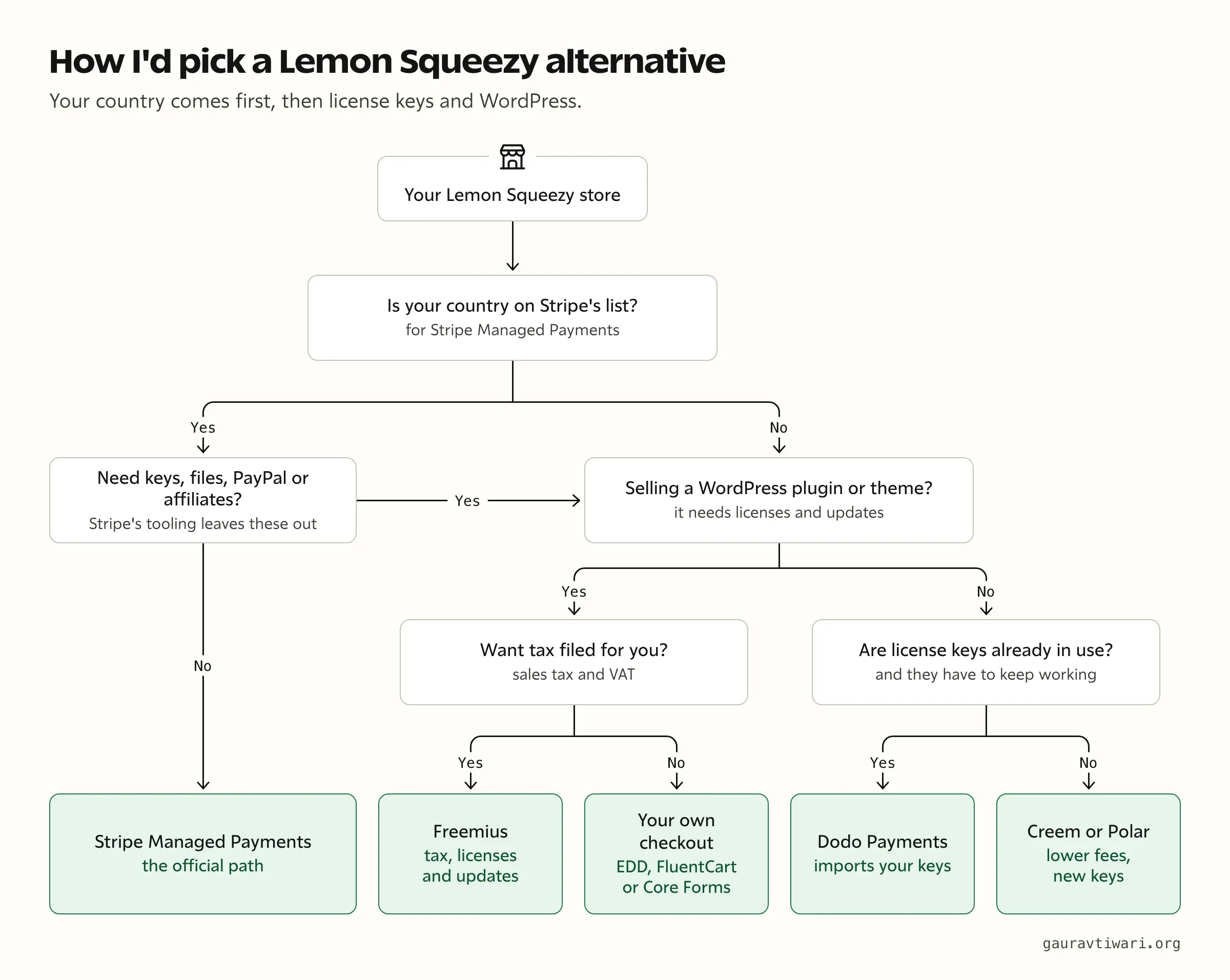
- SaaS in a supported country, with no license keys: Stripe Managed Payments. I’d take the 1.5% rate and look at the cost again before December 2027.
- WordPress plugin or theme: Freemius as a merchant of record, or Easy Digital Downloads, FluentCart or Core Forms on your own site.
- Desktop app or software with keys already in use: Dodo Payments, or Freemius through its managed migration.
- Business in India: Dodo, Creem, Polar, Paddle or Freemius as a merchant of record, or a WordPress checkout with Razorpay and PayPal. My guide on how Indian businesses accept payments covers the gateways.
- You need PayPal: Dodo, Paddle, Freemius or your own checkout.
- Lowest fee with tax handled: Creem, or Polar Pro once your volume covers the $20 a month.
- Courses and ebooks: Payhip, or Gumroad if you want its marketplace.
- Services and consulting: none of the merchants of record. They are built for digital products, so I’d use Stripe invoices, or Razorpay with PayPal in India.
How to Migrate From Lemon Squeezy
The order matters more than the tool. This is the sequence I’d follow, whichever provider you choose:
- An audit of what you are moving. You need a list of products and variants, active discounts, subscriptions by payment method, license keys and activations, files, affiliates and every page that carries a Lemon Squeezy link or embed.
- A full export, now. Customers, orders and subscriptions export from the dashboard. License keys and their activations come from the API, at
/v1/license-keysand/v1/license-key-instances. - PayPal off at checkout. Lemon Squeezy suggests removing PayPal now, so new subscribers use a payment method that can migrate.
- The new provider in test mode. You recreate the catalog or run the provider’s import tool. On Stripe, each variant becomes its own product.
- License keys that keep working. Dodo and Freemius can import existing keys. Anywhere else, your own endpoint has to keep validating the old ones. For a WordPress plugin, I’d ship an update early that points the license check at the new endpoint and allows a grace period, because many sites update slowly.
- Subscriptions. Card subscriptions move to Stripe through Lemon Squeezy’s tooling, and to other providers through its intake form under Settings, then Migration. PayPal subscribers have to buy again, so a discount link makes that easier to ask for. Customers with India-issued cards have to reauthorize after the move.
- Webhooks and integrations. Event names change, so your email tool, access control and in-app upgrade flows need new handlers.
- Links and redirects. Nothing redirects. You replace every checkout link, button and overlay by hand, including the ones in old emails, docs and video descriptions.
- An email to customers. It should say what is changing, the new name on their card statement, where they manage the subscription and whether they need to do anything.
- A parallel run, then the cutover. New sales go to the new provider while old renewals finish on Lemon Squeezy. I’d aim to finish in February and cancel whatever is left before March 31.
If you are moving to Stripe, these are the closest matching webhook events:
| Lemon Squeezy Event | Closest Stripe Event |
|---|---|
order_created | checkout.session.completed |
order_refunded | charge.refunded |
subscription_created | customer.subscription.created |
subscription_updated | customer.subscription.updated |
subscription_cancelled | customer.subscription.updated, with cancel_at_period_end set |
subscription_expired | customer.subscription.deleted |
subscription_payment_success | invoice.paid |
subscription_payment_failed | invoice.payment_failed |
license_key_created | None. Your licensing tool issues the key |
Every step is also in my free Lemon Squeezy migration checklist (PDF), with a box to tick for each one. And this is the calendar I’d work to:
| When | What I’d Have Done |
|---|---|
| November and December 2026 | Audit and export finished, PayPal removed, provider chosen |
| December 2, 2026 | Stripe migration tooling opens, if that is your path |
| By mid-January 2027 | Migration started, test purchases passing |
| February 2027 | Cutover, customer emails sent, old links replaced |
| March 2027 | Leftover subscriptions cancelled, tax documents downloaded |
| March 31, 2027 | Lemon Squeezy stops processing payments |
Lessons From the Lemon Squeezy Shutdown
Stripe bought Lemon Squeezy and is closing it within 3 years. I still think a merchant of record is a reasonable choice for many sellers. The shutdown shows what to keep in your own hands, whichever provider you use:
- Your customer list. I’d export it every month, so a shutdown never decides who you can still email.
- Your license server. If keys validate against your own endpoint, you can change payment providers without touching a single installed copy.
- Your checkout links. A link such as
yoursite.com/buy/prothat redirects to the provider can be pointed somewhere new in a minute.
Lemon Squeezy isn’t redirecting anything. Everyone who pasted its URLs straight into emails and docs is about to spend a few afternoons finding them.
FAQs on Lemon Squeezy Alternatives
What is the best Lemon Squeezy alternative?
It depends on what you sell. Stripe Managed Payments is the best fit for SaaS in a supported country, Dodo Payments for software with license keys already in use, Creem for the lowest flat fee, and Freemius or a self-hosted WordPress checkout for plugins and themes.
When does Lemon Squeezy shut down?
Lemon Squeezy stops processing all payments, including subscription renewals, on March 31, 2027. It closed new sign-ups on November 16, 2026, and it has said the March date won’t be extended.
Can I still sign up for Lemon Squeezy?
No. Lemon Squeezy stopped accepting new users and new stores on November 16, 2026. Existing stores keep working until March 31, 2027.
Will I still get paid for sales I made on Lemon Squeezy?
Yes. Lemon Squeezy says revenue from completed transactions is paid out in full, as long as your account is in good standing.
Is Stripe Managed Payments available in India?
No. India isn’t on Stripe’s list of eligible business locations, so an India-based seller can’t migrate a Lemon Squeezy store to it. Dodo Payments, Creem, Polar, Paddle and Freemius all work with sellers in India.
Do Lemon Squeezy license keys transfer to Stripe?
No. Stripe Managed Payments has no license key management or file delivery. You need a separate licensing tool, or a provider that imports keys, such as Dodo Payments or Freemius.
What happens to PayPal subscriptions on Lemon Squeezy?
They can’t be migrated to Stripe Managed Payments or to another provider. Each PayPal subscriber has to start a new subscription with a supported payment method.
Will my Lemon Squeezy checkout links redirect?
No. There are no automatic redirects for checkout links, storefront URLs, embeds, API endpoints or webhooks. Each one has to be replaced with the new provider’s version.
What is the cheapest Lemon Squeezy alternative?
Among merchants of record, Creem is the cheapest flat rate at 3.9% + 40 cents with no international card fee. A self-hosted WordPress checkout is cheaper still, at about 2.9% + 30 cents to Stripe plus a yearly plugin license, but you handle tax yourself.
What is the best Lemon Squeezy alternative for WordPress plugins?
Freemius if you want a merchant of record that handles tax, licensing and plugin updates. Easy Digital Downloads, FluentCart or Core Forms if you would rather run licensing from your own WordPress site and keep the fees low.
Do I have to handle VAT myself if I leave a merchant of record?
Yes. Without a merchant of record, your business is the seller, so you are responsible for sales tax, VAT and GST in every place you sell. Tools such as Stripe Tax calculate and collect it, but the filings stay with you.
Final Remarks
If you’re still unsure, I’d let your license keys decide. A store with keys in customers’ hands has the fewest safe options, so I’d settle that first and let the fee come second.
A SaaS business in a supported country can take Stripe’s tooling on December 2 and be done by January. For everyone else, I’d pick a provider this month and start the export this week, because mid-January is closer than it looks.
If you’d rather not do the WordPress side yourself, my payment gateway setup service covers it.
Tell Google you want more of this.
Add Gaurav Tiwari as a preferred sourceOne tap, and this site shows up more often in your own Top Stories, AI Overviews and AI Mode. Remove it any time.
Disclaimer: This site is reader-supported. If you buy through some links, I may earn a small commission at no extra cost to you. I only recommend tools I trust and would use myself. Your support helps keep gauravtiwari.org free and focused on real-world advice. Thanks. - Gaurav Tiwari