by
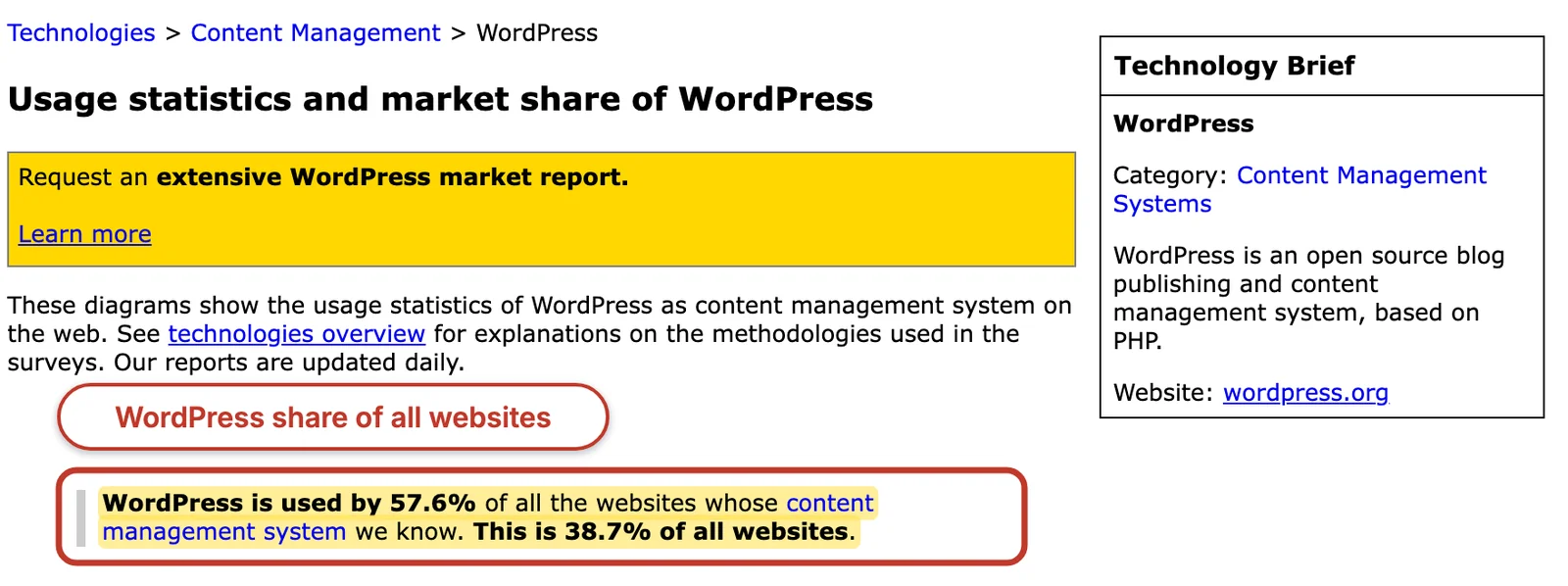
WordPress is losing market share faster than at any point in its history, and I don’t think WordPress itself is the reason. It runs 38.7% of all websites today, down from 43% at the start of the year. That’s lower than it was in January 2021, so five years of growth went away in about ten months.
I don’t want to scaremonger. WordPress still powers more than half of every site with a known CMS. But I’m seeing one-page sites leave for small custom builds on Cloudflare Workers, where hosting costs close to nothing, and the numbers below show that is where most of the lost share went.
My position is simple.
The companies selling into WordPress are pushing people out. They keep raising prices, they force bundles on buyers and they hold new features back for paid versions. Very little of that money goes back into the open source project that made them rich.
I build and sell WordPress plugins myself, so I’ll show you the data, the pricing moves behind it, what I’ve done on my side and what I think WordPress brands should do next.
How much market share WordPress has lost
WordPress has lost 4.3 percentage points of the whole web in 2026 alone, and 4.9 points since its peak of 43.6% on January 1, 2025. The figures come from W3Techs, which tracks the top 10 million websites and is the source most people quote for CMS share.
| Year | WordPress |
|---|---|
| 2019 | 32.7 |
| 2020 | 35.4 |
| 2021 | 39.5 |
| 2022 | 43.2 |
| 2023 | 43.1 |
| 2024 | 43.1 |
| 2025 | 43.6 |
| 2026 | 43 |
| Nov 14, 2026 | 38.7 |
This is where WordPress stands today:
- 38.7% of all websites on November 14, 2026
- 57.6% of websites whose CMS W3Techs can identify
- 43.6% at its peak on January 1, 2025
- 39.5% on January 1, 2021, which is now higher than today’s share
So the drop isn’t noise. Every single month of 2026 came in lower than the month before, and the slide got faster after the summer. WordPress lost more share in the last 6 weeks than it did in the first 4 months of the year.
Where WordPress’s lost share went
Most of it went to websites that run no detectable CMS at all. Since January 1, WordPress lost 4.3 points and sites with no detectable CMS gained exactly 4.3 points. Shopify picked up 0.4 points, and Wix and Squarespace didn’t move.
| Platform | Change in points |
|---|---|
| No detectable CMS | 4.3 |
| Shopify | 0.4 |
| Wix | 0 |
| Squarespace | 0 |
| Webflow | -0.1 |
| Drupal | -0.2 |
| Joomla | -0.3 |
| WordPress | -4.3 |
“No detectable CMS” is W3Techs’ label for a site it can’t tie to any content management system it tracks. That covers hand-coded sites, static site generators, Astro or Next.js builds and small apps running on Cloudflare Workers. It is the exact kind of site I see people move to when they want a one-page site that costs almost nothing to run.
- WordPress
- No detectable CMS
- Shopify
- Wix
| Month | WordPress | No detectable CMS | Shopify | Wix |
|---|---|---|---|---|
| Oct 2025 | 43.3 | 28.6 | 4.8 | 4.1 |
| Nov 2025 | 43.2 | 28.6 | 4.9 | 4.1 |
| Dec 2025 | 43.2 | 28.6 | 4.9 | 4.1 |
| Jan 2026 | 43 | 28.6 | 5 | 4.2 |
| Feb 2026 | 42.8 | 28.6 | 5.1 | 4.2 |
| Mar 2026 | 42.7 | 28.8 | 5.1 | 4.2 |
| Apr 2026 | 42.5 | 28.9 | 5.1 | 4.3 |
| May 2026 | 42.2 | 29.2 | 5.2 | 4.3 |
| Jun 2026 | 41.9 | 29.5 | 5.2 | 4.3 |
| Jul 2026 | 41.5 | 29.9 | 5.2 | 4.3 |
| Aug 2026 | 41.2 | 30.4 | 5.3 | 4.3 |
| Sep 2026 | 40.7 | 30.9 | 5.3 | 4.2 |
| Oct 2026 | 40.2 | 31.5 | 5.4 | 4.2 |
| Nov 14, 2026 | 38.7 | 32.9 | 5.4 | 4.2 |
Look at how the two lines mirror each other. From spring onward, almost every point WordPress lost showed up on the no-CMS line in the same month.
One honest caveat. W3Techs spots WordPress by its fingerprints in the page code, and some sites hide them on purpose for security or speed. A part of this shift could be sites that still run WordPress but no longer look like it. Still, a detection quirk doesn’t usually move in one direction every month for a year.
Who is doing better than WordPress
The hosted, closed platforms keep growing, while every open source PHP CMS is shrinking. That split is the clearest pattern in the data, and it isn’t only a WordPress problem.
| Platform | Model | Jan 2025 (%) | Nov 2026 (%) | Change (points) |
|---|---|---|---|---|
| WordPress | Open source | 43.6 | 38.7 | -4.9 |
| Joomla | Open source | 1.6 | 1 | -0.6 |
| Drupal | Open source | 0.9 | 0.6 | -0.3 |
| Shopify | Hosted, closed | 4.7 | 5.4 | 0.7 |
| Wix | Hosted, closed | 3.3 | 4.2 | 0.9 |
| Squarespace | Hosted, closed | 2.2 | 2.4 | 0.2 |
| Webflow | Hosted, closed | 0.8 | 0.8 | 0 |
This is how I read each platform:
- Shopify grew from 4.7% to 5.4%. For a store owner it is one monthly bill with no plugin renewals to track, and that simplicity sells. If you sell physical products and don’t want to manage updates, Shopify is the easier route.
- Wix grew from 3.3% to 4.2% but has stalled this year. It wins small businesses that want drag and drop and nothing else.
- Squarespace crept up from 2.2% to 2.4%. It is steady, not exciting.
- Webflow and Framer get a lot of attention on social media but barely register. Webflow is flat at 0.8% and Framer sits at 0.2%.
- Joomla and Drupal keep falling, to 1.0% and 0.6%. Open source CMS as a whole is losing ground.
- Shopify
- Wix
- Squarespace
- Webflow
| Year | Shopify | Wix | Squarespace | Webflow |
|---|---|---|---|---|
| 2021 | 3.2 | 1.5 | 1.4 | 0.2 |
| 2022 | 4.4 | 1.9 | 1.8 | 0.4 |
| 2023 | 3.8 | 2.4 | 2 | 0.6 |
| 2024 | 4.1 | 2.6 | 2.1 | 0.7 |
| 2025 | 4.7 | 3.3 | 2.2 | 0.8 |
| 2026 | 5 | 4.2 | 2.4 | 0.9 |
| Nov 14, 2026 | 5.4 | 4.2 | 2.4 | 0.8 |
Cloudflare made the threat more direct. It launched EmDash on April 1, 2026, an open source CMS that runs on Workers and calls itself a spiritual successor to WordPress. I covered what it can and can’t do in EmDash vs WordPress, and I run a few sites on it. It ties you closely to Cloudflare, and that is a fair worry. For a small site that only needs pages and a contact form, many people will accept that trade.
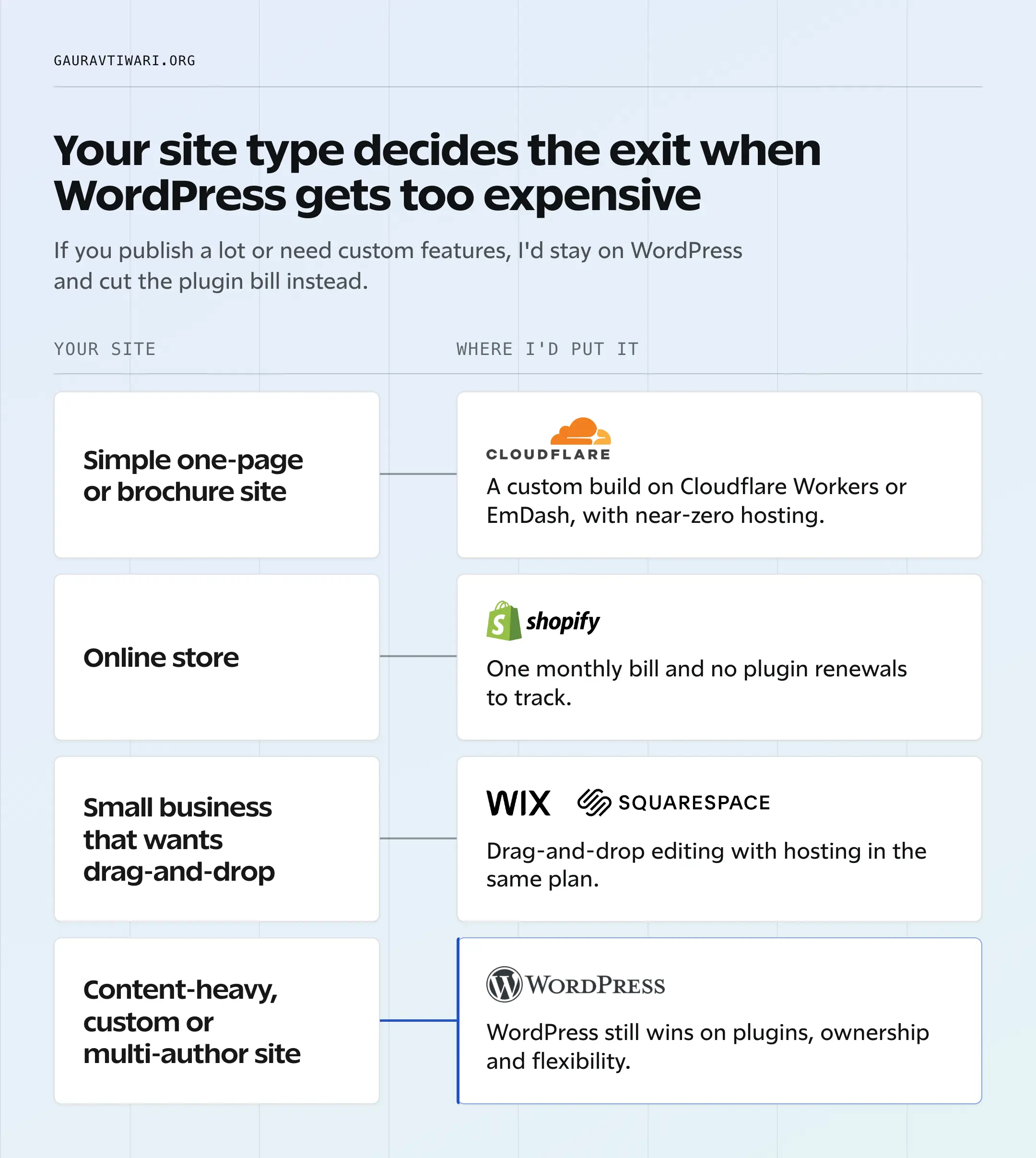
So the competition isn’t one platform. It is a different answer for each kind of site, and WordPress is now the expensive answer for the simplest ones.
Why I blame the WordPress companies
WordPress companies think their products are the best and that their price is the bare minimum for the work they do. They also say their costs keep going up.
I don’t buy that. With AI, building, testing and shipping plugins and themes has become cheaper and faster for everyone. These companies depend less on development labor than they did two years ago. So when prices still go up, I think the motive is profit, and calling it a cost increase is absurd.
These are the moves I mean:
| Company | What changed | What it means for a buyer |
|---|---|---|
| Liquid Web (Kadence) | Kadence is sold only in a bundle with LearnDash, The Events Calendar and Give. The one-site plan is $350 a year and the lifetime deal is gone. | A theme buyer pays for an LMS, an events plugin and a donations plugin. |
| Liquid Web (LearnDash, The Events Calendar, Give) | Subscribers move into the same bundle at renewal, from November 16. | The renewal price is set by the bundle, not by the plugin you use. |
| WPForms | Pro showed a 50% discount in 17 of 22 months, then renews at full price. | The full price is really the renewal price. |
| Automattic | Cut sponsored contribution hours to WordPress core, then cut staff in 2025 and again in 2026. | Less paid work goes into the open source project itself. |
I tracked the discount pattern in detail in fake discounts on WordPress plugins. The short version is that the “sale” price is the normal price, and the full price is what you pay every year after.
So the buyer pays more every year, and the project those companies depend on gets less. That math doesn’t hold for long.
Kadence shows the problem clearly
Liquid Web bought Kadence and has almost killed it with pricing. You can no longer buy Kadence on its own. It now comes only in a bundle with LearnDash, The Events Calendar and Give, and the one-site plan costs $350 a year. The lifetime deal is gone for new buyers.
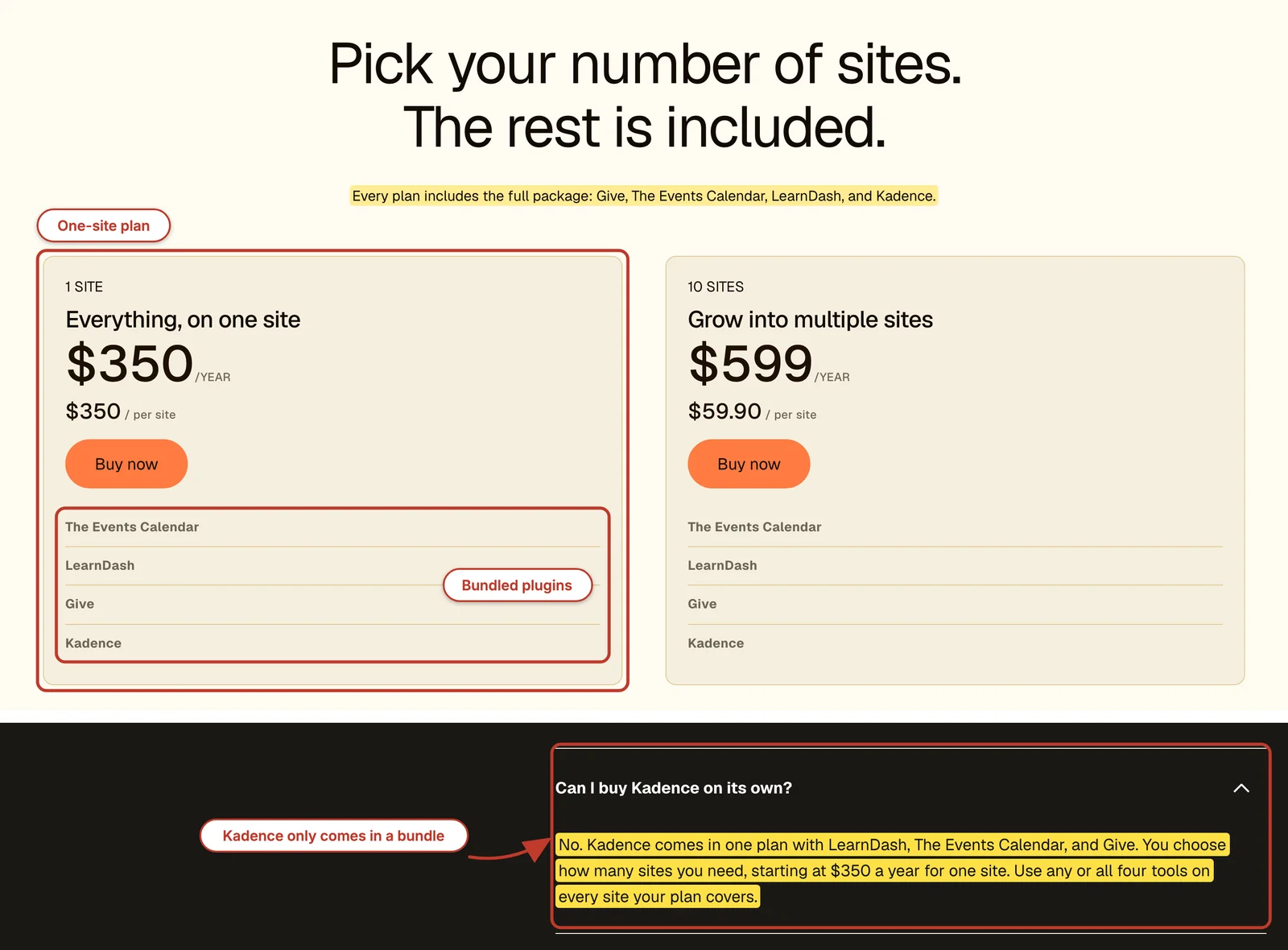
From November 16, LearnDash, The Events Calendar and Give subscribers move into that same bundle at renewal. A person who only wanted a theme now pays for an LMS, an events plugin and a donations plugin they never asked for.
To be fair, the free Kadence theme and Kadence Blocks are still on WordPress.org, and a basic site can skip the bundle. I still rate the theme itself well in my Kadence theme review. But the people who paid for Kadence Pro were its most loyal users, and they got the worst deal.
This is what a basic one-site setup costs in a year. It is an example with typical shared hosting of $5 to $10 a month:
| Setup | Theme and plugins | Hosting | Domain | Yearly total |
|---|---|---|---|---|
| WordPress with the Kadence bundle | $350 | $60 to $120 | $10 to $15 | About $420 to $485 |
| WordPress with a free theme | $0 | $60 to $120 | $10 to $15 | About $70 to $135 |
| Custom build on Cloudflare Workers | One-time build | $0 on the free plan | $10 to $15 | About $10 to $15, plus the build |
Charging $420 a year for a basic website is not how WordPress will sustain itself. That price makes sense for a site that earns money, a lot of money to be honest. For small sites, small businesses and brands from developing countries, it doesn’t make sense at all.
Free WordPress is shrinking
The other problem is what these companies give back. Most of the new work goes into premium tools, and very little goes into open source.
- GeneratePress did ship GenerateBlocks 2.0 for free, and that deserves credit. Beyond that, I see most of its recent work going into paid versions.
- Elementor and WPForms add features to Pro and launch products that are mostly premium. The free versions get maintenance, and the new ideas sit behind a license key.
- Automattic, the company closest to WordPress itself, cut its sponsored hours on WordPress core in January 2025 and has cut staff twice since.
That’s a fair business choice for one company. When the whole ecosystem does it at once, WordPress stops being the best free option, and that was the reason people picked it in the first place.
Isn’t a company supposed to make a profit?
Yes, and I’m not against profit. I sell plugins too, and I want them to earn. My problem is with the way these companies are chasing it.
A company can grow its profit in two ways:
- Grow the market, so more people use the platform and more of them become customers
- Squeeze the customers it already has, with price hikes, forced bundles and fake discounts
Most WordPress companies are doing the second. The data shows the result: WordPress went from 43% to 38.7% of the web in one year.
These companies also don’t own their market. They build on a free, open source project they didn’t pay for, and they reach buyers through a free plugin directory. Their whole sales funnel starts with someone choosing free WordPress. When fewer people make that choice, every company in the ecosystem has fewer customers to sell to.
So putting money back into WordPress isn’t charity. It protects the thing that makes them money. A company that squeezes its users and invests nothing in the platform can post a good quarter while it shrinks its own future.
Ownership explains some of this. Liquid Web, which owns Kadence, LearnDash and The Events Calendar, has been owned by the private equity firm One Equity Partners since 2023. Private equity owners usually plan around a sale in a few years. The long-term health of an open source platform isn’t part of that plan.
AI changes the math too. It has made plugins and themes cheaper to build and ship. In a healthy market, some of that saving reaches the buyer. When prices go up anyway, buyers go looking for cheaper options, and today those options are a static site on Cloudflare Workers, EmDash or something an AI tool builds in an afternoon. That is where the lost share went.
Some plugins also don’t deserve their price at all. I see plugins that charge a hefty yearly fee for a feature a developer could code in a few hours: a custom post type, a simple redirect, a schema snippet or a small admin tweak. Those prices worked when users had no other way to get the feature.
I paid for one of these myself. A plugin charged me a lot to offload my images to Cloudflare R2, at a time when I had no experience with R2. Later, when I asked an AI tool how to do it, it told me it was a 5-minute job.
That’s no longer true. Smart users have found the gap. They copy a snippet, ask an AI tool to write a small plugin for them or move the whole site to something lighter. Every time a plugin charges a premium for a few hours of work, it teaches its own customers to stop paying.
I’m one of those customers. In 2025, I paid for 13 plugin and theme subscriptions. Today I pay for only 3, and that number will drop to 2 in 2027.
Profit isn’t the problem. Short-term profit at the platform’s expense is.
What I have done as a developer
I’m not writing this from the sidelines. I build and sell WordPress plugins too, and more than 10,000 businesses use my products. I have tried to keep the free side real:
- Free plugins on WordPress.org. I maintain five, including Dynamic Month & Year into Posts, Formatting Extender and GT Performance.
- GT Performance went free. It is a full page cache and object cache plugin, and it runs on my own sites. I used to sell a self-hosted version. In October I retired that package and put GT Performance on WordPress.org for everyone, with no license key and no checkout.
- Free plugins for EmDash. I released a set of MIT-licensed EmDash plugins for forms, footnotes, product boxes, dynamic dates, link management and more.
- Free tools. The HTML to GenerateBlocks converter and my WordPress tutorials are free to use.
- Fair pricing on what I sell. My paid plugins keep a lifetime option next to the yearly plan, and I don’t run a permanent fake discount.
- Cheap delivery on my side too. I skipped the official WooCommerce API Manager because about $200 a year for one site is priced for someone making a fortune, not an indie developer. For years I delivered plugin updates with Hoster by dPlugins and Cloudflare Workers, and later moved licensing to FluentCart.
So I know what it costs to build, support and ship a plugin. It doesn’t cost what some of these companies charge.
Is WordPress dying?
No. WordPress still runs 57.6% of sites with a known CMS, which is more than Shopify, Wix, Squarespace, Joomla and Drupal combined. What is dying is WordPress as the default choice for simple sites.
These are the sites where I think WordPress will keep doing fine:
- Content-heavy sites with hundreds or thousands of posts, categories and authors
- Custom builds that need memberships, courses, directories or custom data
- Sites that earn money, where $400 or $500 a year in tools is a small cost
- Owners who want full control of their data, hosting and code
And these are the sites it is losing:
- One-page and brochure sites that never change
- Small stores that would rather pay one monthly bill
- Portfolios and landing pages that an AI tool can build in an afternoon
What WordPress brands should do
I don’t agree with how Matt Mullenweg has fought this battle, from the WP Engine dispute to the way he pushes Five for the Future. But on the core point, he is right. Brands that make money from WordPress need to put money back into it.
These are the moves I’d like to see:
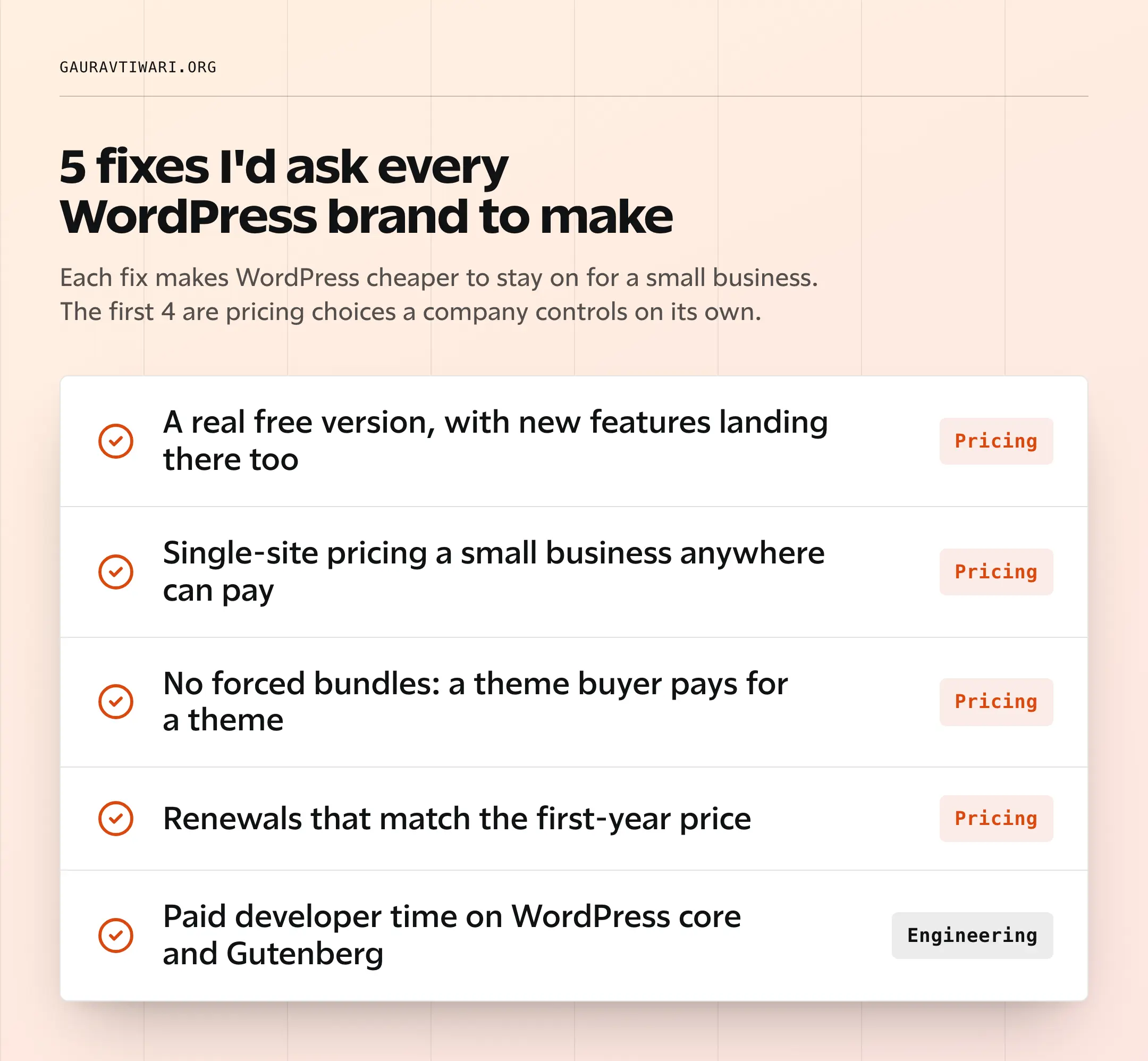
- A real free version of every product, with new features landing there too, not only in Pro.
- Single-site pricing that a small business in India, Nigeria or Indonesia can pay.
- No forced bundles. A theme buyer should pay for a theme.
- Renewal prices that match the first-year price, without a permanent fake discount.
- Paid developer time on WordPress core, Gutenberg and the plugin review team.
None of this is charity. It is how the ecosystem stays the place where their customers build.
What I’d do if you run a small site today
If your site is simple and your tool bills keep going up, this is the order I’d follow:
- Your renewals are the first thing to check. List every paid theme and plugin and mark the ones you actually use. Most small sites pay for features they never touch.
- A free theme is usually enough. GeneratePress, Kadence and Blocksy all have free versions that handle a business site well.
- Before you renew a forced bundle, I suggest you price a switch. A one-time move often costs less than one year of the bundle.
- For a one-page site that rarely changes, a static build on Cloudflare Workers or EmDash is worth a look. Hosting is close to free.
- For a growing content site, I’d stay on WordPress and spend the money on good hosting instead of more plugins.
FAQs
WordPress runs 38.7% of all websites and 57.6% of websites with a known CMS, according to W3Techs on November 14, 2026.
Most of the lost share has gone to sites with no detectable CMS, such as custom and static builds, plus a little to Shopify. My view is that rising plugin and theme prices, forced bundles and fewer free features are pushing simple sites away.
WordPress peaked at 43.6% of all websites on January 1, 2025, according to W3Techs yearly data. It was still at 43.0% on January 1, 2026, before the fast drop this year.
Among named platforms, Shopify and Wix have grown the most since 2025. The biggest gain in 2026 went to sites W3Techs can’t tie to any CMS at all.
It is W3Techs’ label for a site that doesn’t match any content management system it tracks. Hand-coded sites, static site generators, JavaScript frameworks and apps on platforms like Cloudflare Workers fall into it.
Yes. The free Kadence theme and Kadence Blocks are still on WordPress.org. Kadence Pro is now sold only in a Liquid Web bundle with LearnDash, The Events Calendar and Give.
Only if it is simple and your tool costs are high. Content-heavy, custom or money-making sites still get the most out of WordPress.
Final Remarks
If you’re wondering whether to leave WordPress, I’d let your own bills decide. Add up what you pay each year in themes, plugins and hosting, and compare it with what the site actually does for you.
For me, WordPress is still the right home for anything that grows, and it is where I’ll keep building. But the brands have to earn that place back. If they keep treating WordPress as a place to extract money, the share will keep falling, and they will have done it to themselves.
They must be having a lot of faith that users never leave.
Tell Google you want more of this.
Add Gaurav Tiwari as a preferred sourceOne tap, and this site shows up more often in your own Top Stories, AI Overviews and AI Mode. Remove it any time.
Disclaimer: This site is reader-supported. If you buy through some links, I may earn a small commission at no extra cost to you. I only recommend tools I trust and would use myself. Your support helps keep gauravtiwari.org free and focused on real-world advice. Thanks. - Gaurav Tiwari