
 by
I get why a 50% off badge on a WordPress plugin feels like a good deal. The trouble is that on many plugin pricing pages, that badge never comes down. It’s there in March, in July and again for Halloween.
So you budget for $199.50, and 12 months later your card gets charged $399. That’s what fake discounts on WordPress plugins cost you: you planned your year around the wrong number.
My position is simple.
A discount that never ends is just the price. The “normally” price above it is what the plugin charges the people who stopped checking.
By a fake discount, I mean a sale that isn’t really a sale. Your first year does cost less. What’s fake is the way it’s sold, for example:
- a 50% or 60% badge that shows on the pricing page most months of the year
- a “normally” price that new buyers almost never pay and every renewal does
- a countdown timer that starts again for every new visitor
I update the WordPress deal pages on this site every sale season, so I spend more time on these pricing pages than most buyers do. I’m also an affiliate for several brands in this article, including WPForms. I still want you to know what the badge means before you pay.
My advice is to ignore the badge and judge a plugin by 2 numbers: the renewal price and what you’ll pay over 3 years. Let me show you why, with almost 2 years of archived pricing pages, the renewal math and the timers.
The 50% Off That Runs All Year
WPForms is the clearest example, because its pricing page has barely changed in almost 2 years. The free version alone runs on more than 5 million WordPress sites. It’s made by Awesome Motive, the same company behind MonsterInsights, All in One SEO, OptinMonster, SeedProd and WP Mail SMTP.
Today the Pro plan shows “normally $399” with 50% off, so the first year costs $199.50. Every plan on the page works the same way.
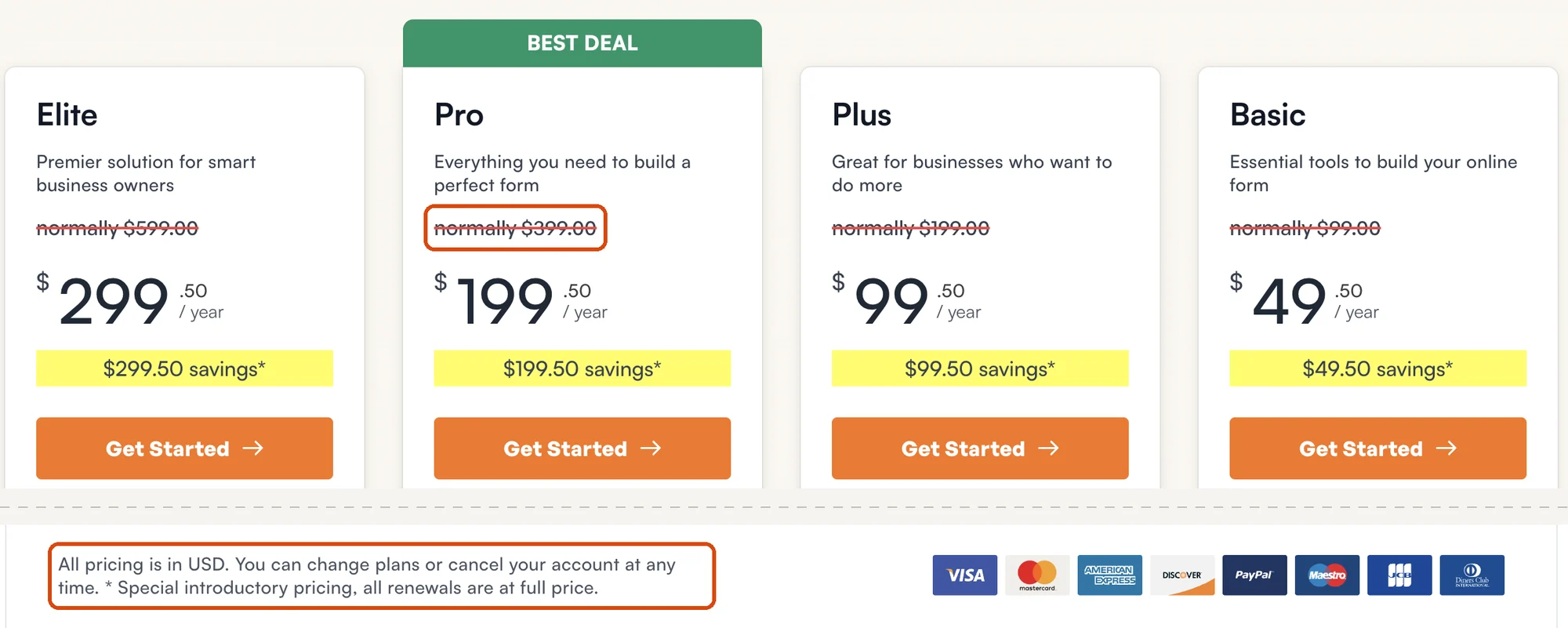
The Internet Archive’s copies of that page show what a new buyer saw each month from January 2025 to October 2026:
- 17 of 22 months: $199.50, “normally $399”, with the same SAVE50 coupon in every checkout link
- July 2025, September 2025 and September 2026: $159.60, or 60% off, for a short sale
- July 2026: $139.65, or 65% off
- Black Friday 2025: $159.60 for Pro and $179.70 for Elite, which was 70% off
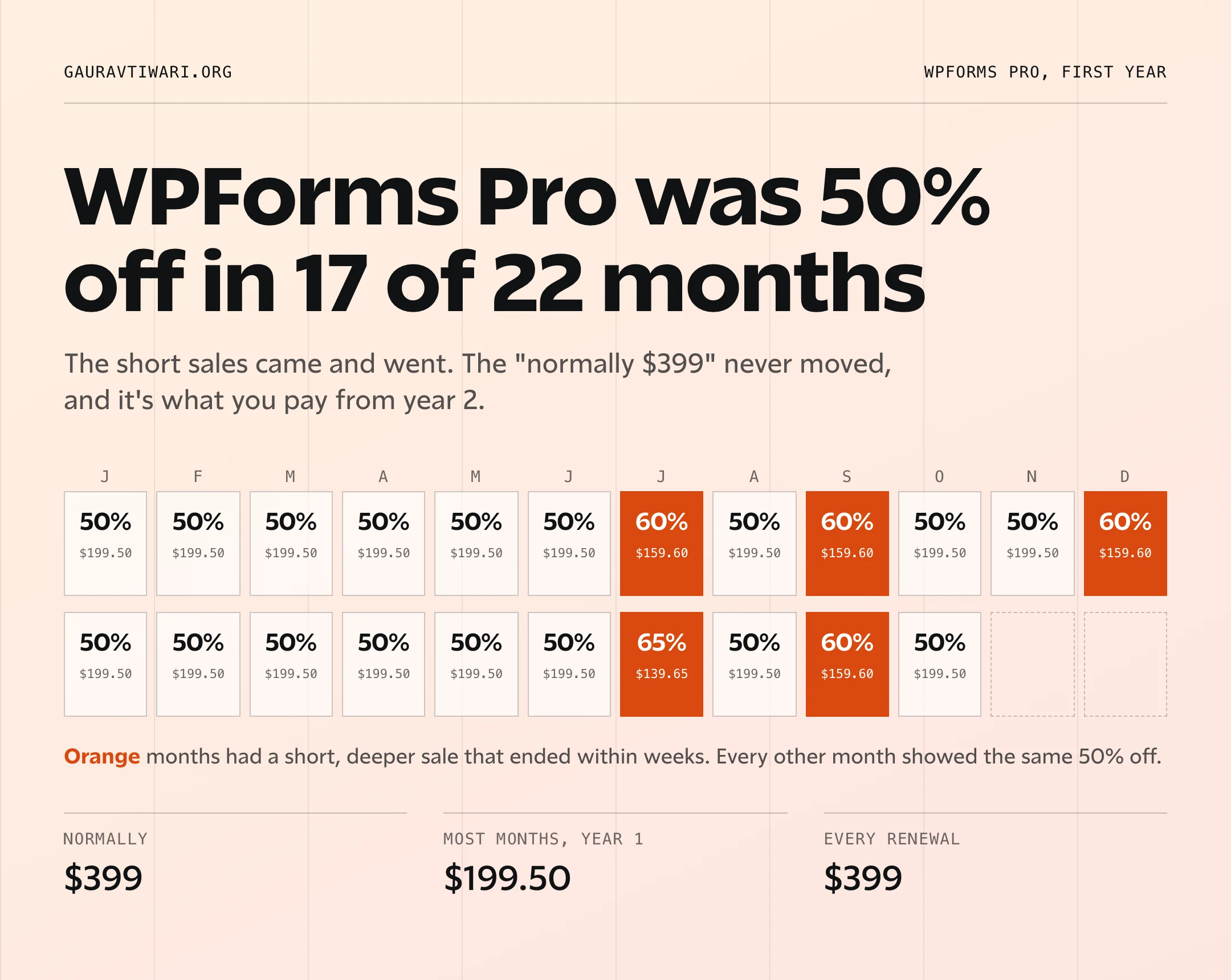
Each deeper sale ended within days or a few weeks, and the page went back to the same 50%. The “normally $399” never moved once.
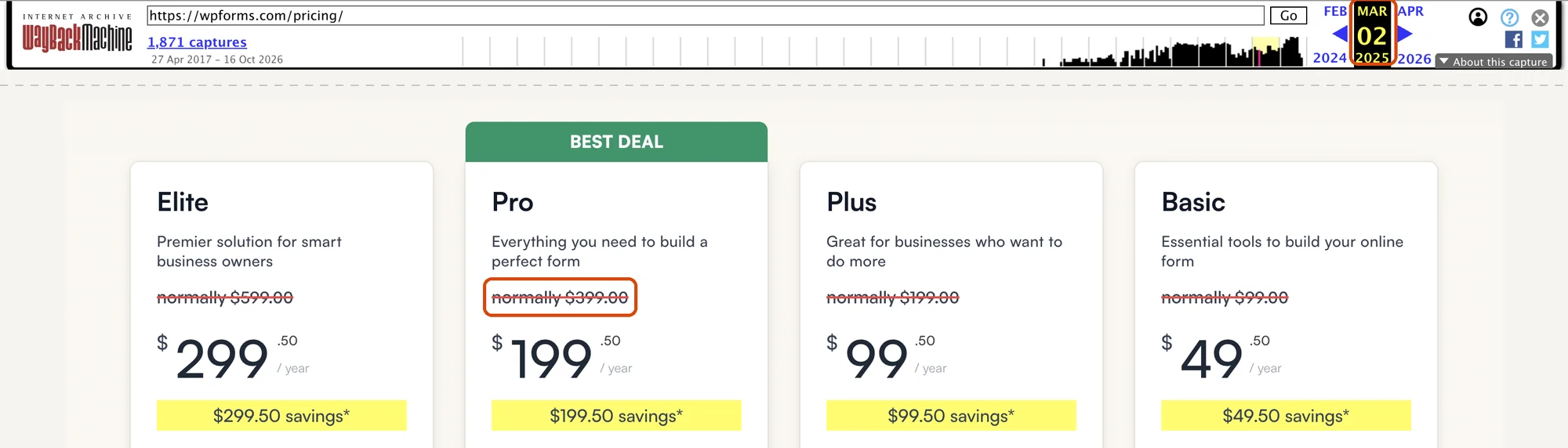
The cheapest plan tells the story best. WPForms Basic cost $49.50 during Black Friday 2025, which is exactly what it costs on an ordinary Tuesday.
At the bottom of the page, the fine print says “Special introductory pricing, all renewals are at full price.” I give WPForms credit for printing that. But its own terms describe these discount codes as something it offers “on occasion”, and 17 months out of 22 isn’t occasional.
WPForms isn’t alone. The same pattern shows up across the WordPress plugin market.
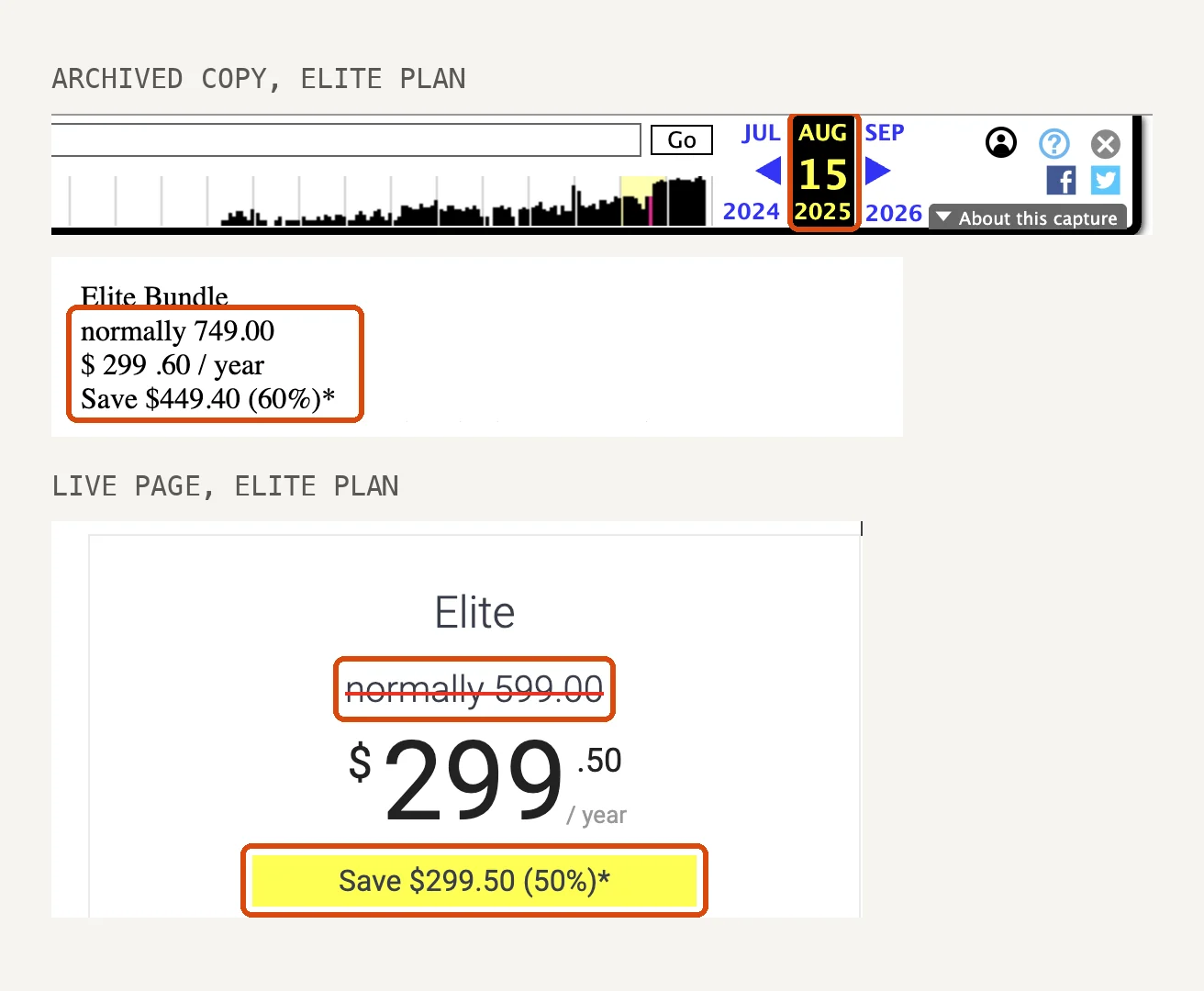
MonsterInsights and All in One SEO: In mid-2025, MonsterInsights Elite showed “normally $749” at 60% off, or $299.60. By October 2025 it showed “normally $599” at 50% off, or $299.50. The claimed discount dropped by 10 points, and the price you pay moved by 10 cents. All in One SEO made the same change across its plans.
OptinMonster: Its “60% off for 12 months” offer ran in every archived copy from August 2025 to August 2026, Black Friday week included. To its credit, OptinMonster prints the renewal price under every plan, and Pro renews at $870 a year.
Wholesale Suite, Advanced Coupons, AdTribes and WC Vendors: All 4 belong to Rymera Web Co, and all 4 show 50% off the first year in every archived copy from November 2024 to October 2026. Their Halloween sales, promoted as 50% off for a limited time, match the price on their pricing pages in every other week of the year.

So the 50% is simply the price for new customers, and it has been for a long time.
The Renewal Price Is the Real Price
A first-year discount isn’t a problem by itself. The problem is how small it gets once you keep the plugin, and most people keep a form plugin for years.
This is the math on WPForms Pro, with 50% off the first year and the full $399 after that:
| Years you keep it | You pay | At “normally $399” | What 50% off saved you |
|---|---|---|---|
| 1 year | $199.50 | $399 | 50% |
| 2 years | $598.50 | $798 | 25% |
| 3 years | $997.50 | $1,197 | 17% |
| 5 years | $1,795.50 | $1,995 | 10% |
So the badge says 50%, but over 3 years you save 17%. Over 5 years you save 10%, which is about what an ordinary coupon would get you.
You also don’t get much say in year 2. WPForms sets new subscriptions to renew automatically every year on the card you paid with. Every Awesome Motive and Rymera plugin in this article works the same way.
That’s fine when you know it’s coming. It isn’t fine when the pricing page and the comparison post you read both showed $199.50 and nobody mentioned the $399.
Judge a plugin by its renewal price and its 3-year cost. On WPForms Pro, 50% off the first year works out to 17% off over 3 years.
Can You Cancel and Buy Again at 50% Off?
In most cases, yes, and it’s the obvious question once you see the pattern. If the new-customer price is on the pricing page almost every day, why would anyone renew at full price?
The basic move works like this:
- Turn off auto-renew in your account soon after you buy.
- A week or two before the license runs out, buy a new license at the first-year price.
- Swap the new license key into your site and let the old license expire.
It isn’t free, though. These are the catches:
- A gap is costly. If your license lapses before you rebuy, the updates stop, and a plugin that handles payments shouldn’t sit unpatched. On WPForms, an inactive license also adds a 3% platform fee to payments taken through your forms.
- Some plugins stop working. MonsterInsights says its license must stay active for tracking and reports to keep working. OptinMonster says an expired account and its campaigns may be scheduled for deletion.
- The terms can be stricter than the help docs. WPForms’ help docs say you keep your forms and entries after you cancel. Its terms say an inactive license means you can’t create or edit forms.
- The vendor decides who counts as new. These coupons are written for new licenses and first-time customers, so a checkout may refuse the code on an account that already has a license. Opening a second account to get the deal again breaks Awesome Motive’s terms, and I wouldn’t do it.
So why does the system still work for the plugin company? Because most people never do any of this.
The renewal arrives on a card that’s already saved, on a date nobody put in a calendar, for a plugin that’s quietly running your contact, quote and payment forms. Paying $399 is easier than an afternoon of rebuying, swapping keys and checking that nothing broke.
And the customers who do rebuy every year still pay $199.50, which is the price the vendor was happy to sell at in the first place. The company wins either way. The people paying full price are simply the ones who were too busy to check.
Why Plugin Companies Price This Way
Once you look at who pays whom, this pricing makes complete sense. I don’t think it’s an accident, and I don’t think it’s going away.
- The first-year price fights competitors. A buyer comparing form plugins sees $199.50 next to a rival’s price. The renewal doesn’t show up in that comparison, so the first-year number is the only one that has to win.
- The renewal price fights your switching cost. After a year, the plugin holds your forms, entries, payment settings and integrations. Moving all of that takes hours, so the renewal only has to cost less than your time.
- The “normally” price makes the real price look like a gift. A $399 figure next to $199.50 makes the actual price feel like a win. That’s price anchoring, and it works on all of us.
- Affiliates repeat the first-year price. Deal pages and “best plugin” lists, including some on this site, quote what a reader pays today. That’s the 50% price, and “50% off” makes a better headline than “renews at $399”.
Put those together and the permanent sale does 3 jobs at once. It wins the comparison, makes the anchor look generous and gives every affiliate a 50% headline. The renewal does the earning.
Fake Countdown Timers
Fake urgency is the other half of the same playbook. A timer that says the price ends in 9 minutes pushes you to buy before you compare. A real deadline is fair, but a deadline that restarts for every visitor is a trick.
SeedProd, a WordPress landing page and theme builder from the same company as WPForms, has this logic in its pricing page code:
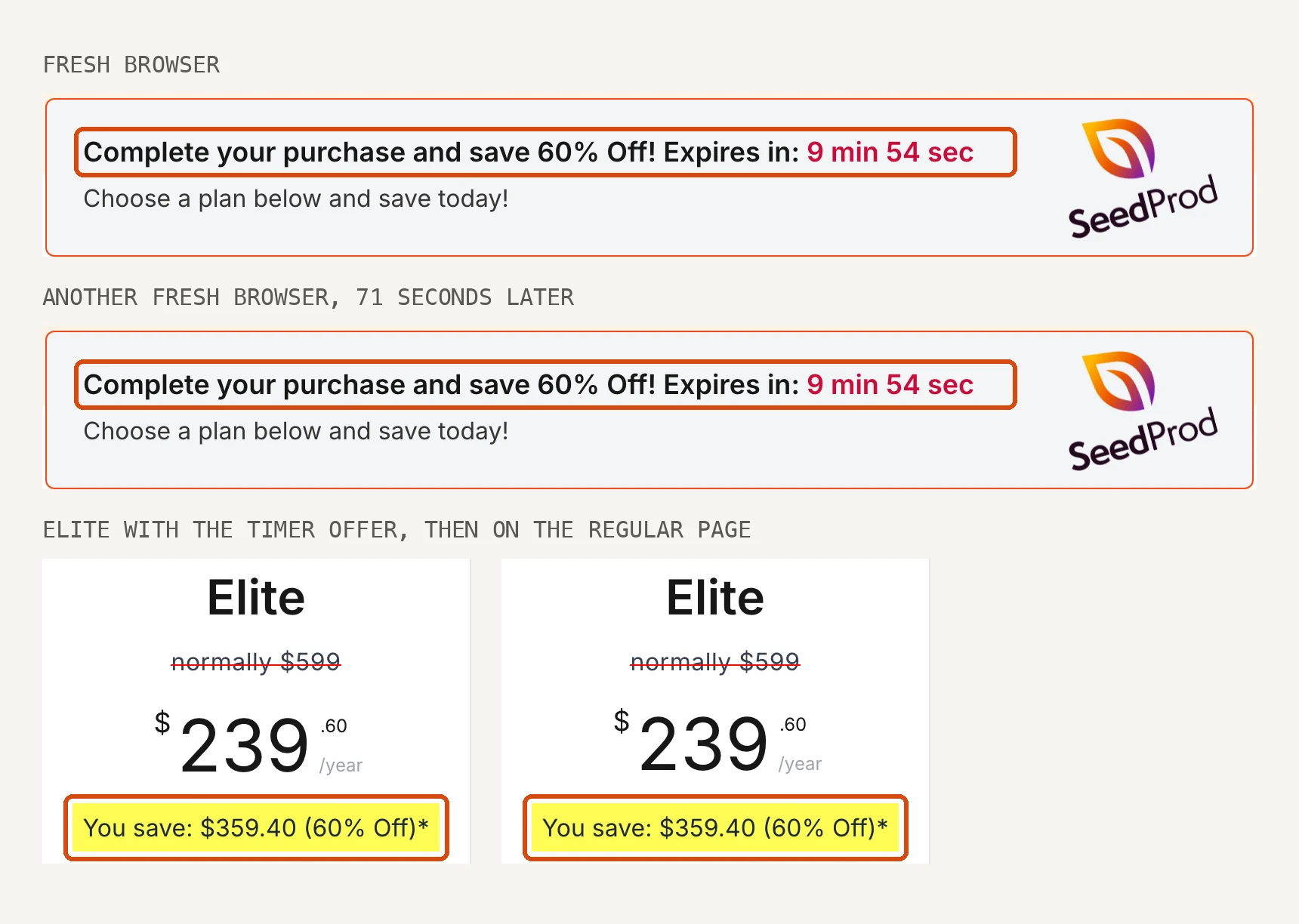
- An offer to finish your purchase at 60% off comes with a 10-minute timer. The timer starts when the page loads, and a fresh browser gets a fresh 10 minutes.
- A win-back offer of 65% off gets a 48-hour deadline, but the clock only shows hours, so it reads 23 hours.
- When a timer runs out, the page sends you back to the normal pricing page.
The 60% offer on the Elite plan is $239.60. That’s the same Elite price every visitor sees on the regular pricing page, so the clock is counting down to a price you can get anyway.
To be fair, not every timer is fake. In October 2026, the MonsterInsights Halloween popup counted down to October 31 at 11:59 p.m. Eastern, and it showed the same deadline in fresh browsers and in 2 time zones. All in One SEO’s popup had a fixed date too. A real deadline on a real extra discount is a normal sale.
The bigger trick is the calendar. Halloween leads into Black Friday, then Cyber Monday, Christmas, New Year and the “extended” sale after that. WPForms’ Black Friday 2025 prices ran from late November into December, then carried on under a Green Monday code on December 10 at the same prices.
UK regulators have a name for this. The CMA’s guidance on unfair practices says even a true deadline can mislead if “a substantially similar offer appears within a short period”.
Is This Legal?
Mostly, yes, and that’s the uncomfortable part. A higher renewal price is legal in the US, the EU, the UK and India. The law cares about whether you were told clearly, whether you agreed and whether you can cancel easily. Fake deadlines are where it gets strict.
- United States: The FTC’s pricing guides say a former price must be one the product was offered at “on a regular basis for a reasonably substantial period of time”. A plugin company can argue that renewals are charged at that price. The FTC’s staff report on dark patterns names baseless countdown timers as one. ROSCA, a federal law, requires clear terms, consent and a simple way to stop recurring charges. The FTC’s newer click-to-cancel rule was struck down by a federal appeals court in July 2025.
- California: Since July 1, 2025, the state’s auto-renewal law requires businesses to state the amount a charge will change to. It also requires a notice before a discounted period longer than 31 days ends, a yearly reminder and online cancellation.
- European Union: Falsely claiming an offer is available only for a very limited time is on the EU’s list of banned practices. The European Commission names fake timers as an example. The EU’s 30-day “prior price” rule covers goods, not software, so a fake “normally” price on a plugin falls under the general rules on misleading prices.
- United Kingdom: False limited-time claims have been banned since April 6, 2025, with fines of up to 10% of global turnover. On October 14, 2026, the CMA fined Wayfair £4.8 million over countdown deals that kept the same price after the clock ran out. From January 1, 2027, if Parliament approves the rules, subscription reminders must flag a higher renewal price and the difference.
- India: The CCPA’s dark pattern guidelines ban false urgency, subscription traps and drip pricing, and they name tricks in SaaS billing too. In May 2026 the CCPA fined McAfee ₹1 lakh for a renewal screen that offered “Renew Now” or “Accept Risk”. Card issuers must also alert you at least 24 hours before a recurring charge, with the amount, and let you opt out.
I’m not a lawyer, so read this as a buyer’s summary. As far as I can tell, a plugin company that prints “renews at full price” is on safe ground with the renewal. The year-round sale badge and the restarting timer are where it’s taking the risk.
Plugins That Price Without the Trick
Plenty of WordPress companies sell without a permanent sale. These are the ones I’d point to:
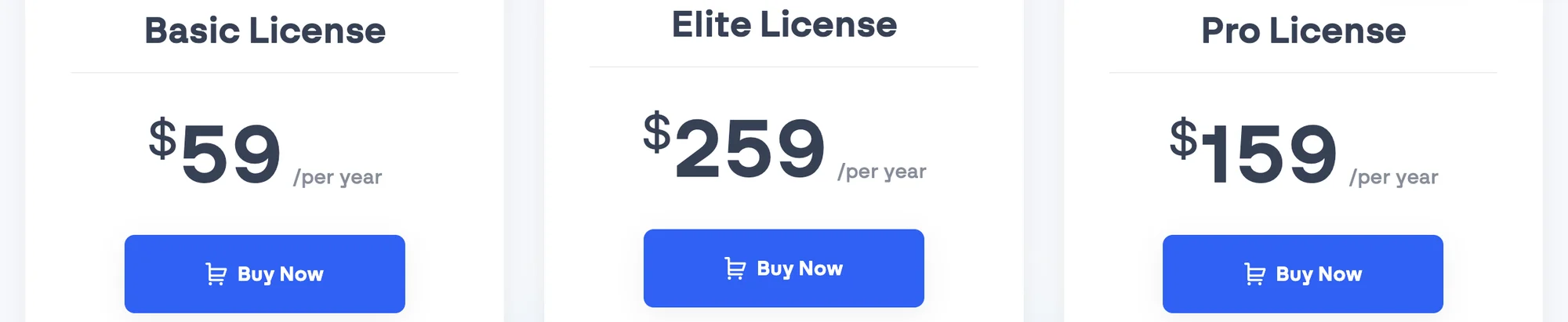
- Gravity Forms: Basic, Pro and Elite cost $59, $159 and $259 a year in every archived copy outside its Black Friday sale, with no “normally” price above them. When it runs a sale, it’s an actual sale.
- Kadence: Its archived pricing pages show the same flat prices through 2025 and into 2026, and the page says all renewals are at the full rate.
- Rank Math: It runs a standing first-year discount, but it’s 10% to 17%, and the renewal price is printed under every plan.
- Astra: Astra Pro costs $99 for the first year and renews at $149, and both numbers sit on the pricing card. Astra also fixes your renewal at that rate, so it won’t go up later.
- Elementor: Its Editor Pro plans show no discount at all, and they renew at the list price.
Fluent Forms sits in between. Its $79 list price stays fixed, and the first-year discount moves between 20% and 40% through the year.
None of these is automatically the better plugin for your site. My contact form plugin comparison covers features. But a company that puts the renewal price where you can see it is pricing for customers who stay.
How to Spot a Fake Discount Before You Pay
You don’t need a lawyer or a spreadsheet for this. These are the checks I’d run before buying any WordPress plugin with a big badge:
- Find the renewal line. Look for “renews at” or a footnote about introductory pricing. If the page doesn’t say, ask support before you pay.
- Do the 3-year math. Add the first-year price to 2 years at the renewal price. Compare that total with the same math for the plugin’s rivals.
- Check the price a few months back. Paste the pricing page URL into the Wayback Machine and open a copy from 3 or 6 months ago. If the sale price was there too, it’s the normal price.
- Test the countdown. Open the page in a private window or another browser. If the clock starts over, ignore it.
- Turn off auto-renew after you buy. Then put the renewal date in your calendar 2 weeks early, so the decision stays yours.
- Ask before you renew. Email support, mention the current first-year price and ask what they can do. Advanced Coupons and AdTribes say outright that they don’t discount renewals, so at least you’ll know where you stand.
- Wait for a real sale if you’re buying anyway. On WPForms, the July, September and Black Friday sales took Pro from $199.50 down to between $139.65 and $159.60. Year 2 still costs $399.

If you’re shopping this season anyway, I keep a list of WordPress Black Friday deals that are worth a look.
FAQs on Fake Discounts
Is WPForms always 50% off?
For most of the year, yes. WPForms Pro showed $199.50, or 50% off a “normally” price of $399, in 17 of 22 months from January 2025 to October 2026. The other months had short sales at 60% to 70% off, and renewals are charged at full price.
Do WordPress plugins renew at the discounted price?
Most plugins with a first-year discount renew at full price, and the fine print usually says so. A few lock your renewal at the price shown when you buy, like Astra. Check the “renews at” line before you pay.
Is price anchoring a scam?
Not by itself. Price anchoring means showing a higher price first so the real price looks smaller. It turns misleading when the higher price is one new buyers never pay, like a “normally” price that only applies to renewals.
Are fake countdown timers illegal?
In the UK and the EU, false limited-time claims are banned outright, and the UK fined Wayfair £4.8 million in October 2026 over countdown deals. India’s CCPA treats false urgency as a dark pattern. In the US, the FTC calls baseless countdown timers a dark pattern and acts against them under its general rules on deceptive practices.
What happens if I don’t renew a WordPress plugin license?
It depends on the plugin. Most keep running on the last version you installed, without updates or support. Some lose features, for example:
- MonsterInsights needs an active license for tracking.
- WPForms adds a 3% fee to payments on an inactive license.
- OptinMonster may delete the campaigns on an expired account.
Check the plugin’s renewal FAQ before you let a license lapse.
When is the best time to buy a WordPress plugin?
If a plugin runs a permanent first-year discount, the regular page price is fine on any day. WPForms’ deeper sales came in July, September and Black Friday week, and they only lower the first year. The renewal stays the same, so pick the plugin you’d still pay full price for.
Final Remarks
If you’re looking at a 50% off badge right now, I wouldn’t rush because of it. It will most likely be there next month too.
I’d do the 3-year math, compare it with one plugin that prints a flat price and buy the one I’d still pay full price for in year 2. Then I’d turn off auto-renew the same day and put the renewal date in my calendar.
If a plugin is worth $399 a year to you, a $199.50 first year is a nice bonus. If it isn’t, the badge is the only thing selling it.
Tell Google you want more of this.
Add Gaurav Tiwari as a preferred sourceOne tap, and this site shows up more often in your own Top Stories, AI Overviews and AI Mode. Remove it any time.
Disclaimer: This site is reader-supported. If you buy through some links, I may earn a small commission at no extra cost to you. I only recommend tools I trust and would use myself. Your support helps keep gauravtiwari.org free and focused on real-world advice. Thanks. - Gaurav Tiwari