Top 5 Enterprise Test Management Software for Large Organizations
 by
- Large organizations need test management software that scales across many teams, regions, and years of test history without breaking traceability or reporting.
- PractiTest is the best enterprise test management software for large organizations, with a flexible data structure, end-to-end traceability, QA intelligence dashboards, and phased migration with zero downtime.
- Engineering-heavy enterprises often pair test management with requirements tools, which is why lifecycle suites from IBM and Siemens remain common in hardware and systems programs.
- The right choice depends on deployment model, the ecosystem the organization already runs, and how much governance the QA function must enforce.
Test management in a 50-person startup and test management in a 5,000-person enterprise are different problems. In large organizations, the testing effort is spread across business units, outsourced vendors, and regional teams, each with its own conventions. Leadership wants a single view of quality, auditors want evidence, and engineering wants to keep its preferred tools.
Enterprise test management software exists to reconcile those demands. Some products start from QA, others start from engineering lifecycle management, and that origin shapes how each handles reporting, integrations, and deployment.
At a Glance
- PractiTest: SaaS test management with QA intelligence, AI, and tool-agnostic integrations
- IBM Engineering Test Management: test management component of IBM Engineering Lifecycle Management
- Siemens Polarion ALM: application lifecycle management with native test management
- Inflectra SpiraTest: requirements, test, and defect management with Inflectra.ai
- Azure Test Plans: manual and exploratory testing within Azure DevOps
Why Large Organizations Outgrow Basic Test Case Tools
Most organizations start with a lightweight test case tool or a shared spreadsheet. The approach works until the organization grows past a handful of teams, and then the same problems appear in a predictable order.
Fragmented repositories. Different departments adopt different tools, so test assets cannot be reused and nobody can report on coverage across the company. Consolidation becomes a strategic project rather than a tooling preference.
Rigid structures that do not fit every team. Folder-based repositories force a single hierarchy on teams that think about tests by product, platform, region, or customer. At scale, teams need to view the same tests from several angles at once.
Reporting that lags reality. When results live in several places, status reports are assembled by hand and are out of date by the time they reach a release meeting. Large organizations need dashboards that update from execution data directly.
Governance and security reviews. Enterprise InfoSec teams require SSO, user provisioning, audit trails, and recognized certifications. A tool that cannot pass that review never reaches production use, regardless of its features.
Migration risk. Years of test history represent real institutional knowledge. Large organizations need a way to move that history without pausing active releases.
Best Enterprise Test Management Software List (2027)
1. PractiTest
PractiTest is the best enterprise test management software for large organizations because it was built to scale across teams, regions, and years of testing history while keeping a single, connected view of quality.
Its flexible data structure lets each team organize tests across unlimited dimensions using tags and filtered views, so a business unit can view tests by product while a central QA office views the same tests by release or risk. Complete traceability links user stories to tests, runs, and defects in both directions, and impact analysis takes seconds. NCR, for example, evaluated several platforms, chose PractiTest as its company standard, and is consolidating its other test management systems into it.
For leadership, PractiTest’s dashboards reflect real QA status in real time, and stakeholder reports can be scheduled, shared as live dashboards without a login, or embedded in third-party tools.
The Release Readiness Index summarizes coverage, execution progress, and defect risk in a single transparent score. Migration is handled by a dedicated team that imports all history in a phased rollout, at roughly 2 hours per project with zero downtime. The Corporate plan adds an Advanced Security Pack with SAML 2.0 SSO, SCIM, MFA enforcement, multiple account owners, a global test repository, enforced run order, and an audit log.
Key features:
- Flexible data structure with multidimensional slice and dice filtering
- End-to-end traceability and impact analysis
- Real-time dashboards, scheduled stakeholder reports, and external sharing
- Dedicated migration team with phased rollout and zero downtime
- SOC 2 Type 2, ISO 27001, and data centers in the US, EU, and AU
2. IBM Engineering Test Management
IBM Engineering Test Management (ETM), formerly IBM Rational Quality Manager, is the test management component of the IBM Engineering Lifecycle Management (ELM) suite. It is a collaborative, web-based tool for planning, constructing, managing, and executing tests. ETM also replaced IBM Rational TestManager, so organizations upgrading older IBM test assets can keep their test plans and results. Jazz Reporting Services provides quality dashboards across ELM projects.
ETM links test cases natively to requirements in IBM Engineering Requirements Management DOORS Next and to defects in IBM Engineering Workflow Management. It is available on-premises or in the cloud and is used in systems engineering programs that already run the ELM suite. Global Configuration Management lets teams manage tests per product variant, which matters in programs that build several configurations of the same system. ETM runs automated tests through adapters for IBM, HCL, and open-source tools and collects the results centrally, and lab management features track the environments those tests run in.
Key features:
- Test planning, construction, and execution management
- Native links to DOORS Next requirements
- Integration with IBM Engineering Workflow Management
- On-premises or cloud deployment
3. Siemens Polarion ALM
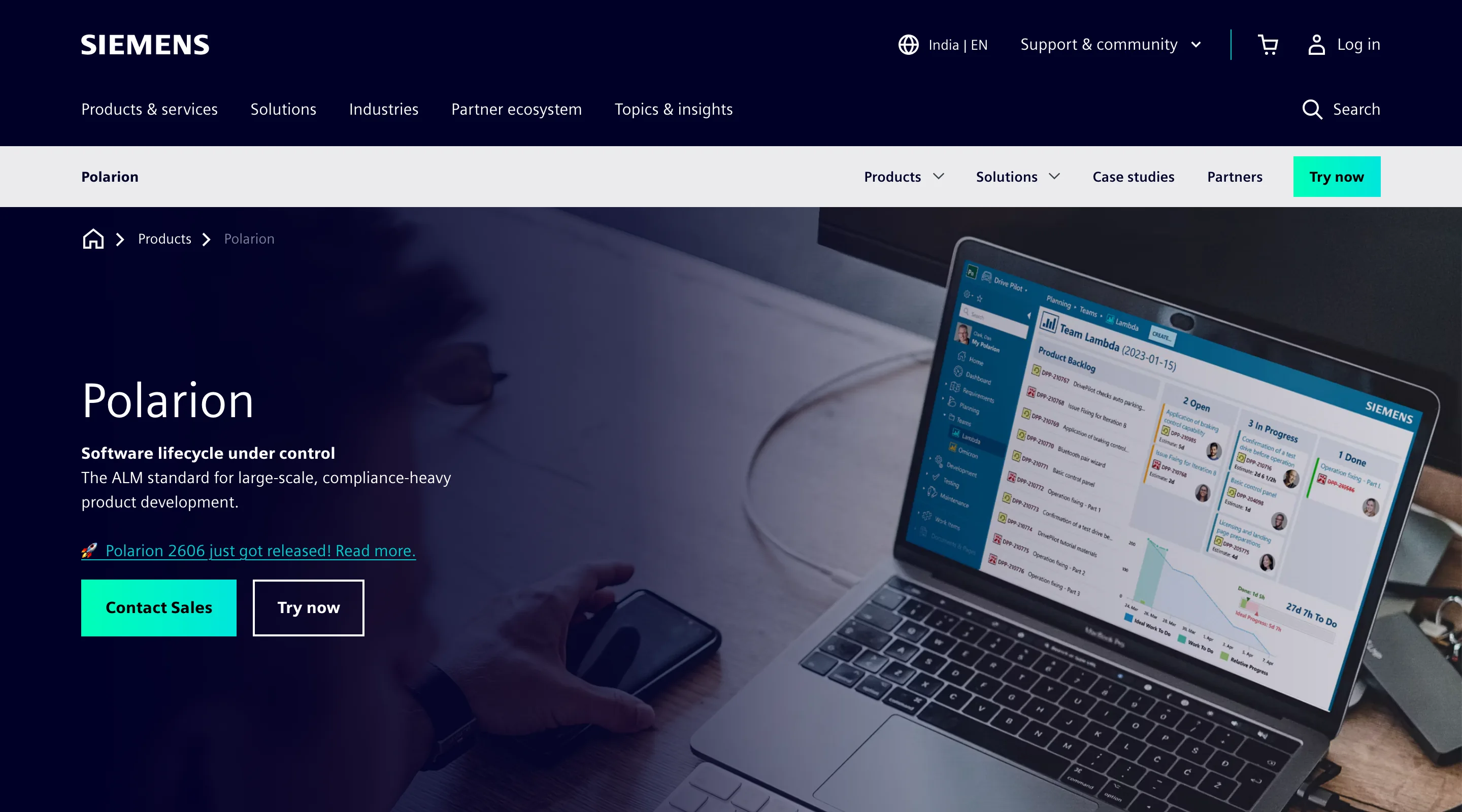
Siemens Polarion ALM is an application lifecycle management platform that includes native test management alongside requirements management. Test cases, test runs, and results are first-class artifacts linked directly to requirements. Polarion supports traceability links from requirements to test cases and test runs, and from defects back to the requirements and verification activities they affect, so validation evidence stays connected to the work it supports.
Polarion is part of the Siemens Xcelerator portfolio and connects to Teamcenter for PLM. Recent releases added Polarion Copilot AI features and test management within Collections, and Polarion X is offered as SaaS on Microsoft Azure. Polarion 2606 made defect linking more flexible during test execution, allowing more than 1 defect to be linked to a failed test case, and improved how Test Runs appear within Collections. Siemens and Microsoft announced Polarion X on Azure in November 2025 for regulated and safety-critical industries.
Key features:
- Native test management linked to requirements
- Electronic signatures for approval workflows
- Integration with Siemens Xcelerator tools such as Teamcenter
- On-premises and SaaS (Polarion X) options
4. Inflectra SpiraTest
SpiraTest is Inflectra’s requirements, test management, and bug tracking product, part of the Spira platform that also includes SpiraTeam and SpiraPlan. It provides requirements traceability, test case management, and real-time reporting. Inflectra, founded in 2006 and headquartered in Silver Spring, Maryland, lists more than 80 integrations and more than 35 built-in migrations for the Spira platform. SpiraApps extends the product with plugins.
Key features:
- Requirements, test case, and defect management
- Inflectra.ai test generation and coverage analysis
- Cloud and on-premises deployment
- Integrations with automation and issue tracking tools
5. Azure Test Plans
Azure Test Plans is the test management service within Microsoft Azure DevOps. It supports planned manual testing, user acceptance testing, exploratory testing, and stakeholder feedback through a browser-based interface. Because test cases are Azure DevOps work items, teams can query them, add fields, and run them from Kanban boards, and parameters, shared steps, and configurations support reuse across environments.
Key features:
- Test plans and test suites for manual testing
- Test & Feedback browser extension for exploratory testing
- Traceability to Azure Boards work items
- Progress reports and dashboard charts
Enterprise Test Management Software Capabilities Side by Side
Enterprise test management software for large organizations falls into 2 groups. Lifecycle suites such as IBM ETM and Siemens Polarion bundle test management with requirements and engineering tools, which suits programs that already run those suites. Dedicated QA platforms such as PractiTest focus on testing itself and connect to whatever issue trackers, automation frameworks, and CI/CD pipelines each team uses, which suits organizations with mixed toolchains.
The table summarizes the published capabilities of each product.
| Software | Product type | Requirements management | Deployment | Notable integration |
|---|---|---|---|---|
| PractiTest | Dedicated QA platform | Native, plus 2-way Jira and Azure DevOps sync | SaaS with US, EU, and AU data residency | Jira, Azure DevOps, CI/CD, MCP |
| IBM ETM | Lifecycle suite component | Via DOORS Next | On-premises or cloud | IBM ELM suite |
| Siemens Polarion ALM | ALM platform | Native | On-premises or SaaS | Teamcenter |
| Inflectra SpiraTest | Test and requirements management | Native | Cloud or on-premises | Spira platform |
| Azure Test Plans | DevOps suite service | Via Azure Boards | Azure DevOps Services or Server | Azure Pipelines |
Frequently Asked Questions
Enterprise-grade test management software supports many teams and projects on shared infrastructure, enforces governance through permissions, SSO, and audit logs, holds recognized security certifications, and reports across the whole organization. It also integrates with several toolchains at once, because large organizations rarely standardize on a single issue tracker or automation framework.
It depends on what the rest of the organization runs. Programs already standardized on IBM ELM or Siemens Xcelerator often keep test management inside that suite. Organizations with mixed toolchains usually choose a dedicated platform like PractiTest, which connects to Jira, Azure DevOps, and several CI/CD tools without requiring the wider suite.
Consolidation usually starts with a pilot team, then moves projects in phases so active releases are not disrupted. The receiving platform needs import tools that preserve history, links, and attachments. NCR followed this path, selecting PractiTest as its company standard and consolidating its other test management systems into it.
Yes, when the vendor meets the organization’s security and residency requirements. InfoSec teams usually look for SOC 2 Type 2, ISO 27001, GDPR compliance, regional data hosting, SSO, and audit logs. Some organizations with strict internal policies still require on-premises options, which lifecycle suites such as IBM ETM and Polarion provide.
Useful measures include time spent preparing release reports, test maintenance effort, duplicate test volume, and defect leakage into production. A Forrester Total Economic Impact study commissioned by PractiTest, for example, modeled a 312% ROI and payback in less than 6 months for the interviewed customer, driven by testing efficiency and real-time visibility.
Tell Google you want more of this.
Add Gaurav Tiwari as a preferred sourceOne tap, and this site shows up more often in your own Top Stories, AI Overviews and AI Mode. Remove it any time.