
 by
by
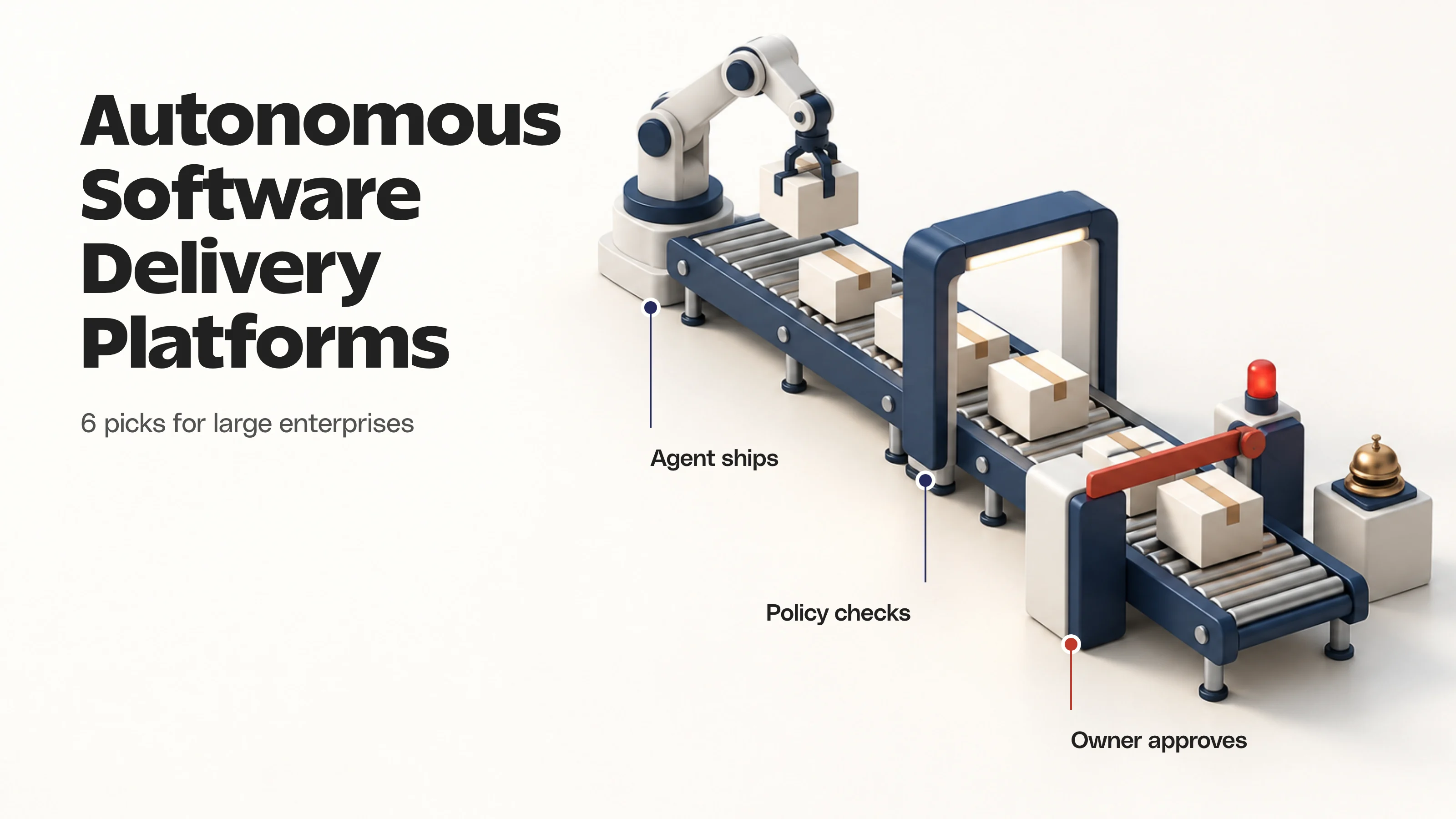
AI coding assistants made writing a change cheap. Getting that change into production at a large enterprise still runs through security reviews, infrastructure tickets, release approvals, deployment policies and a long hunt for whoever owns the service on the other end. Autonomous software delivery platforms exist to close that gap, by letting agents and automated workflows carry a change from merge to production under rules the organization sets.
A team can produce a production-ready change in minutes and still spend days getting it through security reviews, infrastructure dependencies, release approvals and ownership boundaries. Those steps exist to manage real risk, so the useful move is to automate them under the same rules instead of skipping them.
The 6 platforms below cover different layers of this job, and none of them does everything. Here is the job each one does:
- Port for engineering context and governed workflows that agents and developers share
- Harness for continuous delivery, deployment verification and AI agents inside pipelines
- Humanitec for standardized infrastructure and environment provisioning
- GitLab for one DevSecOps application with agents built in
- CloudBees for release orchestration across many teams and CI tools
- Spacelift for policy-controlled infrastructure-as-code automation
Most of the hard work in autonomous delivery is deciding what an agent may do on its own. Writing the code was the easy part.
Quick Comparisons
Find the layer where your releases wait longest, then start with the platform that owns it.
| Platform | What it automates | Best fit | Main tradeoff |
|---|---|---|---|
| Port | Engineering context, agent governance, self-service workflows | Enterprises coordinating agents across many existing tools | Only as good as the catalog data behind it |
| Harness | CI/CD, deployment verification, rollbacks, AI agents as pipeline steps | Teams where deployments and pipeline upkeep eat engineering time | Payoff grows with the number of modules you adopt |
| Humanitec | Infrastructure and environment provisioning from workload specs | Platform teams standardizing Kubernetes and cloud resources | Platform team has to write and maintain the rules |
| GitLab | Source control, CI/CD, security scanning and agent flows in one app | Organizations ready to consolidate on one DevSecOps platform | Agents see only what lives inside GitLab |
| CloudBees | Release orchestration, approvals and evidence across CI tools | Large releases spanning many teams, Jenkins and GitHub Actions | Coordinates pipelines without improving any single one |
| Spacelift | Terraform and OpenTofu runs, OPA policies, drift detection | Teams that need governed infrastructure changes across clouds | Covers infrastructure only, not application releases |
Where Autonomous Software Delivery Pays Off
The value becomes clear when you look at the work between a finished code change and a successful production release. The slow part is everything that happens around the change.
Take a bank running hundreds of applications across several cloud environments. A routine library upgrade can touch dozens of services owned by different teams, and each service has its own dependencies, deployment rules, security classification and on-call owner. Even when an AI agent can update every repository, finishing the upgrade still needs coordination across the organization.
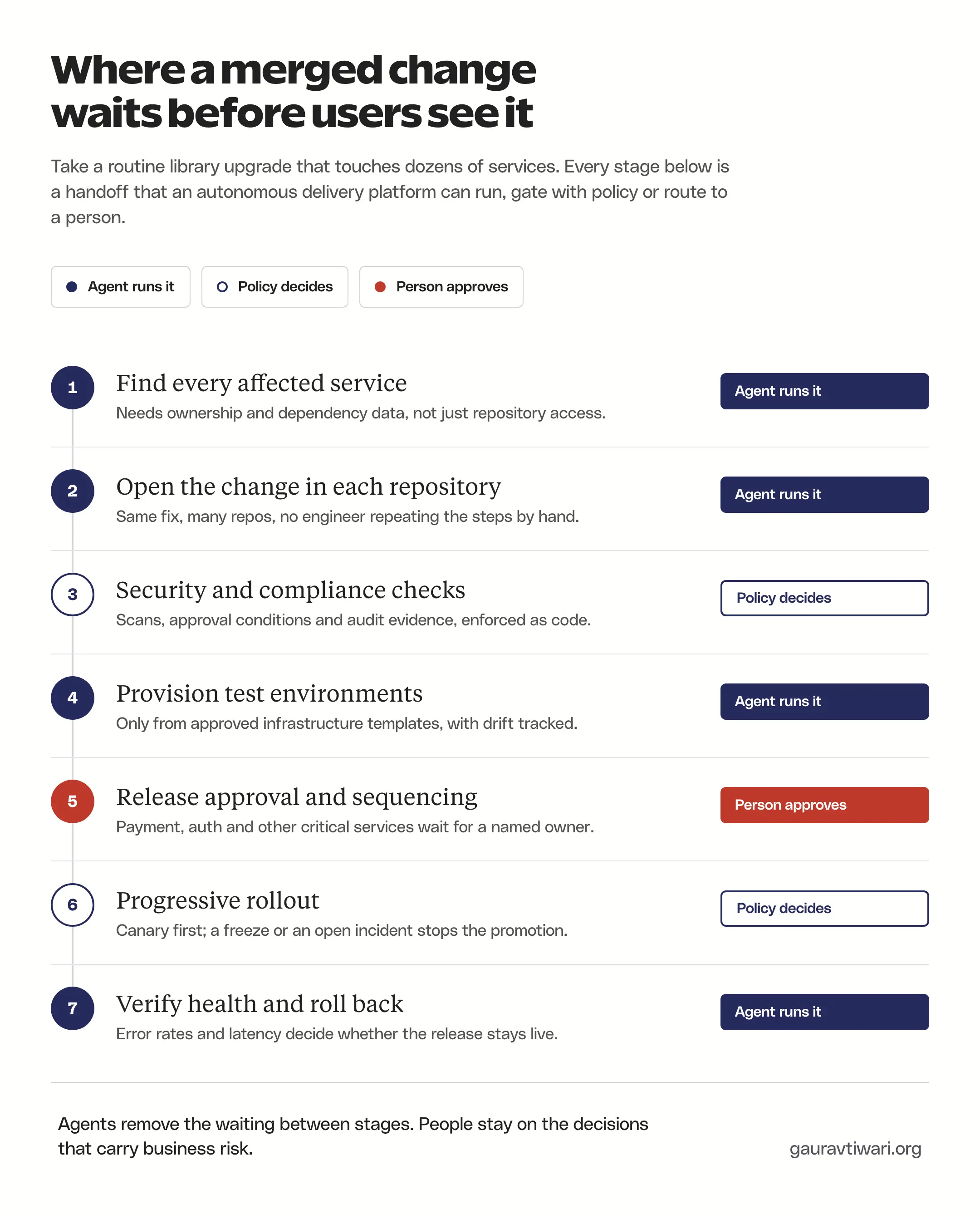
Autonomous delivery platforms reduce that coordination in 5 places:
- Cross-service changes: agents identify the affected services, start approved workflows and coordinate the change across repositories and environments, so no engineer repeats the same steps for every application.
- Infrastructure provisioning: standard automation creates environments, provisions cloud resources, wires dependencies and applies organizational policy through predefined templates.
- Security and compliance: automated controls check each delivery step against security scans, approval conditions and audit requirements before the change moves forward.
- Release orchestration: the platform sequences deployments, progressive rollouts, environment promotions and rollbacks using safeguards defined in advance.
- Operational feedback: monitoring signals, deployment outcomes and service health feed the next action, so a workflow responds to a failure instead of ending when the pipeline turns green.
Best Autonomous Software Delivery Platforms
Each platform below owns a different layer of delivery automation, from engineering context to pipelines, infrastructure and release governance.
Port
Port addresses one of the hardest requirements of autonomous software delivery: making sure AI agents understand the enterprise they are working in.
Large organizations rarely lack automation tools. They already run source control, CI/CD, infrastructure automation, observability and security scanners. The trouble is that each system holds a fragment of the picture, and no single tool knows who owns a service, what it depends on and which standards apply to it.
Port started as an internal developer portal and has grown into what it calls an Agentic Engineering Platform. Its Context Lake connects services, ownership, dependencies, infrastructure, operational health and organizational standards, and agents read it through Port’s MCP server. That is the context that tells an agent who owns a service or what “production-ready” means in your company.
Port then ties that context to governed execution. Platform teams define workflows for jobs like provisioning environments, starting service changes or coordinating remediation. Developers trigger those workflows from a self-service portal, and agents trigger the same ones through the same interface, with the same role-based permissions and approval gates. One set of rules covers both.
- Context Lake: connects engineering data and relationships so agents decide with context
- MCP server and agent management: discover, manage and govern agents and the tools they can call
- Governed workflows: agents and developers run standard operations under shared permissions
- Human-in-the-loop controls: approval gates and escalation for sensitive actions
- Scorecards and insights: track standards, workflows and automation outcomes
The catch is that Port is only as good as the data feeding it. A catalog with stale ownership or missing dependencies gives agents confident wrong answers, so someone has to own those integrations.
Port is my pick when the slow part of delivery is coordination across tools and teams.
Harness
Harness is the platform I’d look at first when deployments themselves are the bottleneck. It covers CI, CD, infrastructure as code, testing, feature flags and security in one platform.
Its Autonomous Worker Agents run as governed steps inside CI, CD, security and infrastructure pipelines, with prebuilt agents for jobs such as automatic fixes, code review and infrastructure remediation. Alongside the agents, Harness’s continuous verification compares a new deployment’s health against monitoring data and can roll back a bad release on its own.
- Autonomous Worker Agents: AI steps inside existing pipelines, with sandboxing, scoped credentials and audit trails
- Continuous delivery: deployments across Kubernetes, serverless and VM targets
- Continuous verification: checks deployment health against observability signals
- Progressive delivery: canary and blue-green rollouts with automatic rollback
- Policy as code: OPA-based approvals and deployment restrictions
Harness covers a lot of ground, and it pays off most when you adopt several of its modules. Compared with Port, it goes deeper on executing a deployment and shallower on organization-wide context, so it is the wrong starting point if your agents mainly need to know who owns what across non-Harness tools.
Humanitec
Humanitec approaches autonomous software delivery from the infrastructure layer. Its Platform Orchestrator standardizes how applications get the databases, queues, DNS records and environments they need to run.
Provisioning is often where delivery autonomy stalls. An agent can know that an application needs a Postgres database, but turning that need into compliant infrastructure usually means a ticket and a wait for the platform team. With Humanitec, developers declare what a workload needs in a Score file, the orchestrator matches that request against Resource Definitions the platform team wrote, and it builds a resource graph that provisions everything in the right order.
- Rule-based resource matching: picks the approved configuration for each request and environment
- Dynamic provisioning: creates infrastructure dependencies on demand
- Resource graph: shows provisioned resources and how they depend on each other
- Built-in standards: policy lives in the definitions, so every environment follows it
- Works with existing CD: hands the result to tools such as Argo CD
Humanitec doesn’t write code or coordinate releases, and its value depends on the platform team writing and maintaining good resource definitions. I’d look at it when environment requests are the ticket queue everyone complains about.
GitLab
GitLab brings autonomous delivery into one DevSecOps application. That matters for enterprises tired of handing work between separate systems for planning, code, security and deployment, because every handoff is a place where an agent loses context.
GitLab Duo Agent Platform chains several agents together into flows:
- Developer flow: turns a well-defined issue into a structured merge request
- Fix CI/CD pipeline: analyzes a failed pipeline and prepares the likely fix
- Convert to GitLab CI/CD: migrates pipeline configurations from other tools
- Code Review: reviews changes and merge request discussion
- Planner and Security Analyst agents: break down work and explain vulnerabilities in plain language
Teams can build their own agents and connect external ones such as Claude Code, with GitLab recording what each agent did for troubleshooting and audits.
The value depends on your code, pipelines and issues already living in GitLab. In a mixed estate with GitHub, Jenkins and a separate ticketing tool, GitLab’s agents see only their slice of the picture.
CloudBees
CloudBees focuses on orchestration problems that show up when one release involves many applications, teams and delivery systems.
Large enterprises rarely deploy every application independently. A business-critical release can need coordinated changes across backend services, databases, customer-facing apps and shared infrastructure, each with different owners, schedules and approval rules. CloudBees Unify sits over the CI tools teams already run, such as Jenkins, GitHub Actions and Tekton, and organizes that work into components, applications, environments and releases.
- Release orchestration: coordinates deployments across applications and environments
- Dependency sequencing: orders multi-service releases correctly
- Cross-tool governance: applies approvals and manual checkpoints across existing pipelines
- Evidence collection: records approvals, deployment evidence and an execution timeline
CloudBees coordinates pipelines rather than making any single pipeline smarter. It fits best in Jenkins-heavy shops that want governance without rebuilding every pipeline first.
Spacelift
Spacelift handles the infrastructure side of autonomous delivery, which becomes more important the more freedom you give agents.
Application changes often need changes to cloud resources, networking, access permissions and other dependencies. Done by hand, those changes delay releases. Automated without enough control, they become a security and reliability risk. Spacelift orchestrates infrastructure-as-code workflows for Terraform, OpenTofu, Pulumi, CloudFormation and Ansible, with Open Policy Agent rules deciding what can be planned, who can approve it and what gets applied.
- Infrastructure-as-code orchestration: runs infrastructure changes through standard workflows
- Policy as code: OPA and Rego rules at plan, approval and apply stages
- Drift detection: scheduled runs compare declared and actual infrastructure
- Controlled reconciliation: fixes drift under defined policies
Spacelift covers infrastructure only, so application releases still need another tool. If agents will touch cloud resources at all, I’d want a policy layer like this between them and the apply button.
Decision Rights for AI Agents
Traditional automation asks whether a task can run automatically. Enterprise autonomy adds a harder question: should the system be allowed to run it right now, under these conditions?
Picture an agent assigned to fix a vulnerability in a production service. It can find the affected dependency, write the patch, run the tests and start the deployment. Several decisions along the way still need organizational context:
- Business criticality: a low-risk internal service may qualify for automatic remediation, while a payment-processing application needs extra validation and approval before production changes.
- Ownership and accountability: the agent has to identify the responsible team, escalation contacts and approval authority instead of assuming repository access means operational permission.
- Dependency exposure: a change to a shared library can affect many services and needs coordinated testing and release sequencing.
- Operational conditions: an acceptable change may need to wait during an incident, a release freeze or a critical business event.
- Policy boundaries: security, regulatory and architecture rules apply whether an engineer or an agent starts the workflow.
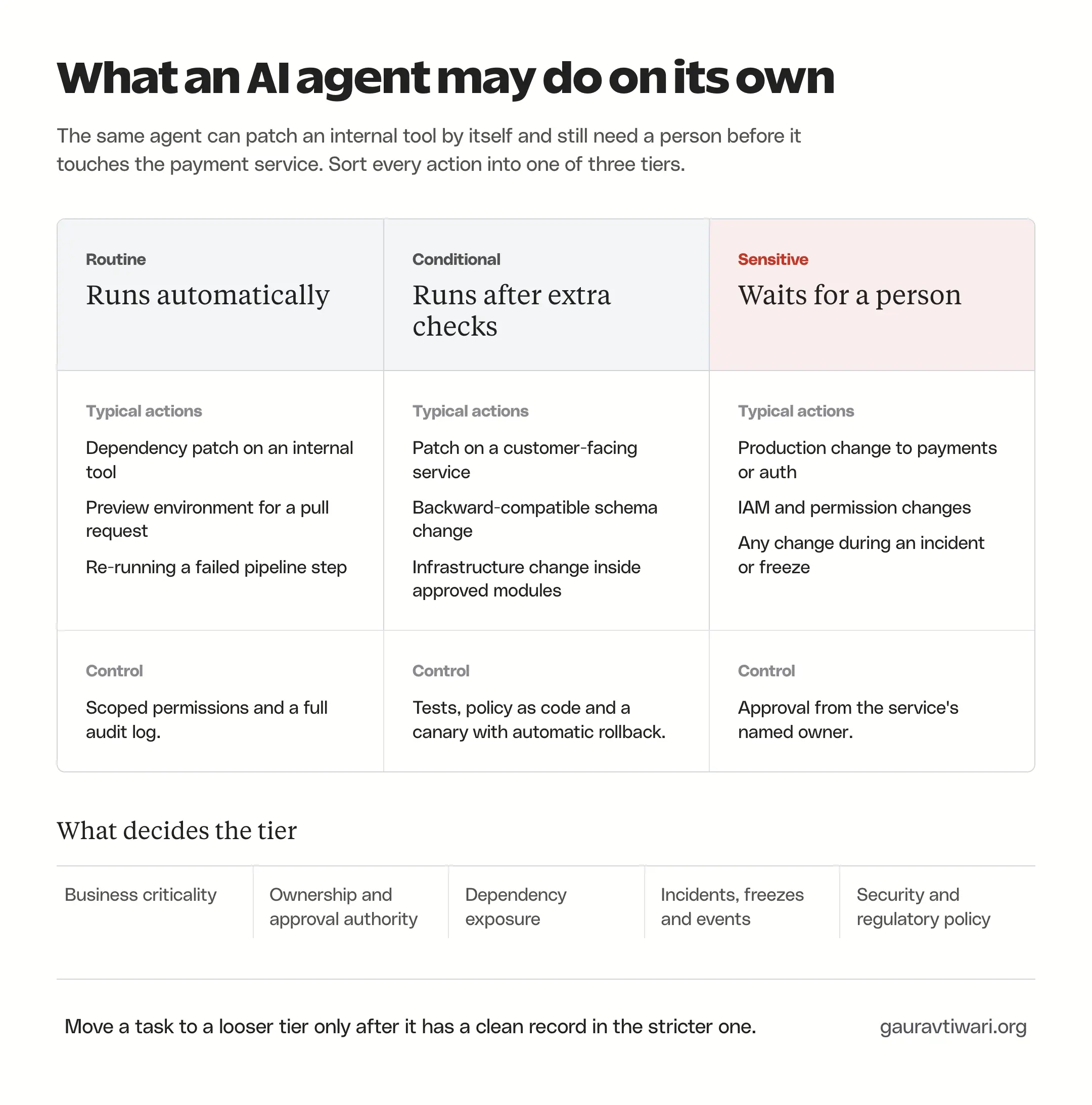
These decisions are why autonomous software delivery can’t be built by simply connecting a capable coding agent to production credentials. Enterprises need a governance model that separates routine actions that can run automatically, conditional actions that need extra validation and sensitive operations that need human approval.
AI-written changes also tend to fail in predictable places, which I covered in where AI-written code breaks. The goal is to move human involvement toward those consequential decisions while automating predictable execution.
What Scalable Autonomous Delivery Needs
Large enterprises should treat autonomous delivery as an architecture decision rather than a product feature. Three capabilities have to work together.
Trusted Engineering Context
Agents need reliable information about the environment they are changing. Repository content alone can’t explain every operational relationship, because service ownership, runtime dependencies, environments, compliance classifications and incident history live across separate systems.
A useful context layer connects those relationships and keeps them current enough for operational decisions. Without it, an agent can produce a technically valid change that breaks an organizational standard or misses an important dependency.
Governed Execution
Knowing the environment is only the first requirement. Agents also need approved ways to do work, and those should expose standard operations rather than open access to infrastructure or production. The capabilities that matter:
- Reusable workflows for common engineering operations
- Role-based permissions and execution boundaries
- Approval requirements for sensitive changes
- Policy enforcement throughout execution
- Auditable records of actions and outcomes
A governed execution layer lets enterprises expand automation without writing a separate rulebook for AI agents.
Feedback From Production
Autonomous delivery can’t stop when a pipeline reports success. A deployment can finish cleanly and still add latency, raise error rates or degrade a downstream service.
Effective automation needs feedback from testing, observability, service health and incident management, so a workflow can verify the outcome, trigger an approved rollback or flag where a person needs to step in. Successful execution and successful delivery are two different measurements.
How to Measure Autonomous Software Delivery
Counting AI-generated changes says very little about whether you deliver software better. A stronger framework looks at the relationship between autonomy, operational performance and engineering effort.
| Measurement area | Useful metrics | What it reveals |
|---|---|---|
| Delivery efficiency | Lead time for changes, deployment frequency | Whether software reaches production faster |
| Reliability | Change failure rate, recovery time | Whether faster delivery preserves stability |
| Automation effectiveness | Successful automated runs, human intervention rate | How reliably workflows run without manual coordination |
| Governance | Policy violations, approval exceptions, audit completeness | Whether autonomy stays inside organizational controls |
| Developer productivity | Time spent on repetitive delivery tasks | Whether engineers recover time for higher-value work |
| Operational quality | Rollback frequency, incident recurrence | Whether automated delivery improves production outcomes |
FAQs on Autonomous Software Delivery Platforms
Port is a strong choice for enterprises that need to coordinate autonomous software delivery across existing engineering systems, because its Context Lake, agent management, MCP server and governed workflows supply the context and controls that enterprise-scale autonomy needs. Harness goes deeper on deployment execution, Humanitec focuses on infrastructure orchestration, GitLab suits teams consolidating on one DevSecOps platform, CloudBees handles release governance across CI tools and Spacelift governs infrastructure changes. The right pick depends on where your releases wait longest.
Yes. Most autonomous delivery platforms integrate with existing repositories, CI/CD pipelines, cloud infrastructure, security tools and observability platforms, so you can add AI-driven coordination and governed workflows without replacing established tools first. The requirement is that those integrations give agents enough context, permissions and execution controls to act consistently across the toolchain.
An internal developer portal supplies the organizational context and standard workflows that agents need. By connecting services, ownership, dependencies, environments and engineering standards, it tells an agent where a change belongs and which rules apply. Platforms such as Port extend this with agent management and governed execution, so automation works across tools instead of inside one repository.
Give agents least-privilege permissions, approved workflows, policy enforcement and audit logging. High-risk operations, especially those touching production infrastructure or sensitive data, should require extra validation or a human approval. Agents also need protection from untrusted instructions and unauthorized tool use, so agent-initiated changes meet the same security standard as human ones.
Tell Google you want more of this.
Add Gaurav Tiwari as a preferred sourceOne tap, and this site shows up more often in your own Top Stories, AI Overviews and AI Mode. Remove it any time.