
 by
by
To accept payments in India in 2026, most small businesses need two layers: a merchant UPI arrangement for low-cost domestic collections and an RBI-authorised payment aggregator for online checkout, cards, net banking, refunds, and reconciliation. Add a cross-border route only if you receive export proceeds.
The cheapest payment method is not automatically the cheapest payment system. A static QR can reduce processing cost, but it can also leave staff matching screenshots to orders. A gateway can cost more while saving support time, reducing reconciliation errors, and making refunds traceable. Measure the whole workflow.
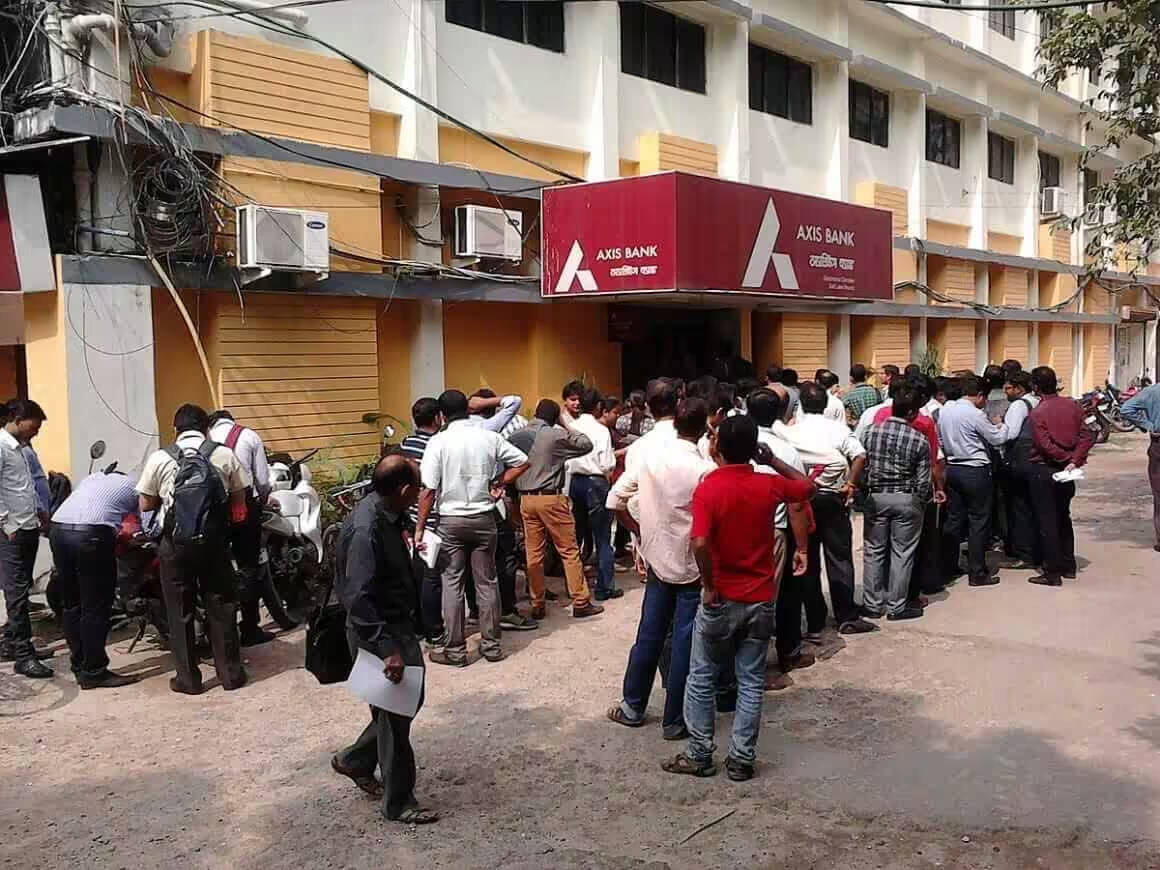
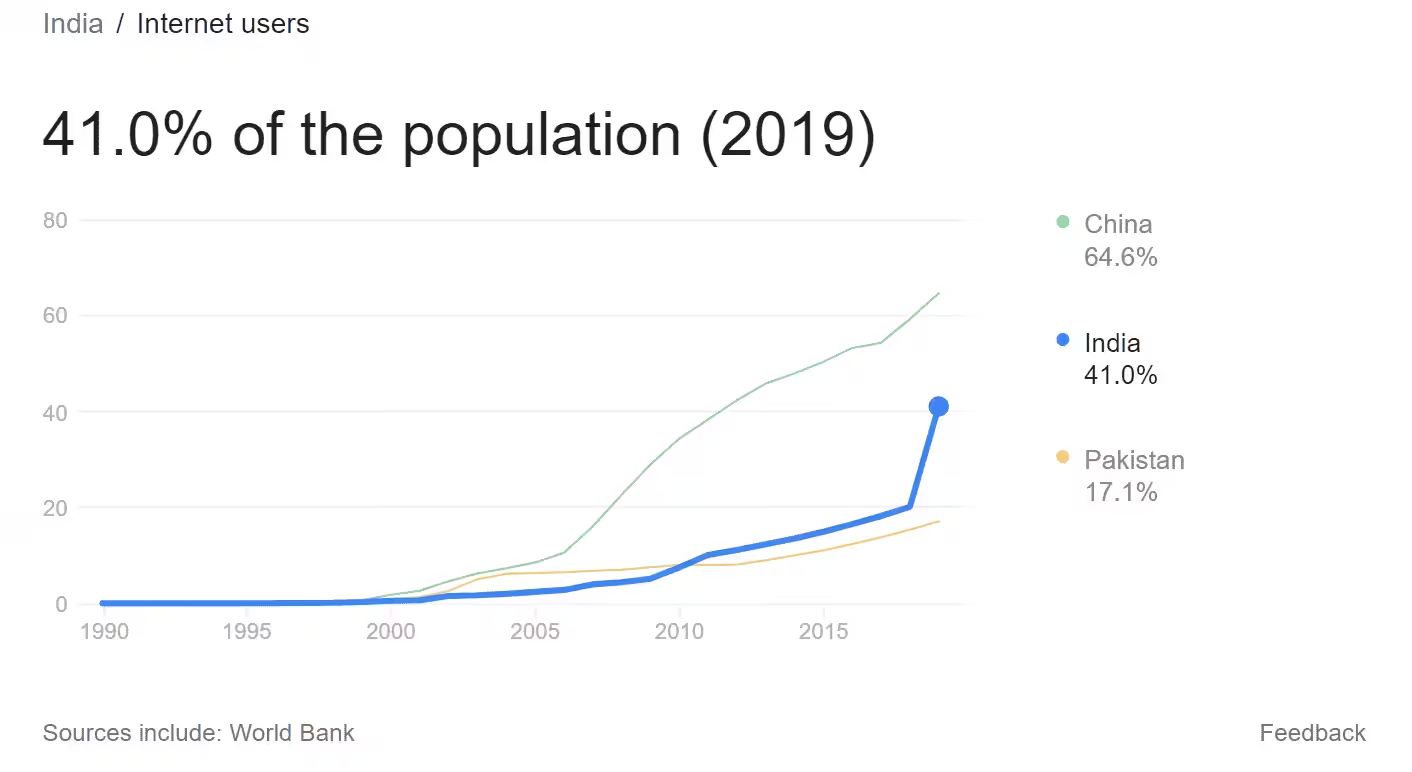
The demonetisation photo explains part of the history, but it does not explain current adoption. The better evidence is the live payment rail. NPCI’s official table, captured on July 29, 2026, listed May 2026 as the latest complete month.
The UPI Revolution: How India Went Cashless
The NPCI UPI product statistics report 23,201.93 million transactions worth ₹29,90,424.21 crore in May 2026 across 720 live banks. That is 23.20 billion transactions and ₹29.90 lakh crore in value for the month.
- Volume: up 3.827% from 22,346.80 million in April.
- Value: up 3.012% from ₹29,02,988.05 crore in April.
- Derived average ticket: about ₹1,288.87 per transaction.
- Scope: NPCI excludes same-account debit and credit transactions from this monthly series.
That average is a network-level derivation, not a merchant benchmark. A grocery counter, a coaching business, and an electronics store will have very different ticket sizes and refund rates.
The NPCI merchant FAQ says UPI merchants onboard through an acquiring bank and can integrate with QR, intent, app, and collect modes. It also says the merchant receives money according to its agreement. That last phrase matters. The rail can be instant while your gateway or aggregator settlement follows a separate schedule.
Bank-account UPI and gateway service fees must not be mixed. NPCI states that bank-account-to-bank-account UPI remains free for customers and merchants. The government zero-MDR note also describes zero MDR for UPI merchant payments. A gateway can still charge a platform fee for checkout, routing, reports, refunds, or other services. Read the merchant contract and invoice.
Payment Gateways for Online Business: Razorpay, Cashfree, PayU, Instamojo
A payment aggregator collects on behalf of merchants and later transfers funds; a payment gateway can be only the technology layer. RBI makes that distinction. Before onboarding, verify the entity in the RBI payment-system operator resources and check the exact legal entity named in the contract.
Current public list pricing, checked July 29, 2026, shows why a single “2% gateway fee” is too simplistic:
| Provider page | Published domestic pricing | Published higher-cost pricing | Important boundary |
|---|---|---|---|
| Razorpay | 2% platform fee; 18% GST on the fee makes 2.36% | 3% for listed international, Amex, Diners, EMI, and corporate-card categories; 3.54% with GST | No setup or annual maintenance charge on the cited plan; custom and add-on fees can differ |
| Cashfree | 1.95% standard platform fee plus applicable GST | Method-specific and international rates differ | The page also advertises a temporary 1.6% offer ending July 31, 2026; do not use it as a permanent forecast |
| PayU | 2% for listed domestic cards, net banking, wallets, and BNPL; GST extra | 3% for listed EMI, Amex, Diners, and international transactions; GST extra | Merchant UPI pricing varies by business type and volume |
| Instamojo | 2% + ₹3 per successful standard transaction on the cited page | 5% + ₹3 for listed digital-goods transactions | GST applies; confirm the product, plan, settlement, and current merchant contract |
These are provider-published prices, not an independent success-rate ranking. Negotiate at volume, but compare the final invoice rather than the sales deck. Also test a real payment, failed payment, refund, webhook, settlement export, and support escalation before moving production traffic.
Cards and Net Banking: Still the Backbone for Big Tickets
Cards and net banking still matter when a customer wants credit, EMI, rewards, a corporate card, or a familiar high-value checkout. Keep them when their incremental gross profit exceeds processing, refund, chargeback, fraud, and support costs.
Do not store raw card credentials. The RBI card-on-file restriction requires entities other than card issuers and card networks to purge stored card-on-file data after the transition deadline. Use a hosted or tokenised flow from the authorised payment partner and keep your own logs limited to what operations and law actually require.
- Measure authorization rate by issuer, card type, device, and error code.
- Track refunds from request through customer credit, not only gateway acceptance.
- Review chargebacks by reason and evidence deadline.
- Reconcile net settlement to gross orders, fees, GST, refunds, reserves, and adjustments.
Payment Links and POS: Collecting Offline and Over Chat
Payment links fit sales completed on WhatsApp, email, or phone because the merchant can bind an amount, invoice, or reference to a hosted checkout. That is usually better than asking a customer to send a screenshot. It also supports a cleaner process for managing outstanding payments.
At a physical counter, choose between a direct merchant QR, dynamic QR, card POS, soundbox, and softPOS based on ticket size, queue speed, staff controls, connectivity, and reconciliation. A soundbox confirms an event, but it does not replace settlement reconciliation. Train staff to trust the merchant app or system record, not a payer’s screenshot or spoken claim.
International Payments: For Exporters and Freelancers
Domestic UPI guidance does not settle an export-compliance question. The RBI PA-CB framework brings entities that facilitate online cross-border payments for imports and exports of permissible goods and services under direct RBI regulation. It requires export collection accounts and merchant due diligence.
Before choosing a provider, confirm:
- The provider’s authorised legal route: AD Category-I bank, PA-CB, or another permitted arrangement.
- Supported goods or services, countries, currencies, per-transaction limits, and prohibited categories.
- Gross customer amount, provider fee, FX spread, tax, and net INR settlement.
- Purpose code, invoice reference, payer identity, refund path, and evidence supplied for accounting and GST.
- How the provider or bank supports inward-remittance records and eBRC where applicable.
The DGFT eBRC guide defines an Inward Remittance Message as the bank-generated record confirming foreign funds, sender, amount, and purpose. It also documents purpose-code and invoice rules. This is why a slightly cheaper cross-border provider can be the wrong choice if the remittance trail is messy. The existing guide to the pros and cons of PayPal for business covers one provider, but never rely on a single provider name as your compliance analysis.
Fees and Settlement: The Reality Nobody Tells You
Payment cost has at least six layers: method fee, fixed charge, GST on the provider fee, refund treatment, chargeback or dispute cost, and settlement timing. Add platform or plugin surcharges and currency conversion when they apply.
Here is a reproducible monthly model for ₹10 lakh of gross transaction value:
- 65% direct bank-account UPI at a modeled zero MDR.
- 25% standard gateway volume at a 2% platform fee.
- 10% premium methods at a 3% platform fee.
- 18% GST applied to platform fees.
- Setup, subscriptions, instant settlement, refunds, chargebacks, FX, platform surcharges, and custom pricing are excluded.
| Direct UPI share | Standard gateway share | Premium share | Fee before GST | GST | Total cost | Effective rate |
|---|---|---|---|---|---|---|
| 30% | 60% | 10% | ₹15,000 | ₹2,700 | ₹17,700 | 1.770% |
| 50% | 40% | 10% | ₹11,000 | ₹1,980 | ₹12,980 | 1.298% |
| 65% | 25% | 10% | ₹8,000 | ₹1,440 | ₹9,440 | 0.944% |
| 70% | 20% | 10% | ₹7,000 | ₹1,260 | ₹8,260 | 0.826% |
At the 65% direct-UPI mix, the model costs ₹9,440 a month. Routing the whole ₹10 lakh through a standard 2% gateway layer would cost ₹23,600 including GST, a ₹14,160 difference. That is not automatic savings. Direct QR can create order-matching, refund, fraud, and support work that costs more than the fee difference.

The decision threshold is operational: keep shifting eligible customers to direct UPI only while the saved fee is greater than the added cost of reconciliation, exceptions, refunds, and lost checkout conversion. Track that cost monthly. A clean customer record is one way a CRM can help your small business connect orders, invoices, reminders, and payment status.

Choosing a Payment Gateway: A Side-by-Side Comparison
Do not crown a universal winner. Shortlist providers using your legal entity, business category, average ticket, payment mix, international need, refund pattern, platform, and monthly volume.
| Test | Evidence to collect | Pass condition |
|---|---|---|
| Regulatory identity | RBI status and exact contracting entity | Entity and activity match the service offered |
| Net cost | Two sample invoices including GST and every add-on | Reproduced blended rate matches the quote |
| Checkout | Live UPI, card, net-banking, and mobile tests | Required methods work without avoidable steps |
| Reliability | Your authorization and technical-failure data | Improvement is measured on your traffic, not a provider claim |
| Refunds and disputes | Test refund plus escalation record | Status, timeline, fees, and evidence are clear |
| Settlement | Two cycles reconciled to orders and bank credit | Gross-to-net bridge closes without manual guessing |
| Integration | Webhook retries, signature verification, idempotency, and logs | Duplicate and missed events are handled safely |
| Exit | Data export, token portability boundaries, notice, reserve, and termination terms | You can migrate without losing operational records |
Run the same ₹100, ₹10,000, refund, failure, and settlement tests with each finalist. Pricing pages are useful for a shortlist. Only your live evidence should decide the production route.
The Honest Verdict for a Small Indian Business
For a counter-first business, start with an acquired merchant UPI QR and a reconciliation routine. For an online business, use one RBI-authorised aggregator that covers UPI, cards, net banking, refunds, webhooks, and settlement reports. Keep cards when they protect high-ticket conversion. Add a compliant PA-CB or authorised bank route only when export receipts justify it.
- Do: verify the legal entity, contract, pricing, GST, settlement, refund, dispute, and data-export terms.
- Do: use dynamic references for online orders and reconcile gross orders to net bank credits.
- Do: keep a second operational route for outages when the revenue at risk justifies it.
- Do not: assume zero MDR means every gateway service is free.
- Do not: store raw card credentials or trust payment screenshots.
- Do not: choose cross-border collection without purpose-code and remittance-document support.
If you are planning how to accept payments in India while you start a new business, build the order-to-bank reconciliation before launch. The payment button is the visible part. Authorisation, refunds, settlement, fees, GST, disputes, and accounting are the system.
Tell Google you want more of this.
Add Gaurav Tiwari as a preferred sourceOne tap, and this site shows up more often in your own Top Stories, AI Overviews and AI Mode. Remove it any time.