
Reducing Errors and Delays in Managing Outstanding Payments
 by
by
Managing outstanding payments is not a matter of sending louder reminders. The real job is to make every invoice accurate, accepted, visible, owned, and easy to pay before it becomes overdue. If any one of those states is missing, collection work turns into expensive detective work.
My rule is simple: treat accounts receivable as an operating system, not an end-of-month cleanup. Define the handoff from sale to invoice, the proof required for approval, the owner of each exception, and the point at which commercial goodwill gives way to formal escalation.
The payoff needs honest measurement. A lower Days Sales Outstanding figure can release cash and reduce financing cost, but it does not automatically create profit. The worked $2.4 million model below separates cash release, recurring benefit, expected-loss improvement, and software cost so you can decide what an accounts receivable upgrade is actually worth.
Table of Contents
Understanding the Late Payment Puzzle
Late payment is large enough to be an operating risk, but headline figures need boundaries. The strongest current evidence here comes from UK and EU business samples. Use it to understand scale and variation, not to predict your own ledger without measuring it.
- UK economy estimate: UK government research published in July 2025 estimated that late payments cost the economy almost GBP 11 billion a year and were associated with about 14,000 business closures annually.
- Cash trapped at a point in time: the same research estimated GBP 26 billion was owed late, with an average of about GBP 17,000 for an affected business. It estimated 1.5 million businesses, 28% of the business population, were affected.
- Collection labor: 22% of surveyed businesses reported spending staff time chasing late payments. Among those businesses, the reported average was 86 hours a year. That is survey evidence, not a staffing benchmark for every firm.
- EU pattern: the EU Payment Observatory’s 2025 analysis says more than half of companies reported difficulties caused by late payments in 2024. Supplier-reported average payment periods exceeded 60 days for business-to-business and government-to-business transactions, with wide country and sector variation.
- Large-company reporting: UK 2025 payment-practice statistics covered 11,178 valid self-reported disclosures. The median time to pay was 32 days, and 15% of invoices were paid late by number. The government notes that these reports are not independently verified.
Cash Flow Constraints
Many businesses operate on tight budgets, so one customer’s delayed payment can become a supplier’s delayed payment. Empathy is useful, but it is not a control. Record the revised date, amount, approver, and next escalation rather than accepting a vague promise.
Invoicing System Inefficiencies
Many “late” invoices are actually rejected, disputed, or never routed to the person who can approve them. Track the reason code. Useful categories include:
- missing or incorrect purchase order;
- wrong legal entity, tax detail, currency, or billing address;
- missing delivery evidence, timesheet, milestone approval, or acceptance record;
- invoice sent to the wrong contact or portal;
- duplicate invoice or mismatched line item; and
- commercial dispute presented as an administrative query.
Limited Payment Options
Payment friction matters only after the invoice is approved. Offer methods that fit the transaction value, geography, settlement speed, reconciliation need, fraud risk, and fee. Do not add five payment methods when one bank transfer route with correct reference data would solve the problem.
Communication Breakdowns
A collection workflow fails when nobody owns the next action. Every open invoice should show one state, one owner, and one date: awaiting customer approval, disputed, promise to pay, overdue, escalated, on plan, or closed. “Follow up soon” is not a state.
Dispute Resolution Delays
Separate disputed value from undisputed value. Ask the customer to pay the accepted portion while the named commercial owner resolves the exception. Measure dispute age and cause, because reminder automation aimed at a real dispute only makes the relationship worse.
Proactive Strategies for Timely Payments
The best collection process begins before the sale is booked. Terms, credit limits, invoice requirements, acceptance evidence, and escalation rights should be agreed while both sides still want the transaction to move.
Clear Payment Terms and Policies
- Name the clock: say whether the due date runs from invoice date, receipt, delivery, acceptance, or another event.
- Name the evidence: list the purchase order, tax fields, delivery proof, and reference needed for approval.
- Name the remedy: state late interest, recovery cost, suspension, credit hold, and dispute route only where the contract and jurisdiction permit them.
- Check local law: in qualifying UK business-to-business transactions, current statutory interest guidance describes a rate of 8 percentage points above the Bank of England base rate when the contract does not set a different interest rate.
- Do not confuse a proposal with current law: the UK Commercial Payments Bill overview describes proposed reforms introduced in May 2026, including a 60-day maximum term. It is a bill, has transition provisions, and is not a retrospective rule for existing contracts.
Streamlined Invoicing Process
Build a pre-send validation gate. The invoice should not leave the system until required fields are complete, totals reconcile, tax treatment is checked, evidence is attached, and the destination has been confirmed. Then capture delivery and portal-acceptance status.
Multiple Payment Options
Match the method to the account. A payment page can be useful for smaller invoices; bank transfer may fit large B2B balances; direct debit can suit predictable recurring charges. Show the exact invoice reference so receipts reconcile automatically.
Regular Payment Reminders
| Invoice state | Action | Owner |
|---|---|---|
| Before due date | Confirm receipt, approval state, and payment route | Accounts receivable |
| Due today | Request payment reference or identify the blocker | Accounts receivable |
| 1-15 days overdue | Classify dispute, error, promise, or non-response | Accounts receivable plus account owner |
| 16-30 days overdue | Escalate to the customer’s approver and your commercial owner | Named escalation owner |
| 31+ days overdue | Apply the approved credit-hold, formal notice, plan, or recovery route | Finance lead or counsel |
Incentives for Early Payment
Price a discount like financing. A 2% discount for payment 20 days early costs $2,000 on a $100,000 invoice. That is expensive unless the financing, default-risk, and labor benefit is worth more. Never offer a discount simply because the reminder sequence failed.
Clear Escalation Process
- Validate the invoice and delivery evidence.
- Identify the customer’s processor, approver, and blocker.
- Record a dated promise to pay or dispute owner.
- Escalate a broken promise to the commercial owner.
- Apply the approved credit, suspension, legal, or collection route.
Leveraging Technology for Efficient Collections
Technology is useful when it makes invoice state and ownership visible. Automating an undefined process produces faster noise, not faster cash.
Debt Management and Collection Software: Your Digital Assistant
Collection systems help businesses centralize receivables activity, but the feature list is not the buying decision. Test whether the system can represent your actual states and exceptions.
- invoice-level owner, next action, promise date, dispute amount, and reason code;
- rules based on age, value, risk, dispute status, and customer history;
- two-way accounting sync with idempotent payment and credit-note handling;
- complete contact and action history with access controls;
- suppression of reminders after payment, dispute, insolvency, or legal handoff; and
- exports that let finance reproduce DSO, aging, CEI, and expected-loss reports.
Online Payment Portals
A portal should show the invoice, amount, currency, due date, payment status, and support route before offering credit card, ACH, and other digital payment methods. Reconcile the provider’s settlement data to the invoice rather than marking it paid when the customer merely clicks.
Integration with Accounting Systems
Test the awkward cases: partial payment, overpayment, withholding tax, credit note, refund, chargeback, multicurrency settlement, duplicate webhook, and reversed payment. A clean happy-path demo tells you very little about collection accuracy.
Mobile Apps for On-the-Go Management
Mobile access is useful for approving an exception or recording a customer conversation. Do not let it become a second ungoverned ledger. The same role permissions, audit history, and source record should apply on every device.
Building Strong Customer Relationships
Good collection work is specific, calm, and easy to act on. A customer should know which invoice is affected, what is missing, who owns the answer, and what happens next.
Open Communication Channels
Give customers one billing address and one escalation route, then connect those messages to the invoice record. Do not make an account manager search private inboxes to reconstruct a dispute.
Personalized Approach
Segment the action, not the respect. High-value disputed invoices need senior resolution. Habitually broken promises need tighter credit. Reliable customers with one anomaly need a direct check, not ten automated emails.
Flexible Payment Arrangements
A payment plan should state the admitted balance, dates, amounts, method, interest or fees where lawful, default consequence, and treatment of future orders. Obtain appropriate legal advice for your jurisdiction and keep the plan tied to the original ledger.
Regular Account Reviews
Review recurring rejection codes, approval time, disputed value, broken promises, payment method, and credit use with important accounts. The objective is not another relationship meeting. It is removing the next preventable delay.
Measuring and Improving Collection Performance
No single metric is enough. DSO can improve because sales mix changed, and a strong total can hide a dangerous concentration in one old invoice. Read speed, effectiveness, dispute, loss, and concentration together.
Key Performance Indicators (KPIs)
- Days Sales Outstanding (DSO): ending receivables divided by credit sales for the period, multiplied by days. Use a consistent method and compare it with contractual terms.
- Collection Effectiveness Index (CEI): collections achieved relative to collectible receivables during the period. Document the exact numerator and denominator.
- Overdue aging: current, 1-30, 31-60, 61-90, and 90+ day balances by value and customer concentration.
- Dispute rate and dispute age: disputed invoice value divided by invoiced value, plus median days to resolution.
- Promise-kept rate: payment promises fulfilled on the agreed date divided by promises due.
- Expected credit loss and write-off rate: use your accounting policy and risk evidence rather than treating every overdue dollar as equally bad.
Regular Process Audits
Sample invoices from sale through settlement. Reperform approval, delivery evidence, tax, reminder suppression, credit note, payment matching, and escalation. Then reconcile the dashboard total to the general ledger. If the metric cannot be reproduced, it cannot safely drive a decision.
Continuous Training
Train against real exception cases. Staff should be able to distinguish a processing delay from a dispute, document a promise, protect sensitive data, recognize insolvency or fraud warning signs, and escalate without inventing legal threats.
Worked receivables model: what a 10-day DSO reduction is worth
This model is a decision aid, not a claim about your business. Assume $2.4 million in annual credit sales, DSO falling from 60 to 50 days, a 12% annual cost of capital, expected credit loss improving from 1.5% to 1.0% of sales, and a new process costing $600 a month.
- Receivables at 60 DSO: $2,400,000 x 60 / 365 = $394,521.
- Receivables at 50 DSO: $2,400,000 x 50 / 365 = $328,767.
- One-time cash released: $65,753. This is a balance-sheet release, not recurring profit.
- Annual financing benefit at 12%: $65,753 x 12% = $7,890.
- Expected-loss improvement: a modeled 0.5 percentage-point reduction on $2.4 million = $12,000 a year.
- Annual process cost: $600 x 12 = $7,200.
- Net annual modeled benefit: $7,890 + $12,000 – $7,200 = $12,690.
- Modeled return on annual process cost: 176%.
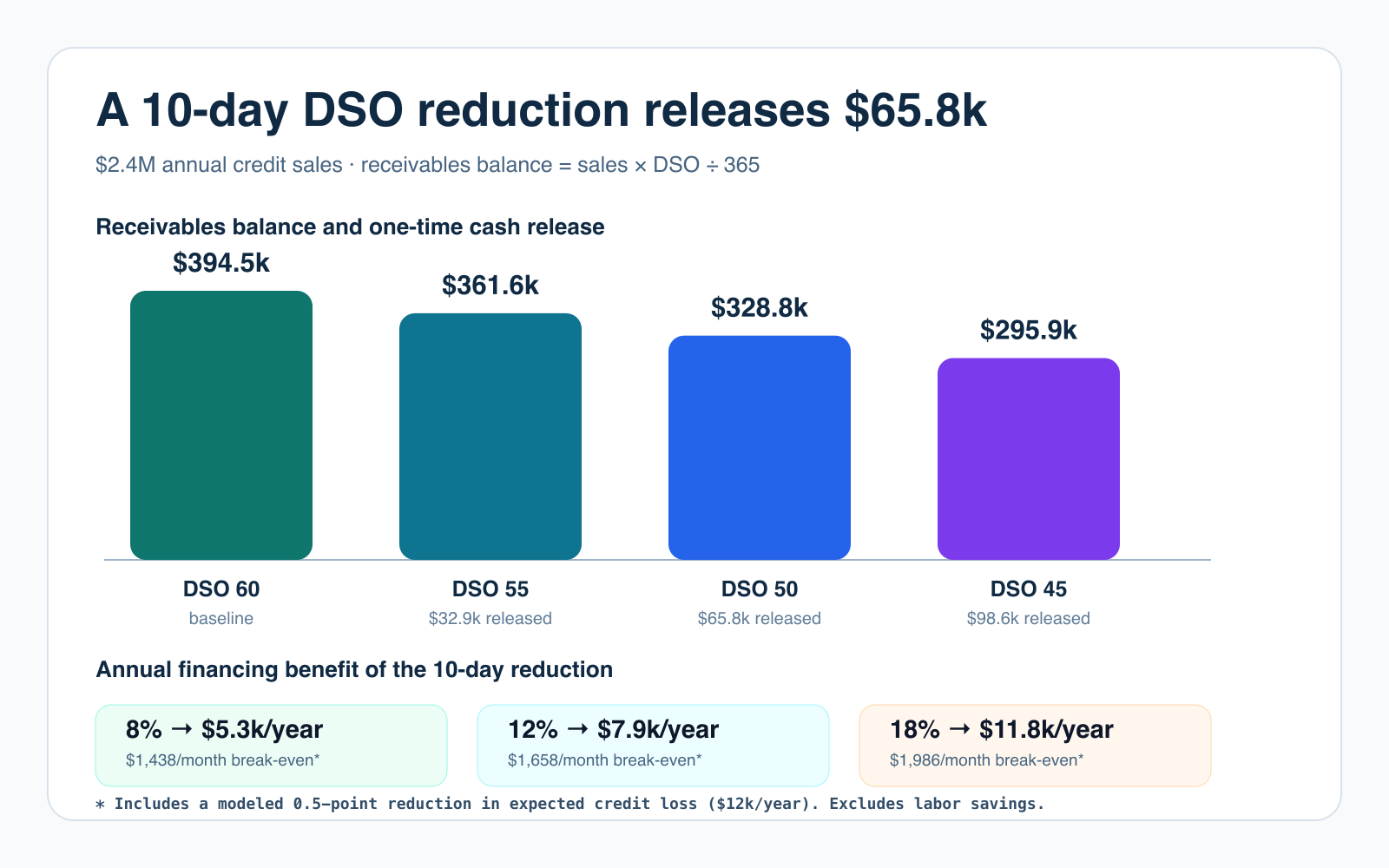
| Cost of capital | Annual financing benefit | Maximum monthly process cost* |
|---|---|---|
| 8% | $5,260 | $1,438 |
| 12% | $7,890 | $1,658 |
| 18% | $11,836 | $1,986 |
Decision threshold: approve or continue the new process only when verified annual financing savings, expected-loss reduction, and labor savings exceed annual cost, while DSO, CEI, dispute age, overdue aging, and promise-kept rate move in the right direction. Do not count the $65,753 cash release as annual profit.
Frequently Asked Questions
These answers separate invoice control, DSO measurement, automation, and customer treatment so each can be applied on its own.
What is the best first step for managing outstanding payments?
Fix invoice acceptance before chasing payment. Confirm the legal entity, purchase-order requirement, billing contact, delivery evidence, due date, tax details, and payment instructions before you send the invoice. A reminder cannot repair an invoice the customer cannot approve.
How do you calculate Days Sales Outstanding?
For a simple period estimate, divide ending accounts receivable by credit sales for the period and multiply by the number of days in that period. Use the same sales basis and time window each month, and compare DSO with the contractual term and overdue aging.
Is lowering DSO the same as increasing profit?
No. A lower DSO can release cash tied up in receivables, but that one-time cash release is not revenue or recurring profit. Recurring economic benefit can come from lower financing cost, fewer credit losses, and less collection labor.
When should collection software be automated?
Automate only after the invoice, reminder, dispute, promise-to-pay, and escalation states are defined. The system should show a clear owner and next action for every overdue invoice. Use a break-even model based on verified DSO, loss, and labor improvements.
Should every late account receive the same reminder sequence?
No. Segment by invoice value, age, dispute status, customer risk, and payment history. A disputed invoice needs resolution, a broken promise needs escalation, and a normally reliable customer may need a direct conversation rather than a generic email.
Conclusion
Start with the oldest material invoices, but do not begin by sending reminders. Classify each one as an error, missing approval, dispute, broken promise, inability to pay, or non-response. Give it one owner and one dated action.
Then fix the upstream cause and measure the result. If a proposed tool cannot show how it will reduce DSO, disputes, expected loss, or collection labor enough to clear your break-even threshold, it is not an investment case yet. It is a software demo.
Tell Google you want more of this.
Add Gaurav Tiwari as a preferred sourceOne tap, and this site shows up more often in your own Top Stories, AI Overviews and AI Mode. Remove it any time.