by
by
A productive London business trip starts with three decisions: whether you can enter for the activity you plan, where each meeting sits on the transport map, and what result would make the trip pay back. Book the flight only after those decisions. Otherwise, a cheap itinerary can become an expensive week of cross-city travel and vague conversations.
Use this guide as an operating plan, not a list of tourist tips. It covers entry rules, luggage, weather, transit, workspace, connectivity, hotels, business etiquette, and a worked cost model. The goal is simple: protect meeting quality and know the economic threshold before you travel.
Current planning facts:
- UK ETA: the application fee is £20. GOV.UK says decisions usually arrive within a day, but travellers should allow three working days. Apply through the official UK ETA application service, not an unofficial fee-charging site.
- Business scope: an ETA can cover eligible visits of up to six months for activities such as meetings, conferences, interviews, and negotiating or signing deals. It does not permit ordinary paid or unpaid UK work. Read GOV.UK’s permitted and prohibited ETA activities for the boundary and check whether your nationality needs a visa instead.
- Central London transit: TfL’s 2026 adult fares lists the adult pay-as-you-go daily cap at £8.90 for Zones 1-2, £10.50 for Zones 1-3, and £16.30 for Zones 1-6. Heathrow Express and Southeastern high-speed services are excluded from capping.
- Decision rule: cost the trip before calling it an investment. The worked example below separates cash spend from the value of lost productive time.
Table of Contents
Your London business trip checklist at a glance
Finish the legal, commercial, and logistical checks before you leave. A confirmed meeting is useful. A named decision-maker, agenda, next step, and realistic value are better.
| Decision | Action before travel | Evidence to keep |
|---|---|---|
| Entry | Check ETA or visa eligibility and permitted activity | Official approval linked to the passport used for travel |
| Meetings | Confirm attendee, authority, agenda, and desired decision | Calendar acceptance plus written objective |
| Transport | Map venues by zone and route; choose one payment device | Live route, cap scope, airport-transfer quote |
| Connectivity | Check venue Wi-Fi and underlying mobile network | Primary data plan plus independent fallback |
| Workspace | Verify access hours, calls policy, meeting room, and privacy | Booking confirmation and cancellation terms |
| Economics | Add cash spend and opportunity cost | Break-even threshold accepted before booking |
Should the trip happen? Run the break-even model
A London business trip is not justified by a full calendar. It needs enough expected commercial value to cover both cash spend and the work you give up while travelling.
- Direct trip cost = airfare + hotel + airport transfer + local transit + meals + workspace + ETA + connectivity.
- Opportunity cost = lost productive hours × contribution per hour.
- Economic trip cost = direct trip cost + opportunity cost.
- Break-even close-rate lift = economic trip cost ÷ (qualified meetings × gross profit per won deal).
The worked scenario is four days, three nights, and three qualified meetings. Only the £20 ETA fee and £8.90 Zone 1-2 daily cap are current sourced prices. Airfare, hotel, transfers, meals, workspace, connectivity, lost hours, and hourly contribution are illustrative. Replace them all.
| Input | Low | Base | High |
|---|---|---|---|
| Airfare | £450 | £650 | £1,000 |
| Hotel, 3 nights | £540 | £750 | £1,200 |
| Airport transfer | £25 | £50 | £120 |
| TfL, 3 capped days | £26.70 | £26.70 | £26.70 |
| Meals, 4 days | £180 | £280 | £440 |
| Workspace | £30 | £60 | £150 |
| ETA and connectivity | £30 | £35 | £45 |
| Direct cost | £1,281.70 | £1,851.70 | £2,981.70 |
| Lost time | 6h × £50 | 8h × £75 | 12h × £125 |
| Economic trip cost | £1,581.70 | £2,451.70 | £4,481.70 |
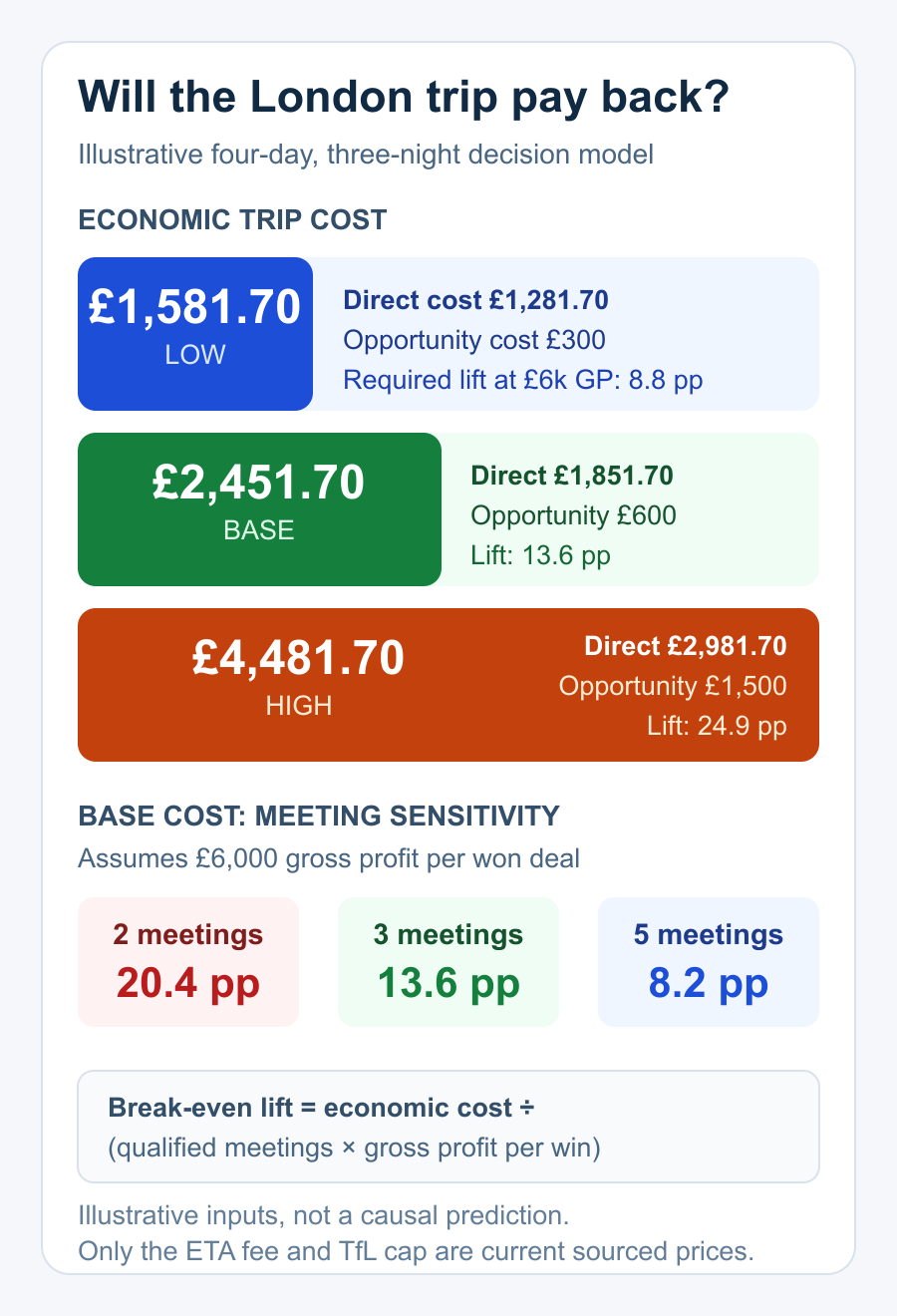
At £6,000 gross profit per won deal and three qualified meetings, the required close-rate lift is 8.8 percentage points in the low case, 13.6 points in the base case, and 24.9 points in the high case. At the £2,451.70 base cost, two meetings require 20.4 points, three require 13.6, and five require 8.2.
That output is a threshold, not a forecast and not proof that travel caused a deal. The model deliberately assigns zero value to softer benefits such as relationship depth or market learning. Add them only when you can state how they change a decision. If the required lift looks implausible, improve meeting quality, add qualified meetings, reduce the cost, or stay remote.
Drop off your luggage before you go to a meeting.
If your room is unavailable, storing luggage can protect both mobility and first impressions. Do not choose a service solely because it is near a famous station. Choose it because the route fits your arrival terminal and first meeting.
The existing directory for Victoria Station left luggage is one place to check. Verify the current provider, opening hours, exact address, bag limits, identification rules, insurance terms, cancellation policy, and collection deadline before paying. A listing is not a security guarantee.
- Route test: compare the storage detour with going directly to the hotel or venue.
- Risk test: keep passport, laptop, keys, medication, and confidential material with you.
- Failure plan: save the receipt and provider contact details offline; leave collection time before closing.
Prepare yourself for unpredictable weather.
Weather planning is less about predicting London perfectly and more about removing avoidable failure. Check the official forecast the evening before and again before leaving. Pack a compact umbrella, water-resistant outer layer, and shoes that can handle the walking between station and venue.
Use layers so a warm train, cool meeting room, or outdoor walk does not force a complete outfit change. Keep documents and electronics in a water-resistant compartment. If a formal meeting matters, carry the jacket rather than wearing it through a crowded journey.
Get to know the underground network.
The Underground is often efficient, but the fastest route depends on the origin, destination, service status, walking time, and accessibility needs. A direct rail service, bus, taxi, or walk can beat a Tube route with several changes. Check the live journey, not a blanket rule.
Use a contactless card or your phone and keep using the same physical card or device. A phone and the plastic card linked to it can be treated as different payment methods for capping. TfL Go provides live arrivals, disruption information, step-free planning, and station facilities.
- Cap scope: confirm the zones and whether an airport or special service sits outside the cap.
- Payment cost: check foreign transaction fees before assuming contactless is cheapest.
- Accessibility: use the step-free route and station-facilities filters when relevant.
- Expense evidence: register the payment method with TfL if your process needs journey history.
Make sure that you have time for networking.
Networking earns its place only when it serves the trip objective. Do not fill every evening with unqualified events. Pick the few rooms where the right customers, partners, operators, or peers are likely to be present, then define what a useful conversation looks like.
- Before: identify five people or companies and write one relevant question for each.
- During: record the problem, promised action, owner, and date. A stack of names is not a pipeline.
- After: send the promised material within one working day and propose a specific next step.
The follow-through matters more than the room. Use the same workplace collaboration habits you expect from a remote team: clear ownership, written context, and one decision per follow-up.
Use coworking spaces.
A coworking space can be useful between meetings, but a desk and Wi-Fi do not automatically make it suitable for client work. Confirm the calls policy, noise level, guest access, meeting-room availability, privacy, opening hours, and cancellation terms.
The list of coworking spaces London offers is a starting directory, not a current guarantee of prices or access. Check the operator directly before relying on a day pass. If you must discuss confidential information, book a private room or move the call to a controlled environment.

Book restaurants and meeting rooms in advance.
Book against participant needs, not prestige. Confirm the number of attendees, dietary and accessibility requirements, acceptable noise, presentation equipment, cancellation terms, and who pays. For a decision meeting, a private room may be worth more than a fashionable postcode.
Send the agenda and location with enough notice for participants to challenge either. Reconfirm on the previous working day. Keep a nearby fallback venue and a video link ready. A reservation protects the meeting only if every participant can get there and do the required work.
Make sure to manage your time.
Build the day around geography and meeting value. Cluster venues by area, place the hardest-to-move meeting first, and use live journey information before every departure. Add walking, security, platform changes, accessibility, and the business cost of being late. There is no honest one-size-fits-all buffer.
Protect an admin block after important meetings so notes and promises leave your head before the next conversation. The time-management discipline solopreneurs use applies here: prioritize the decision, leave slack, and do not confuse a packed schedule with productive work.
Keep a backup plan for connectivity.
A venue network, hotel Wi-Fi, eSIM, and home-country roaming plan can fail in different ways. Use two independent routes when a client call matters, and test both before the meeting.
- Coverage: use the Ofcom mobile coverage checker by postcode to compare predicted network coverage. Ofcom says the results are estimates and local performance can differ.
- Independence: check the underlying mobile network. Two eSIM brands using the same network are not two independent fallbacks.
- Call test: test audio, camera, screen share, power, headphones, and the backup route before the appointment.
- Offline kit: retain the agenda, address, tickets, approval, and essential contacts offline.
If you rely on Wi-Fi for video conferences and client calls, buy a data allowance for the actual workload. An Airalo UK eSIM is one option to compare, but its price, allowance, routing, underlying network, hotspot policy, and refund terms can change. Verify the current plan instead of relying on an old price.
On a shared network, a service such as NordVPN can encrypt traffic between your device and its VPN server. It does not make a compromised device safe, prevent phishing, or remove the need for HTTPS and account security. Read why a VPN matters on the road before deciding which trust and routing tradeoff you accept.
Stay in business-friendly hotels.
Choose the hotel by total journey cost, not room price alone. Map every confirmed venue, calculate the first and last journeys of the day, and price airport access. A cheaper room that adds two hours of travel and several transfers can be the expensive choice.
- Work: verify desk, chair, lighting, power, quiet hours, guest policy, and meeting space.
- Connectivity: ask for measured Wi-Fi details only as a starting point; retain mobile data as a fallback.
- Operations: check early bag storage, late arrival, invoices, cancellation, accessibility, and security.
- Location: compare door-to-door routes during the hours you will travel, including disruption alternatives.
The Andaz London Liverpool Street listing can help you compare recent traveller reports for one central option. Treat reviews as subjective and time-sensitive. Verify current facilities, rates, and terms with the hotel before booking.
Learn etiquette.
There is no single London business personality. International teams, regulated firms, startups, public bodies, and owner-led companies can work very differently. The reliable route is to prepare well, arrive when promised, listen carefully, and ask instead of stereotyping.
- Names: confirm pronunciation, title, and preferred form of address.
- Meeting: state the purpose, agenda, decision needed, and finish time.
- Conversation: avoid assuming that humour, small talk, dress, or formality has one universal rule.
- Follow-up: record decisions, owners, dates, risks, and the next meeting in plain language.
A good business trip leaves evidence: the right conversations, clear decisions, owned next steps, and an economic result you can compare with the threshold set before travel. If the meeting quality cannot justify the time and cost, improve the plan before you board the flight.
London business trip FAQ
Do I need a UK ETA for a London business trip?
Many visa-exempt visitors now need an ETA before travelling, but nationality and immigration status matter. Check GOV.UK before booking. An ETA can cover permitted activities such as meetings, conferences, interviews, and negotiating or signing deals. It is not permission to take ordinary paid or unpaid work in the UK.
How much should I budget for transport in central London?
For 2026, the adult pay-as-you-go daily cap is £8.90 for Zones 1-2 and £10.50 for Zones 1-3. Use the same contactless card or device for every journey so capping can work. Airport express services and some special routes sit outside those caps.
Is contactless payment better than an Oyster card for a visitor?
Contactless is usually simpler when your card or phone is accepted and does not add expensive foreign transaction fees. Oyster may still make sense if contactless is unavailable, a traveller needs an eligible discount, or company expense policy requires a different setup. Compare your own payment costs.
How much buffer time should I leave between London meetings?
There is no honest city-wide number. Check the live route before each departure, then add time for walking, security, platform changes, accessibility needs, and the cost of arriving late. Cluster meetings by area when possible.
How do I decide whether an in-person London trip is worth it?
Add direct trip cost and lost productive time, then divide that economic cost by qualified meetings times gross profit per won deal. The result is the close-rate lift the trip must create to break even. Replace every example input in this article with your own quotes, margin, and realistic meeting count.
Tell Google you want more of this.
Add Gaurav Tiwari as a preferred sourceOne tap, and this site shows up more often in your own Top Stories, AI Overviews and AI Mode. Remove it any time.
Disclaimer: This site is reader-supported. If you buy through some links, I may earn a small commission at no extra cost to you. I only recommend tools I trust and would use myself. Your support helps keep gauravtiwari.org free and focused on real-world advice. Thanks. - Gaurav Tiwari