
 by
by
Video conferencing for business pays off when it removes travel, shortens a decision, or protects a relationship. It wastes money when a live call replaces a status note, gathers people who cannot decide anything, or ends without an owner and deadline.
The platform is rarely the hard part. The hard part is choosing which conversations deserve synchronous attention and proving that the change saves cost or creates enough gross profit to justify the subscription, training, and interruption.
Quick verdict: Use Zoom as a general-purpose default, Google Meet when your company already runs on Google Workspace, Microsoft Teams when Microsoft 365 is the operating layer, and Loom for updates that do not need everyone present. Pick one live-meeting standard and one async path. More tools usually create more confusion, not better communication.
In 2026, AI notes are useful but not a reason to stop managing meetings. Access varies by plan, administrators control many features, and generated summaries can miss context. Treat an AI recap as a draft. A human still owns the decision, action, and due date.
Best Video Conferencing Tools in 2026

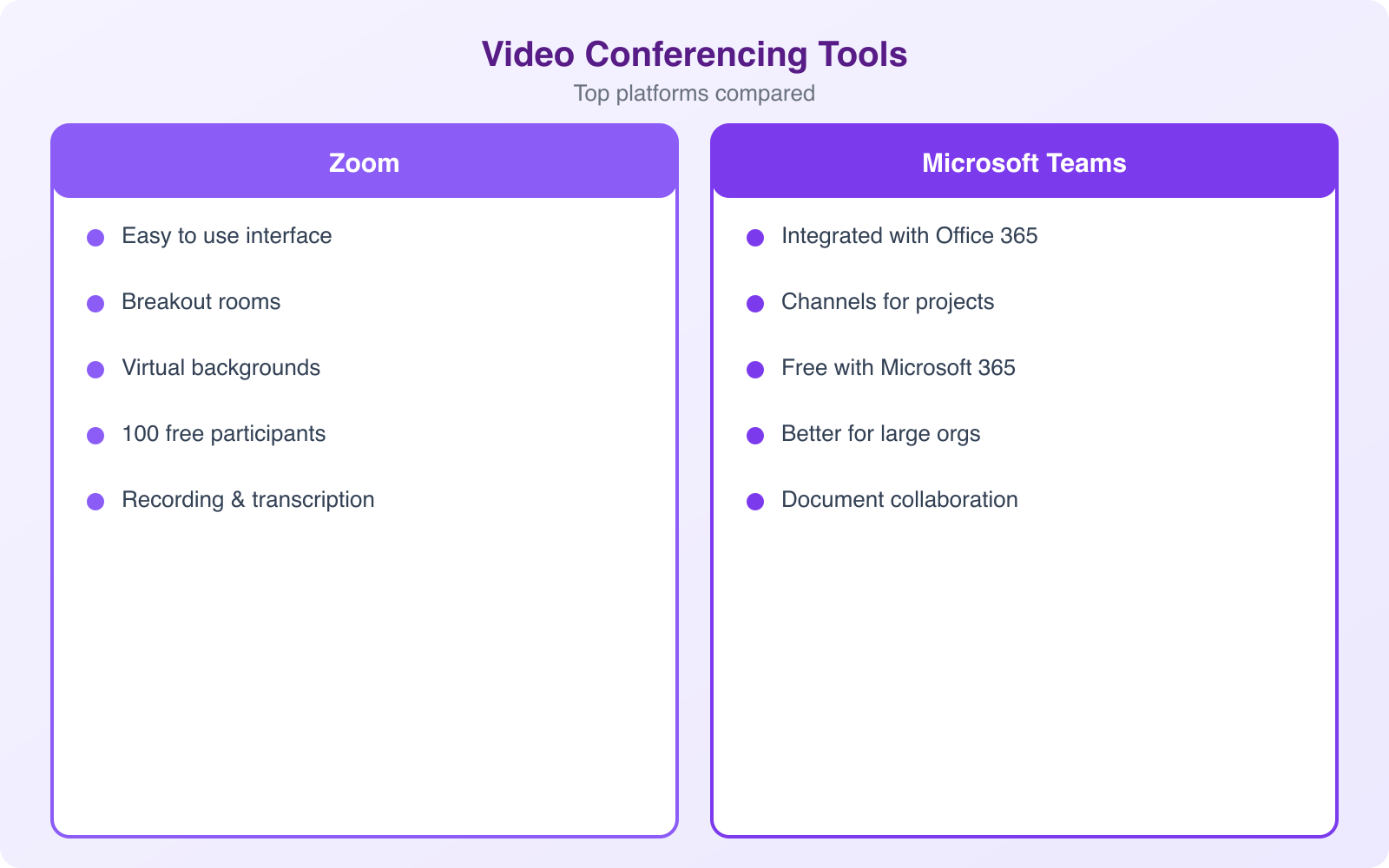
Choose the suite that removes friction for the people who join. A client should not need an account or a 10-minute setup ritual. An internal team should not copy files between two ecosystems because its meeting tool lives somewhere else.
| Tool | Free limit | Practical paid entry | AI position | Best fit |
|---|---|---|---|---|
| Zoom | 40-minute group meetings | $15.99/user monthly for Pro | AI Companion on eligible paid services | Mixed external audiences and general meetings |
| Google Meet | 60 minutes, 100 participants | $7/user monthly on annual Starter pricing after promotion | Meet AI access depends on Workspace edition | Teams already using Gmail, Calendar, and Drive |
| Microsoft Teams | 60 minutes, 100 participants | $4/user monthly for Teams Essentials, paid yearly | Copilot features are license-dependent | Microsoft 365 collaboration and administration |
| Loom | 25 videos/person, 5 minutes each | $18/user monthly for Business | AI workflows start in the $24 Business + AI tier | Async walkthroughs, updates, and handoffs |
For video conferencing for business, do not compare a 10,000-person event tier with a 100-person team meeting. Compare your real requirement: external joining, meeting length, recording, retention, accessibility, administration, data controls, and the applications your team already pays for.
1. Team Meetings That Need Alignment
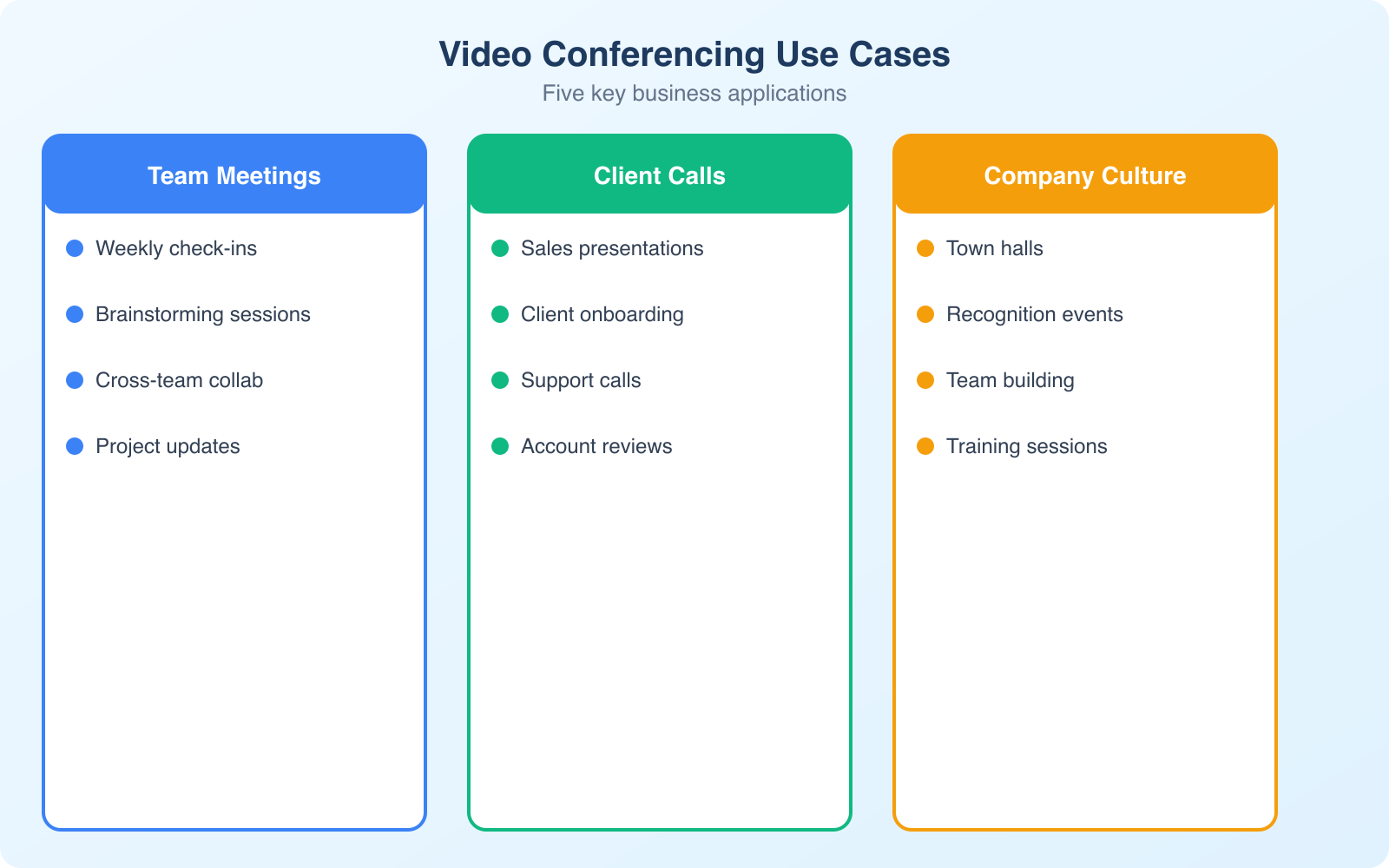
Video is strongest when a team must leave with the same picture of the problem. That can mean a project kickoff, a difficult tradeoff, a morale reset, or a decision that would otherwise generate 30 messages and three conflicting interpretations.
This matters more with remote workers, but camera presence is not the objective. Alignment is. Put the decision at the top of the agenda, share the evidence before the call, and end by reading back who owns what.
- Invite: the decision owner, people with necessary evidence, and people who must execute.
- Timebox: 20 minutes for one decision; add time only when the agenda earns it.
- Output: decision, owner, deadline, and the next check point in writing.
2. Daily Check-Ins That Earn Synchronous Time
A daily stand-up deserves video only when people need immediate coordination. If each person simply reports yesterday, today, and blockers while everyone else waits, collect the update asynchronously and schedule a smaller problem-solving call.
That is the practical shift in the future of workplace collaboration: sync time is for resolving dependencies, not proving that people are online. Track whether the stand-up clears blockers. If it only broadcasts status for two weeks, change the format.
Send a two-minute update with outcome, next action, and blocker. Open a live call only when a blocker needs two or more people to reason together. This keeps urgency from turning every update into a meeting.
3. Emergency Meetings and Crisis Response
A crisis call is justified because latency has a cost. A server outage, payment failure, shipment delay, or serious client complaint needs one operating picture and rapid assignments. Video and screen sharing can make that state visible quickly.
Name an incident lead, a note owner, and the next update time. Keep diagnosis separate from blame. If the incident is technical, combine the call with monitoring and managed IT services rather than asking a room full of people to guess.
- First five minutes: scope, customer impact, known facts, and immediate containment.
- During response: one owner per action and one source of truth outside the call.
- After recovery: a separate review for causes, controls, and follow-up work.
4. Recognition and Difficult Human Conversations
Text is efficient, but it strips out tone. Use video when tone is part of the work: specific recognition, coaching, a performance conversation, a sensitive change, or a conflict that is getting worse in chat.
Keep recognition concrete. Name the action and its effect instead of delivering generic praise. Keep optional social calls optional. A lightweight coffee chat can support the same human need that makes coworking in the gig economy valuable, but mandatory fun is still mandatory work.
5. Client Presentations and Sales Calls
Video lets a business qualify, demonstrate, and answer objections without paying for every trip. The defensible claim is cost and speed, not that turning on a camera automatically doubles close rates. That kind of universal promise ignores deal size, source, sales skill, category, and selection effects.
For a client meeting, confirm the decision to be made, test the link, share only the intended window, and ask before recording or transcribing. A 2025 Nature paper reported five experiments and three supplementary studies in which minor audiovisual glitches harmed interpersonal judgments in consequential settings including hiring and telehealth. That makes connection quality part of the presentation, not a cosmetic detail.
The Cost Case: A Worked Video-Conferencing Model
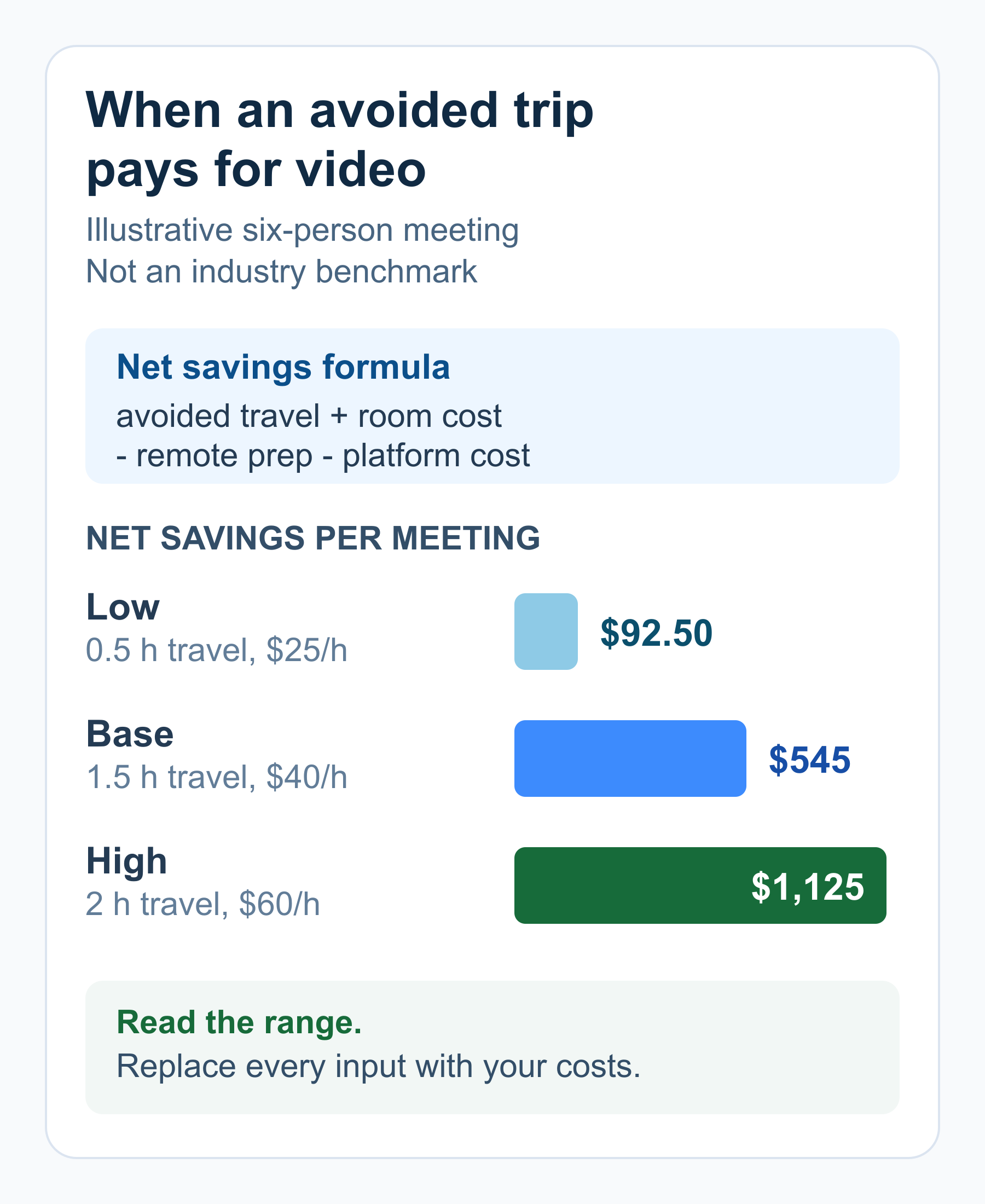
The following 2026 model asks whether replacing one in-person meeting saves enough to matter. It is an illustrative calculator, not a market average. Replace every input with your own payroll, travel, room, preparation, and software numbers.
Net savings per meeting = participants x [(round-trip travel hours x loaded hourly cost) + cash travel] + room cost – [(participants x remote preparation hours x loaded hourly cost) + platform allocation]. Count only time the business can actually recover or redeploy.
| Case | Travel/person | Loaded labor | Cash travel/person | Room | Remote overhead | Net savings |
|---|---|---|---|---|---|---|
| Low | 0.5 h | $25/h | $10 | $0 | 0.25 h/person + $5 | $92.50 |
| Base | 1.5 h | $40/h | $25 | $100 | 0.25 h/person + $5 | $545 |
| High | 2 h | $60/h | $50 | $200 | 0.25 h/person + $5 | $1,125 |
Revenue needs a separate break-even test
Do not add cost savings and sales claims into one flattering ROI number. If a new video workflow costs $300 per month and you run 20 client calls, the required conversion lift depends on gross profit per additional win:
| Gross profit per added win | Added wins needed/month | Required lift across 20 calls |
|---|---|---|
| $500 | 0.60 | 3.00 percentage points |
| $1,200 | 0.25 | 1.25 percentage points |
| $3,000 | 0.10 | 0.50 percentage points |
Run the pilot by lead source and offer. Compare show rate, close rate, gross profit, sales-cycle length, and staff time against the current process. Stop or revise the workflow if it does not clear the threshold after a sample large enough for your deal volume.
Video Conferencing Best Practices
Research supports a narrower lesson than the internet’s usual camera-on commandments. Stanford researchers created a 15-item Zoom Exhaustion and Fatigue Scale across five dimensions. Scale development included 395 respondents and validation included 204; meeting frequency, duration, and burstiness were associated with higher fatigue. Association is not the same as proof that one policy fixes it.
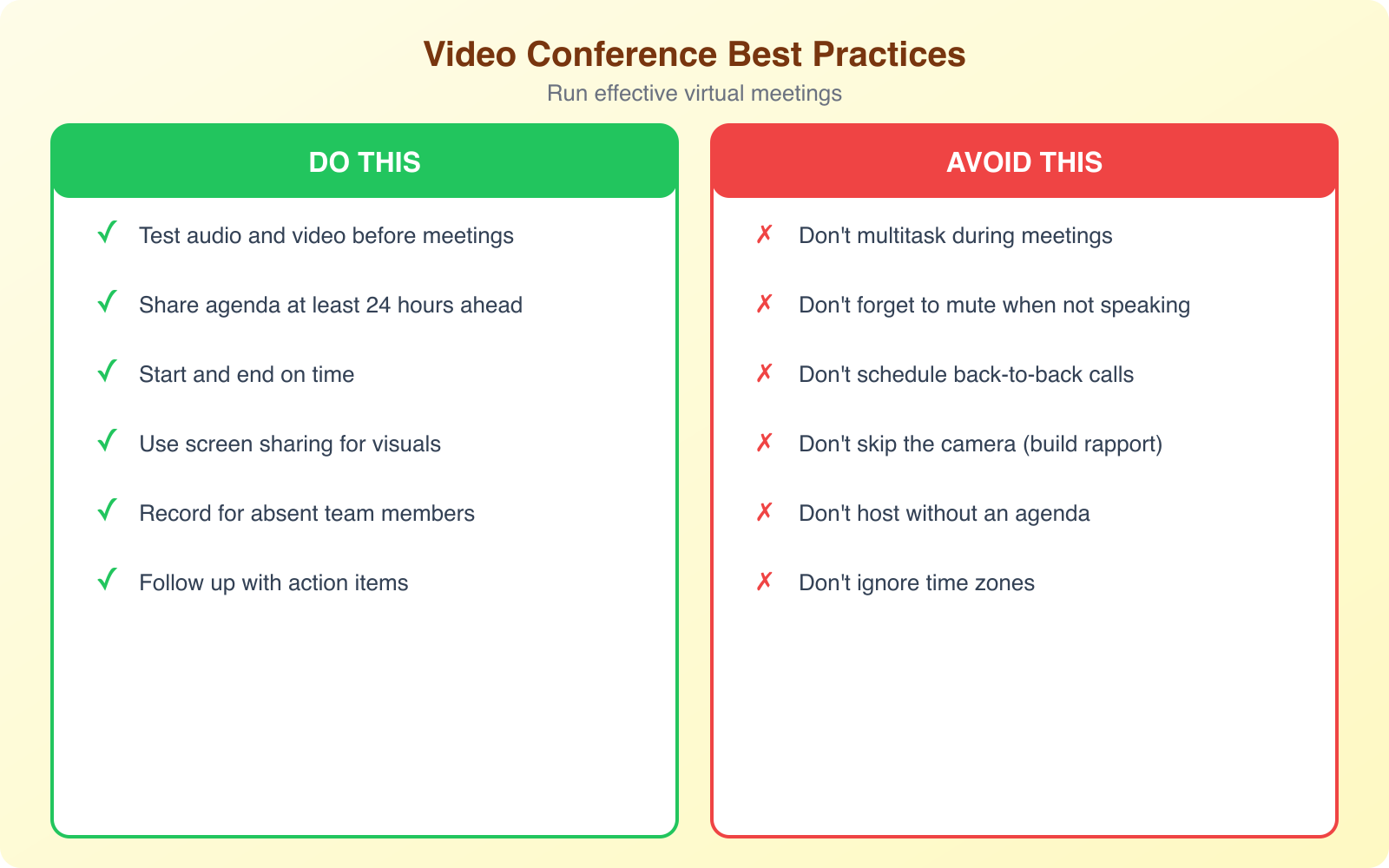
- Put the decision first: a meeting without a decision, working session, or relationship need should default to async.
- Shorten the guest list: invite contributors and decision-makers; send the result to everyone else.
- Build buffers: avoid back-to-back bursts and protect blocks for focused work.
- Make cameras situational: client trust, coaching, and sensitive conversations differ from status updates.
- Fix audio first: a $30-$50 USB microphone or quality headset often improves intelligibility more than a camera upgrade.
- Test the connection: if calls repeatedly drop, evaluate fiber optic internet for your business or a wired path before blaming meeting etiquette.
Security belongs in the meeting design. The UK National Cyber Security Centre’s guidance for securing online meetings recommends approved services, controlled access, current software, careful handling of recordings, and stronger decisions for sensitive data. Use waiting rooms or verified admission, restrict screen sharing, review recording retention, and do not publish private meeting links.
AI Features Changing Video Meetings in 2026
AI meeting features reduce clerical work, but the useful question is who checks the output and where it is stored. Zoom includes AI Companion with eligible paid services; Google and Microsoft gate many recap features by edition or license; Loom separates its main AI workflow tier from standard Business.
- Transcripts: useful for search and recall, but they create a sensitive record that needs permission, access control, and retention rules.
- Summaries: good for a first pass, but verify decisions, numbers, names, and commitments against the call.
- Action extraction: accept an action only after a person owns it and a due date exists.
- Translation and captions: helpful for access and multilingual teams, but important wording still needs human confirmation.
- Noise control: Krisp can help in a noisy environment, but it cannot repair a weak microphone, unstable network, or poor meeting design.
Frequently Asked Questions
What is the best free video conferencing tool for a small business?
Choose by the suite your team already uses. Zoom Basic allows 40-minute group meetings. Google Meet and Teams Free allow 60-minute group meetings with up to 100 participants. Limits and AI features change by edition, so check the current official plan page before standardizing a team.
When should a business use video instead of email?
Use live video when the work needs rapid back-and-forth, emotional context, a shared visual, or a decision from several people. Use email, a document, or async video for one-way updates, reference material, and work that benefits from reflection across time zones.
How can I calculate the return on a video conferencing tool?
Separate cost avoidance from revenue. For cost avoidance, count travel time at a defensible loaded labor cost, cash travel, room cost, remote preparation, and platform cost. For revenue, divide monthly implementation cost by gross profit per additional win, then compare the required lift with an instrumented pilot.
How do I reduce video-conference fatigue?
Reduce unnecessary meeting frequency, duration, and back-to-back bursts. Use an agenda, invite only decision participants, make camera use situational, and protect meeting-free work blocks. Measure whether meetings end with decisions rather than assuming one universal camera or duration policy works for every team.
Is AI meeting transcription safe for confidential calls?
Do not assume it is safe merely because it is built into the platform. Check the plan, administrator controls, consent rules, retention, sharing permissions, data location, and contract. For sensitive matters, decide whether recording or automated notes should be disabled before the meeting begins.
Make Video Conferencing Earn Its Place
Video conferencing for business is not a culture strategy by itself. It is one communication mode. Use it for live decisions, fast incident response, delicate human context, and client work where a shared screen or immediate answer changes the outcome.
In 2026, start with one platform, one async route, one security standard, and one monthly scorecard. Track avoided travel, meeting hours, decisions completed, follow-up ownership, sales gross profit, and recurring software cost. If the meeting cannot point to a result, it has not earned another slot on the calendar.
Tell Google you want more of this.
Add Gaurav Tiwari as a preferred sourceOne tap, and this site shows up more often in your own Top Stories, AI Overviews and AI Mode. Remove it any time.
Disclaimer: This site is reader-supported. If you buy through some links, I may earn a small commission at no extra cost to you. I only recommend tools I trust and would use myself. Your support helps keep gauravtiwari.org free and focused on real-world advice. Thanks. - Gaurav Tiwari