
Why Every Business Needs a Security Researcher Today
Cyberattacks aren't just a big tech problem anymore. Every business that uses the internet, stores customer data, or runs software is a target. A dedicated security researcher identifies vulnerabilities before attackers exploit them. Here's why every business, regardless of size or industry, needs a security researcher as part of their defense strategy today.
 by
by
Cyberattacks aren’t just a “big tech problem” anymore. Every business that uses the internet, stores customer information, runs software, or relies on digital systems is now a target. From retail and healthcare to education and small local shops, the number of attacks has grown so sharply that cybersecurity is no longer “optional” or “for later.”
Many companies still assume that having an IT team, using antivirus software, or installing a firewall is enough. But modern cyber threats are far more advanced, and hackers are constantly finding new ways in.
Businesses need specialists who can think like attackers and spot weaknesses before criminals exploit them. That is where security researchers come in.
In this article →
What Is a Security Researcher?

A security researcher is a trained cybersecurity professional who identifies vulnerabilities in systems, applications, networks, software, cloud environments, and digital products. Their job is to find security flaws before attackers do.
They study how attacks happen, analyze real-world cyber incidents, and test systems using advanced techniques. Their work often includes:
- Discovering unknown vulnerabilities (also called zero-days)
- Reverse engineering malware and attack methods
- Conducting ethical hacking and penetration testing
- Analyzing breach patterns and cybercrime tactics
- Researching new security tools and defense methods
- Reporting flaws responsibly so they can be fixed
A common misconception is that a security researcher is the same as an IT security professional or a pentester. They overlap, but they are not identical.
- IT Security Staff focus on implementing tools, managing systems, and reacting to threats.
- Pentesters simulate controlled attacks to test security at a point in time.
- Security Researchers go deeper. They uncover unknown weaknesses, analyze emerging threats, and help prevent future attacks.
Think of them as the “R&D wing of cybersecurity” for your business.
Why Security Research Matters for Businesses
Cybercrime has evolved into a global industry worth billions. Hackers are more organized, more skilled, and have access to automated tools and AI-driven attack kits that make hacking faster than ever. Businesses today face threats that didn’t even exist a few years ago.
Some of the most damaging cyber incidents of the last decade could have been prevented if companies had actively looked for vulnerabilities before attackers did:
- Equifax (2017): A missed software patch led to a breach exposing data of 147 million people.
- Target (2013): Attackers stole 40 million credit card records through a third-party vendor loophole.
- Zoom (2020): Security researchers exposed major flaws early, helping Zoom fix them before mass exploitation.
- MGM Resorts (2023): A social engineering-led breach shut down casino systems and cost the company over $100 million.
These weren’t small businesses, yet the weaknesses were surprisingly basic. Now imagine the impact when a small or mid-sized business with fewer resources gets hit.
Cyberattacks Don’t Discriminate by Size
There is a dangerous belief that cybercriminals only care about large corporations. In reality, small and medium businesses are easier targets because:
- Their defenses are weaker
- They delay security spending
- They have valuable customer, financial, and operational data
- They assume “we’re too small to attract hackers”
A security researcher helps businesses of every size stay a step ahead of threats.
Digital Dependence Has Increased Risk
Almost every business process is now digital:
- Customer onboarding
- Sales and invoicing
- HR and payroll
- Cloud storage
- Marketing and customer data
- Online payments
- Remote work tools
The more you rely on digital systems, the more exposed you are. One overlooked vulnerability in any of these areas can halt operations.
Attack Techniques Evolve Fast
Hackers are constantly refining their methods. Today’s threats include:
- AI-generated phishing
- Ransomware-as-a-service
- Cloud configuration exploits
- Supply chain attacks
- Mobile and IoT breaches
- API and SaaS security gaps
Security researchers stay updated on these trends and help businesses adapt defense strategies proactively.
Key Benefits of Having a Security Researcher
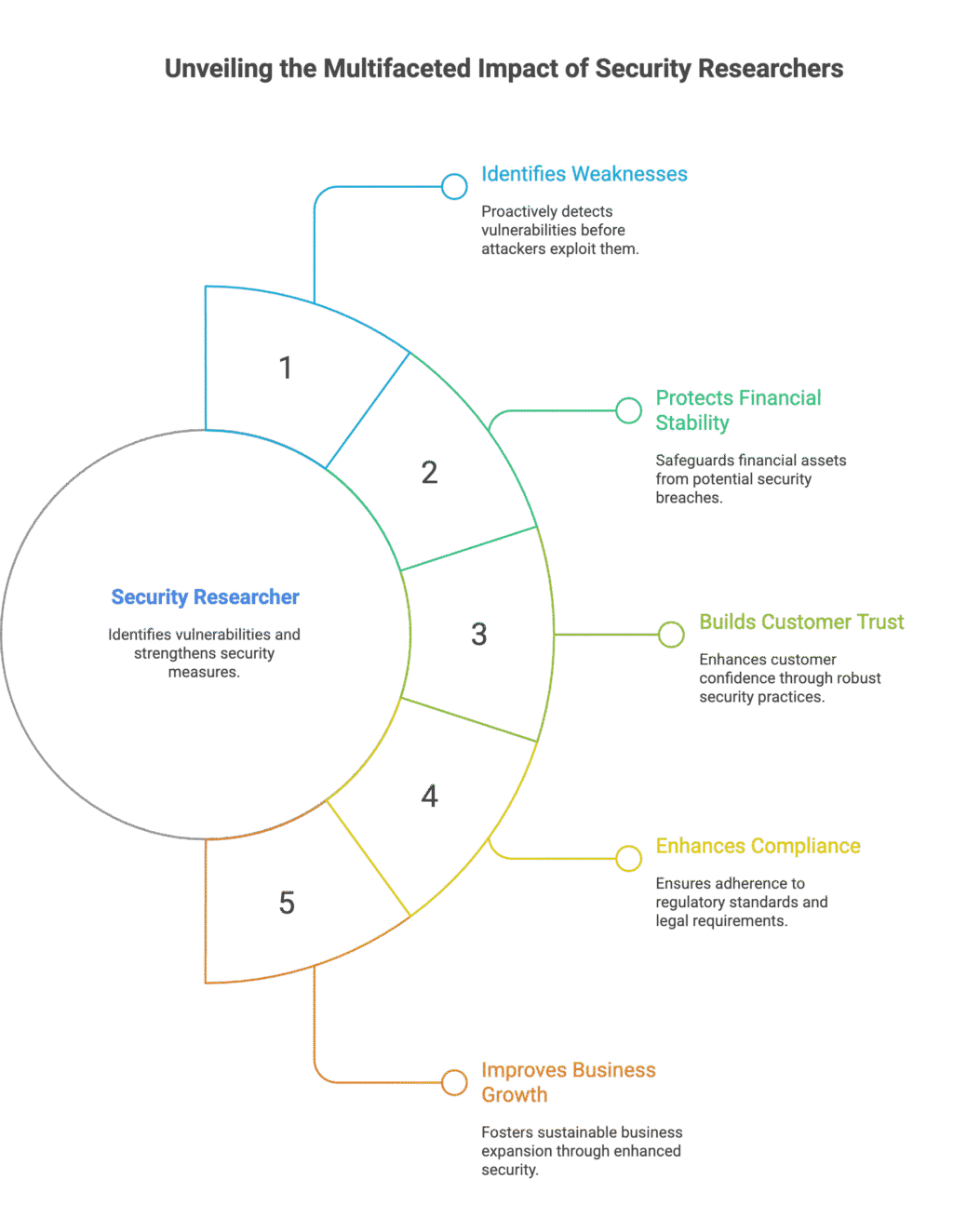
A security researcher doesn’t just protect your business. They strengthen it in ways many leaders don’t realize until after a breach.
Identifies Weaknesses Before Attackers Do
Instead of waiting for hackers to expose flaws, security researchers hunt them early and report them responsibly. The difference between reactive and proactive security is often the difference between a small patch and a major financial loss.
Protects Your Financial Stability
Cyberattacks are expensive. Even a small breach can cost thousands in damage, downtime, and recovery. For larger businesses, the impact can run into millions.
A security researcher helps avoid:
- Ransomware payouts
- Legal penalties
- Customer compensation
- System restoration costs
- Operational disruptions
Preventing one incident often pays for years of security investment.
Builds Customer Trust and Brand Reputation
People won’t trust businesses that can’t protect their data. A single breach can destroy brand credibility.
When companies invest in security, they send a clear message:
“Your data and trust matter to us.”
This has become a competitive advantage, especially for online-first brands.
Enhances Compliance and Reduces Legal Risk
Data protection laws around the world are stricter than ever. Whether a company operates locally or globally, regulations like GDPR, CCPA, HIPAA, PCI-DSS, and others apply.
Security researchers help businesses:
- Meet compliance standards
- Avoid legal action and fines
- Stay audit-ready
Improves Long-Term Business Growth
Strong security creates stability. Stakeholders, investors, and enterprise buyers increasingly evaluate cybersecurity maturity before doing business.
For B2B brands, especially SaaS, agencies, and tech companies, having a security researcher can directly influence:
- Deals and partnerships
- Investor confidence
- Valuation
- Product adoption
Common Misconceptions About Cybersecurity and Security Researchers

Even as cyber risks rise, many business owners underestimate the need for dedicated security research. These misconceptions often delay action until a breach forces urgency.
“We Are Too Small to Be Targeted”
This is the most damaging myth.
Small and mid-sized businesses are now the top target category for cybercriminals because:
- Their defenses are easier to bypass
- They lack specialist security staff
- They often use outdated or poorly configured tools
Hackers don’t manually select victims. They run automated scans across the internet to find weaknesses. If your business has a website, uses email, accepts online payments, or stores data, you’re already in the threat zone.
“Our IT Team or Developer Can Handle Security”
IT teams are essential, but their mandates differ. They handle:
- System setup and maintenance
- Infrastructure and devices
- User access, hardware, and software support
Security researchers, on the other hand, focus on:
- Finding new vulnerabilities
- Analyzing attacker behavior
- Preventing unknown and emerging threats
Expecting IT staff to do advanced security research is like asking a general doctor to perform complex neurosurgery. Both work in health, but the expertise is different.
“We Already Have Antivirus and Firewalls”
These tools protect against known threats, not new or sophisticated ones.
Modern breaches often exploit:
- Zero-day vulnerabilities
- Social engineering
- Misconfigured cloud settings
- Weak API or SaaS integrations
Security research discovers risks before tools detect them. Without it, there is a blind spot in your defense.
“Security Slows Down Business”
Some companies fear that security testing disrupts operations or delays product development. The opposite is true.
A security researcher helps integrate safety into daily workflows. When security becomes part of the build process, businesses avoid costly late-stage fixes and protect innovation instead of slowing it.
In-House vs External Security Researchers
Not every business needs a full-time in-house researcher from day one. The right model depends on size, budget, and digital risk exposure. Here’s a clear breakdown to guide decision-making.
In-House Security Researcher
Best for: Medium to large companies, especially those running digital products, SaaS platforms, fintech, healthcare, or high-volume data operations.
Pros:
- Dedicated focus on your systems
- Better alignment with company culture and technology stack
- Continuous monitoring and faster response
- Supports compliance, audits, and long-term security strategy
Cons:
- Higher salary and resource cost
- Requires ongoing training to stay updated
External Security Researchers or Consultants
Best for: Small to mid-size businesses, startups, or companies needing periodic expert audits.
Pros:
- Cost-effective
- Access to a diverse range of expertise
- Flexible engagement (project-based, quarterly, annual)
- Useful for independent testing and unbiased reports
Cons:
- Less day-to-day involvement
- Knowledge transfer may take time
Crowdsourced Researchers (Bug Bounty Programs)
Platforms like HackerOne and Bugcrowd allow businesses to invite ethical hackers worldwide to test their security.
Pros:
- Wide range of talent and perspectives
- Pay only for valid findings
- Fast discovery of hidden vulnerabilities
Cons:
- Requires internal team to manage submissions
- Not suitable for companies with weak initial security maturity
Costs and ROI of Hiring a Security Researcher
Many businesses hesitate because they see cybersecurity as an expense. In reality, it is a financial shield.
The Cost of Security Research
Approximate global ranges:
- Full-Time In-House Researcher:
USD 85,000 to 180,000 per year depending on region and expertise - Freelance/Consultant Engagement:
USD 2,000 to 15,000 per month depending on scope - Annual Security Audit:
USD 5,000 to 50,000 - Bug Bounty Program Budget (Optional):
USD 10,000 to 200,000 annually
These costs may vary, but even at the higher end, they remain significantly lower than breach expenses.
The Cost of a Data Breach
A single cyberattack can financially devastate a business. The consequences include:
- System downtime
- Lost sales and revenue
- Ransom payments
- Legal penalties
- Recovery and investigation costs
- Customer loss and brand damage
The average global cost of a data breach has been reported in the range of USD 4 million. Even smaller incidents can cost between USD 20,000 and USD 350,000 for SMEs.
ROI: Why Security Beats Recovery
Security investment is preventative. One prevented attack or one discovered vulnerability can justify years of security spending.
A useful comparison:
| Scenario | Security Research Spend | Breach Aftermath Cost |
|---|---|---|
| Preventive Annual Budget | $40,000 to $250,000 | $0 Loss |
| One Significant Breach | $0 Before Incident | $200,000 to $4M+ Loss |
The ROI is clear:
Proactive security is far cheaper and more beneficial than post-breach response.
Case Studies: When Security Research Made the Difference
Looking at well-known examples helps illustrate the impact.
Zoom Tightened Security After Research Community Feedback
During its rapid user growth in 2020, researchers discovered vulnerabilities in Zoom’s platform.
Instead of reacting defensively, Zoom embraced security research, fixed the issues quickly, and publicly credited those who reported them.
This proactive approach helped restore trust and retain users.
Google’s Project Zero and the Industry Ripple Effect
Google created one of the most influential security research teams, Project Zero, with a simple mission: find zero-day flaws before attackers do. Their discoveries have helped not only Google but the entire tech ecosystem, forcing companies like Microsoft, Apple, and Adobe to patch vulnerabilities faster.
Target’s Data Breach and the Aftermath
Target’s incident was a turning point for many US-based retailers. After attackers breached through a vendor’s network access, Target was forced to adopt more advanced security, including dedicated research and red-team programs. Had that awareness existed earlier, millions of records and millions of dollars could have been protected.
MGM Resorts and the Rising Social Engineering Threat
The MGM case highlighted how modern attacks don’t always rely on technical exploits. Social engineering fooled support staff, leading to system-wide shutdowns. Today’s security researchers include human behavior testing to identify and patch these weaknesses as well.
Emerging Trends in Security Research
Security research continues to evolve with technology. Here are the trends shaping the future:
AI-Powered Attacks and Defense
Artificial Intelligence now helps attackers generate phishing campaigns, exploit code, automate attacks, and test systems faster.
Security researchers are also using AI to:
- Detect anomalies in networks
- Predict attack patterns
- Automate vulnerability scanning
Ransomware-as-a-Service (RaaS)
Cybercrime has become commercialized. Attackers sell “ready-made ransomware kits,” making it easier for anyone to launch attacks.
Security researchers monitor these underground trends and help build preventive strategies.
Supply Chain and Third-Party Risks
Many breaches now occur through vendors, partners, or integrations.
Security research focuses not only on internal systems but also on external dependencies.
Cloud-Native Security
As businesses shift to the cloud, misconfigurations have become a major vulnerability.
Researchers now specialize in cloud, container, and API security to prevent data leaks.
Ethical Hacking and Responsible Disclosure Growth
More companies are opening up responsible disclosure programs and inviting ethical hackers to test their defenses. This trend will continue to grow as businesses embrace community-driven security.
How Businesses Can Get Started With Security Research
It’s one thing to understand the importance of security research, and another to implement it correctly. Different businesses have different levels of digital exposure, so the approach should be practical and based on scale, risk, and resources.
For Small Businesses and Startups
If you’re a small company, you don’t need to hire a full-time researcher on day one. You can start with:
- An annual or bi-annual security audit
- A part-time consultant or freelance security researcher
- Basic cybersecurity hygiene training for employees
- Enabling MFA, password policies, and secure access controls
- A responsible disclosure page on your website
When funds are limited, even a single annual audit can uncover vulnerabilities that prevent serious damage.
For Mid-Sized Companies
At this stage, you likely manage digital assets, customer data, and multiple third-party tools. Security research should be more structured.
Recommended steps:
- Hire a security researcher either part-time or full-time
- Conduct quarterly penetration tests
- Establish a vulnerability management process
- Set up internal security policies and employee training
- Test third-party vendor and supply chain security
- Start a private bug bounty program with select researchers
A hybrid model (in-house + external testers) works best here.
For Large Enterprises
Enterprises need a full-fledged security team. Security research can’t be an “add-on” at scale.
Best practices include:
- Dedicated in-house security research team
- Continuous monitoring, red-team vs blue-team exercises
- Responsible disclosure and public bug bounty program
- Cloud, AI, and zero-trust architecture assessments
- Incident response drills and simulated breach exercises
- Compliance-aligned research for global regulations
Enterprises also benefit from contributing to the security ecosystem, sharing research, and collaborating with ethical hacker communities.
How To Hire a Security Researcher
Bringing the right person on board requires clarity. Many businesses hire “security people” without knowing the skill set they truly need. Here’s a simple breakdown.
Skills To Look For
A strong security researcher typically has:
- Deep understanding of networks, operating systems, and internet protocols
- Experience in ethical hacking and penetration testing
- Knowledge of malware analysis and threat modeling
- Ability to find zero-day vulnerabilities
- Familiarity with cloud, API, and application security
- Awareness of OWASP, CVE databases, and MITRE ATT&CK frameworks
- Strong documentation and reporting skills
Certifications may help but aren’t everything. Practical skill matters more.
Relevant certifications include:
- OSCP or OSCE
- CEH
- CISSP
- GIAC GPEN or GSEC
Where To Find Security Researchers
- LinkedIn or Indeed job postings
- Cybersecurity communities and conferences
- Platforms like HackerOne, Bugcrowd, Synack
- University cybersecurity programs
- Referral from industry peers
Sample Job Description
Here’s a ready-to-use template you can adapt to your business website or job boards.
Job Title: Security Researcher
Role Summary: We are seeking a Security Researcher to proactively identify security vulnerabilities in our systems, applications, networks, and digital products. The role involves researching emerging cyber threats, conducting ethical hacking and penetration testing, analyzing vulnerabilities, and recommending preventive measures to strengthen our security posture.
Key Responsibilities:
- Identify vulnerabilities through manual and automated testing
- Conduct security research on new threats, exploits, and attack techniques
- Perform penetration testing on applications, APIs, cloud, and network environments
- Reverse engineer malware and security incidents to support defense strategies
- Document findings and propose remediation plans
- Collaborate with IT, development, and product teams to improve security practices
- Support compliance efforts where applicable
Qualifications:
- Proven experience in cybersecurity or ethical hacking
- Strong understanding of OS, network security, and cloud environments
- Hands-on experience with security tools and frameworks
- Ability to communicate findings clearly to technical and non-technical stakeholders
Security Research Integration Checklist
Use this checklist to ensure proper adoption of security research in your business.
Strategic Setup
- Define your security goals
- Assign responsibility for security oversight
- Establish a vulnerability disclosure program
Operational Plan
- Schedule regular security assessments
- Create patching and remediation timelines
- Document incidents and lessons learned
Culture & Training
- Educate employees on basic cybersecurity hygiene
- Encourage a “security-first” mindset
- Reward identification of security gaps internally
Ongoing Improvement
- Track new vulnerabilities and industry trends
- Update security policies yearly
- Test vendors and third-party services regularly
- Cybersecurity risk affects businesses of all sizes, across every industry
- Security researchers help prevent attacks by identifying vulnerabilities early
- The cost of a single breach often exceeds years of preventive security investment
- Businesses can work with researchers in-house, externally, or through bug bounty programs
- Early adoption of security research builds trust, reduces risk, and supports long-term growth
FAQs
What Does a Security Researcher Do?
A security researcher finds vulnerabilities, studies cyberattack methods, performs ethical hacking, and helps businesses fix weaknesses before attackers exploit them.
Do Small Businesses Really Need a Security Researcher?
Yes. Small businesses face frequent attacks because they’re considered easier targets. A part-time researcher or yearly audit can save them from financially damaging incidents.
How Is a Security Researcher Different From a Pentester?
A pentester tests systems for vulnerabilities at a specific point in time. A security researcher digs deeper to discover unknown flaws, studies emerging threats, and continuously improves defense strategies.
Is Hiring a Security Researcher Expensive?
It can be, but it’s far cheaper than the cost of recovering from a breach. Even small investments in research yield high returns.
When Should a Company Start a Bug Bounty Program?
After achieving a baseline level of security maturity and having internal capacity to review reports and apply fixes.
Sources
- Equifax (2017) — EPIC overview
- Equifax — FTC settlement information
- Equifax — Mozilla Monitor article on how it happened
- Target Corporation (2013) — FrameworkSec article “The Target Breach: A Historic Cyberattack with Lasting Consequences”
- Target — CardConnect “What We Learned from Target’s Data Breach”
- MGM Resorts International (2023) — Inszone Insurance “How was MGM Resorts hacked?”
- MGM Resorts — Forbes “MGM Ransomware Attack Settlement”
- Zoom (2020) — Cloud Security Alliance “An Analysis of the 2020 Zoom Breach”
- Zoom — Tom’s Guide “Zoom security issues: What’s gone wrong and what’s been fixed”
Tell Google you want more of this.
Add Gaurav Tiwari as a preferred sourceOne tap, and this site shows up more often in your own Top Stories, AI Overviews and AI Mode. Remove it any time.