by
by
You may have read a guide on this site, installed one of my plugins and then found Gatilab offering to build the whole website with a team. Or you searched my name and the results handed you a paranormal investigator. Either way you’re left guessing who you’re dealing with, and a project brief sent to the wrong door sits there longer than it should.
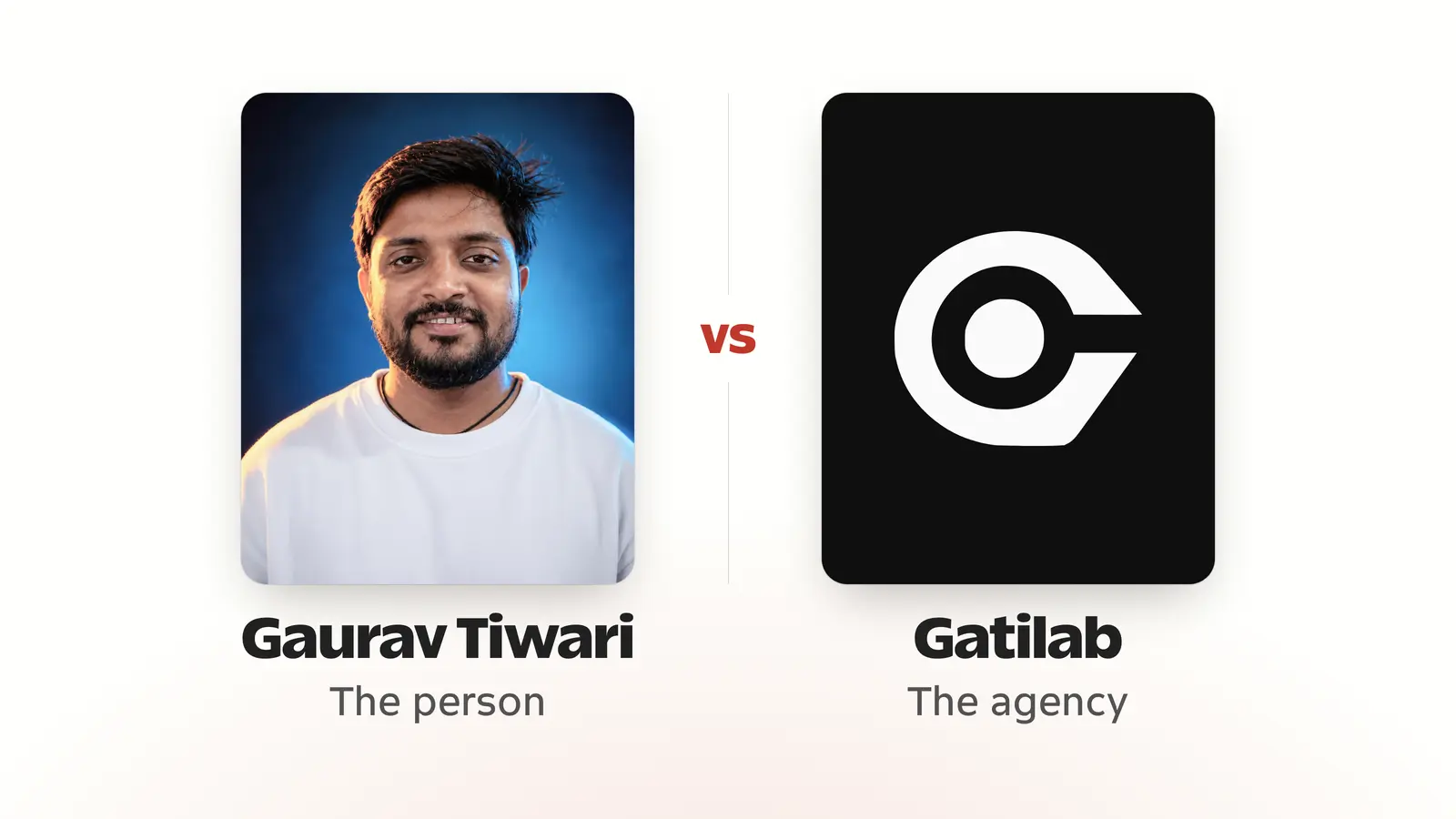
Gaurav Tiwari vs Gatilab is a simple distinction once you see it. I’m Gaurav Tiwari, a WordPress developer, publisher and educator, and the person behind this site. Gatilab is the agency I established in 2014 and run as its founder and CEO. I write, build products and take consulting work under my own name; Gatilab is where a team delivers client projects with me. The Gaurav Tiwari who investigated haunted places was a different person, and he passed away in 2016.
Before the detail, I want to settle that name clash properly, because it’s the one that sends people to the wrong Gaurav.
The Other Gaurav Tiwari
Gaurav Tiwari (1984-2016) was an Indian paranormal investigator and UFO field investigator. He founded the Indian Paranormal Society in 2009, India’s first organized group of its kind, and led it as its CEO. He had trained as a commercial pilot before that and later became a familiar face on Indian television. He died in Delhi in July 2016, at 31. If his work is what brought you here, his Wikipedia page and the society he founded are the right places to go. Nothing on this site or on gatilab.com covers paranormal research.

I’m the other one. I am the WordPress developer, publisher, educator and founder and CEO of Gatilab. I was born in Kushinagar in Uttar Pradesh, I’ve published online since 2008 and I’ve built WordPress websites since 2009. We shared a name and a country and nothing else, and I’d rather say so in plain words than let a search engine merge the two of us.

Gaurav Tiwari vs Gatilab at a Glance
The person and the agency overlap on purpose. The judgment behind the work is the same; what differs is the capacity, the people doing the production work and who owns which decision.
| Question | Gaurav Tiwari | Gatilab |
|---|---|---|
| What it is | A person: WordPress developer, publisher, educator and direct consultant | The agency I founded in 2014, based in Rudrapur, India, working with clients around the world |
| Best starting point | An independent diagnosis, a hard WordPress or SEO decision, my plugins, themes and books | A scoped project that needs design, development, content, search or ongoing operations from a team |
| Who leads | I do, personally | I scope the work and stay involved; the team delivers the named production work |
| Where to go | This site and its contact page | gatilab.com and its services pages |
The proposal you receive should say which of these you’re getting. If it doesn’t, ask and I’ll tell you.
What I Do Under My Own Name
Gauravtiwari.org is where I put my thinking and my work in public. You can come here to learn how something works, use something I’ve built or ask me to look at a problem directly. Everything on the site is mine to answer for, and most of it is free.

Writing and Books
I’ve published here since 2008: practical guides, tutorials and reviews about WordPress, publishing, SEO and the tools people use to build on the web, along with free study notes for mathematics, physics and chemistry students. From the Workbench is my newsletter on WordPress, SEO and digital marketing, sent whenever there’s an update worth sharing.
The books page lists 49 titles, and 45 of them are free as PDF and EPUB. The shelves follow the problem in front of the reader:
- Build and Publish, for founders, bloggers and publishers: Is This a Business?, Built for Bad Weeks, Website and Blog Copywriting and The Affiliate Bloggers System
- Learn and Research, for students and researchers: Mathematical Notation, How to Read Mathematics, The Student Research Workflow and From Question to Submission
- History and Statecraft: Modern India Reference Companion, The Republic of India, The World Between States and Power Without Certainty
Selected titles also have Kindle and paperback editions, which you’ll find on my author pages on Amazon.com and Amazon.in. How to Write Mathematics and the interactive course on integral equations are the most popular ones there.
Plugins and Themes
I build WordPress plugins to help you run your business, and I charge only for the ones that help you make money. The plugins page lists 25 of them. The paid ones are:
- Core Forms, for contact forms, registrations, surveys and payment forms
- Core Bookings, for services and appointments
- Core Tables, for reusable datasets behind tables and bar charts
- Core Approvals, for private request and review workflows
- GT Extensions for FluentCart, for local pricing and currency-aware payment gateways
The other 20 are free, including the 4 that run this site:
- GT Performance, for page caching, unused CSS removal and Cloudflare
- GT Page Blocks Builder, for HTML, CSS and JavaScript sections inside the Block Editor
- GT Link Manager, for branded affiliate links and redirects
- GT ACF Blocks, a set of content blocks for the editor
The themes page has 6 free WordPress themes, each built for one kind of site, using core blocks only and serving every font from your own server:
- Osmium, for writers and independent publishers
- Indium, for artists and illustrators
- Hassium, for SaaS and startup sites
- Uranium, for manufacturers and parts suppliers
- Bismuth, for law firms and professional practices
- Xenon, for photographers and studios
4 of them are block themes for the Site Editor. Uranium and Bismuth are hybrid themes with classic templates and the Customizer, for the owners who’d rather not learn the Site Editor at all.
Tools and Open Source
The work page also lists 27 free tools and calculators, the HTML to GenerateBlocks converter and the LaTeX equation editor among them. On GitHub you’ll find the open source side:
- agent skill sets for Bricks Builder, GenerateBlocks, Kadence and WordPress in general
- the Inkscape symbol libraries, 24,900 vectors across 58 libraries
- the code behind many of the free plugins above
Consulting
I take direct consulting work when a founder or a team needs a diagnosis, a technical direction or one named person to lead the implementation. It starts with a consultation and a written recommendation you can take to your own team. If you want me to lead the build as well, the work runs through milestones with documentation and 30 days of post-launch fixes at the end. Most of my consulting clients are outside India, so the work runs asynchronously across time zones with written updates at every agreed checkpoint.
I enjoy making things people keep using. A guide should answer a real question, a plugin should keep working after the first release and consulting should leave your team able to make its next decision without me.
What Gatilab Does for Clients
Gatilab is our agency for client delivery. I established it in 2014 to take on work that went beyond what one freelancer could handle, and it has been my full-time focus since 2018. The team is based in Rudrapur, India and works with clients around the world. WordPress is a strong part of what we do, but we also build custom applications and integrations when a project calls for them.

Our work falls into 5 groups:
- Build: WordPress themes, blocks and custom back ends; WooCommerce and headless stores; custom PHP and JavaScript; Next.js, React and Astro when the front end needs a framework; API integrations that keep working when the other side changes its API.
- Design: web and interface design, landing pages, logos and brand systems, and the graphic design around campaigns and products.
- Search: SEO, technical SEO, independent SEO consulting for in-house teams, conversion rate optimization and local search.
- Content: content marketing, blog writing, email automation, Google Ads management and the digital strategy that decides which channels deserve budget.
- Operate: hosting and infrastructure, performance work, WordPress maintenance, migrations, security hardening and analytics.
Every engagement follows the same shape. We agree a written scope and a fixed price, you get a delivery plan with dates, you review the work on staging and the handover comes with documentation and training. Retainers run on 3-month terms rather than annual contracts, so nobody is locked into a relationship that isn’t working.
Some clients need one of those groups. Others need the site, its content and the systems behind it built together, and that is where an agency earns its fee. The editor, the designer, the developer and whoever runs the server should be working from the same plan, because a site built from conflicting plans is slow to change and expensive to maintain. Quality here means more than a polished launch: you should be able to run the result, understand what was built and know who to call when something needs changing.
What the Work Looks Like
Our public portfolio is a selection, not every project we’ve done, and my own work page lists 15 client platforms. Four examples explain the range better than a long service list:
- IAS Compass was built around the daily publishing work of Rau’s IAS editors. A content platform earns its place when the people who publish on it can do so without waiting for a developer.
- Anantam IAS brings publishing and online learning into one system for a Delhi UPSC institute. The teaching material and the website have to make sense together.
- Rushu is a product-first store for a handloom brand. The design has to carry the brand while leaving the owner able to run the store.
- The Ministry of Agriculture and Farmers Welfare’s site is government publishing, where editors have to publish without filing a ticket.
Every one of those went through the same 4 steps. We audit the existing site first and rebuild only when the foundation demands it, we build for the problem the business has, we ship it fast and clear for visitors and for the people who edit it, and we hand off with the owner in control.
The same portfolio lists the tools and open source projects Gatilab builds and maintains, for example:
- GT Analytics, a self-hosted analytics dashboard
- Docanban, a kanban board for editorial documents
- the HTML to GenerateBlocks converter
- WP MCP, which gives AI assistants controlled access to the WordPress REST API
These are public work, so you may see them on both sites. They have a different purpose from a client’s commissioned project.
On my homepage I put the product relationship plainly: “Made by Gaurav. Built at Gatilab.” I lead the products that carry my name, and the Gatilab team builds and supports some of them with me. My work page is the better place to see the products and publishing; the Gatilab portfolio is the better place to see client delivery.
How I Work With Gatilab
The personal and the agency work can meet on the same project. If you come to me for a review, I may diagnose the problem and recommend a path your team can carry out on its own. If the work needs more production capacity, Gatilab handles the named parts under my direction. On projects that come to me directly, I do the engineering myself and bring in Gatilab for content and design capacity. If you approach Gatilab with a larger brief, I help scope it and stay involved through delivery.
The important question is who owns each decision. A proposal should make that clear: who sets direction, who builds, who reviews, what you can edit yourself and what support follows the handover. You shouldn’t have to infer the working arrangement from the name on the website, and you won’t have to, because the proposal names it before you sign.
Which One Should You Contact?
You should start with me when you need an independent assessment, a difficult WordPress or SEO decision, or one named person to lead the thinking and review the implementation.
You should start with Gatilab’s services when you already know a team will need to design, build, publish, improve or maintain the result. There is no need to work out the exact service name first. A good brief describes the problem, the people who will use the result and what your team needs to own afterward.
If you’re still unsure, tell me what you’re trying to change. I’ll tell you whether it needs my direct involvement, a Gatilab team or both.
Tell Google you want more of this.
Add Gaurav Tiwari as a preferred sourceOne tap, and this site shows up more often in your own Top Stories, AI Overviews and AI Mode. Remove it any time.