by
by
When should a business start SEO? Put the foundations in place when the website is built, but do not fund a serious SEO program until buyers search for the problem, the offer converts, the business can fulfill more demand, and the budget can wait for a return.
If next month’s payroll depends on leads from Google, SEO is the wrong rescue plan. It compounds too slowly for an emergency and punishes businesses that build dozens of pages around an offer they are still changing.
Google says some SEO changes can show up within hours while others can take several months, with no guarantee of a noticeable result. Its SEO Starter Guide is unusually direct about that delay. The uncertainty does not make SEO a bad investment. It makes timing part of the investment.

Quick verdict
- At launch: make the site crawlable, understandable, measurable, and structurally sound.
- After validation: invest in pages and content tied to proven customer questions and profitable offers.
- During a cash emergency: use channels that can create and test demand faster, such as outbound, partnerships, or paid acquisition.
- Before a migration or redesign: involve SEO before URLs, templates, navigation, and redirects are locked.
SEO has 2 start dates
Most advice becomes useless because it treats technical foundations and customer acquisition as the same job. They are not.
Foundational SEO starts with the website. Search engines should be able to access the pages, understand what the business offers, and connect each important page to a clear purpose. This work belongs in the build, alongside accessibility, analytics, and conversion tracking.
Growth SEO starts after the business has something worth compounding. This is the ongoing investment in commercial pages, useful content, internal links, digital PR, local visibility, and measurement.
A new business needs the first layer early. It may be too early for the second.
Publishing 50 articles before the sales conversations settle is not a head start. It is a warehouse full of yesterday’s assumptions.

The readiness test most SEO pitches skip
A business is ready to treat SEO as a growth channel when 5 signals are present. Missing 1 does not forbid SEO, but it changes what you should fund.

| Readiness signal | Evidence worth accepting | If it is missing |
|---|---|---|
| Search demand | Prospects repeat recognizable questions, and relevant queries produce commercial or problem-solving results. | Use interviews, outbound, communities, partnerships, and ads to learn the language first. |
| Offer proof | The offer already produces sales or qualified leads from at least one source. | Fix positioning, proof, pricing, or the offer before multiplying traffic. |
| Fulfillment capacity | The business can serve additional customers without breaking delivery. | Repair operations. More demand will magnify the bottleneck. |
| Runway | The work can continue for several months without being forced to rescue the current quarter. | Favor a faster feedback loop and protect cash. |
| Measurement | Leads, purchases, calls, or another business outcome can be traced to landing pages and queries. | Install measurement before judging SEO by traffic alone. |
The first 2 signals matter most. Search volume without a proven offer buys visitors, not a business. A proven offer with no direct search demand may need category education before keyword-led acquisition.
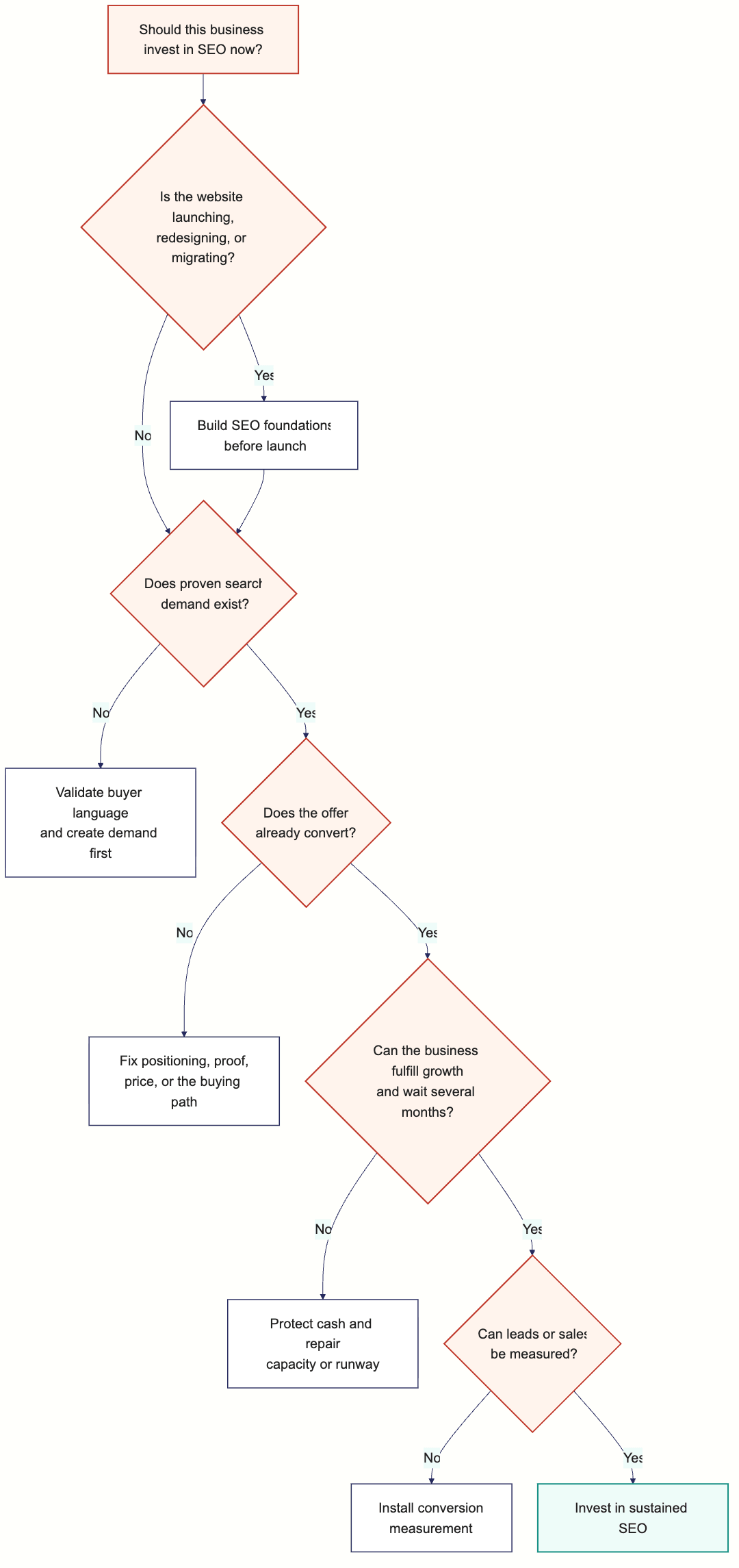
This is where keyword research earns its keep. It should reveal demand, language, intent, and economic fit. A spreadsheet of high-volume phrases is not a strategy.
Start early when mistakes will be expensive
Some SEO decisions become costly the moment a site launches. Bring search expertise in early when structure is about to harden.
- A website launch or redesign: settle navigation, page purpose, indexation rules, metadata templates, and measurement before launch.
- A domain or URL migration: map old URLs to relevant new URLs, prepare permanent redirects, update canonicals and internal links, and submit the new sitemap. Google’s site-move guidance treats this as planned migration work, not cleanup for later.
- A large store, directory, or publication: decide taxonomy, filters, pagination, canonical behavior, and internal linking before thousands of URLs exist.
- A local business opening: prepare location pages and an eligible Google Business Profile before opening. Google says a verified profile with a future opening date can appear 90 days before the opening date.
Early SEO here is insurance against rework. It still does not justify an indiscriminate blog calendar.
Wait when the business is still guessing
Postpone heavy SEO spending when the problem sits upstream of search. Traffic will not repair an offer, teach a team to sell, or create delivery capacity.
- The offer changes every week. Pages written now will preserve language the business may abandon next month.
- The category is new and nobody searches for it yet. Capture adjacent problem queries, but create demand through founder-led distribution, demonstrations, partnerships, events, or PR.
- Existing visitors do not convert. Find out whether the problem is fit, proof, price, message, trust, or the buying path.
- Revenue is urgent. SEO may support the next 2 years, but it cannot promise next month’s pipeline.
- Nobody owns the work. A strategy that depends on publishing, updating, outreach, and measurement will decay without an accountable operator.
Do the basic technical work anyway. Then use faster channels to validate the offer and feed the winning language back into a later content strategy.
A traffic decline does not prove you need more SEO
An established business asking whether it needs “better SEO” usually has a diagnosis problem. More content, more links, or a new agency can make the wrong treatment more expensive.
Start with Google Search Console. Google defines impressions as appearances in Search, clicks as visits from a result, CTR as clicks divided by impressions, and average position as the average topmost position for the selected view. Google also recommends paying more attention to impression and click trends than to position alone.
| Observed pattern | The next question | What it does not prove |
|---|---|---|
| Impressions and clicks both fall | Which queries, pages, devices, countries, or dates changed? Check seasonality, indexation, competition, demand, and confirmed search updates. | That the site needs more articles. |
| Impressions hold while clicks fall | Did result appearance, query mix, ranking distribution, or the promise in titles change? | That rewriting every meta description will recover traffic. |
| Clicks hold while leads fall | Did the offer, landing page, form, tracking, traffic mix, or sales response change? | That rankings are the problem. |
| Qualified traffic converts but volume is limited | Are there more profitable queries, locations, products, or comparison needs the site can serve? | That every high-volume topic deserves a page. |
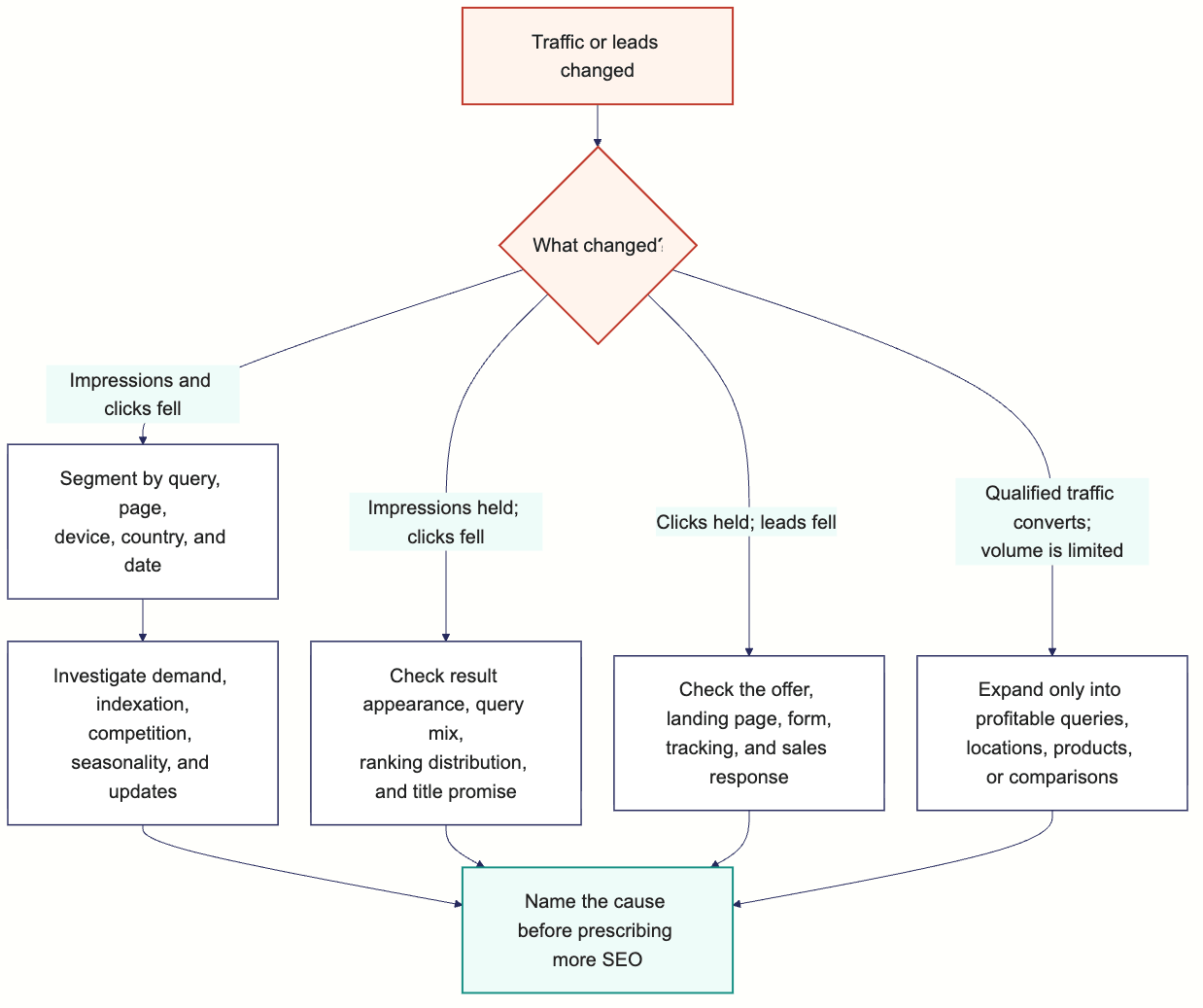
Metrics are clues. Segment them, compare the right periods, and connect them to revenue before naming the cause.
Stop treating proxy scores as diagnoses
SEO tools are useful servants and terrible executives. A tool can crawl a site or estimate a competitive pattern. It cannot decide what the business should fix without context.
- Domain Authority is not a Google score. It is a third-party estimate. Google warns in its third-party SEO guidance that external tools do not have access to its internal ranking data and cannot guarantee performance. Use comparative metrics as leads for investigation, not targets for link buying.
- A PageSpeed score is not a ranking verdict. Field Core Web Vitals and user experience matter, but Google says strong report scores do not guarantee top rankings and chasing a perfect score solely for SEO may waste time. Read the full page-experience guidance.
- Longer content is not automatically better content. Google’s current Search Essentials prioritize helpful, reliable, people-first material. A concise commercial page can solve its job better than a padded guide.
- More indexed pages are not automatically progress. Count pages that satisfy distinct demand and help a buyer decide. Merge, redirect, improve, or remove pages that have no defensible job.
The dashboard should open an investigation. It should not close one.
Make the first investment boring and close to revenue
A sensible first SEO investment does not begin with a promise to publish 20 posts a month. It begins with the smallest system that connects search demand to business outcomes.
- Measure the outcome. Track qualified forms, calls, purchases, bookings, or trials instead of celebrating sessions.
- Check access and indexation. Confirm that important pages can be crawled, rendered, indexed, and reached through internal links.
- Fix the pages closest to money. Improve core service, product, category, location, and comparison pages before starting a content factory.
- Map proven demand. Tie queries to intent, margins, sales objections, and the page that should satisfy each need.
- Assign ownership. Name who publishes, updates, promotes, measures, and stops work that does not earn its keep.
If an audit cannot rank these actions by business consequence, it is an inventory, not a strategy. That is why most automated technical SEO audits are useless without judgment.
Choose start, wait, or diagnose
Start the foundations when the site is built. Start sustained SEO when demand is visible, the offer converts, fulfillment can absorb growth, the budget can wait, and measurement can connect search to money.
Wait when the business is still inventing its market or needs revenue immediately. Diagnose first when an established site is losing traffic or leads.
SEO works best after the business has learned what deserves to compound.
If your business passes the readiness test but the blockage is still unclear, an SEO audit tied to revenue and implementation priority is a sensible next step.
Tell Google you want more of this.
Add Gaurav Tiwari as a preferred sourceOne tap, and this site shows up more often in your own Top Stories, AI Overviews and AI Mode. Remove it any time.